Home Decor
Large Luxury Kitchen Ideas for Dream Homes

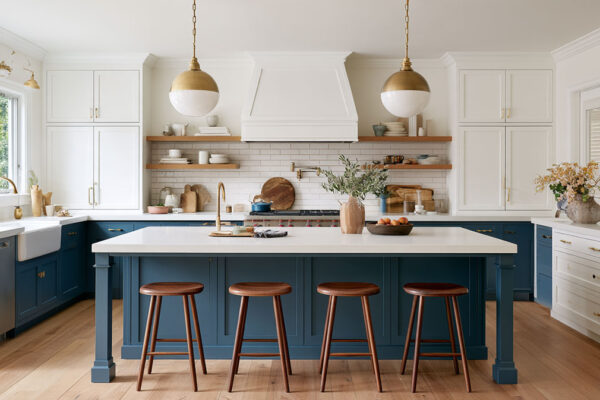
NKBA’s Kitchen Planning Guidelines call for a work aisle of at least 42 inches when one person cooks and 48 inches when several do. Most large luxury kitchen ideas come down to those two numbers, since they decide how much island and how much perimeter run the room can actually hold.
The spending tier is just as specific. In Houzz’s 2025 U.S. Kitchen Trends Study, the top 10% of large kitchen projects (250 square feet or more) spent at least $200,000 on major remodels.
Houzz counts a major remodel as one that replaces at least all cabinets and appliances.
To settle the palette for a kitchen this size, our kitchen color schemes guide pairs cabinet colors with countertops, hardware and floors.
Which layouts work best in a large luxury kitchen?

An island kitchen with a perimeter run holds up in most large rooms. A second island earns its floor space only when every aisle around it still clears the NKBA minimums.
Room shape, the number of cooks, and whether the kitchen opens onto living space decide the rest.
Single island versus double island

One island can handle prep and seating, and often the dishwasher or a second sink too. That suits a room with one clear cooking wall.
Two islands split the jobs, with prep on one and meals on the other, which is the setup Hunker’s roundup of large kitchens describes.
One kitchen addition published on Houzz by UBER used its larger footprint for two sizeable islands, a 48-inch rangetop and two double ovens.
Width is the limiting factor. Two parallel islands add a third aisle, and each aisle has to clear 42 to 48 inches. If the room is anywhere near borderline, I’d go with one island.
Perimeter shapes with an island
A U-shaped run gives a large island the clearest center.
With an L, one side stays open toward the living area, which some people want and some don’t. Galley layouts with an island show up mostly in smaller homes (Gambrick), so a large luxury kitchen rarely needs one.
Open plan kitchens turn layout into zoning. Cooking needs a defined edge, and so does the pass between seating and the living area. Careful space planning keeps guests from crossing the cooking zone to reach their seats.
Does the work triangle still apply in a large kitchen?
Partly. The NKBA Kitchen Planning Guidelines cap a three-center triangle at 26 feet in total, with each leg between 4 and 9 feet.
A large room overshoots that quickly. For plans with more than three work centers, the guidelines keep every added travel distance inside the same 4 to 9 foot band. No leg should cross an island by more than 12 inches, and no full-height, full-depth tall unit should separate two primary work centers (a recessed corner unit is the exception).
Houzz Pro’s write-up of its 2026 study points to the same shift in practice, with task-specific zones now directing traffic instead of one central triangle.
How big should a luxury kitchen island be, and how much clearance does it need?

Plan at least 42 inches of work aisle around an island for one cook and 48 inches for multiple cooks. Then size the island to the length and depth the room leaves after those aisles.
The rest of the numbers are below.
- Work aisles run at least 42 in for one cook and 48 in for multiple cooks (NKBA Kitchen Planning Guidelines).
- Walkways need at least 36 in (NKBA).
- Seat knee space is 24 in wide, and 18 in deep at 30-in counters, 15 in deep at 36-in counters and 12 in deep at 42-in counters (NKBA).
- Behind seating, leave 32 in where there is no traffic, 36 in to edge past and 44 in to walk past (NKBA).
- On length, 52% of upgraded islands exceed 7 ft, 30% run 6 to 7 ft and 18% fall under 6 ft (2026 U.S. Houzz Kitchen Trends Study).
Some dealer guides quote 36 inches as the island clearance. That figure is the walkway minimum, and the cooking sides fall under the longer work aisle rule.
Counter height changes the knee depth, which is why bar-height seating needs a shallower overhang. Seating on both long sides doubles the overhang to plan, so layouts with kitchen island seating on two sides need the clearance behind each side checked separately.
The Houzz study also found that 53% of renovating homeowners install at least one appliance in the island.
Wine storage is one use of that space, and kitchen islands with a wine fridge need the door swing planned against the aisle. An island cooktop has its own rule, since NKBA asks for 9 inches of counter behind the cooking surface when the counter height matches it.
Which supporting rooms belong next to a large luxury kitchen?

Start with pantry storage. Add a scullery if the plan is open and you entertain, and give a butler’s pantry floor area only when the dining room sits next to the kitchen.
Houzz’s 2026 study ranks pantry cabinets first among specialty storage and beverage stations second. Walk-in pantries and butler’s pantries or prep kitchens trail well behind.
Fitting a pantry into a tighter footprint is its own planning problem, and these kitchen pantry ideas cover shelving and door options by size.
| Room | Wet or dry | Typical fixtures | Best fit |
|---|---|---|---|
| Walk-in pantry | Dry | Shelving, landing counter, small appliances | Bulk food storage |
| Butler’s pantry | Dry | Cabinets, serveware storage, bench space | Kitchen beside a formal dining room |
| Scullery | Wet | Sink, dishwasher, large appliances | Open plan kitchens that host |
| Prep kitchen | Wet | Sink, cooking appliance, refrigerator | Hosting with a second cook |
Sources don’t agree on what goes in these rooms. Lockwood Homes places no sink or dishwasher in a butler’s pantry, and Angi says it stores items without washing or food prep. Angi describes a scullery as prep plus cleanup, while a design explainer syndicated on AOL calls it a cleanup zone only.
This article uses the wet and dry split from the table.
One New Zealand designer quoted in Channel magazine puts the scullery minimum at about 1.6 m by 3 m (roughly 5 by 10 feet), and calls anything smaller a pantry store. The same piece warns against squeezing a small scullery into the plan and suggests sliding or pocket doors to close off a prep area inside the main kitchen.
Hunker notes that a separate scullery hides the working side of an open plan kitchen. A coffee or beverage station fits in either a scullery or a butler’s pantry.
Which cabinetry styles and finishes suit a large luxury kitchen?

Wood-toned Shaker or flat-panel doors, paired with a contrasting island, suit a large room better than one continuous white run.
Wood took the top cabinet color in renovated kitchens at 29%, up 6 points on the year before and just ahead of white at 28% (Houzz, January 2026). Shaker leads door styles with flat-panel second, and bar pulls lead hardware ahead of knobs, per the study as summarized by Ohio REALTORS.
At the custom end, Poggenpohl says it was founded in 1892 in Herford, Germany, and lists ergonomic work-top heights and the kitchen island among its firsts. bulthaup’s b3 system (2004) hangs a multi-function wall holding units and appliances plus the lights.
Large kitchens carry a storage target too. NKBA sets 2,000 inches of total shelf and drawer frontage for kitchens over 350 square feet, split across wall (360 in), base (660 in), drawer (525 in), pantry (310 in) and miscellaneous (145 in).
An appliance garage built to the countertop counts toward NKBA’s 158-inch countertop frontage total. It can still interfere with landing areas, so place it away from the range and refrigerator.
Hunker flags the usual failure, which is that a large kitchen’s design gets lost in a sea of white. A darker island fixes it, and a dark green island against pale perimeter cabinets is one way to add that weight.
Which countertop and backsplash materials hold up on a large island?

Marble gives the look but costs the most upkeep, since acids etch it and sealer doesn’t stop that. True quartzite and engineered quartz resist acid. Dekton goes further with a near-nonporous sintered surface.
| Material | Look | Upkeep | Main limit |
|---|---|---|---|
| Marble (Calacatta, Carrara) | Bold or soft veining | pH-neutral cleaner | Etches from acids |
| Quartzite | Natural veining | Periodic sealing | Mislabeled slabs act like marble |
| Engineered quartz (Cambria, Caesarstone) | Uniform to marble-look | Low | Resin binder tolerates less heat |
| Dekton | Stone and concrete looks | Low | Slabs run 126 x 56 in |
Marble versus quartzite on etching
Houzz’s countertop guide says quartzite is not prone to etching. A Daltile slab director quoted in an AOL feature calls etching a concern.
The Natural Stone Institute explains the gap. Stone sold as quartzite sometimes includes dolomitic marble, and “soft quartzite” is marble (Building Stone Magazine, Fall 2018). Its guidance on sealers is the same as for marble, which is that they slow staining but do not protect against acid.
Test a sample with lemon juice or a drop of acid before you buy.
Slab size and seams
Cambria’s standard slab measures 122 x 55.5 in and its jumbo measures 132 x 65.5 in. Dekton (Cosentino) comes in at 126 x 56 in.
Cambria tells buyers to confirm the maximum piece size with the fabricator. A jumbo slab covers an 11-foot run in one piece, so most of the 52% of upgraded islands that pass 7 feet still fit one slab, and the longest ones need a seam.
Slab or tile backsplash
Slab backsplashes reached 28% of renovated kitchens, up from 24% a year earlier. Engineered quartz (39%) and quartzite (33%) lead the slab materials (Houzz, 2026).
Zellige is the handmade tile alternative when a slab feels too heavy for the wall. Hunker also suggests matching only the island top to the backsplash slab for a bold effect.
If the island is marble, the next question is which backsplash pairs with marble countertops without competing with the veining.
Which appliance package and range hood fit a large luxury kitchen?

A luxury package pairs a 48-inch professional-style range with panel-ready refrigeration, wine storage and a ducted hood. The hood is the item most plans get wrong.
Wolf makes 48-inch dual fuel ranges with four, six or eight dual-stacked sealed burners, and the top burner reaches 20,000 Btu (Wolf spec sheets). Sub-Zero builds refrigeration that accepts custom cabinet panels, along with a 30-inch designer wine column listed at 146 bottles.
Gaggenau’s wall ovens are handcrafted at its factory in Lipsheim, France (dealer listing). La Cornue was founded in Paris in 1908, and its Chateau series is built to order around a vaulted oven (Abt).
“Professional-style” is the right label for this tier. NKBA’s guidelines say commercial cooking appliances do not belong in residential kitchens.
On hood sizing, NKBA recommends a ducted system for every cooking surface at 150 cfm or more, while the code floor for a ducted hood is 100 cfm (2015 IRC M1507.4). The air has to discharge outdoors.
A common rule of thumb is 100 cfm per 12 inches of range width, which puts a 48-inch range at 400 cfm. That sits exactly on the makeup air trigger, because the IRC requires makeup air for hoods exhausting more than 400 cfm.
Width understates demand on a big range. The burners on Wolf’s eight-burner 48-inch model add up to 128,200 Btu, so treat the width figure as a floor.
Sources disagree on that makeup air trigger. NKBA’s guideline text, built on the 2015 IRC, applies the rule to any hood above 400 cfm. A code columnist in Fine Homebuilding describes the practical trigger as a hood over 400 cfm in a home with naturally drafted fuel-fired appliances, and newer editions number the section M1503.6.
As of October 2026 the locally adopted edition governs, so confirm it before you pick a hood.
Once the duct route and airflow are settled, the hood can be the focal point of the cooking wall. NKBA’s 24-inch clearance above the cooking surface sets how low the canopy hangs.
How should lighting be layered in a large luxury kitchen?

Put the lighting on separate dimmers, with ambient light for the room and task light at every work surface. Accent light for cabinets and the hood wall comes last.
NKBA’s lighting guideline asks for task lighting at every work surface on top of code-required general light, and its access standard adds that light should come from multiple, adjustable sources.
Recessed ceiling fixtures carry the general ambient lighting for the whole room, and splitting them across circuits lets one zone dim while another stays bright.
Task light comes from under-cabinet lighting on the perimeter counters and from pendants over the island. This Old House puts island pendants 30 to 36 inches above the counter, with 24 to 30 inches between shade centers.
Accent lighting picks out glass-front cabinets, the hood wall or a slab backsplash, and it runs at lower levels than the task layer.
That pendant height has a cost. Hunker points out that pendants hung low block sight lines across a long island, so slim fixtures or a higher hang keep conversation easy.
Daylight counts toward the plan. NKBA, citing the 2015 IRC, calls for glazing equal to at least 8% of the kitchen floor area, or of a living space that includes the kitchen, which is 32 square feet in a 400-square-foot kitchen.
As of October 2026, Lutron’s RadioRA 3 support FAQ says the Sunnata RF dimmer with PRO LED+ needs a neutral wire, while the Maestro RF dimmer works without one.
Under-cabinet LED tape runs from a constant-voltage driver on a forward-phase dimmer such as the Sunnata LED+. In an older house, check the switch boxes for neutrals before choosing dimmers.
When does a large luxury kitchen layout stop working?
A layout stops working when the room cannot hold the aisles it needs, and a second island is the first thing to fail that test. Width decides it before style does.
| Layout | 42-inch aisles | 48-inch aisles |
|---|---|---|
| One island | 174 in (14.5 ft) | 186 in (15.5 ft) |
| Two parallel islands | 258 in (21.5 ft) | 276 in (23 ft) |
| Added by the second island | 84 in (7 ft) | 90 in (7.5 ft) |
The totals are wall-to-wall room widths. They use NKBA’s 42-inch and 48-inch work aisles, a 24-inch perimeter run on both long walls, and 42-inch-deep islands (the run and island depths are assumptions for this calculation, not NKBA figures).
A room 20 feet wide holds one island at either aisle width and fails the two-island test at both.
Access is a second failure point. NKBA’s access standard asks for 60 inches between the opposing arms of a U-shaped kitchen and a 60-inch wheelchair turning space, which 42-inch and 48-inch aisles do not meet.
Households with two cooks hit a similar wall, because a 42-inch aisle is below NKBA’s 48-inch figure for multiple cooks. The left column suits one-cook households only.
Skipping the island is a normal outcome too. 36% of renovated kitchens in Houzz’s 2026 study have none.
Large luxury kitchen cost by tier
Published figures for a major remodel run from $55,000 (a median) to about $83,000 (an average job cost) depending on the source, and the luxury tier starts near $150,000. Houzz defines a major remodel as one that replaces at least all cabinets and appliances.
- For large kitchens of 200+ sq ft, the major remodel median is $55,000, with high-end spend at $150,000 (Houzz and Home Study, 2026 report).
- Kitchens over 250 sq ft have a major remodel median of $75,000 (2026 U.S. Houzz Kitchen Trends Study).
- On average job cost, a major midrange remodel runs $82,793 against $164,104 for a major upscale one (Zonda Cost vs. Value Report, 2025).
Two Houzz studies split on the median, $55,000 against $75,000. The Kitchen Trends Study surveys homeowners who recently finished, are in the middle of, or are planning a kitchen renovation and sets “large” at 250 square feet, while the Houzz and Home Study sets it at 200.
NKBA’s storage guideline starts “large” at 350 square feet, so size labels vary by source.
The sources agree closely at the top. The Houzz and Home Study puts large upscale kitchens at $150,000 and up, and the Cost vs. Value upscale average is $164,104, so $150,000 to $165,000 is a reasonable entry point for luxury.
Houzz’s study, as summarized by Hunker, ranks cabinets, countertops and flooring as the highest-priced investments in a kitchen budget. That is why the cabinet tier and the slab choice move the total most.
Before collecting quotes, run your own square footage through a home renovation cost calculator to see where the room lands against these tiers.
In what order should the planning decisions be made?
Set clearances first, lock the appliance package second, and order cabinets and stone before demolition. Each step fixes a dimension the next one depends on.
- Run the NKBA aisle widths against the room’s wall-to-wall width and decide between one island and two.
- Fix the cooking, cleanup and refrigeration zones, then any scullery or beverage station, and draw every appliance door open.
- Lock the appliance package. Wolf’s spec sheets say to verify specifications before finalizing cabinetry or enclosures, and list 19 1/2 to 21 inches of door clearance on 48-inch ranges.
- Order the long-lead items. Contractor and retailer guides name custom cabinets and imported ranges as the longest waits, and they split on whether cabinets or appliances go first.
- Choose the slab, then book the template. Fabricators template after the base cabinets are installed, so the cabinet delivery date sets the stone schedule.
- Settle lighting and the hood duct before rough-in. Circuits, dimmer neutrals and the duct route to the outdoors all need to be set before the walls close.
For a luxury package, appliances come first, because their spec sheets set the cutouts the cabinets are built around.
Ordering cabinets before the floor plan is final shows up as a common slowdown in Quik Cabinets’ 2026 remodel timeline.
Large Luxury Kitchen FAQ
What size is a large kitchen?
No single standard exists. NKBA’s storage guideline calls a kitchen large above 350 square feet, with medium at 151 to 350 and small under 150.
Houzz sets lower cutoffs, 200 or 250 square feet depending on the study.
Which style leads in large kitchen renovations: transitional, traditional or modern?
Transitional leads. Among homeowners changing their kitchen’s style, it takes 25%, ahead of traditional, modern and contemporary (2026 U.S. Houzz Kitchen Trends Study).
The style blends traditional and contemporary design elements.
What flooring works best in a luxury kitchen?
Hardwood and ceramic or porcelain tile are level in popularity. Wood tones dominate the color choice at 49% of renovating homeowners, per the 2026 U.S. Houzz Kitchen Trends Study.
Is a pot filler worth installing?
Yes, for a household that boils large pots often. The cost sits in the wall, not the faucet, because it needs a dedicated cold water line behind the range.
Run that line before the backsplash goes up, and add a separate shutoff valve so the pot filler can be isolated for repairs (Ask the Builder).
Does a luxury kitchen raise resale value?
Yes, but only in part. An upscale major kitchen remodel recouped 35.7% of its cost at resale in the 2025 Cost vs. Value Report, against 50.9% for a major midrange remodel.
Build it for daily use, not for the sale.
What to Cut First When the Budget Is Capped
A capped large luxury kitchen budget loses least by trimming finish upgrades first. In the 2025 Cost vs. Value Report, the $81,311 extra spent on an upscale major remodel over a midrange one returned only $16,431 more at resale, about 20 cents on each added dollar.
Cut finishes first, meaning the hood finish, accent fixtures and stone grade. A second island or a scullery goes next. Aisle widths, ducted ventilation and appliance cutouts stay.
Finishes can be swapped after move-in, while clearances and duct routes cannot. The trade-off is a plainer look at move-in in exchange for a kitchen that works from day one.
Verified October 2026 against the 2025 report, and a newer Cost vs. Value edition would change that ratio. After the build, decorating a large kitchen island is the natural next step.

- Kitchen Color Schemes by Cabinet Color: What Pairs Well - October 19, 2026
- Curtain Colors for Every Wall Color: Safe vs Bold Picks - October 18, 2026
- Interior Design Styles: Find Your Primary and Secondary - October 14, 2026