Green Cabinets
Ideas for Green Kitchen Cabinets with Gold Hardware

Green kitchen cabinets with gold hardware work when the metal’s warmth matches the green’s undertone: brushed or satin brass suits sage and olive, and unlacquered brass suits forest and emerald.
Professionals split almost evenly between the two green families. NKBA’s 2026 Kitchen Trends Report, a survey of 634 industry professionals, found 56% naming light green or sage as popular and 51% naming dark green, emerald or olive.
The gold is the part buyers misjudge most often. Satin brass can mean a lacquered finish or a PVD coating, and the two wear differently.
Green is one of five cabinet colors compared side by side in our guide to kitchen color schemes.
Which green shades work best with gold hardware?
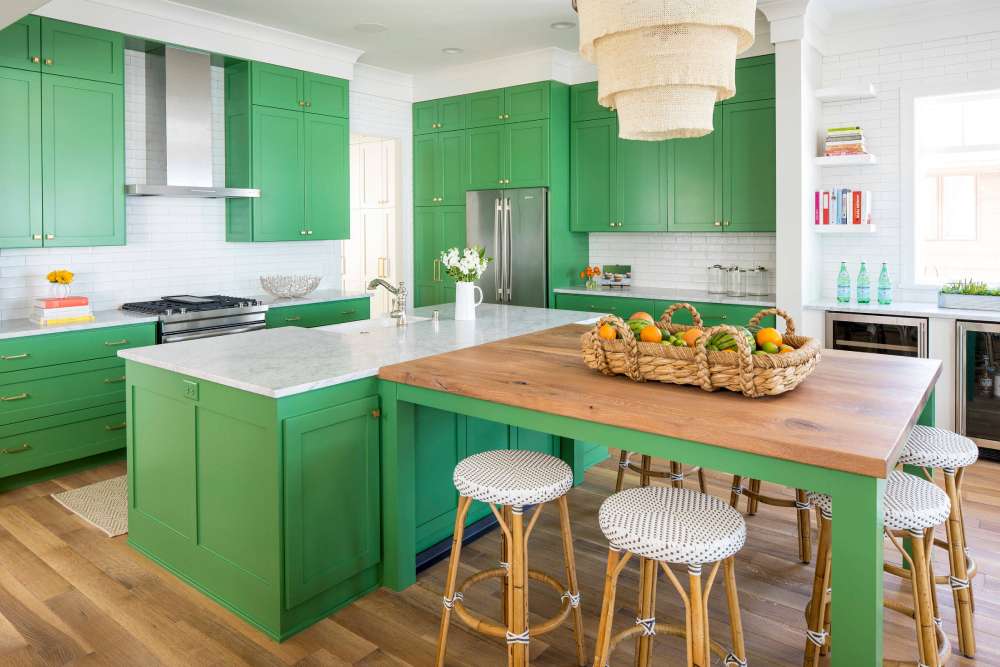
Warm, yellow-based greens such as olive and sage take gold most easily, and deep greens such as forest and emerald give it the strongest contrast. Cool blue-greens work too, but they need a quieter finish.
Undertone decides it. Gold reads yellow, so it blends into a green with yellow in it and fights one with blue.
Warm and yellow-based greens

Sage and olive are the safe starting point. Both sit on a gray or yellow base that gold warms instead of competing with.
Sherwin-Williams Evergreen Fog is the usual sage reference. It was the brand’s 2022 Color of the Year and has an LRV (light reflectance value, the share of light a color bounces back on a 0 to 100 scale) of 30.
Reviewers disagree on its undertone. Setting for Four reads it as blue-gray, while Paint Color Consultants lists a low yellow undertone, so test a sample door before you commit.
If you want wall and trim partners for a sage kitchen, this list of colors that work with sage green is a good place to start.
Deep and blue-based greens

Benjamin Moore Essex Green (HC-188) has an LRV of 3.53, according to Benjamin Moore. Next to Evergreen Fog at 30, it reflects about an eighth of the light.
Farrow & Ball describes Studio Green No. 93 as its darkest green, one that looks almost black indoors unless the room is very well lit.
- Forest and emerald carry polished or brushed gold well
- Blue-greens and teals look better with champagne bronze or a soft satin brass
- Near-black greens need strong lighting, or the hardware becomes the only thing you see
Darker greens also leave more room for the rest of the palette, and the guide to colors that go with dark green covers walls and accents.
Which gold finish looks right on which green?

Brushed or satin brass suits most greens. Unlacquered brass suits deep greens and anyone who wants the metal to darken over time, and champagne bronze suits gray or blue-leaning greens.
| Finish | Best on | How it ages | Care |
|---|---|---|---|
| Brushed or satin brass | Sage, olive, mid greens | Holds its look while the lacquer lasts | Soap and water |
| Unlacquered brass | Forest, emerald, warm olive | Darkens to a honey tone | Wipe dry, polish if wanted |
| Champagne bronze | Gray-green, blue-green | Stays pale and soft | Soap and water |
| Polished gold | Emerald, deep forest | Shows fingerprints fast | Frequent wiping |
| Antique or aged brass | Traditional olive, forest | Fixed, pre-darkened look | Soap and water |
Knobs.co’s 2026 guide to sage green cabinets warns that strongly yellow finishes, raw polished brass among them, fight sage’s gray-green base.
Gold or brass?
Brass is a copper and zinc alloy. “Gold” cabinet hardware is usually brass with a gold-toned finish, or a plated metal made to look like it.
Solid brass can be polished or refinished. Plate Prestige notes that brass-plated pieces can chip or wear through at high-touch points, and a worn plating cannot be buffed back.
Unlacquered brass in a working kitchen

Rejuvenation says unlacquered brass patinates naturally. Its care advice is a dry soft cloth for routine wiping and brass polish for heavy tarnish, with no abrasive pads, harsh chemicals, alcohol or ammonia products.
Emtek’s guidance on brass patina adds a way to slow the change: a thin coat of clear lacquer or wax.
Gold that feels too warm against a deep green has one common alternative, matte black pulls on green cabinets.
How to choose knobs, pulls and sizes for green cabinets

Standard cabinetry takes knobs of 1-1/4 or 1-3/8 inch and pulls of 3 inch, 4 inch, 96 mm or 128 mm center-to-center, according to Arthur Harris. Knobs go on doors and pulls on drawers in the usual split.
Knobs, pulls or both
Knobs on uppers, pulls on lowers is the other common split, and San Diego Hardware lists it as one of two ways to mix them without the kitchen looking random.
Pulls alone read more modern. Knobs alone read more traditional, and both suit shaker doors in green.
The NKBA Kitchen & Bath Planning Guidelines add a functional test. Hardware should not demand a tight grasp or twisting of the wrist, and it should not interfere with neighboring doors or drawers.
Center-to-center sizes
Emtek lists the common center-to-center measurements as 3 inch (76 mm), 3.75 inch (96 mm), 4 inch (102 mm) and 5 inch (128 mm).
Superarbor’s sizing guide maps them to drawer width:
- 96 mm: drawers 12 to 15 inches wide
- 128 mm: drawers 18 to 21 inches wide
- 160 mm: drawers about 24 inches wide
- Two pulls: drawers wider than about 36 inches, placed at the quarter points
One trap. A 5 inch pull spans 127 mm, while a 128 mm pull spans about 5.04 inches, so a strict 5 inch pull can fall 1 mm short of existing 128 mm holes.
Measure old holes in millimeters before ordering, and order a spare. Thirty pieces in a gold finish that is out of stock is a bad week.
Door styles and materials that suit painted green cabinets

Shaker doors are the default pairing for green and gold, because the flat center panel and the rails give knobs and pulls a defined spot. Slab doors suit slim pulls, and inset doors suit traditional hardware.
Door styles
Shaker: works with knobs, pulls or both. A Houzz kitchen feature on green cabinetry paired shaker and slab fronts in sequoia green with simple satin brass hardware.
Slab or flat-panel: no rail to anchor a knob, so pulls are the better choice. Gold looks stark on a flat deep green unless the pull is slim.
Inset: sits flush inside the frame, which suits cup pulls and latch-style brass.
Materials
Paint behaves differently on each substrate.
- Solid wood takes paint well, but open-grain oak shows its grain through green unless it is filled
- MDF paints smooth and flat, though the edges swell if water gets in
- Thermofoil rarely holds a repaint, so replacing the doors is usually the better route
Smooth doors show off a dark green and brass best. Heavy grain does the opposite.
Which paint and sheen work best, and how do you apply them?
Use a cabinet-grade waterborne enamel in satin or semi-gloss. Benjamin Moore Advance and Sherwin-Williams Emerald Urethane Trim Enamel are the two usual choices, and they trade finishing time against hardness.
Advance or Emerald Urethane
Benjamin Moore Advance: dry to the touch in 4 to 6 hours, 16 hours before recoating, and about 30 days to full cure, per Benjamin Moore’s product data. Apply between 50 and 90 degrees F.
Emerald Urethane Trim Enamel: sold in satin, semi-gloss and gloss, with a 4 hour recoat time according to Sherwin-Williams.
Sources split on its full cure. Reviewers report anywhere from 7 days to 30, and humid rooms sit at the long end.
Sheen
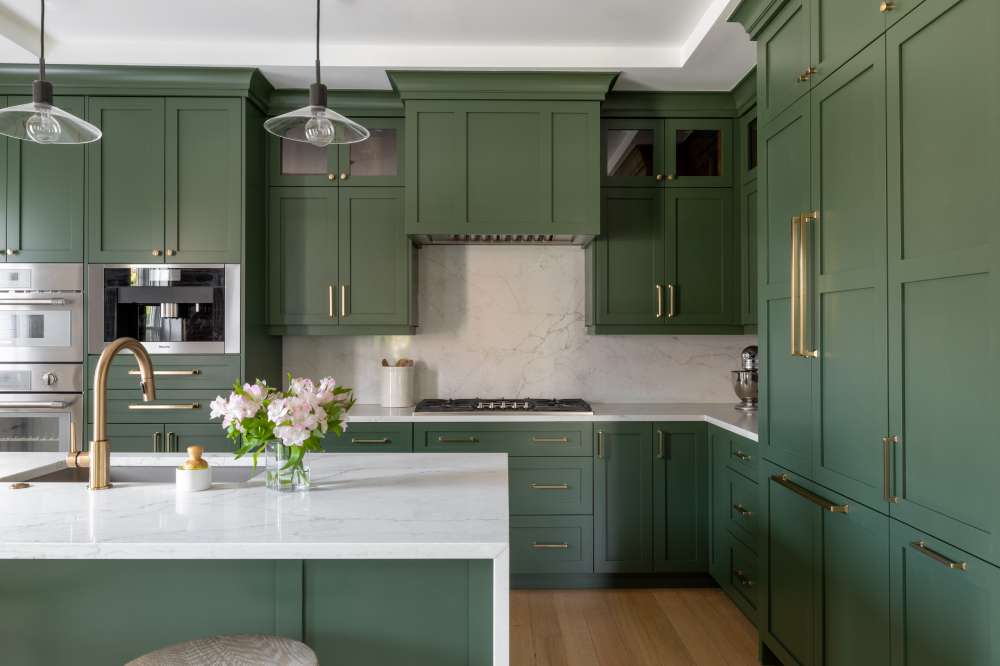
Farrow & Ball sells Studio Green in sheens from 2% to 95%. It points cabinets and trim to its 20% Flat Eggshell, and to 40% Modern Eggshell for the hardest-working surfaces.
A flat matte on a dark green shows every fingerprint, and gold pulls draw hands to the same spots. Satin is the sensible middle.
How to paint the cabinets
- Label and remove the doors, drawer fronts and old hardware. Fill unused screw holes and drill new ones for the gold pulls before priming.
- Degrease every surface and rinse.
- Scuff-sand glossy finishes.
- Apply a bonding primer. Skipping it lets enamel peel off slick cabinets.
- Paint the backs of doors first, let them dry, then paint the fronts in thin coats.
- Wait the full recoat time, then apply the second coat.
- Rehang and install the hardware, then handle the doors gently until the paint cures.
Heavy coats leave brush marks, which is the usual complaint with Emerald Urethane. Dark greens also cure slower than light ones, and they look different on a door than on a chip.
Before ordering, run the door and frame area through a paint calculator, since custom-tinted cans are rarely returnable.
Countertops, backsplash, walls and floors that sit well with green and gold
White or pale stone counters, a quiet backsplash and warm wood underfoot keep the green and the gold in front. Busy veining, loud tile and dark floors compete with them.
Countertops
- White quartz or marble: the cleanest contrast, and the combination Backsplash.com shows most often with brass on forest and sage shaker doors
- Butcher block: warms a cool green and softens the gold
- Black or deep gray stone: works on a light sage, but swallows a deep green
A kitchen with white countertops against green cabinets shows the paint color at its truest.
Wood is the other route, and the look of butcher block under green cabinets leans toward country and traditional.
Backsplash
The backsplash should be the quietest surface in the room.
Quiet: soft white zellige tile or a marble slab keeps attention on the cabinets and the pulls.
Loud: deep green zellige reads moody, and Tango Tile advises pairing it with brass or copper fixtures to take the edge off.
Villa Lagoon Tile shows the dark route in a project by designer Hannah Adams, where satin brass hardware sits against a Deep Forest glazed zellige backsplash.
Walls and floors
Warm white or a tone-on-tone green on the walls lets the cabinets carry the color. A second saturated wall color turns the room into a competition.
Medium or light wood floors suit the pairing, and white oak topped the wood choices in the NKBA 2026 kitchen trends survey. White oak shelving next to green doors and gold pulls repeats the same warm tone three times without shouting.
How do gold finishes hold up, and how do you clean them?
Lacquered and PVD gold stays consistent until the coating fails. Unlacquered brass changes from day one and can be polished back whenever you decide to.
Lacquered, unlacquered and PVD compared

Lacquered brass sits under a clear coating. BHMA’s A156.18 finish standard lists it as 605 for bright brass and 606 for satin brass, both clear coated.
- Pro: the look holds steady and cleaning is soap and water
- Con: once the coating wears at the touch point, the brass underneath tarnishes unevenly and the fix is a full refinish, according to XTJ’s brass guide
Unlacquered brass has no coating at all.
- Pro: scratches blend in, and a polish resets the metal
- Con: it darkens fastest where hands land, and Plate Prestige notes that less cleaning means faster, deeper patina
PVD brass is a hard coating bonded to a base metal such as brass or zinc alloy.
- Pro: Knobs.co reports better scratch and tarnish resistance than lacquered or electroplated finishes
- Con: it costs more up front, and it never develops a patina
One naming trap. BHMA defines 606 satin brass as clear coated, while Knobs.co says satin brass is often a PVD finish, so the same label covers two builds.
Emtek labels satin brass as US4, the older code BHMA maps to 606. Ask which build you are buying before you order 30 pieces.
Cleaning by finish
Lacquered: a soft cloth and mild soap whenever fingerprints show, per Plank Hardware. No schedule needed.
Unlacquered: brass polish or a paste of vinegar, salt and flour lifts the tarnish, and Plank Hardware says the metal starts oxidizing again right after.
PVD: follow the maker’s care sheet, because Knobs.co notes that coating thickness varies by manufacturer.
What the green paint has to survive
The KCMA A161.1 cabinet standard tests factory finishes against heat and humidity, hot and cold cycling, detergent, and household liquids such as vinegar, grape juice and coffee. The finish must show no blistering, checking or other film failure.
That certification covers cabinets a manufacturer submits for testing. A door you repaint green yourself falls outside it, which is one more reason to follow the cure schedule of the paint you chose.
How much do green cabinets with gold hardware cost?
Gold hardware for a typical kitchen costs a few hundred dollars, and painting your cabinets yourself costs several times more because labor drives it. Replacing the cabinets costs more than either in every cost guide retrieved.
Key figures:
- 30 to 45 knobs and pulls for a typical kitchen, budgeted at $400 to $1,800 (Knobs.co, 2026)
- Emtek Westridge pull list prices of $24 at 5 inch and $30 at 8 inch center-to-center (Emtek price book, January 2025)
- $2,000 to $6,500 for professional cabinet painting (HomeGuide)
- 80% to 85% of a painting bill is labor (HomeGuide)
Hardware
Price depends on tier more than on color. Knobs.co puts designer lines such as Top Knobs and Atlas Homewares at the top of the range.
A quick worked example: 15 drawers with 5 inch Emtek pulls is $360 before a single door knob. Count every door, drawer and appliance panel first, and add a few spares.
Painting against replacing
The painting figures disagree. HomeAdvisor lists about $1,000 at $3 to $10 per square foot, well under HomeGuide’s range, and the gap probably comes from scope, since spraying, door count and prep depth move a quote.
Labor dominates, so the painter you hire matters more than the can of green. Run your own door count through a home renovation cost calculator before comparing quotes.
Where extra money does nothing
A $30 pull and a $24 pull open the drawer the same way. Spend on the finish build (PVD or a quality lacquer) and on proper prep for the paint.
When does the green and gold pairing not work?

It fails in small, dim kitchens, in households that will not tolerate a living finish, and where the green is dark enough that gold stops being the point.
- Small, dim rooms: a deep green perimeter eats light, and a list of the best colors for small rooms will point you to something paler
- Dark green with an easy fix: keep the perimeter light and paint only a dark green kitchen island
- Hard water and steam: XTJ points to lacquered or satin brass over unlacquered near the sink
On deep, saturated greens such as hunter, forest and dark emerald, Knobs.co’s 2026 guide says matte black works best. That is a legitimate call, not a compromise.
The trend question
The same NKBA 2026 survey is read two ways. The Kitchn headlines it as green no longer being the “it” kitchen color, while Sweeten says green leads.
NKBA’s own release has neutrals first at 96% and greens second at 86%, so green is the top non-neutral and not the default. If resale worries you, painted doors are far cheaper to reverse than replaced ones.
FAQ About Green Kitchen Cabinets with Gold Hardware
Where should knobs and pulls sit on green cabinet doors?
On shaker doors, center a knob on the stile and rail in the lower corner of an upper door and the upper corner of a lower door, per Tidbits&Twine. Schoolhouse sets hardware 2.5 to 3 inches from the bottom edge of uppers and the top edge of lowers.
Can only the island be green?

Yes. Lily Ann Cabinets lists an island-only green as one of three ways to bring the color in, next to repainting everything and a two-tone layout.
NKBA’s 2026 trends report has 57% of respondents expecting statement colors on the island. A green island against white perimeter cabinets is the lowest-risk version.
Does gold hardware look right with stainless steel appliances?
Yes. The cabinets carry the gold, so the two metals only meet at the appliance handles.
Emtek sells brass appliance pulls in 12 and 18 inch lengths for panel-ready units, listed at $218 and $318 in its January 2025 price book.
Can you mix gold hardware with a black or nickel faucet?
Yes, but guides disagree on how far to take it. Kitchen and Bath Reno says to match the faucet and lighting finish first, while IST Cabinets describes brass dominant with matte black as a second metal.
Renhive’s rule covers both views: one lead metal and one accent, nothing more.
Test the Pairing Before You Order Hardware

Green kitchen cabinets with gold hardware should be tested with one painted sample door and one pull of each finalist finish, judged in the room’s own light before any order goes in.
Green comes first because its undertone decides the gold. Size comes last because it only matters once the finish is chosen.
- Green first: a sample door in morning and evening light
- Gold second: one pull per finalist finish held against the door
- Size last: pull outlines taped on a real drawer
Priced at Emtek’s $24 list for a 5 inch pull, 30 to 45 pieces come to $720 to $1,080, so one sample is cheap insurance.
A sample shows unlacquered brass on day one only, so choosing it means accepting a patina nobody can preview.
Wall color is the next decision, and the guide to the best colors for kitchen walls picks up from there.
More Kitchen Color Guides
- Green cabinets with black countertops
- Green cabinets with grey countertops
- Green cabinets with brown countertops
- Green cabinets with granite countertops
- All kitchen color schemes by cabinet color

- Shoji White vs Alabaster: Which Soft White Wins? - October 25, 2026
- Color Combinations for 32 Colors and 10 Wood Tones - October 22, 2026
- Kitchen Color Schemes by Cabinet Color: What Pairs Well - October 19, 2026


