Green Cabinets
Green Kitchen Cabinets with Black Hardware: A Natural Pairing
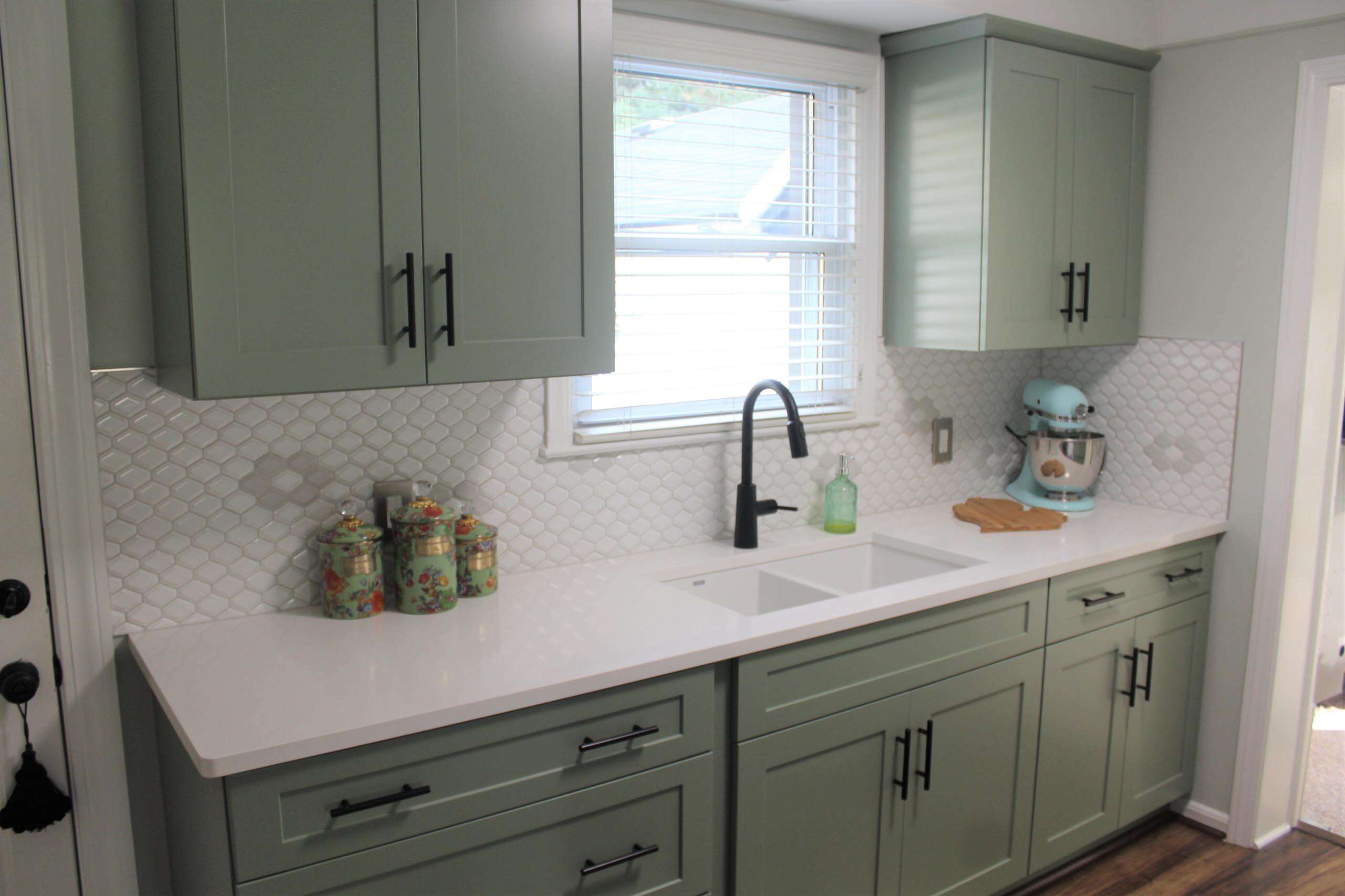
Green kitchen cabinets with black hardware work best in gray-greens and mid-tone sages, where the black pulls and knobs still outline every door. Very dark greens narrow that contrast, so the hardware needs a longer profile or a warmer metal.
Industry professionals also rank green first among kitchen colors. NKBA’s 2025 Kitchen Trends Report names it the top shade for the second year running, selected by 76% of the 523 professionals surveyed.
If you are still choosing between green and another cabinet color, our kitchen color scheme chart puts them next to each other.
Which shades of green look best with black hardware?

Gray-greens and mid-tone sages show black hardware best, because the contrast stays visible against the paint. Very dark greens such as Hunter Green and Pewter Green pull the hardware toward the door color, so it stops outlining the doors.
The number that predicts this is light reflectance value (LRV), a 0 to 100 scale where 0 is black and 100 is pure white. Matte black hardware sits near the bottom of that scale, so the contrast it gives is close to the LRV of the paint underneath.
| Shade | LRV | Undertone | Black hardware reads as |
|---|---|---|---|
| Saybrook Sage (Benjamin Moore HC-114) | about 45 | Muted gray-green | Soft, clear contrast |
| Evergreen Fog (Sherwin-Williams SW 9130) | 30.4 | Gray-green, near neutral | Crisp, graphic accent |
| Pewter Green (Sherwin-Williams SW 6208) | about 12 | Deep gray-green, cool-neutral | Low contrast, tonal |
| Hunter Green (Benjamin Moore 2041-10) | about 6 | Deep green, cool | Close to merging in dim light |
Sherwin-Williams publishes the Evergreen Fog figure. The other three come from color databases and shift slightly by listing.
Sage and gray-green

Sherwin-Williams lists Evergreen Fog at LRV 30.4, so black hardware lands as a crisp accent on a muted, near-neutral gray-green. The company named it its 2022 Color of the Year.
Saybrook Sage runs lighter, at about 45 across most listings, and gives a softer version of the same effect. A kitchen with limited daylight pulls it toward gray, so test it beside the hardware before committing.
Lighter sages also raise the wall color question. A guide to colors that sit well with sage green helps there, since the cabinet shade sets the wall and trim choices around it.
Deep forest, hunter and emerald

Deep greens need hardware with presence, or the black fades into the door. A longer bar pull holds its line where a small knob disappears.
Hunter Green shows how loose the published numbers are. Design Shop lists its LRV at 4.31, while MyPerfectColor lists 7.28, so a physical sample matters more than the spec sheet.
- Pewter Green and Hunter Green: bar pulls over knobs
- Olive and emerald: read the LRV on the chip, not the name
- Any green under about LRV 15: keep counters and upper walls light so the hardware has something to read against
Walls and counters decide the rest, and a roundup of colors that go with dark green covers that side.
Which black hardware finish suits painted green cabinets?
Matte black with a PVD or powder-coat finish is the practical pick. The coating process decides how it holds up, so check it before the color name.
Quality matte black hardware bonds its finish to the metal through powder coating or physical vapor deposition (PVD). That resists chipping and scratching better than painted or lacquered finishes, according to FMD Distributor’s finish guide.
Knobs.co adds a limit: some matte black lines use a softer PVD layer, so heavy-use drawers need a lacquer-over-PVD topcoat.
Black hardware is the sharp point of contrast in the room’s design, so the finish should match from door to door. Mixed sheens read as mistakes against a solid green field.
Matte black

Pros:
- Hides fingerprints and water spots better than polished or satin black (Knobs.co)
- Flat color with no sheen variation between pieces
- Low upkeep
Cons:
- Coating quality varies by product line
- A satin finish sold as black can read gray under some lights
Satin and glossy black

Glossy black gives the sleekest, highest-contrast look on a green door, as Willy Homes describes it. It also shows every touch, a weakness Knobs.co flags for polished finishes.
Satin sits between the two, with a subtle sheen that is more forgiving than gloss and less flat than matte.
Oil-rubbed bronze

Oil-rubbed bronze is the dark alternative when black feels too hard against a warm green. It is not stable, though: bronze darkens over time, and patina can wear unevenly in high-contact spots, per a finish guide from Mi and Gei.
Trade-off: warmer and softer than black, less predictable after a few years of use.
Should green cabinets get knobs, bar pulls or cup pulls?

Knobs on doors and pulls on drawers is the simplest split. KraftMaid lists it, along with knobs on uppers and pulls on lowers, as a combination that looks consistent.
Bar pulls suit slab and Shaker fronts alike, and 3 to 6 inches center-to-center (the distance between the two screw holes) is the range Knobs.co finds most consistent in matte black. Cup pulls belong on drawers, set in the top third of the front so low drawers need less reach, as Julie Blanner advises.
On dark greens, small knobs lose to the paint. Knobs.co makes the same point about black cabinets, and the logic carries over to Pewter Green or Hunter Green.
Hardware size by door and drawer width

- Knob diameter: 1 to 1-1/2 inches, with 1-1/4 inches the common default (CliqStudios)
- Pull length on drawers: about one-third of the drawer face, so a 4-inch pull on a 12-inch drawer (KraftMaid)
- Wide drawers: two pieces of hardware from 24 inches wide, installed in thirds (Room for Tuesday)
- Knob offset on doors: 2-1/2 to 3 inches from the door corner (CliqStudios)
Knob width has a ceiling too. A knob wider than the door frame crowds neighboring hardware and appliances, KraftMaid warns.
Where sources disagree on placement
Placement guides split into two camps, and the split is real, not an error in one of them.
Traditional placement:
- Mark the middle of the stile and the middle of the rail, then install where the lines cross (KraftMaid)
- Offset about 2-1/2 to 3 inches from the corner (CliqStudios)
Updated placement:
- Center on the stile, level with the edge of the rail (KraftMaid)
- Easier for installers to line up, according to San Diego Hardware
Fynes Designs gives a wider range, 1-1/4 to 3 inches, and suggests marking positions with painter’s tape before drilling. The right offset follows the rail width of the door, so tape a few doors and step back.
Which cabinet door styles carry black hardware best?

Shaker doors carry black hardware best, because the flat stile gives every knob and pull a fixed, repeatable position. Slab and inset doors work too, with different placement rules.
- Shaker: center the pull on the stile and mount it vertically on upper doors, about 2 to 2.5 inches above the bottom edge (Kitchen Cabinet Kings)
- Slab and flat-panel: set hardware 2 to 3 inches from both edges (KraftMaid), or the same distance from the bottom and the side (San Diego Hardware)
- Inset: choose hardware with a backplate, so the metal never touches the frame (Cabinets4Sure)
- Detailed profiles: pick a narrow-footprint pull and mount it on the flattest part of the frame (TaylorCraft)
Flat fronts leave no frame to anchor the hardware, so the black has to carry the design. Elodie Home Styling pairs flat-panel green doors with minimal hardware and a sparse backsplash in kitchens with black countertops.
Working rule: the flatter the door, the longer the pull. A bar pull gives a slab front the horizontal line its missing frame would otherwise supply.
What countertops, backsplash and wall colors go with green cabinets and black hardware?
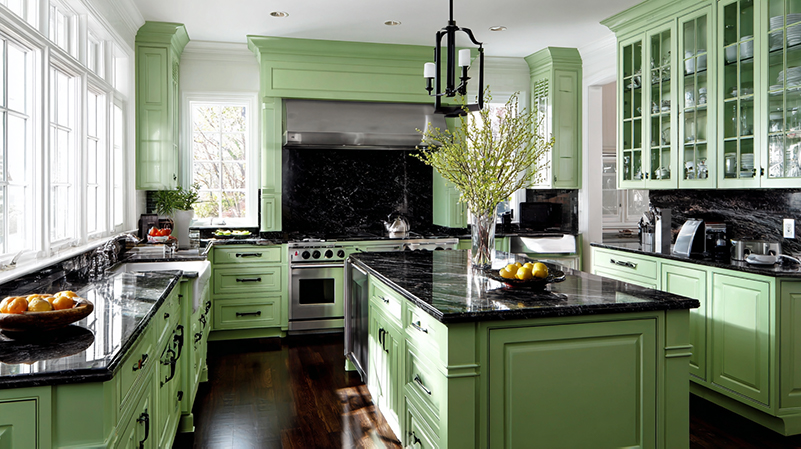
White, gray and black backsplashes are the most common partners for green cabinets, according to Backsplash.com, and the countertop sets the mood. Black granite or quartz pushes the room toward moody, while marble and marble-look stone keep it light.
| Surface | Look | Backsplash that works |
|---|---|---|
| Black granite or quartz | Moody, strong contrast | Black slate subway, or lighter neutral tile |
| Soapstone | Charcoal that deepens with age | Simple, understated tile |
| Marble or marble-look | Light and veined | White, beige, gray or gold-accented tile |
Countertops

Soapstone is a natural partner for black hardware because it is nonporous and never needs sealing. Mineral oil is optional, and Remodelista puts the average homeowner at once a month or every two to three months to keep the charcoal tone.
The trade-off is softness. Soapstone scratches more easily than granite, though a light sanding or a wipe of mineral oil removes most marks, per Soapstones.com.
For a closer look at granite, quartz and soapstone in black, this breakdown of green cabinets sitting over black countertops goes shade by shade.
Backsplash, walls and floors

- Backsplash: black slate subway tile adds depth and texture next to polished black granite and deep green Shaker doors (Backsplash.com)
- Walls: warm white lets the green carry the only strong color in the room
- Floors: warm wood tones sit well under olive cabinets with matte black pulls (Emma Courtney Home)
If the counter is black granite, a backsplash that suits black granite narrows the tile choice fast.
Faucets, lighting and appliances
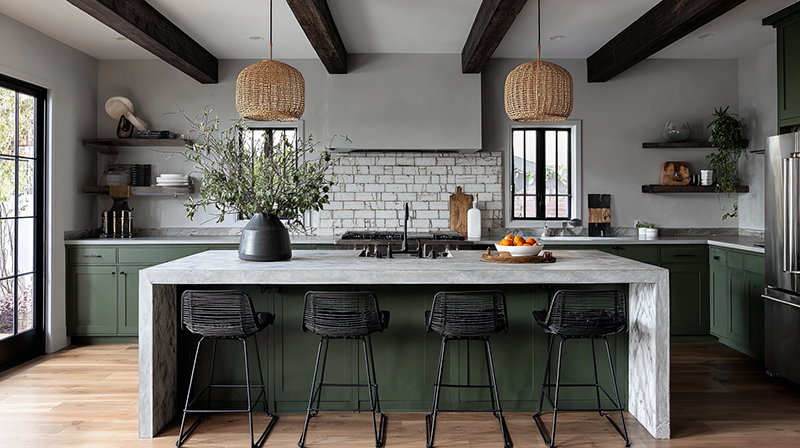
Stainless steel is the dominant appliance finish, chosen by 72% of homeowners in Houzz’s 2026 kitchen trends report. Black pulls usually end up beside a stainless range, so the mix is already the norm.
Fabuwood shows it in a green and timber two-tone kitchen: black hardware with a stainless steel faucet.
Knobs.co sets one firm rule for the faucet. If it is brushed nickel, the cabinet hardware should be brushed nickel or matte black, not warm brass.
How to paint green kitchen cabinets so the black hardware lasts
Degrease, sand lightly, prime with a bonding primer, apply two coats of waterborne enamel, then let the paint cure before the black hardware goes on. Skipping the cleaning is the most common reason cabinet paint peels, according to RTA Wholesalers.
- Remove the doors, drawer fronts and old hardware, and label each one.
- Degrease every surface and rinse, with extra attention around the handles and the stove (Hyde Tools).
- Scuff-sand with 150 grit, then wipe off the dust.
- Apply a bonding primer such as Stix, and use a stain-blocking primer like BIN where tannin shows through (Paint Outlets, RepcoLite).
- Scuff the dry primer with 220 grit.
- Apply two thin coats of waterborne alkyd or urethane enamel, respecting the recoat time on the can.
- Let the film cure, then rehang the doors and install the hardware.
If the new pulls use a different center-to-center spacing than the old ones, fill and prime the old screw holes before the first topcoat.
Sheen and paint choice
Satin and semi-gloss are the two sheens pros reach for on cabinets. Benjamin Moore Advance ships only in satin, semi-gloss and high-gloss, with no flat option.
Sheen numbers differ by brand. Sherwin-Williams lists Emerald Urethane Trim Enamel in satin at 35 to 45 gloss units at 60 degrees, so check the data sheet rather than the word on the can.
Working rule: on a deep green where the color contrast is thin, a semi-gloss door gives a matte black pull a second kind of contrast to work with. Satin keeps both quiet.
Cure time and the hardware install
Benjamin Moore Advance: 16-hour recoat, up to 30 days to reach full hardness.
Sherwin-Williams Emerald Urethane Trim Enamel: 4-hour recoat at 77 degrees F and 50% humidity, per the Sherwin-Williams product data sheet. Reviewers such as Rocks Painting report a full cure in 7 to 14 days.
Composite Paint’s Advance review lists re-handling at 24 hours and normal use at 7 days. A painter at Evolution of Style adds that dark colors seem to cure slower, which matters for deep green.
So hang the doors and drill for hardware gently in the first week, and avoid heavy use of the drawers until the film hardens.
When repainting is the wrong call
Painting costs far less than replacing cabinets, but only when the boxes are solid, per RTA Wholesalers. Swollen, delaminating or water-damaged doors need replacing, not painting.
If paint is off the table entirely, there are ways to cover kitchen cabinets without painting them.
When does black hardware not work on green cabinets?
Black hardware fails when the green is so dark, or the kitchen so dim, that the pulls merge with the doors instead of outlining them. Brass or gold is the usual fix, and a controlled mix of both is the third option.
Dark green in a low-light kitchen
Very dark cabinets beside other very dark surfaces remove contrast and make a room feel heavy, according to usepaintpilot.com. Keeping the upper walls light offsets the depth on the lower cabinets.
Smaller kitchens have a second option: lighter uppers, with dark green on the lowers only, as one dark-green kitchen guide at bkciandre.com suggests.
Another way to limit the dark is to keep the perimeter neutral and let a dark green kitchen island carry the color.
Where sources disagree on black versus brass

Undertone view: Knobs.co pairs warm brass with sage and matte black with hunter green, matching the metal’s temperature to the green’s undertone.
Contrast view: the LRV math in the shade section points the other way, with black reading best on lighter greens and fading on the darkest.
Both hold up in practice. Choose black when you want the outline, and brass when you want warmth, then size the pulls longer on the darkest doors.
Black versus brass at a glance
| Option | Strength | Limit |
|---|---|---|
| Black | Sharp outline, modern contrast (Inspire Hardware) | Feels stark without wood or a warm metal nearby |
| Brass | Softer and layered, suits warm greens like sage and olive (Knobs.co) | Unlacquered brass patinas, which can read as neglected on sleek modern greens |
| Mixed | Less matchy, such as black on uppers and brass on lowers (Knobs.co) | Random mixing looks accidental, so set one rule |
For the brass side in depth, see this look at green cabinets paired with gold hardware.
Is black hardware still current?

Black is not out of fashion. Houzz’s 2026 kitchen trends report, as reported by Real Simple, puts brushed nickel first at 28%, black second at 18% and brushed gold third at 12%.
The drift toward warmer metals is real, though. 10 Percent Cabinetry’s 2026 dealer guide calls flat matte black no longer the only default, so the limit on green is tonal, not a matter of trend.
FAQ About Green Kitchen Cabinets With Black Hardware
Can black hardware go on both upper and lower cabinets?
Yes. One black finish on both keeps the look cohesive, according to Willy Homes.
To vary the shape without changing the finish, put knobs on the uppers and pulls on the lowers, a split KraftMaid lists as a consistent combination.
How much does it cost to swap in black hardware?
Hardware is the cheapest change in a green kitchen, and the total is piece count times unit price. Knobs4Less lists Top Knobs flat black knobs at about $10 each and pulls at about $14 to $18.
Count every door and drawer before ordering.
How do I clean matte black cabinet hardware?
Skip abrasive cleaners. Knobs.co advises avoiding them on PVD-finished hardware.
Matte black also hides fingerprints better than satin or polished black, so a soft, damp cloth usually covers daily upkeep.
Does black cabinet hardware rust?
Not when the finish is PVD or powder coat. Knobs.co notes that neither rusts and both are rated for interior use.
The coating process matters more than the color name, so check the finish spec before buying.
How to Test the Pairing Before You Buy

A painted sample board with the real black pulls taped on shows whether green kitchen cabinets with black hardware suit a room, because chips and catalog photos hide how the contrast reads in daylight and evening light.
The order matters, since each step costs less to reverse than the next:
- Paint one board in the planned sheen
- Tape the actual knob and pull at the planned offset
- Check it in the morning, at midday and at night
The test costs one quart of paint and an evening. Skipping it risks a repaint, and RTA Wholesalers’ timeline runs five days from degreasing to reassembly, with a week without full kitchen access.
This advice was verified in October 2026. If brass or bronze pulls replace black on the shortlist, run the same board test with those.
More Kitchen Color Guides
- Green cabinets with white countertops
- Green cabinets with grey countertops
- Green cabinets with brown countertops
- Green cabinets with granite countertops
- All kitchen color schemes by cabinet color

- Shoji White vs Alabaster: Which Soft White Wins? - October 25, 2026
- Color Combinations for 32 Colors and 10 Wood Tones - October 22, 2026
- Kitchen Color Schemes by Cabinet Color: What Pairs Well - October 19, 2026


