
A fireplace mantel sets the tone for an entire room. Get it wrong and the whole wall feels off. Modern fireplace mantels have moved past carved wood and classical columns into clean lines, raw materials, and designs that blend into the architecture instead of sitting on top of it.
The global fireplace mantel market hit an estimated $4.36 billion in 2024, and the modern segment is growing faster than traditional styles. Concrete, steel, reclaimed wood, and natural stone are replacing ornate trim work in living rooms across the country.
This guide covers materials, installation methods, fireplace type compatibility, clearance codes, costs, and where to buy. Everything you need to pick the right mantel for your space.
What Is a Modern Fireplace Mantel?

A modern fireplace mantel is a mantel shelf or surround built with clean geometry, minimal ornamentation, and materials like concrete, steel, or natural wood. It looks nothing like the carved oak pieces your grandparents had.
Traditional mantels lean heavy on corbels, fluted columns, and classical proportions. Modern mantels strip all that away. You get flat planes, sharp edges, and materials that speak for themselves without decorative filler.
The real shift happened when fireplaces stopped being just heat sources and started functioning as architectural elements. A modern mantel doesn’t sit on top of the fireplace like an afterthought. It blends into the wall, wraps around the firebox, or floats above it as a single clean shelf.
According to Wise Guy Reports, the global fireplace mantel market reached an estimated $4.36 billion in 2024, with wood mantels alone accounting for $1.2 billion of that figure. North America holds the largest regional share at $1.75 billion.
Common forms you’ll see right now:
- Floating shelves mounted flush to the wall with hidden hardware
- Flush surrounds where the mantel and wall plane are nearly seamless
- Full-wall treatments running floor to ceiling with integrated mantels
Most modern mantels sit between 5 and 8 inches deep. Anything deeper and you start running into heat clearance issues, which I’ll get into later. Width typically extends 6 to 12 inches past the firebox opening on each side, though some designers push wider for dramatic effect on large walls.
Acucraft’s 2026 trend report confirms that minimalist fireplace designs continue to gain ground. Frameless openings, concealed hardware, and simplified details let the flame become the primary visual, not the trim around it.
Materials That Define Modern Mantels
Material choice is what actually makes a mantel look modern or traditional. You can take the same basic shelf shape and build it from rough-sawn barn wood or polished concrete, and the room reads completely differently.
Market data from Wise Guy Reports shows the material breakdown for 2024: wood leads at $1.2 billion, stone follows at $1.0 billion, and metal sits at $0.75 billion. But those numbers don’t tell the whole story because composite and concrete categories are growing fast and often get lumped together.
Concrete and Micro-Cement

Image source: Dura Supreme Cabinetry
Concrete has become one of the most requested modern mantel materials, and for good reason. It’s non-combustible, which means it can sit closer to the firebox opening than wood can.
Three main types show up in residential projects:
- Cast-in-place: poured on site, fully custom, heavy
- Precast: made in a shop, shipped in sections, easier to install
- GFRC (Glass Fiber Reinforced Concrete): lightweight panels that look identical to solid concrete but weigh a fraction of it
Companies like LA Precast Mantels and DreamCast Design have built entire businesses around GFRC fireplace surrounds. DreamCast’s concrete mantels were featured on Studio McGee’s Dream Home Makeover, which pushed the material further into mainstream awareness.
Concrete Network notes that GFRC can be molded into virtually any shape and integrally colored to match nearly any hue. That flexibility is why architects keep specifying it for custom residential fireplaces.
Steel and Blackened Metal
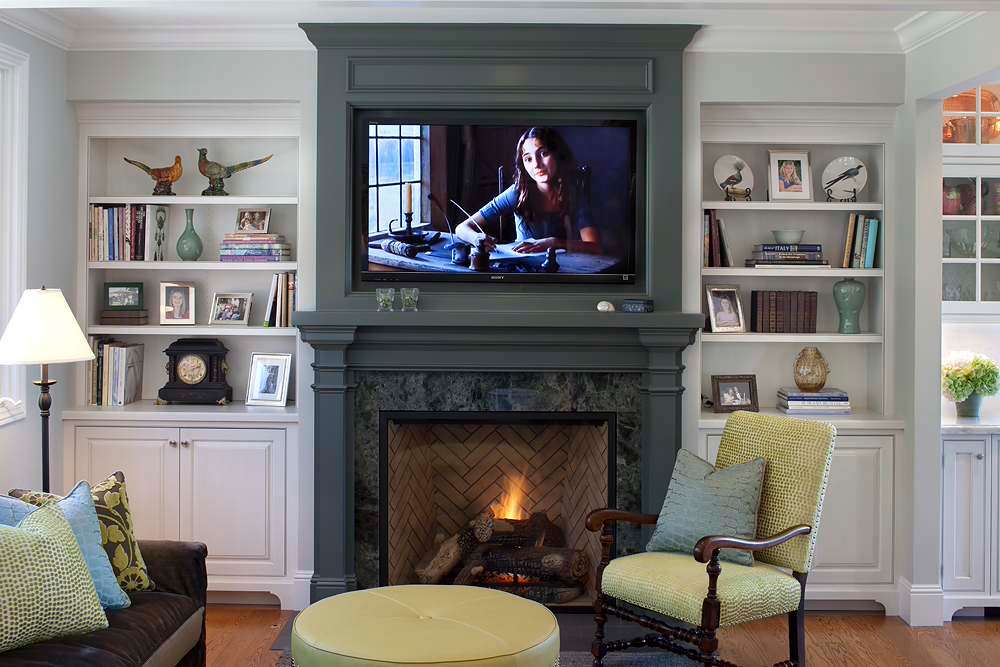
Image source: Julie Williams Design
Powder-coated steel and raw Corten (weathering steel) both show up in modern mantel applications. Steel mantels tend to run thinner than wood or stone, sometimes as slim as 1.5 inches, which gives the shelf a razor-sharp profile against the wall.
Blackened steel surrounds pair well with linear gas fireplaces. The dark finish creates contrast against lighter wall materials like plaster or drywall, and the metal handles heat better than any wood species will. Metal mantels accounted for $0.75 billion of the global market in 2024 according to Wise Guy Reports.
Reclaimed and Live-Edge Wood

Image source: A & J Woodworking Inc
Reclaimed wood mantels aren’t going anywhere. If anything, they’ve moved from a farmhouse-only material to a legitimate luxury specification.
Atlanta Woods reported in late 2025 that designers are increasingly specifying genuine barnwood and reclaimed lumber because it instantly anchors a room. The move toward oversized, rough-hewn timber mantels is especially strong in homes with linear gas fireplaces, where the organic warmth of wood balances all the glass and metal.
White oak, walnut, and maple are the most common species. Live-edge slabs (where the natural tree edge is preserved) are popular for homeowners who want a one-of-a-kind piece. Expect to pay significantly more for live-edge since each slab requires individual selection and finishing.
Natural Stone Slabs

Image source: Parker Design Build Remodel
Marble, limestone, and quartzite slabs work as both mantel shelves and full surrounds. Stone brings visual weight that other materials can’t match.
A single slab of Calacatta marble running the width of a fireplace wall looks completely different from a standard wood shelf. But stone is heavy, typically requires professional installation, and costs more per linear foot than most alternatives.
Wood Modern Mantels vs. Stone Modern Mantels
| Factor | Wood Mantel | Stone Mantel |
|---|---|---|
| Visual effect | Warmth, organic texture | Mass, permanence |
| Typical cost | $150 – $2,000 | $500 – $5,000+ |
| Installation | DIY-friendly (floating shelf) | Usually needs a pro |
| Heat clearance | Min. 6″ from firebox (combustible) | Can sit closer (non-combustible) |
| Best room style | Transitional, Scandinavian, rustic-modern | Contemporary, Mediterranean, luxury |
Wood adds warmth fast and costs less. Stone makes a bigger visual statement but demands more budget and structural support. Honestly, the choice usually comes down to whether the room needs softening or grounding.
Modern Mantel Styles by Fireplace Type
Your fireplace type dictates your mantel options more than most people realize. A floating walnut shelf that looks perfect over a linear gas unit could be a fire hazard above a wood-burning firebox if clearances aren’t right.
The electric fireplace market alone reached $2.46 billion in 2024, according to Market Research Future, with wall-mounted units leading the product segment. That growth directly affects mantel design because electric units produce far less heat, which opens up material and placement options that gas and wood-burning fireplaces don’t allow.
Mantels for Linear Fireplaces

Image source: Michael Abrams Interiors
Linear fireplaces are the dominant format in modern residential design right now. Acucraft’s 2026 trend report states these are no longer a passing trend but a defining element of contemporary homes, especially in open-concept layouts.
The linear fireplace insert market was valued at $1.3 billion in 2023 and is projected to reach $1.84 billion by 2030 (QY Research). That growth rate tells you how many living rooms are getting these units installed.
Key proportions to get right:
- Mantel width should extend at least 4-6 inches past each side of the firebox
- Mounting height depends on firebox type and mantel material (more on clearances below)
- Shadow gaps of 1/4″ to 1/2″ between mantel and wall surface give a clean, floating look
The visual ratio matters more than people think. A 36-inch mantel shelf over a 60-inch linear firebox looks awkward. Match proportions or go wider. Never go narrower.
Electric Fireplaces with Integrated Wall Surrounds

Image source: jordan peterson interior design
Electric units are the easiest to work with from a mantel standpoint. Most produce surface heat under 100 degrees F, so combustible materials like wood can sit much closer to the unit than with gas or wood-burning models.
Many electric fireplace installations skip the standalone mantel entirely and go with a full wall surround. Shiplap, large-format porcelain tile, or stacked stone runs from floor to ceiling, with the electric insert recessed into the wall and a simple floating shelf above it.
Wood-Burning Fireplaces and Heat-Safe Materials

Image source: Anthony Shields & Sons
Wood-burning fireplaces generate the most intense radiant heat. That’s where material selection gets serious and clearance codes become non-negotiable.
According to Mantels Direct, combustible mantels above wood-burning fireplaces typically must sit at least 12 inches above the firebox opening. Non-combustible materials like concrete or stone can be placed closer, but you still need to follow the specific firebox manufacturer’s installation manual.
If you want a wood mantel over a wood-burning fireplace, you’ll either need to mount it high enough to meet code or install a non-combustible surround material between the firebox and the mantel as a heat barrier.
Double-Sided and Peninsula Fireplaces
These are tricky for mantel placement. A see-through fireplace serves two rooms, so any mantel needs to work visually from both sides or be placed on only one face.
Peninsula (three-sided) fireplaces usually skip the traditional mantel shelf entirely. The fireplace itself becomes the focal point, and adding a shelf can clutter the clean lines that make these units appealing in the first place.
Floating Mantel Shelves: Mounting, Depth, and Proportions

Image source: Get It Together
Floating mantel shelves are the most popular modern mantel format right now. No visible brackets. No corbels. Just a shelf that appears to come straight out of the wall.
Centennial Woods, a reclaimed wood supplier, reports that floating mantels are a top-selling accent piece, and their step-by-step installation guides are among their most-viewed content. That tells you how many homeowners are doing this project themselves.
Standard depth ranges: 5 to 8 inches for most residential floating mantels. Go deeper than 8 inches and you’re adding projection that increases heat exposure and may require additional clearance from the firebox.
Construction types:
- Solid wood beam: heaviest, most expensive, needs heavy-duty mounting
- Hollow-box construction: lighter, slides over a hidden steel bracket or French cleat, easier to install
- GFRC concrete shelf: lightweight, non-combustible, mounts on hidden steel supports
Mounting hardware matters. A French cleat is the simplest and most forgiving for DIY installation, but it limits weight capacity. Hidden steel rod systems (where steel rods are lag-bolted into studs and the mantel slides over them) handle heavier shelves but require precise alignment.
For placement height, the general rule is the mantel’s bottom edge sits 54 to 60 inches from the floor. But that’s just a design guideline. The actual minimum distance from the firebox opening is dictated by your local building code and the firebox manufacturer’s specs.
Full-Wall Mantel Surrounds and Overmantel Treatments

Image source: Liz Levin Interiors
Full-wall fireplace treatments go beyond the shelf. These are floor-to-ceiling installations where the mantel is just one piece of a larger built composition.
According to Clever Real Estate’s 2024 survey, American homeowners spent an estimated $485 billion on renovations in 2024, up from $363 billion in 2020. A big chunk of that goes into living room upgrades, and full-wall fireplace surrounds are among the most impactful single-room changes you can make.
Surround Materials That Work
Stacked stone: ledger-style panels give a textured, organic look. Works in both rustic-modern and contemporary spaces, though it can read dated if the stone profile is too chunky.
Large-format porcelain panels: these have exploded in popularity for fireplace walls. A single 5-foot by 10-foot slab of porcelain with a marble or concrete look eliminates grout lines almost entirely. Clean, modern, and heat-resistant.
Shiplap and wood paneling: still common for the area above the mantel (the overmantel), but it needs to stay well above any heat zone. Shiplap is combustible, so the same clearance rules apply.
TV Integration Above the Mantel

Image source: LORRAINE G VALE, Allied ASID
Let’s be honest. Most people put a TV above the fireplace whether designers recommend it or not.
The heat concern is real, though. Mounting a $2,000 television 12 inches above a gas firebox is asking for trouble. The fix is either a recessed TV niche with ventilation, a mantel deep enough to deflect heat forward before it rises to the screen, or simply choosing a fireplace with low heat output.
Anthony Concrete Design points out that a concrete mantel beam protruding over the fireplace is non-combustible and can help deflect heat away from electronics mounted above it. That’s one of the practical reasons concrete mantels keep gaining ground in rooms where TVs live above the fire.
Overmantel Design Options
The space between the mantel shelf and the ceiling is the overmantel. In modern design, this area gets treated as part of the fireplace composition rather than ignored.
Common approaches:
- Continuous material (same stone or tile as the surround) running to the ceiling
- Recessed niches for art or built-in lighting
- Contrasting paint color or textured plaster to frame the wall section
The strongest modern fireplace walls treat the entire surface, from hearth to ceiling, as one unified design. Mixing too many materials in the overmantel area creates visual noise. Pick one or two and commit.
Modern Mantel Brands and Where to Buy
Sourcing a modern mantel used to mean hiring a custom carpenter or concrete fabricator. That’s still an option, but the retail and online market has expanded significantly.
Data Bridge Market Research projected the global fireplace mantel market would grow at a CAGR of 5.75% through 2029, and that growth is showing up in the number of brands and direct-to-consumer options now available.
Wood Mantel Brands

Image source: Fredman Design Group
Pearl Mantels: one of the most recognized names in the category. Their contemporary floating shelf models are widely available through Home Depot and Amazon. Decent quality for the price.
Dogberry Collections: focuses on rustic and modern farmhouse styles. Their box-beam mantels are popular for DIY installation because they’re hollow and lightweight.
Mantels Direct: carries a broader range including concrete, wood, and stone options. Their website has one of the better fireplace mantel clearance guides I’ve come across.
Concrete and GFRC Brands

Image source: John Buchan Homes
| Brand | Specialty | Price Range |
|---|---|---|
| DreamCast Design | GFRC surrounds, multiple finishes | $800 – $3,500+ |
| LA Precast Mantels | Custom GFRC, full surrounds | $1,000 – $5,000+ |
| Anthony Concrete Design | Custom cast panels, mantels, hearths | $1,500 – $6,000+ |
| Thermastone | Non-combustible concrete shelves | $300 – $800 |
DreamCast ships across North America and has been featured on multiple HGTV shows. LA Precast has been operating out of Glendale, California since 2000 and does both standard and fully custom GFRC work.
Custom Steel and Metal Options
Metal mantels are harder to find off-the-shelf. Most come from local fabricators or Etsy sellers specializing in custom metalwork. Expect to pay $400 to $2,000 for a custom steel floating shelf, depending on length, finish, and thickness.
Powder-coated finishes in matte black or bronze are the most requested. Raw steel with a clear coat gives an industrial look but requires periodic maintenance to prevent rust in humid environments.
Big-Box and Online Retailers
Home Depot and Lowe’s both carry basic floating mantel shelves in pine, MDF, and faux-stone finishes. These are budget options, usually under $300, and they work fine for electric fireplaces or purely decorative setups.
Wayfair has a larger selection of stone and concrete mantels, including GFRC options from multiple manufacturers. Prices range widely from $200 for a basic shelf to $4,000+ for a full surround package.
Etsy is the best source for reclaimed wood mantels and live-edge slabs from small makers. Quality varies wildly, so check reviews and ask for photos of the actual piece you’ll receive.
How to Install a Modern Fireplace Mantel
Most floating mantel shelf installs take under four hours. Full surround systems can stretch to a full day or more, depending on material weight and wall conditions.
Homewyse estimates the total cost of a basic mantel installation at $703 to $984 per mantel as of early 2026, including labor and materials. That figure covers a standard residential-grade shelf with hidden cleat mounting.
Before you start, you need to answer two questions. What’s behind the wall? And what type of fireplace are you mounting above?
Stud-Mounted vs. Masonry-Anchored Installs
Stud-mounted: Most drywall installations. Use a stud finder, confirm locations with a pilot hole, then lag-bolt your mounting hardware (French cleat or steel rod bracket) directly into the studs.
Masonry-anchored: Brick or stone chimney walls need masonry anchors or sleeve bolts. Drill with a hammer drill and masonry bit. These hold more weight than drywall anchors but take longer to install.
Porch.com data puts the national average materials cost for mantel installation at $236, with total installed cost (labor included) ranging from $483 to $673 for a standard wood shelf.
Tools and Hardware for a Floating Shelf Install
- Stud finder and level
- Drill with appropriate bits (wood or masonry)
- Lag bolts or steel mounting rods
- French cleat or hidden bracket system
- Measuring tape and pencil
Hollow-box mantels slide over steel rods that protrude from the wall. Solid wood beams need a French cleat or a heavy-duty ledger board. Either way, the mantel should feel completely rigid once mounted. If it flexes or shifts, the mounting isn’t strong enough.
Clearance Requirements and Building Codes
This is the part where people get into trouble.
The National Fire Code states that any combustible material must be at least 6 inches from the firebox opening. For mantels projecting more than 1.5 inches from the wall, you need an additional inch of clearance for every 1/8 inch of projection.
| Fireplace Type | Min. Clearance (combustible mantel) | Notes |
|---|---|---|
| Wood-burning | 12″+ above firebox opening | Strictest rules, increases with depth |
| Gas | Varies by model | Check manufacturer’s manual first |
| Electric | Minimal | Most forgiving, low heat output |
| Non-combustible mantel | Can be closer | Concrete/stone, still check local code |
Fine Homebuilding notes that the 12-inch minimum above the firebox opening for combustible mantels has been standard since the 1940s. That dimension hasn’t changed in the International Residential Code (section R1001.11).
Local codes often exceed national minimums. A forum discussion on Woodweb highlighted that Ventura County, California requires 12 inches of clearance regardless of projection, while some Oregon municipalities defer to manufacturer specs. Always call your local building department before installing.
We Love Fire recommends a simple rule: when in doubt, add more clearance. If the manual says 28 inches above the opening, installing at 30 or 32 inches costs nothing extra and adds a safety margin.
Styling a Modern Mantel
A modern mantel needs fewer objects, not more. The whole point of a clean-lined shelf is that it reads as part of the architecture, not as a display rack.
NAHB data from 2023 suggests that minimalist mantels can increase a room’s perceived value by up to 20% in open-plan living areas. And an HGTV survey found that roughly 63% of homeowners want more manageable mantel styling options, meaning less clutter, not more.
The Minimalist Approach
The 40% rule: leave about 40 percent of the mantel surface empty. That negative space is what makes the objects you do place actually stand out.
A single oversized piece of art leaned against the wall, or one sculptural vase, can carry an entire mantel. Spacejoy’s styling guide recommends limiting mantel objects to 2 or 3 items maximum for a modern look, then rotating them seasonally.
Asymmetrical vs. Symmetrical Arrangements

Image source: JD’s
Symmetrical layouts (matching objects on each side) read as traditional. Think matching candlesticks flanking a centered mirror. It looks polished, but it’s predictable.
Asymmetrical groupings feel more modern and more personal. A tall vase on one end, a small framed print leaned on the other, and nothing in between. The visual weight doesn’t have to be equal. It just needs to feel intentional.
Quick test: step back 10 feet. If the arrangement looks balanced from across the room, it works.
Scale and Proportion of Objects
Mantels Direct recommends grouping items in sets of three with varying heights and textures. One tall element, one medium, one low.
The biggest mistake with mantel decor? Objects that are too small. A 4-inch figurine on a 60-inch mantel looks lost. Scale up or leave the space empty.
What to Avoid on a Modern Mantel
- Clusters of small items that read as clutter from across the room
- Themed groupings (matching seasonal sets from a big-box store)
- Anything that blocks the TV or art above
WanderLife Studios puts it simply: keep the mantel free of clutter and stick to a neutral color scheme of blacks, whites, and grays. This keeps the focus on the fireplace itself.
Cost of Modern Fireplace Mantels
Mantel prices cover a wide range, and the gap between budget and custom is larger than most people expect.
HomeAdvisor survey data shows most homeowners spend between $400 and $2,000 on a full fireplace remodel, with the mantel being one piece of that total. A prefabricated wood mantel with custom fitting and installation runs $100 to $110 for a basic shelf, and up to $1,100 to $3,000 for an ornate, stained piece.
Budget Range: $100 to $300
What you get: MDF floating shelves, pine box beams, basic faux-stone shelves from Home Depot or Lowe’s.
These work fine above electric fireplaces or for purely decorative mantels where heat exposure isn’t a factor. Paint-grade MDF can look surprisingly good with a couple coats of semi-gloss white. At this price, you’re buying function and basic form, not heirloom quality.
Mid Range: $300 to $1,200
Solid hardwood floating shelves in walnut, white oak, or maple live here. So do basic stone mantel shelves and entry-level GFRC concrete options like Thermastone’s non-combustible shelves.
Builds and Buys’ cost guide lists installation labor for this tier at $200 to $800 depending on material weight and wall conditions. A hollow-box walnut mantel is a straightforward DIY install. A 200-pound limestone shelf is not.
High End: $1,200 to $5,000+
| Material | Typical Price Range | Includes |
|---|---|---|
| Custom concrete (GFRC) | $1,000 – $5,000+ | Surround + shelf, custom sizing |
| Fabricated steel | $400 – $2,000 | Shelf only, powder-coated finish |
| Natural stone slab | $1,500 – $5,000+ | Marble/quartzite, professional install |
| Live-edge hardwood | $800 – $3,000 | Individual slab, hand-finished |
Custom stone veneer surrounds can push costs even higher. HomeAdvisor data indicates standard stone veneers cost $45 to $75 per square foot, with full fireplace installations ranging from $4,000 to $15,000.
Chicago Fireplace Inc. notes that custom built-in features like cabinetry or a stone hearth alongside the mantel can add $2,000 to $10,000 on top of the mantel itself.
Installation Labor Costs
HomeAdvisor’s contractor data shows skilled fireplace professionals charge $50 to $100 per hour. A basic shelf install takes 2 to 4 hours. A full surround with hearth extension can take two people multiple days.
Builds and Buys recommends scheduling mantel installation during a larger room renovation to share contractor setup costs. If a painter is already on site, they can finish the mantel at minimal additional charge.
Common Mistakes with Modern Mantel Design
I’ve seen these errors repeat in project after project. Some are cosmetic. Some are safety hazards. All of them are avoidable.
Mantel Too Narrow for the Firebox
A mantel shelf that’s the same width as the firebox opening, or narrower, looks wrong. The eye expects the shelf to extend past the firebox on both sides.
Mantels Direct’s measuring guide recommends a mantel that extends 3 to 6 inches beyond the firebox on each side. For a 40-inch firebox, that means a shelf at least 46 to 52 inches wide. Go narrower and the whole composition feels pinched.
Ignoring Heat Clearance Requirements
This is the most dangerous mistake on the list.
A contributor on the Woodweb forum noted that about half the mantels they see are non-compliant with clearance codes, partly because inspectors don’t always check and partly because DIYers follow Pinterest photos instead of manufacturer specs.
Mantels Direct’s clearance guide warns that ignoring manufacturer instructions can void warranties, violate building code, and create genuine fire risk. Deeper shelves sit closer to rising heat. The deeper your mantel projects from the wall, the higher it needs to be above the firebox.
Wrong Material for the Surround
The clash: a rustic barn-beam mantel on top of sleek, modern porcelain panels. Or a polished marble shelf above rough-cut stacked stone.
Material combinations need to share at least one visual quality, whether that’s color temperature, texture weight, or finish type. Otherwise the mantel fights the surround instead of completing it.
Mounting Height That Crowds the TV
Stoneyard’s builder guide recommends placing the bottom of a TV at least 4 to 12 inches above the mantel shelf. Anything less and the TV looks like it’s sitting on top of the mantel rather than being part of the wall composition.
The Finish Carpenter notes that modern styles sometimes lower mantel height to around 48 inches from the floor for a sleek, contemporary look. But if a TV is going above, that lower mounting height compresses the space between mantel and screen, which rarely looks right.
Over-Styling or Under-Scaling Decor
A 60-inch mantel with twelve small objects on it defeats the purpose of a modern design. And a single tiny candle on that same shelf looks like you forgot to finish decorating.
The sweet spot is 2 to 3 items, scaled large enough to hold their own visually from across the room. Homestyler’s research found that keeping 40% of mantel space empty actually makes the displayed items more effective, not less.
A fireplace mantel sets the tone for an entire room. Get it wrong and the whole wall feels off. Modern fireplace mantels have moved past carved wood and classical columns into clean lines, raw materials, and designs that blend into the architecture instead of sitting on top of it.
The global fireplace mantel market hit an estimated $4.36 billion in 2024, and the modern segment is growing faster than traditional styles. Concrete, steel, reclaimed wood, and natural stone are replacing ornate trim work in living rooms across the country.
This guide covers materials, installation methods, fireplace type compatibility, clearance codes, costs, and where to buy. Everything you need to pick the right mantel for your space.
A fireplace mantel sets the tone for an entire room. Get it wrong and the whole wall feels off. Modern fireplace mantels have moved past carved wood and classical columns into clean lines, raw materials, and designs that blend into the architecture instead of sitting on top of it.
The global fireplace mantel market hit an estimated $4.36 billion in 2024, and the modern segment is growing faster than traditional styles. Concrete, steel, reclaimed wood, and natural stone are replacing ornate trim work in living rooms across the country.
This guide covers materials, installation methods, fireplace type compatibility, clearance codes, costs, and where to buy. Everything you need to pick the right mantel for your space.
FAQ on Modern Fireplace Mantels
What materials work best for a modern fireplace mantel?
Marble, concrete, MDF, and reclaimed wood are the most popular choices right now. Each brings a different feel. Marble reads formal and clean. Concrete works well in industrial or minimalist spaces. Reclaimed wood adds warmth without looking rustic in the heavy, overdone way.
How high should a fireplace mantel be from the firebox?
Most building codes, including NFPA 211 and the International Residential Code, require a minimum clearance of 12 inches from the firebox opening to the mantel shelf. If the mantel projects more than 1.5 inches, that clearance increases.
Can I install a floating mantel shelf instead of a full surround?
Yes, and honestly it is one of the cleaner modern fireplace mantel ideas out there. A floating mantel shelf skips the pilasters and frieze entirely, giving you a stripped-back look that works well in minimalist and Scandinavian-style interiors.
What is the difference between a mantel and a fireplace surround?
The surround is the full fireplace facing, including the firebox trim, pilasters, and hearth surround. The mantelpiece specifically refers to the shelf and decorative structure above the firebox. Some designs combine both; others use just one element.
How do I choose the right mantel proportions for my room?
Match the mantel width to the firebox width, typically extending 6 to 12 inches on each side. Ceiling height matters too. A floor-to-ceiling fireplace surround works in rooms with high ceilings; a lower, simpler mantel shelf suits standard-height rooms better.
What is the most low-maintenance modern fireplace mantel material?
MDF is the most common choice for painted mantels because it holds paint well and resists warping better than solid wood in climate-controlled rooms. It is affordable and easy to work with. For a more durable option, limestone and concrete require very little upkeep over time.
Are electric fireplaces compatible with modern mantel designs?
Yes. Most electric fireplace inserts, including units from Dimplex and Napoleon Fireplaces, are designed to fit into a standard firebox surround. You can pair them with a custom fireplace mantel in any style, from a clean white modern mantel to a concrete or wood beam design.
How do I decorate a modern fireplace mantel without making it look cluttered?
Keep it asymmetrical and intentional. A single large object, like a mirror or a piece of art, anchors the mantel shelf. Add one or two smaller objects off-center. Avoid lining things up evenly, it reads staged rather than lived-in.
What is the best way to update an old fireplace mantel without full replacement?
Paint is the fastest fix. A fireplace remodel does not always mean ripping things out. You can also add new tile to the firebox surround, replace just the mantel shelf, or add shiplap paneling to the chimney breast above it for a completely different look.
Where can I find custom modern fireplace mantel designs?
Local millwork shops are the best starting point for truly custom work. For off-the-shelf options, Restoration Hardware, West Elm, and Wayfair carry a range of styles. Design platforms like Houzz and Pinterest are useful for collecting ideas before committing to a direction.
Conclusion
Modern fireplace mantels do a lot of heavy lifting in a room. They set the tone, anchor the wall, and give you a place to layer in personality without committing to anything permanent.
Material choice matters more than most people expect. Whether you go with a marble fireplace surround, a concrete mantel, or a reclaimed wood beam, each one reads differently depending on the light, the room size, and what surrounds it.
Proportions, clearance requirements, and the firebox surround all factor into how the final result looks and functions.
Get those details right and the mantel stops being just a decorative element. It becomes the most considered part of the room.

- Paint Colors That Go with Oak Floors - August 22, 2026
- Paint Colors That Go with Gray Floors - August 20, 2026
- What Color Bedding Goes with Dark Wood Furniture - August 18, 2026


