Home Decor
Neat Kitchen Color Schemes with Dark Floors

Dark wood floors are rare in kitchen renovations. Only 2% of renovating homeowners chose one in Houzz’s July 2025 survey for its 2026 Kitchen Trends Study, compared with 26% for medium tones and 21% for light wood.
If yours are dark anyway, whether you picked them or inherited them, the floor stops being a choice and becomes a given. Light cabinets and light walls work best against it, with one tone from the floor repeated somewhere else, like a pull, a fixture or a grout line. Paint and bulbs do most of the brightening the boards won’t.
Our kitchen color scheme chart covers the cabinet, countertop and hardware side of the same decision.
Which cabinet colors go with dark floors?

White and off-white cabinets give the sharpest contrast against a dark floor. Gray and green soften it. Deep colors only work with strong daylight, and without it they sink into the boards. It really comes down to how much visual weight the room can take.
| Cabinet color | Contrast with dark floor | Best floor undertone | Watch-out |
|---|---|---|---|
| White | Highest | Neutral or cool brown | Reads stark in north light |
| Off-white or cream | High, softer edge | Red-brown, walnut | Turns yellow under warm bulbs |
| Gray or greige | Medium | Gray-brown, charcoal | Clashes with red-toned wood |
| Navy | Medium to low | Neutral brown, near-black | Needs strong daylight |
| Sage green | Medium | Walnut, espresso | Goes dull in dim rooms |
Whites and off-whites

White cabinets account for 28% of renovated kitchens in the 2026 Houzz Kitchen Trends Study (surveyed in July 2025), one point behind wood at 29%.
Sherwin-Williams Pure White (SW 7005) keeps neutral undertones and draws the sharpest line against espresso or charcoal floors. If you want something warmer, Benjamin Moore Simply White (OC-117) carries only a slight warmth, and Sherwin-Williams Alabaster (SW 7008) leans creamier. Both flatter red-brown wood.
The cabinet shade matters less than what surrounds it. This look at kitchen color schemes built around white cabinets maps the wall, counter and tile options that follow.
Grays and greige

Gray works when its undertone matches the floor and fails when it doesn’t.
A cool gray suits neutral or gray-brown floors and reads modern and crisp. Warm greige is the better partner for red-brown and walnut, and it looks softer, closer to cream.
RTA Cabinet Store gives the same advice: compare your floor against several tones of gray before committing. A gray with the wrong undertone can clash with red-toned wood, so hold samples right up against the boards.
Navy and sage green

Deep blue and muted green add personality without competing with the floor.
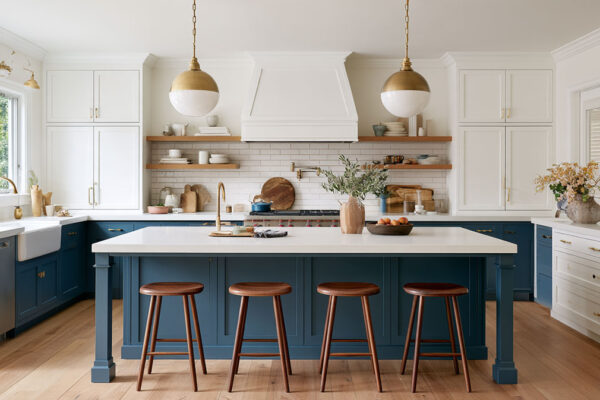
Navy is the safer of the two, and a closer look at blue kitchen cabinets over dark floors shows how much the exact shade matters. Benjamin Moore describes Hale Navy (HC-154) as a use-anywhere navy with a classic maritime feel. Homes & Gardens (2025) reports designers moving toward blues dark enough to read almost black.
Sage has its own momentum. Sherwin-Williams lists Sage (SW 2860) among its ten most popular colors as of October 2026. It’s also the better pick when the room has little daylight, because it stays lighter than navy.
Wood tones and two-tone cabinets

Keep a medium step between floor and wood cabinets. Houzz gives this rule for dark wood cabinets over lighter floors, and it applies in reverse when the floor is the dark element: cabinets go a few shades lighter than the boards.
Two-tone layouts follow the same logic. RTA Cabinet Store describes pairing two cabinet colors over dark wood in open-plan kitchens, and the NKBA 2025 Kitchen Trends Report says homeowners largely prefer an island in a different color from the main cabinets.
A second color adds interest, but it also adds one more undertone to match against the floor. Worth it if you’re confident about your samples. Not worth it if you’re guessing.
Dark cabinets on dark floors
Dark-on-dark works in large, bright kitchens and fails in small, dim ones.
A Houzz roundup of black kitchen schemes features dark stained floors with black cabinets and black trim, lifted by sculptural Tom Dixon pendants and a Carrara marble-topped island.
RTA Cabinet Store wants plenty of natural light first. Reflective surfaces like stainless steel and other metallic elements help, as do lighter countertops and lighter paint on the walls and trim. Wren Kitchens adds high ceilings to that list.
How floor undertone and finish shape the color match

Undertone sets the rules for the rest of the palette. Red-brown floors take warm whites and creams, gray-brown floors take cool grays, and near-black floors accept either. Finish decides how much glare and how many marks show.
Red-brown floors, like cherry or mahogany stain, go with warm white, cream and soft greige, and a cool gray fights the red. Neutral brown (walnut, espresso) is the most flexible base, and white, sage, navy and gray all sit well on it. Gray-brown, such as ash or weathered oak stained dark, wants cool gray or crisp white. Near-black or charcoal needs light cabinets for contrast, unless you’re committing to a deliberate dark scheme with strong light.
Undertone matching comes down to basic color theory: warm with warm, cool with cool, unless the contrast is deliberate.
The floor itself offers reference tones. RTA Cabinet Store notes that stained wood carries off-whites, beiges, grays, blondes and even black in its grain, and suggests picking cabinets from one of them.
Material changes how much there is to pull from. Hardwood and engineered hardwood vary plank to plank, so you get more tones to work with. Luxury vinyl plank repeats a printed grain, which reads flatter. Houzz’s 2025 study ranks vinyl and resilient flooring first for kitchens, narrowly ahead of hardwood and porcelain tile. Porcelain tile brings grout in as a second tone, and grout matched to the tile keeps the field calm.
Satin or matte finishes scatter light and show fewer smudges than gloss. Gloss on a dark floor mirrors the cabinets and windows, and every footprint with them.
Salvatori’s guide to stone floors says dark floors in small or poorly lit rooms call for light-colored walls and furniture, while spacious, light-filled rooms can take layers of dark shades. Its aim is to avoid a heavy, oppressive feel.
What wall color works in a kitchen with dark floors?
Light, warm neutrals, mostly. They sit far above the floor in value and return the light a dark floor absorbs. Light reflectance value (LRV) puts a number on this, running from 0 (absorbs all light) to 100 (reflects all of it).
Benjamin Moore Simply White (OC-117) sits at 89.52 and Sherwin-Williams Pure White (SW 7005) at 84. Benjamin Moore Hale Navy (HC-154) is down at 8.36. Those figures come from each brand’s own color page.
Both brands use the same 0 to 100 scale, so the numbers compare directly. Hale Navy sits near the bottom, and the two whites sit roughly 76 to 81 points above it, which is why the walls carry the brightness in a navy-and-dark-floor kitchen.
A Houzz color feature pairs black-stained timber floors and white cabinets with greige walls, a cosier choice than stark white. It also notes that lighter walls and ceilings over a dark floor make a room feel taller.
Sherwin-Williams calls Alabaster (SW 7008) a balanced white and named it its April 2022 Color of the Month. Warm walls like this look best when cabinets and trim are chosen around them, which this guide to colors that pair with Alabaster lays out.
The same logic carries into open-plan rooms next to the kitchen. A broader guide to wall colors that work with dark wood floors covers those spaces.
Countertops, backsplash and hardware for dark floors
The floor supplies the dark, so everything above it needs to bring the light and the accent. That means light countertops, a quiet backsplash and a metal finish or two.
Countertops

White is the most chosen main countertop color in Houzz’s 2025 study.
Quartz needs the least upkeep and comes in solid or veined light patterns, though Caesarstone’s care guide says sudden or prolonged heat can damage the surface and recommends trivets. Calacatta marble adds bold veining against a plain floor, and it etches from acids. With granite, pick a pale, fine-grained slab, since dark granite just piles on weight the floor already provides. Butcher block warms a cool palette and breaks up large light surfaces.
Backsplash tile
Rectangular tiles are the choice of 68% of homeowners in the 2025 Houzz Kitchen Trends Study.
That makes subway-style tile the default, and the grout color sets the contrast. Light grout keeps the wall quiet, while dark grout echoes the floor.
Subway is neutral and low-risk. Zellige adds movement through handmade glaze variation, and natural stone ties into granite or marble counters. With marble counters the tile choice shifts, and this guide to backsplash options for marble countertops covers the pairings.
Hardware and fixtures
Match the metal to the cabinet color first, then repeat one dark accent from the floor.
Brass is warm and the standard partner for deep blue and green cabinets. Navy with brass pulls is the pairing covered in this look at navy cabinets with brass hardware.
Rocky Mountain Hardware describes black hardware, whether matte black or an aged bronze, as the high-contrast choice on white cabinetry. Nickel and chrome are cooler, and they suit gray and white schemes.
Houzz suggests carrying the dark grout color into dark cabinet hardware and a black light fixture. The NKBA 2025 Kitchen Trends Report adds that homeowners are blending hardware finishes, so a second metal in one fixture is acceptable.
How lighting changes a dark-floor color scheme

Window direction and bulb color temperature shift every paint color in the room, and a dark floor gives little bounce to correct for it. Test cabinet and wall samples under both before ordering.
Natural light direction
North light is the weakest and the coolest, per Sherwin-Williams, which points to higher-LRV colors in these rooms. South light is warm and steady all day. Sherwin-Williams advises against very warm colors there, since neutrals read warmer and cool tones read more neutral. East and west are mirror images: east gets warm morning light and cool evening light, and west reverses it.
The window wall matters most over a dark floor, because the boards won’t throw daylight back into the room.
Bulb color temperature
Sources disagree on the right Kelvin number for a kitchen.
Energy Trust of Oregon says about 3500K for kitchens and work spaces, and 2700K for relaxing rooms. The Houzz guide suggests 3000K to 3500K when the home is full of cool colors such as black, blue, green and crisp white, and 2700K for evening use and traditional interiors.
The gap comes from what the room is for and what it’s painted. Behr’s VP of color, quoted by Homes & Gardens, notes that warm artificial light emphasizes yellow undertones, while bright white light brings out cooler tones.
So a warm off-white cabinet drifts yellow under a low-Kelvin bulb, and a cool gray goes flat under a high one. Pick one temperature for the whole room and check the samples again after dark.
Fixture placement
Pendants lead over-island lighting in Houzz’s 2025 Kitchen Trends Study, with two pendants (36%) narrowly ahead of three (35%), as reported by Home Accents Today.
Aim recessed fixtures at the walls and cabinet fronts rather than straight down. A dark floor absorbs most of what lands on it, so light that hits a wall comes back and light that hits the floor mostly doesn’t.
nobilia North America splits the layers into task lighting over prep areas, accent lighting for design details and ambient lighting for the overall mood.
To size the layers, a calculator for LED light requirements gives a starting fixture count for the floor area.
Do dark floors make a kitchen look smaller?
Not on their own. Dark floors lower the room’s average reflectance, so the outcome depends on wall and ceiling LRV, window area and ceiling height.
Sources split on how far to push it. Li-pra, an Italian flooring and wallcovering manufacturer, limits black or dark parquet-style floors to very large, well-lit rooms. Houzz’s color feature, cited in the wall color section, shows dark floors working under light cabinets with light walls and ceiling.
Both positions agree on the mechanism: a dark floor needs light surfaces and light sources above it. They differ on how much room that takes.
A rough test is to ask whether the room has a window on at least one full wall, walls and ceiling in the light-neutral range, and a ceiling of standard height or higher. Two yeses and dark floors are workable. Fewer than two and the limits in the section on when this scheme fails apply.
In a small kitchen, change things in this order: cabinets lighter first, walls second, floor last. The floor is the most expensive item to redo.
Light does part of this work, and the principle is covered in this piece on how light shapes a room.
Paint does the rest, and a list of colors that make a room look bigger shows which ones.
How to build the color scheme step by step
Start from the floor and work outward, since every other color gets judged against it. The most expensive and least flexible choices go first.
- Photograph the floor in daylight and at night, and note its undertone: red-brown, neutral brown or gray.
- Set the contrast level. Light cabinets for small or dim rooms, deeper colors only with strong light.
- Choose the wall color by LRV, then test it on the window wall and the opposite wall.
- Add a countertop and backsplash that bring light, with one patterned surface at most.
- Pick one metal finish matched to the cabinets, and repeat the floor’s dark tone once in a fixture or pull.
- Fix a single bulb color temperature, then recheck every sample after dark.
Benjamin Moore advises buying a sample and watching it through the day and evening, in both natural and artificial light. A room color scheme generator can preview combinations before any sample is bought.
For proportion, the 60-30-10 rule gives a dominant color 60%, a secondary color 30% and an accent 10%. In a dark-floor kitchen the floor usually anchors the 30%, so walls and cabinets split the 60 and the hardware, tile or textiles take the 10.
Once the wall color is final, a room paint calculator converts wall area into gallons.
When a dark-floor color scheme does not work
A kitchen with no window on a full wall can’t carry dark floors and dark cabinets together, so go light on the cabinets or change the floor.
If the floor is about to change, an undertone-specific palette fails the day the boards are refinished or replaced. Hold off on the cabinet and wall colors until then.
Open plans cause a different problem. Where a dark kitchen floor meets a lighter floor, the step in value reads as a line across the room, so the cabinet and wall colors need to bridge both floors.
And in a kitchen that’s both small and dim, every dark surface compounds the last one. That’s the case for reversing the scheme.
Li-pra describes the reverse: dark cabinets over a light floor, which it says suits small spaces where the room should not visually close in. The same company adds that dark cabinet fronts hide fingerprints and marks better than white ones.
That is the one case where the obvious scheme loses. If the room is small, dim and has dark floors you cannot change, lighter cabinets will not solve it and deeper ones may.
FAQ About Kitchen Color Schemes With Dark Floors
Do dark floors show more dirt than light floors?
Yes, for light-colored debris. Dust, crumbs and pet hair stand out against dark boards, while light floors show mud and dark debris more.
A satin finish and a microfiber mop keep the floor presentable between deep cleans.
Which paint sheen suits kitchen walls over dark floors?
Satin is the usual pick. It returns slightly more light than flat paint and wipes clean near the stove and sink.
Sheen is separate from LRV, so check both before choosing a color.
What ceiling and trim colors go with dark floors?
Keep both light. A crisp white on the ceiling and trim gives the walls a clean edge and carries brightness above the floor.
Warm walls can make a cool white trim read bluish, so sample the pair side by side.
How should a rug or runner be chosen for a dark kitchen floor?
Pick a medium-toned rug in a warm neutral, which steps down the contrast between the boards and light cabinets. For ideas, see these rug colors that suit dark wood floors.
On wood, the National Wood Flooring Association advises a breathable area rug in front of the sink and stove. Walk-off mats at doorways keep grit off the finish.
What to Change First When the Floors Stay
With kitchen color schemes built around dark floors that aren’t going anywhere, change the cheapest reversible things first. Bulb temperature goes first, then wall paint at a higher LRV, then cabinet paint, and only after that counters and hardware.
Each step also tests the next one. Bulbs and walls show whether the cabinet color needs to change at all.
Houzz’s July 2025 survey puts median spend at $20,000 for a minor kitchen remodel and $55,000 for a major one, which is why replacement belongs last.
A home renovation cost calculator turns the remaining budget into line items before any paint is bought.
The catch is that the floor’s undertone stays a fixed constraint on every choice until the boards are refinished or replaced.
This order was verified in October 2026. A new or refinished floor changes that undertone and restarts the sequence.
More Kitchen Color Guides
- Kitchen color schemes with grey floors
- Kitchen color schemes with black appliances
- White kitchen floor ideas
- All kitchen color schemes by cabinet color

- Kitchen Color Schemes by Cabinet Color: What Pairs Well - October 19, 2026
- Curtain Colors for Every Wall Color: Safe vs Bold Picks - October 18, 2026
- Interior Design Styles: Find Your Primary and Secondary - October 14, 2026