Fireplace Decor
Cozy Coastal Fireplace Ideas to Transform Your Living Room
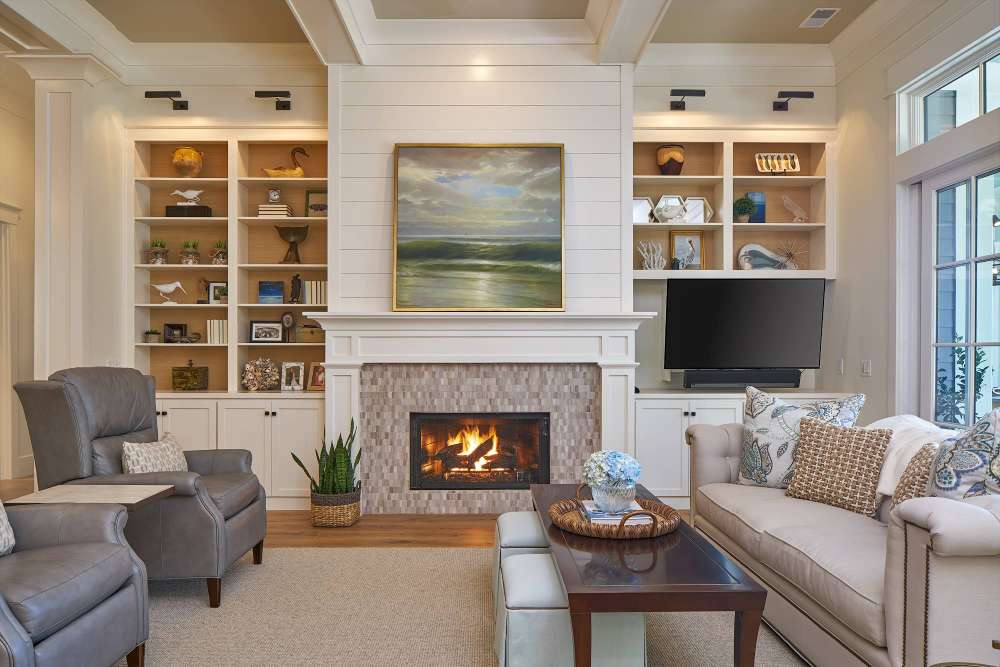
Salt air gets less attention than it should when people plan a coastal fireplace. According to Bromic’s coastal corrosion guidance (2021), it can affect metal structures more than 50 miles inland, so a house doesn’t have to sit on the sand to have the problem.
The look itself is easy to describe. A light, textured surround in whitewashed brick, shiplap, limestone or stacked stone, a raw wood mantel, and a sealed gas or electric unit cover most of it. Cottages, shingled Cape Cods and glass-fronted new builds all draw on the same materials, adjusted for how close the house sits to the surf.
Durability decides more than style does. A finish that peels in damp air or a burner that corrodes in salt spray fails no matter how good it looked in the photos.
Which coastal styles work for a fireplace?

Hamptons, Cape Cod, modern coastal, coastal farmhouse and rustic beach house cover most coastal fireplaces, and they differ mainly in how the surround, mantel and finish are handled.
- Hamptons rooms go for a painted or marble surround under a classic white mantel, with some limestone detail.
- Cape Cod keeps it plainer. White trim, a simple shelf, brick or plaster behind.
- Modern coastal puts a raw wood mantel on top of a marble or plaster surround.
- Coastal farmhouse means shiplap, a reclaimed beam and a black firebox.
- Rustic beach houses use stacked stone and exposed wood, with very little paint.
The wider practice of coastal interior design supplies the common base, which is light walls and natural texture with little ornament.
The boundaries blur in real rooms. Hunker’s coastal roundup pairs a time-worn brick surround with a terra cotta tile threshold for a Mediterranean feel, and a marble surround with a raw wood mantel for a modern one.
Cape Cod belongs in houses that already have the bones. The style comes from 17th and 18th century Massachusetts, and its floor plans traditionally center on one large chimney (Century 21, James Hardie).
In a shingled cottage, the white trim and plain shelf of traditional Cape Cod interiors look right. In a glass-fronted new build they look like a costume.
What are the best surround materials for a coastal fireplace?

Brick, stacked stone, shiplap, tile and limestone all fit a coastal room, and the choice turns on moisture. Porous masonry needs a breathable finish or a sealer, while wood cladding needs distance from the firebox.
| Material | Coastal look | Upkeep | Best style match |
|---|---|---|---|
| Limewashed or painted brick | Soft white, visible texture | Limewash breathes, paint can trap moisture | Cape Cod, coastal farmhouse |
| Stacked stone | Rough, layered, natural | Hardwearing, seal if porous | Rustic beach house |
| Shiplap | Clean white lines | Repaint as needed, keep back from the opening | Coastal farmhouse |
| Tile | Glossy or matte color | Grout lines need cleaning | Cape Cod, modern coastal |
| Limestone | Pale, matte, quiet | Porous, so it needs a sealer | Hamptons, modern coastal |
Brick is where most people go wrong. Angi’s finish comparison explains that limewash soaks into the masonry and lets moisture escape, while whitewash and standard paint sit on top and hold it in.
Trapped moisture shows up later as peeling. On a wall that already deals with damp air, that can mean repainting well before the finish should have worn out.
Limestone looks right and stains easily. Custom Building Products’ 2021 data sheet for its StoneSpecific sealer describes honed limestone and travertine as highly susceptible to staining, so the sealer goes on before the first fire.
White shiplap is the fastest route to a coastal farmhouse look, and a farmhouse shiplap fireplace translates to a beach house with only the paint color changed. Wood cladding is combustible, so it stays back from the opening.
Terra cotta tiles bring warmth to rooms where white starts to feel cold. A hearth threshold is the low-risk place to try them.
One documented case is a Boca Raton fireplace. Innovative Design Build kept the footprint and firebox, then replaced the surround, hearth and mantel with a traditional brick pattern in creamy colors, laid out in a multi-format design (Houzz project notes). The texture of the surround did the coastal work.
Which color palette suits a coastal fireplace wall?

Start with white or sand as the base and add a single cool accent. Navy and sea glass green are the usual picks, and driftwood gray works when the mantel is weathered wood. Stay in that range and the fireplace reads coastal in any light.
White goes on the surround and trim. Sand warms a white wall without turning it yellow.
Navy works best in small doses, like built-ins or one wall. Sea glass green keeps things open, and Sherwin-Williams lists Sea Salt (SW 6204) at an LRV of 63 on its 0 to 100 reflectance scale, which is light enough for that job. Driftwood gray ties the wall to a weathered wood mantel.
The firebox interior counts too. A black or soft beige box gives a plain surround some contrast, according to A Blissful Nest.
Anything painted inside or right beside the opening needs a heat-rated product. The can states the temperature limit.
Warm whites turn creamy next to a flame, and cool whites go flat gray at dusk. The undertone logic behind that comes from the basics of color theory in interior design, and a sample patch on the wall settles it faster than reading about it.
If the wall and furniture are still undecided, run a few combinations through a room color scheme generator before buying sample pots.
How to style a coastal mantel

A few larger pieces beat a row of small ones. A round mirror or a single beach landscape above the shelf does most of the work, a woven basket or a length of rope adds texture, and one soft gold or brass accent is plenty. Driftwood or a reclaimed beam can serve as the mantel itself.
Reclaimed wood is the staple coastal mantel material, and a weathered beam sits well over a white or stone surround. A Blissful Nest shows a white mantel carrying a round mirror, a woven basket and soft gold accents.
Clearances matter here. IRC section R1001.11 keeps combustible mantels and trim at least 6 inches from a masonry fireplace opening. Within 12 inches, they can project only 1/8 inch for each inch of distance, as the Journal of Light Construction explains.
At 8 inches from the opening, that means trim projecting 1 inch or less. Local code and the unit’s installation manual set the final numbers, and factory-built units follow their listing.
Candles, art and adhesive follow the same logic. Hunker’s seashell mantel project uses high-heat cement as the adhesive, and anything glued near the firebox should carry a heat rating.
Coastal versus nautical decor

Coastal decor takes its color and material from the shore. Nautical decor is more literal, with objects like anchors and ship wheels.
Hunker’s roundup tells readers to skip the nautical motifs and seashells at every turn in favor of a laid-back, cozy scheme. That advice holds on a mantel, where every object sits at eye level.
Layering texture carries the beach feel without a single anchor. Two or three of linen, jute, weathered wood and rough stone are enough, and the page on texture in interior design covers how to balance them.
Wood, gas, electric or bioethanol: which fuel type fits a beach house?
Direct-vent gas fits most beach houses: sealed combustion, no creosote, no wood to keep dry. Electric suits rentals and small rooms, wood-burning suits owners who book a chimney sweep every year, and bioethanol needs a large, well-aired room.
| Fuel | Venting | Upkeep | Beach house fit |
|---|---|---|---|
| Wood-burning | Chimney or flue | Annual sweep, dry storage | Full-time homes |
| Direct-vent gas | Sealed, exhausts outdoors | Professional service | Most coastal homes |
| Electric | None | Almost none | Rentals, small rooms |
| Bioethanol | None | Refueling, room airing | Large rooms, occasional use |
Wood-burning gives real flame and real heat with no gas line or power needed. The price is a chimney that has to be built and inspected, plus dry fuel to store somewhere. Soot on a pale surround is a nuisance too.
Direct-vent gas has the cleaner story. Regency’s guide explains that the sealed chamber takes combustion air from outdoors and exhausts outdoors, which also means no creosote and no ash. It does need a vent route to the outside and a gas line.
Electric plugs into a standard outlet and needs no venting at all. It only supplies supplemental heat, though, and the flame is a simulation.
Bioethanol skips the flue and the chimney work, so it is easy to place in a new layout. It adds water vapor and carbon dioxide to the room, and the fuel needs safe storage.
Electric output is modest but real. Napoleon’s Element 42 built-in delivers up to 5,000 BTU on a 120 V plug, rated for 400 square feet, and up to 10,000 BTU hardwired at 240 V, rated for up to 800 square feet.
Tight rooms need proportion more than power, and fireplace ideas for a small living room cover how to size the surround to match.
Bioethanol has the strictest room requirement of the four. EcoSmart Fire’s ventilation guide, citing UL 1370, sets the minimum at 200 cubic feet (5.7 cubic meters) of room air per 1,000 BTU/hr of burner output.
The same guide notes that clean combustion produces carbon dioxide and water vapor, and its reference list includes a 2025 peer-reviewed burner study that measured carbon monoxide and nitrogen oxide emissions that differ with burner design. Ventless means no flue. It does not mean no moisture, which matters in a house that already runs humid.
For a house that sits empty between weekends, pick electric or direct-vent gas. Wood rewards owners who are there to tend it.
What works for an outdoor coastal fireplace or fire pit?

A gas burner in a fixed masonry or metal pit is the practical choice for a coastal patio or deck. No embers, no ash, no firewood to keep dry. Check the local rules before choosing the form, because some beaches ban the pit itself.
Cape Cod National Seashore shows how strict it gets. The National Park Service prohibits portable fire pits of all kinds on seashore beaches and limits campfire permits per beach per day.
A backyard is a different jurisdiction, and the town sets the burn rules. Ask before building.
A stone or limestone surround around a gas burner suits a covered patio. On a deck or terrace, a linear metal gas pit with fire glass makes more sense, and a low masonry fire ring on grade works if it stays away from dune grass.
Form is a style call, and modern outdoor fireplace ideas are worth browsing once fuel and rules are settled.
A roof over the seating changes the clearance question, so pick the unit before the structure. A backyard pavilion is one option for the cover.
Corten looks right on a coastal patio, but The Outdoor Plus warns that weathering steel is not ideal where salt-laden air, humidity or persistent fog stop its protective layer from forming.
How does salt air affect a coastal fireplace?
Salt spray, humidity and fog speed up corrosion on exposed metal, so a coastal fireplace needs 316-grade stainless hardware and breathable finishes on masonry. The effect weakens with distance from the water.
Reach is the part that surprises people. Bromic puts it at more than 50 miles inland for metal structures, and says wind speed and direction, coastal topography and wave height decide how far salt travels in a given spot.
The grade of stainless matters because of molybdenum. Bromic notes that 316 carries 2% to 3% of it, the addition that lifts its corrosion resistance above 304.
Standards put numbers on the exposure. ISO 9223:2012 rates many tropical coastal sites with chloride exposure as C5, “very high,” and areas with occasional salt spray as CX, “extreme” (pv magazine USA, 2026).
Metals and fasteners
A conference paper in the Atlantis Press series exposed 304 and 316L stainless to the marine atmosphere of the South China Sea. The 316L showed fewer and smaller pits.
Retail specs tell a different story. The Outdoor Plus lists 304 stainless burners on pits sold for outdoor use, while Bromic says 304 performs well inland and 316 resists corrosion better at the coast.
The disagreement is about distance. Oceanfront decks call for 316, and houses set back from the surf have more room to choose.
Fasteners undo good metal. The pv magazine USA piece notes that a 316 enclosure can still fail when installed with plated-steel screws, incompatible fittings or supports that deteriorate first, so match screws, brackets and trim to the grade of the unit.
Bromic adds that coastal sites need a more intense maintenance routine than inland ones. Skip painted mild steel anywhere salt reaches.
Stone, brick and paint
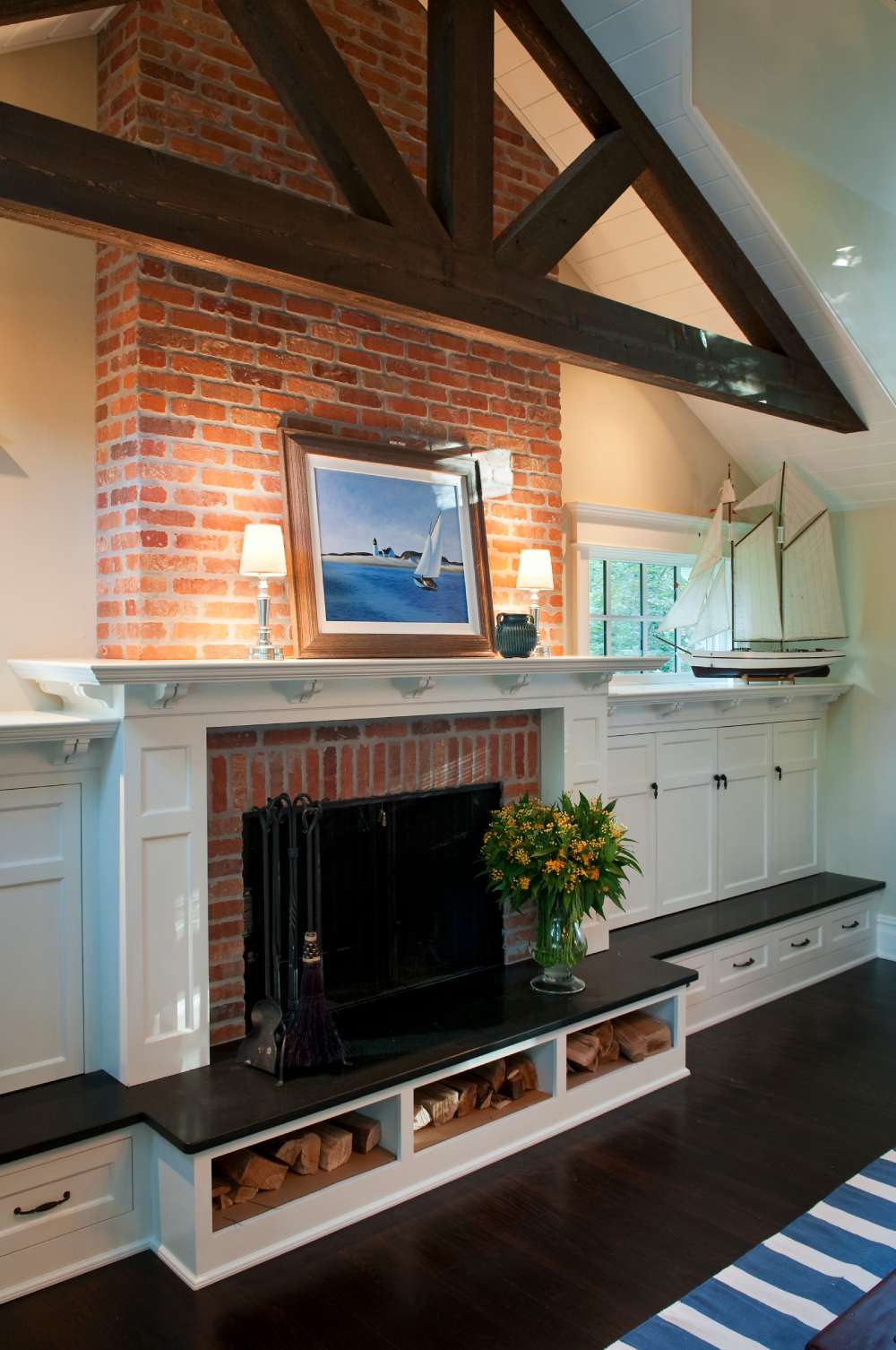
Salt travels in moisture, so masonry finishes have to let vapor through. Breathable penetrating sealers list efflorescence and salt spalling among the problems they address, according to the Chemforce Stain Protector data sheet from Haus Collective.
A film-forming coat holds in what a breathable sealer lets out. Follow the product data sheet for the re-sealing interval.
Not every beach house needs the full treatment. A home set back behind dunes sees less salt than an oceanfront deck, and the corrosivity class depends on the site.
What clearances, inspections and listings does a coastal fireplace need?
The appliance needs a recognized listing, the chimney needs a certified sweep every year, and local permits have to match the fuel. Skip any of it and an inspector or insurer will find the gap first.
- Read the appliance label for its listing and keep the installation manual.
- Ask the local building department what permit applies, especially before switching fuel.
- Book a Level I inspection with a CSIA-certified sweep before the first fire of the season.
- Move to Level II when anything changes: a new appliance, a fuel switch, a property sale, or a storm or fire that could have damaged the chimney.
- File the inspection report with the manual.
Listings are the quickest filter. UL 127 is the standard for factory-built fireplaces, and ANSI Z21.88 with CSA 2.33 covers vented gas fireplace heaters.
Gas appliances follow the National Fuel Gas Code (ANSI Z223.1 and NFPA 54), while NFPA 211 governs chimneys, fireplaces, vents and solid fuel-burning appliances.
NFPA 211 defines three inspection levels. The Chimney Safety Institute of America describes Level I as the routine annual check, where the sweep verifies that the chimney is sound and free of obstructions and combustible deposits such as creosote.
Level II adds attics, crawl spaces and basements, and it applies when a new appliance goes in or the fuel changes. Level III opens concealed areas when a lower level suggests a hidden hazard.
That fuel-change trigger links back to the choice between wood and gas. Swapping a wood-burner for a gas insert is not a cosmetic update, so budget for the inspection and the permit with it.
Coastal Fireplace Ideas FAQ
How much does a coastal fireplace makeover cost?

Scope sets the price more than style. A paint or limewash refresh stays small, while a new surround and mantel is a remodel, and a new gas or ethanol unit adds venting, gas lines and permits.
A home renovation cost calculator gives a starting range once the scope is fixed.
Can you paint or whitewash a brick fireplace?

Yes, once the brick is primed. Brick is porous, so Angi advises a masonry primer first, then an angled brush for the mortar lines and a high-density roller for the faces.
Limewash is the breathable option for a washed look.
Does a coastal fireplace work in a landlocked home?

Yes. HGTV notes that coastal style works whether the home is seaside or landlocked, and the salt-air hardware concerns drop away.
Keep the palette and textures of white, sand, driftwood gray and reclaimed wood. Bromic says 304 stainless performs well inland.
Can a TV go above a coastal fireplace?

Yes, when the unit’s manual allows it and the wall stays cool. Heat damage to a TV mounted above a fireplace can void its warranty, according to Bob Vila.
Millwork doors can hide the screen, and the steps for how to hide TV wires over a brick fireplace cover the cables.
Do corner fireplaces suit a coastal living room?

Yes. A corner unit frees the long walls for windows and water views.
Keep the surround light and the mantel simple so the corner does not feel heavy.
Keeping a Coastal Fireplace in Shape After the First Year
A coastal fireplace needs a short yearly routine, and the order matters because safety work outranks cosmetic work. The Level I chimney inspection comes before the first fire. The hardware and fastener check follows storm season, and a humidity reading in the hearth room is worth taking whenever the weather turns.
Humidity sets the limit for ventless units. The EPA advises keeping indoor relative humidity below 60%, ideally 30% to 50%, and notes that unvented combustion appliances add water vapor.
EcoSmart Fire confirms that bioethanol burners release water vapor into the room, so a ventless unit in a humid beach house uses up margin under that ceiling.
Direct-vent gas trades the crackle of a wood fire for sealed combustion and no ash, and electric trades it for no combustion at all.
As of October 2026, the 2024 edition of NFPA 211 sets the inspection levels, and a newer edition could change the triggers. Once the hearth is settled, furniture arrangement around the fireplace decides how the room gets used.

- Kitchen Color Schemes by Cabinet Color: What Pairs Well - October 19, 2026
- Curtain Colors for Every Wall Color: Safe vs Bold Picks - October 18, 2026
- Interior Design Styles: Find Your Primary and Secondary - October 14, 2026


