Home Decor
The Most Interesting Kitchen Color Schemes with Cherry Cabinets

Cherry cabinets are rarely the part of the kitchen you get to change, so the colors around them have to do the work. Warm whites and greige blend with the wood, and taupe or pink-beige takes some of the red out. If you’d rather lean into it, sage, olive, deep green and navy push the red forward instead.
Which one fits depends on the red or reddish-brown undertone of your cherry and the depth of the stain. Honestly, the daylight in the room matters just as much.
Wood finishes are having a good run, which helps. Houzz’s 2026 U.S. Kitchen Trends Study found wood overtaking white as the most popular cabinet finish in renovated kitchens, at 29 percent versus 28 percent.
Cherry belongs to that category. Whether it reads current or heavy mostly comes down to the colors sitting next to it.
Our kitchen color schemes guide compares wood with green, grey, blue and white cabinets.
Which kitchen color schemes work with cherry cabinets?

Warm whites, cream, taupe and greige blend with cherry cabinets. Sage, olive, deep green and navy push the red forward.
Every scheme that works does one of those jobs. It blends with the cherry, softens it or highlights it. Decide which one you’re after before you buy a single sample, and the pile of paint chips shrinks fast.
The 60-30-10 rule keeps any of these balanced. It gives 60 percent of the room to a dominant color, 30 percent to a secondary one and 10 percent to accents.
In most cherry kitchens the walls carry the 60 and the cabinets the 30. Hardware, backsplash or barstools take the 10.
Blending in
Blending keeps the whole room in one warm family. Cream and warm white share cherry’s warmth, so the wood reads as part of the room instead of a block of red.
Warm white or cream walls do most of the work. Brass or oil-rubbed bronze hardware keeps the metal in the same family, and a lighter wood accent, like a butcher block counter or an open shelf, rounds it out.
Homes and Gardens notes in its 2026 coverage of the cherry revival that warm whites suit cherry the same way they suit oak and walnut.
Softening the red
Softening tones the red down without painting over the wood.
Jenna Kate at Home points to taupe, warm gray and pink-beige undertones for this job. Paints that share the cabinets’ undertone make the wood blend in instead of stand out.
The safest full palette is greige, taupe, cream and chrome. Style by Emily Henderson says it works whether the wood leans brown-red or runs closer to cherry-soda red.
Pushing the red forward
Green and blue-green sit opposite red on the color wheel, so they make cherry look richer instead of quieter. Basic color theory explains the pull: opposite hues intensify each other.
This route suits larger kitchens with plenty of natural light, because dark colors absorb it. Hunker’s general rule is that brighter rooms can carry darker colors, while rooms with little natural light suit lighter ones.
In a small or dim kitchen I’d skip it, or keep it to an accent wall. An accent wall holds a dark color at a manageable scale there, which is how Hunker handles black in smaller kitchens.
How cherry undertone, stain depth and aging change the palette
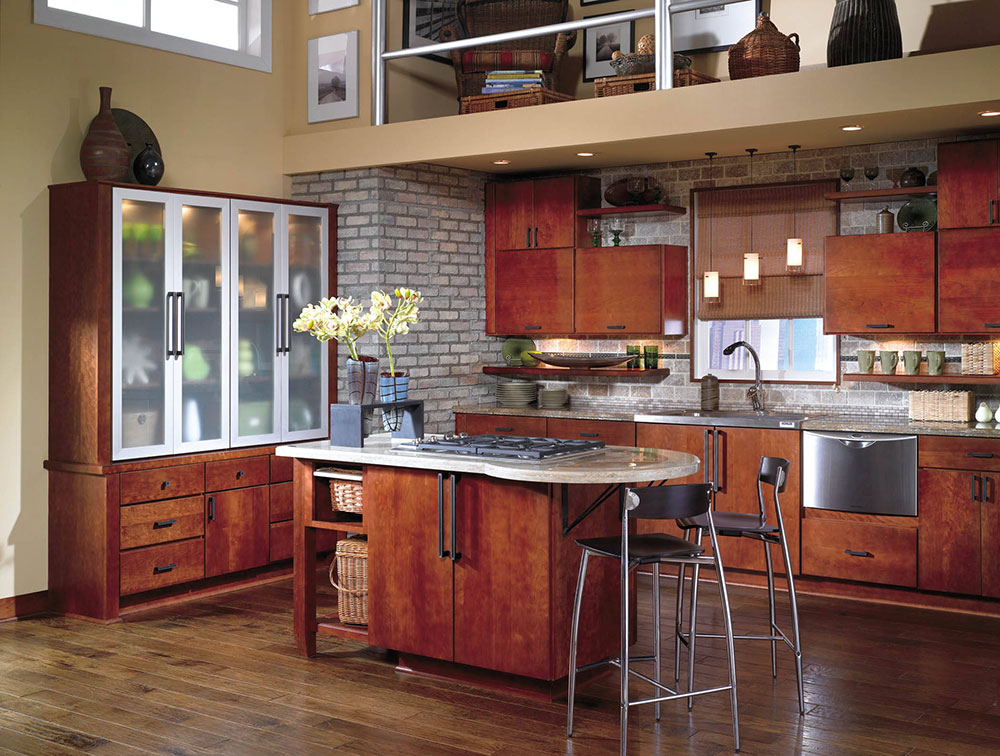
Cherry starts pink-salmon and deepens to red-brown with light and age, most of it in the first year. The right wall color depends on the stage your wood is in today. Stain depth then decides how much light the room loses to the cabinets.
Undertone
Freshly milled black cherry (Prunus serotina) heartwood ranges from light pink to dark red-brown, according to Purdue University’s hardwood guide.
Finished cabinets sit at the warm end of that range. Jenna Kate at Home describes the typical undertone as warm red or reddish-brown.
That undertone is why green and gray-green read as contrast. It is also why orange-based or yellow-heavy walls pile warmth on warmth.
Stain depth
Depth sets how much light the cabinets take out of the room.
Natural or light stain keeps things bright and open, and it puts up with strong wall colors better than anything else. Medium stain has the widest range, from warm white to sage to navy.
Dark stain is the heavy one. It needs light walls, a lighter floor and good daylight.
Hunker’s paint guidance points the same way as before: little natural light suits lighter colors, and brighter rooms can carry darker ones.
How aging shifts the scheme
Cherry darkens fastest in its first year, with about 80 percent of the total change arriving in the first six to twelve months, according to the Thos. Moser furniture journal. The color keeps developing for decades, only more slowly.
American Woodmark’s cabinet guidance adds that any light source counts, light bulbs included. Exposed doors can darken faster than shaded ones, and replacement doors start lighter before catching up.
So match paint to the cabinets as they look today, and expect the contrast with the wall to shift as the wood deepens.
The table below is my working rule, built from the aging notes above and the lighting advice earlier.
| Cherry stage | Palette direction | Wall family | Why |
|---|---|---|---|
| New, light cherry (first year) | Flexible base | Warm white, soft greige | The wood will deepen, so a tint matched to pale salmon drifts out of balance |
| Aged red-brown (several years) | Widest range | Sage, olive, navy, taupe | The red has settled toward brown, so greens and blues read as contrast |
| Dark stain or dark cherry | Lighter, warmer surround | Warm white, light greige | Dark wood absorbs light, so the walls and floor have to give some back |
Best wall colors for cherry cabinets
Sherwin-Williams Alabaster covers the warm white job, and Benjamin Moore Revere Pewter is the greige. Sherwin-Williams Evergreen Fog gives a muted sage, while Benjamin Moore Hale Navy is the dramatic pick. Between them they handle most cherry kitchens.
Light reflectance value (LRV) shows how each one behaves in a room. It runs from 0 for absolute black to 100 for pure white, as Benjamin Moore defines it.
| Paint | LRV | Role | Light conditions |
|---|---|---|---|
| Alabaster (Sherwin-Williams) | 82 | Blend | Reads warm and creamy |
| Revere Pewter (Benjamin Moore) | 55.51 | Soften | Shifts gray to beige with daylight |
| Evergreen Fog (Sherwin-Williams) | 30.4 | Highlight, muted | Darkens as daylight fades |
| Hale Navy (Benjamin Moore) | 8.36 | Highlight, bold | Needs strong natural light |
LRV figures are taken from each maker’s own color page as listed in October 2026.
Warm whites and neutrals

Alabaster sits at the light end with an LRV of 82. That is why it brightens a kitchen the cabinets would otherwise close in, and it leaves the cherry as the only strong color in the room.
Revere Pewter lands mid-scale, and Benjamin Moore calls it a light gray with warm undertones. A greige reads differently as daylight shifts, so test it on the wall that gets the least sun.
For trim, ceiling and an accent color, the shades that pair well with Alabaster are worth a look.
Greens

Sage and olive are the classic complement to cherry. Style by Emily Henderson builds one palette from sage, burgundy, natural wood and brass.
Evergreen Fog is a gray-green that reads muted, and its LRV of 30.4 makes it look deeper as daylight fades. Deeper greens work where there is daylight to carry them, and Homes and Gardens shows saturated hues pairing well with cherry.
For accents, rugs and window treatments, the colors that sit well beside sage green make a good starting list.
Blues and navy

Hale Navy has an LRV of 8.36 according to Benjamin Moore, which makes it the darkest wall choice in this guide.
Hunker says black works best in larger kitchens with ample natural light and suggests an accent wall in a smaller one. For navy, it advises balancing the moodiness with bright elements such as white cabinets, or painting only the lower half of the walls.
Softer routes exist too. Dusty blue with walnut and cream is another of Emily Henderson’s cherry palettes.
Grays
Warm gray shares cherry’s undertone and softens the red, which fits Jenna Kate at Home’s advice to stay with taupes and warm grays when blending.
A gray with a blue base sets up a hard temperature split against the wood. Light gray works when the aim is depth and contrast, as long as it leans warm.
Countertop and backsplash colors that pair with cherry
Cream or warm white quartz, black granite, soapstone and butcher block all work beside cherry. The rule is to match its warmth or contrast with it, and never compete with the red.
Homes and Gardens shows black countertops against cherry cabinetry in its 2026 coverage of the cherry comeback.
Countertops

Granite works best with brown, black or cream movement. Skip slabs with strong red veining, which echo the cabinets and flatten the contrast.
Quartz in an even cream or warm white gives a calm base. Soapstone is dark and matte, so it deepens the contrast. Butcher block adds a warm wood layer, though it works best in a lighter tone than the cabinets.
White counters with a slab backsplash make the lighter route. Jenna Kate at Home shows that pairing in a bright, modern cherry kitchen.
Backsplash

The backsplash is where a new color enters the room. A designer quoted by Homes and Gardens suggests bringing it in through the tile or a tall run of cabinets.
Neutral subway tile or a stone slab keeps the cabinets as the focus. Neutral zellige squares add texture, as in the black-countertop kitchen Homes and Gardens features.
For high contrast, use a colored tile in sage, blue or green and keep the wall quiet.
Black granite narrows the options, and this guide to choosing a backsplash for black granite covers those pairings.
What floor color goes with cherry cabinets?
Pick a neutral floor that is visibly lighter or darker than the cabinets. Gray, beige, white tile and a clearly different wood all separate from cherry.
A floor close to the cabinet tone merges with it and flattens the room. It ends up reading as one more red-brown surface instead of a base.
- Gray or beige tile
- White tile
- Light wood or wood-look plank
- Terracotta, with a cool wall to balance it
Dark floors give strong contrast, but with dark stain they cut daylight fast, so keep the walls light. These palettes that work with dark kitchen floors show how to balance that.
Gray floors give the cleanest separation, since gray stays out of cherry’s red range. Kitchen palettes built around gray floors show which wall and counter colors sit best above them.
Warm floors call for cooler or neutral walls, according to Jenna Kate at Home. That stops the floor and cabinet warmth from stacking on a warm wall.
Hardware, appliance finishes and lighting for a cherry kitchen
Brass, unlacquered brass and oil-rubbed bronze keep a cherry kitchen warm, while polished nickel, chrome and black cool it or sharpen it. Stainless steel is the neutral appliance finish.
Bulb temperature decides how red the cabinets read after dark.
Hardware finish
Brass and unlacquered brass give a golden counterpoint to the red, and they’re the quickest way to modernize the wood. Oil-rubbed bronze sinks into the wood tone for a quiet, traditional look.
Polished nickel and chrome are cooler accents, with polished nickel the warmer of the two. Black gives the sharpest contrast against red wood.
For the black route, this look at black hardware on wood cabinets shows how far to take it.
Sources split on brushed nickel. Houzz’s 2026 kitchen study of 1,780 homeowners (surveyed July 2025) found it the most popular hardware finish at 28 percent, ahead of black at 18 percent and brushed gold at 12 percent.
Style by Emily Henderson advises against it for cherry kitchens because it gives the room a “landlord” feel, and points to polished nickel, chrome, unlacquered or polished brass, or oil-rubbed bronze instead.
NKBA’s 2024 Kitchen Trends Report points warmer still, with 49.5 percent of surveyed kitchen and bath professionals expecting gold to be the top faucet color over the next three years. On cherry, brass or bronze earns its cost, and brushed nickel works only when the rest of the room carries the warmth.
Appliances are simpler. Stainless steel is chosen by 72 percent of renovating homeowners in the same Houzz study, and white and black appliances each draw fewer than 10 percent.
Against cherry it adds a cool neutral without competing with the red. Emily Henderson’s advice is to match the appliances as closely as possible so the eye has fewer variations to resolve.
Lighting
The U.S. Department of Energy classes 2700 to 3000 K as warm light and recommends 2700 to 3600 K for most indoor general and task lighting.
On the Kelvin scale, the low end of that range deepens cherry’s red and the high end mutes it. Pick one temperature for the whole kitchen, because mixed bulbs make the cabinets read as two different reds.
The same agency rates color rendition as a more important lighting quality than color temperature, which matters for a wood with this much color range.
North light cools a wall and south light warms it. For the wider picture, see how light in interior design shapes color and mood.
Full kitchen palettes for cherry cabinets, compared
The palettes below run from lowest risk to highest, and each one says which cherry stage it suits.
Greige, taupe, cream and chrome
Greige on the walls and seating reads current without a strong hue. A creamy backsplash tile repeats its tone in the shade and the light fixture, and polished nickel or chrome handles the hardware.
A darker neutral rug and walnut shelving anchor everything, so the lighter picks never sit in hard contrast with the wood.
This one works at any stage of cherry and is the first choice for dark stain.
Sage, burgundy, natural wood and brass
Restraint makes this one work. Burgundy appears in one small moment, a curtain or a rug, so the red cabinets read as a choice instead of an accident.
For the fabric, the shades that pair well with burgundy narrow the options quickly.
Meet West Studio’s kitchen, featured by Style by Emily Henderson, pairs warm wood cabinets with a terra-cotta floor, a mahogany vintage island and sage from the countertops up.
It suits aged red-brown cherry over a warm floor.
Olive, ochre, blonde wood, cream and brass

Olive carries a yellow undertone and ochre adds an orange-gold, so this palette runs warmer than the sage version.
Sources disagree on white. Homes and Gardens favors warm whites with cherry, while Style by Emily Henderson steers away from bright white here and prefers a cream that stays non-yellow.
White oak or another blonde wood works as the second wood, with polished brass pulls and knobs. Textiles set the era, so a floral curtain reads cottage and a plain linen shade reads modern.
Go with this one for cherry in a kitchen with strong daylight, since the yellow undertones need light to stay clean.
Dusty blue, walnut and cream
The lighter version uses milky white walls, dusty blue in a small offset tile stack and a walnut barstool for a contemporary read.
Heidi Caillier Design’s kitchen goes deeper with a slightly greener slate blue, which shows how far the palette stretches. Milk glass pendants and a brass rail make it ornate, and plainer fixtures keep it contemporary.
Gray stone counters or a gray and white marble checkerboard floor tie the blue back to the cherry. It suits aged red-brown cherry.
Charcoal, sage, cream and walnut
Charcoal grounds the room and sage lifts it.
Cream carries the trim, counters and ceiling, and walnut adds a second wood that sits darker than the cherry.
That darker wood is the risk, because two dark woods in one dim kitchen read heavy. Medium cherry in a bright kitchen is where this one belongs.
Navy or charcoal walls with warm lighting
This is the highest-risk palette, and it only works with a plan. Put warm bulbs on every fixture. Keep the counters light so the dark wall is the only heavy surface, and add a pale floor that bounces light back up.
For trim, stools and rugs, the shades that sit well with navy blue cover the supporting cast.
Use it with aged red-brown cherry in a large, bright kitchen. Skip it with dark stain in a small one.
Which colors clash with cherry cabinets?
Orange-based walls, green-leaning beiges, cream that reads yellow, yellow-toned floors and a crowd of one-off colors all clash with cherry. The table gives a simple swap for each.
| Clash | Why it fails | Swap |
|---|---|---|
| Beige or tan with a green or yellow read | Goes flat and muddy beside the red | Taupe or pink-beige |
| Orange-based or yellow-heavy wall paint | Stacks warm on warm | Warm white or a gray-green |
| Cream that reads yellow in your light | Makes the room look tea-stained | A non-yellow cream, tested on site |
| Gray-washed or yellow-toned wood floor | Looks dated against the cabinets | A plain neutral floor |
| Many one-off colors | Leaves the eye too many variations to resolve | Repeat one color on stools, shelves and chairs |
Gray tile separates from cherry cleanly. A gray-washed wood plank is a different story, and Style by Emily Henderson lists it among the floors to avoid.
Sources disagree on Grant Beige, the beige Jenna Kate at Home flags as flat beside cherry. She reads a green undertone, Kylie M Interiors reads yellow-green, Benjamin Moore calls it an equal mix of gray and beige, and independent color databases list it as orange, red or warm yellow.
The lesson holds either way. A beige’s undertone is a reading, so test it against the wood.
Small kitchens leave little margin for any of these mistakes, so the best colors for small rooms make a safer starting list.
How to test a color scheme before painting
Paint 2 or 3 large sample boards, hold them beside the cabinets, and watch them in morning, afternoon and evening light for several days before buying paint.
A room color scheme generator can narrow the shortlist to those 2 or 3 candidates first.
- Settle the surfaces first: floor, counters and backsplash, then lighting, with paint last.
- Paint 2 or 3 coats on poster board or foam core instead of the wall, so the old color cannot show through.
- Make the boards large, and tape them beside a cabinet door and the trim on at least two walls.
- Check them in morning, afternoon and evening light, under daylight, bulbs and both together.
- Leave them up for at least three days (CertaPro’s 72-hour rule), then hold the counter, backsplash and floor samples against each board.
- Choose by how the board looks next to the cabinets at the hour the kitchen gets the most use.
Testing misleads when the samples go straight onto the old wall color, when only one wall gets checked, when everything is judged at a single time of day, and when the boards are too small to read from across the room.
Re-run the test whenever the walls are repainted years later, against the cabinets as they look then.
Once a color wins, a room paint calculator works out the quantity so one purchase covers the job.
FAQ About Kitchen Color Schemes With Cherry Cabinets
How can I brighten a kitchen with cherry cabinets?
Lighten the walls, counters and floor, and keep the bulbs warm. A wall with a high LRV, a pale counter and a lighter floor return the light that the cabinets absorb.
Cutting dark surfaces works better than adding fixtures.
Are cherry cabinets outdated?
No. Homes and Gardens reports cherry making a strong comeback in 2026, and Domino notes that red-toned wood cabinetry is back on trend.
What dates a cherry kitchen is the palette around it, such as green-leaning beige walls and yellow-toned floors, not the wood.
Is it worth painting cherry cabinets instead of changing the palette?
Rarely. Changing the walls, hardware or backsplash usually modernizes cherry and keeps the wood.
Painting is a one-way decision, and it ends the natural aging that deepens the color.
Does a painted island work with cherry cabinets?
Yes. Homes and Gardens shows cherry cabinetry mixed with dark green cabinets.
Take the island color from the wall or backsplash palette, so it reads as part of the scheme instead of a third competing color.
Which trim color suits cherry cabinets?
A warm white or non-yellow cream. Style by Emily Henderson prefers a non-yellow cream to bright white beside cherry.
Hold the trim sample against a cabinet door in the room’s own light before committing.
Where to Start When Updating a Cherry Kitchen
On a limited budget, kitchen color schemes with cherry cabinets start with wall paint, then hardware, then backsplash. Hunker calls paint the least expensive decorating tool.
Sample the wall color on boards first, put brass or bronze hardware on next, and choose the backsplash against the finished wall.
The order follows reversibility. Paint and pulls change in a weekend, while tile does not, so the backsplash should answer to a wall color that has already passed the sample stage.
The catch is that the wall color chosen first narrows every later pick, tile included.
The sequence holds as of October 2026 unless a counter or floor replacement is already planned, since either one resets every color decision. A home renovation cost calculator prices the three changes before the first sample pot opens.
More Kitchen Color Guides
- Kitchen color schemes with wood cabinets
- Green cabinets with black countertops
- Green cabinets with white countertops
- Green cabinets with grey countertops
- All kitchen color schemes by cabinet color

- Kitchen Color Schemes by Cabinet Color: What Pairs Well - October 19, 2026
- Curtain Colors for Every Wall Color: Safe vs Bold Picks - October 18, 2026
- Interior Design Styles: Find Your Primary and Secondary - October 14, 2026