Home Decor
Gorgeous Kitchen Color Schemes with Grey Floors

Grey has a reputation as the floor that goes with everything, and that holds up right until the cabinet samples arrive. A grey floor has an undertone (blue, green, purple or beige) and a shade (light, medium or charcoal), and those two facts rule out more paint colors than most people expect. It’s also the one surface that stays put while everything else gets repainted.
White, navy, green and wood cabinets all suit grey. Which one suits your floor depends on the undertone.
Grey is the floor color in 10% of renovated kitchens, behind wood tones at 46% and rich browns at 15%, according to Houzz’s 2025 Kitchen Trends Study.
Our kitchen color scheme chart covers the cabinet, countertop and hardware side of the same decision.
How do grey floor undertone and shade set the palette?

Which whites, blues and wood tones sit well beside a grey floor comes down to its undertone (blue, green, purple or beige). Shade does a different job. Light, medium or charcoal decides how much contrast and brightness the rest of the kitchen needs.
Check both before buying a paint chip. A cabinet color that looks sharp in a showroom turns muddy when it fights the cast of the floor.
What undertones do grey floors carry?
- Blue-grey floors run cool and take crisp white or navy cabinets, plus pale blue-grey walls.
- Green-grey sits between cool and warm. Sage and olive work with it, and pinkish beiges fight it.
- Purple-grey is the trickiest of the lot. A warm cream beside it makes the violet more obvious, so neutral or cool whites are the safer route.
- Beige or brown-grey (greige) is warm. It pairs with cream and wood tones, and brass suits it too.
Material changes how the cast reads. Luxury vinyl plank and porcelain tile hold one consistent color, while concrete and grey-washed wood shift from board to board.
How does floor shade change the palette?
A light grey floor bounces light around the room, so the kitchen can carry deeper cabinets like navy or forest green without feeling heavy.
Medium grey forgives the most. Most cabinet colors register against it, which means undertone matters more than depth.
Charcoal floors need lighter cabinets and walls or the room closes in. Palettes built around dark floors follow the same rule of one dark anchor with everything above it kept light.
Upkeep shifts with shade too. Salvatori’s kitchen guide notes that dark floors show crumbs and fluff more than lighter ones, while grey stone hides scrapes and scratches well.
How to test a grey floor’s undertone
- Clean a patch of the floor and look at it in daylight, away from direct sun.
- Lay a sheet of plain white paper beside the patch. The cast the grey takes against the white is the undertone.
- Set a neutral grey card (sold for photography) next to the same patch for a second read.
- Tape cabinet and wall samples to boards and stand them upright beside the floor, because a swatch lying flat reads differently from one on a wall.
- Check the whole set in the morning, at midday and in the evening, then again under your actual bulbs.
Write the result down as one word: blue, green, purple or beige. Every pairing that follows starts from it.
What color cabinets go with grey floors?

Almost any cabinet color works on a grey floor if the undertone agrees. White, off-white, navy, green, black, charcoal and wood tones all qualify, and the floor’s shade sets how dark the cabinet can go.
Green led kitchen color preferences for the second year running in NKBA’s 2025 Kitchen Trends Report, named by 76% of surveyed professionals. In the same survey, 71% preferred colorful kitchens with statement colors, and cabinets were the most common place to put them.
The report also put all-white and all-grey kitchens out of favor. That leaves a grey floor as the neutral base, with the cabinets carrying the color.
| Cabinet color | Suits | Effect | Watch for |
|---|---|---|---|
| White or off-white | Any shade | Brightens, widens | Stark white looks cold on warm floors |
| Navy or deep blue | Light to medium grey | Adds depth, anchors the room | Needs daylight |
| Green, sage to forest | Warm and green-grey floors | Warms a cool floor | Clashes with purple-grey |
| Black or charcoal | Light to medium grey | Sharp contrast | Vanishes against a charcoal floor |
| Wood, white oak to walnut | Light to medium grey | Adds warmth and texture | Mid tones blur into mid-grey floors |
White is the safest start, and color schemes built around white cabinets cover the walls and counters that follow. Benjamin Moore describes White Dove as a clean, classic white, which makes it a reliable reference.
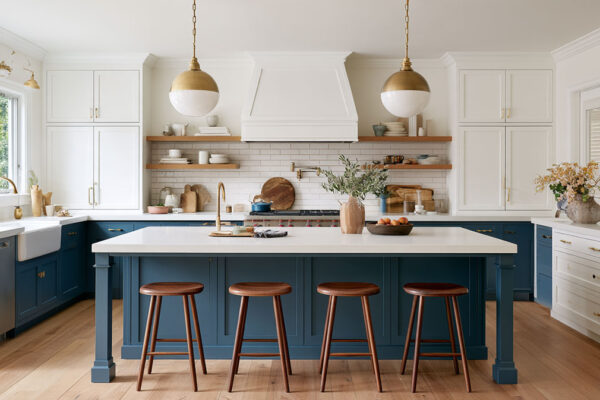
Navy suits light and medium floors, where the cabinet gives the room weight. Over a charcoal floor it is the harder pairing, so look at real blue cabinets with dark floors before committing.
Benjamin Moore Hale Navy and Sherwin-Williams Naval are the usual references for a true navy. Farrow & Ball Hague Blue is the muted deep-blue alternative.
Color consultant Maria Killam recommends greens and teals to warm up a kitchen with grey floors. Black or charcoal cabinets belong on a light floor and never on a charcoal one. For wood, Hunker pairs grey limestone floors with light oak cabinets in an Amber Interiors modern farmhouse kitchen.
Should cabinets match the floor or contrast with it?

Sources disagree. Hunker’s roundup of cabinet colors for gray floors quotes a rule against matching the two, because the kitchen feels closed in.
The same piece features a deVOL shaker kitchen with greige cabinets over a darker grey floor, and calls the tonal result soothing and sophisticated. Salvatori goes further and calls the all-grey scheme elegant.
The workable middle is a visible gap in depth between cabinet and floor, with the sheen or texture changed as well. Cabinets that match the floor in depth and sheen, and share its undertone on top of that, are where the flat look comes from.
Wall paint colors for a kitchen with grey floors

Pick a wall color with the same undertone as the floor, then set its depth by how much light the kitchen gets. Warm greige and warm whites suit beige-leaning floors. For blue-leaning ones, cool whites and pale blue-greys are the better call.
Light reflectance value (LRV) scores how much light a paint reflects, from 0 for black to 100 for white. The numbers below come from the manufacturers’ own pages, and they show how far apart common choices sit.
- Benjamin Moore White Dove sits at 83.16
- Sherwin-Williams Alabaster comes in at 82.215
- Benjamin Moore Revere Pewter is 55.05
- Sherwin-Williams Naval drops to 4.458
A charcoal floor needs a wall near the top of that list, and White Dove or Alabaster do the job. Naval reflects very little light, so it belongs on cabinets or an island rather than on four walls.
Which walls suit which floor undertone?
Benjamin Moore describes Revere Pewter as a bridge between warm and cool tones, which makes it a natural fit for warm and beige-leaning floors. Alabaster gives a creamy white for trim. Cool, blue-leaning floors want cool whites, or soft blues and pale blue-greys.
Sherwin-Williams Repose Gray is a popular wall pairing for neutral floors, but reviewers split on its undertone. Some read it as a warm greige and others see a violet cast in north light, so hold a sample next to the floor first.
Alabaster also works on cabinets and trim, and the colors that pair with Alabaster are worth checking before you commit to it.
The wall color usually runs into the next room as well, and a wider list of paint colors for gray floors helps there. Near the range and sink, pick a finish that wipes clean. Matte hides wall flaws but marks easily.
Countertop and backsplash colors that work with grey floors

Counters should sit a clear step lighter or darker than the floor, in the same undertone family or in deliberate contrast. White and cream quartz, veined marble, warm granite and butcher block all work. Grey on grey flattens the room.
Which countertop materials suit grey floors?
- White or cream quartz is the easiest match.
- Marble with grey veining echoes the floor.
- Granite with warm brown flecks offsets a cool one.
- Butcher block warms a blue-grey floor.
White cabinets with grey countertops over a grey floor only work when the counter sits clearly lighter or darker than the floor.
Maria Killam shows a kitchen with grey counters, a marble backsplash and grey floors that balance warm wood cabinets. The grey pieces calm the wood instead of competing with it.
What backsplash goes with grey floors?
Subway tile is the usual answer. White keeps the wall bright, and a grout shade close to the floor ties the two together.
Marble counters bring their own pattern, so the backsplash should stay quieter. This guide to which backsplash suits marble countertops covers the tile options in detail.
A colored backsplash is the cheapest place to add the accent. It’s easier to swap than cabinets or floors.
A grey floor, grey cabinets and grey counters together leave the room with no depth at all. I’d avoid that combination even if every individual piece looks good in the showroom.
Cabinet hardware and fixture finishes for grey floors
Brushed nickel, matte black and satin brass all work on grey floors, and undertone picks between them. Nickel and black suit cool floors, while soft brass warms a beige or green-grey one.
Houzz’s 2026 kitchen trends report (survey fielded in July 2025) ranks brushed nickel first among cabinet hardware finishes at 28%, ahead of black at 18% and brushed gold at 12%.
Houzz’s own pro roundup shows designers moving away from highly reflective chrome and polished nickel toward brushed, matte and textured metals.
| Finish | Pairs with | Watch for |
|---|---|---|
| Brushed nickel | White, navy, wood cabinets | Little contrast on a cool grey floor |
| Matte black | White and light wood cabinets | Vanishes on black or charcoal cabinets |
| Satin brass | Dark cabinets, wood | Bright polished brass reads loud |
| Chrome or polished nickel | White cabinets, cool floors | Reflective, fading with designers |
Navy cabinets take brass well. Soft brass pulls over a medium grey floor are the classic version, and plenty of examples of blue kitchen cabinets with brass hardware are easy to find if you want to compare.
Black pulls on wood cabinets add a clean outline against a light grey floor. Examples of wood kitchen cabinets with black hardware are just as easy to find if you want to judge the pull size.
Pick one dominant metal for pulls, faucet and pendants. NKBA’s 2025 report notes rising interest in blending hardware finishes, so a second metal is fine as long as one clearly leads.
How natural light and bulb temperature change a grey floor
The same grey floor reads cooler in north light and under daylight bulbs, and warmer in south light and under warm bulbs. Test the palette in the room’s own light, at the hours you actually cook.
Which way do the windows face?
North-facing rooms get indirect, cool, blue-toned light. Benjamin Moore’s Helen Shaw advises avoiding grey undertones there, where they read cool.
South light is warm and intense at midday. East windows give bright, warm light in the morning that turns cool and blue by late afternoon. West light is cooler early in the day, then warm and golden in the late afternoon and evening.
Farrow & Ball takes another route for north rooms. It suggests embracing the cool light with darker wall colors such as Railings or Down Pipe instead of fighting it.
What bulb color temperature suits a grey floor kitchen?
The US Department of Energy generally recommends 2700 to 3600 K for most indoor general and task lighting. It treats 2700 to 3000 K as warm and 3600 to 5500 K as cool.
The same DOE page calls color rendition more important than color temperature, so check a bulb’s rendering as well as its Kelvin number.
Warm bulbs pull the beige and brown out of a grey floor. Daylight-white bulbs push it toward blue, which a blue-grey floor does not need.
Sanderson’s advice on paint applies here too. Buy the bulbs before the test pots, because a swatch only means something under the final light.
Under-cabinet lights count as task lighting and light the counter first. An LED light requirement calculator gives a starting count for how many fixtures the kitchen needs.
For the principles behind all of this, see how light in interior design shapes color and mood.
Applying the 60-30-10 rule to a grey floor kitchen
Applied to a grey floor, the rule gives the neutral base (walls plus floor) the 60 and the cabinets the 30. Hardware, textiles or one colored object share the 10, and one or two accent colors is plenty.
The split is a basic idea from color theory in interior design, and sources disagree on what the 60 covers in a kitchen.
Country & Town House puts the dominant color on cabinets and worktops, while Levi’s 4 Floors puts the primary color on the walls and the secondary on cabinetry.
With the floor already fixed, the walls-plus-floor reading is simpler. The cabinets carry the 30, and the accent becomes the only open decision.
Light grey floor, cool undertone
White Dove walls and the light grey floor make up the 60. Naval cabinets take the 30, and brushed brass pulls with one warm wood piece cover the 10.
Navy has room to work here because the floor is light.
Medium grey floor, warm undertone
Alabaster walls and the greige floor form the base. Sage cabinets take the 30.
Matte black pulls and a yellow runner share the 10. Color consultant Maria Killam singles out yellow as a strong partner for grey.
Charcoal floor

White walls and white quartz keep the room open, and that’s the base. Cabinets go white oak or off-white, never the same depth as the floor. The accent is brushed nickel pulls and one deep green.
Setting for Four’s version of the rule runs 60% light grey, 30% charcoal grey and 10% blue, which shows an all-grey base can carry a single colored accent.
A room color scheme generator lets you test these splits against your own floor color before ordering paint.
When grey floors work against the color scheme, and how to fix it
A grey floor limits the palette when its undertone fights every warm option, or when it reads cold and flat. A sheen that shows every mark is the other common complaint. Warm rugs, natural materials and a color on the cabinets fix most of it. Replacement is the last resort.
Where grey floors fail
- An undertone you cannot match, meaning a purple or green cast that stays visible against every cabinet and wall color you try.
- Faux-wood grey is another weak spot. A designer cited by The Spruce says grey-toned wood flooring looks cold and flat beside natural wood.
- High gloss gets the same treatment in that piece, which says ultra-shiny floors are falling out of favor because they are hard to care for.
Designers disagree on how much this matters. The Spruce quotes a designer who calls cool grey floors a fading trend, while designers in a USA Today piece say grey is not dead and still works with warm undertones and natural variation.
Both camps target cool, faux-wood grey, not warm greige. Check your floor against that line before deciding anything.
How to warm up a grey floor kitchen

Designer Carin Elle Mead’s formula in USA Today is warm wood, creams, natural textures and earthy colors.
- Natural materials such as wood, stone and woven textures
- Cream and earthy tones on walls or counters
- A warm-toned runner by the sink
- A cabinet color the floor lacks
A runner or rug does the most work for the least effort, and examples of rugs that go with grey floors are easy to compare.
Is replacing a grey floor worth it?
Rarely. HomeAdvisor’s 2025 cost guide puts vinyl flooring materials at $2 to $7 per square foot, with installation labor adding $3 to $10 per square foot.
The cheap fixes (bulbs, a rug, cabinet paint) come first. If you do go ahead, a home renovation cost calculator helps frame the full budget.
The one real case for replacing is an undertone that still clashes with every cabinet color you would otherwise choose, even after the warm-up steps.
Common questions about kitchen color schemes with grey floors
Can warm and cool greys share one kitchen?
Yes, when the two undertones are clearly different instead of nearly identical. A cool grey floor under greige walls reads as a choice, while two greys one step apart with opposing casts read as a mismatch.
Put both samples side by side in daylight before painting.
Which appliance finish suits a grey floor kitchen?
Stainless steel wins by a wide margin. In Houzz’s 2026 Kitchen Trends Study, 72% of homeowners chose it, and white and black appliances each took fewer than 10%.
Its brushed silver tone reads neutral beside any grey floor undertone.
Do two-tone cabinets work with grey floors?
Yes, and the layout is common. Nearly one-quarter of homeowners in the 2026 Houzz study picked contrasting upper and lower cabinets, with white the top upper color at 40%.
Over a grey floor, set the deeper color below (wood, or a blue or green) and the lighter one above.
Should the kitchen island be a different color from the rest of the kitchen?
Often, yes. NKBA’s 2025 report found consumers largely prefer an island in a different color from the main cabinets.
Among Houzz’s 2026 respondents who chose a contrasting island countertop, wood led at 39%, and a wood top also warms a cool grey floor.
Which Palette Decisions Come First on a Grey Floor
Settle the choices in order of how costly each one is to reverse, starting with the floor’s undertone and the room’s lighting, since everything else gets judged against those. Cabinets and counters come second and are the costliest to redo. Walls, hardware and accents come last, and they’re the cheapest to swap.
The order assumes the floor stays. Combining HomeAdvisor’s materials and labor ranges gives $5 to $17 per square foot installed, which is why every other choice bends around the floor.
The cost is a palette limited to the floor’s undertone. As of October 2026, designers describe cool, faux-wood grey as the fading style, so a cool floor already due for replacement moves to the top of the list.
Once the wall color is chosen, a room paint calculator gives the quantity to buy.
More Kitchen Color Guides
- Kitchen color schemes with black appliances
- White kitchen floor ideas
- Green cabinets with black countertops
- Green cabinets with white countertops
- All kitchen color schemes by cabinet color

- Kitchen Color Schemes by Cabinet Color: What Pairs Well - October 19, 2026
- Curtain Colors for Every Wall Color: Safe vs Bold Picks - October 18, 2026
- Interior Design Styles: Find Your Primary and Secondary - October 14, 2026