Color Combinations
What Color Goes With Orange

Two oranges can share a name and still behave like different colors in the same room. As of October 2026, Sherwin-Williams rates Cavern Clay at a light reflectance value of 19.94 on a 0 to 100 scale, while Benjamin Moore rates Orange Appeal at 43.85. That gap matters more than most color wheel advice does.
A deep orange wants a light partner. A light orange can handle a darker one.
Once orange is settled, our room color combinations guide helps with the rest of the palette.
Once orange is settled, our roundup of safe and bold color pairings helps with the rest of the palette.
Which colors go with orange?
Blue gives the strongest contrast. Adobe’s color guide lists blue and orange as opposites on the wheel, and navy, teal, cobalt and aqua all draw on that.
Neutrals do the quieter work. White, cream, beige, gray, brown and black all sit well beside orange, and they stop it from dominating the room. Yellow, red, pink, green and purple show up in real rooms too, though each takes more care.
If complementary and analogous schemes are new terms, this primer on how color theory shapes interior design covers them before the orange-specific advice below.
Whatever else you pick, keep a neutral in the scheme. Orange already dominates a room, and a second saturated color beside it competes for the same attention.
Settle the orange first and the neutral second. Whether the room needs a cool partner can wait.
How the shade of orange changes what goes with it

Rust and terracotta lean red, so creams and deep blues sit well beside them. Tangerine leans yellow and wants white or charcoal. Peach leans pink, which makes soft neutrals and sage the easier match.
| Shade | Undertone | Best partners | Risky partners |
|---|---|---|---|
| Burnt orange | Red-brown | Olive green, chocolate brown, navy, cream | Neon pink, lime green |
| Terracotta | Clay, red-yellow | Cream, sage green, warm white, walnut | Icy white, neon brights |
| Rust | Deep red-brown | Deep teal, charcoal, brass, ivory | Bright red |
| Tangerine | Yellow-orange | White, charcoal, cobalt, aqua | Other saturated warm hues |
| Peach | Pink-leaning | Sage, warm cream, soft gray, dusty blue | Strong, saturated orange |
Burnt orange gets along with nearly everything, from olive and chocolate brown to navy and brass. This set of pairings that work with burnt orange goes further for anyone building a room around it.
Depth is the part people skip. Benjamin Moore describes light reflectance value (LRV) as a scale from 0 for black to 100 for white, based on how much light a paint reflects. Here are published manufacturer values, as of October 2026:
- Sherwin-Williams Cavern Clay (SW 7701) comes in at an LRV of 19.94
- Benjamin Moore Bronze Tone (2166-30) sits at 25.68
- Benjamin Moore Orange Appeal (124) reaches 43.85
The two deeper paints land between roughly 20 and 26. Orange Appeal reflects more than twice as much light as Cavern Clay.
That changes the partner you choose. A deep orange absorbs most of the light it gets, so cream or warm white nearby keeps the room from closing in. A lighter orange can take navy without much trouble.
Peach sits somewhere between pink and orange, and Pantone put Peach Fuzz (13-1023) exactly there when it named it the 2024 Color of the Year (Pantone Color Institute, 2023).
Soft shades like it work best beside other soft colors. A look at how peach is used in interiors shows where it fits next to stronger oranges.
Blue, teal, and navy with orange
Adobe puts blue directly opposite orange on the color wheel, which makes it the complementary partner. Navy reads formal and teal reads retro. Cobalt is just loud.
Navy and deep blue

Navy is the safest blue to put next to orange. Let it be the base and keep the orange as an accent, a rust armchair against navy walls, say.
Farrow & Ball describes its deep orange Charlotte’s Locks as best used in small areas against All White or Black Blue, a very dark blue.
Navy pairs with plenty of colors besides orange, so check what else works with navy blue before adding anything new.
Teal and aqua

Deep teal walls with a rust or burnt orange sofa is the version I like best. Aqua and tangerine make a lighter mix. A rug that carries both colors in its pattern can pull a room together without repainting anything.
Teal and orange have a mid-century feel, so the pair suits rooms with walnut furniture and low, slim lines.
A split-complementary scheme pairs orange with the two colors flanking blue, teal and blue-violet, which softens the contrast of a straight blue and orange pairing. Teal accepts many other partners too, which this breakdown of what pairs with teal covers.
Cobalt and bright blue
Cobalt works with a deep orange like rust or burnt orange, as long as it stays on one large piece. Put bright orange and bright cobalt together in equal amounts and neither one backs off.
That combination suits playrooms and creative spaces better than bedrooms.
Neutrals that keep orange from taking over
White, cream, beige, gray and brown all suit orange. What separates them is undertone, since warm neutrals soften orange and cool ones sharpen it. Black works in small doses.
White and cream

Clean white with a rustier orange gives a fresh, open room. Cream softens the same orange and reads warmer.
Hold the swatch against the trim before deciding. A yellow-leaning cream beside a blue-leaning white looks dingy.
Beige and taupe
Beige on the walls and big upholstery leaves orange as the only saturated color in the room, which is the whole point of the pairing. The orange goes in cushions, art and one chair. If beige turns too yellow in your light, taupe fixes it.
The same neutral has a long list of partners of its own, laid out in this guide to what works with beige.
Gray and charcoal

Light gray keeps a room modern and quiet, with burnt orange as the accent. Charcoal is heavier and more dramatic, and it makes tangerine look brighter.
Gray leans cool, which gives orange a cool partner without adding another hue. It carries many partners beyond orange, covered in this look at what goes with grey.
Brown and black

Brown is orange’s closest neutral. Wood furniture, leather and brown flooring bring it in without any paint decision, and dark wood with orange is the base of most mid-century modern rooms.
Black is the exception. A black frame, lamp or table leg sharpens orange, but a large black surface beside bright orange makes a room feel heavy.
Green, yellow, red, pink, and purple beside orange
Yellow and red sit next to orange on the wheel, while green and purple complete a triadic scheme with it. Pink behaves like a softer relative of red. All of them need a neutral nearby.
Yellow and red

Yellow brightens orange and suits kitchens and sunrooms. Red or coral deepens it toward a sunset palette. An all-warm room has no cool relief, though, so add white or one blue accent.
Schemes built from neighboring hues are called analogous, and they blend easily because the colors share a base.
Green

Olive, sage and dark green keep orange earthy. Apple green pushes the same orange toward playful.
Olive with chocolate brown and burnt orange makes a rustic palette. More partners for that green are listed in this guide to what suits olive green.
Pink and purple

Pink makes orange playful. Coral and peach sit between the two, so they bridge the pairing most easily.
Purple works through the triadic scheme, with orange, green and purple spaced evenly around the wheel. Lavender is the softest version and aubergine the heaviest, and the colors that pair with purple follow their own rules.
How much orange belongs in a room?
About 10 percent as an accent, or up to 30 percent as the secondary color, with a neutral covering the other 60.
The 60 percent goes to the dominant color, usually on the walls (Country & Town House). Bob Vila puts the secondary 30 percent on curtains, upholstery or an accent wall, and Country & Town House gives the 10 percent accent to cushions, art and trim. UK retailer Flooring Surgeons is the outlier, allowing 20 to 30 percent orange in a bold palette.
That last figure is two to three times the usual accent share, and the jobs differ. At 10 percent orange is an accent. At 20 to 30 percent it takes the secondary slot, which suits a sofa, curtains or a set of cabinets.
Bob Vila’s guide treats the split as a guideline that is meant to be broken, so adjust it for room size and light.
Statement orange means one large piece, like a sofa or an island, with everything else neutral. Accent orange means cushions, art, a rug or a lamp, repeated in two or three spots so it reads as a plan.
A single orange piece at 10 percent becomes the room’s focal point, so the neutral 60 percent has to stay quiet around it.
Using orange room by room

A sofa or a wall carries the orange in a living room, cabinets or an island in a kitchen, bedding in a bedroom. Bathrooms and entryways get small surfaces.
Living room
Pick one route and stay on it. Either an orange sofa or accent chair goes on neutral walls with a neutral rug, or a single orange wall goes behind neutral furniture. The wall is the cheaper one to reverse.
Before committing to the wall, compare the full range of living room accent wall colors.
Kitchen
HGTV’s orange kitchen feature shows designer Kate Maloney pairing burnt orange lower cabinets with white uppers and a teal island.
If the cabinets aren’t the right place, backsplash tile, an orange island with neutral or green cabinets, or just hardware and a single appliance can carry the color instead.
Walls stay neutral when the cabinets do the work. For picking that neutral, use a guide to choosing kitchen wall colors.
Bedroom
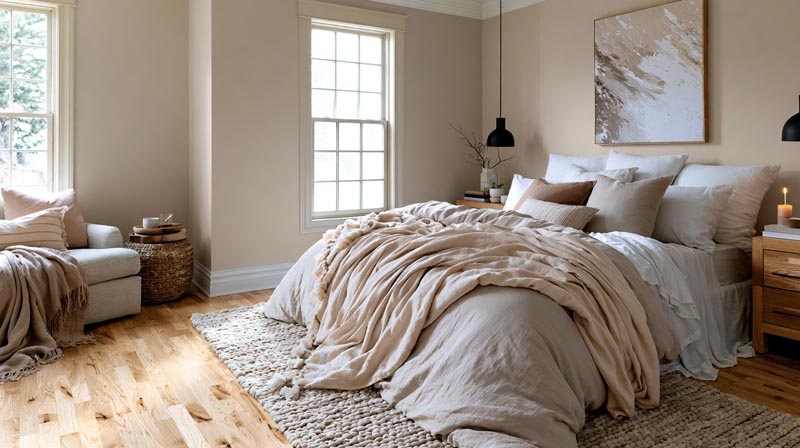
Muted orange suits a bedroom better than bright orange. HGTV’s 2015 color feature shows designer Kim Myles using deep browns and grays with a muted orange accent.
Bedding, a throw or one armchair is the easiest way in, since all of them are simple to change.
Bathroom and entryway
| Room | Orange element | Pairs with |
|---|---|---|
| Bathroom | Vanity, mirror frame, stool | White, sage green |
| Entryway | Painted door, console, mirror | Warm white, walnut |
Nobody lingers in either room, so orange can run stronger here than in a bedroom.
How lighting and materials change orange
North light mutes orange and warm bulbs deepen it. Textured surfaces shift it again.
Natural light direction
Benjamin Moore color marketing manager Arianna Barone says north-facing light is steady but cooler and more muted than light from the south (quoted in Homes & Gardens). Orange loses some warmth there.
South-facing rooms get warm, bright light, and Homebuilding & Renovating notes such rooms can carry colors with a lower LRV.
So a north-facing room needs a warmer, lighter partner beside the orange, while a deep orange in a south-facing room can stand alone. For the wider effect of daylight and lamps, see this explainer on light in interior design.
Bulb color temperature
Energy Trust of Oregon’s guidance, as of October 2026, points 2700K at living rooms, bedrooms and dining rooms, 3500K at kitchens and work areas, and 5000K at reading lamps and desk lamps.
Lighting retailer BLT Direct says warmer temperatures of 2700K to 3000K enhance warm-toned colors such as reds, yellows and oranges. For lived-in rooms that points to 2700K.
Package names vary, so read the Kelvin number on the Lighting Facts label. Pair it with a color rendering index (CRI) of 90 or higher, since BLT Direct treats 80 as the standard for general lighting and 90 or higher as the target where color accuracy matters.
Wood, metal, and textile partners
Gold and brass are the metals that suit orange, according to HGTV. Oak helps too, since Living Spaces’ color guide credits it with natural orange undertones. Linen next to smooth ceramic gives the texture contrast.
Walnut is darker and browner than oak, and this guide to colors that go with walnut wood lists more partners for it.
Chrome and nickel also work, but they read cooler and push the scheme toward a blue partner.
When orange pairings fail
Most failures trace back to too much saturated orange, pale and bright shades with no bridge between them, cool light, or heavy dark partners in a small room. Each has a cause and a fix.
| Failure | Cause | Fix |
|---|---|---|
| Orange tires the eye | Saturated orange covers walls and large furniture | Cut it to the secondary or accent share |
| Shades fight | Peach or pastel beside a strong tangerine | Add a bridge, such as cream or terracotta |
| Orange turns muddy | Cool north light or cool bulbs | Switch to 2700K bulbs and add a lighter partner |
| Room feels heavy | Deep orange with black or charcoal in a small, dim room | Swap one dark partner for cream or warm white |
Furniture retailer Vox warns that a saturated orange can dominate an interior and turn visually dull over time.
Most of these come down to share, not hue. Fixing the proportion usually fixes the scheme before any color changes.
How to test an orange scheme before you commit
Put the orange and its neutral up together, on two walls, and look at them at different times of day under the bulbs the room will actually use. A scheme that survives all of that is safe to paint.
If the palette is still open, a tool that builds room color schemes narrows the options before any sample is bought.
- Paint or stick samples of the orange and its closest neutral
- Place them on at least two walls, one near the window and one far from it
- Check them in morning, afternoon, and evening light, then under the room’s own bulbs
- Hold fabric, wood, or flooring swatches beside each sample
- Leave the samples up for a day or two before ordering
Crown Paints advises sampling on at least two walls, and testing with heavy curtains both open and closed.
Samplize peel-and-stick samples, as of October 2026, use two coats of real paint on a no-damage adhesive backing, which suits step two.
Cushions and a throw are the cheapest test of all, because they come back off. Once the samples pass, a paint calculator for the room’s dimensions sizes the order.
Colors That Go With Orange FAQ
Is an orange accent wall a good idea?
Yes, as long as the accent stays on one wall. The wall behind the sofa or bed works best, with the other walls kept neutral. Match the orange to the room’s light too, or it turns muddy in a north-facing room.
Does orange work in a small room?
In small doses, yes. An accent or a single wall adds warmth without shrinking the room, while orange on every surface closes it in.
Keep the neutral share high and the partner colors light.
Can orange and black go together without looking like Halloween?
They can when the black stays small and the orange runs deep. Burnt orange or rust beside black frames, lamps or table legs reads industrial. Bright orange against large black areas leans toward Halloween.
Which wall color goes behind an orange sofa?
Warm white, cream or light gray, all from the neutral share. Navy also works behind a rust or burnt orange sofa when the room gets plenty of daylight.
What color curtains suit an orange sofa or chair?
Cream, white or linen curtains suit an orange sofa best, because they keep the sofa as the focus.
On neutral walls, navy or teal panels add the cool partner. A patterned rug nearby calls for plain curtains.
Which orange shades suit mid-century modern and bohemian rooms?
Mid-century rooms suit burnt orange with teal and walnut, a pairing laid out in this look at the mid-century modern color palette.
Bohemian rooms lean toward terracotta and rust layered with earthy greens and patterned textiles, as in modern Bohemian interior design.
Which paint brands make good orange and terracotta shades?
Sherwin-Williams, Benjamin Moore and Farrow & Ball all carry terracotta, clay and burnt orange shades. Farrow & Ball’s Red Earth (No. 64) is a light terracotta.
Compare the published light reflectance value of each shade before buying.
Keeping an Orange Scheme Easy to Change
An orange scheme stays easy to change when the orange sits in removable pieces and a neutral covers the walls and floor.
Buy in order of reversibility. Textiles come first, since cushions and throws are the easiest to undo. A rug, lamp or piece of art comes next, and fixed items like the sofa, cabinets and paint come last.
Each tier costs more to undo than the one before, which is why paint comes last. The trade-off is impact, since a cushion cannot match a painted wall.
Re-test the scheme whenever the bulbs, flooring or curtains change, since each shifts how the orange reads.
Cushions are the natural place to start, and a look at how to combine throw pillows shows how to layer them.

- Kitchen Color Schemes by Cabinet Color: What Pairs Well - October 19, 2026
- Curtain Colors for Every Wall Color: Safe vs Bold Picks - October 18, 2026
- Interior Design Styles: Find Your Primary and Secondary - October 14, 2026