Kitchen Decor
Practical Over Kitchen Sink Lighting Ideas

The best over kitchen sink lighting ideas put light in front of or beside the person at the sink. A fixture behind the head throws a shadow across the hands and the basin.
Sinks are the one work zone where shadow and moisture both bear on the fixture, and hanging height gets a say too.
For a sense of what people actually install, NKBA’s 2023 Design Trends survey asked respondents which kitchen lighting applications are in demand. Under-cabinet lights came first at 73%, ahead of recessed lights (57%) and pendants (50%).
Lighting changes how cabinet and countertop colors read, and our kitchen color schemes guide covers those pairings.
Which lighting works best over a kitchen sink?

Under-cabinet bars win when wall cabinets sit above the sink. When they don’t, a sconce or pendant takes it.
I ranked the options by task coverage first and shadow risk second. Moisture exposure comes third, and style comes last.
NKBA’s kitchen safety guidance, as published by HGTV, sets the test every option has to pass. Task light should land on the work surface and stay even and glare-free, and it shouldn’t leave shadows.
Whichever fixture comes out on top, it’s task light sitting over the general ambient lighting the ceiling already provides.
| Fixture | Best when | Main limit |
|---|---|---|
| Under-cabinet bar or strip | Wall cabinets sit above the sink | Needs something to mount under |
| Wall sconce or gooseneck | Sink sits under a window | Needs clear wall beside the frame |
| Pendant | Sink is on an island or open counter | Height is critical at low ceilings |
| Recessed can | Ceilings are low or the kitchen is small | Shadows if placed over the user’s head |
| Track or linear bar | Counter is long, aim needs to change | Glare when aimed badly |
| Flush mount | A ceiling box already exists | General light only, weak at the task |
Under-cabinet strips and bars

A U.S. Department of Energy LED fact sheet describes under-cabinet lighting as task light for the counter that also adds to the room’s ambient light.
At the sink it has another use. According to the Lighting Research Center at Rensselaer, it removes the shadow the wall cabinets throw onto the counter.
The light lands on the work surface instead of behind you, and the fixture mostly disappears under the cabinet. Dimming it for evening use is easy too.
The downside is that it needs a cabinet or shelf above the sink to mount under. It also only supplements, so the room still needs ambient light.
Wall sconces and gooseneck lights
Sconces suit a sink under a window better than any other fixture.
One on each side of the frame follows the Lighting Research Center’s advice to put luminaires on both sides of a primary work area to control glare. A gooseneck arm does the same job from one side and can be aimed at the dishes.
Nothing hangs from the ceiling, so there’s no sightline problem, and the window gets a neat frame as a bonus. The catch is wall space. You need clear wall beside the window, and an exposed arm or shade sits within splash range.
Pendant lights

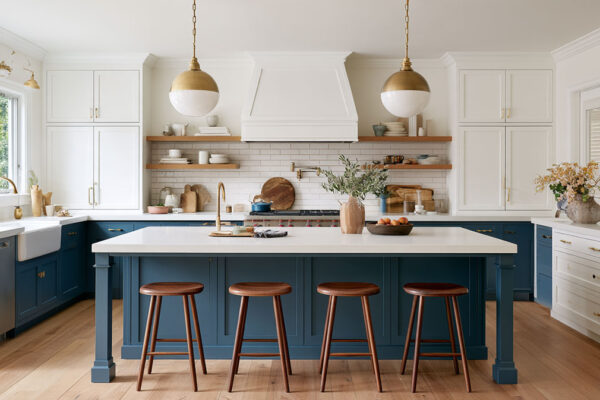
A pendant brings light close to the task area, which is why designers like it over islands (Journal of Light Construction). One medium pendant sized to the sink delivers enough light without dominating the room.
You stand directly beneath it, though, so hanging height decides whether it helps or gets in the way.
Philips Hue’s pendant size guide ties the right size to sink width and ceiling height.
Recessed cans

Visual Comfort warns that recessed lights placed directly over the sink create shadows and uneven light. The fix is position, not wattage.
Lighting designer Philip Blosser adds that black baffles absorb reflected light that would otherwise glare back at the user.
Cans work when the ceiling is low and they sit in front of the person at the sink. They fail when they land straight overhead, behind the head and over the hands.
Track and linear bars

Track heads can be aimed at the faucet and basin, while linear bars lay an even strip of light along the counter. Both read as modern or industrial, and both add visual weight to a small wall.
Aim is the catch. A badly angled head throws glare off a polished faucet.
Flush mount fixtures

A flush mount is general light, not task light.
Faro’s kitchen lighting guide points out that a single central luminaire casts constant shadows, because the person at the counter blocks the beam.
It makes sense when a ceiling box is already wired there and the budget is tight, or when another source such as an under-cabinet bar handles the task. Skip it if it would be the only light over the basin.
Matching the fixture to your sink layout

The layout around the sink mostly picks the fixture for you.
Under a window, go with a sconce on each side of the frame or one gooseneck above it. If wall cabinets sit above the sink, an under-cabinet bar does the job. A sink on an island takes one or two pendants, hung by the height rules below.
Galley and low-ceiling kitchens call for slim recessed cans or a linear bar. Ideal Home suggests simple spotlights where the ceiling is low, since a hanging fixture has little room there.
With no window at all, you need layers: a ceiling fixture plus an under-cabinet bar.
Daylight carries part of the load when the sink faces a window. That’s why the Lighting Research Center suggests putting the sink at a window where the plan allows. Without one, artificial light does all the work.
My view goes against the common choice. A decorative pendant over a sink that already has upper cabinets is style, not function. The under-cabinet bar does the lighting, and the pendant can wait.
How high should a pendant hang over a kitchen sink?

Hang the bottom of the pendant 30 to 36 inches above the countertop, the range both Philips Hue and HORNE publish (measured from the sink rim or countertop to the fixture bottom).
Bicycle Glass gives a wider range, 30 to 40 inches from the countertop to the bottom of the shade.
Hunker works through an example. A 30 inch drop over a 36 inch counter puts the bottom edge at 66 inches, or 5 ft 6 in, from the floor. Standard US building code sets no minimum height above a sink, Hunker adds, so local rules are the only check.
What shifts the range
Hunker says ceiling height, pendant size and sink location all move the number, along with how tall the people in the kitchen are.
That last factor matters most. At 36 inches the bottom edge sits at 72 inches, exactly 6 feet, so a tall household should start at the high end.
Why two ranges circulate
Neither range comes from a code. The gap between 36 and 40 inches is a design call, not a violation.
Go lower for stronger task light and higher for a clear sightline. Either way, the lower edge has to clear the faucet and its swing.
How many lights go over the sink and where to put them
One fixture centered on the sink covers most kitchens. A wider sink or a double bowl takes two.
HORNE says kitchens with small footprints work well with a single pendant over the sink.
- Mark the sink center on the wall or ceiling, and the divider if the sink has two bowls.
- Set the fixture height from the countertop, using the ranges above for a pendant.
- Pick the count: one for a single bowl, two evenly spaced for a double bowl or a wide sink.
- Place recessed cans to the side of and slightly in front of where the person stands, closer to the wall at the sink than elsewhere in the kitchen, and not over the upper wall cabinets (Lighting Research Center, Philip Blosser).
- Stand at the sink and check the sightline to the window and the faucet before cutting or drilling.
One rule for every fixture
Never put the light behind the person at the sink. Both the Lighting Research Center and Faro say the same thing, because the user’s body blocks the beam and drops a shadow on the hands.
Blosser applies it to recessed cans. Set them closer to the wall at the sink than elsewhere in the kitchen, so the workspace stays shadow-free when someone leans in against the counter.
Size against the sink and cabinets
Fixture size follows the same logic as anything else in the room. HORNE says a sink pendant should be proportional to the cabinetry around it, which is a basic question of scale and proportion.
Too small and it reads as an afterthought. Too large and it crowds the window and the faucet.
Does a light over a kitchen sink need a damp rating?
Not automatically. The code’s zone rule, section 410.10(D), names bathtub and shower areas, not kitchen sinks (EC&M).
Sources still disagree on how to treat the area, and the disagreement has a clear cause.
What the ratings mean
| Rating | UL 1598 wording, shortened | Where it fits |
|---|---|---|
| Dry | Not normally subject to dampness | Most finished indoor rooms |
| Damp | Normally or periodically subject to condensation | Covered porches, steamy rooms |
| Wet | Water can drip, splash or flow on the fixture | Showers, exposed exteriors |
DMF Lighting’s 2022 technical bulletin notes that interior luminaires are often listed dry or damp, while most exterior ones are listed wet.
EC&M explains the hierarchy in section 410.10(A). A fixture marked for damp locations installs in damp or dry spaces, and one marked for wet locations installs in wet, damp or dry spaces.
Where the sources disagree
Dutton Brown counts almost every finished indoor area, including the space above a kitchen sink, as a dry location. Lumens takes the other side and points to the zone right beside the sink during dishwashing as a good case for a damp-rated fixture.
Green Creative says surfaces more than 2 feet from the kitchen sink can count as damp locations when ventilation is adequate. A designer at Rothschild and Bickers, quoted by Ideal Home, recommends at least 60 cm (about 2 feet) between lights and the water source.
The split has one cause. UL 1598 sorts fixtures by moisture exposure, not by room name, so the answer turns on whether water, steam or condensation reaches the fixture.
A working rule for the sink area
NKBA’s kitchen safety guidance also says to keep lighting fixtures away from water sources and wet hands.
Choose a damp-rated fixture for anything within splash or steam reach, like low pendants, sconces beside the faucet and bars under a cabinet above the spout. Dry-rated is fine for ceiling fixtures well away from the basin.
A damp listing stops at condensation and steam. Where water can splash directly onto the fixture, step up to a wet-rated one, and read the label before the catalog copy.
How bright should sink lighting be, and which color temperature and CRI work?

Task areas at the sink need about 50 to 100 footcandles. Color temperature should sit near 3000K, and CRI should be 90 or higher.
Penn State’s EGEE 102 course materials list 30 to 40 footcandles for general kitchen light and 50 to 100 for task areas such as the stove and sink.
Brightness
One footcandle is one lumen per square foot of surface. So a 10 square foot sink-and-counter zone needs 500 to 1,000 lumens landing on it, before the fixture’s own losses.
Some blog posts quote 450 to 800 lumens as the sink figure. Mr. Electric ties that same band to low-light spaces such as hallways and closets, so read it as a bulb floor, not a work-surface target.
A calculator that estimates LED light requirements converts the footcandle target into a lumen count for the whole room.
Color temperature
Sources split here, though there’s an overlap.
Carbon Switch rates cool white at 3000K to 4100K as the most suitable range for kitchens. Mr. Electric puts warm, soft light at 2000K to 3000K and says 4000K or higher keeps people alert.
The one value both accept is 3000K, which makes it the safe pick for a sink that also gets evening use.
Color rendering
CRI scores how faithfully a bulb shows color, on a scale to 100.
ENERGY STAR’s luminaire specification sets the minimum at 80. Carbon Switch recommends 90 or higher where detailed tasks happen, and that includes checking whether a pan is actually clean.
CRI is often missing from the package, so check the product spec online (Consumer Reports). Higher-CRI bulbs can cost slightly more.
When do dimmers and smart bulbs make sense at the sink?

Add a dimmer when the sink light also works as an evening light. Skip it when the fixture only has to get the dishes done.
Either way, the sink light should have its own switch, a point the Journal of Light Construction makes for fixtures over the sink, island, counters and table.
| Control | Best when | Watch for |
|---|---|---|
| Wall dimmer | The fixture doubles as an evening light | Bulb must be dimmable and match the dimmer type |
| Tunable-white smart bulb | You want cool task light by day, warm light at night | Wall switch must stay on, bulb must suit the shade |
| Smart dimmer or switch | The fixture has a built-in LED driver | Some models need a neutral wire |
Why dimmed LEDs flicker
Lutron’s support pages state that LEDs have no manufacturing standard, so a bulb labeled dimmable can still dim less smoothly than the next one.
Flicker shows up more often at low light levels, and Lutron Caseta dimmers let you adjust the low-end trim to reduce it. ELV loads and some LEDs need reverse phase dimming. When nothing else works, Lutron points to its neutral-wire PD-5NE Caseta dimmer.
Where to put the switch
Lighting designer Philip Blosser says to place controls at points of entry and wherever they are easy to reach if a task changes.
For the sink, that means a dimmer or switch near the sink wall, not only at the doorway.
What does over-sink lighting cost?

Installing a pendant typically costs $95 to $250, according to Angi’s 2025 cost data. Angi puts under-cabinet lighting at $230 to $300 (about $265 on average) and light bars at $330 to $440. The fixture price is separate.
The best task fixture isn’t the cheapest to install. In Angi’s ranges, light bars cost more to install than pendants or track lighting.
Swapping a fixture at an existing box is the cheap job, and new wiring adds labor on top. Recessed cans cost more to install than pendants (Angi’s range is $100 to $480) because the work includes cutting and finishing drywall.
Doing it yourself means the only expenses are the fixture and tools, though hardwired work belongs to a qualified electrician (Inch Calculator).
Where spending stops paying off
Task light at the sink comes from position and bulb quality, not from the price tag. Once the fixture sits in the right spot with a 90 CRI bulb, extra spending buys finish and style.
For budget fixtures, retailer lines such as IKEA’s are a common starting point, and these IKEA lighting ideas show how they look in a room.
Which over-sink lighting choices backfire?

Most problems come from pendants hung too low, harsh bulbs, mismatched color between fixtures, and the wrong LED inside an enclosed shade.
Pendants hung too low
Ideal Home points out that people lean slightly over the sink, which puts the head right where a hanging fixture sits.
Raise the pendant, or move to a recessed can set toward the wall.
Harsh or mismatched bulbs
Visual Comfort cautions against task light so strong that the sink becomes an unpleasant place to work.
Mixing is its own problem. Consumer Reports advises sticking with one brand across the house so color temperature and CRI stay consistent.
Enclosed fixtures with the wrong LED
Glass globes and closed shades trap heat.
Family Handyman’s LED bulb guide warns that enclosed bulbs shed heat poorly, which can kill LEDs not designed for enclosed use. Read the bulb label for an enclosed-fixture rating, and swap in a rated bulb if the shade is closed.
Over Kitchen Sink Lighting FAQ
Is a chandelier acceptable over a kitchen sink?
Yes, if it follows the same rules as a pendant. The bottom edge needs a comfortable hanging height, the faucet has to clear it, and the label should suit splash and steam.
A calculator for chandelier size checks its width against the sink and counter.
Does sink lighting have to match the rest of the kitchen?

No. Finishes can mix, and NKBA’s 2025 Kitchen Trends Report notes growing homeowner interest in blending different hardware and lighting finishes.
What should stay consistent is the color temperature and CRI of the bulbs.
Which bulb base does a sink pendant take?
Whichever base the socket label lists, along with its maximum wattage. Family Handyman notes that LED bulbs are made to fit traditional sockets.
A bulb’s depth still has to fit inside the shade.
Can a backlit splashback or skylight light the sink?

They help, but neither replaces a task fixture. Ideal Home describes a backlit splashback as mood lighting, and a skylight only works in daylight.
The hands and basin still need a fixture in front of or beside the user.
Which Part of a Sink Light Swap Needs an Electrician?
Replacing the lighting over a kitchen sink starts at the existing electrical box, because that box decides how much of the job is a fixture swap and how much is new wiring.
Angi advises hiring an electrician for any hardwired fixture unless the installer already works with electrical systems. For lighting installed near a sink, moisture exposure also matters. Where suitable for the fixture and permitted by electrical codes, waterproof wire connectors can help protect compatible low-voltage wiring connections from moisture. Mains-voltage connections should use approved connectors and enclosures installed by a qualified electrician.
The order that costs least is to mark the old box against the sink center and pick the fixture the layout calls for. Then match the dimmer to that fixture’s built-in driver.
The trade-off sits in that first step. A box off the sink center either forces the old position or adds wiring labor, while a plug-in under-cabinet bar skips hardwiring altogether.
A renovation cost calculator for the whole project places the electrician’s share inside the full budget.

- Kitchen Color Schemes by Cabinet Color: What Pairs Well - October 19, 2026
- Curtain Colors for Every Wall Color: Safe vs Bold Picks - October 18, 2026
- Interior Design Styles: Find Your Primary and Secondary - October 14, 2026