Color Combinations
Colors That Go With Sage Green in Your Home Decor

Sage is a strange paint name, because it tells you almost nothing about the paint.
Benjamin Moore’s Sage 2143-10 reflects 15.31% of light, while its October Mist 1495, a gently shaded sage, reflects 46.54% (Benjamin Moore, 2026). A white that suits the lighter paint turns stark beside the darker one.
What decides a good pairing is undertone. Sage is muted and leans gray, so it acts like a neutral in most rooms, kitchens and bedrooms especially. White, cream, beige and gray sit next to it easily. Blush pink and mustard warm it up (terracotta too, if you want it earthier), navy and black add weight, and wood, brass and linen keep the whole thing natural.
To see how sage green compares with the partners other colors take, browse our guide to what goes with what.
To see how sage green compares with the partners other colors take, browse our guide to color combinations in interior design.
Which Colors Go With Sage Green?

Muted and gray-leaning is what lets sage behave like a neutral. Restrained colors sit beside it without a fight, and louder ones need a bit more thought.
Both big paint brands landed on a sage for 2022, which tells you how mainstream the color had become. Benjamin Moore named October Mist 1495, a gently shaded sage, its 2022 Color of the Year and built a 14-color palette around it (October 2021). Sherwin-Williams chose the cool gray-green Evergreen Fog SW 9130 for the same year (September 2021).
| Pairing | Effect | Undertone to pick | Best rooms |
|---|---|---|---|
| White | Fresh, crisp contrast | Warm white for yellow sage, clean white for gray sage | Kitchen, bathroom |
| Cream | Soft and tonal | Warm cream | Bedroom, living room |
| Beige and taupe | Quiet and layered | Warm beige, greige-leaning taupe | Living room, bedroom |
| Gray | Cool and modern | Same temperature as the sage | Home office, bathroom |
| Terracotta | Earthy and warm | Clay with a little orange | Kitchen, living room |
| Blush pink | Calm and soft | Dusty, slightly warm pink | Bedroom |
| Mustard | Sunny, a little retro | Ochre, not lemon | Living room, home office |
| Navy | Dramatic and grounded | Deep navy with a gray cast | Living room, bedroom |
| Black | Graphic and sharp | Soft black, small doses | Kitchen, home office |
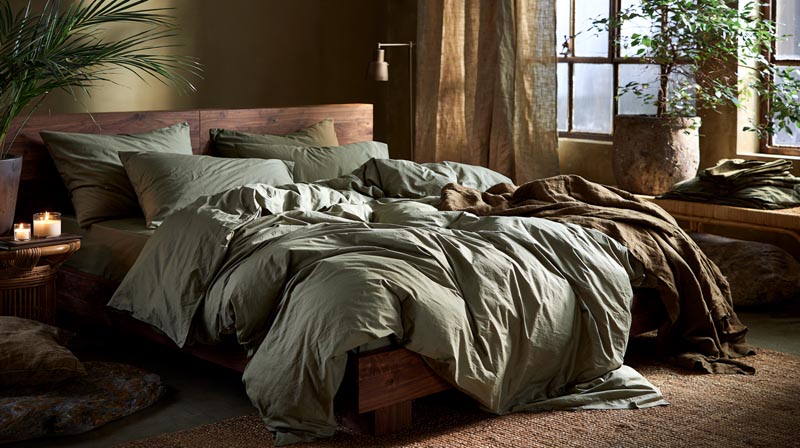
Sage also sits comfortably inside an earthy interior palette, which is why clay, oat and walnut feel natural beside it.
Neutrals are the safe call. Terracotta and navy are the pairings people remember.
How Does the Undertone of Sage Green Change What Goes With It?
Undertone is the part of sage that decides what sits well next to it. Sage leans yellow, brown or gray, and a partner color has to share that temperature.
A warm sage looks muddy next to a cool white, and that’s an easy mistake to make. A cool sage just goes dull beside a heavy cream.
Warm and cool undertones in sage
Yellow-leaning sage is warm and slightly olive. Cream, warm white, tan and terracotta all suit it.
Gray-undertone sage is cool and chalky, and it does better with a clean white, a soft gray, navy or blush.
The blue-green ones read mineral and cool. Pale gray and cool whites go with them, while orange-heavy clay clashes.
This is basic interior color theory. A muted green takes on the cast of whatever sits beside it.
Benjamin Moore’s director of color marketing and development, Andrea Magno, said October Mist can read greener or grayer depending on context (2021). One paint, two undertones.
How to test a pairing before painting
Don’t trust a screen. Benjamin Moore’s color pages state that on-screen colors differ from the actual paint, and they point buyers to free chips at a local store.
- Paint a large sample board and fix it to the wall you plan to cover.
- Hold the partner color against it: a fabric swatch, a wood sample or a paint chip.
- Check both in the morning, at midday and in the evening.
- Switch on the bulbs you actually use and look again.
- Drop any pairing where one color makes the other look dirty.
To narrow the field before sampling, a room color scheme generator previews combinations without opening a pot of paint.
Which Neutrals Pair Best With Sage Green?
White, cream, beige, taupe and gray all work with sage, as long as the neutral shares the sage’s undertone temperature. Warm sage wants warm neutrals. Gray sage does better with cool ones, and that’s most of the rule.
White and cream

White gives sage the sharpest contrast and keeps a room fresh. Next to yellow-leaning sage, though, a warm white or cream is safer than a stark one.
A crisp white suits trim, ceilings and cabinets against gray sage. Walls and upholstery beside yellow sage look better in warm white or cream.
Benjamin Moore’s page for October Mist 1495 coordinates it with Glacier White OC-37 and Steam AF-15, two pale neutrals.
Light rooms built this way echo Scandinavian color palettes, where white and pale wood leave room for one soft green.
Beige, taupe and greige

Beige is the closest tonal match for warm sage and the easiest to live with.
Taupe bridges sage and brown furniture, so if the room already has a taupe sofa, other colors that suit taupe are worth a look.
Greige is fussier. It works only when its gray-beige balance matches the sage.
For Evergreen Fog, Sherwin-Williams named Shoji White SW 7042, Accessible Beige SW 7036 and Woven Wicker SW 9104 as the organic neutrals to use (2021).
Gray
Gray is the tricky neutral.
A soft, cool light gray works beside gray-leaning sage, and a warm gray works beside yellow sage. Warm greige beside gray sage fails, and so does a cool blue-gray beside olive sage. Both look muddy.
Charcoal is easier. It adds depth through furniture, an accent wall or textiles without fighting the sage.
How Do Terracotta, Pink, Mustard, Navy and Black Work as Accents?

Terracotta, blush pink and mustard warm sage up. Navy and black deepen it.
Terracotta is earthy and warm, and it’s strongest in tile, ceramics and textiles rather than on walls. Blush pink is soft and calm as long as it’s a dusty pink and not a sweet one, and I’d keep it to bedding or art. Mustard is sunny and a little retro. Ochre works. Lemon yellow turns acidic against gray sage.
Navy is dramatic and grounded, and it looks good on rugs, cushions and cabinetry with sage on the walls. Black is graphic and sharp, so use it for trim, frames and hardware and leave the large surfaces alone.
Real terracotta tiles on a floor or backsplash add a texture that painted clay tones cannot copy.
Both big paint brands anchored sage with one deep tone and kept the rest soft in their 2022 palettes.
Sherwin-Williams paired Evergreen Fog with Urbane Bronze, Uber Umber and Bakelite Gold (2021). Benjamin Moore set October Mist beside the deep denim blue Mysterious AF-565, which can read near-black, the red Wild Flower 2090-40, touched with pink and orange, and the soft lilac Hint of Violet 2114-60 (2021).
One dark anchor is enough. A room with navy, black and terracotta all at once stops reading as sage.
What Wood Tones, Metals and Textiles Suit Sage Green?

Warm woods and brushed brass are the safest materials beside sage. Linen, rattan and stone keep the room natural.
Oak and other light woods keep sage airy. Walnut and dark brown add depth, but they need daylight or the room turns heavy.
For a walnut-heavy space, the colors that go with walnut wood make a useful cross-check.
Brown needs a warm undertone. A cool, ashy brown beside yellow sage looks dull.
Brass and gold sit softly against sage without competing, while black metal adds a sharper edge.
Linen, wool, rattan and honed stone share sage’s matte, organic look. Area rugs and throw pillows in those fibers add texture that paint cannot.
Sherwin-Williams’ 2021 guidance for Evergreen Fog named champagne gold, warm brass and inky black as the metals to use, plus natural-looking textiles for depth.
All of this follows the logic of biophilic design, which brings natural materials and green tones indoors.
What Proportions Make a Sage Green Room Look Balanced?
The 60-30-10 rule is the easiest way to balance a sage room. Sage can take the 60 on the walls, the 30 on a sofa or cabinets, or just the 10 as an accent, and the other colors fill whatever shares are left.
The rule splits a room into 60% dominant color, 30% secondary and 10% accent, according to Country & Town House. Rugs, curtains and upholstery count toward those shares as much as paint does.
| Role of sage | 60% | 30% | 10% |
|---|---|---|---|
| Dominant | Sage walls | Cream or oak furniture | Terracotta or navy |
| Secondary | Warm white walls | Sage sofa or cabinets | Brass and black details |
| Accent | Beige or cream | Wood and linen | Sage cushions and art |
Kitchens move the starting point. Country & Town House starts with cabinets and worktops, and an expert quoted by Ideal Home likewise puts the 60 on kitchen cabinets rather than walls. In other rooms, Ideal Home’s experts start with walls because walls dominate an interior more than any other component.
Either anchor works. The room reads balanced as long as sage covers one large group of surfaces and not all of them.
Layering sage with a deeper green adds depth without adding a new hue. Benjamin Moore’s 2022 palette sets October Mist beside Fernwood Green 2145-40 and High Park 467 (2021).
Deeper greens bring their own partners, so the colors that suit dark green apply to the second layer.
When sage is the accent, one wall is the usual move. Living room accent wall colors show how sage compares with the alternatives.
How Do Light and Reflectance Value Affect Sage Green Pairings?
Light direction and bulb temperature shift the undertone of sage, and light reflectance value (LRV) tells you how much pale partner color the room needs.
LRV runs from 0 (black) to 100 (white) and measures how much light a painted surface reflects.
Room exposure and bulb temperature
Benjamin Moore UK describes north light as cool and blue-toned, which dulls colors with gray, blue or lavender undertones. South light is warm and at times intense.
In a north room, gray-undertone sage goes flat, while yellow-leaning sage and warm cream hold up. South light intensifies yellow undertones, so a grayer sage balances it. East rooms are bright and warm in the morning and cool by late afternoon, so check both times. West rooms get muted late light with a blue cast at dusk, and warm neutrals counter it.
The same logic runs through every surface, which is why light in interior design belongs in the palette decision, not after it.
Bulbs matter as much as windows. Westinghouse Lighting puts warm white at 2000K to 3000K, cool white at 3100K to 4500K and daylight above 4500K.
Other makers draw the lines elsewhere. BLT Direct starts daylight bulbs at 6000K, so read the Kelvin number on the box, not the label.
I’d go with 2700K to 3000K for sage with cream, terracotta or wood. Cooler bulbs turn sage gray and take the warmth out of its partners.
Fixtures that supply most of a room’s glow decide that cast, so ambient lighting is the first place to fix bulb temperature.
Why sage paints from different brands behave differently
A paint called Sage can be a dark olive. Benjamin Moore’s color pages, as listed in October 2026, show how far one name stretches.
- Sage 2143-10 sits at LRV 15.31, a dark olive with green and brown tones
- Saybrook Sage HC-114 is LRV 45.46, an aloe green cooled with gray
- October Mist 1495 comes in at LRV 46.54 and is a gently shaded sage
- Glacier White OC-37 reaches LRV 80.18 as an off-white with cream undertones
Same brand, same word, about 30 points apart.
A white that looks soft beside the mid-tone sage looks stark beside the dark one. Check the LRV before trusting the name.
Which Sage Green Pairings Work in Each Room?
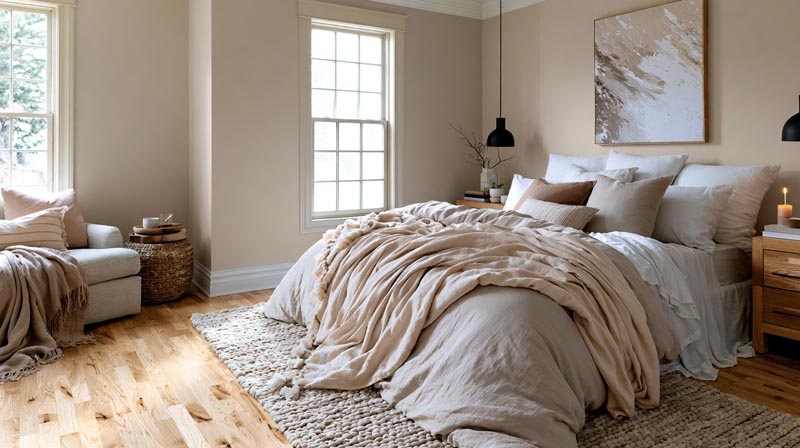
Kitchens like wood and brass beside sage, and bedrooms lean toward dusty pink and cream. A neutral sofa suits the living room. Bathrooms and home offices get white fixtures and a dark accent.
Kitchen
Sage cabinets carry a kitchen best when wood and metal do the warming.
Hunker’s roundup of sage pairings shows it working. Heidi Caillier paired sage cabinets with terracotta-colored floor tile, and AMA Studio Interiors went with pale sage cabinets, a light gray zellige backsplash and natural wood accents.
For a wood counter, the way green cabinets sit with wood countertops is worth checking before ordering.
Bedroom
Dusty pink works as bedding or art against sage walls, and Mylands calls the pairing warm and friendly. Cream suits headboards, linen and curtains. Pale lilac belongs in throws and cushions, kept soft.
A sage bedroom belongs among the calming bedroom colors, and pink and cream are its warm side.
Living room
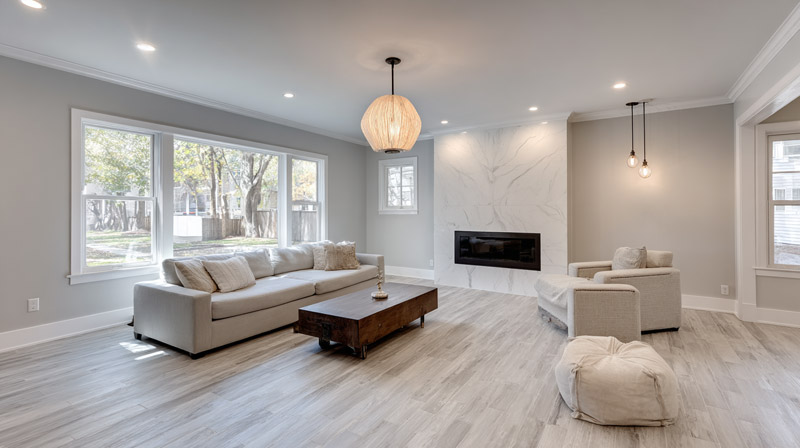
Sage walls call for a neutral sofa (cream, oat or tan) and one earthy accent such as terracotta. If the sofa is the sage piece instead, keep the walls warm white or pale and bring navy in through the rug or cushions.
Tan is the easiest bridge. Hunker features a Palm Beach living room by designer Caitlin Kah that pairs the two.
Bathroom and home office
A bathroom does well with white fixtures, oak or brass accents and cream towels.
In a home office, sage walls pair with navy or black in shelving, frames and desk hardware.
When Does a Sage Green Palette Not Work?
A sage palette goes wrong when a dark sage lands in a small room, when bulb temperatures are mixed, when sage sits beside a green or gray of equal value, or when it covers every surface with no contrast.
| Condition | What goes wrong | Fix |
|---|---|---|
| Dark sage in a small, dim room | Room feels closed in | Lighter sage, white ceiling |
| Mixed bulb temperatures | Sage shifts between fixtures | One Kelvin range throughout |
| Sage beside a green or gray of equal value | Flat, no focal point | Add white, wood or a darker tone |
| Sage on every surface | Monotone, no depth | Break it with wood, trim and texture |
Small rooms are where dark sage fails most often, and the best colors for small rooms lean light for a reason.
Sometimes sage is just the wrong call. In a small north-facing room with little daylight, a warm white or cream carries the walls better.
Benjamin Moore Canada’s north-room guidance tells buyers to weigh warm and cool undertones and brightness first. Keep sage to cushions, a throw or one piece of furniture there.
Once a pairing survives a sample board, a room paint calculator sizes the order, so you buy one batch instead of two.
Common Questions About Colors That Go With Sage Green
What curtain colors go with sage green walls?
White, cream, navy, terracotta, lavender and light blue-gray curtains all suit sage walls, according to RoomDsign. Pale fabrics keep the room open, while navy or terracotta adds weight. A wider range sits under curtain colors for green walls.
What color rug goes with sage green walls?
Oat, natural jute, rust and deep navy rugs all work, because each either matches the sage’s undertone or contrasts it without competing. Wool and jute add the texture sage likes, and rug colors for green walls cover more options.
Does sage green go with lavender or light blue?
Yes, as long as both stay muted. Powder, mist and duck egg blues balance a sage sofa, according to Furn, and Blinds Direct pairs sage with dusky pinks and pale lilacs for a soft look.
Can sage green go with silver or chrome hardware?
Yes. Mylands notes that silver adds a sheen and texture that contrast with muted matt green walls. Brushed finishes sit more quietly than polished chrome.
Can sage green furniture sit against sage green walls?
Yes, when the two sages differ in depth. Hunker features a home office by Chauncey Boothby that styles sage furniture beside sage walls, and a step lighter or darker on the furniture keeps both visible.
Is sage green still in style for 2026?
Yes, with a caveat. The sources disagree as of October 2026. Family Handyman lists sage green among the colors on the way out for 2026 because of overexposure, while Livingetc concludes that sage kitchens are not out of style when styled with timeless features and natural wood.
Matching Sage Green to Finishes You Already Own
Whatever stays in the room sets the undertone you should pick. Warm oak, brown and beige finishes take yellow-leaning sage, while gray stone and tile take gray-leaning sage.
Floors, counters and sofas can’t be swapped on a whim, so they come first. The sage shade comes next, checked by undertone and LRV, then a neutral partner and one accent.
Paint and textiles are the cheap, reversible layers, so they adapt to the floor and never the reverse.
The trade-off is range. Building around fixed finishes narrows the usable sage shades and removes the boldest pairings first, such as navy walls or black cabinets.
Wood is the most common fixed finish, so paint colors that go with wood floors is the next check before buying samples.

- Kitchen Color Schemes by Cabinet Color: What Pairs Well - October 19, 2026
- Curtain Colors for Every Wall Color: Safe vs Bold Picks - October 18, 2026
- Interior Design Styles: Find Your Primary and Secondary - October 14, 2026