Color Combinations
Colors That Go With Light Pink: Awesome Interior Ideas

Light pink never looks the same twice. It is red lightened with white, and whatever pigment gets left over shows up as peach in one formula and lilac in another. A partner that flatters the first can make the second look flat.
That is why the pairing starts with the undertone of the pink, not the color name. Cream, greige, sage, navy, terracotta, burgundy, brass and walnut all work somewhere. Which of them works in your room depends on the pink.
Depth varies too. Benjamin Moore lists Ballerina Pink at an LRV of 77.64 and Peach Kiss at 72.38 (Benjamin Moore, 2026), and the direction of a room’s light shifts how both read on the wall.
Our chart of which colors go together puts light pink side by side with every other color we cover.
Our interior color pairing guide puts light pink side by side with every other color we cover.
How does the undertone of light pink decide which colors work?
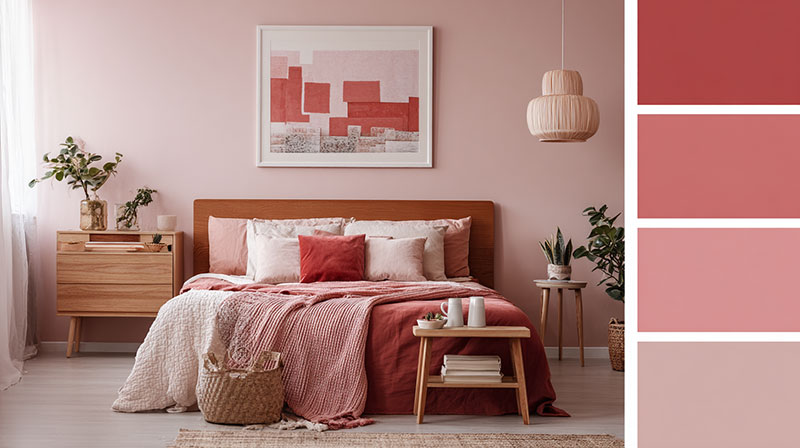
Match the temperature. Warm pinks take warm partners and cool pinks take cool ones, which covers most of the decision. A peach-leaning light pink suits creamy whites and olives, with brown if you want it heavier. A rosy or lilac one does better with crisp white and navy, or gray when you want it quieter.
That leftover bias is what a partner color has to match.
To find out which side your pink falls on, hold the swatch against a pure white card. Peach, coral or a yellowish cast means warm. Lilac, mauve or blue means cool.
| Undertone of the pink | Partners that work | Weak matches | Mood |
|---|---|---|---|
| Warm (peach, salmon, yellow-tinged) | Cream, olive, deep green, brown, brass | Icy blue-gray, stark white | Cozy, earthy |
| Cool (rosy, lilac, blue-tinged) | Crisp white, cool gray, navy, charcoal, chrome | Yellow-based creams, orange woods | Fresh, polished |
| Muted (dusty, grayed) | Sage, greige, warm gray, burgundy, gold | Saturated brights | Quiet, grown-up |
Farrow & Ball describes Setting Plaster as a pink with a touch of yellow pigment, and its own pairings stay warm. The brand suggests Mahogany alongside it in a more contemporary home. Joa Studholme, who created the shade, uses Tanner’s Brown on trim and Dead Salmon below a dado rail (Farrow & Ball, 2024).
Undertone really just means color temperature, the same warm-versus-cool split you see on the color wheel. If that part is hazy, the basics of color theory show how the split plays out across a whole palette.
Which neutrals go best with light pink?

Cream and greige are the safe picks. Gray works as well, provided its undertone matches the pink.
White and cream
White acts as a frame around pink, and cream does the same job more gently.
Mylands shows crisp white on ceilings and woodwork against pink walls, which is the easiest version to pull off. White bedding or curtains keep a pink bedroom from feeling heavy. Add one accent in a deeper tone, though, or the white washes everything out.
Creamy white goes with warm pinks and clean white with cool ones, more or less.
Scandinavian-style rooms often use exactly this mix of white walls, pale wood and one muted pink. For the wider range of tones in that style, see these Scandinavian palette ideas.
Greige, beige and warm gray
Greige is the neutral that makes pink look grown-up.
Hunker credits it with adding warmth and an earthy note that counters pink’s sweetness. Put it on a sofa or rug beside a pink wall. Beige does the same job with less depth.
Does gray still work with light pink?
Yes, once the undertone matches. Warm gray suits peach and salmon pinks, and cool gray suits rosy and lilac ones.
Cool and blue-based grays read crisp, so they need something soft like wool or bouclé to take the edge off. A light gray stays close to the pink in value, which keeps the room airy and gentle.
Gray is neutral enough that another color slots in easily, and the guide to other colors that work with grey lists the options.
Green, navy and charcoal as contrast partners for light pink
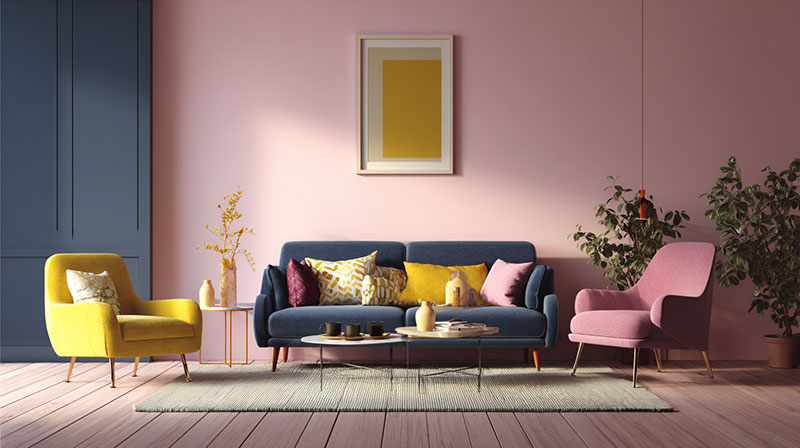
Deep greens, navy and charcoal give light pink something heavier to push against. What they share is a big drop in value from the pink, and that matters more than the hue.
Pink is a high-value color, so any deep partner creates strong separation. That gap is the basis of how contrast works in a room, and it is why these pairings look deliberate instead of sweet.
Sage, olive and emerald green
When Dorothy Draper redecorated the Greenbrier in West Virginia, starting in 1946, green carpeting and plenty of pink became the hotel’s signatures (The New York Social Diary). Her own advice on color was to keep it “honest, fresh, and clear” (Domino).
Sage is muted and calm, which makes it the easiest green for a bedroom, and olive is the earthier option that suits warm, peach-leaning pinks. Emerald is the loud one. It’s saturated and a bit glam, though a pale pink beside it takes some of the edge off.
Navy blue
Navy is the strongest single contrast for light pink.
Pantone’s 2016 Color of the Year was the first time it named two colors at once: Rose Quartz (13-1520) beside the lighter blue Serenity (15-3919). Pantone described the pair as a warmer rose balanced against a cooler blue, and navy pushes that logic darker.
A classic way to use it is a two-tone wall, navy on the lower half (skirting boards included) with pale pink above. For the rest of the scheme, see what else pairs with navy blue.
Charcoal and black
Black works in small doses, such as frames, lamp bases and hardware. Matte charcoal is better on a sofa, a rug or a single accent wall.
Hunker recommends pairing pale pink with black and white for a grown-up makeover, with the black kept to small touches.
It goes wrong when black or charcoal covers every wall of a small, dim room. The pink stops reading as a color and the space closes in.
Terracotta, coral, burgundy and dusty rose: tonal and warm partners
Staying inside the red family is the tonal route. Coral and terracotta warm the pink, burgundy anchors it, and dusty rose or mauve deepens it. It only works if the shades sit at different depths.
| Partner | Effect on light pink | Depth gap |
|---|---|---|
| Coral | Warm, sunny | Small to medium |
| Terracotta | Earthy, grounded | Medium |
| Burgundy | Rich, dramatic | Large |
| Dusty rose or mauve | Soft, layered | Small |
Joa Studholme at Farrow & Ball suggests Setting Plaster walls with Dead Salmon below a dado rail. For a lighter scheme, she pairs the same walls with a Pink Ground ceiling (Farrow & Ball, 2024). Either way you get a tonal room with each shade at its own depth.
Burgundy works the other way round. Mylands pairs light pink with rich burgundy, so the pink becomes the relief instead of the star. The wider set of burgundy color combinations shows what else sits well with it.
Coral is the lively option. A coral cushion or throw against a peach-leaning pink wall warms the room, and coral pairings cover the next layer.
Two pinks that sit too close in depth blur into one. Leave a clear step between them.
Do brass, gold and wood tones suit light pink?
Yes. Brass and gold warm a pink room up, chrome cools it down, and dark woods like walnut give it some weight.
Metals
Brass is the default for pink kitchens and bathrooms. It’s warm without shouting. Gold is glossier and more glam, so keep it to small doses like a mirror frame or a lamp. Copper sits close to salmon pink and blends in instead of contrasting, while chrome runs cooler and matches rosy and lilac pinks.
Mylands pairs warm golden accessories with light pink walls.
Finish counts as much as the metal. Brushed and matte surfaces read quieter against pink, and polished ones read brighter.
Wood tones
Walnut and oak behave differently next to pink.
Walnut is dark and rich, and it gives a pale pink wall a visible anchor. The pairing is a staple of mid-century modern interiors, where walnut, brass and a soft pink sit together easily.
A walnut sideboard or bed frame is a good starting point, and the colors that suit walnut wood fill in the rest of the scheme.
Oak is lighter and more casual. It keeps pink fresh and suits Scandinavian-leaning rooms. Honey-toned oak beside a cool lilac pink is the weak match, because the undertones fight.
How do you split light pink under the 60-30-10 rule?
Where the pink sits in the split decides what goes with it. On walls it takes the 60%. On a sofa or bedding it moves to the 30%, and as pillows or art it drops to the 10%.
| Role of the pink | 60% | 30% | 10% |
|---|---|---|---|
| Wall color | Light pink | Sage, navy or greige furniture and textiles | Brass, walnut, black |
| Sofa or bedding | White or greige walls | Light pink | Deep green or navy, brass |
| Accent only | Neutral walls and floor | Gray or wood | Light pink pillows and art |
In a bedroom, a common way to apply the rule is to put the dominant color on the walls or bedding, the secondary on curtains and throws, and the accent on cushions and trims.
When pink is only the 10%, the other two colors can be as bold as you like.
Homes & Gardens calls the split a guideline rather than a law, and suggests breaking it by adding one extra accent at a time.
Texture does the work the missing colors would do. A pink wall, sofa and curtains in one flat cotton read two-dimensional, so mix velvet, linen, rattan and matte plaster to layer texture through the room.
To check a split before buying anything, a color scheme generator built for rooms shows the colors as proportions.
How do light direction and LRV change a light pink pairing?
North light cools both the pink and whatever sits next to it, while south and west light warm them. LRV tells you how much of that light the wall sends back. A pairing picked from a swatch can look quite different once direction, bulbs and LRV get involved.
Light direction
| Aspect | Light quality | What happens to light pink | Pairing move |
|---|---|---|---|
| North | Cool, indirect, limited | Peach pinks hold, blue- and gray-leaning pinks go cold | Warm partners: cream, brass, terracotta |
| South | Warm, strong, intense at midday | Almost any pink flatters | Cooler partners soften it |
| East | Warm morning, cooler evening | Pink warms early, cools late | Neutrals that hold both |
| West | Cool morning, golden afternoon | Pink glows after midday | Wood and brass amplify it |
Farrow & Ball describes west-facing rooms as cooler in the morning and brighter in the afternoon, with east-facing rooms the reverse. For north-facing rooms, the brand advises avoiding a blue or gray base in lighter tones, and Benjamin Moore’s Helen Shaw likewise advises avoiding gray undertones if you want the room to look brighter.
Sources disagree on north rooms, though. Dulux recommends warm pinks to lift a cool, shadowed north room. Farrow & Ball’s Charlotte Cosby says colors read cooler and harsher there and advises against chasing brightness, favoring saturated tones instead (Domino).
They’re after different things, really. Dulux wants a lighter room and Cosby wants a cozier one. With a light pink I’d go with Dulux and keep the partner warm.
Daylight is only one input to how light behaves in a room across a day.
What LRV tells you
Benjamin Moore measures LRV as the percentage of light a surface reflects, from 0 for black to 100 for white. Values below were listed on the brands’ own sites in October 2026.
- Ballerina Pink (Benjamin Moore 2082-70) comes in at an LRV of 77.64.
- Peach Kiss (Benjamin Moore 2089-60) sits at 72.38, a soft, creamy pink with a hint of peach.
- Charming Pink (Sherwin-Williams SW 6309) is 69.3.
- Farrow & Ball publishes no LRV for its pinks, so any figure you find online is a third-party estimate.
Read together, the Dulux and Benjamin Moore guidance points a north room toward a warm, light pink. Peach Kiss fits that description. The listed values span only 69 to 78, so a pink’s name tells you little about its depth.
Bulbs after dark
Energy Trust of Oregon puts the usual choice at 2700K for living rooms, bedrooms and dining rooms, and around 3500K for kitchens and workspaces.
A warmer bulb flatters peach pinks and brass, whereas the cooler option tends to pull pink toward gray.
Dulux warns that low-energy compact fluorescent bulbs cast a cool violet and pink light that makes subtle neutrals and tints look washed out, so pale pinks and pale partners suffer first. Warm LED and halogen bulbs suit all colors. Whatever you install becomes the ambient lighting the pairing is judged under every evening.
What do the best light pink pairings look like room by room?
Each room pushes the pairing in a slightly different direction. Bedrooms and nurseries want softness, living rooms can carry heavier partners, and bathrooms and kitchens come with hard surfaces that settle the palette before you start.
Bedroom
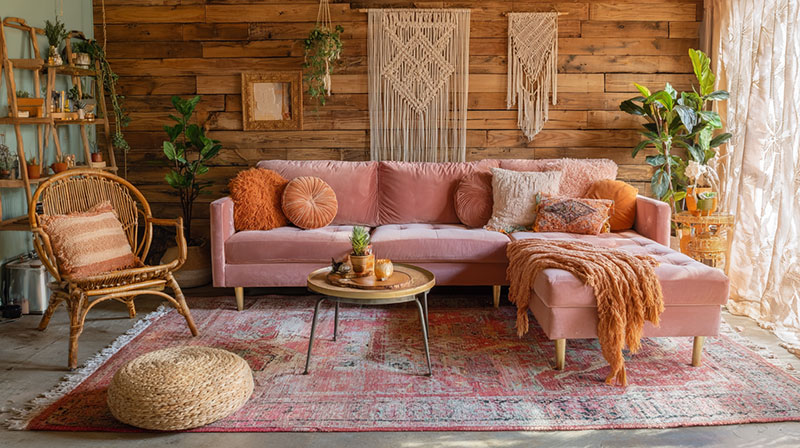
A bedroom can build on a deep blue foundation with light pink beside it. It shows how far a blue partner can go before the pink gets lost.
For more restful options, the guide to calming bedroom colors covers the rest of the range.
Nursery
Keep the walls white or cream and let the pink come in through bedding and a rug. Pale wood furniture works, dark anchors don’t. One soft blue or sage textile at most.
Low contrast is the point here.
Living room
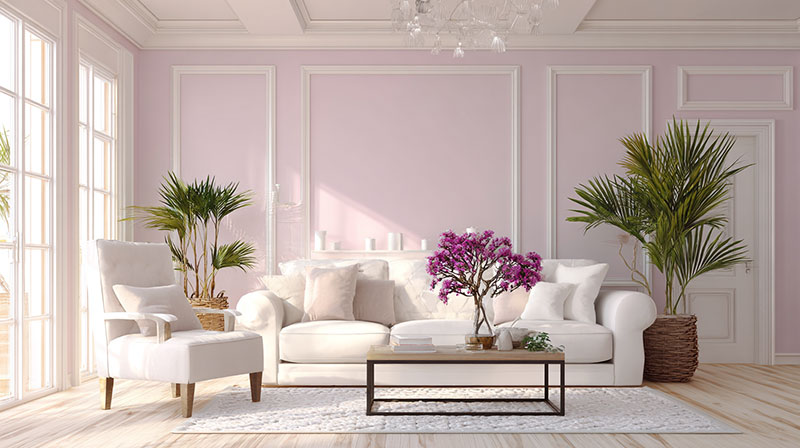
A blush sofa against rich blue walls is an easy way to keep a pink living room from reading overly feminine.
A more maximal version puts pink on the ceiling and trim, with sage and aubergine alongside and pattern everywhere else.
Bathroom
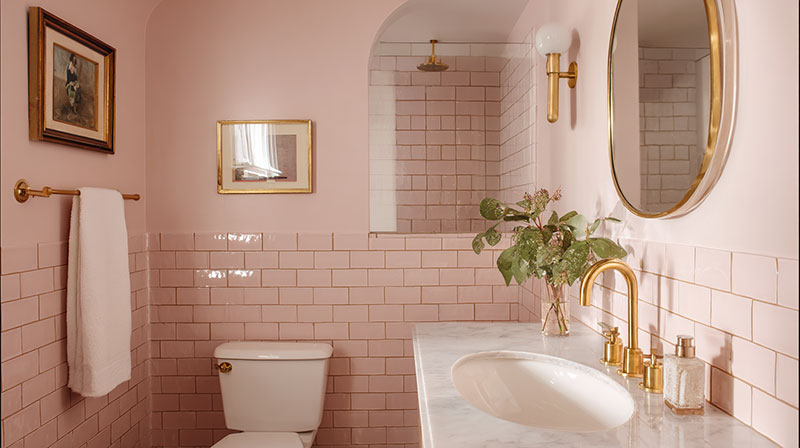
Hard surfaces set the palette here. White basins, tile and fixtures leave fabric little room to rebalance a pink.
A green-and-pink bathroom takes black accents well, such as a mirror frame, faucet and pendant light over a white basin. Homes & Gardens notes that pink on every wall reads more modern than a single accent wall, and the list of best bathroom wall colors shows where pink sits among the alternatives.
Kitchen
Pink cabinets go well with white counters, a wood floor, and rattan or metal stools. A pale pink island against cabinets in a darker tone is another option.
With pink walls, the cabinets stay white or wood and one accent does the talking, like the bold pendant lights over the island in the pink Boston kitchen Apartment Therapy features.
When do light pink pairings fail, and how do you test them first?
Mostly they fail for ordinary reasons. Everything sits at the same depth, someone judged a small chip instead of a wall, or the light changed the pink after painting. A sample test across one full day catches most of it.
Where pairings fail
Undertone clash is still the most common failure, and a side-by-side swatch exposes it first.
Light pink, pale blue and mint at similar LRV read as candy, not as a scheme. The fix is a single deep anchor (charcoal, navy or olive) plus one natural material.
Judging from a chip is the other trap, since a small swatch looks very different across a full wall, according to experts quoted by AOL Lifestyle.
How do you keep light pink from looking childish?
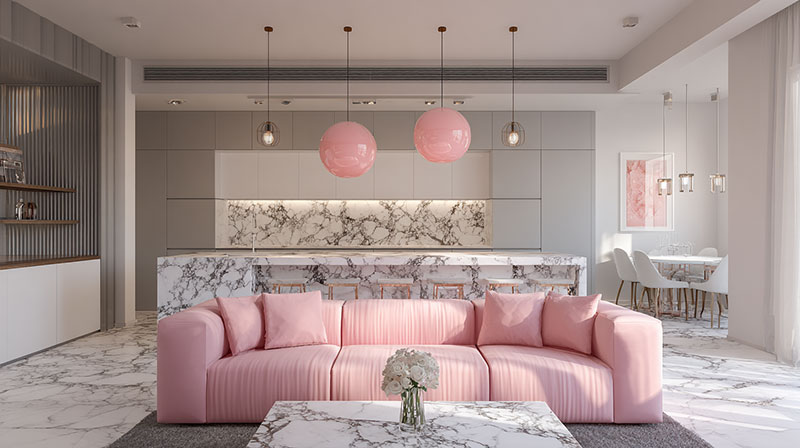
Bubblegum pink, a matched pastel set, glossy plastics and cartoon prints all push a room toward childish. Going muted or dusty, adding one deep anchor, and sticking to natural materials and matte finishes pulls it back toward grown-up.
Saturation and contrast decide it, not the color name.
How to test a pairing before painting
- Paint two coats of each candidate pink on white foam core board, as Benjamin Moore advises, so the old wall color cannot skew the result.
- Lay the partner swatch, a fabric and the metal finish beside each board.
- Tape boards to every wall, including the darkest corner and the window wall.
- Check morning, afternoon and evening under the bulbs you actually use.
- Repeat over two or three days before deciding.
- Order paint once the pair holds up, using a room paint calculator to size the quantity for each wall.
Common Questions About Colors That Go With Light Pink
What curtain and furniture colors go with light pink walls?
Warm white or linen curtains keep pink walls light, while sage curtains add contrast. For furniture, walnut, gray or navy upholstery anchors the room.
Pick curtains one step lighter or darker than the wall so they do not disappear against it.
Do yellow and lilac go with light pink?
Yes to both. Mustard and butter yellow warm a pink, and a pale lilac sits beside it as a soft neighbor.
Keep yellow to an accent such as a lamp or cushion.
Can a ceiling be painted light pink?
Yes. A pale pink ceiling over white, cream or greige walls reads as a soft glow instead of a second wall color.
The ceiling should stay lighter than the walls.
Does light pink make a room look bigger or smaller?
Bigger, as a rule. Indigo Paints says light pink generally makes a room feel more open and airy, not smaller.
The effect depends on depth. A high-LRV pink reflects more light, while a dusty, darker pink absorbs it and makes the room feel snugger.
Is blush pink still in style?
Yes. Dusty blush shades, the end of light pink often called millennial pink, remain popular, and Homes & Gardens lists Farrow & Ball’s Setting Plaster among that brand’s best sellers.
Which Light Pink Pairing Should You Sample First?
Start with the partner that matches the undertone of the pink. Among colors that go with light pink, that pairing costs least to test and holds up best when the light changes.
Order the decisions by how hard they are to reverse. Fixed surfaces like floors, counters and large furniture come first, then one neutral or green that shares the pink’s undertone, and metals and textiles last.
Fixed surfaces cannot be repainted, so they set the undertone the pink must meet. Brass hardware and cushions are the cheapest items to swap, so they come after the paint is settled.
The warm route has a cost. A peach pink with cream, olive and brass gives up the crisp edge of cool gray and navy, so the room ends up softer and a little less sharp.

- Kitchen Color Schemes by Cabinet Color: What Pairs Well - October 19, 2026
- Curtain Colors for Every Wall Color: Safe vs Bold Picks - October 18, 2026
- Interior Design Styles: Find Your Primary and Secondary - October 14, 2026