Mid-Century Modern Design: Furniture, Colors and Room Ideas That Work Today
Mid-century modern design is the furniture, interior and architectural style of the postwar decades, roughly the mid-1940s to the late 1960s, known for clean lines, low profiles, warm wood and function before ornament.
Its signatures are tapered legs, molded plywood and fiberglass seating, teak and walnut, sculptural lighting and large windows that connect the room to the outdoors. Designers such as Charles and Ray Eames, Eero Saarinen, Isamu Noguchi and Hans J. Wegner shaped it, and the name itself was popularized later, by a 1984 book.
This page begins with what the style is, then covers its designers and iconic pieces, color and lighting, the rooms you are most likely to furnish, and two architectural features of the era.
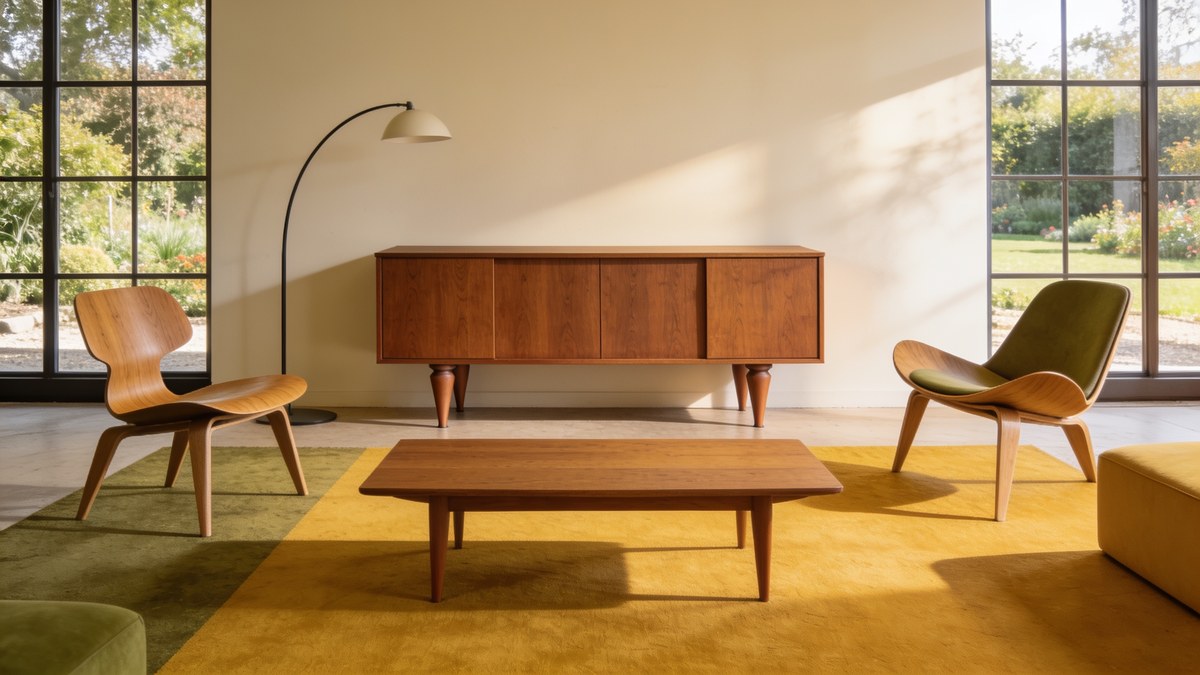
What makes a room mid-century modern?
These are the details that carry the style, each with the guide that explains how to get it right.
| Element | What to look for | Full guide |
|---|---|---|
| Furniture lines | Low, clean-lined pieces raised on tapered legs, with little or no ornament | Mid-century modern living room |
| Color | Warm neutrals and natural wood as the base, with a few saturated accents | Mid-century modern color palette |
| Lighting | Lamps treated as objects: sputnik chandeliers, arc and tripod floor lamps, sculptural pendants | Mid-century modern lighting |
| Seating | Molded shells and steam-bent wood frames from named designers and producers | Mid-century modern furniture designers |
| Dining chair | A steam-bent top rail, a Y-shaped back and a woven paper cord seat | Wishbone chair |
| Coffee table | A glass top resting on a sculptural wooden base | Noguchi coffee table |
| Pattern | Atoms, orbits and starbursts on lamps, wallpaper and dinnerware | Atomic age decor |
| Fireplace | A wide, low firebox set into Roman brick, slate or glazed tile | Mid-century modern fireplaces |
What is mid-century modern?
The definition, the space-age branch of the style, and how it compares with the style that came before it.
-

What is mid-century modern
Get the full picture of the style: its origins, materials, palettes, furniture, architects and the indoor-outdoor link that defines it.
-

Atomic age decor
Recognize the atom, orbit and starburst motifs of this mid-century branch, and use a few space-age pieces without the room feeling themed.
-

Mid-century modern vs Art Deco
Compare the two styles side by side, choose the one that suits your room and habits, or mix them in one space.
Designers and iconic pieces
Knowing who designed what, and who makes it now, helps you buy the right piece at the right price.
-

Mid-century furniture designers
Meet the American, Nordic and European designers behind the era, then decide between an original, a licensed reproduction or a replica.
-

Noguchi coffee table
Understand how the two-piece base and glass top work, compare Herman Miller and Vitra versions, and spot a replica before buying.
-

Wishbone chair
Learn how Wegner's dining chair is built, which woods and finishes it comes in, and whether it suits daily use.
Colors and lighting
Two choices that decide whether a room reads as mid-century or just old.
-

Mid-century modern color palette
Build a palette from warm neutrals, wood tones and a few saturated accents, with paint matches and room-by-room examples.
-

Mid-century modern lighting
Choose pendants, sputniks, arc lamps and sconces by room, set pendant heights, and decide between vintage and reproduction fixtures.
Mid-century modern rooms
Room guides with layouts, furniture choices and what to buy first.
-

Living room ideas
Plan a living room around low furniture and warm wood, with layout, lighting, rug and buying advice for every budget.
-

Dining room ideas
Pick a table, chairs, pendant and sideboard that work together, with clearances for the table, rug and walking space.
-

Home office ideas
Set up a mid-century office that survives a full workday, starting with a chair that swivels and adjusts, then desk and storage.
-

Entryway ideas
Measure first, then choose a console, mirror, lighting and finishes that fit a ranch, split-level or apartment entry.
Fireplaces and sunken living rooms
Two built-in features of the era that people still want to keep, restore or add.
-

Mid-century modern fireplaces
Choose a fireplace type, surround and fuel for your room, update an original without losing its character, and check clearances first.
-

Conversation pits
Decide whether to keep, fill in or add a sunken seating area, with the building code rules and modern alternatives to weigh.
Common questions
What years are considered mid-century modern?
Most references date the style to the postwar decades, roughly from the mid-1940s to the late 1960s. Some designs that define it, including early molded plywood work, appeared a little before that.
What are the main features of mid-century modern design?
Clean lines, low profiles, tapered legs, warm woods such as teak and walnut, and new materials like molded plywood and fiberglass. Rooms favor function over ornament and often use large windows to connect inside and outside.
Who are the best-known mid-century modern designers?
Charles and Ray Eames, Eero Saarinen, George Nelson and Isamu Noguchi are the best-known American names. Hans J. Wegner and Arne Jacobsen are among the Danish designers whose pieces are central to the style.
Is mid-century modern the same as Scandinavian design?
No, but they overlap. Danish and other Nordic designers of the same postwar period are part of mid-century modern, while Scandinavian interior design is a broader style built around light colors, pale woods and daylight.