Art Deco Interior Design: Colors, Motifs, Furniture and Rooms Explained
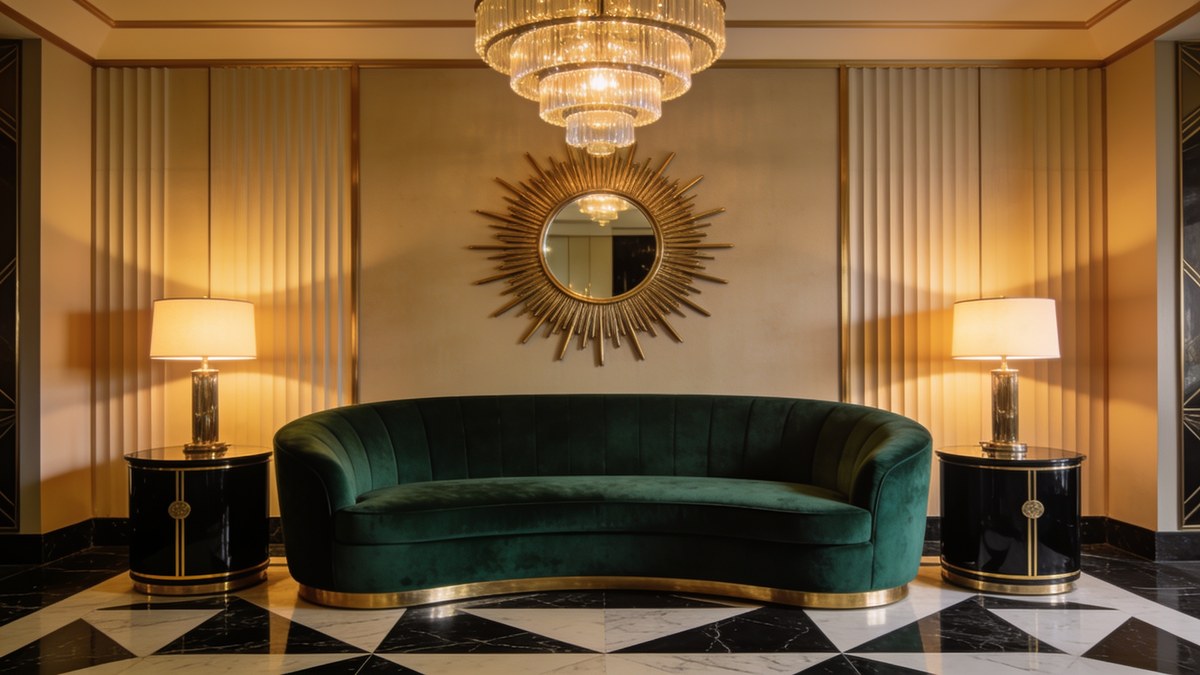
Art Deco interior design is the decorative style of the 1920s and 1930s that combines geometric ornament, strict symmetry and luxurious materials to look modern and glamorous at the same time.
It took its name from the 1925 Exposition internationale des arts décoratifs et industriels modernes in Paris, although the label itself only caught on in the 1960s. You can recognize it by sunbursts, chevrons, zigzags and stepped forms, by black and deep navy set against gold and emerald, and by lacquer, exotic veneers, chrome and polished brass.
This page starts with what the style is and where it came from, then moves through its patterns, its colors, its furniture, floors and trim, and finally the rooms where it works best at home.
How do you spot Art Deco in a room?
Use this as a quick checklist, then open the full guide for any element you want to get right.
| Element | What to look for | Full guide |
|---|---|---|
| Overall look | Symmetry, repeated geometric ornament and glossy, luxurious surfaces | What is Art Deco interior design |
| Shapes | Chevrons, zigzags, sunbursts, fans and stepped forms repeated across surfaces | Geometric shapes in Art Deco |
| Color | Black or deep navy as the base, with gold, emerald and burgundy accents | Art Deco color palette |
| Wall paint | Saturated jewel tones such as emerald, navy, deep teal and plum, softened with cream or blush | Art Deco paint colors |
| Furniture | Stepped or streamlined silhouettes in exotic veneers, lacquer, polished metal and glass | Art Deco furniture characteristics |
| Floors | Terrazzo, stone or wood with contrasting materials inlaid flush in geometric patterns | Art Deco floor inlays |
| Trim | Stepped cornices, fluting and reeding, often hiding indirect lighting behind a ceiling step | Art Deco moldings |
| Pattern on fabric and paper | Flowers reduced to a few bold, symmetrical shapes in flat color | Art Deco floral patterns |
What is Art Deco and where did it come from?
Start here for the definition, the history and the buildings that made the style famous.
-

What is Art Deco interior design
Learn the defining features, colors, materials and furniture of the style, and how to bring it into a modern home without overdoing it.
-

1920s interior design style
See how Art Deco sat alongside Craftsman, period revival and early modernist rooms, with a room-by-room guide to recreating the decade.
-

Art Deco vs mid-century modern
Compare shapes, materials, palettes and designers so you can choose between the two styles or mix them in one room.
-

Famous Art Deco buildings
Find the landmark skyscrapers, cinemas and hotels worth visiting, from New York to Miami Beach and beyond, and learn how to recognize the style.
-

Stepped forms in architecture
Understand how New York zoning rules produced the tiered tower silhouette and how the stepped motif moved into ornament.
Which patterns and motifs define Art Deco?
Art Deco ornament comes from a small set of shapes. These guides explain each one and where it belongs.
-

Geometric shapes in interiors
Match each Art Deco shape to the right surface and material, and keep symmetry and repetition working in a modern room.
-

The Art Deco sunburst
Trace the sunburst from the Chrysler Building to Radio City, learn its materials, and tell a true Deco sunburst from a lookalike.
-

Chevron patterns
Tell chevrons apart from zigzag and herringbone, and decide where inverted V bands work on floors, borders and textiles today.
-

Zigzag patterns
Learn what the zigzag meant to Deco designers, which buildings show it best, and how to identify or reproduce an authentic one.
-

Stylized floral patterns
See how Deco designers simplified roses and other flowers into flat, symmetrical shapes, and how they differ from Art Nouveau florals.
Art Deco colors and paint
The palette relies on strong contrast. One guide covers the color theory, the other the paint.
-

Art Deco color palette
Build a high-contrast palette of darks, metallics and jewel tones for a room or brand, with color values and tested combinations.
-

Popular Art Deco paint colors
Pick jewel-tone wall colors, choose the right finish, and learn why the Miami Beach pastels are a later restoration palette.
Furniture, floors and trim
These pieces carry the style most clearly, whether you buy vintage, restore originals or install new.
-

Art Deco furniture characteristics
Recognize Deco silhouettes, veneers and inlay, compare French, American and British pieces, and judge whether a piece is authentic.
-

Art Deco floor inlays
Compare terrazzo, wood, stone, linoleum and brass inlay, and decide between restoring an original floor or installing a reproduction.
-

Art Deco decorative moldings
Choose stepped cornices and casings by room, pick plaster, wood or polyurethane, and install or restore trim without visible gaps.
Art Deco rooms at home
Two rooms where the style is easy to try without committing the whole house.
-

Art Deco hallway decor
Plan a Deco hallway with checkerboard floors, brass sconces, mirrors and gloss walls, including a decorating order for narrow spaces.
-

Art Deco kitchen elements
Choose cabinets, backsplashes, lighting and hardware for a Deco kitchen, and decide between a period-accurate or modern take.
Common questions
What is Art Deco interior design?
Art Deco is a decorative style of the 1920s and 1930s built on geometric ornament, symmetry and luxurious materials such as lacquer, exotic wood veneers, chrome and brass. It took its name from the 1925 Paris Exposition internationale des arts décoratifs et industriels modernes.
What is the difference between Art Deco and Art Nouveau?
Art Nouveau came first and uses flowing, curving lines taken from plants and nature. Art Deco replaced those curves with straight lines, symmetry and geometric shapes such as chevrons, zigzags and sunbursts.
What colors are typical of Art Deco?
The classic palette is high contrast: black or deep navy as the base, with gold, silver or brass and jewel tones such as emerald and burgundy as accents. The pastel facades of Miami Beach are a later restoration scheme, not the original palette.
How can I add Art Deco style to a modern home?
Start with one strong element, such as a sunburst mirror, a pair of brass sconces or a geometric floor, and keep the rest of the room simple. Symmetry and a restrained palette do more for the look than filling a room with period pieces.