Color Combinations
Colors That Go With Maroon When Decorating a Room
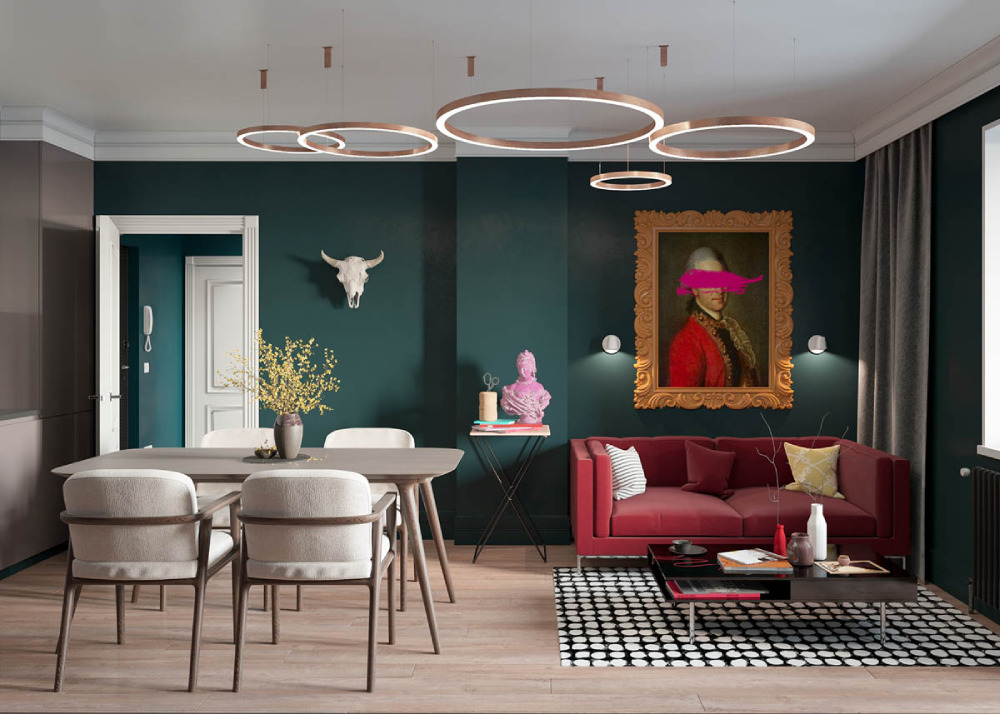
Cream, gray, gold and navy are the colors that go with maroon most reliably in interior design. Forest green, teal, blush pink and white sit just behind them. Maroon runs warm and leans brown, and these are the shades that settle it down without competing for attention.
It makes little difference whether the maroon is on a wall, a sofa, a rug or curtains. The pairings carry over.
The W3C CSS Color Module defines maroon as #800000, a red with no blue channel at all. Canva’s color reference puts burgundy at #800020. That blue value of 32 pushes it toward wine, which is why palettes written for burgundy tend to run cooler.
For the same kind of pairings with other shades, see our guide to color pairings by shade, wood tone and room.
For the same kind of pairings with other shades, see our guide to home color combinations.
Which Colors Go With Maroon?

Start with cream, gray, gold and navy. Forest green, teal, blush pink, white and black all work after that, and mustard works only if you keep the amount small.
| Pairing | Effect | Watch for |
|---|---|---|
| Cream and beige | Softens the red, warm and traditional | Flat without texture |
| Light gray and charcoal | Modern, cooler balance | Blue-leaning grays fight the brown base |
| Gold and brass | Regal, high-contrast metal | Too much reads staged |
| Navy and teal | Cool contrast that steadies the warmth | Equal amounts compete |
| Forest green | Near-complement, rich and classic | Dark on dark in dim rooms |
Nippon Paint, Berger Paints and Designingidea all agree on warm neutrals and gray, with gold on top. The bolder colors are where they start to disagree.
Before buying paint, a color scheme generator for rooms shows how a pairing looks next to your own wall color.
How Maroon’s Undertone Sets the Palette
Maroon carries a brown undertone and burgundy carries a purple one. That small difference changes which colors look right beside either.
Maroon Versus Burgundy
On screen the gap is tiny, so the numbers are worth a look.
Maroon is #800000, or RGB 128, 0, 0, a named color in the W3C CSS Color Module Level 3. Burgundy in Canva’s reference is #800020, the same red channel with a blue value of 32 added. Dark red (#8B0000) and firebrick (#B22222) are the nearest reds, per Canva. Then there’s marsala, Pantone 18-1438, the 2015 Color of the Year, an earthy wine red with red-brown roots (Pantone, 2014).
A brown-leaning maroon goes best with warm, earthy partners like cream, gold, tan and walnut. Wines that lean purple read cooler, and they take gray and silver more easily, or a dusty rose.
If your swatch tips toward purple, you’re really in burgundy territory and the best partners shift. A separate rundown of burgundy pairings covers that side.
Farrow & Ball’s Eating Room Red sits right at that purple end. The brand describes a rich burgundy that looks almost like a saturated purple next to the more modern Incarnadine. Independent paint databases give it an LRV (light reflectance value) of roughly 11 to 12 on a 0 to 100 scale.
What the Color Wheel Says About Maroon Partners
Sources disagree on maroon’s complement, and each answer shows up in real rooms. Canva names teal. Designingidea lists yellow and green, depending on the hue. Artincontext treats green as the complement and teal as a split complement.
Which wheel you use explains most of it. A digital RGB wheel puts teal opposite #800000, while a traditional painter’s wheel puts green opposite red.
For the mechanics behind these answers, a primer on how color theory works in interiors explains complements, analogous sets and split complements.
In an actual room the verdict is the same either way. Deep green and teal both hold up beside maroon, and yellow needs care.
Neutral Colors That Work With Maroon
Warm neutrals do the most for maroon. Cream, ivory and beige soften it, and white brightens it. Gray, whether light or charcoal, makes it feel modern, while black takes it somewhere more dramatic.
Cream, Ivory and Beige
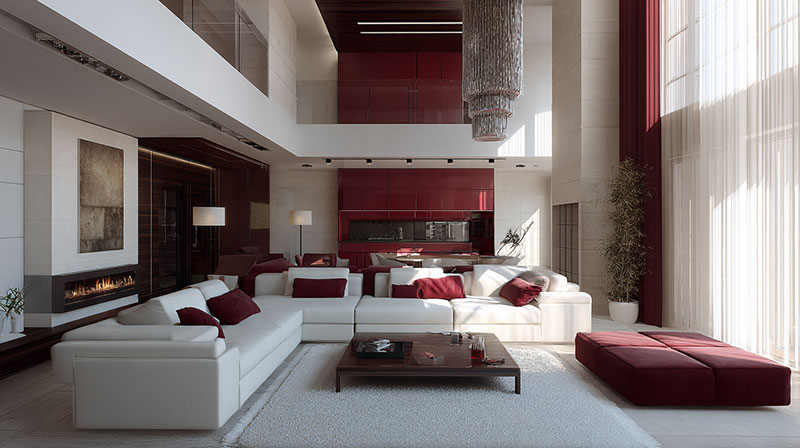
Cream beats pure white in most maroon rooms. It shares the warm undertone, so nothing fights, and it reads as classic comfort in living rooms and bedrooms. Beige is quieter and suits rooms where maroon only shows up as an accent. Ivory sits a step lighter and stays warm.
Berger Paints suggests painting one wall maroon and keeping the rest beige for a balanced contrast.
White
White gives maroon the cleanest backdrop and the sharpest contrast.
Berger Paints proposes three white walls with one maroon wall for a bold but airy room, and Interior Company puts burgundy cabinets in an otherwise white kitchen.
Trim and molding deserve a thought here. Warm white trim usually sits softer against maroon walls than bright white, which draws a hard line along every edge.
Gray and Charcoal
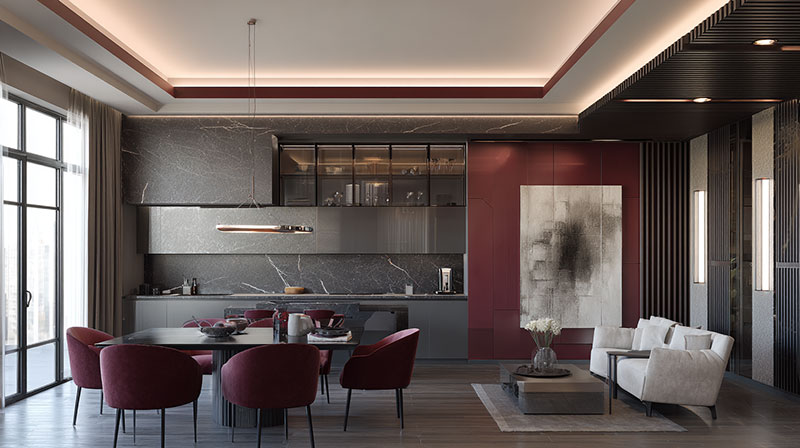
Gray modernizes maroon. Nippon Paint says gray tones bring out maroon’s depth, and Birla Opus suggests gray walls accented with maroon rugs, bedspreads and pillows.
Pick a gray with a warm cast, and check what else suits gray before adding another color.
Light gray feels airy and modern and is easier in small rooms. Charcoal is formal and heavier, so it needs light fabrics nearby.
Black
Black is the boldest neutral partner, and without a light buffer like cream or white the maroon sinks into it.
I’d use black on frames, hardware and furniture legs rather than on a large wall beside maroon. A rundown of colors that pair with black covers the buffer shades.
Which Accent Colors Work With Maroon?
Cool blues and deep green give maroon the strongest contrast, blush pink softens it, and mustard is the risky one.
Navy and Teal
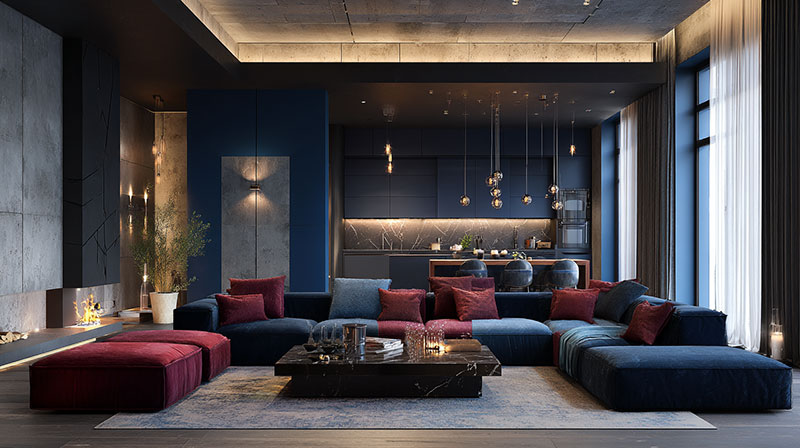
Cool blues steady maroon’s warmth. Roomdsign says navy’s cool undertone balances the warm red and adds depth and drama.
The catch is ratio. Artincontext warns against giving navy and maroon equal share and says to pick one as the base and use the other as a pop of color, such as blue walls with minimal maroon décor. A list of what pairs with navy blue helps when a further color enters.
Teal is the brighter route. Canva lists it as maroon’s complement, and Roomdsign pairs teal walls with maroon furniture, noting that the cool teal tones down maroon’s warm hues. The colors that suit teal help with the next shade.
The contrast deepens a room nicely. Equal amounts of the two will compete, though, so one of them should clearly lead.
Forest Green

Forest green is the safest bold color for maroon. Artincontext places green at the center of the split-complementary scheme, and Berger Paints says dark forest green or emerald gives maroon a regal, elegant look.
Berger Paints goes further with deep green walls and maroon trim.
It’s classic, rich and forgiving in traditional rooms. The downside is that dark green beside dark maroon feels closed in without daylight or warm lamps.
Blush Pink
Blush pink is the soft option, and bedrooms are where it works best. Nerolac suggests cream or pink with maroon in bedrooms, and Berger Paints puts soft pink on the main walls with one maroon accent wall.
It lightens the room without leaving the red family. A very saturated pink reads sweet, so a dusty rose with a gray cast is the better pick.
Mustard and Yellow
Sources split on mustard. Interior Company calls maroon and mustard a positive pairing, and Nerolac lists yellow and maroon among its combinations. Roomdsign disagrees, calling both colors tricky and the pairing hard to pull off.
The difference usually comes down to ratio and saturation. Keep mustard to small pieces such as a cushion or a lamp, and hold a swatch against the maroon in your own light first.
How to Use Gold, Brass, Wood and Velvet With Maroon
Treat metals and wood as accents and let fabric handle the texture. Gold and brass warm maroon, dark wood grounds it, and velvet gives a flat dark red some depth.
Gold, Brass and Copper
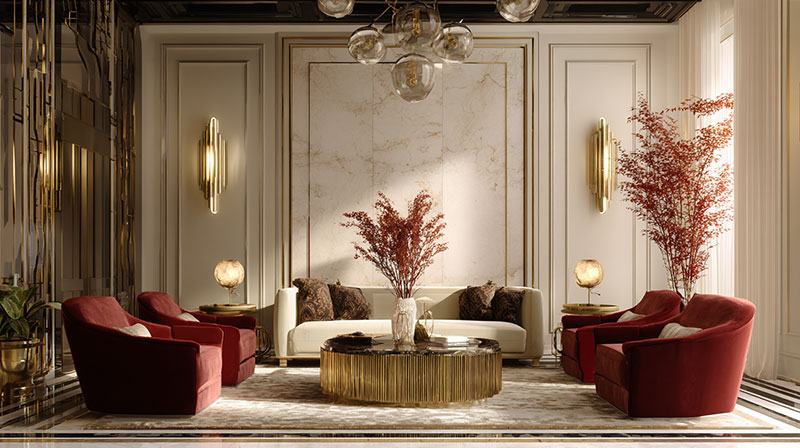
Gold is the classic partner. Designingidea ties maroon walls with gold curtains to Baroque, French and Rococo interiors.
Brass works on hardware, lamp bases and frames. Gold suits curtains, borders or a mirror. Berger Paints points to copper for kitchens and lofts.
Keep gold to a couple of touches per room, since gold on every surface looks staged.
Gold has its own best partners too, and a look at what else goes with gold helps with the next hue.
Wood, Leather and Velvet

Dark wood shares maroon’s brown base, which is why it works. Hunker features a living room by Nong Studio that pairs deep maroon with dark wood tones, and Berger Paints suggests maroon walls with dark brown wooden furniture.
Brown or tan leather follows the same logic.
Velvet changes how the color reads. Pantone’s 2014 Marsala announcement said the wine red looks richer on textured surfaces and pointed to rugs and upholstered furniture.
A maroon velvet sofa against plain cream walls often reads richer than the same color flat on a wall. Why texture shifts a deep color this way is covered in a guide to texture in interior design.
Balancing Maroon With the 60-30-10 Rule
Maroon can fill any slot in the 60-30-10 rule, but its weight changes what each slot looks like. According to Bob Vila, the rule splits a room into 60 percent dominant color, 30 percent secondary and 10 percent accent.
Where Maroon Fits in the Ratio
| Slot | Share | Maroon in this slot |
|---|---|---|
| Dominant | 60% | Painted walls or a large rug, the heaviest use |
| Secondary | 30% | Sofa, curtains or one accent wall |
| Accent | 10% | Pillows, throws, art, a single chair |
Most of the pairings above fit the 30 and 10 slots. A warm neutral or gray usually takes the 60.
Maroon Walls or Maroon Furniture
Maroon walls give the strongest atmosphere and the least flexibility. They need light fabrics and pale floors as a counterweight, and Nippon Paint suggests curtains, cushions or rugs when full walls feel too intense.
Maroon furniture leaves the backdrop to neutral walls. It’s also easier to change later, since upholstery swaps faster than paint.
Dark walls carry heavy visual weight, and spreading that weight across a room is the core of how visual balance works in interior design.
Build the Palette Step by Step
- Pick the undertone, either a brown-leaning maroon or a purple-leaning wine.
- Choose the 60 percent backdrop, a warm neutral or gray.
- Decide whether maroon takes the walls, the sofa or the textiles.
- Add one metal, gold or brass, as part of the 10 percent.
- Add one contrast color, such as navy, teal or deep green.
- Test swatches in morning, afternoon and evening light.
If maroon takes the walls, a room paint calculator sizes the order before you buy.
How Does Lighting Change Maroon?
Room direction and bulb temperature decide how maroon reads. North light turns it darker and cooler, while south light and warm bulbs keep it rich.
Natural Light and Room Direction
Sue Wadden, Sherwin-Williams’ director of color marketing, recommends considering the presence and direction of natural light before choosing a final color.
| Direction | Light quality | Maroon result |
|---|---|---|
| North | Least light, cooler | Reads darker and cooler |
| South | Consistent, warm | Stays rich, holds depth |
| East or west | Shifts through the day | Changes by the hour |
More on how daylight shapes a room sits in this guide to light in interior design.
Sources disagree on dark colors in north rooms. Sherwin-Williams steers north-facing rooms toward higher LRV colors, while Decorating Centre says deep blue, teal or black can look dramatic in crisp north light.
For maroon, the safer read is Sherwin-Williams. Keep maroon to one feature wall in a north room and let cream or white carry the rest. Decorating Centre adds that red undertones maximize warmth in a smaller south-facing room, which suits maroon well.
Bulb Color Temperature
ENERGY STAR’s consumer bulb guide (2009) runs the Kelvin scale from 2700K warm white to 6500K daylight, with 2700K matching an incandescent bulb.
Lampwise says warm white light makes reds and oranges look more vivid, while cool white favors blues and greens. It places warm white at 2700K to 3000K, which is the range to stay in for a maroon room.
A dark wall also absorbs light, and Paint Outlets notes that low-LRV rooms need more artificial lighting. An LED light requirement calculator gives a starting lumen count for the extra fixtures.
Matte Versus Glossy Paint
Matte and eggshell absorb light and hide wall imperfections, and they show the deepest color. Semi-gloss and gloss reflect light and show every flaw, so they belong on trim, doors and cabinets.
Toolstation points out that dark, rich colors look glossier than they are, so a flatter finish suits them. Eggshell on the walls with semi-gloss on the trim is the usual split, and 360 Painting lists semi-gloss for trim and molding.
Best Maroon Color Combinations by Room
Room function decides how much maroon goes in and which surface carries it.
Living Room

Living rooms hold both walls and large furniture, so they take the widest range of palettes.
Hunker shows one with light blue walls, white curtains and plenty of daylight balancing maroon, cobalt blue and olive green.
For a maroon sofa, Roomdsign lists pure white, soft gray and beige as the safe walls, teal and navy as the bold ones, and dusty rose or lilac as the soft ones.
If the sofa is the only maroon piece, a feature wall in a second color is an option. Ideas for living room accent wall colors help pick it.
Bedroom
A bedroom follows the 60-30-10 split by layer, according to Molly Freshwater of Secret Linen Store, quoted in Country & Town House. Walls or bedding take the dominant share, curtains and throws take the secondary one, and cushions and trims make up the accent.
With maroon, bedding is the easiest layer to commit to. A duvet cover changes faster than wall paint.
Dining Room
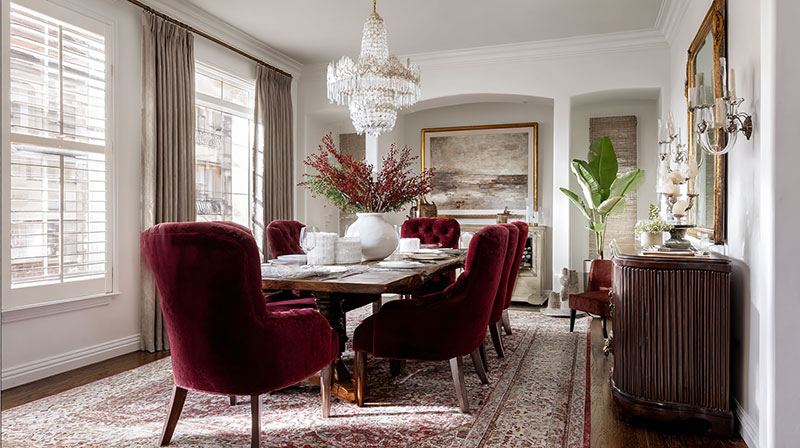
The dining room is where maroon sits most naturally. Pantone’s Leatrice Eiseman called Marsala a natural fit for the kitchen and dining room in 2014, ideal for tabletop pieces and linens.
Start with napkins, a runner or glassware before painting a wall.
Kitchen
A maroon island or set of lower cabinets with cream uppers keeps the room from feeling heavy.
Bulb choice gets a little awkward here. ENERGY STAR’s guide (2009) calls cool white good for kitchens and workspaces, but Lampwise says cool light favors blues and greens over reds. ENERGY STAR places 3000K at the top of its warm and soft white range and 3500K in its cool white range, so about 3000K is the compromise for maroon cabinets.
Bathroom
Use maroon in small doses here, say a vanity, a towel set or a mirror frame, with brass or chrome fixtures. The best colors for bathroom walls cover the backdrop.
Moisture is the catch. Benjamin Moore’s Sharon Grech points to Aura Bath and Spa as the brand’s most durable matte for bathrooms and kitchens.
When Does a Maroon Palette Not Work?
A maroon palette fails when the room has too little light, too much dark color, or a finish that fights the shade.
| Situation | What goes wrong | Fix |
|---|---|---|
| Small room, one window | Walls feel close, shade reads near black | Maroon on one wall, cream elsewhere |
| Purple-leaning accent on brown-leaning maroon | Undertones clash | Match the lean or switch to a neutral |
| Gloss on a large wall | Glare and visible flaws | Matte or eggshell |
| Maroon beside another dark color | Contrast disappears | Add a light buffer such as cream |
Small Rooms and Dark Walls
Sources split here. Benjamin Moore’s Helen Shaw and Sharon Grech both say dark colors blur a room’s edges and can make a space look larger.
Kylie M Interiors says dark colors generally advance and make walls feel closer, while admitting they also blur corners. Both can be true, which is why a swatch test in your own room beats any rule.
For lighter options in a tight space, see the best colors for small rooms.
Common Questions About Colors That Go With Maroon
What color curtains go with maroon walls?
Gold or cream are the dependable choices. Gold gives a formal, traditional look, while cream or white sheers let daylight in so the maroon does not close the room.
How do you choose a rug for a room with maroon walls?
Hunker recommends starting with a patterned rug that repeats maroon alongside colors already in the room.
On maroon walls, a cream, beige or gray rug lightens the floor and lets the walls stand out.
Which ceiling color suits maroon walls?
Warm white or cream. Maroon walls absorb light, so a pale ceiling bounces some of it back into the room.
Bright white works too, but it sits harsher against dark walls.
Which countertops and backsplash go with maroon kitchen cabinets?
Counters in white or cream with a pale tile backsplash keep maroon cabinets from feeling heavy. Butcher block adds warmth, and brass or copper hardware picks up the red.
Does purple go with maroon?
Yes. Nerolac and Berger Paints both list purple among maroon pairings, and Designingidea adds mauve and rose.
Choose lighter, dustier purples such as lilac or mauve so the two dark colors do not blur together.
Is a maroon interior outdated?
No. Asian Paints, Godrej Properties and Nerolac still publish maroon palettes for modern homes, and Nerolac recommends gold or copper accents to lift it.
Dated rooms come from matching sets and gold on every surface, not from the color itself.
Testing Maroon Pairings Before You Buy
Colors that go with maroon should be tested as physical swatches under the room’s own bulbs before any paint or furniture is bought. A swatch judged at noon says little about the same wall at 9 p.m.
Sherwin-Williams advises treating a low-light room lit by warm bulbs like a south-facing room, and one lit by cool white bulbs like a north-facing room. In those rooms the bulb, not the compass direction, sets the conditions.
Fix the bulbs first, then check swatches in morning light and again in the evening. Buy cushions and throws before paint.
Bulbs come first because they change every later result, and cushions come before paint because a cushion returns more easily than a painted wall. The cost is time, since checking the light properly takes a full day.
Once a shade holds up, a paint calculator sizes the order.

- Kitchen Color Schemes by Cabinet Color: What Pairs Well - October 19, 2026
- Curtain Colors for Every Wall Color: Safe vs Bold Picks - October 18, 2026
- Interior Design Styles: Find Your Primary and Secondary - October 14, 2026