Color Combinations
What Color Bedding Goes with Gray Walls

Gray walls do not come with a single bedding answer. They come with dozens, and the wrong choice exposes undertones you never noticed before.
Figuring out what color bedding goes with gray walls starts with one question most people skip: is your gray warm, cool, or true neutral? That single variable changes everything.
This guide covers bedding color pairings for every gray type, from light gray to dark charcoal, including which colors to avoid, how fabric texture shifts color perception, and how room lighting changes the whole equation.
For wall and accent colors to go with it, see our complete color combination guide.
What Gray Wall Tone You Have Changes Everything
Gray is not one color. It is a family of dozens, and each member behaves differently depending on the light source, room orientation, and the finishes surrounding it. Get this wrong, and the bedding you chose will either fight the wall or disappear into it.
The 3 gray categories that matter for bedding decisions are cool gray, warm gray, and true neutral gray. Every bedding color decision starts here.
How to Identify Cool Gray vs. Warm Gray
Cool gray carries blue, violet, or green undertones. Sherwin-Williams Repose Gray (LRV 58) sits in this category, reading slightly blue-violet depending on light exposure. Benjamin Moore Gray Owl (LRV 66) leans blue-green in north-facing rooms.
Warm gray pulls toward beige, taupe, or earthy green. Sherwin-Williams Agreeable Gray (LRV 60) is technically a greige, meaning it carries enough warmth to read brown in certain lighting. Benjamin Moore Revere Pewter (LRV 55) has a notable earthy green undertone.
3 quick ways to check your gray’s undertone:
- Hold a bright white card against the wall in natural light. The color that shows up next to it is the undertone.
- Take a photo with your phone. Slightly desaturate the image in editing. The remaining hue is the dominant undertone.
- Check the paint chip strip. The darkest version on the same strip shows the undertone most clearly.
What True Neutral Gray Looks Like
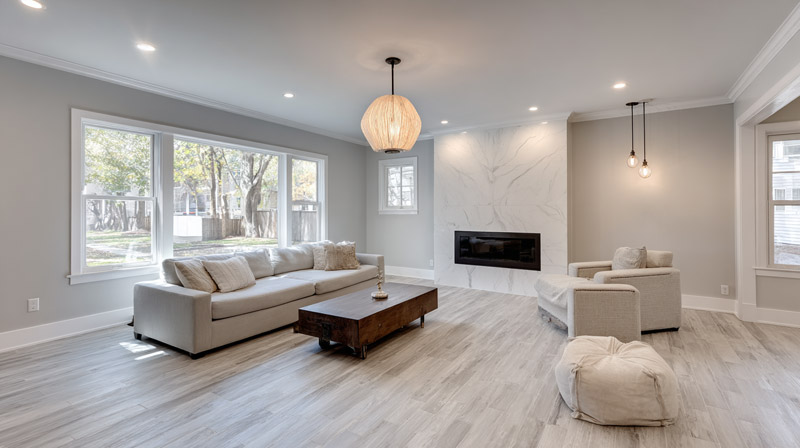
True neutral gray sits between warm and cool with no dominant pull in either direction. Sherwin-Williams Light French Gray (LRV 53) is close to this. So is Benjamin Moore Stonington Gray (LRV 49.18), though both can shift slightly blue-green in low light.
Neutral grays are the most flexible for bedding pairings. They accept both warm and cool bedding tones without conflict. The catch is they are also the hardest to source accurately. Most paint colors marketed as “true gray” still carry a detectable undertone in real-world lighting.
A BedroomZZ and Houszed.com survey of 2,674 Americans (November-December 2024) found that 38% of respondents reported better sleep quality after changing their bedroom color. Color decisions in the bedroom, including bedding and wall combinations, have measurable effects on how restful the room feels.
| Gray Type | Undertone | Paint Examples | LRV Range |
| Cool gray | Blue, violet, blue-green | Repose Gray, Gray Owl | 49–66 |
| Warm gray | Beige, taupe, earthy green | Agreeable Gray, Revere Pewter | 55–60 |
| True neutral | Minimal or no pull | Light French Gray, Stonington Gray | 49–55 |
What Color Bedding Goes With Cool Gray Walls?

Cool gray walls shift how bedding reads. Warm-toned bedding looks more saturated, while cool-toned bedding blends and layers. Both outcomes can work. The choice depends on whether you want contrast or cohesion.
White Bedding on Cool Gray Walls
Crisp, bright white is the most reliable pairing for cool gray walls. It creates clean contrast without introducing competing undertones.
The distinction that matters here is white type. Warm white (with yellow or cream undertones) will clash against cool gray walls, making the wall look more blue and the bedding look dingy. Bright white, optical white, or white with a faint blue cast all work cleanly.
Brands like Parachute and Brooklinen sell their whites as “true white” or “white” rather than “ivory.” Those are the right choices for cool gray bedrooms.
Navy Bedding on Cool Gray Walls
Navy and deep blue bedding align with the undertone of cool gray walls, creating a tonal scheme with strong visual weight.
- Navy on light cool gray creates high contrast with blue undertone alignment
- Navy on dark cool gray creates a moody, low-contrast layered look
- Works best in matte or satin weaves rather than shiny sateen, which can read too formal
The color pairing succeeds because both the wall and the bedding share the same color temperature. There is no undertone conflict. The room reads calm and deliberate rather than accidental.
Blush and Dusty Rose Bedding on Cool Gray Walls
Blush works against cool gray because of complementary contrast. Cool gray sits in the blue-violet range. Muted pinks sit opposite it on the color wheel, creating visual interest without aggression.
Key distinction: This only works with dusty, muted blush (think aged rose, antique pink) and not bright or bubbly pink. According to Opendoor’s 2024 Home Decor Report, pink was cited as the #1 least appealing interior color by 34% of respondents. Bright pink reads poorly. Muted blush on cool gray reads sophisticated.
Sage green bedding follows the same logic and has been cited by multiple designers as a top bedroom pairing for 2024-2025.
What Color Bedding Goes With Warm Gray Walls?

Warm gray and greige walls operate on different color logic than cool gray. The bedding color rules flip in several important ways.
Cream and Ivory Bedding on Warm Gray Walls
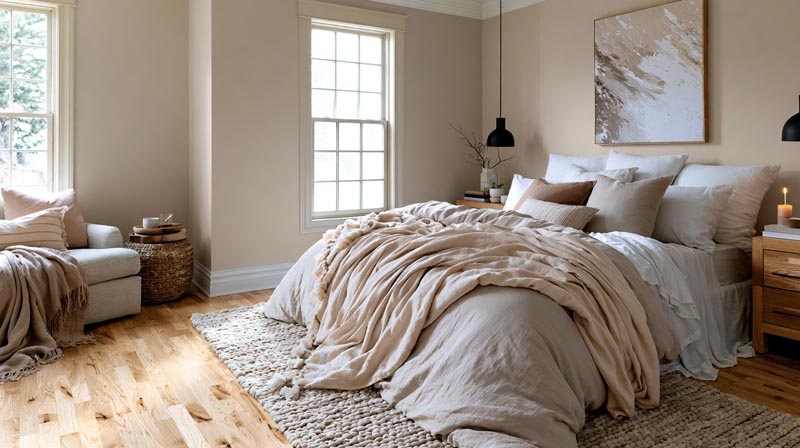
Cream and ivory share the warm undertone of greige walls, creating an enveloping, low-contrast bedroom scheme that reads organic and calm.
Bright white does not work here. It exposes the warm gray’s undertone and makes the wall look dirty or yellowish by contrast. This is the single most common color mistake in gray bedrooms. The fix is switching from optical white to warm white, cream, or ivory bedding.
Sherwin-Williams Agreeable Gray is the most searched warm gray paint color (Samplize data). Many people painting walls in Agreeable Gray immediately buy white bedding, then wonder why something looks off. It is the white type, not the gray.
Earthy and Warm Tones on Warm Gray Walls
Terracotta, rust, camel, and warm tan bedding work well against warm gray because they share the same color temperature family.
- Terracotta: High contrast against warm gray, adds warmth and an earthy quality
- Camel and tan: Low contrast, creates a soft, layered desert palette
- Rust and burnt orange: Bold choice that works in rooms with good natural light
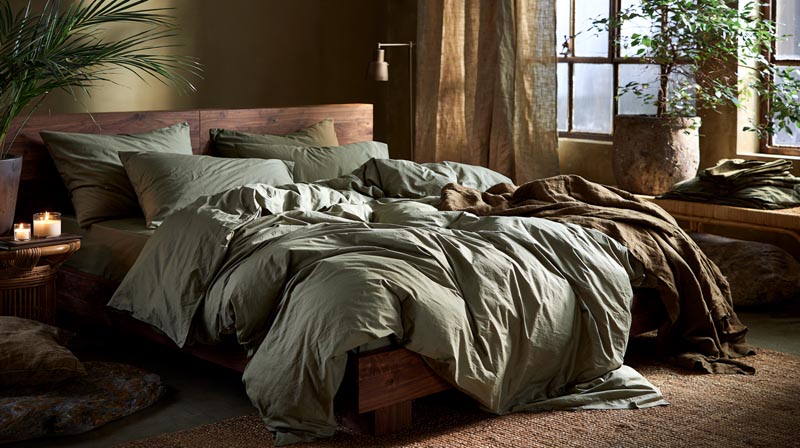
Sage and olive green also work on warm gray walls for a different reason. Both earthy greens share the green undertone that many warm grays (including Revere Pewter) already carry. The result is a harmonious scheme rather than a contrasting one.
According to the 2025 color trend reports from Homes and Gardens, earthy neutrals including olive greens, warm taupes, and muted terracottas continue to dominate bedroom color preferences heading into 2025 and 2026.
What Bedding Colors Work With Any Gray Wall?

Some bedding colors function across the full gray spectrum. They carry no strong undertone of their own, so they create no conflict regardless of wall type.
5 universally flexible bedding colors for gray walls:
- True neutral gray bedding: Tonal with no undertone conflict. Works on any gray wall, creates depth through texture.
- Soft white (no cast): Between bright white and cream. Avoids both the clash of optical white on warm gray and the muddiness of ivory on cool gray.
- Eucalyptus and soft sage green: Muted enough to read neutral. Works because gray walls rarely conflict with desaturated greens.
- Light taupe and greige: Shares undertone logic with warm gray and reads calm on cool gray through contrast.
- Dusty lavender (very muted): Shares the violet undertone present in many cool grays and sits close to neutral on warm gray.
The 1stDibs Designer Trends Survey (624 designers, August-September 2023) found that neutral, layered bedroom palettes remain the dominant professional recommendation, with designers consistently favoring low-contrast, tone-on-tone approaches for restful spaces.
How Bedding Color Contrast Affects the Feel of a Gray Bedroom

Contrast level is as important as color choice. The same white bedding reads differently in a room with light gray walls versus dark charcoal walls. Getting the contrast level right determines whether the room feels calm, spacious, or closed in.
Dark Gray Walls and Bedding Color
Dark gray walls like Benjamin Moore Chelsea Gray (LRV 22) absorb light significantly. They need bedding with enough LRV difference to prevent the room from feeling like it has no focal point.
Bedding that works on dark gray walls:
- Crisp white or off-white (maximum contrast, prevents cave effect)
- Light cream or soft linen (softer contrast, still readable)
- Pale blush or dusty rose (medium contrast with color interest)
Charcoal bedding on dark gray walls is technically the most common mistake in dark-walled bedrooms. It creates a monochromatic scheme with no definition between the bed and the wall, making the room feel like it has no center. Add depth through texture instead (chunky knit throws, waffle weave duvet) rather than through additional dark color.
Light Gray Walls and Bedding Color
Light gray walls (LRV 55 and above) have more flexibility. They can handle both high-contrast and low-contrast bedding approaches without the room feeling unbalanced.
Contrast options by effect:
- High contrast: Deep navy, charcoal, or emerald green bedding. Creates a bold focal point. Best in larger bedrooms with strong natural light.
- Medium contrast: Dusty blue, warm taupe, sage green. The most balanced option. Works in most rooms regardless of size.
- Low contrast: White or pale gray bedding. Creates a serene, enveloping quality. Requires texture and layering to avoid feeling flat.
A Travelodge study found that people sleeping in blue rooms averaged close to 8 hours of sleep per night, the highest of any color tested. Both medium and high-contrast navy and dusty blue bedding options on light gray walls produce this effect.
What Bedding Colors to Avoid With Gray Walls
Knowing what to avoid saves more decision time than knowing what works. These are the specific pairings that consistently fail regardless of room size, lighting, or style.
Warm white bedding on cool gray walls. The undertone conflict makes both colors look worse. The wall reads more blue. The bedding reads yellowish. Neither looks intentional.
Optical white bedding on warm gray walls. Same problem in reverse. Bright white exposes the warm undertone in the wall and creates a contrast that looks unfinished rather than crisp.
| Avoid This | On This Wall Type | Why It Fails |
| Warm white (ivory) bedding | Cool gray walls | Conflict: Walls look blue; bedding looks “dirty” yellow |
| Bright optical white bedding | Warm gray / greige walls | Exposure: Makes the wall’s beige/green undertone look muddy |
| Charcoal / dark gray bedding | Dark gray walls | Zero Contrast: The bed “disappears” and the room feels heavy |
| Saturated primary colors | Any gray wall | Competition: Lacks grounding and makes the gray feel “cheap” |
| Mismatched base patterns | Any gray wall | Clutter: The pattern’s hidden base tone fights the wall color |
Pattern-heavy bedding is worth a separate note. If you are buying a patterned duvet, the base color of the pattern (not the accent colors) determines whether it works with your gray wall. A gray-and-white geometric works on almost any gray. A cream-and-yellow floral will expose undertone issues on cool gray walls the same way a solid cream would.
How Bedding Fabric Texture Changes Color Perception Against Gray Walls

The same color reads differently depending on fabric weave and surface finish. This is one of the most overlooked variables in bedroom color pairing. Two duvets in the same white can look like different colors on a gray-walled bed.
Matte vs. Sheen Fabrics
Matte fabrics (linen, cotton percale, brushed cotton) absorb light. They read slightly darker and warmer than their actual color.
White linen on cool gray walls reads like a soft, slightly warm white because linen absorbs rather than reflects the blue light in the room. It rarely clashes. It is one of the more forgiving fabric choices in gray bedrooms.
Sateen and high-thread-count cotton reflect light. They read slightly brighter and cooler because they pick up ambient light from the room. White sateen on cool gray walls can look brilliant and clean. The same sateen on warm gray walls can look slightly cold because of the reflective surface.
Texture and Layering Depth
Chunky knit, waffle weave, and bouclé bedding add visual depth through surface variation rather than color contrast. This matters especially in low-contrast gray bedrooms (white bedding on light gray walls) where the risk is flatness.
Textured bedding solves the low-contrast problem without changing the color scheme. You can keep the calm, tonal palette and add interest through the weave rather than through a bolder bedding color.
According to Saatva’s 2025 bedroom trend survey, textured fabrics including bouclé, velvet, and jacquard were cited as top choices for bedroom depth, aligning with the broader shift toward tactile, layered bedroom design over flat color approaches.
How Bedding Pattern and Print Work With Gray Walls

Gray walls are one of the better backdrops for patterned bedding. The neutrality of the wall lets the pattern do its job without competing. The rule is simple: the base color of the pattern determines success, not the accent colors within it.
Trending duvet colors for 2024 included soft earth tones like beige, terracotta, and sage, along with rich hues like deep navy and burgundy, according to Beddley’s 2024 bedding trend analysis. These are the same base colors that work cleanly against color in interior design with gray walls as a backdrop.
Geometric and Stripe Patterns on Gray Walls
Gray-based geometric patterns are the safest patterned bedding choice for gray walls. They share the same tonal family, creating cohesion rather than conflict.
- Gray and white geometric: clean contrast, works on any gray wall
- Navy and white stripe: high contrast, suits cool gray walls particularly well
- Cream and taupe stripe: low contrast, works best on warm gray and greige walls
Stripe direction matters more than most people expect. Horizontal stripes across a duvet emphasize the bed’s width. Vertical patterns draw the eye upward toward the headboard, which can make low ceilings feel slightly taller.
Floral and Organic Prints on Gray Walls
Background color is everything with florals. A white-background floral on cool gray walls creates clean, fresh contrast. A cream-background floral on cool gray walls creates the same undertone conflict as solid cream bedding would.
Livingetc’s designer roundup noted that interior designer Michelle Murphy recommends keeping one piece bold (patterned duvet or statement sheets) and using accents to complement, rather than competing patterns throughout.
Gray-background florals and organic prints are the most universally safe option. They require zero undertone calculation because the base color and the wall share the same family.
Scale of Print Relative to Room Size
Large-scale prints shrink visual space. Small-scale prints add texture without reducing the perceived room size.
Practical guidelines:
- Small bedroom (under 120 sq ft): stick to small or medium-scale prints
- Large bedroom (over 180 sq ft): large-scale patterns work without making the room feel smaller
- Dark gray walls plus large-scale dark pattern: the room will feel significantly more enclosed
For more on how pattern in interior design functions at a structural level, the principles of scale and visual weight apply directly to bedding choices in gray rooms.
What Accent Colors to Add When Bedding and Gray Walls Are Both Neutral

Neutral bedding on gray walls is calm, but it needs anchoring. Without accent color injection, the room reads as unfinished or flat. The solution is not to change the bedding. It is to use layered accent color through smaller, replaceable pieces.
The 60-30-10 color distribution rule applies directly here. Gray walls cover roughly 60% of visual space. Neutral bedding covers the 30% secondary role. The accent injection point is the remaining 10%, handled through cushions, throws, and small decor pieces.
Warm Accent Colors for Gray and Neutral Bedding
3 high-performing warm accent combinations for gray walls with neutral bedding:
Gray walls + white bedding + terracotta accents. Terracotta throw pillows and a woven blanket introduce warmth against cool-neutral bedding without changing the wall or duvet color. Works on both cool and warm gray.
Gray walls + cream bedding + brass and gold accents. Lamp bases, picture frames, and cushion piping in warm metallic tones pull the cream bedding toward warmth and give the gray walls a richer quality. Parachute and CB2 both carry this palette well.
Gray walls + linen bedding + rust accent pillow. One rust or burnt orange pillow against natural linen on a gray wall creates a complete, resolved palette with very little investment.
Cool Accent Colors for Gray and Neutral Bedding
Cool accents work differently. They extend the gray’s undertone rather than contrasting it.
| Accent Color | Best With | Effect |
| Navy blue throw | White bedding, cool gray walls | Grounds the palette, adds sophisticated depth |
| Deep sage green pillow | Gray or cream bedding, any gray wall | Adds organic warmth and a “biophilic” touch |
| Dusty lavender cushion | White bedding, cool or neutral gray | Subtle; shares and enhances violet undertones |
| Terracotta / Clay | Oatmeal bedding, warm gray walls | Creates a cozy, earth-inspired 2026 “Desert” look |
| Mustard / Ochre | Charcoal bedding, dark gray walls | Provides high-contrast energy to moody spaces |
The 60-30-10 rule is widely recognized among professional designers as the most reliable color proportion framework for bedrooms. Applying it to a gray bedroom with neutral bedding means the accent colors (10%) become the primary design decision, not the bedding or wall color.
How Room Lighting Affects Bedding Color Choice in Gray Rooms

Room orientation changes how both the wall and bedding read throughout the day. Getting this wrong means the bedding combination that looks good in-store looks wrong at home. The two variables that matter most are natural light direction and artificial bulb temperature.
Natural Light Direction and Bedding Color
North-facing rooms receive no direct sunlight. The light is cool and slightly blue-gray throughout the day, according to Benjamin Moore’s directional paint guidance. Cool gray walls in a north-facing room will read even cooler, and bright white bedding can look harsh rather than clean.
North-facing room adjustment: shift bedding one degree warmer. Soft white instead of optical white. Warm linen instead of crisp percale. The goal is to offset the room’s natural coolness through textile warmth rather than through wall color change.
South-facing rooms receive warm, golden light, especially in the afternoon. Warm gray walls in south-facing rooms can shift toward a creamy or yellowish cast. Cooler bedding tones (dusty blue, soft gray, cool white) balance this out. Farrow and Ball’s color guidance specifically notes that south-facing light allows cooler colors to read as neutral rather than cold.
Artificial Lighting and Bedding Color
Warm-toned bulbs (2700K-3000K) add amber to every color in the room. They push cool gray walls toward neutral gray and make white bedding read creamier. Feit Electric’s lighting guide identifies 2700K as the optimal bedroom Kelvin range for relaxation, which also happens to be the range that makes most bedding color pairings look their best.
Daylight bulbs (5000K-6500K) strip warmth from the room. They make cool gray walls look sharper and white bedding look clinical. Avoid these in bedrooms where the wall color is cool gray.
Sherwin-Williams’ directional paint guidance confirms that artificial light temperature should be treated like room exposure: warm lighting requires the same color adjustments as a south-facing room, and cool lighting requires the same adjustments as a north-facing room.
The practical test: take a paint chip swatch of the bedding fabric and hold it against the wall under the actual lighting conditions of the room. Not in a store. Not in daylight. In the room at night.
Gray Wall Paint Colors and Their Best Bedding Matches
Specific paint colors behave differently from their category labels. Knowing that “Agreeable Gray is a warm gray” is useful. Knowing exactly which bedding colors work with it is more useful. Below are the 5 most-searched gray paint colors and their proven bedding pairings.
| Paint Color | Type | LRV | Best Bedding Colors |
| SW Agreeable Gray | Warm gray / greige | 60 | Cream, ivory, camel, sage green, warm white |
| BM Revere Pewter | Warm gray, green pull | 55 | Cream, olive, rust, deep teal, warm linen |
| BM Gray Owl | Cool, blue-green shift | 66 | Crisp white, navy, blush, dusty blue, soft gray |
| SW Repose Gray | Cool gray, violet pull | 58 | Pure white, navy, dusty lavender, charcoal |
| F&B Purbeck Stone | Warm mid-gray | 40 | Off-white, terracotta, warm sage, oatmeal |
Sherwin-Williams Repose Gray is the most popular gray paint color sold in the US, according to Samplize market data. Its violet undertone means warm white bedding and yellow-toned cream create an undertone conflict. The pairing looks muddy rather than elegant.
Benjamin Moore Revere Pewter has an earthy green undertone (LRV 55) confirmed through color chip analysis. This rules out cool lavender and bright blue bedding, both of which will pull against the green shift and make the room feel visually unresolved.
Gray Owl (LRV 66) sits at the high end of the light range, which means bedding contrast is less critical than undertone alignment. A wider range of bedding colors work here simply because the wall is light enough to absorb mild undertone mismatches without the conflict becoming visible.
For a deeper understanding of how color theory in interior design informs these pairings, including how undertones interact across surfaces and textiles, the principles of complementary and analogous color schemes apply directly to every gray-and-bedding combination covered here.
FAQ on What Color Bedding Goes With Gray Walls
Does white bedding work with gray walls?
Yes, but the white type matters. Crisp optical white works on cool gray walls. Warm white works on warm gray and greige walls. Using the wrong white creates an undertone conflict that makes both the wall and bedding look worse.
What color bedding goes with dark gray walls?
White, off-white, and light cream create the contrast needed to stop the room feeling closed in. Pale blush and soft linen also work well. Avoid charcoal or dark gray bedding on dark walls as the bed disappears into the background.
What color bedding suits warm gray or greige walls?
Cream, ivory, camel, sage green, and terracotta all share the warm undertone of greige walls. Avoid bright optical white. It exposes the wall’s warm undertone and makes the bedroom color scheme look unfinished rather than intentional.
What bedding colors go with cool gray walls?
White, navy, blush, dusty rose, and muted sage green all pair well with cool gray. These colors either align with the wall’s undertone or complement it. Warm ivory bedding clashes with cool gray walls due to undertone conflict.
Is navy bedding good with gray walls?
Navy is one of the strongest pairings for cool gray walls. It shares the blue undertone, creating a cohesive bedroom color scheme. A Travelodge study found people in blue bedrooms averaged close to 8 hours of sleep per night.
Can you use patterned bedding with gray walls?
Yes. The base color of the pattern determines success. A gray-background geometric works on any gray wall. A cream-background floral will create the same undertone conflict as solid cream bedding on the wrong wall type.
What accent colors work with neutral bedding on gray walls?
Terracotta, brass, deep sage, navy, and dusty lavender all work as accent injections. Use the 60-30-10 color rule: gray walls take 60%, neutral bedding fills 30%, and accent colors through pillows and throws cover the remaining 10%.
Does room lighting change which bedding colors work?
Yes, significantly. Warm bulbs at 2700K push cool gray walls toward neutral and make white bedding read creamier. North-facing rooms amplify cool undertones, requiring warmer bedding tones to compensate. Always test bedding color under your actual room lighting.
What bedding works with Sherwin-Williams Agreeable Gray?
Cream, ivory, warm white, camel, and sage green all work well. Agreeable Gray is a warm greige with an LRV of 60. Bright optical white bedding exposes its warm undertone and makes the wall look slightly yellow or dirty.
Does bedding fabric texture affect color pairing with gray walls?
It does. Matte fabrics like linen absorb light and read slightly warmer than their actual color. Sateen and high-thread-count cotton reflect light and read cooler. White linen on cool gray walls often looks softer and less stark than white sateen.
Conclusion
This conclusion is for an article presenting bedding color decisions as a direct result of wall undertone, contrast level, fabric texture, and lighting, not guesswork.
Warm gray walls need cream, ivory, and earthy tones. Cool gray walls accept white, navy, and dusty rose. True neutral gray gives you the most flexibility across the full bedroom color palette.
Pattern base color determines success more than the pattern itself. Lighting at 2700K shifts every pairing warmer. North-facing rooms require compensation through textile warmth.
The 60-30-10 distribution keeps neutral bedding schemes from falling flat. Accent color placement through throws and cushions does more work than changing the duvet entirely.
Start with your gray’s undertone. Everything else follows from there.

- Kitchen Color Schemes by Cabinet Color: What Pairs Well - October 19, 2026
- Curtain Colors for Every Wall Color: Safe vs Bold Picks - October 18, 2026
- Interior Design Styles: Find Your Primary and Secondary - October 14, 2026