Color Combinations
Paint Colors That Go with Gray Floors
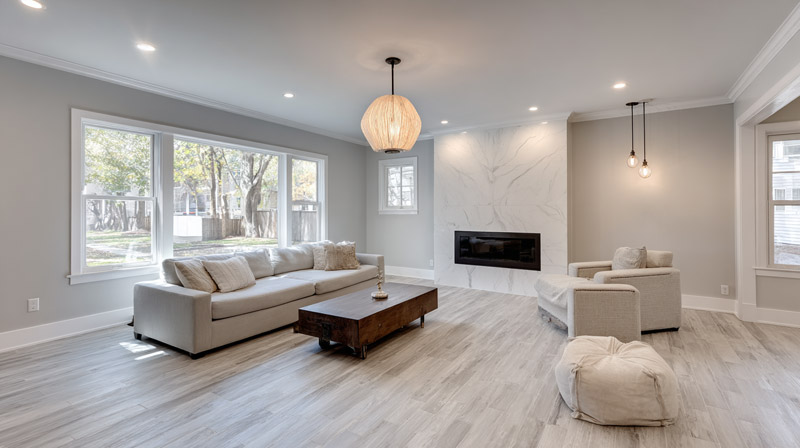
Gray floors look sharp until you try to pick a wall color.
The right paint colors for gray floors depend on 3 things most guides skip: undertone, light reflectance value, and how your room’s natural light behaves. Get those wrong and even a beautiful color will make the room look off.
This guide covers every gray floor scenario. Cool gray, warm gray, dark charcoal, bleached light gray. It covers room-by-room color choices, the white paint options that actually work, bold wall colors worth considering, and the combinations to avoid entirely.
By the end, you will know exactly which wall colors work for your specific floor, and why.
Wood, floors and other fixed surfaces are one part of our guide to color combinations in interior design, which also covers walls, textiles and rooms.
What Determines Whether a Paint Color Works With Gray Floors
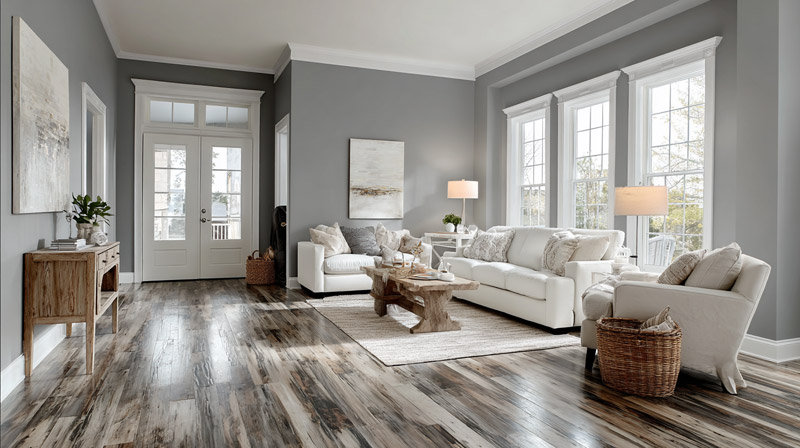
Choosing wall paint for gray floors is not as simple as picking a color you like. 4 specific variables control whether the pairing works: the floor’s undertone, the wall color’s light reflectance value (LRV), the room’s natural light exposure, and the paint finish. Get any one of these wrong and the room looks off, even if each element looks fine on its own.
Gray hardwood has become one of the most sought-after flooring options in recent years, earning the label of the “new neutral” among flooring professionals (Slaughterbeck Floors, 2024). That popularity makes getting the wall color right more important than ever.
How Gray Floor Undertones Affect Wall Color Compatibility
Every gray floor pulls in one of 3 directions: cool (blue, purple, or green cast), warm (brown, beige, or yellow cast), or true neutral. The wall color needs to respond to that pull, not ignore it.
Cool gray floor: pairs best with warm or neutral walls to avoid a cold, clinical feel.
Warm gray floor: pairs well with cooler or true neutral walls to keep visual balance.
Neutral gray floor: the most flexible option, accepts warm, cool, or high-contrast wall choices.
Luxury vinyl plank (LVP) and porcelain tile floors tend toward cool or neutral undertones. Gray-stained hardwood often reads warmer because the wood grain pushes brown through the gray surface layer. Gray concrete floors are almost always cool-neutral.
The Role of Light Reflectance Value in Floor-to-Wall Pairings
LRV measures how much light a color reflects on a scale of 0 (pure black) to 100 (pure white). For interior walls, colors in the LRV range of 50 to 70 reflect enough light to brighten a room without washing out the color (Welsh Design Studio). Colors above LRV 70 add maximum brightness, critical for pairing with darker gray floors.
Benjamin Moore Chantilly Lace has an LRV of 92. Benjamin Moore Hale Navy has an LRV of 8. The contrast between those 2 numbers explains why dark walls require enough ceiling height and natural light to avoid making the room feel compressed against a gray floor.
Key rule: the lower your gray floor’s LRV, the higher your wall color’s LRV should be to maintain visual balance and room brightness.
Why Paint Finish Changes How Gray Floors Read
Matte and eggshell finishes on walls reduce reflected light and soften the gray floor’s presence. Satin finishes add light bounce that can amplify cool floor undertones in brightly lit rooms. Semi-gloss works best on trim and kitchen or bathroom walls, not on large living areas where the sheen competes with a reflective gray tile or polished LVP surface.
The finish decision matters most with dark wall colors. A deep navy or charcoal wall in eggshell reads sophisticated against gray floors. The same color in semi-gloss can feel jarring.
—
What Are the Undertones in Gray Floors and Why Do They Matter
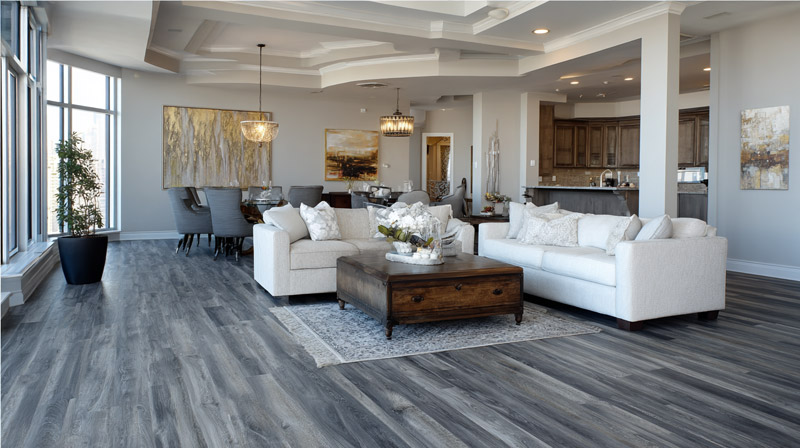
Undertone is the most important variable in gray floor and wall color coordination. A gray floor with a blue undertone and a wall painted in warm cream will fight each other visually, regardless of how beautiful each is in isolation. Getting the undertone read right is the first step in any gray floor color scheme.
The gray and greige trend that dominated residential flooring for years is currently evolving toward warmer gray tones, with industry data showing a clear shift away from cool blue-grays toward brown-leaning neutrals (Vantia Hardwoods, 2024). That shift changes which wall colors work in newer installs vs. older ones.
Cool Gray Floor Undertones
Cool gray floors show blue, purple, or green color casts, most visible in natural daylight against a white surface. LVP flooring in the gray category tends to land here, along with most gray porcelain tile and gray concrete.
- Blue-gray floors are the most common cool variant and pair with crisp whites, warm whites, and navy walls
- Purple-gray floors are rarer and work well with warm whites, warm taupes, and soft sage greens
- Green-gray floors pair with warm neutrals, earthy taupes, and warm off-whites
Sherwin-Williams Naval (a deep navy with gray undertones) is one of the most reliable bold wall choices for cool gray floors. The gray in the paint echoes the floor’s undertone without duplicating it.
Warm Gray Floor Undertones
Brown-leaning warm grays are increasingly common in 2024 and 2025 gray-stained hardwood installs. They read almost like greige in certain lighting, especially under warm artificial light (2700K-3000K bulbs).
The warm gray and greige category offers the widest wall color compatibility. It works with:
- Warm whites like Sherwin-Williams Alabaster or Benjamin Moore White Dove
- Soft sage and olive greens
- Warm cream and greige wall tones
- Earthy terracotta tones as accent walls
What it does not work with: stark cool whites with blue undertones, icy blues, or any wall color with a heavy purple cast.
How to Read Your Floor’s Undertone Before Choosing Paint
Hold a bright white sheet of paper flat against your floor in natural daylight. The color the gray seems to shift toward next to pure white is the undertone. Blue or purple shift signals a cool floor. Yellow, brown, or green shift signals a warm floor. No visible shift means a true neutral gray.
Test this at multiple times of day. Morning light (bluer spectrum) and afternoon light (warmer spectrum) can make the same floor appear to shift undertone categories. The undertone that shows up most consistently across lighting conditions is the one to design around.
| Gray Flooring Type | Typical Undertone | Most Common Appearance |
|---|---|---|
| Luxury Vinyl Plank (LVP) | Cool to neutral | Blue-gray or neutral gray |
| Gray-Stained Hardwood | Warm to neutral | Brown-gray or greige |
| Gray Porcelain Tile | Cool to neutral | Blue-gray or green-gray |
| Gray Concrete or Polished Concrete | Neutral to cool | True neutral gray |
—
What Paint Colors Work With Cool Gray Floors
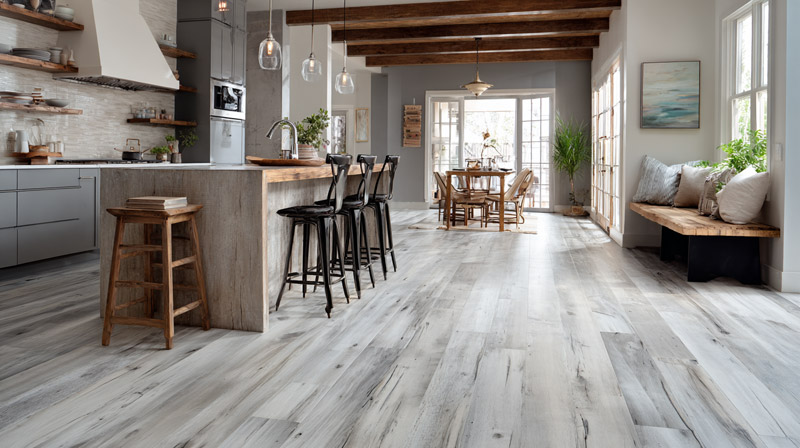
Cool gray floors with blue, purple, or green undertones need wall colors that either complement the cool palette or provide intentional warm contrast. The wrong choice, especially a warm cream or golden beige, will make the floor look dirty and the room look uncoordinated.
Blue-toned gray floors are the dominant gray floor variant in current residential installs. Provenza Floors’ color director noted in 2023 that gray with subtle undertones remains the most requested neutral in the LVP and hardwood category (Houzz, 2023).
White and Off-White Options for Cool Gray Floors
3 whites consistently perform well against cool gray floors:
- Benjamin Moore Chantilly Lace (OC-65): LRV 92, bright cool white with minimal undertone pull, works in any room
- Sherwin-Williams Extra White (SW 7006): subtle blue undertone reinforces the floor’s cool cast cleanly
- Benjamin Moore Simply White (OC-17): slightly warmer than Chantilly Lace but still reads crisp against cool floors
Interior designer Kirsten Holmstedt recommends Simply White or Chantilly Lace specifically for gray floors because they create a classic contrast without pulling competing undertones (Homes and Gardens, 2023).
Warm whites like Sherwin-Williams Alabaster or Benjamin Moore White Dove work less reliably with cool gray floors. They can make the floor’s blue cast look pronounced and unintentional.
Deep and Saturated Colors That Work
Sherwin-Williams Naval is a deep navy with embedded gray undertones, making it a natural fit for cool gray floors. The gray in the paint mirrors the floor’s undertone without creating an exact match that flattens the room.
Benjamin Moore Hale Navy HC-154 is another reliable option. It adds richness and depth while complementing the cool undertone in blue-gray flooring. Block Renovation’s design guides consistently list Hale Navy as one of the most effective high-contrast wall choices for gray floors (Block Renovation, 2025).
Soft steel blues and slate tones reinforce the floor’s contemporary quality. Sherwin-Williams Tradewind, a light blue with a small green hint, pairs with cool gray floors for a calming, layered color scheme.
Colors to Avoid With Cool Gray Floors
The 4 wall color categories that fight cool gray floors:
- Yellow-based creams and warm beiges (undertone conflict is immediate)
- Warm terracotta and rust tones (push orange against the floor’s blue cast)
- Heavily saturated purples (amplify the purple undertone in some gray floors to an uncomfortable level)
- Golden and honey tones (clash visually with the cool floor surface)
—
What Paint Colors Work With Warm Gray Floors
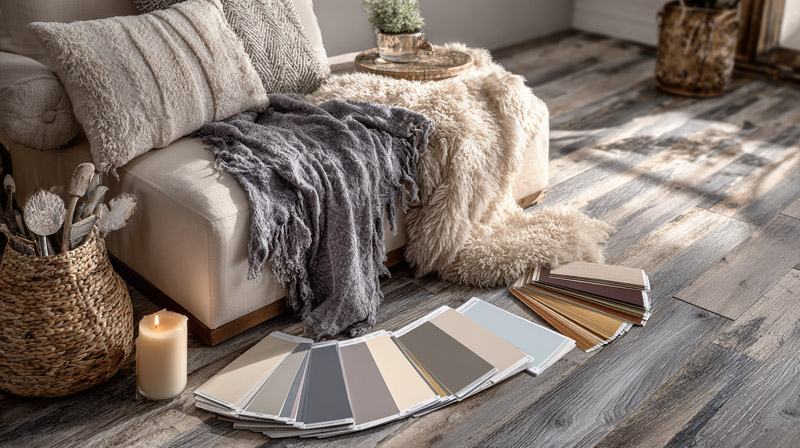
Warm gray floors, especially gray-stained hardwood and warm-toned LVP, are forgiving to design around. The brown and beige undertones in these floors align naturally with a wide range of wall colors, from earthy neutrals to saturated jewel tones.
The greige category, a blend of gray and beige, has remained a top residential flooring choice heading into 2024 and 2025, pairing well with light, airy spaces, minimalist furniture, and natural textures like linen or stone (First Atlanta Flooring, 2024).
Warm Whites and Creams
Sherwin-Williams Alabaster (SW 7012) has an LRV of 82 and a warm, slightly yellow undertone that aligns directly with brown-leaning gray floors. It is one of the most consistent performers in open-plan living areas with warm gray LVP.
Benjamin Moore White Dove (OC-17) brings a soft, creamy warmth that complements greige-toned floors without making the room feel yellowed. The combination reads clean without being stark.
What to avoid: cool whites with blue undertones (Super White, Extra White) will create visible undertone conflict against warm gray floors in natural daylight.
Earth Tones and Warm Neutrals
Sherwin-Williams Agreeable Gray (SW 7029) is one of the most widely used wall colors with warm gray floors in new residential construction. It reads as a warm greige and coordinates with brown-leaning floors by sharing their underlying warmth without duplicating the floor color.
Benjamin Moore Revere Pewter (HC-172) adds more depth and slightly more color. It works in dining rooms and studies with warm gray hardwood floors where a heavier wall tone adds character rather than weight.
Earthy terracotta and dusty rust tones work as accent wall options. In living rooms with large gray-stained hardwood floors, a single terracotta accent wall adds contrast in a way that honors, rather than fights, the floor’s warm undertone.
Colors to Avoid With Warm Gray Floors
Stark cool whites with high blue content create an immediate undertone conflict with warm gray floors. Icy blue and purple-toned wall colors make the warm floor look dirty or inconsistent. Bright white with no undertone warmth (LRV above 90 and cool-leaning) can wash out warm gray floors and make the color look flat.
—
What Paint Colors Work With Dark Gray Floors
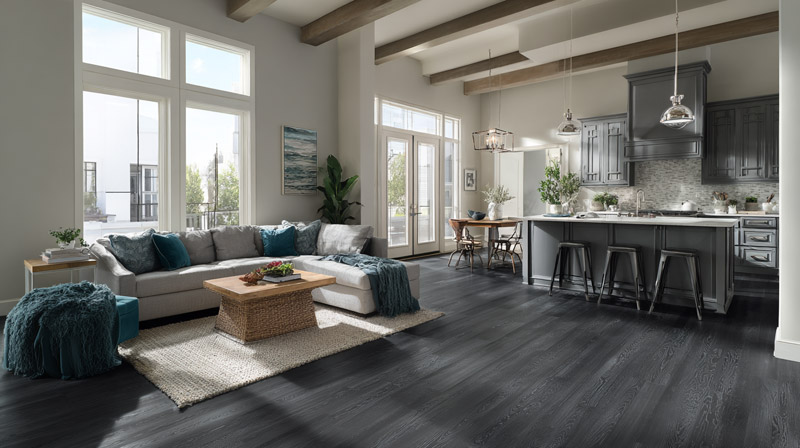
Dark gray floors, including deep charcoal LVP, dark gray tile, and heavily pigmented gray-stained hardwood, absorb significant light. This makes wall color selection a direct function of LRV. The darker the floor, the more the walls need to compensate with brightness and light reflection.
Colors with an LRV above 50 reflect more light than they absorb, creating a daytime-look expansive feel (Shoreline Painting, 2024). For dark gray floors specifically, wall colors in the LRV 60-90 range perform best in most residential spaces.
Light Walls as the Primary Strategy
Pale gray, soft white, and warm cream wall colors are the most reliable choices for dark gray floors. They prevent the room from feeling compressed by providing strong LRV contrast against the floor’s low-value surface.
Specific options that work:
- Farrow and Ball Pavilion Gray: a soft, warm-neutral gray with enough lightness to contrast dark floors cleanly
- Sherwin-Williams Agreeable Gray: warm greige tone that lifts dark gray floors without competing with them
- Benjamin Moore White Dove: warm white that prevents starkness while maintaining bright contrast
Medium Tones That Work Without Going Too Light
Dusty blue, sage green, and blush pink wall colors in the LRV 40-60 range can work with dark gray floors in rooms with good natural light. The key is that the room must have enough light volume to compensate for both a low-LRV floor and a mid-LRV wall.
Benjamin Moore October Mist, a soft sage-olive, is one of the most approachable medium-tone options. It was Benjamin Moore’s 2021 Color of the Year and has been consistently used alongside dark flooring in contemporary residential projects.
When Dark-on-Dark Works
A dark wall paired with a dark gray floor requires 3 conditions to succeed: ceiling height above 9 feet, substantial natural light (south or west-facing room), and deliberate use of light-colored furniture and textiles to introduce contrast. Without those conditions, the room loses definition between floor plane and wall plane.
| Wall Color Approach | Best For | Recommended LRV |
|---|---|---|
| Pale Gray or Soft White | Most rooms and nearly all lighting conditions | 70–92 |
| Warm Cream or Greige | Living rooms, open-concept spaces, and areas needing extra warmth | 60–82 |
| Dusty Blue or Sage Green | Well-lit rooms, especially those with south-facing exposure | 40–60 |
| Dark Navy or Charcoal | High-ceiling rooms or spaces with abundant natural light | 8–25 |
—
What Paint Colors Work With Light Gray Floors
Light gray floors, including bleached gray hardwood, pale gray LVP, and light gray tile, present the opposite challenge to dark floors. Without enough wall contrast, the room loses definition and looks flat. Medium and deep wall tones perform better here than additional light colors.
In 2024, the smoked and bleached/whitewashed floor finish categories gained significant traction. 50Floor’s 2024 flooring trend report noted that bleached light floors were gaining ground as homeowners looked to open up spaces and emphasize natural light (50Floor, 2024). This makes understanding wall contrast more relevant than ever.
Medium and Deep Wall Tones for Visual Grounding
Light gray floors need wall color with enough value depth to create a visual anchor.
Benjamin Moore Hale Navy HC-154 is one of the most effective deep wall colors against light gray flooring. The LRV of 8.36 creates sharp contrast that grounds the pale floor and adds significant visual weight to the walls without making the room feel heavy, particularly in rooms with good natural light.
Charcoal and soft black wall tones work in the same way. They define the room’s boundaries clearly and prevent the light floor from dissolving into the walls.
Warm Mid-Tones as a Contrast Option
Clay, terracotta, and warm taupe: these mid-tones add visible contrast against light gray floors without the commitment of a dark wall. They bring warmth into rooms where the light floor and natural light could otherwise feel cold or sterile.
Farrow and Ball Elephant’s Breath, a warm greige-gray mid-tone, is frequently used with light gray floors in transitional and contemporary interiors. It bridges the gap between cool floor and warm decor without pulling in either direction aggressively.
Dusty rose and muted blush tones also work well in bedrooms with light gray LVP, adding softness and warmth against a floor that could otherwise read clinical in a private space.
—
What Are the Best White Paint Colors for Gray Floors
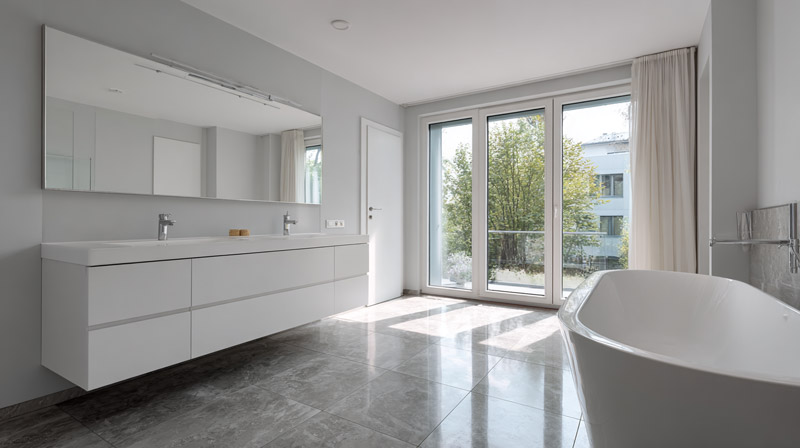
White walls with gray floors is the most searched combination in the gray floor color scheme category. It is also the most commonly done wrong. Not all whites work, and the reason is always undertone conflict. A yellow-based white against a blue-gray floor will look dingy. A blue-toned white against a warm gray floor will look cold.
Behr named Frosted Jade, a soft green-gray, as one of its top 2025 color trends, while paint brands across the industry signaled a broader shift toward greens and warm neutrals as white alternatives for floors with gray undertones (House Digest, 2024). But white remains the most popular wall choice for gray floors overall.
Cool Whites for Cool Gray Floors
Benjamin Moore Chantilly Lace (OC-65) is the benchmark. LRV 92, minimal undertone, works in any room with cool gray floors from bleached LVP to blue-toned porcelain tile. Sherwin-Williams Extra White has a subtle blue undertone that reinforces rather than fights the floor’s cool cast.
The practical rule: for cool gray floors, choose whites with an LRV above 85 and no yellow or red undertone. Test on the actual wall surface at midday, not just from the paint chip.
Warm Whites for Warm Gray Floors
Sherwin-Williams Alabaster (LRV 82) and Benjamin Moore White Dove are the 2 most consistent warm white choices for brown-leaning gray floors. Both have enough warmth to align with the floor’s undertone while remaining light enough to brighten the room.
Benjamin Moore Decorator’s White (OC-149) works for true neutral gray floors. It is a clean, balanced white with neither cool nor warm pull, making it adaptable to floors that do not read clearly in either undertone direction.
Why Ceiling White Choice Matters in Gray Floor Rooms
The ceiling white interacts with both the wall color and the floor surface through reflected light. A cool-white ceiling above warm white walls and warm gray floors creates a layered light environment that can make the floor color read inconsistently across the day.
The standard practice is to keep ceiling white 1 to 2 LRV values above the wall white. If the walls are Alabaster (LRV 82), the ceiling works best at LRV 88-92, using Benjamin Moore Chantilly Lace or a similar near-pure white. This keeps the ceiling from competing with the wall tone while maintaining a bright, coherent overhead plane above the gray floor.
How Room Function Changes Paint Color Choice With Gray Floors
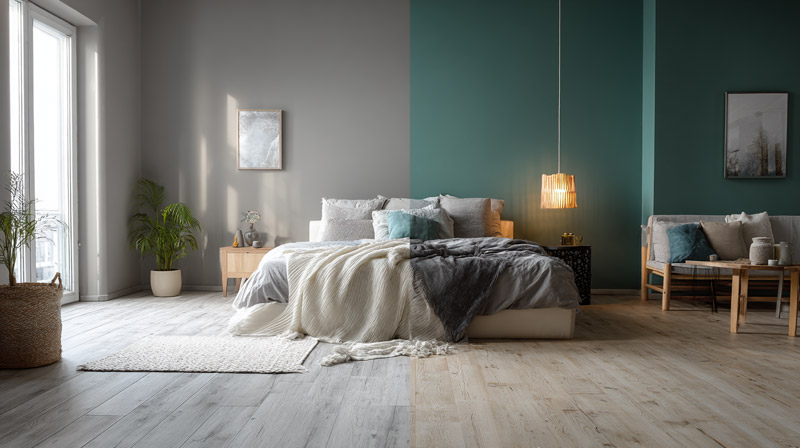
The same gray floor reads completely differently in a bedroom vs. a kitchen. Room function changes the color requirements, not just the aesthetic preference. A color that works beautifully in a living room can feel wrong in a bathroom with the same floor.
Green is the most searched bedroom paint color in the US, generating over 168,300 searches between August 2023 and July 2024, more than any other room color category (Level Frames via Apartment Therapy, 2024). That preference translates directly into how designers pair greens with gray floors across room types.
Bedroom Paint Colors With Gray Floors
Bedrooms with gray floors work best with lower-saturation wall colors. The goal is rest, not visual stimulation.
- Soft sage and eucalyptus greens (Benjamin Moore October Mist, Sherwin-Williams Sea Salt)
- Muted lavender and blush tones for softer, warmer contrast
- Warm whites and off-whites for a clean, minimal approach
The National Sleep Foundation data shows people in blue rooms sleep an average of 7 hours and 52 minutes compared to 6 hours and 12 minutes in purple rooms (Right Touch Painting, 2024). Soft blue walls above gray floors are a measurable bedroom improvement, not just an aesthetic choice.
Avoid high-saturation accent walls in bedrooms with gray floors. A single deep navy or forest green wall works. A fully saturated room in those tones can feel aggressive in a space designed for downtime.
Kitchen Paint Colors With Gray Floors
Cabinet color becomes a third variable. In kitchens, the wall color interacts with both the gray floor and the cabinet finish, making the selection more complex than in any other room type.
White and off-white walls are the most reliable kitchen choice with gray floors because they keep the visual weight balanced between dark or mid-tone cabinets and the floor surface. Sage green walls work in kitchens with white or natural wood cabinets, especially when gray LVP or tile floors anchor the lower half of the room.
Green emerged as the most popular kitchen paint color in the US in 2024, as tracked by Level Frames search data (Apartment Therapy, 2024). Sherwin-Williams Garden Gate and Benjamin Moore October Mist are the 2 kitchen green options designers return to most consistently against gray flooring.
Bathroom Paint Colors With Gray Floors
Bathrooms with gray tile or gray LVP floors are the most common pairing in new residential construction. The small floor area and high moisture content change both the color and finish requirements.
Satin finish is the correct choice for bathroom walls, not eggshell. Sherwin-Williams notes that satin prevents moisture from penetrating the paint pigment, making it the standard for wet zones (Sherwin-Williams, 2024). Eggshell will degrade faster in high-humidity conditions regardless of the color selected.
Color options by fixture tone:
- White fixtures: any wall color works, from crisp white to deep navy
- Chrome fixtures: cool whites, soft blues, and pale grays
- Matte black fixtures: warm whites, sage greens, and warm taupes
- Brass or gold fixtures: warm creams, terracotta, dusty rose
—
How Lighting Conditions Affect Paint Color Choices Over Gray Floors
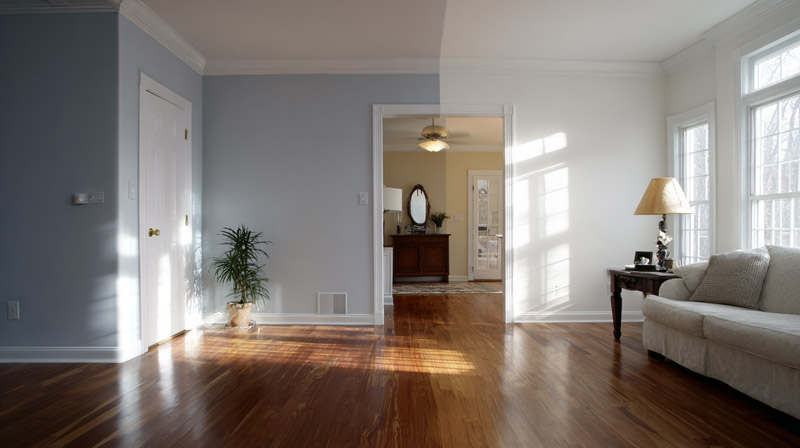
The same wall color can look like a completely different paint in a north-facing room vs. a south-facing one. This is one of the most common reasons paint choices fail, and it has nothing to do with the color itself.
North-facing rooms receive cooler, diffused light all day. South-facing rooms get warm, direct sunlight that intensifies colors and brings out warmer undertones. East-facing rooms are warm in the morning and grayer by afternoon. West-facing rooms are the reverse (Three Bears Home Staging, 2020).
| Room Direction | Natural Light | How Gray Floors Appear | Best Wall Color Approach |
|---|---|---|---|
| North-facing | Cool, diffused, and consistent | Enhances cool blue or gray undertones | Choose warm whites, creamy off-whites, or warm neutrals to balance the cool light. |
| South-facing | Warm, bright, and consistent | Softens cool undertones and makes greige floors appear warmer | Use crisp whites, neutral whites, or cool-toned neutrals to maintain balance. |
| East-facing | Warm morning light, cool afternoon light | Floors appear warmer in the morning and cooler later in the day | Select warm neutrals with an LRV of 55–70 for a balanced look throughout the day. |
| West-facing | Cool morning light, warm afternoon light | Floors look cooler early in the day and warmer by evening | Opt for neutral whites or balanced greige shades that perform well in changing light. |
North-Facing Rooms and Gray Floors
North-facing rooms are the trickiest. The consistent, cool light amplifies blue and purple undertones in gray floors. A blue-gray floor in a north-facing room can read almost lavender by midday.
The fix: warm whites and warm neutrals on the walls offset the cool light instead of reinforcing it. Benjamin Moore’s color experts recommend warm and cool undertone balance specifically for north-facing applications, noting that northern light can appear muted and toned down throughout the day (Benjamin Moore, 2024).
Avoid cool whites (Chantilly Lace, Extra White) in north-facing rooms with gray floors. They will make the room feel cold rather than clean.
South-Facing Rooms and Gray Floors
Warm, south-facing light is the most forgiving for gray floor and wall color pairings. It activates warm undertones in greige floors and makes cool gray floors look lighter and cleaner.
The risk in south-facing rooms is oversaturation. Strong direct light can wash out high-LRV colors and make mid-tone colors feel more intense than they appear on a paint chip. A color with an LRV above 50 can wash out in very bright south-facing light, while darker colors hold their tone better (Kylie M Interiors, 2024).
Cool whites and neutral tones work reliably in south-facing rooms with gray floors. The warm light naturally counterbalances any cool undertone in the floor without additional adjustment from the wall color.
Artificial Lighting and Gray Floor Color Behavior
Bulb color temperature (measured in Kelvin) changes how gray floors read at night as dramatically as window direction does during the day. Household bulbs typically range from 2700K to 5000K (The Picky Painters, 2024).
- 2700K-3000K bulbs: warm amber tone, shifts gray floors toward greige
- 4000K bulbs: neutral white light, shows gray floors most accurately
- 5000K+ bulbs: blue-white light, amplifies cool undertones in gray floors
Test paint samples at multiple times of day and under the room’s actual artificial lighting before committing. A paint color that works beautifully at noon in natural light can read differently under warm Edison-style bulbs at 8pm.
—
What Paint Finishes Work Best With Gray Floors
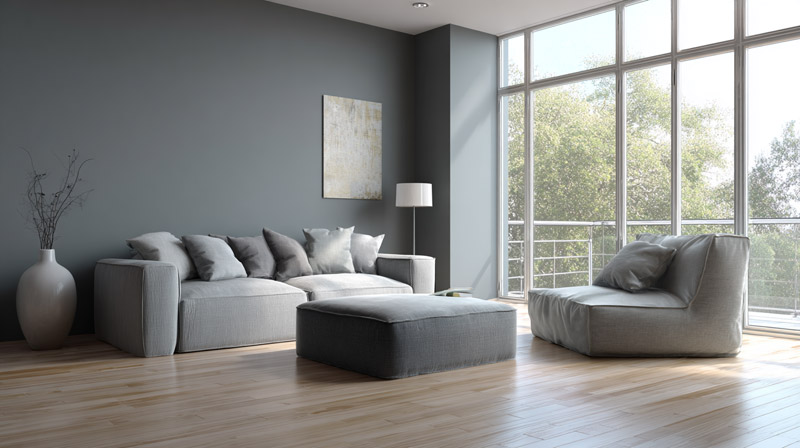
Finish is not a minor detail. The same color in matte vs. satin creates a genuinely different room. Eggshell and satin together account for roughly 60 percent of interior wall paint sold in the US, according to the American Coatings Association (via FacadeColorizer, 2026). They dominate for a reason.
Interior painting offers a return on investment of around 107 percent for home resale (Angi, 2023). Getting the finish wrong is the most common reason for premature repainting, with roughly 40 percent of interior repaints happening sooner than planned due to incorrect finish selection for the room (Paint Quality Institute, via FacadeColorizer, 2026).
Matte and Eggshell Finishes Against Gray Floors
Matte finish absorbs light completely, softening the gray floor’s presence and making the wall color appear deeper and quieter. Good for adult bedrooms, dining rooms, and any space where a calm color palette with gray floors is the goal.
Eggshell is the practical default for most rooms. It has a soft, low-luster appearance (Benjamin Moore describes it as perennially popular with both professional and DIY painters) and handles light cleaning without burnishing. It works in living rooms, bedrooms, and home offices with any gray floor type.
Key limitation: neither matte nor eggshell belongs in kitchens or bathrooms with gray tile floors. Moisture will degrade them faster than satin, and the color will start to look uneven before the gray floor shows any wear.
Satin Finish and Its Effect on Gray Floors
Satin has a pearl-like glow that adds visible light bounce to the room. In brightly lit spaces with light gray floors, satin walls can amplify cool undertones in the floor by bouncing more reflected light toward the floor surface.
Satin performs best in kitchens with gray LVP or tile floors. It handles moisture, wipes clean, and does not compete visually with polished or matte floor surfaces the way semi-gloss does. Sherwin-Williams specifically recommends satin for kitchen and bathroom walls because of its moisture barrier properties (Sherwin-Williams, 2024).
In living rooms and bedrooms with gray hardwood floors, satin can feel slightly too reflective unless the room has lower ambient light or the wall color is deep enough to absorb some of the sheen.
Semi-Gloss and High-Gloss Use Cases
Semi-gloss on trim and doors creates a clean contrast layer above gray floors without competing with the floor surface directly. This is the standard approach in rooms with gray LVP or tile, where trim definition matters for the overall color scheme.
High-gloss is not a wall finish for rooms with gray floors. It catches light aggressively and makes the visual relationship between floor and wall harder to control. Reserve it for interior doors, statement millwork, or kitchen cabinetry where the reflective surface is intentional.
—
What Colors to Avoid With Gray Floors
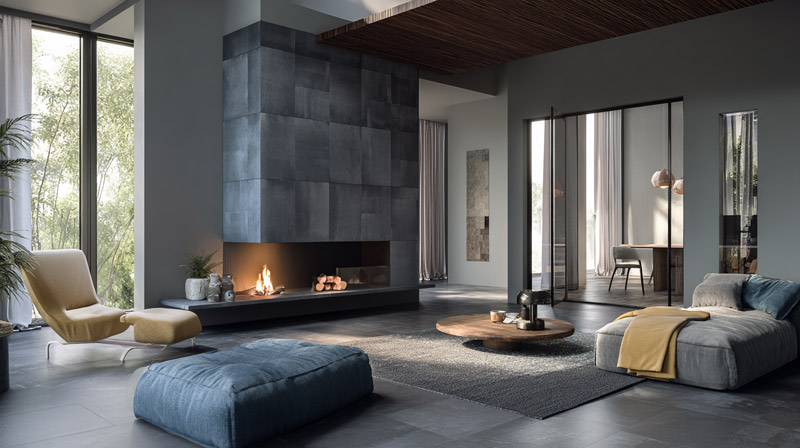
Knowing what fails saves as much time as knowing what works. The most expensive gray floor color scheme mistakes come from undertone conflict, not from bold or unusual choices.
The interior design trend data for 2024-2025 shows a clear shift away from cool grays entirely, with warm earthy palettes moving into the space gray used to occupy (Inside Stories Interior Design, 2024). That shift makes understanding undertone conflict more relevant, because some of the most popular current wall colors clash directly with cool gray floors.
Undertone Conflicts That Fail Every Time
These 4 wall color categories create immediate visual conflict with gray floors:
- Warm yellows and golden tones against cool blue-gray floors (the yellow pulls orange; the floor pulls blue; the room looks unresolved)
- Bright oranges and saturated rust against any gray floor (too much color temperature contrast)
- Red-based warm tones against cool gray, including warm terracotta in north-facing rooms where cool light amplifies the conflict
- Heavily saturated purples against warm gray floors (amplifies any latent purple undertone in the floor to an uncomfortable level)
Same-Value Pairings That Flatten Rooms
Color temperature conflict is not the only failure mode. Same-value pairings, where the wall and floor share similar lightness levels, remove all visual contrast and make rooms feel flat.
A medium gray wall against a medium gray floor is the most common example. Both surfaces compete for the same visual plane. The room loses definition between vertical and horizontal surfaces. Even if the undertones are compatible, the absence of value contrast flattens the space.
The fix is simple: always introduce at least one step of LRV difference between the floor value and the wall value. If the floor is medium gray (LRV 35-50), the walls should read noticeably lighter (LRV 60+) or noticeably darker (LRV under 25).
The Greige-on-Greige Problem
Greige walls against greige warm-gray floors can work, but only when the wall tone is clearly lighter or darker than the floor. When both are in the same LRV range of 40-60 and share similar warm undertones, the result is a room with no visual hierarchy.
The fix used by designers is to add contrast through trim, furniture, or textiles rather than fighting the wall-floor combination. A crisp white trim against greige walls over warm gray floors solves the contrast problem without changing either surface color. Farrow and Ball Pavilion Gray on the walls, Sherwin-Williams Alabaster on trim, and a warm greige LVP floor is a combination that works reliably in open-plan residential spaces precisely because the trim introduces the value step the wall-floor relationship lacks.
When selecting rugs that go with grey floors, the same value-contrast principle applies: a rug that is either clearly lighter or clearly darker than the floor reads more intentional than one that blends into it.
Understanding color theory in interior design makes these relationships easier to predict before the paint goes on the wall. The principles of value, undertone, and contrast apply to every surface in the room, not just the walls.
For a broader view of how these pairings interact with specific wall colors, the full guide to colors that go with grey covers the wider palette relationships that extend beyond just the floor-to-wall connection.
If you want to check how much paint you need before committing to a color scheme, a paint calculator removes the guesswork on coverage for different room sizes.
FAQ on Paint Colors That Go With Gray Floors
What paint colors go best with gray floors?
White, soft blue, sage green, navy, and warm greige are the most reliable wall colors for gray floors. The best choice depends on your floor’s undertone. Cool gray floors pair with warm whites and blues. Warm gray floors work with creamy whites and earthy tones.
What white paint works with gray floors?
Benjamin Moore Chantilly Lace and Sherwin-Williams Alabaster are the top 2 choices. Chantilly Lace suits cool gray floors. Alabaster suits warm gray floors. Always match the white’s undertone to your floor’s undertone or the pairing will look off.
Do gray walls go with gray floors?
They can, but only when there is a clear value difference between the two. A light gray wall against a dark gray floor works. Same-tone gray on gray flattens the room and removes all visual contrast between the floor plane and walls.
What colors should I avoid with gray floors?
Avoid warm yellows, golden tones, and saturated oranges with cool gray floors. Avoid icy blues and stark cool whites with warm gray floors. Same-value pairings, where wall and floor share similar lightness levels, also fail by removing contrast.
Does navy blue go with gray floors?
Benjamin Moore Hale Navy and Sherwin-Williams Naval both work well. Naval has embedded gray undertones that align directly with gray flooring. Navy adds depth and contrast, especially in living rooms and dining rooms with good natural light.
What color walls make gray floors look warmer?
Warm whites like Sherwin-Williams Alabaster, soft sage greens, and earthy greige tones all add warmth above gray floors. Terracotta as an accent wall also works on warm gray floors. Avoid cool whites, which will push the floor further toward cold.
Does sage green go with gray floors?
Yes. Sage green is one of the most compatible wall colors for gray floors across both cool and warm undertone categories. Benjamin Moore October Mist and Sherwin-Williams Sea Salt both perform reliably. Green was the most searched US room color in 2024 (Level Frames).
What is the best paint finish for walls with gray floors?
Eggshell is the standard for most rooms. It balances a soft appearance with practical washability. Use satin finish in kitchens and bathrooms with gray tile or LVP floors. Matte works well in bedrooms and dining rooms where a quieter look is the goal.
How does room lighting affect wall color choices with gray floors?
North-facing rooms amplify cool undertones in gray floors, so warm whites work better there. South-facing rooms with warm light suit cool whites and neutral tones. Always test paint samples at different times of day before committing to a color scheme.
Can dark walls work with gray floors?
Yes, in the right conditions. Dark walls need ceiling height above 9 feet, strong natural light, and light-colored furniture to maintain contrast. Deep navy, charcoal, and forest green all work against gray floors when those 3 conditions are in place.
Conclusion
This conclusion is for an article presenting the wall color decisions that make or break a gray floor scheme.
Undertone matching, light reflectance value, room function, and paint finish all affect the final result more than any single color choice does.
Warm gray floors and cool gray floors need different approaches. A greige wall that works beautifully over warm LVP will fight a blue-gray porcelain tile floor in the same room.
Room direction matters too. North-facing rooms need warm neutrals. South-facing rooms can handle cooler wall tones without losing warmth.
Test samples on your actual walls. Check them at different times of day, under both natural and artificial light. That one step prevents most gray floor and wall color coordination mistakes before they happen.

- Kitchen Color Schemes by Cabinet Color: What Pairs Well - October 19, 2026
- Curtain Colors for Every Wall Color: Safe vs Bold Picks - October 18, 2026
- Interior Design Styles: Find Your Primary and Secondary - October 14, 2026