Art Deco Interior Design
Stylized Floral Patterns in Art Deco Décor

The 1925 Paris exposition gave Art Deco its name, but the flowers were already there. The Met records Paul Iribe’s stylized rose on Paul Poiret’s label in 1908 or 1909, more than 15 years before the fair (Met; Dezeen, 2025).
Stylized floral patterns from this period cut a flower down to a few bold, symmetrical shapes in flat color. Art Nouveau had let curving stems wander across the surface. Designers in Paris workshops and pochoir pattern-book studios worked the new way from the 1910s through the 1930s, and so did glass and ceramic makers and ironworkers.
What Counts as a Stylized Floral Pattern in Art Deco?

A repeating ornament counts when it reduces a flower to a few bold shapes and sets them on a symmetrical axis or a strict repeat. Britannica describes Art Deco ornament as geometric or stylized from representational forms, and the flower is the clearest case of the second kind.
In practice the petals become fans, ovals, or stepped shapes. Color is flat, with solid fields and clear outlines instead of tonal modelling. The motifs sit on a grid, along a border, or on a mirrored axis. You can still name the flower, though. A rose is still a rose, only simplified.
Botanical illustration doesn’t qualify, and neither do the looping vines of Art Nouveau. A chevron or zigzag border with no flower in it is something else again.
Inside a room, the pattern is one layer of a wider Art Deco interior design scheme, set beside materials like lacquer and ivory.
When and Where Did Art Deco Floral Patterns Develop?
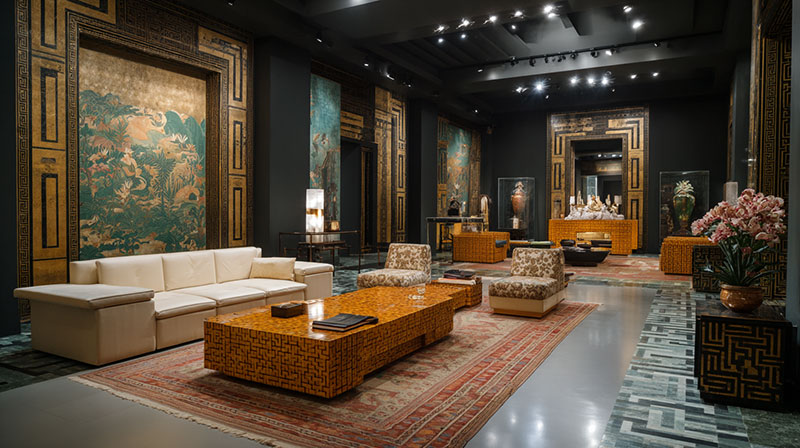
Paris, between the 1910s and 1925. The pattern type existed before the style carried a name.
The name came from the French term for decorative arts in the title of the 1925 Exposition Internationale des Arts Decoratifs et Industriels Modernes. The fair put 15,000 exhibitors from 20 countries in central Paris between April and October (Dezeen, 2025), and the Art Deco Society UK counts 16 million visitors.
The Dating Disagreement Between Sources
Sources don’t agree on when Art Deco starts, and the gap changes how a floral pattern gets labeled. Apartment Therapy has Art Deco replacing Art Nouveau around 1910, while Halls Auctioneers (2015) says it does not properly arrive until the mid-1920s.
Britannica puts the start in the 1920s and the rise as a major style in the 1930s.
The floral record explains part of the split. Christie’s lot notes date the popularity of the stylized “Iribe rose” to 1910, and describe Ruhlmann’s stylized-rose corner cabinets, including an amaranth example ordered by the Mobilier National in 1922.
Sources that date the style by its first motifs land near 1910. Sources that date it by the 1925 label land in the mid-1920s.
Place shifts the date again. Halls Auctioneers notes that Art Nouveau held on in Britain and America through the mid-1920s, with Deco taking over in the UK only in the early 1930s.
Egyptian Influence After 1922
The V&A ties the Egyptian wave to the 1922 excavation of Tutankhamun’s tomb (Howard Carter’s discovery came that November), and lists lotus flowers among the Egyptian imagery that proliferated afterward.
The Met’s catalogue entries for Guerinet’s pochoir plates tie the same fascination with early Egyptian and Meso-American cultures to archaeological discoveries of the period.
Egyptian ornament predates 1922 (FIDM Museum), but the discovery pushed it to the front. That makes the lotus a later layer than the stylized rose, which the Met and Christie’s notes document from 1908-1910.
How Did Art Deco Designers Stylize Flowers?
They cut each flower down to a handful of repeating shapes and fixed it on an axis of symmetry. Flat color went in, often against a geometric ground.
Emile-Allain Seguy shows the shift within one career. His 1902 portfolio of 30 pochoir plates (Met catalogue) includes a naturalistic poppy drawn with a dissected side view of the flower.
His album Floreal, dated 1925 or earlier, holds 20 plates of semi-abstract flower motifs that the Met reads as a blend of Art Nouveau and Art Deco.
Symmetry and Repetition
Symmetry does the structural work. Motifs mirror across a vertical axis or repeat at fixed intervals.
The repeat adapts to the surface. Trim gets a single-row border, a wall gets a frieze band, and textile and wallpaper get an all-over tile.
Interior designers use symmetry to anchor a room around a center, and a mirrored floral panel applies that logic at pattern scale.
Geometry in the Flower Versus Geometry in the Ground
Most guides say Art Deco turns flowers into geometric shapes. The Met’s pochoir plates show a second route.
In a Hennequin-Reveur plate from the fourth “Studio d’arts decoratifs” series, interlacing circle and square outlines lie over semi-abstract tulips and peonies on a purple ground. A Sorokine plate from the third series, which has 12 plates plus a title page with index (Met), runs large stylized roses over a red and dark blue check on white.
So the geometry can live in the flower itself. The petals shrink to simple units and the outline does most of the shaping. Or the flower stays rounded and semi-abstract while checks, circles, squares, and diagonals build the structure around it.
Those checks and circles come from the same family of geometric shapes found across Art Deco interiors.
Pick one place for the geometry and let the other stay calm.
Which Flowers Recur in Art Deco, and How Are They Drawn?

Roses, peonies, tulips, lotus blossoms, and daisies all appear in museum-documented Art Deco work, and each gets a different edit.
The rose got the richest color. Ruhlmann’s later wallpapers pack large-headed roses into bright, dense repeats (Cooper Hewitt), and a Sorokine plate in the Met’s Guerinet series pairs orange, red, and pink petals with aquamarine and turquoise leaves on cream.
Saturated hues against a plain or dark ground is where the wider Art Deco color palette begins.
Peonies and tulips show up as semi-abstract heads in red, violet, yellow, and orange, with green and light blue accents. Daisies are semi-abstract too, in white and gray or in aquamarine and green, and they sit beside circle fragments and lozenges.
The lotus arrived later. The V&A ties it to the Egyptian imagery that spread after 1922, and the 1939 Woolworth Company Building described below carries it as a stylized relief. The FIDM Museum notes that Egyptian line looked strikingly modern in 1923, with the lotus among the floral forms designers admired.
Furniture shows the luxury end of the vocabulary. The V&A’s Ruhlmann dressing table (ca. 1919-1923) is veneered in Andaman padouk and purpleheart with ivory and ebony inlay, and the museum notes his rich materials and stylised surface decoration.
Art Nouveau Flowers Versus Art Deco Flowers
Art Nouveau treats a flower as growth, so the lines curve and the layout is often lopsided. Deco edits it. What comes out is angular and, more often than not, symmetrical.
| Attribute | Art Nouveau | Art Deco |
|---|---|---|
| Line | Whiplash curves, winding stems | Angular, straight-edged |
| Symmetry | Often asymmetrical | Often symmetrical |
| Floral treatment | Fronds and tendrils weaving across the surface | Single flower heads reduced to repeat units |
| Inspiration | Plants and natural growth | Cubism, modernity, Egyptian and Meso-American art |
| Materials | Delicate, nature-infused | Costly: lacquer, ivory, gold |
The table draws on Halls Auctioneers (2015), Apartment Therapy, Homes & Gardens, and Britannica.
The difference shows first in how each style handles line. Nouveau stems wander. Deco ones get pinned to a straight axis.
The V&A describes the whiplash as an ornamental S-curve that writhes and coils, and notes that its appeal wore thin fast.
The line between the styles is not sharp, and two museum records show it. Cooper Hewitt (2014) describes an early Ruhlmann wallpaper that keeps meandering Nouveau vines but cuts the plants to basic silhouettes in a restrained palette. The Met reads Seguy’s Floreal album as a combination of both styles.
Ruhlmann’s later wallpapers move to dense stylized roses in brighter colors (Cooper Hewitt).
Art Nouveau interior design applied the same curve to architectural ironwork and furniture, which is why a pattern that mixes vine and axis points to a transitional piece.
Who Designed Art Deco Floral Patterns, and Where Are They Documented?
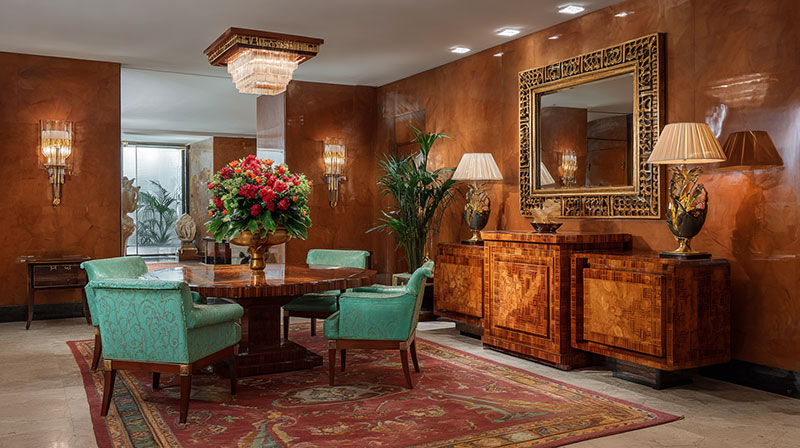
Pochoir pattern books and Paul Poiret’s circle of workshops leave the best paper trail, and museums catalogue both plate by plate.
Poiret ran Martine, which opened on 1 April 1911, as a design business with a school attached (Met). The students, young working-class girls, sketched plants and animals in parks and zoos, and Poiret bought the best drawings for Atelier Martine to adapt.
Textiles and wallpapers came first. Carpets, lighting, hand-painted glassware, and ceramics followed.
Raoul Dufy, whose textile career Poiret helped launch, matched Poiret’s taste for simplified forms in intense color. The Met’s Poiret exhibition (2007) shows Paul Iribe’s rose motif for Poiret reappearing in a Dufy textile, before Bianchini-Ferier hired Dufy away.
Maurice-Pillard Verneuil shows where a pattern-book designer ended up. In the plates the Met catalogues from his “Kaleidoscope: Ornements Abstraits” (20 plates and 87 designs), most textile designs are circles, squares, triangles, and stripes, with one nature-inspired design of green abstract leaves over overlapping semicircles.
What a Pochoir Pattern Book Plate Contains
A plate is a design sample, not a finished object.
The fourth Guerinet series carries the subtitle “Motifs inedits pour toutes Industries d’Art” (novel motifs for all art industries), and the Met reads such designs as likely meant for textiles and wallpaper. It dates the Guerinet series to the second half of the 1920s or early 1930s.
Each color needed its own stencil, so the image was split into color layers and one stencil was cut per layer. A brush called a pompon then worked watercolor or gouache through each stencil (RISD library guide). Jean Saude published a treatise on stencil-colored pochoir printing in 1925 (Smithsonian Libraries).
Gouache piles up against the stencil edge and leaves a slight raised surface that can be seen and felt (Smithsonian Libraries).
The limit follows from the record. A plate proves a design existed on paper, and it does not prove anyone wove, printed, or cast it.
Which Materials and Techniques Carry Art Deco Floral Patterns?
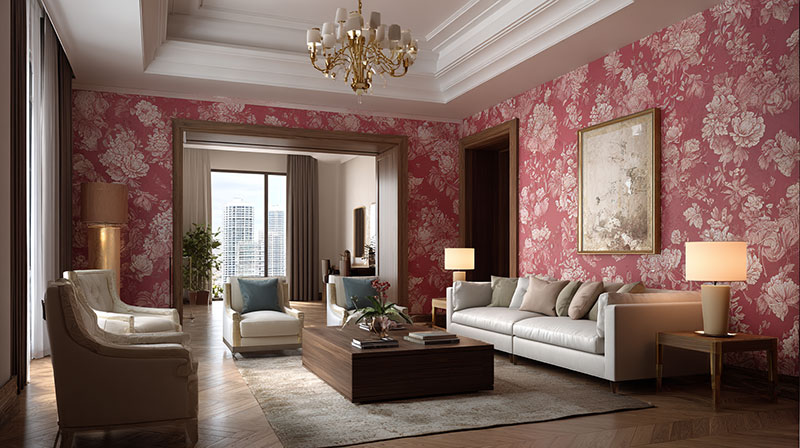
Terra cotta, wrought iron, molded glass, marquetry, and hand-painted ceramics all carry the pattern, and each medium decides how much of the flower survives.
Architecture and Ironwork
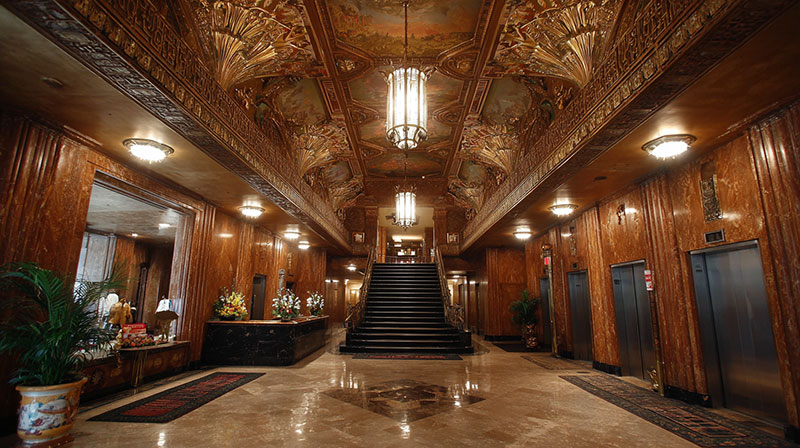
Terra cotta put floral relief on commercial streets. The Strong Building of 1929, by Oman and Lilienthal, crowns its piers with large stylized white and yellow daisies on a dark green ground (Wisconsin Historical Society). Incised and applied ornament in geometric and floriated patterns fills the spandrels below.
A 1939 Woolworth Company Building sets a stylized lotus relief in tile above its casement windows. Its National Park Service registration form describes the low-relief ornament as confined to bands or blocks.
Floral relief also reached ordinary commercial blocks, well beyond the famous Art Deco buildings.
Wrought iron took the flower in a different direction. Edgar Brandt’s floral door panel (ca. 1923) went to the 1923 Salon d’Automne, gained feet to stand freely, and entered the Met’s collection in 1924 (Cooper Hewitt).
Mixed materials mean more construction behind the flower. In a Brandt and Daum firescreen, one of four known examples, each glass roundel sits in its own iron receptacle fixed to the back of a scalloped iron flower (Sotheby’s, 2018).
Interiors, Glass and Furniture
Lalique’s “Dahlias” vase, designed in 1923, molds overlapping dahlias into frosted and clear glass with sepia patina and black enamel highlights (Smith & Singer).
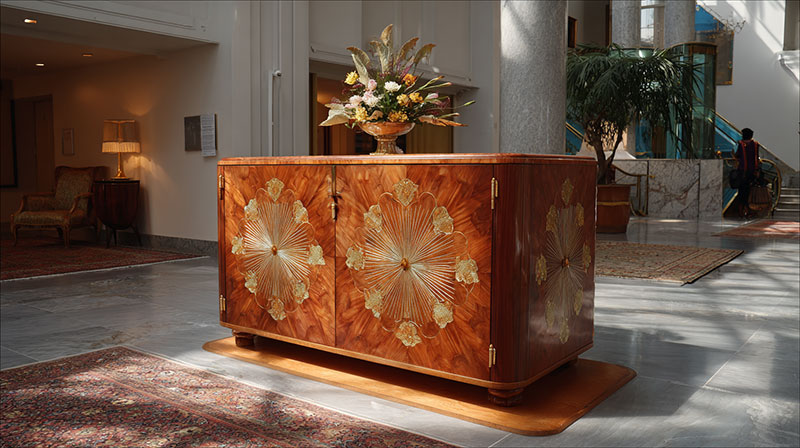
Ruhlmann mixed rich woods with ivory and shagreen, and some of his pieces carry marquetry panels of dense flowers and bouquets (Cooper Hewitt).
Christie’s lot notes describe one Ruhlmann corner cabinet as one of five three-legged examples carrying variants of the same decorative motif, and observe that Ruhlmann and contemporaries such as Iribe chose to stylize the rose.
The stylized rose moved between media, from inlaid furniture to Ruhlmann’s wallpapers (Cooper Hewitt), and the woods and inlays are part of a longer list of Art Deco furniture characteristics.
Textiles and Ceramics
Dufy’s graphic effects came largely from woodblock printing (Met). Atelier Martine’s students hand-knotted its deep-pile carpets, while outside specialists handled most other products (Met).
On the ceramics side, Clarice Cliff’s Crocus of 1928 reduced the flower to orange, blue, and purple upstrokes, and the V&A notes it was entirely hand painted.
By 1929 she had seventy women working for her (Tooveys), which is the labor price of a hand-painted pattern.
How to Draw a Stylized Floral Motif in the Art Deco Manner
The order matters more than the drawing skill.
- Study one flower. Seguy framed his plates as applied scientific study of flowers (Met), and Martine’s students sketched plants before any simplifying started.
- Reduce it to a few flat shapes. Keep the head and a leaf, maybe a bud, and drop the veining and shading.
- Decide where the geometry goes. It belongs in the flower or in the ground, not both.
- Fix the axis and the repeat. Mirror across a vertical axis, then tile it as a border or frieze, or as an all-over field.
- Limit the color layers. Pochoir cut one stencil per color, so every added color added work.
- Test the draft against dated plates. Stems that curve like a whiplash read as Art Nouveau.
Naturalistic petals make the flower read as botanical illustration. Curling stems pull the pattern back toward Art Nouveau. Putting geometry in both the flower and the ground is another common miss, and so is a busy palette that hides the symmetry.
Contrast between flower and ground follows the same logic as color theory in interior design. A dark ground lifts a pale flower, and a pale ground lets saturated color carry.
If the motif is headed for a wall, the repeat size decides how much paper a room needs. Check quantities with a wallpaper calculator before ordering.
When Does the Art Deco Label Not Fit a Floral Pattern?
The label slips when the flowers keep Art Nouveau curves. It also slips when a pattern copies a non-Deco source without editing it, or when the piece was made decades after the period.
The Nelson-Atkins catalogs a Lalique molded vase (ca. 1920-1925) with alligators inside vertical curves against a background of flowers and fruit-bearing trees, and its label ties Lalique’s plant designs to Art Nouveau line. So a Deco date alone doesn’t guarantee Deco curves.
Borrowed sources cause trouble too. The floral pattern on Brandt’s door panel reflects Persian manuscript sources, with the boldness of contemporary textiles (Cooper Hewitt).
Long production runs blur dating. A collector publication reports the 1928 Crocus pattern in production into the 1960s, so a Deco look does not date a piece to the 1920s. Revivals do the same thing, since Britannica reports renewed interest in Art Deco from the late 1960s and later work can copy period motifs.
Place and category matter as well. The National Park Service lists the Miami Beach Architectural District, nicknamed the Art Deco District, under revival and Moderne styles, with significance periods of 1900-1924 and 1925-1949.
These cases make the label incomplete, not wrong. They show why a pattern needs checking against features, not against the name.
A workable test is to score the pattern on symmetry, reduced silhouette, and flat color. Two of three fits the Art Deco label. One or none points to Art Nouveau, a revival, or a different source.
Stylized Floral Patterns in Art Deco FAQ
Which colors do Art Deco floral patterns use?
Saturated hues set against a contrasting ground, with no single fixed palette.
A Sorokine plate in the Met’s Guerinet series sets yellow-and-orange petals on dark blue, while another pairs orange and pink roses with aquamarine leaves on cream.
Is the rose or the lotus more typical of Art Deco?
The rose has the longer record. Paul Iribe’s rose reached Poiret’s label by 1908 or 1909 (Met), while the V&A ties the lotus surge to the 1922 Tutankhamun discovery.
Can Art Deco floral patterns work in modern interiors?
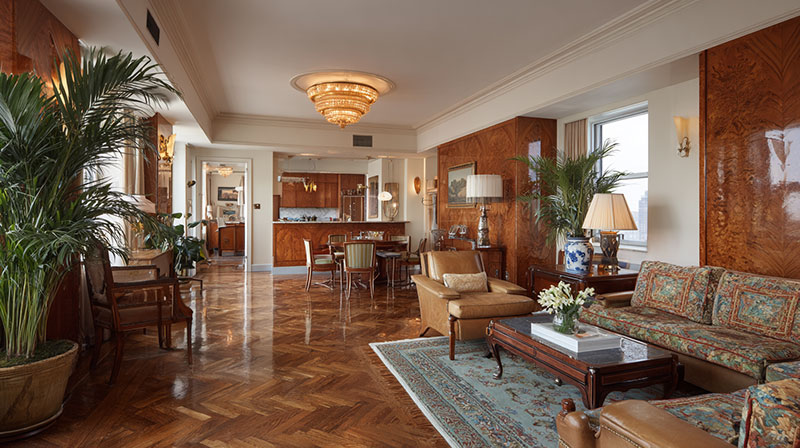
Yes. Apply the usual rules for pattern in interior design, which means one dominant pattern per room with calm surfaces around it.
The symmetry and flat color of the motif read cleanly at room scale, which suits a single wallpaper panel or a set of cushions.
Is there a difference between Art Deco floral wallpaper and floral textile design?
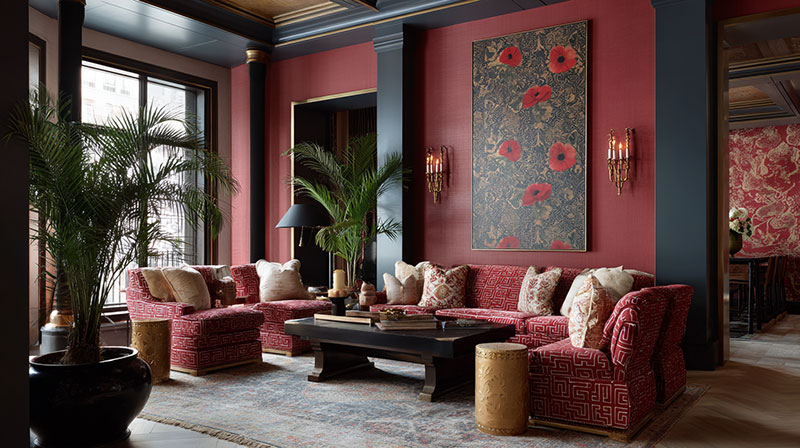
Not in the motif. The Met reads the same pochoir designs as likely meant for textiles and wallpaper, and Atelier Martine adapted student drawings for both.
Manufacture differed. Martine sent its wallpapers to outside specialists such as Paul Dumas or Defosse & Karth (Met).
Where to Check a Pattern Against Period Originals
Dated museum plates make the best check: the Met’s pochoir records, the V&A, Cooper Hewitt, and the Smithsonian Libraries.
Work in a fixed order, because each check narrows the next. Date the plate from its catalog entry, then match line and symmetry, then match ground and palette.
Dating comes first because a plate with a catalog date gives the comparison a fixed reference. Line and ground checks without one prove only resemblance.
Check the rights note before saving an image. As of October 2026, Met records covered by Open Access allow free copying, while some records, such as a ca. 1910 evening stole, restrict enlarging and downloading.
For the geometric grounds those plates pair with flowers, the chevron patterns found in Art Deco design are the next family to study.

- Shoji White vs Alabaster: Which Soft White Wins? - October 25, 2026
- Color Combinations for 32 Colors and 10 Wood Tones - October 22, 2026
- Kitchen Color Schemes by Cabinet Color: What Pairs Well - October 19, 2026


