Color Combinations
Colors That Go With Taupe When Decorating Your Home

Taupe is the paint chip that looks right in the store and a little off once it’s on your wall. Part of that is the undertone, which swings between warm brown and cool gray, and part is whatever you put next to it.
Designers use it as a base neutral on walls, upholstery and cabinetry, so the partner colors decide whether a room feels cozy or just flat.
Hue gets all the attention, but value does a lot of the work. Sherwin-Williams lists Studio Taupe (SW 7549) at an LRV of 34.5 and Taupe Tone (SW 7633) at 35.8 in 2026, so a taupe wall reflects roughly a third of the light that hits it.
Our breakdown of colors that work together puts taupe side by side with every other color we cover.
Our color combination guide puts taupe side by side with every other color we cover.
Which colors go with taupe?
White, cream, navy, charcoal, sage and emerald all sit well next to it, and so do terracotta, mustard, blush pink, brass, gold and walnut. Taupe is a brown-gray neutral, so it picks up the warmth or coolness of whatever is beside it.
Composite Paint puts taupe somewhere between warm brown and cool gray, which means it carries a bit of both temperatures and goes where the room leads it. Livingetc’s color consultant Trina Rogers adds blues, greens, pastels, dusty pinks and earth tones.
| Pairing | Example shades | Best with | Effect |
|---|---|---|---|
| White and cream | Crisp white, warm cream, linen | Any taupe | Frames the walls, keeps the scheme clean |
| Navy and charcoal | Deep navy, charcoal, black | Either undertone | Sharp contrast, more definition |
| Greens | Sage, emerald | Either undertone | Sage cools, emerald deepens |
| Terracotta, mustard, blush | Burnt clay, ochre, dusty pink | Warm taupe | Cozy, sun-baked |
| Brass, gold, walnut | Aged brass, cognac, walnut | Warm taupe | Soft glow, natural depth |
Composite Paint’s pairing guide boils every row down to one rule. Set a single richer anchor color against the taupe and keep everything else soft.
Which shade inside each row looks right comes down to undertone.
How taupe undertone decides the right pairing
Taupe has no fixed formula, so a pink-leaning chip and a green-leaning chip need different partners even when both are labeled taupe. Rawlins Paints warns against picking taupe by name alone.
How to read a taupe’s undertone
Warm taupe leans red-brown. Mustard enlivens it, according to Composite Paint, and Rawlins Paints finds oak, walnut and brass comfortable beside it.
Cool taupe leans gray, and sage or soft blue keeps it fresh. Rawlins Paints calls grey taupe cooler and more contemporary than the brown ones, best in bright rooms, and lists RAL 280 70 05 Taupe Grey as a balanced neutral taupe, neither too warm nor too cool.
Then there’s the pink-violet kind. Maria Killam warns that it reads pink next to green-undertone colors, so keep it with other taupes and test large samples against hard finishes.
To find the undertone, hold the chip against pure white paper and a neutral gray card. Whatever color creeps into the chip is the undertone. Simple, and it takes a minute.
How taupe differs from greige, beige and gray
Sources disagree on which undertone belongs to which name. Kylie M Interiors assigns violet-pink to taupe and green-yellow to greige, and notes that other writers swap the two.
So a chip called taupe can lean green in one brand’s deck and pink in another’s. Sample it instead of trusting the label.
Hunker places beige lighter than taupe, with a warmer undertone. Gray is cooler and has none of taupe’s brown base, while greige is gray plus tan with a green lean.
Apartment Therapy describes taupe as a grayish brown that sometimes picks up a touch of pink.
Neutrals and dark colors that work with taupe

Cream is the safest partner for warm taupe. Crisp white frames any taupe, and charcoal or black supplies the contrast that taupe doesn’t have by itself. Soft gray works too, as long as the undertone matches.
Composite Paint recommends crisp white or soft cream for trim and ceilings, so taupe walls look framed instead of muddy.
Crisp white trim draws a clean line around the walls and holds its own against cool taupe. Next to warm, earthy taupe it can look stark, though. Soft cream matches the temperature of warm taupe and gives a gentler edge, but the smaller value gap makes the walls read less defined.
Rawlins Paints advises against brilliant white woodwork with warm or earthy taupe, which is the main reason to reach for cream there.
Sherwin-Williams lists Pure White (SW 7005) at an LRV of 84 and Tony Taupe (SW 7038) at 37 as of October 2026. That gap of about 47 points explains why white trim reads so sharp.
Apartment Therapy’s tour of Kirsten and Kyle’s Portland home shows the pairing at work. Taupe walls make crisp white and beige furnishings stand out.
Charcoal and black are the contrast play. Hunker singles out black cabinets against taupe walls, and the logic behind how contrast works in a room applies here, since one dark mass gives the eye a place to land.
Soft gray echoes taupe’s cool side and keeps a room minimal, per Composite Paint. Rawlins Paints flags it as the pairing that needs care.
An all-neutral scheme has no accent color to carry interest. Hunker advises leaning on texture in the room so the space does not fall flat. Linen, wool, rough plaster and oak grain all help.
Which accent colors make taupe stand out?
Deep blues and greens give taupe its sharpest contrast. Terracotta and mustard warm it up, blush pink softens it, and brass, gold and walnut add a quiet glow. Pick one anchor color and leave the rest soft.
Blues and greens
Benjamin Moore lists Hale Navy (HC-154) at an LRV of 8.36, about 29 points below Tony Taupe’s 37. That gap gives navy its definition against taupe’s mid-range value.
The pairing also follows color theory as it plays out in a home, since blue sits opposite the orange-brown base of a warm taupe on the wheel.
Sage cools a warm taupe and feels fresh, according to Composite Paint, while emerald makes quiet taupe feel like a deliberate choice.
In Lisa Vanin’s Canadian rental, as Apartment Therapy tells it, taupe-painted walls sit behind a bright green couch.
Terracotta, mustard and plum
Warm accents suit warm taupe. Mustard enlivens it, according to Composite Paint.
Terracotta and mustard pull the room into an earthy color palette, the cozy end of taupe’s range.
Plum goes the other way. Hunker’s example sets a jewel-toned eggplant sofa in a room grounded by taupe.
Pinks, metals and woods
Blush and dusty pink are named among taupe’s partners by Livingetc’s color consultant Trina Rogers. Aged brass adds a soft shine that flatters taupe’s earthy tone, per Composite Paint, and walnut and cognac leather share taupe’s warmth while adding depth. Maria Killam says nickel and pewter work too.
Warm metals and woods follow warm taupe. Nickel and pewter suit the cooler ones.
How much taupe should a room carry against its accent colors?
About 60 percent of the room goes to taupe when it covers the walls, 30 percent to a secondary color and 10 percent to an accent. That 60-30-10 split is a guide, and it shifts when taupe moves from the walls to a sofa or cabinets.
Ideal Home quotes Andrew Martin’s Martin Waller on why the walls come first: they dominate a room more than any other component. For taupe, that usually puts the 60 on the paint.
A taupe sofa against white walls changes the math. Composite Paint’s guide treats the dominant color as whatever fills the most visual field, so the sofa can share the 60 with the walls.
The 30 should differ from taupe in value or temperature instead of being a slightly different beige. A second taupe beside the first adds nothing.
In practice the order goes like this.
- Test the taupe for undertone against pure white and a gray card.
- Give taupe the 60: walls, or a large sofa on white walls.
- Pick the 30 from a different value or temperature, such as navy, deep green, charcoal or cream.
- Keep the 10 for pillows, lamps, art and brass.
- Check the split under the room’s own light.
Katerina Tchevytchalova of K’Arte Design treats the rule as a point of reference, not a strict formula. A room that drifts from the exact ratio is not wrong.
To test a split before buying paint, run the colors through a room color scheme generator.
How light changes taupe and its pairings

Taupe is a mid-value color, so light moves it more than it moves a white or a black. Warm light pulls it toward brown, cool light toward gray, and weak light toward a heavier tone.
Going by manufacturer pages and ENERGY STAR guidance as of October 2026, Studio Taupe (Sherwin-Williams SW 7549) has an LRV of 34.5 and is rated medium, and Taupe Tone (SW 7633) sits at 35.8, also medium. Benjamin Moore’s Tyler Taupe (HC-43) comes in at 31.85. On the bulb side, warm bulbs run 2200 to 3000 K, whiter and cooler ones 3500 to 4100 K, and bluer daylight bulbs 5000 to 6500 K.
Three taupes from two brands sit within four LRV points of each other. A taupe wall reflects roughly a third of the light that hits it, so white trim and cream bedding always read much brighter beside it.
Benjamin Moore’s Spanish site lists Tyler Taupe at 31.44 against 31.85 on its US page. Check the page for your market.
North-facing rooms get steady, muted light. Benjamin Moore Canada notes that cool blue-gray tones are popular here, so warm taupe supplies the warmth the light lacks. South light is warm and strong, and Benjamin Moore Canada suggests greens, blues and violets to balance it, which makes sage and navy accents the natural fit.
East rooms get bright, warm morning light that turns cooler and muted by evening (Farrow & Ball). West rooms run the other way, cooler in the morning, then brighter and golden in the afternoon (Farrow & Ball).
Window size changes the picture too, and it is part of how light behaves in a room. Two north-facing rooms can show the same taupe very differently.
Artificial light acts as a second direction. Farrow & Ball says halogen and incandescent bulbs warm wall colors, while cool white bulbs give paint a bluer cast.
Behr adds that warm 2700 K bulbs enhance creamy, yellow or peach undertones, while 5000 K daylight bulbs emphasize blue and gray ones. Under warm bulbs, warm taupe with walnut and brass stays cohesive. Cool bulbs push taupe toward gray and sharpen blue accents.
Benjamin Moore recommends oversized swatches, peel-and-stick samples or brush-on samples, viewed through the day and evening in natural and artificial light. Hold the intended accents next to each sample too, like the navy cushion and the brass handle, plus whatever trim color you’ve picked.
Which taupe pairings suit each room?
Living rooms do best with navy, green or cream beside the taupe. Bedrooms like white or pink textiles. In kitchens it’s white or a muted blue island, and a green-leaning taupe with natural stone suits bathrooms.
Living room

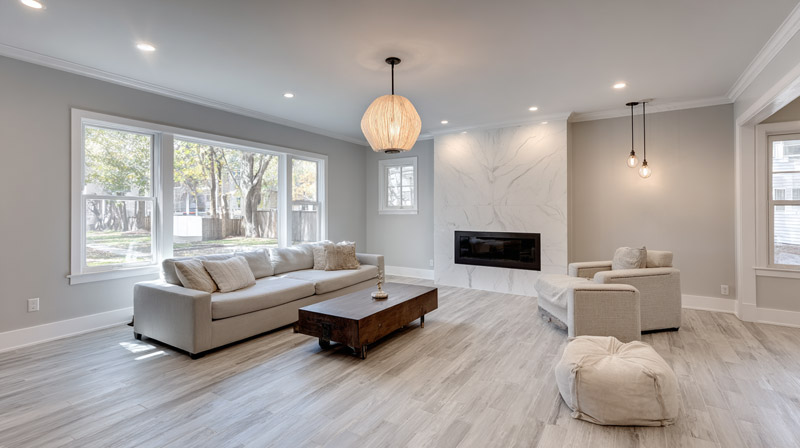
Rawlins Paints recommends taupe for living rooms when the aim is calm, warmth and flexibility. Warm taupe walls with cream trim make the starting point, then navy or deep green goes on the seating, with oak, walnut or aged brass for the wood and metal.
For a cozy living room palette, put the deep color on the seating and let the taupe walls stay quiet.
Bedroom

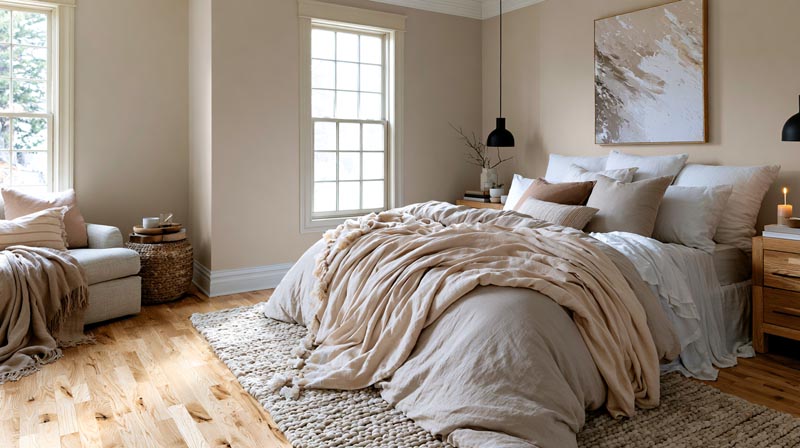
Designer Paris Forino, quoted by Livingetc, used taupe upholstery in a Beverly Hills bedroom to bring out the detail in a cloud-pattern wallcovering. In Forino’s words, taupe relates to pattern more closely than white does, which is why it works there.
Rawlins Paints adds that bedrooms suit taupe when white feels too stark and beige too yellow.
Taupe sits comfortably among calming bedroom colors, and Hunker’s example pairs a taupe upholstered headboard with white furnishings to keep the room crisp.
Kitchen
| Layout | Pairing | Effect |
|---|---|---|
| Taupe cabinets | White walls | Warm cabinets, clean frame |
| Taupe walls and cabinets, one shade | Muted blue island | Larger, brighter room |
| Taupe backsplash | White cabinets | Soft contrast |
Seattle designer Katie Hackworth painted the walls and cabinets of chef Aran Goyoaga’s kitchen in one taupe, which Hunker credits with making the room feel bigger and brighter.
In Livingetc, Forino’s view is that bright white, monochrome kitchens look off the shelf, and taupe cabinets look more designed.
Bathroom
A taupe with green undertones gives a spa-like bathroom, according to Hunker’s room-by-room roundup.
Domino shows taupe cabinets in a bathroom with a cool, mellow palette. Livingetc’s marble bathroom picks the color up in the stone veining beside a timber vanity.
When taupe pairings stop working
Rooms built from nothing but warm woods and beige are the most common mistake with warm taupe, according to Composite Paint. A clean white or a cool accent such as navy, black or charcoal breaks the sameness.
Bright primary colors as the main partners make taupe look dull by comparison, per the same guide. Push them down to the accent 10 percent or choose muted versions.
Picking taupe by name is a trap too. Benjamin Moore describes Tyler Taupe as a deep tan with golden undertones, not the gray-brown many buyers expect, so judge the chip and not the label.
And in dim north-facing rooms, Benjamin Moore UK says colors with gray, blue or lavender undertones look duller in cool north light. Choose a warm taupe there.
Maria Killam finds warm-undertone taupe reads earthier and dirtier than greige or green-gray, and she finds greige more versatile. A room meant to feel airy is a case for greige instead.
Taupe FAQ
What colors make taupe?
Brown and gray, mixed in different ratios. More brown reads warm, more gray reads cool, and a trace of pink or violet produces the rosy variants.
Which curtain colors go with taupe walls?
Cream or white curtains suit most taupe walls, and cream matches warm taupe best. For contrast, hang navy or sage, which takes the 30 percent role in a 60-30-10 split.
Does taupe go with orange or red?
Yes, in muted shades. Designer Sabrina Soto (a Behr paint ambassador), quoted by Livingetc in July 2026, pairs warm taupe-brown with rich rust reds or terracotta.
Keep them to the accent 10 percent.
Can taupe be paired with teal?
Yes. Teal sits between blue and green, and taupe takes both. Hunker pairs it with sky blue and, in a bathroom, teal, while Composite Paint pairs it with sea glass green.
A deep or muted teal reads as an accent against taupe’s earthy base.
Is taupe still in style?
Yes, in a warmer form. Livingetc’s July 2026 piece on taupe describes designers moving to warm, milk-chocolatey taupes that lean browner than older gray-adjacent ones, with Benjamin Moore Taupetone and Farrow & Ball Broccoli Brown among its examples.
The Pantone Color Institute named a warming brown, Mocha Mousse (17-1230), its 2025 Color of the Year.
What to Change First When a Taupe Pairing Looks Off
When a taupe pairing looks off in the room, swap the accents first, then the secondary color, and repaint last. The order follows cost and reversibility, so each step tests the diagnosis before the next one spends more.
- Pillows, lamps, art, hardware
- Curtains, rug, upholstery
- Wall paint
If the clash survives the second step, the undertone of the taupe is the cause, and no accent swap corrects it.
Repainting settles the most and costs the most, so size the job with a room paint calculator before buying.
This order holds as of October 2026. It resets whenever the room’s light changes, such as new bulbs or a larger window.

- Kitchen Color Schemes by Cabinet Color: What Pairs Well - October 19, 2026
- Curtain Colors for Every Wall Color: Safe vs Bold Picks - October 18, 2026
- Interior Design Styles: Find Your Primary and Secondary - October 14, 2026