Rugs
Living Room Rug Ideas That Anchor Your Whole Space
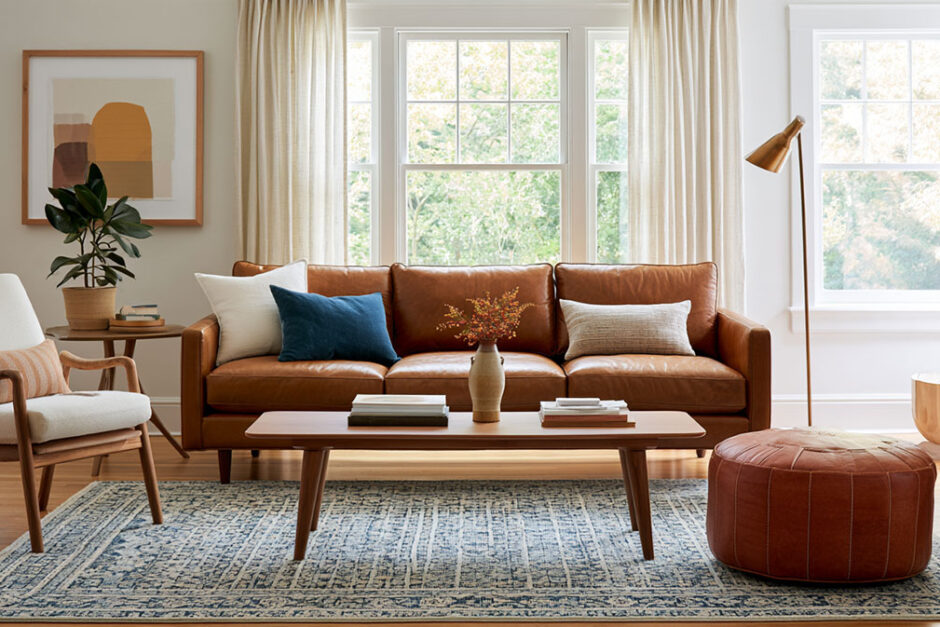
Most people buy a living room rug that’s too small. The 5×8 is the usual pick, and for a standard sofa and two chairs the room really wants an 8×10 or 9×12.
A rug’s job is to pull the furniture into one seating area instead of leaving it scattered across the floor. Style comes second. Once the size is right, almost anything works, from plain neutral wool to a faded vintage Persian or a layered jute setup.
The gap between rug and wall is where makers stop agreeing. It runs from 6 to 8 inches at Ernesta to 18 to 24 inches at Well Woven, and the right figure depends on how big the room is.
What Size Rug Does a Living Room Need?
An 8×10 rug fits most living rooms. A 9×12 suits larger rooms or layouts where every furniture leg sits on the rug, per Revival Rugs’ size guide.
A 5×8 can’t handle a standard sofa and two chairs. It shrinks the seating area instead of holding it together.
Size the rug to the furniture group, not the floor. It should be at least as wide as the sofa, and running a little past each arm is better.
| Seating setup | Rug size | Furniture layout |
|---|---|---|
| Loveseat and one chair | 5×8 | Floating, legs off |
| Sofa and two chairs | 8×10 | Front legs on |
| Large sofa or sectional | 9×12 | All legs on |
| Oversized open-plan group | 10×14 | All legs on |
The gap between rug and wall is where the advice falls apart.
Ernesta recommends about 6 to 8 inches, Rugs.com’s general size guide says 8 to 24 inches, and Well Woven asks for 18 to 24 inches of exposed floor. That’s three answers to one question.
The spread makes more sense once room size is part of it. Rugs.com has a separate wall-spacing guide that scales the gap, with 6 to 8 inches in small rooms, 8 to 12 in standard living rooms, 12 to 18 in large ones.
So consistency matters more than any single number. An even border on every side beats hitting a specific inch count, and that’s really just a basic point about scale and proportion in a room.
Rug Sizes for Small Living Rooms
Small rooms push people toward small rugs, and that usually backfires.
An 8×10 with the sofa’s front legs on it makes a compact room look wider than a 5×8 floating in the middle. Keep the wall gap tight, around 6 to 8 inches.
Before buying, mark the corners on the floor with painter’s tape and leave it there for a day. You’ll know pretty fast if it’s wrong. You can also run your room and sofa measurements through a rug size calculator to check the fit.
Rug Sizes for Large and Open-Plan Rooms
A sectional needs a 9×12 at minimum so both arms of the L sit on the rug. Two facing sofas do better on a 9×12 or a 10×14 with all legs on. In a very large room, give each seating zone its own rug rather than stretching one across the whole floor.
Rugs.com offers a simple test. If there’s a big gap between the rug edge and the furniture, size up.
How to Place a Living Room Rug Under Furniture
The rug should connect every seat in the conversation zone. Center it on the sofa or the room’s main feature, with the coffee table near its middle.
- Measure the seating group, not the whole room.
- Pick a layout: all legs on, front legs on, or floating.
- Tape the rug outline on the floor.
- Center it on the sofa or fireplace.
- Check walkways, then set the coffee table on the rug’s center line.
Revival Rugs recommends keeping 30 to 36 inches clear for the main paths through the room. A rug edge that cuts across a walkway becomes a trip hazard fast.
All Legs On, Front Legs On or Floating
With all legs on, every piece of furniture sits fully on the rug. Ernesta recommends this for mid-size to large rooms, and it reads as one finished zone.
Front legs on means the sofa and chairs rest only their front legs on the rug. It’s the default for an 8×10 and the easiest layout to get right.
Floating, where nothing but the coffee table touches the rug, is fine for tiny apartments. In a normal living room the seating ends up looking disconnected.
Rooms built around a hearth follow the same logic. The rug usually centers on the firebox, and the way seating is arranged around the fireplace decides whether front legs or all legs land on it.
Using a Rug to Zone an Open Floor Plan
In an open plan, the rug does the job walls would do.
Treat its edges as the room’s boundary and float the sofa and chairs around it, rather than pushing them against the far walls. Each zone gets its own rug, sized to its own furniture, whether that’s a lounge or a reading corner.
Rugs in the same space don’t need to match. They need one shared element, like a color or a fiber. For more layout options, see these ideas for splitting a large living room into zones.
Living Room Rug Ideas by Style
The best rug style is the one that sets the room’s palette or repeats it. Pick it after size, never before.
Neutral and Natural-Fiber Rugs
Textured wool in ivory or grey works with almost any sofa. It’s the safe choice, and safe is fine here.
Jute and sisal suit coastal or farmhouse rooms, and undyed wool loop pile fits Scandinavian and minimalist spaces. If a plain rug feels flat, low-contrast stripes help.
Natural fibers have a coarse, matte surface that balances smooth leather or velvet upholstery. That contrast is the core idea of texture in interior design.
Patterned and Vintage Rugs
Persian and Oriental rugs add age and color to a modern room. The faded, low-pile vintage ones work best, since their patterns hide everyday wear.
Kilims are flatweave and reversible, with bold geometric motifs. They lie flat under doors and suit casual or boho living rooms.
Geometric and abstract designs go in a modern, graphic direction, and they’re easy to repeat in pillows or art.
Round and Shag Rugs
Round rugs soften a room full of straight lines. They work under a round coffee table or in a reading corner, but rarely under a full seating group.
Shag and Moroccan Beni Ourain rugs have deep, soft pile, usually cream wool with simple dark lines. They feel great underfoot. They’re also hard to clean, and a poor fit under a coffee table that gets moved often.
Layered Rugs
Layering fixes a common problem, which is a rug you love that’s too small for the room.
Put a large, flat jute or sisal rug down first, then lay the smaller patterned rug on top, slightly off center. The base sets the size and the top layer sets the style.
Keep the base low pile. Two thick rugs stacked together will curl at the edges and catch feet.
Matching Rug Color to Your Sofa
| Sofa | Rug direction |
|---|---|
| Grey | Warm tones: rust, camel, cream |
| Beige or cream | Pattern or deeper color for contrast |
| Leather (brown or cognac) | Blue, ivory or a faded vintage red |
A neutral sofa gives the rug room to carry the pattern. For specific pairings, see these rugs that work with a beige couch.
Which Rug Material Holds Up Best in a Living Room?
Wool is the best all-round living room rug material. It wears well, resists stains naturally and feels soft underfoot. Polypropylene wins on price and cleaning, and viscose is the one to avoid.
| Material | Durability | Feel | Best for |
|---|---|---|---|
| Wool | High | Soft, springy | Most living rooms |
| Jute / sisal | Medium to high | Coarse | Layering base, low-spill rooms |
| Polypropylene | High | Firm | Kids, pets, budget |
| Viscose | Low | Silky, sheen | Low-traffic formal rooms only |
Natural Versus Synthetic Fibers
Viscose looks like silk in a showroom and behaves very differently at home.
Loloi’s care guidance tells owners to keep viscose and rayon rugs out of high-traffic and high-moisture areas, because the fibers absorb water, swell and can shrink or bleed color. A living room counts as high traffic by definition.
Cotton flatweaves wash easily but flatten and fade quickly. Polypropylene shrugs off spills and sun, though it can feel plasticky and crushes under heavy furniture.
Labels help here too. The CRI Green Label Plus certifies low VOC emissions after a 14-day chamber test under California’s Section 01350 method, per the Carpet and Rug Institute. GoodWeave is a numbered label confirming a handmade rug was produced without child, forced or bonded labor.
Hand-Knotted, Hand-Tufted and Power-Loomed
Construction decides lifespan more than fiber does.
Hand-knotted rugs last decades, can be repaired and hold resale value. They also cost the most and take a long time to make.
Quality is graded in knots per square inch (KPSI). Australian retailer Hali treats anything over 100 KPSI as high quality, with 200 as the floor for complex designs.
Tufted rugs give a handmade look at a mid-range price. The yarn is glued to a backing that can break down, and new ones shed.
Lifespan claims for tufted rugs vary wildly between sellers, from up to 10 years or more at Frontgate to a minimum of 15 in high traffic at Hali. The gap comes down to backing and wool quality, so check what’s on the back.
At the budget end, power-loomed rugs are the cheapest and come in the widest range of colors and sizes. They don’t last as long, and most budget lines use synthetic fibers.
Frontgate puts a quality power-loomed rug at up to 10 years with proper care. Flatweaves such as kilims and dhurries can pass 20.
Choosing a Rug for Pets, Kids and Heavy Traffic
A busy household does best with a low-pile or flatweave rug in wool or a washable synthetic, with a pattern busy enough to hide the daily mess.
Pile height matters more than people expect. Long pile traps crumbs and pet hair, and loop pile (Berber-style weaves) catches claws and pulls into runs.
Cut pile under half an inch holds up well, and so does no pile at all. Wool resists soiling better than cotton because it holds lanolin. Mid-tone colors and dense patterns hide far more than solid white or black ever will.
Machine-washable rugs are the other route. Ruggable sells a two-piece system, a cover that goes in the washer and a non-slip pad that stays on the floor.
Its flatwoven cover is 2mm thick and the tufted cover 7mm, sitting on a standard pad of 1/8 inch or a cushioned pad of 2/5 inch, according to Ruggable’s product specs.
On the plus side, spills and muddy paws come out at home, and the cover can be swapped without buying a new pad. The thin profile also clears doors and robot vacuums.
The downsides are real, though. Even on the cushioned pad it feels thin and firm underfoot, and polyester faces look flatter than wool. Large sizes push the limits of a home washer too.
That last point is not hypothetical. A Reviewed tester found a 6×9 Ruggable premium cover overloaded a home front-loader, and the rug was very heavy once wet.
Whatever rug you choose, put a pad under it on hardwood. A sliding rug in a house with kids is a fall waiting to happen.
Living Room Rug Mistakes That Make a Room Look Smaller
Most rug problems come down to size and position, and the table covers the usual ones.
| Mistake | What goes wrong | Fix |
|---|---|---|
| Rug floating alone | Seating looks scattered | Size up so front legs land on it |
| Rug touching the walls | Reads as wall-to-wall carpet | Pull it in for an even border |
| Off-center placement | Room feels tilted | Align with sofa or fireplace |
| Thick pile near a door | Door drags, edges lift | Low pile or flatweave in swing zones |
| No rug pad | Rug creeps and bunches | Felt-and-rubber pad cut just inside the edges |
Some mistakes don’t show up in a showroom. A busy rug under patterned upholstery and patterned curtains gives the eye nowhere to rest, so let one pattern carry the room and keep the others to solids or texture.
A deep navy or charcoal rug on dark floors swallows the floor line and shrinks the space. Light and mid-tone rugs push the room outward, the same logic behind colors that make a room look bigger.
And then there’s the half-and-half layout, with one chair on the rug, one off and the sofa somewhere in between. Pick a layout and apply it to every piece.
How to Care for a Living Room Rug
Vacuum at least weekly and rotate the rug twice a year. Professional cleaning depends on the fiber, not on when the rug starts to look dirty.
The Carpet and Rug Institute’s 2024 care guide sets the vacuuming pace by traffic. High-traffic and pet areas get vacuumed daily, medium traffic twice a week, and light traffic once a week.
Most living rooms sit in the first two categories. Turn off the beater bar on hand-knotted and shag rugs, because the spinning brush frays the pile and pulls at fringe.
Rotation and Sun Fading
Sun fades one side and foot traffic wears a path, and rotating the rug spreads both out.
Cyrus Rugs recommends turning a rug at least every 6 months, and every season (four times a year) when it sits in a high-traffic spot.
Rotation can’t fix a rug already baking in afternoon sun. Sheers or blinds on the sunniest window help more, and the right window treatments filter UV without darkening the room.
Professional Cleaning Schedules
Cleaning schedules vary a lot between sources too.
CRI recommends a professional deep clean every 12 to 18 months. Cyrus Rugs, a handmade rug dealer, suggests cleaning handmade wool rugs about once every five to seven years, more often in heavy traffic.
The gap comes from the product. CRI’s schedule is written for carpet and machine-made rugs under daily wear, while dense hand-knotted wool holds soil near the surface and gets damaged by frequent wet cleaning.
A workable middle looks like this in practice. Synthetic and tufted rugs can follow CRI’s timing. Hand-knotted wool goes in when it looks dull or after a big spill, and viscose always goes to a specialist.
Spills get the same treatment on every fiber. Blot, never scrub, and use cool water sparingly.
Living Room Rug FAQ
What’s the difference between an area rug, a runner and a throw rug?
It comes down to size and job. The area rug is the big one, large enough to hold a seating group.
Runners are long and narrow, made for hallways and walkways. A throw rug is small (3×5 or under) and sits in front of a chair, a door or a fireplace.
Do you actually need a rug in a living room?
No, but most rooms look unfinished without one. Bare hard floors leave the sofa and chairs reading as separate pieces.
Rooms with wall-to-wall carpet need a rug least, unless you want to add pattern or define a zone.
Does a rug make a living room quieter?
Yes. Rug fibers and the pad underneath absorb footsteps and soften the echo off hard floors, tile and concrete.
A dense wool rug on a felt pad does more than a thin flatweave on bare floor.
Can you put a rug on top of wall-to-wall carpet?
Yes. Choose a low-pile or flatweave rug and a pad made for carpet, which grips the fibers below and stops the rug from creeping.
Thick shag over plush carpet tends to ripple. For more on how the two differ, see this guide on carpet versus rugs.
Should the rug match the curtains or wall color?
Coordinate, don’t match. Pull one color from the rug into the pillows or curtains so the room feels connected.
Matching everything exactly flattens the room. Contrast in tone or texture keeps it interesting.
How much should you spend on a living room rug?
Spend according to construction, not size alone. Power-loomed synthetics cost the least, hand-tufted wool sits in the middle, and hand-knotted wool costs the most but lasts the longest.
Renters and young families often get more value from a mid-range rug they won’t worry about.
Should Your Living Room Rug Budget Go to Size or Material?
Size comes first. A correctly sized living room rug in a modest fiber looks better on day one than an undersized hand-knotted piece, and no material upgrade fixes a rug that leaves the seating group stranded.
After size, pick a fiber that suits your traffic. Construction comes last, once the budget allows.
A large power-loomed or hand-tufted rug bought for size will likely need replacing within about a decade, so plan for a second purchase rather than an heirloom.
The order flips in one case, a room you won’t redecorate for 20 years. There, a hand-knotted wool rug in the right size pays for itself, even if it means waiting.
Advice checked against current maker guidance as of October 2026. Once the rug is down, the next decision is fabric at the windows, and these living room curtain ideas pick up where the floor leaves off.

- Living Room Rug Ideas That Anchor Your Whole Space - November 1, 2026
- Shoji White vs White Duck: Which Neutral Wins? - October 28, 2026
- Shoji White vs Alabaster: Which Soft White Wins? - October 25, 2026


