Color Combinations
Shoji White vs Alabaster: Which Soft White Wins?
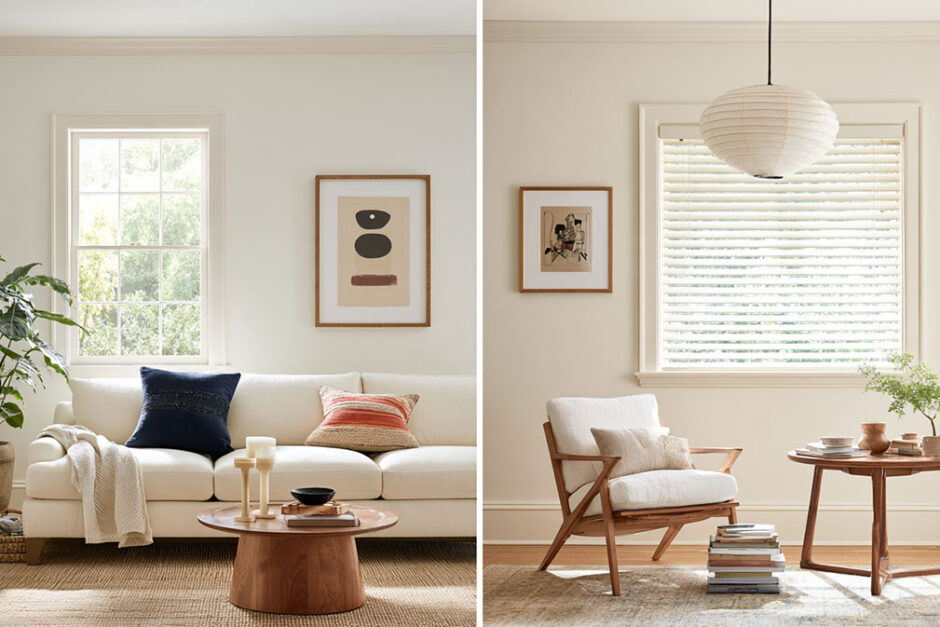
Alabaster (SW 7008, LRV 82) is the lighter, creamier option and works on walls, trim and cabinets. Shoji White (SW 7042, LRV 74) sits deeper in greige territory and mostly belongs on walls.
Both are Sherwin-Williams warm whites, and people usually end up comparing them when they want one color for the whole house.
Sherwin-Williams files both under White on its color pages. It also named them Colors of the Month in 2022, Alabaster in April and Shoji White in August. The 8-point LRV gap still decides whether a wall looks white or putty-colored.
What is the difference between Shoji White and Alabaster?
Put the two on a wall and Shoji White looks like a color while Alabaster looks like white. Alabaster (SW 7008) runs lighter and creamier, and Shoji White (SW 7042) is the deeper, greiger paint.
The numbers behind that, for reference:
- Shoji White is SW 7042 at LRV 74 (Sherwin-Williams, PaintDB, Composite Paint)
- Alabaster is SW 7008 at LRV 82 (Sherwin-Williams, Kylie M Interiors, PaintDB)
- The gap is 8 LRV points, or about 3 on a perceptual color-distance scale (CIEDE2000, calculated from Sherwin-Williams’ published hex values)
- For scale, Pure White SW 7005 sits at LRV 84 and High Reflective White at 93 (Postcards from the Ridge)
Sherwin-Williams color marketing manager Emily Kantz describes LRV as the measured share of visible light a shade reflects, on a scale from 0 to 100 percent (Apartment Therapy).
You can see the gap on the wall. Jenna Kate at Home calls Shoji White definitely more beige than Alabaster, and Love Remodeled says nobody mistakes it for a true white.
Alabaster can do the true-white job, and people use it on trim.
Composite Paint files Alabaster under White and Shoji White under Neutral. Sherwin-Williams also named Alabaster its 2016 Color of the Year, per Postcards from the Ridge.
Numbers drift between sources. Sherwin-Williams’ own color page lists Alabaster at LRV 82 (hex #EDEAE0), and most databases match it. A 3D Warehouse listing that reproduces older Sherwin-Williams color data shows LRV 83 (hex #EEEBE1), which is the outlier.
Shoji White’s hex splits as well. Sherwin-Williams publishes #E6DFD3, and PaintDB matches it, while Composite Paint lists #E1DAC4, which does not match the manufacturer’s value. Treat hex values as screen approximations and confirm LRV on the physical chip.
Which color has the warmer undertone, and does either look yellow or green?
Alabaster looks warmer, with a creamy yellow cast. Shoji White lands in greige territory, and the green trace some reviewers flag is something most people never notice (Heathered Nest).
Shoji White undertones
Heathered Nest sees beige and gray with very mild green. Jenna Kate at Home goes a step further and notes a smidge of green, typical of greige, and a reason to skip it if muddy tones bother you. The hex-based databases (PaintDB, Composite Paint) call it warm and yellow-leaning instead.
The split likely comes from method, since databases read a hex value and reviewers read a painted wall. I’d trust the wall reports more.
Alabaster undertones
Yellow, but how much is disputed.
Kylie M Interiors describes creamy yellow undertones, and The Color Concierge calls the yellow strong. Designer Trapped sees a neutral base that balances warm and cool.
Next to a brighter white, the cream becomes obvious. Jenna Kate at Home notes that Extra White or Pure White nearby makes the creaminess more apparent.
On its own it reads soft and close to off-white despite its LRV of 82 (Jenna Kate at Home).
How do Shoji White and Alabaster change with room exposure and light bulbs?
South-facing sun keeps both colors warm. North light is where the sources disagree.
| Exposure | Shoji White | Alabaster |
|---|---|---|
| North, cool daylight | Settles into a calm greige (Facade Colorizer) | Clean, slightly gray white, or flat and chalky (Meltflex AI, Facade Colorizer) |
| South, strong sun | Lifts toward a clean warm white | Stays soft and creamy |
| West, late sun | Warm, creamy undertones come forward (Welsh Design Studio) | Not isolated in the sources reviewed |
Facade Colorizer’s 2026 comparison, Postcards from the Ridge and Hey There Home favor Shoji White for north-facing or shaded rooms. Meltflex AI picks Alabaster there instead, at least when the floors are gray, because it keeps the room from feeling like a fridge.
Floor color and bulb temperature probably explain the split, which is why a sample in your own room beats any verdict.
The LRV gap matters here too. A paint can only reflect the light it receives (Kylie M Interiors), so the 8-point difference is easiest to see in a dim room.
Bulbs change things more than people expect. Energy Trust of Oregon puts lighting between about 2200K and 6500K, with 2700K suggested for living rooms and bedrooms, 3500K for kitchens and 5000K for a bright-day look.
Facade Colorizer flags 5000K daylight LEDs in a north room as the setup that can give Shoji White a faint, dull green-gray, so look at the wall after dark. The Kelvin number sits on the Lighting Facts label of each bulb package.
East rooms get warm morning light that fades by afternoon, but none of the comparisons reviewed test either color there.
Where does each color work: walls, trim, cabinets or ceilings?
Alabaster works on all four surfaces. Shoji White is mainly a wall color, and its use on cabinets is a split call.
On walls, both can carry a whole house. Kylie M Interiors recommends Alabaster for open plans and whole-home use, and Welsh Design Studio calls Shoji White a beautiful whole-house color.
Trim is different. Love Remodeled says Alabaster can function like a true white and is used for trim. Postcards from the Ridge lists Shoji White for trim too, though it reads as a color there, not a white.
Cabinets get mixed reviews. The Color Concierge calls Alabaster a great cabinet color, while Jenna Kate at Home says Shoji White is not a particularly popular cabinet choice and suggests Accessible Beige instead. Postcards from the Ridge lists cabinets among Shoji White’s uses.
The Color Concierge shows a client kitchen with Alabaster perimeter cabinets and a Pewter Green island, a useful reference if you are building a color scheme around white cabinets.
Whichever color goes on, cabinets need cabinet-grade paint. Sherwin-Williams positions Emerald Urethane Trim Enamel for cabinets, doors and trim, a water-based enamel that resists yellowing compared with oil-based coatings and goes on in fewer coats.
Ceilings come down to reflectance. ASHRAE/IES design guidance recommends ceiling reflectance of roughly 80 percent or more in many building types, such as offices, small retail and warehouses, and some, such as K-12 schools, set a 70 percent floor with 80 to 90 percent preferred (ASHRAE/IES Advanced Energy Design Guides, via Lighting Now). Alabaster at LRV 82 clears the 80 percent mark and Shoji White at 74 does not.
The guidance is written for commercial buildings and varies by type, so a Shoji White ceiling at home is a style call, not an error. Sherwin-Williams’ sheen guide lists flat for ceilings, and a paint calculator that works from room dimensions sizes the order if you carry the wall color overhead.
Sheen changes the color as much as the surface does. The same white in matte and semi-gloss reads like two different colors (Jenna Kate at Home).
- Walls: eggshell or satin
- Trim and doors: semi-gloss or satin
- Cabinets: satin
- Ceilings: flat
Those picks follow Sherwin-Williams’ sheen guide and Jenna Kate at Home. Glossier sheens make a light color read lighter, per the BNP Media course.
What pairs well with Shoji White and Alabaster?
Pure White is the one trim white that suits both colors. Love Remodeled notes that Sherwin-Williams itself pairs it with Shoji White.
Beyond trim, Shoji White leans on other greiges and dark accents. Alabaster takes warm wood and stone.
Trim whites
Welsh Design Studio calls Pure White a great trim for Shoji White, and Maison de Pax names it the classic option under Alabaster walls. Extra White gives a crisper, brighter edge, and Jenna Kate at Home shows it on Shoji White walls in her photos.
Colored trim is an option too. Postcards from the Ridge shows Alabaster walls with Accessible Beige trim, and Maison de Pax shows Repose Gray trim in an open living room.
Alabaster walls turn trim into a white-on-white decision, and the right trim color for white walls depends on how much contrast you want.
Floors and countertops
Sherwin-Williams’ own blog calls matching paint to the undertones in wood flooring tricky. The two colors lean in different directions.
The WC Supply says light to medium hardwood complements Shoji White, and that white quartz or marble countertops bring out its warmth. Welsh Design Studio adds that its greige base sits comfortably beside a gray backsplash or countertop.
PaintDB pairs Alabaster with warm wood floors, including white oak and honey tones. Block Renovation also lists it among the warm whites that flatter dark warm gray floors without going stark.
Kylie M Interiors shows Alabaster in a kitchen with off-white quartz and natural maple lower cabinets, a warm-on-warm mix.
Neighboring wall colors
Around Shoji White, Hey There Home suggests tonal greiges such as Accessible Beige and Alpaca, plus Amazing Gray, with Urbane Bronze or Iron Ore for contrast. The WC Supply likes Dovetail to ground it.
Brick & Batten’s designers often use it with stone cladding, and one of their pairings sets it against Pewter Green.
Alabaster plays the quiet white. Jenna Kate at Home uses Sea Salt walls with an Alabaster vanity, and the wider palette of colors that suit Alabaster is worth scanning before you choose a second wall color.
How to choose between them, and what to try if neither fits
Alabaster is the pick for a lighter, creamier white that can run through the whole house. Shoji White suits a deeper greige wall that holds up where whites go flat.
When to choose each color
Alabaster makes sense if the room already holds white cabinets, quartz or built-ins (Facade Colorizer), or if you want one soft white across walls and doors with the trim to match. It also wants decent daylight if you expect it to read bright.
Shoji White earns its place when a white keeps failing in a dim room (Facade Colorizer), or when you want walls that read as a soft neutral with a brighter white on the trim. A green-gray cast should not bother you, since Jenna Kate at Home lists sensitivity to green or muddy undertones as the reason to skip it.
Where each color fails
Both have predictable weak spots.
Shoji White goes flat and slightly green-gray in small windowless north bathrooms and cool-lit basements, according to Facade Colorizer.
Facade Colorizer adds that an all-over tonal Shoji White reads as a painted-out greige box, and that beside white cabinets or quartz it can look a shade dirty.
Alabaster struggles when other whites crowd it. Kylie M Interiors flags appliances and subway tile as the finishes that can over-enhance its creamy yellow, and warns that a nearby white either clashes with it or exposes its warmth.
Closest alternatives
| Alternative | Code | LRV | How it differs |
|---|---|---|---|
| White Duck | SW 7010 | 74 | Near-twin of Shoji White, usually a touch more beige |
| Greek Villa | SW 7551 | 84 | Slightly brighter than Alabaster, warmer or cooler depending on the source |
| White Dove | BM OC-17 | 83.16 | Cross-brand match for Alabaster, a touch brighter and less yellow |
Pure White (SW 7005) is the cleaner step up when Alabaster feels too cream. Welsh Design Studio calls Alabaster distinctly warmer than it.
White Duck is the stand-in when Shoji White looks muddy, but sources disagree on which of the pair carries the green. Kylie M Interiors says White Duck is more likely to show a subtle green, while Heathered Nest says Shoji White is the one with green and Welsh Design Studio reads White Duck as slightly more yellow.
A side-by-side of Shoji White and White Duck is the fastest way to settle it.
Greek Villa splits reviewers on warmth. The Color Concierge calls Alabaster the warmer of the two, while Facade Colorizer calls Greek Villa creamier and a step more yellow.
Benjamin Moore lists White Dove at 83.16, while older blog posts cite 85, so check the date before comparing LRV across articles (Jenna Kate at Home). For the undertone split, see this head-to-head between White Dove and Alabaster.
How to test both colors before you commit
Put two-coat samples of both colors on your walls, under the bulbs you plan to keep, and judge them over several days. A screen only narrows the field.
- Order large samples. Samplize peel-and-stick sheets carry real Sherwin-Williams paint in two coats, measure 9 x 14.75 inches and start at $6.95 each (Samplize, Postcards from the Ridge, Kylie M Interiors). Painted sample pots work too if you apply two coats on a primed spot or board (CertaPro, Decorating Centre).
- Stick both colors on one wall, then repeat on a second wall that gets less light (Berger Paints).
- Install the bulbs you plan to keep before sampling (CertaPro).
- Look at the samples in the morning, afternoon and evening, then after dark with the lights from dim to bright, and leave them up for several days (Stow and Tellu, CertaPro).
- Hold your trim sample and a flooring sample against them before deciding (Stow and Tellu).
Sherwin-Williams’ ColorSnap Visualizer helps with shortlisting. Its App Store listing says it matches colors from photos and virtually paints your own walls.
It cannot settle the choice. Benjamin Moore’s own White Dove page warns that screen colors may differ and tells readers to test with samples.
One caveat on finish: Samplize sheets do not come in every finish, so judge sheen separately (The DIY Nuts).
Shoji White vs Alabaster FAQ
Can you use Shoji White and Alabaster in the same home?
Yes. Paint Color Consultants lists Alabaster as trim beside White Duck walls, a near-twin of Shoji White, so the lighter paint frames the deeper one.
Sample the pairing in the room first.
Are Shoji White and Alabaster rated for exteriors?
Yes. Sherwin-Williams lists both for interior and exterior projects on its color pages.
Sample the least conspicuous side of the house in two coats before you buy gallons (CertaPro).
Is Benjamin Moore Alabaster the same color as Sherwin-Williams Alabaster?
No. Benjamin Moore Alabaster (OC-129) shares the name but carries a touch of pink and a higher LRV of 85.08, according to Benjamin Moore.
The Sherwin-Williams color is SW 7008, so quote the code, not just the name, at the paint counter.
What are the hex and RGB codes for Shoji White and Alabaster?
Sherwin-Williams lists Alabaster at #EDEAE0 (RGB 237, 234, 224) and Shoji White at #E6DFD3 (RGB 230, 223, 211), and PaintDB matches both. Composite Paint gives Shoji White as #E1DAC4 instead, which does not match the manufacturer’s value.
Treat hex values as screen approximations and confirm on a physical chip.
How Long Does a Paint Sample Verdict Hold?
A sample verdict on Shoji White or Alabaster holds until the room’s light changes, whether through new bulbs, new windows or new flooring.
A bulb chosen during sampling can stay in place for up to 15 years (Energy Trust of Oregon), so the Kelvin number you test under is the one the paint lives under.
Order matters when you test. Get the final bulbs in first, then put both samples on two walls, and only after that hold the trim and flooring against them. Bulbs come first because every later judgment depends on them.
The downside is a delay before the first gallon gets bought. As of October 2026 the LRV figures here hold, and a reformulated can would count as a new color with its own spectral data (Retro Renovation).
Once the winner is on the wall, a room color scheme generator can build the rest of the palette around it.

- Shoji White vs Alabaster: Which Soft White Wins? - October 25, 2026
- Color Combinations for 32 Colors and 10 Wood Tones - October 22, 2026
- Kitchen Color Schemes by Cabinet Color: What Pairs Well - October 19, 2026