Rugs
Rugs that go with grey floors

Whether a rug works on a grey floor mostly depends on the undertone underneath the grey. How grey the floor looks has little to do with it. Warm neutrals like cream and beige lift a cool floor. Cool shades such as navy and sage green blend into it, which is calmer but can feel a bit cold. Then there are the deep contrasts, rust or a black-and-white pattern, and those suit a room that can handle the extra colour.
Floor World’s 2022 guide to grey laminate notes that grey flooring usually carries a purple, blue or green undertone, so two floors that look alike can call for different rugs. Sherwin-Williams (2021) sorts undertones into warm (orange, yellow, red) and cool (blue, green, purple).
Light and dark grey flooring pull in opposite directions, so the same rug reads differently on each.
Which Rug Colours Go With Grey Floors?
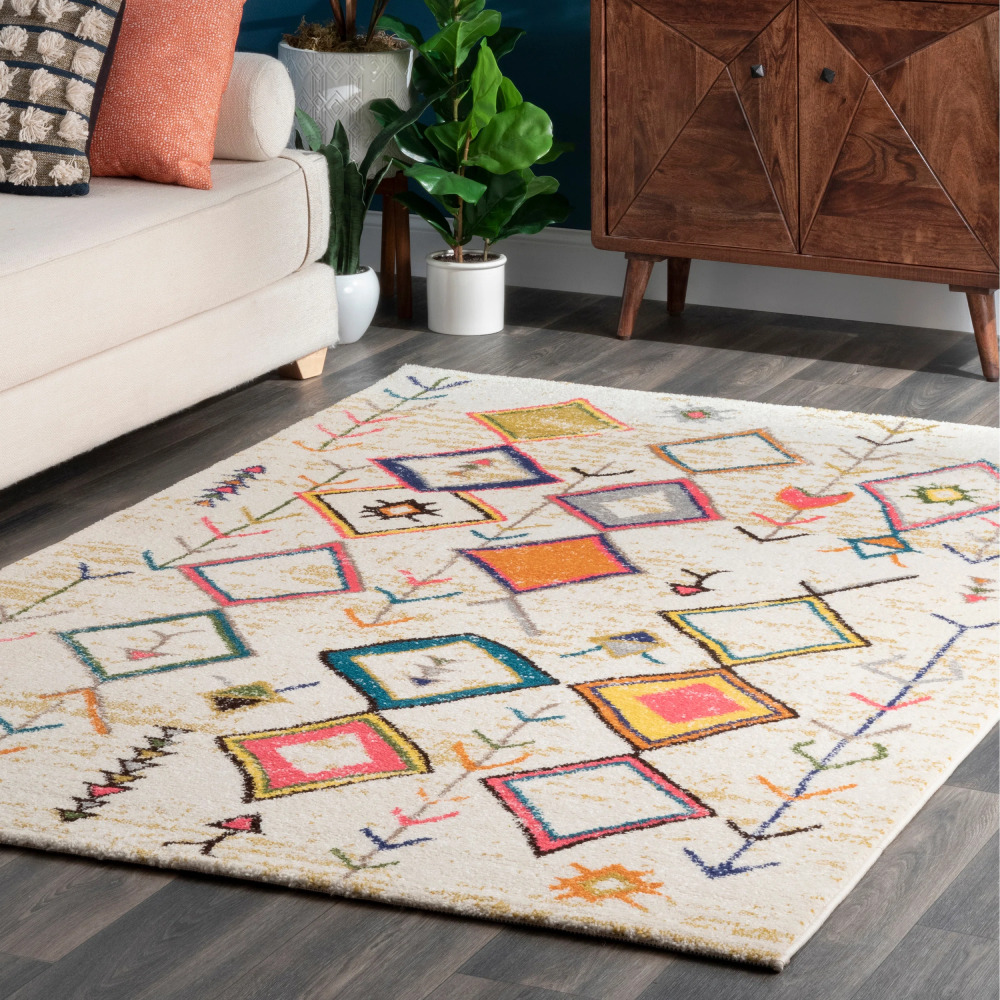
Cream, ivory, navy, sage green, rust and a black-and-white pattern cover most of what works on grey. Warm neutrals lift a cool floor and cool shades blend into it, while deep contrasts set it off.
| Rug colour | Effect on the floor | Works best on | Watch for |
|---|---|---|---|
| Cream or ivory | Warms the grey, brightens the room | Mid and dark greys | Washes out on very light greys |
| Navy | Cool, formal contrast | Light and warm greys | Looks steely on blue-leaning floors |
| Sage or forest green | Calm, natural note | Cool and neutral greys | Turns muddy beside purple-leaning greys |
| Rust, terracotta or mustard | Strong warm accent | Dark and cool greys | Overpowers a small room |
| Black-and-white pattern | Graphic contrast | Any grey | Competes with a patterned sofa |
Grey and blue share a cool undertone, so they sit together easily. They can also look cold, a drawback Livingetc flagged in its March 2023 guide to colours that go with grey rugs.
Caroline Cockerham of the rug brand CICIL pairs grey rugs with warm tonal colours such as several shades of warm beige and a hint of terracotta or mustard (quoted in the same Livingetc piece).
Black and white is the low-risk pick. It echoes the grey without copying it.
Choose the sofa colour first, since it is the largest block of colour after the floor. Then test your shortlist with a tool that generates a room colour scheme around your floor shade.
How to Match a Rug to a Warm or Cool Grey Floor
Find out whether the floor leans warm or cool, then pick a rug that either balances that lean or matches it on purpose. Warm undertones are orange, yellow or red, and cool ones are blue, green or purple (Sherwin-Williams, 2021).
How to Tell Which Undertone Your Floor Has
Grey flooring usually carries a purple, blue or green undertone. Green-based greys read as the most neutral, according to Floor World’s 2022 guide to grey laminate. Purple-based greys are the hardest to work with, according to flooring importer FinFloors, because most furnishings and woods carry orange or red tones that clash with purple.
- Hold a sheet of plain white paper against the floor and compare the two. The undertone shows in the comparison.
- Look at the floor at midday and again in the evening.
- Switch on the bulbs you actually use and look again.
- Label the floor warm, cool or neutral, and note the lean next to it (blue, green, purple, beige).
- Lay a rug swatch on the floor and judge it in the same light before ordering the full size.
Steps 1 to 3 follow Sherwin-Williams’ undertone guide, which advises comparing a colour against a pure example instead of judging it alone.
Material does not change the method. A grey porcelain tile, a polished concrete slab and a grey hardwood plank each get the same paper test, and each can land on a different side.
Light matters more than most buyers expect. The same guide notes that northern daylight pushes blue undertones forward and bright white bulbs add cool tones, so the way light behaves in a room shifts a floor’s apparent temperature through the day.
Which Rug Tones Suit Each Undertone
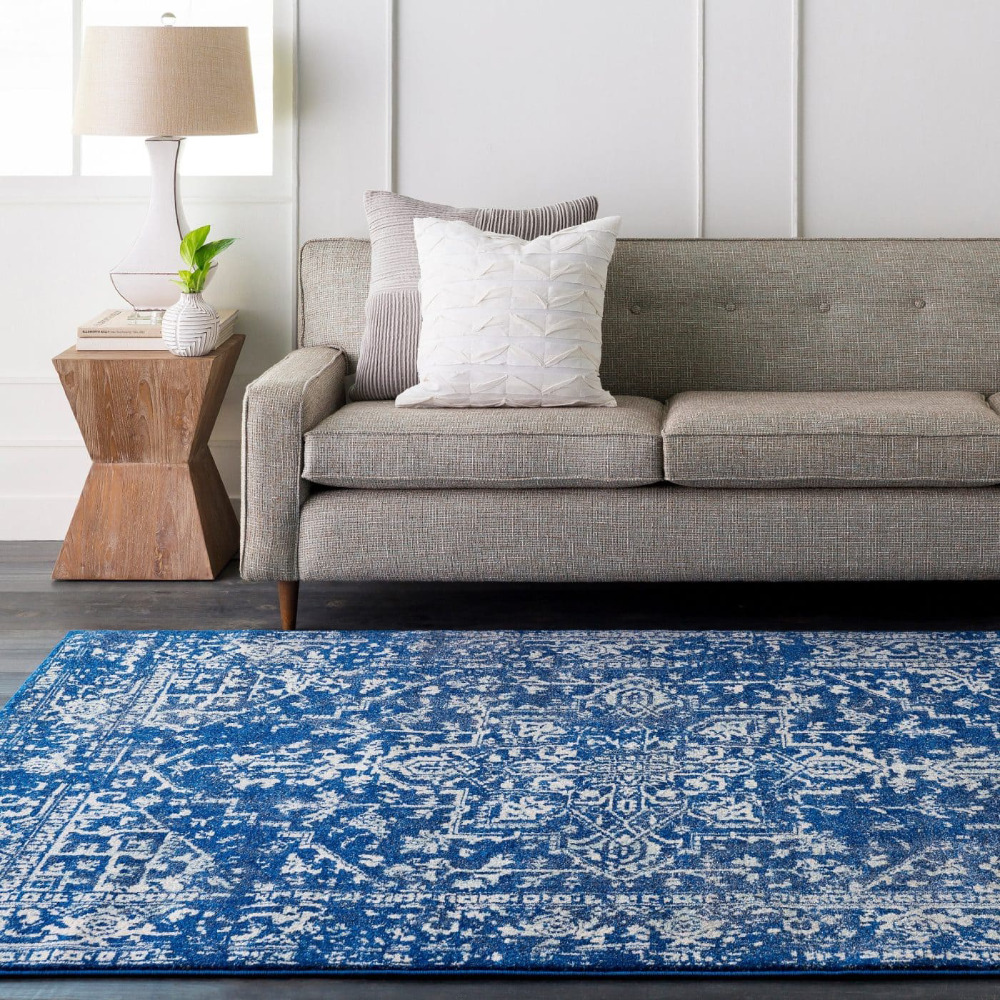
On a cool grey floor, warmth does the balancing. Warm whites and creams work, and so do camel, tan or honey tones. Terracotta, rust or mustard make a stronger accent, and one deep colour like burgundy or forest green can take the lead if you’d rather not go neutral.
A warm grey floor can take a rug that matches it or one that goes deeper. Creamy neutrals and sandy greys match. Rich colours like deep green or navy deepen it.
Opposite temperatures cancel each other and matching ones stack, which is basic colour theory.
Balance is the safer default. Matching works only when the rug’s texture supplies the contrast.
Should the Rug Be Lighter, Darker or Tone-on-Tone With the Floor?
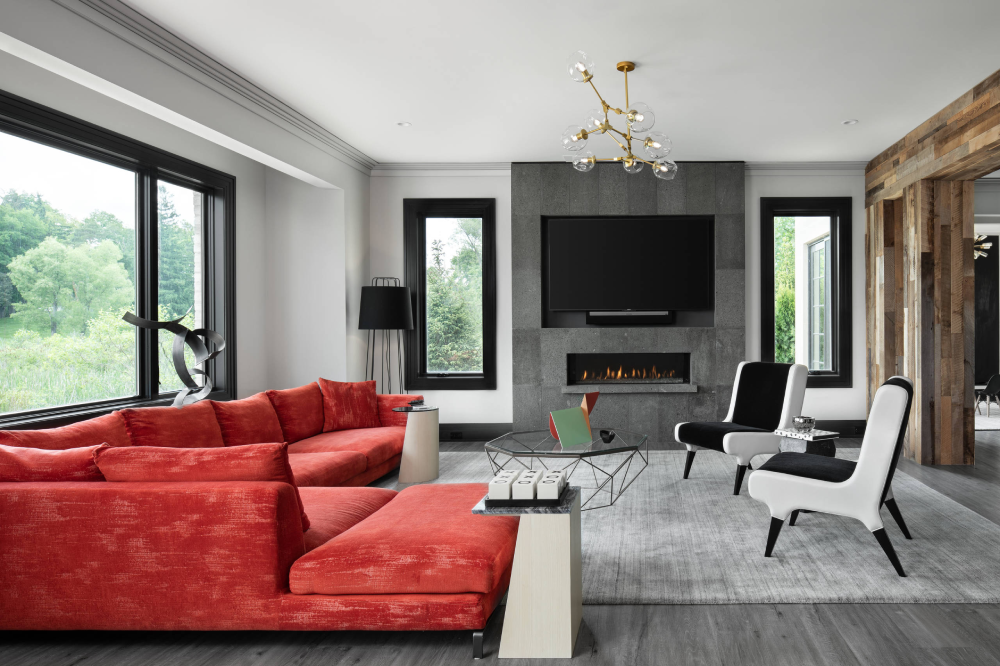
A rug a clear step lighter or darker than the floor suits most rooms, and an exact grey match works only when texture supplies the contrast. What decides it is how much colour the rest of the room already carries.
Light grey floors versus dark grey floors
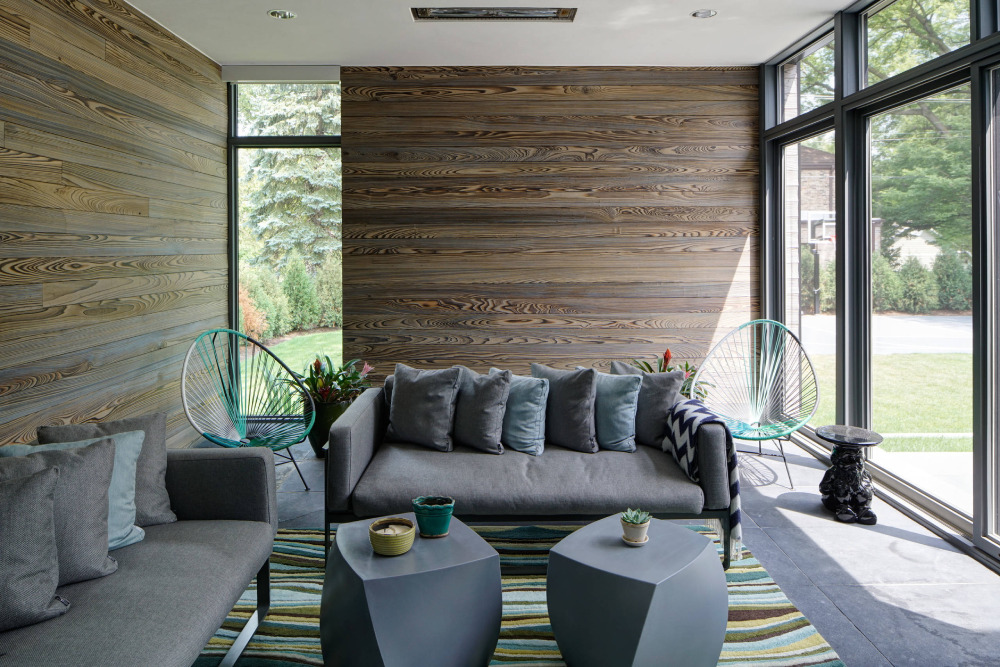
Per Tumble’s April 2024 grey-floor guide, blue, green and pastel rugs go well with light grey floors, and a charcoal or navy rug adds depth and anchors the seating.
Dark grey floors go the other way. The same guide pairs them with rust, mustard and terracotta for a cosy feel, and Rug Love’s guide to grey rugs and carpets says a light rug here makes the space feel larger.
Why advice on contrast conflicts
Tumble recommends either matching the floor’s grey tone or contrasting it with colour. Designer Anne Hindley of Hindley and Co takes the opposite line in Livingetc (2023). She wants little contrast in colour and tone between floor and rug, because it is more relaxing and less jarring.
They’re answering different questions, really. Tumble treats the rug as the focal point, whereas Hindley wants it to stay calm in the background.
My rule is simple. When furniture, art and curtains already bring colour, keep the rug close to the floor in tone. A mostly neutral room gives the rug permission to carry the contrast.
Lighting and room size break ties, since darker rugs add depth and lighter ones open up a small room. Both camps apply the same principle, and the amount of contrast in the room’s design decides whether the rug reads as backdrop or focal point.
When tone-on-tone works
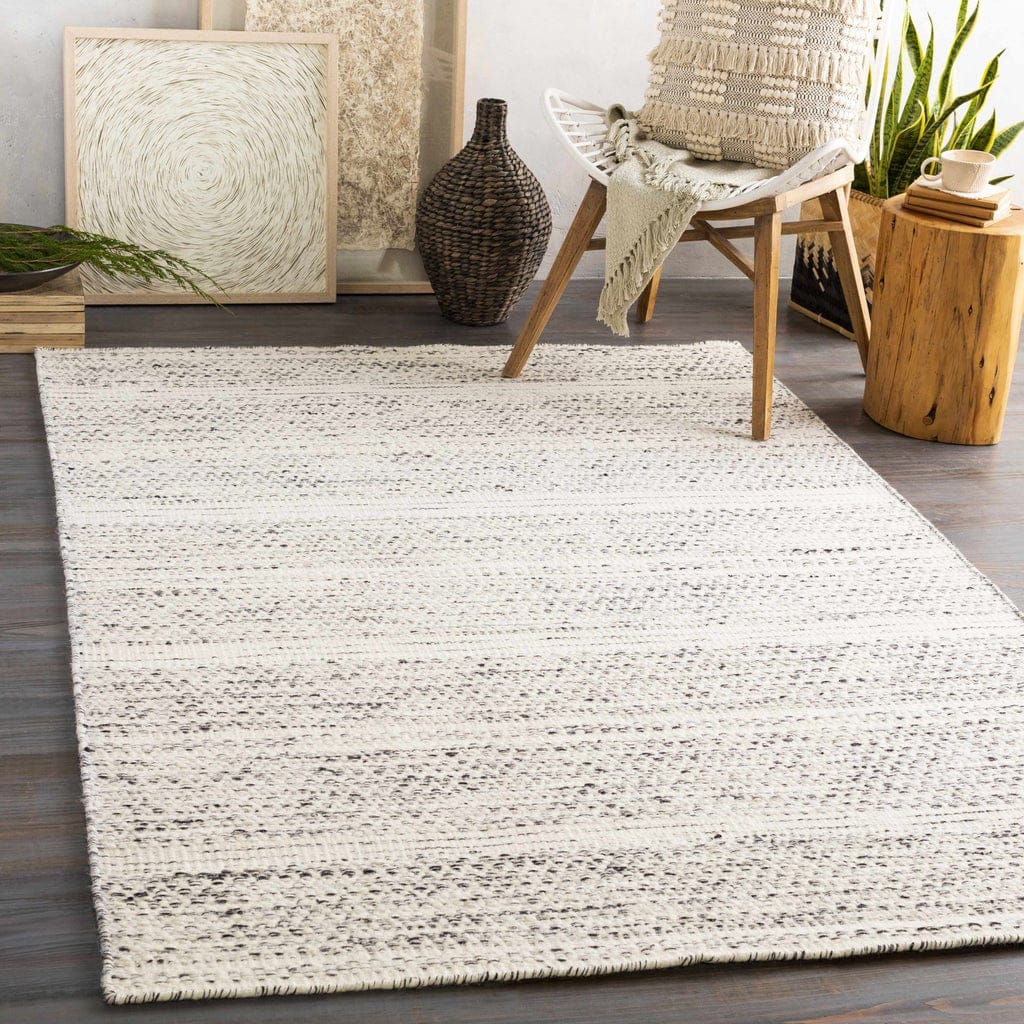
Tone-on-tone is the hardest option to get right. Tumble suggests minimal or tone-on-tone patterns for a subtle look.
A plush high-pile rug on a sleek floor works because pile height creates the difference. So does a tone-on-tone design with a visible weave or pattern. What fails is a flat, solid grey that matches the floor exactly, since it reads as a stain on the floor.
Which Rug Materials Work Best on Grey Floors?
Wool suits most rooms. Sisal is the better call in a hallway, polypropylene copes with spills, and viscose really only belongs where few people walk. Every fibre has its own way of failing, so pick the fibre for the room before you think about colour.
Wool
Wool recovers from crushing, keeps its appearance and is naturally flame-resistant. Its warm texture also offsets a cool grey floor.
The downsides are real, though. Wool cannot be treated for stain resistance, so spills need fast attention, and some wool rugs shed loose fibres for several months, especially in cut pile. Consumer NZ’s 2012 carpet buying guide calls wool the gold standard for carpets and lists both drawbacks.
Jute and sisal
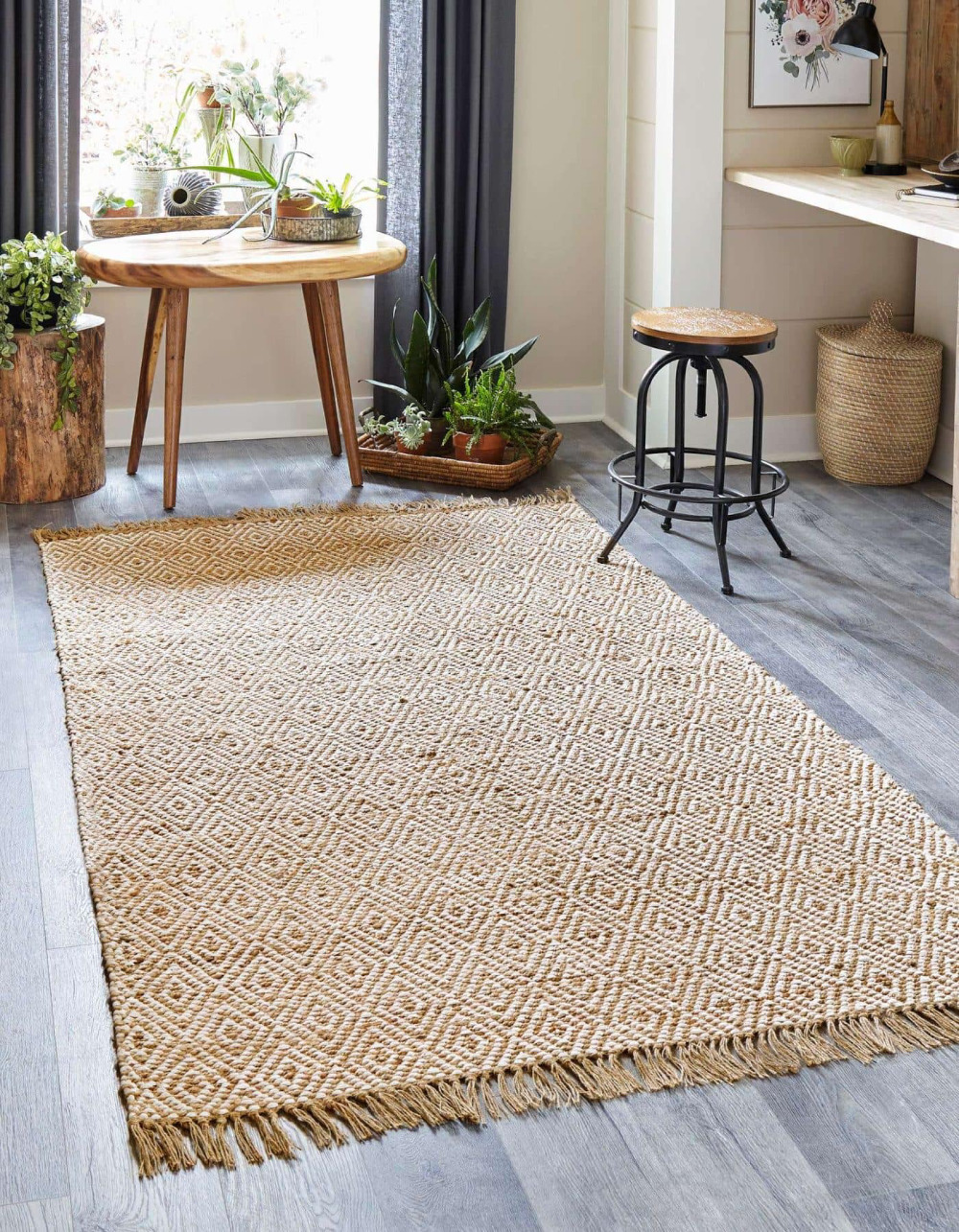
Natural fibres give a flat grey floor the texture it lacks. Jute is softer underfoot, but it sheds and absorbs moisture. Sisal is coarse and tough, which is why it ends up in hallways and busy rooms.
Neither takes water well. Cleanfax (2018) warns against spot cleaning jute because it leaves water marks or bleached patches, so the whole rug needs cleaning instead.
Polypropylene
Solution-dyed synthetic fibres (colour added while the fibre is still molten) keep their colour through cleaning and resist fading better than surface-dyed ones (Consumer NZ, 2012). Polypropylene is commonly made this way, so check the label. That helps in sunny rooms and kitchens next to grey tile, although any rug in front of a large sunny window will still show some colour change.
The feel is where it loses points. The same guide notes polypropylene is cheaper than nylon but has a rougher feel, looks cheaper and has a lower melting point.
Viscose
Viscose rayon loses up to 50 percent of its strength when wet, according to Cleanfax’s 2018 guide to problem rugs. Another Cleanfax piece gives a range of 30 to 50 percent.
Rug Insider’s 2018 report on viscose adds the elasticity gap. Viscose stretches back only about 2 to 3 percent, against roughly 30 percent for dry wool and up to 50 percent for wet wool.
Read together, the two reports show opposite wet behaviour. Wool’s elasticity rises when damp, while viscose loses about half its strength.
On the plus side, viscose has a silk-like sheen that catches light on a matte grey floor. It also sheds, yellows when wet and shows wear quickly.
Keep viscose for a bedroom or a low-traffic corner. Skip it under a coffee table or a dining chair, and keep it away from the dog.
Pile height and texture
A flat grey floor needs texture more than extra colour. Tumble (2024) suggests a plush high-pile rug for cosy contrast on sleek floors, and a textured low-pile weave for a traditional touch that stays soft.
Layered surfaces do the job colour cannot on a monochrome floor, which is why the way texture works in a room matters as much as shade.
Light-coloured polyester shag is the one I’d avoid. Cleanfax (2018) reports that a coffee table in the middle creates a stubborn traffic lane, and oily spills are hard to lift.
Do Patterned Rugs Work on Grey Floors?
Yes, because a neutral floor gives a pattern room to work. Ruggable’s pairing guide states it as a rule, with simpler rugs for bold floors and patterned rugs for neutral ones.
Pattern styles that suit grey
| Style | Look on a grey floor | Pairs with | Watch for |
|---|---|---|---|
| Persian-style | Warm, worn-in depth | Faded reds, soft blues, earth tones | Dye bleed in modern pieces |
| Kilim | Bold geometry, no pile | Plain sofas, cool walls | Thin, little cushion |
| Beni Ourain | Ivory pile, dark line motifs | Mid and dark greys | Ivory shows dirt |
| Geometric or abstract | Modern, tonal | Silver, black, white, navy | Clashing with plank grain or grout lines |
Tumble’s April 2024 guide points to Persian designs in soft blues, faded reds and earthy tones as a fit for grey’s understated look.
Dye is the problem with them. Cleanfax (2018) warns that many Persian rugs made after 1980 are not colourfast, and bleed on modern Tabriz pieces can be impossible to correct.
A kilim is a pileless flatweave, so the pattern is the structure itself. With no pile it offers little cushioning, and Revival Rugs calls a pad a must for flatweaves and other low-pile pieces.
Beni Ourain rugs come from the Middle Atlas in Morocco. Dealer Moroccan Corridor describes thick undyed wool pile with restrained dark geometric motifs on ivory.
Matching pattern to the floor
Plain grey floors, like polished concrete or large-format porcelain tile, take bold geometry or kilim stripes without any fuss, and a dense Persian field is fine too.
Busy ones with heavy plank grain or visible grout lines need a quieter pattern. Two textures end up competing for the same sightline otherwise.
Count the patterns already in the room before you choose, and let the floor’s grain count as one. The rest comes down to how pattern works in interior design: one dominant pattern per view, the others kept quiet.
Scale and bridging
Large motifs suit large rooms, and small repeats suit compact ones. It is a question of scale and proportion in interior design, and a big pattern in a small room reads as noise.
A pattern can also bridge the floor and the furniture. Livingetc (2023) pointed to a 2modern rug mixing silver, grey, black and white in a subtle geometric shape as an anchor for a dining area.
Pull one colour from the pattern and repeat it in the sofa or curtains. That single link makes the rug look chosen.
What Rug Size Fits Each Room With Grey Floors?
Most living rooms take an 8×10 or 9×12, small ones take a 5×8 or 6×9, and about 18 inches of floor should show around the edge (Nourison, February 2024). On a grey floor, that visible border does a lot of the work.
The rest of these measurements also come from Nourison’s rug size guide.
- At least 18 inches between the bed edge and the rug edge
- 18 to 24 inches of dining rug past the table and chairs, on every side
Sources vary slightly on the living room border. Ruggable’s size guide gives 12 to 18 inches around an 8×10 but 18 to 36 inches around a 10×14, so smaller rugs in smaller rooms take the tighter border.
Measure the seating group first. Then check the numbers in a calculator that sizes a rug to your room.
Living room
Put at least the front legs of the main seating on the rug. Edward Martin calls a rug that fits only under the coffee table the classic sizing mistake, because the seating around it ends up on bare floor.
Oversized 10×13 and 12×15 rugs suit larger family rooms, where every piece can sit on the rug.
Bedroom
A king bed takes a 9×12 under it or, in a large bedroom, two runners with a 6×9 at the foot. A twin bed is happy with a runner plus an accent rug, or a single runner if the bed sits in a corner.
The goal is a soft landing for bare feet.
Dining room
Every chair must stay on the rug when pulled out. Lowe’s buying guide asks for at least two feet past the table edges on every side, which is the top of Nourison’s range.
Hallway and home office
Runners fit narrow spaces such as hallways and kitchens, per Nourison. Becki Owens’ sizing page suggests a 5×8 for a small office or under a loveseat.
Which Backing and Rug Pad Are Safe on Grey Laminate and Vinyl Plank?
Felt pads and rugs with woven, non-staining backings are the safe choice on grey vinyl plank and laminate. Flooret’s support guidance, for example, lists cotton, jute and woven backings, along with non-staining vinyl-backed mats, as fine on its floors.
What damages the floor
Vinyl plank maker Godfrey Hirst lists rug and mat backings among the rubber products that discolour its floors, alongside furniture feet and rubber-soled shoes. Its care guide allows only non-staining vinyl-backed mats or woven rugs identified as colourfast.
The mechanism is plasticiser migration, according to Flooring Surgeons. Compounds in some rug backings interact with the vinyl surface and leave yellow stains or other discolouration.
Do manufacturers agree on natural rubber?
They do not.
| Pad or backing | Guidance on vinyl plank | Source |
|---|---|---|
| 100% felt | Recommended, little grip | Ambient Flooring |
| Felt with grip layer | Fine if the layer is non-staining and labelled for your floor | Flooring Surgeons |
| Natural rubber | Split: Ambient (breathable natural rubber) and Flooret (solid, no adhesives) accept it; Godfrey Hirst and Floor & Decor warn against rubber backings | Ambient, Flooret, Godfrey Hirst, Floor & Decor |
| Latex | Avoid | Floor & Decor |
| PVC or vinyl backing | Only if labelled non-staining | Godfrey Hirst, Flooret |
Flooring Surgeons notes that vinyl manufacturers publish different restrictions for backing materials. Read the care sheet for your exact plank before buying, because it settles the question.
Thickness, fit and grip
Cut the pad slightly smaller than the rug so it never shows at the edge. Wellwoven’s pad guide treats 1/4 inch as the default for most rooms and notes that thickness does not set grip.
Add the rug’s pile height to the pad thickness, then check the total against the gap under every door that swings over the rug.
Tile and laminate need the grip. Flooring Clarity’s buying guide puts safety first on hard, slick grey floors.
Washable rugs and day-to-day care
Flooret’s support page says Ruggable’s latex-free TPR backing passed flooring compatibility tests and does not stain or leave residue. Treat that as the brand’s claim and match it against the floor maker’s care sheet.
Wipe liquid spills at once, even on a water-resistant floor (Godfrey Hirst). Felt protectors under heavy furniture help, and entrance mats should be free of rubber backing.
When Does a Rug Not Work on a Grey Floor?
Underfloor heating and thick rugs don’t mix well, and neither do pastels and direct sun. The other usual problem is a rug that’s too small. None of it shows up in a colour chart, and all of it can be fixed.
Heated floors and thick rugs
EGGER, the laminate maker, states that the thermal resistance of the whole flooring structure must stay below 0.15 m²K/W on heated floors.
A rug and its pad add insulation on top of that, so Flooring Surgeons advises checking the combined thermal resistance of floor, rug and pad. Thin, flat rugs pass heat through more easily than very thick ones, but Onlinetapijten (April 2026) says the backing matters as much as the pile height.
The limit is not undisputed. A 2022 University of Cadiz simulation of 60 wood floorings found no objective justification for a single 0.15 limit across climates, but flooring makers still write it into their guidance, so treat it as the working limit.
A flatweave or short-pile rug with a breathable backing is the sensible choice. Thick foam and solid rubber backings or pads act as extra insulation (Onlinetapijten, April 2026), so skip them.
Pastel rugs in direct sun
Tumble’s April 2024 guide recommends blue, green and pastel rugs for light grey floors. Consumer NZ’s 2012 carpet guide flags pastel blues and greens as especially prone to fading, and says dark colours fade less because they carry more dye.
If a light grey floor sits beside a large sunny window, pick a deeper blue or green, or keep the pastel out of the sun patch. A thin, dark flatweave answers both the heat limit and the fade problem.
Rugs that are too small
Nourison observes that rugs are often sized to match a table or sofa instead of the space, which makes the room look smaller.
On a grey floor the damage is visible. The floor becomes the dominant surface and the rug floats. Outline the size with painter’s tape before you buy.
Rugs for Grey Floors FAQ
Should the rug match the sofa colour?
Not exactly. Livingetc (2023) quotes CICIL’s Caroline Cockerham recommending different depths of one colour alongside a muted grey rug, which points to a sofa a shade lighter or deeper than the rug rather than an exact match.
Do the walls need to match the rug?
No. Rug Love’s guide says a rug should be either darker or lighter than the walls and furniture, so it stands out. Keeping walls and rug in the same temperature family, both warm or both cool, helps them agree.
Can a rug hide a grey floor I dislike?
Yes, up to a point. Rug Love recommends large area rugs in complementary colours or patterns to cover it.
The border that stays visible still shows the floor, so a strong dislike of the shade rules out small rugs.
What is greige, and which rug suits it?
Grey with a beige undertone, greige sits in the warm group. Cream, camel and sandy tones blend with it, while navy or deep green adds contrast.
How do you layer a rug over another rug on a grey floor?
Start with a neutral, textured natural base such as jute, sisal or flatweave wool, and let 6 to 12 inches of it show around the top rug (Atlanta Designer Rugs’ 2026 layering guide; other guides allow up to 24 inches).
Keep the top rug bolder than the base. Two busy patterns compete.
How to Test a Rug on Your Grey Floor
Start with the floor maker’s care sheet for the backing and pad. Tape out the full size next, then put a swatch beside the planks or tiles.
The order follows reversibility. A stained plank cannot be undone by returning the rug, a wrong size is costly to fix after delivery, and a wrong shade is the cheapest mistake to catch.
The swatch step carries a trade-off. Tumble lists rug swatches as final sale with no free returns, a policy checked in October 2026, so confirm each seller’s terms on the day you order.
Once the rug is settled, the next decision that follows the floor’s undertone is wall paint colours for grey floors.

- Kitchen Color Schemes by Cabinet Color: What Pairs Well - October 19, 2026
- Curtain Colors for Every Wall Color: Safe vs Bold Picks - October 18, 2026
- Interior Design Styles: Find Your Primary and Secondary - October 14, 2026