Color Combinations
Colors That Go With Black for an Interesting Decor

Black paint isn’t one color. Benjamin Moore describes Black Beauty as a black with a hint of warmth, while Farrow & Ball describes Railings as more blue than black (both as of October 2026). A partner that suits the first can clash with the second, which is why a plain list of colors that go with black only gets you halfway.
Once black is settled, our breakdown of colors that work together helps with the rest of the palette.
Once black is settled, our roundup of safe and bold color pairings helps with the rest of the palette.
Which colors go with black?

Almost anything, once you decide what mood you want. Black counts as a neutral, so whatever sits next to it sets the tone of the room, whether that’s crisp, calm, warm or dramatic. Whites, grays, beiges, wood tones, metallics and saturated jewel colors cover most of the useful ground.
| Color group | Mood it sets | Example partners |
|---|---|---|
| Whites | Crisp, contemporary | Warm white |
| Grays | Calm, contemporary | Charcoal, light gray |
| Beige and greige | Soft, quiet, sophisticated | Sandy beige, creamy parchment |
| Wood tones | Warm, timeless | Blonde oak, walnut |
| Brass, gold and copper | Rich, glamorous | Brushed brass, polished gold, copper |
| Jewel and bold colors | Moody, high impact | Emerald, burgundy, burnt orange, blush |
The mood column says more than the color names do. Black beside warm white reads graphic. Black beside walnut reads settled.
Black has the highest contrast of any wall color, and the way contrast behaves in a room decides whether a pairing looks balanced or harsh. A pale partner sharpens the black, while a mid-tone one softens it.
The undertone of the black and the amount of it in the room both change the result, from a single accent up to the dominant color. Light and finish matter just as much, whether that’s north-facing daylight or a matte coat versus gloss.
How do white, gray and beige pair with black?
Warm white is the safest partner, and gray is the quietest. Beige is softer than either one. Each changes how heavy the black feels, and each has a version that goes wrong.
White

Paint brands publish a number for how much light a color bounces back, and it makes the white question easier to answer. Alabaster, a warm white, has an LRV (light reflectance value) of 82 in Sherwin-Williams’ own color data (as of October 2026). The scale runs from 0 for absolute black to 100 for pure white.
At 82 it sits near the top of that scale, so black beside it reads sharp. Stark, cool whites push the contrast further.
A cool or stark white gives the cleanest, most graphic line against black. Warm white is more restful and has a softer edge, and Alabaster and Benjamin Moore White Dove both sit in that camp.
Scandinavian rooms use this pairing in small doses. White walls, black picture frames, black lamp bases and window hardware.
Gray

Gray bridges black and white.
Light gray keeps the walls airy and lets black act as the accent, while charcoal gives a tone-on-tone depth (charcoal trim has been used to warm black cabinetry). Cool gray is the calm, contemporary option.
Cool gray on every surface goes hard and cold fast. Wood or a warm white breaks it up.
Beige and greige

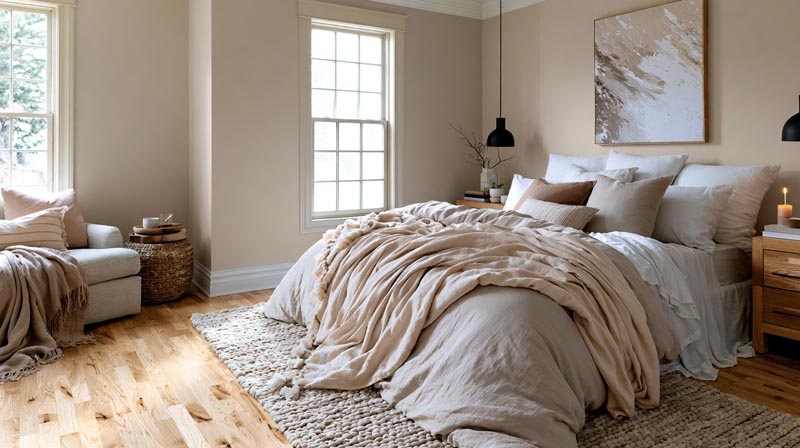
Beige is among the best muted partners for black. It tones the black down, so it looks sophisticated rather than severe.
Sandy beige and creamy parchment tones work best. Greige splits the difference between gray and beige, which makes it the easy choice when the rest of the room already mixes warm and cool.
Beige also leaves room for another color, and the range of colors that pair with beige gives you plenty to add.
Do wood tones, brass and gold go with black?
Yes. Wood and warm metals add the warmth that black lacks.
Wood tones

Blonde oak and ash are soft and friendly, and they’re the core of the black-and-wood look in Scandinavian rooms. Walnut and other mid-tone woods feel settled and classic, with enough strength to hold their own beside black.
Dark brown wood is the problem child. It blurs into black and loses its punch unless a light color sits between them.
Japandi rooms lean on pale wood and matte black fixtures, and very little else.
Brass, gold and copper

Brushed brass on black reads rich without shouting.
Polished gold is louder. It pushes the room toward glamour, and an Art Deco color palette is built on exactly that black-and-gold pairing.
In large amounts, polished gold turns theatrical, so keep it to hardware, frames and lighting. Brushed brass is quieter and easier to live with on cabinetry and fixtures.
Copper behaves differently. Its pink-tinged undertone sparkles against a black backdrop, which makes it the most distinctive of these metals.
Which jewel tones and bold colors work with black?
Saturated color holds its own against black, so emerald green, navy, burgundy and burnt orange make the strongest bold partners. Jewel tones pop harder here than against any other neutral.
Standard color theory pairs hues across the wheel, but black has no hue to oppose. Value and saturation do the work instead. A deeper partner makes a moodier room, and a brighter partner pops harder.
Green and blue

Emerald green is the standard example. A powder room with black fixtures and emerald backsplash tile reads dramatic without a stark high-contrast scheme.
Once black and emerald are in place, the other colors that suit emerald green fill out the palette.
Navy is trickier. Black and navy sit close in value and blur together unless a light color separates them.
Apartment Therapy suggests white as a buffer. Composite Paint advises a light color between the two dark tones, and Art in Context recommends keeping both as accents against a neutral base. They’re all saying the same thing, really.
Warm bold colors

Burnt orange, rust and mustard bring heat to black.
Burnt orange suits a warm black, and a cool black adds more contrast. Rust and wood together warm a black room fast. Mustard works best as a small, lively pop on a black wall.
Pink and blush

Blush pink softens black into something edgy and elegant, a modern pairing with a gentler tone than the jewel colors.
The weak point is heavy black trim beside pale blush with nothing between them. The contrast turns harsh, so add a warm white or a wood tone as a buffer.
Does the undertone of black change what goes with it?
Yes. A warm black pairs easily with warm colors, while a neutral or cool black holds up against whites and grays and adds contrast to warm partners.
LRV figures for Caviar, Iron Ore and Black Beauty come from the brands’ own color data (as of October 2026).
| Black paint | LRV | Undertone | Pairs well with |
|---|---|---|---|
| Sherwin-Williams Tricorn Black (SW 6258) | About 3 | Neutral | Bright whites, warm neutrals |
| Sherwin-Williams Caviar (SW 6990) | 2.97 | Neutral on the chip, warm in reviews | Warm whites, wood |
| Sherwin-Williams Iron Ore (SW 7069) | 5.55 | Soft charcoal, faintly warm | Light grays, whites |
| Benjamin Moore Black Beauty (2128-10) | 5.32 | Black with a hint of warmth | Warm whites such as White Dove |
| Farrow & Ball Railings (No. 31) | Third-party values conflict | Blue-leaning | Blackened, the white Farrow & Ball lists with it |
Published figures for Tricorn Black differ. Brick & Batten’s review lists 2.45, while most reviews round to 3.
The gap is under 1 point and barely shows on a wall. Check a physical chip instead of arguing over decimals.
Caviar shows a different kind of conflict. Sherwin-Williams files it in its neutral family, yet reviewers describe it as brownish.
Match temperature first and adjust contrast after. A warm black like Black Beauty or Caviar sits well with warm whites, wood and brass. Tricorn Black is neutral enough for any white, gray or beige. A cool-leaning black such as Railings wants crisp whites and light grays, plus some wood to stop the room going cold.
Keep one black per room. Put Tricorn Black beside a warmer black and it reads cool, so a second black shifts both.
A deliberate mismatch is a contrast tool, not an error. A cool black against orange adds punch that a warm black would not.
How much black should a room have?
In the 60-30-10 rule, black can be the 10% accent, the 30% secondary color or the 60% dominant color, and the right partner changes with each.
The rule splits a room into a dominant, a secondary and an accent color, and Bob Vila’s guide stresses that it is a guideline meant to be broken.
As an accent (frames, lamp bases, hardware, throw pillows), black goes with almost anything, so choose by mood. As a secondary color in cabinetry, a sofa or a feature wall, it needs a light neutral as the dominant color so the black reads as a deliberate contrast. When black takes over the walls, the other 40% has to reflect light, so lean on white, pale wood or metal.
The role also changes what counts as a good partner. A black accent forgives a loud partner, while black walls need wood, brass or a pale neutral to keep the room from closing in.
If you’re building a palette from scratch, this order works.
- Pick the black paint first, because its undertone sets the temperature for everything else.
- Decide whether black is the accent, the secondary color or the dominant color.
- Choose the main partner for that role: a light neutral for the first two, wood or brass for a dominant black.
- Add one bold color at about 10%, such as a jewel tone or terracotta.
- Adjust the ratio by eye once the furniture is in.
Before buying paint, preview the ratio in a color scheme generator built for rooms.
A black accent wall sits between the accent and secondary roles. It becomes the focal point of the room, so keep the furniture and art in front of it light.
How do light and finish change black pairings?
Warm bulbs and south light favor warm partners, and cool bulbs and north light favor cool ones. A flatter finish makes the same black look deeper.
Natural light
North-facing rooms get cooler, softer light. South-facing rooms get warmer, brighter light for most of the day.
Homes & Gardens notes that darker tones suit north rooms because they create a cocooned feel. Benjamin Moore’s Helen Shaw advises warm undertones in any white used there.
Advice splits on strategy. HomeStars recommends bright, warm colors to balance a north room, while Farrow & Ball recommends embracing the cool light with dark walls such as Railings.
South light is more forgiving. Decorating Centre Online says deep colors look more modest in it, so you can afford to go darker.
Light acts on every surface, so the same partner color can read cooler in one window direction and warmer in another. That is the practical reason light in a room gets checked before partners get chosen.
Bulb temperature
Warm bulbs give a black room an enclosed, cozy feel, which is usually the point. Cool bulbs tend to make it feel clinical.
Farrow & Ball notes that halogen and incandescent bulbs push wall colors warmer, while cool white bulbs give paint a bluer cast.
Dimmable LEDs let one room move between evening and daytime light, and dimmable ambient lighting keeps shadows soft on matte dark walls.
Paint finish
Matte gives the deepest, richest black because it absorbs most of the light, and it pairs well with textured partners. Gloss is more reflective and reads lighter beside a flat version of the same color.
Sherwin-Williams makes the same point in its sheen guidance, reported by the Interior Design Society (2025): the flatter the coating, the darker the color looks.
Designer Jean Stoffer painted a sunroom ceiling in high-gloss ebony, and the sheen added a reflective quality that made the room feel lighter, according to Hunker.
Numbers to check before choosing a bulb and finish
- 2700K is the usual bulb for living rooms, bedrooms and dining rooms where the goal is a relaxing mood (Energy Trust of Oregon, as of October 2026).
- 5000K simulates a bright day and suits reading lights and desk lamps (Energy Trust of Oregon).
- Matte paint has a 60-degree gloss value of 10 or less (Sherwin-Williams).
- High-gloss paint sits at 80 or more on that same 60-degree scale (Sherwin-Williams).
When do black pairings fail?
They fail when the room can’t support the amount of black. Usually that means too little light or too much unbroken surface, and sometimes a finish that shows every flaw.
| Condition | What goes wrong | Fix |
|---|---|---|
| Black on most surfaces in a dim room | Room reads heavy, needs extra artificial light | Layer dimmable light, add mirrors |
| Pure black under harsh light | Sharp shadows look jarring | Wall washers, soft dimmable LEDs |
| Glossy black on uneven walls | Dust and flaws show | Switch to a matte finish |
| Black on every wall of a very small room | Some designers say it feels confined | Match walls, ceiling and trim, or limit black to one wall |
Low light and heavy surfaces
Dark colors absorb more light, so a dark room needs more artificial light to work, according to a Benjamin Moore continuing-education course on paint and light.
That course cites ASHRAE guidance recommending wall reflectance of at least 50 percent across various building types (as of October 2026).
Those targets come from building standards, not home decor, so they work as a benchmark and not a rule. Black walls sit far below it, which is why layered lighting matters.
Do black walls make a small room look smaller?
The sources disagree.
Real Homes quotes designer Mohammad Ahmed saying dark colors, black included, can make a room feel more confined. Livingetc argues the opposite. Dark colors blur the divisions between walls and can make a small room look bigger.
Seattle magazine (2014) sides with the second view, reporting that a carefully chosen dark hue makes walls recede, and quoting designer Leah Steen on pairing dark paint with mirrors and reflective metal.
The split tracks the lighting plan. The sources that back dark walls add reflective pieces or strong light, and Homestyler cautions against pure black in very small areas unless the lighting plan is robust.
If size is the main worry, compare which colors make a room look bigger before committing every wall to black.
How to soften or brighten a black room
A light-toned rug helps, and so do mirrors and reflective metal. A lighter ceiling over dark walls works too, as does dimmable light at more than one height.
Designer Corine Maggio used black lower walls and a black ceiling in a small powder room, with floral wallpaper breaking up the dark, as HGTV describes it.
A flat black surface also needs layers of texture. Wool, linen and rough wood supply it.
Which colors work with black in each room?
Rooms pull in different directions, mostly because of how much light they get and what already sits in them.
Kitchen
Black hardware, an island or matte faucets look strongest against white or wood.
A black island under pale cabinets is the simplest version. The white cabinet and black island pairing works because the contrast sits low and the upper half stays bright.
Livingetc shows a variation: black storage with a gold-fronted cabinet and a white island.
Bedroom
Soft textiles do the work here. Hunker pictures matte black walls with eggplant bedding and a gray rug on light wood floors, which brightens the room from below.
Blush works too. Apartment Therapy describes black with blush as edgy elegance.
Living room
Gray and one warm accent carry a black living room.
Livingetc shows black walls with a red sofa and a gray chair, and Apartment Therapy shows nude-colored walls with black lighting and decor.
If the black sits in furniture and not paint, wall colors that suit black furniture need a different approach.
Bathroom
Black fixtures and a black-framed mirror look best against white. Black walls and floors give a hip, urban feel, and HGTV’s designers describe the result as dramatic and intimate.
Home office
Black built-ins, black trim and a wood desk make a calm combination, and Livingetc points to sage as the earthy partner.
Hunker shows the full-commitment version: black ceiling, walls, doors, built-ins and trim, interrupted by a moody floral wallpaper.
Common Questions About Colors That Go With Black
Is black a color or a neutral in interior design?
Black works as a neutral. Physically it is the absorption of all light, but designers treat it like white or gray. It pairs with every hue and sets the contrast.
Does black go with brown?
Yes. A brown wood table beside a black leather sofa gives a textured, eclectic look, and tan chairs work against black walls.
Mid-tone browns separate from black more clearly than very dark ones.
Which wall color goes with black floors?
Crisp white walls give the sharpest contrast. Pale gray or charcoal walls give a quieter one.
Bold wall colors work when their intensity is balanced against the floor, so neither one overwhelms the room.
What color walls suit a black ceiling?
Keep the walls light and neutral, such as pure white, light greige, light gray, ivory or taupe. Slate blue and teal also work when you want color.
A light wall color balances the dark overhead.
Do pastel colors work with black?
Yes, in muted versions. Sage green, blush, dusty rose, slate blue and lilac all soften black without dulling its edge.
Use them in textiles and accessories so the black keeps the structure of the room.
What wall color goes with black furniture?
Light neutrals suit black furniture best, like warm white, beige or light gray. The furniture stands out and the room stays open.
Dark walls give a moodier result, but then a lighter rug or textiles keep the furniture from disappearing.
Testing Black Pairings Before You Paint
Colors that go with black need a test in the room itself. Use large samples, view them in the morning, afternoon and evening, and do it under the bulbs that room actually uses.
Painting samples onto lining paper and hanging them on the wall lets the color be judged through the day without touching the wall, according to Brewers (2023).
Start with black and one partner, side by side. Put one sheet on the darkest wall and one on the brightest, then check again at night under the evening bulbs.
Evening comes last because the bulbs decide the result for any room used after dark.
A sample shows color, not volume. A patch cannot show how heavy black feels over a large share of the room, so judge proportion with furniture and fabric in place.
When the pairing holds, a calculator for how much paint the room needs turns the winning colors into quantities to buy.

- Kitchen Color Schemes by Cabinet Color: What Pairs Well - October 19, 2026
- Curtain Colors for Every Wall Color: Safe vs Bold Picks - October 18, 2026
- Interior Design Styles: Find Your Primary and Secondary - October 14, 2026