Color Combinations
Colors That Go With Burgundy for a Noble-Looking Interior
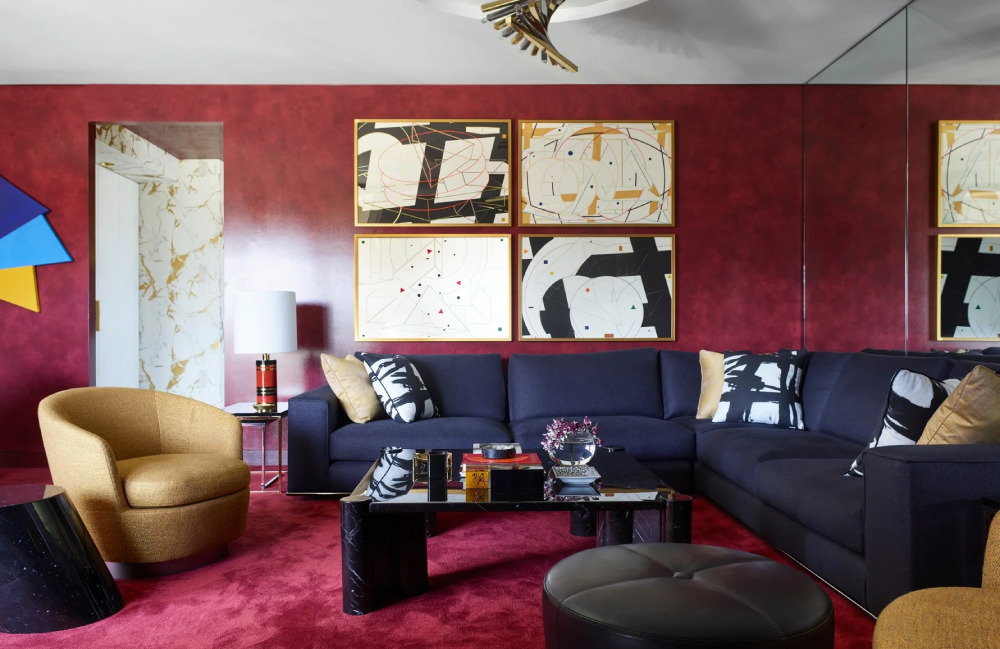
Benjamin Moore lists Classic Burgundy (HC-182) at a light reflectance value (LRV) of 7.23. On a scale where 0 is absolute black and 100 is pure white, the paint reflects only 7.23 percent of the light that reaches it (Benjamin Moore color page, accessed October 2026).
So whatever sits next to it has to do the brightening. That’s most of the job with this color.
Warm creams and beiges soften burgundy, deep greens and navy match its weight, and dusty rose or earthy browns sit close to it on the wheel. Aged brass and gold add a little shine on top.
Check the undertone before any of that. Burgundy leans brown or plum, and which way it leans decides what flatters it.
For the same kind of pairings with other shades, see our interior color combinations guide.
For the same kind of pairings with other shades, see our color matching guide for interiors.
Which colors go best with burgundy?

Warm cream, dusty rose, forest or emerald green, navy and mustard come up again and again. Each one either softens the depth or matches the richness.
| Pairing | Effect | Best placement | Watch for |
|---|---|---|---|
| Warm cream and beige | Softens burgundy, keeps the room bright | Walls, trim, large upholstery | Stark white reads cold |
| Dusty rose and blush | Romantic, low contrast | Bedding, curtains, accent chair | Neon pinks clash |
| Forest and emerald green | Moody, high contrast | Dining rooms, libraries, cabinets | Bright greens clash |
| Navy | Formal, balanced | Sofas, rugs, bedroom walls | Heavy without a light neutral |
| Mustard and golden yellow | Warm, lively | Cushions, lamps, art | Lemon yellow clashes |
Green sits near the opposite side of the color wheel, which is why it gives the sharpest contrast. Pink and plum sit right beside burgundy and blend in with almost no effort.
Brass and gold work as the metal in every row above.
If you want to compare a few of these side by side before buying a sample pot, a color scheme generator built for rooms does the job.
How does burgundy’s undertone decide the right partner?
The way a burgundy leans matters more than the name on the tin. Brown-leaning shades want earthy, warm company. Plum-leaning ones do better with rosy and cooler colors.
The hex code is #800020 (RGB 128, 0, 32), a purplish red named after the wine from France’s Burgundy region, per Wikipedia’s entry on the color.
Designer Jane Lockhart describes its range as running from brown undertones to rosy-purple plums (Livingetc).
The same burgundy reads differently in every room and at every hour of the day, so how light works in interior design ends up deciding which undertone you actually see.
Farrow & Ball notes that northern light brings out the cooler tones in a color, so a plum-leaning burgundy looks colder in a north-facing room. Their advice for those rooms is to work with the cool light using deep wall colors rather than fight it.
Look at the swatch in the morning, then again under the evening bulbs.
Hunker adds that burgundy absorbs light at different angles and shows several shades at once. That’s why matching wall paint to burgundy furniture rarely works.
Brown-leaning burgundy
Oxblood and wine tones sit here, and they look best beside colors with the same earthy weight. North Carolina designer Tula Summerford pairs them with cocoa, tobacco and walnut browns instead of anything that reads bright red.
Camel and tan sit comfortably next to them, and warm cream does too. Brass or gold fixtures finish the look.
Pantone’s 2015 Color of the Year, Marsala (18-1438), is the best-known example. Pantone describes it as a wine red with red-brown roots and recommends it on textured surfaces such as rugs and upholstery.
Plum-leaning burgundy
Plum-leaning burgundy wants softer, rosier company.
Dusty rose and blush echo its red-purple side, and an AOL feature on 2026 rich neutrals calls that pairing the romantic option. Navy and sage green also hold up well beside it.
Keep the partner lighter than the burgundy, or the plum side disappears into the shadows.
Which neutrals work with burgundy?
Warm cream, ivory, soft beige and greige are the safest bets. Charcoal and black add drama, and gray only works when it leans warm.
Cream and ivory are softer than stark white, so burgundy can lead without a harsh contrast, according to Composite Paint. Beige and greige go quieter still and suit large walls behind a burgundy sofa. Charcoal and black are better in small doses.
White works with one catch. Hunker warns that “hospital white” on walls and trim looks stark and shows dirt, and suggests a bright white on the ceiling instead.
Black and navy together with no light neutral can make a room feel closed in, especially in low light, per Composite Paint.
Gray is where sources disagree. Hunker lists it among the soothing hues that pair with burgundy, and Composite Paint recommends a soft dove gray. Homes & Gardens quotes experts who say cool grays and icy blues make a room feel too austere beside a warm burgundy.
Both sides are probably right. It comes down to the gray’s undertone. Warm, soft grays sit close to burgundy and give it a calm backdrop. Cool or icy grays pull against its warm base and the room starts to feel austere.
A room that already has gray walls or a gray sofa gains more options than burgundy alone, and a wider look at colors that work with grey covers them.
How do greens and blues pair with burgundy?
Deep greens and dark blues pair well when they match burgundy’s depth. Bright, acidic or icy versions of the same hues clash.
Greens
Homes & Gardens found green on both sides of the debate. Some experts flag it as a risk and others champion it.
The split follows the shade. Tash Bradley of Lick avoids bright, saturated greens, while softer tones such as sage work.
Interior color theory puts green near the opposite side of the wheel from burgundy, which explains why the contrast holds when the depth matches.
Emerald and forest make the moody pairing, suited to a library or formal dining room (Composite Paint). Olive is earthier, and OROA’s palette guide says one color should lead while the other supports. Sage is the softest option of the lot.
Blues and teal

Navy is the safest blue.
Designer Julia Mack recommends pairing a dark burgundy with a dark navy of the same value, so neither takes the spotlight (Livingetc).
Texas designer Roz Murphy expects navy to become the go-to partner for burgundy and brown through 2026, according to AOL’s rich neutrals feature.
Blinds Direct suggests teal cushions and lampshades against heavy burgundy. Spoak uses pale blue to modernize a traditional burgundy room. Icy blues only work with caution, since they turn austere.
Navy partners well beyond burgundy too, and this breakdown of colors that go with navy blue shows the rest.
How do pinks, yellows, browns and plums work with burgundy?
Dusty rose, buttery yellow, mustard, cocoa brown and plum all work in muted or deep versions. Neon pinks, acidic yellows and bright oranges clash.
Pink and rose

One designer quoted by Homes & Gardens paired Farrow & Ball’s Dead Salmon with a burgundy Pratt and Larson micro tile, and called the result a success.
Dusty rose and blush soften burgundy without hiding it.
Spoak points to a fully monochrome route as a classic alternative, with burgundy against an array of pink tones.
Mustard and yellow

Blinds Direct puts burgundy on the walls and mustard on accessories toward the center of the room. Deep golden and buttery yellows behave the same way.
Lemon yellow and other acidic yellows clash, according to Homes & Gardens.
Livingetc also describes a three-color scheme of burgundy, navy blue and mustard yellow, built from three points on the color wheel.
Brown and plum
Browns range from light beige to deep mahogany beside burgundy (Spoak). Blinds Direct says mixing these dark, comforting colors makes a cozy space.
A brown-heavy room has more options than burgundy alone, and this guide to colors that go with brown lists them.
Plum divides designers. Homes & Gardens quotes Alexandra Azat of Plaster & Patina, who allows almost any partner for burgundy except deep purple.
Livingetc describes a house where plum and burgundy run throughout.
Which metals and materials suit burgundy?

Aged brass and gold suit burgundy best, with copper close behind. Velvet, leather and walnut give it body, while pale woods and cold surfaces work against it.
| Metal | Effect | Best use |
|---|---|---|
| Aged brass | Period warmth, pairs with marble | Cabinet hardware, taps |
| Gold | Adds light and richness | Chandeliers, mirror frames, flatware |
| Copper | Warmer, a little more modern | Pendants, small accents |
| Silver | Glamorous, cooler | Frames, candlesticks |
Ideal Home’s kitchen guide pairs rich burgundy with marble and aged brass for a period look.
Designer Gil Walsh puts dark burgundy together with metal accents such as a chandelier and flatware, according to AOL.
Surface changes burgundy as much as its neighbors do, so how texture shapes a room matters here.
Velvet reads rich and soft, while oxblood leather in the same color family looks heavier (OROA). Burgundy in stone looks less decorative because the color varies naturally (OROA).
Walnut and warm oak are the safe timbers. Olive & Oriel warns that light ash or birch looks too stark beside burgundy, and Composite Paint lists cognac leather and honey oak as warm partners.
Matte versus gloss is where even the authoritative sources disagree about which finish makes burgundy look darker.
Sharon Grech of Benjamin Moore says a flat or matte finish has no reflection and can appear darker. Behr says color appears darker as sheen goes up.
Sherwin-Williams explains the gap. Head-on, dark glossy finishes look darker than matte ones, while matte colors look darker from an angle or in low light.
A matte burgundy absorbs light and hides wall flaws (Behr), though it looks darker at an angle or in low light (Sherwin-Williams). Gloss reflects light and can bring a dark color to life (Benjamin Moore), but it reads darker when you look at it straight on.
How much burgundy should a room have?
In a room with neutral walls, burgundy takes the 30 or the 10 of the 60-30-10 split. In a deliberately drenched room, it takes the 60.
Molly Freshwater of Secret Linen Store describes the rule as 60 percent feature color, 30 percent secondary and 10 percent accent (Country & Town House). Walls usually carry the dominant share, since they fill an interior more than any other element, says Martin Waller of Andrew Martin in Ideal Home.
The split is a tool of scale and proportion, not a law. OROA argues for deciding burgundy’s role in the visual hierarchy instead of following a fixed percentage.
Composite Paint lands in between for burgundy specifically. Cream or beige on most walls and large surfaces, and burgundy in a supporting role.
- Decide whether burgundy is dominant (drenched walls), supporting (sofa, curtains, cabinets) or an accent (cushions, rug, lamp).
- If it isn’t dominant, put warm cream or beige on the walls and large surfaces.
- Pick a deep green or navy for the sofa, curtains or rug.
- Add brass, gold or mustard in small objects.
- Paint a large patch on the wall that will carry burgundy, not a spare board.
Light neutrals carry the contrast, which is why contrast in interior design decides how far burgundy can go before the room feels heavy.
Which colors work with burgundy in each room?
Each room takes a different share of burgundy and a different partner. Living rooms favor cream, bedrooms soft textiles, dining rooms warm metal and wood, and kitchens and bathrooms a light surface beside the cabinets.
Living room

A burgundy sofa works as the focal point, so the rest of the room can stay quiet.
Cream walls keep the room bright around it (Composite Paint).
For the ceiling and trim there are two routes. Hunker recommends a bright white ceiling and a complementary hue on baseboards, window frames and door trim. Composite Paint goes the opposite way, with burgundy on trim and ceiling too for a wrapped, enveloping effect.
On the floor, a cream or oat rug under a burgundy sofa works, and so does a burgundy rug under a neutral one, which A Blissful Nest says anchors the room and adds warmth.
Bedroom

Bedding, curtains and a plush rug are the lowest-commitment route (A Blissful Nest). A burgundy headboard works if wall paint feels like too much (Blesser House).
Blush or taupe beside it softens the depth. Brass bedside lamps bring out the red undertone (Olive & Oriel).
A burgundy accent wall behind the bed is the boldest option among accent wall colors for a bedroom.
Julia Mack suggests deep burgundy walls with brighter red accents, as long as the room reads as balance and not a clash of warm tones (Livingetc).
Dining room
Dining rooms were the top pick for moody paint among the designers AOL polled.
The Olive & Oriel room-by-room plan is a feature wall in wallpaper, a brass chandelier, a walnut table and velvet chairs.
Livingetc shows a different mix, with burgundy walls, a timber ceiling and a blue banquette.
Light it from below. Olive & Oriel recommends table lamps, floor lamps and sconces over a single overhead fixture, because warm directional light makes burgundy glow.
Kitchen and bathroom
deVOL’s Heirloom Kitchen Collection includes an earthy burgundy called Refectory Red, which picks up the undertones of subtle pink walls (Livingetc).
Cream walls keep a burgundy kitchen bright, according to Composite Paint.
Designer Lisa Staton says a kitchen in a dark shade does not feel dark when a tile backsplash bounces light around.
For bathrooms, Hunker suggests burgundy cabinets in a powder room or primary bath. Katie Logan Leblanc and Jensen Killen apply high-gloss paint to paneled walls in small dark powder rooms.
When does burgundy not work, and which colors clash with it?
Burgundy works against a room that is small, dim or meant to stay quiet. The limit is light, not the color.
Remember the numbers from the top. Benjamin Moore lists Classic Burgundy (HC-182) at an LRV of 7.23 on a scale where 0 is absolute black and 100 is pure white (Benjamin Moore color page, accessed October 2026).
Sources split on what that does to a small room. Blesser House says dark hues blur the edges of a room so walls recede and the space looks larger, while Composite Paint says a small, dark, north-facing room can turn oppressive in burgundy.
Both sides depend on light. Designer Lisa Hudson says how a dark color looks depends entirely on the amount and direction of natural and artificial light (AOL).
| Situation | What goes wrong | Safer move |
|---|---|---|
| Small north-facing room | Walls absorb light, room feels closed in | Accent wall or textiles only |
| Room meant to stay quiet | Burgundy becomes the loudest element | Soft neutral walls, one burgundy chair |
| Color chosen on a screen | Reads lighter and redder than on the wall | Order a physical sample |
| Tight painting schedule | Dark colors almost always need two coats | Plan for the second coat |
A workable rule is to match the wall to when the room gets used. Composite Paint notes that burgundy turns rich and velvety after dark under lamps and candles, so evening rooms such as dining rooms and studies can take burgundy walls.
Daytime rooms with weak light are better off with burgundy on furniture and textiles. Small rooms usually lean on lighter shades, and this guide to which colors suit small rooms best covers the alternatives.
On the clash side, Tash Bradley of Lick also steers away from bright oranges. Francesca Wezel of Francesca’s Paints says cool colors look jarring beside a warm, deep burgundy.
Burgundy FAQ
How is burgundy different from maroon, wine and oxblood?
Maroon, wine and oxblood all run browner, while burgundy sits closer to a purplish red. Oxblood is the darkest of them, which is why designers pair it with cocoa and walnut instead of rosy partners.
Is burgundy still in style for interiors?
Yes. Hunker reports that burgundy appeared across major paint brand forecasts for 2026, and Benjamin Moore’s Hannah Yeo told Livingetc that burgundy and red-browns have seen a resurgence.
Can burgundy work in a modern interior?
Yes, as long as the walls and large pieces stay neutral. Blinds Direct says burgundy suits traditional and modern schemes alike, and Spoak points to pale blue as the quickest way to modernize it.
What color curtains go with burgundy walls?
Cream or warm beige curtains keep burgundy walls from closing in the room.
For more contrast, choose a deep green or navy drape and match its depth to the walls.
Is burgundy a warm or cool color?
Warm, since it’s rooted in red (Hunker). Plum-leaning versions carry a cooler purple tint, which is why cool grays and icy blues turn austere beside them.
Where to Start With Burgundy in a Room
Bring burgundy in through a rug or cushions, or one chair, and paint walls only after the room proves it can carry the depth.
That order puts the cheapest, most reversible decisions first and the hardest to undo last. Textiles go first, then a single piece of furniture such as a chair or sofa, and walls or cabinets only after a sample test.
The trade-off is drama. Textiles supply the 10 or 30 percent of the room, not the enveloping effect of burgundy walls.
A 9 by 15 inch peel-and-stick sample of Sherwin-Williams Burgundy (SW 6300) costs $6.95 at DesignShop (accessed October 2026). Benjamin Moore calls sampling especially smart for a dark hue like burgundy.
Once the sample holds up on the actual wall, sizing the order takes a room paint calculator and a few measurements.

- Shoji White vs Alabaster: Which Soft White Wins? - October 25, 2026
- Color Combinations for 32 Colors and 10 Wood Tones - October 22, 2026
- Kitchen Color Schemes by Cabinet Color: What Pairs Well - October 19, 2026