Color Combinations
Colors That Go With Brown and Look Good

Brown has gone from the color people paint over to the one they ask for. Wood cabinetry, the biggest source of brown in most homes, overtook white as the most popular cabinet color in Houzz’s 2026 Kitchen Trends Study, at 29% against 28%.
Cream, white, gray, black, blue, green, terracotta and mustard all get along with it. Which ones actually look right depends on whether your brown runs warm or cool.
On the color wheel, brown is basically a darkened, muted orange. That puts blue directly across from it, and terracotta and mustard right next door.
Our guide to combining colors in a room puts brown side by side with every other color we cover.
Our overview of how colors work together puts brown side by side with every other color we cover.
What colors go with brown?
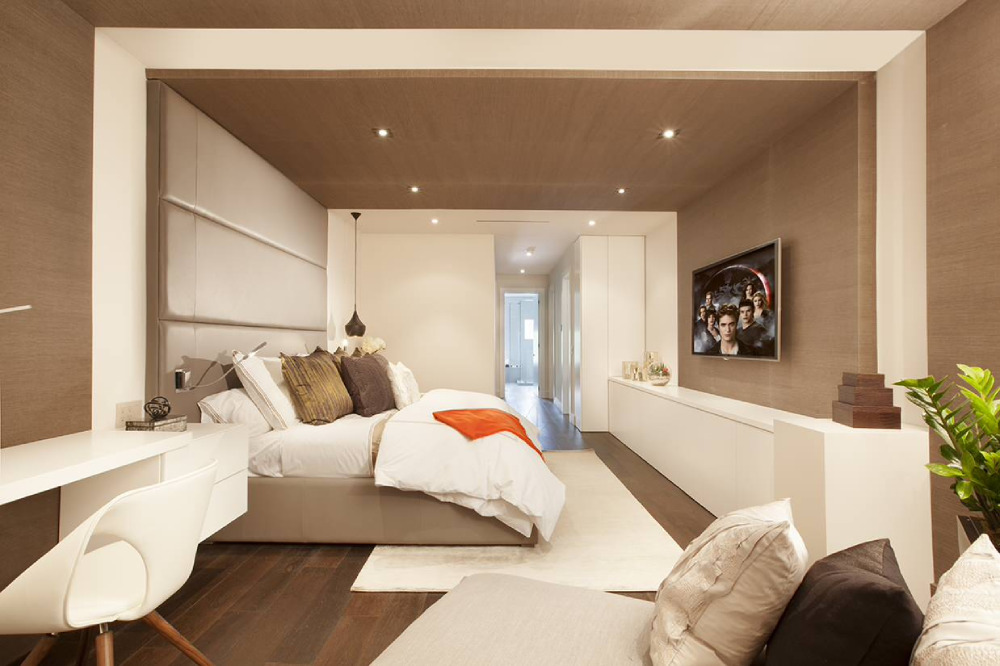
Cream, white, gray, blue, green, terracotta and gold are the dependable partners for brown. The right pick comes down to the brown’s undertone.
Brown behaves like a neutral, so almost every color tolerates it. Undertone and mood do the narrowing.
| Partner family | Suits | Mood | Typical use |
|---|---|---|---|
| Cream and white | Warm cream for warm brown, linen tones for cool brown | Soft, clean | Walls, trim, upholstery |
| Gray, charcoal, black | Cool browns and dark brown | Moody, modern | Accent walls, hardware, rugs |
| Navy, teal, powder blue | Teal for warm brown, powder blue for cool brown | Calm, polished | Sofas, accent walls, textiles |
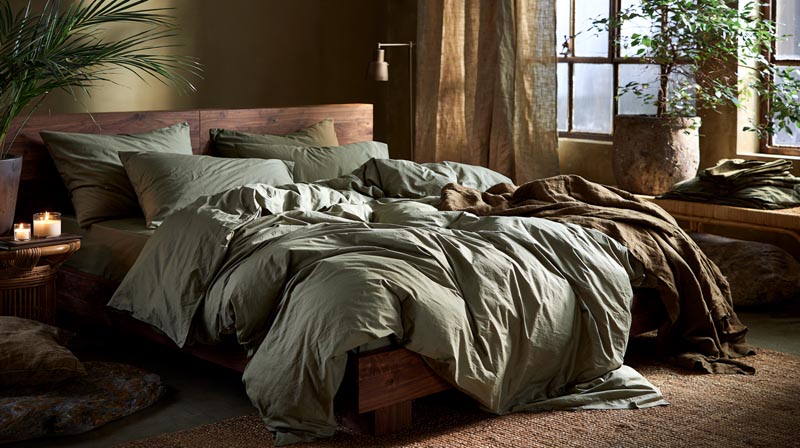
| Sage, olive, forest green | Warm browns | Earthy, restful | Walls, plants, cabinetry |
| Terracotta, mustard, burnt orange | Warm browns | Cozy, energetic | Cushions, throws, ceramics |
Contrast does most of the work here. The designers Homes & Gardens consulted treat how much contrast a room carries as the deciding factor, because a wider gap between brown and its partner gives a stronger effect.
Nor is brown a dated choice right now. Pantone named PANTONE 17-1230 Mocha Mousse its Color of the Year for 2025, and Benjamin Moore followed with the deep espresso Silhouette AF-655 for 2026, announced October 16, 2025.
Andrea Magno, Benjamin Moore’s director of color marketing, said growing interest in the brown family was behind the pick.
How do brown undertones decide the partner color?
Underneath every brown there’s a faint red, orange, yellow or gray note, and that note decides which partners look natural beside it.
The Munsell system, which the USDA uses to describe soil color, splits any color into hue, value and chroma. According to the MFA Boston CAMEO database, value runs from 0 (black) to 10 (white). Chroma measures how muted or pure the color is.
You match undertone. You contrast value.
The classic clash is a cool, blue-based gray sitting next to an orange-based brown with nothing between them. Put a cream or greige in the middle and the two stop fighting.
Warm browns
Warm browns carry red, orange or yellow notes. Caramel, honey oak and cherry all fall here.
Terracotta, olive, mustard, gold and warm cream sit well beside them, and ivory or warm greige works as the bridge to anything cooler. Blue-based grays and stark cool whites are the ones to watch.
BHG Australia steers warm browns toward green-blues such as teal.
Cool browns

Cool browns lean gray or taupe, and mocha is a common example. Light blue, silver-gray and linen-toned whites go straight on top with no bridge needed.
Even a paint brand’s headline brown mixes both notes. Benjamin Moore describes Silhouette AF-655 as burnt umber with delicate charcoal undertones, so one dark brown can carry a warm note and a gray note together.
Hold partner swatches up against the actual sofa or floor. One chip against another chip tells you very little.
Neutrals and other browns that go with brown
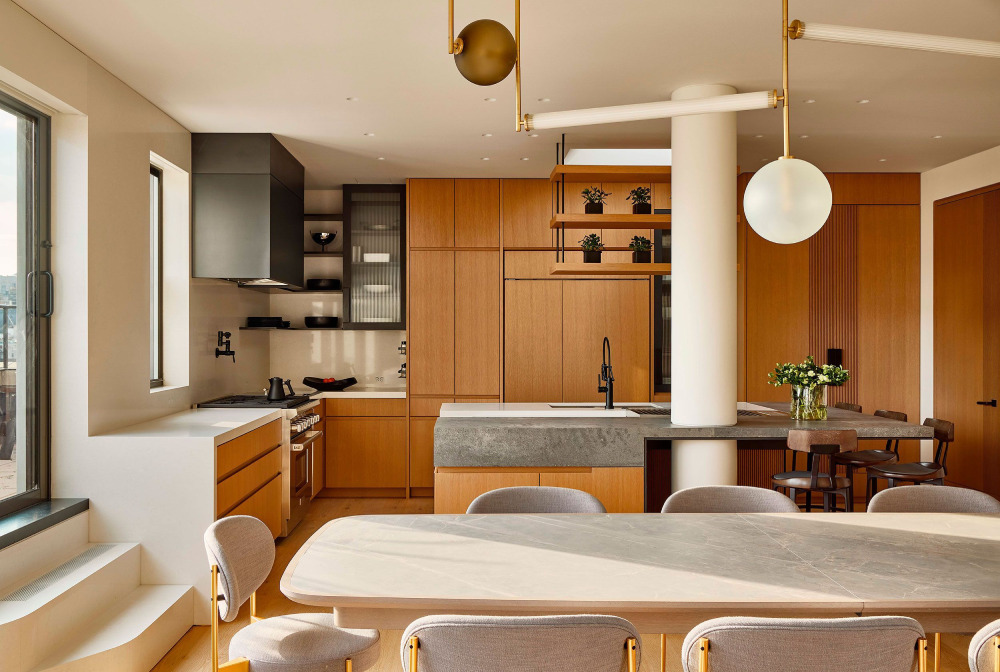
Cream, white, beige, gray, taupe, black and other browns are the safest partners. They share brown’s muted chroma, so all you need is a matching undertone.
- Warm cream suits warm brown, and linen-toned cream suits cool brown.
- A clean white makes brown look sharper, though a stark cool white looks jarring against warm brown.
- Camilla Clarke of Albion Nord, quoted by Livingetc, suggests greiges and fawn tones to add warmth to rooms built from several browns.
- Gray and charcoal give dark furniture a darker, more modern backdrop.
- A small dose of black in frames, hardware or a rug sharpens the whole scheme.
Taupe sits between brown and gray, so a taupe wall can bridge a warm brown sofa and cool gray textiles. If taupe is where you’re starting, the colors that pair with taupe itself fill out the rest of the palette.
Designers split on gray. Wayfair’s color guide lists it among the contrasting neutrals for brown, while Rossetti Art warns that a blue-based gray fights an orange-based brown unless a neutral sits between them.
Both are right, and the disagreement is really about undertone, not gray. A warm greige passes with warm brown. A blue-gray needs cream or taupe in between.
Brown with more brown works when the tones differ in depth. Dark leather against lighter camel velvet or cane stops a room from reading as one flat block, and layering texture such as wool, wicker and burl wood finishes the job.
HGTV Home by Sherwin-Williams anchored its 2026 Color Collection of the Year on a mid-tone tan, Universal Khaki SW 6150, and a neutral brown, Griffin. So a paint maker’s own palette pairs the two.
Blue and green with brown

Blue is brown’s complement, so navy, teal and powder blue make brown look richer. Green matches it instead, since both come from nature.
Brown is a darkened, muted orange, and blue sits opposite orange on the standard RYB color wheel. That’s basic color theory at work, because the opposite hue gives the strongest contrast.
On the blue side, navy gives a polished look against dark leather and wood. Teal goes with warm brown and powder blue with cool brown.
Green splits a few ways. Sage and olive make calm, earth-based rooms, and forest or dark green wraps brown furniture in a heavier mood. Mint is the odd one out, worth trying if you want a fresher statement wall.
Green doesn’t make brown stand out the way blue does. Livingetc describes it as a synchronized pairing, which makes it the quieter choice.
Benjamin Moore’s Color Trends 2026 palette sets Narragansett Green HC-157 beside Silhouette AF-655, so the brand itself endorses a deep green-and-brown pairing.
Heavy colors have a limit, though. Livingetc advises against crowding a small living room that already holds bulky wooden furniture with deep teal, navy or dark green walls.
Warm accent colors and metals for brown schemes
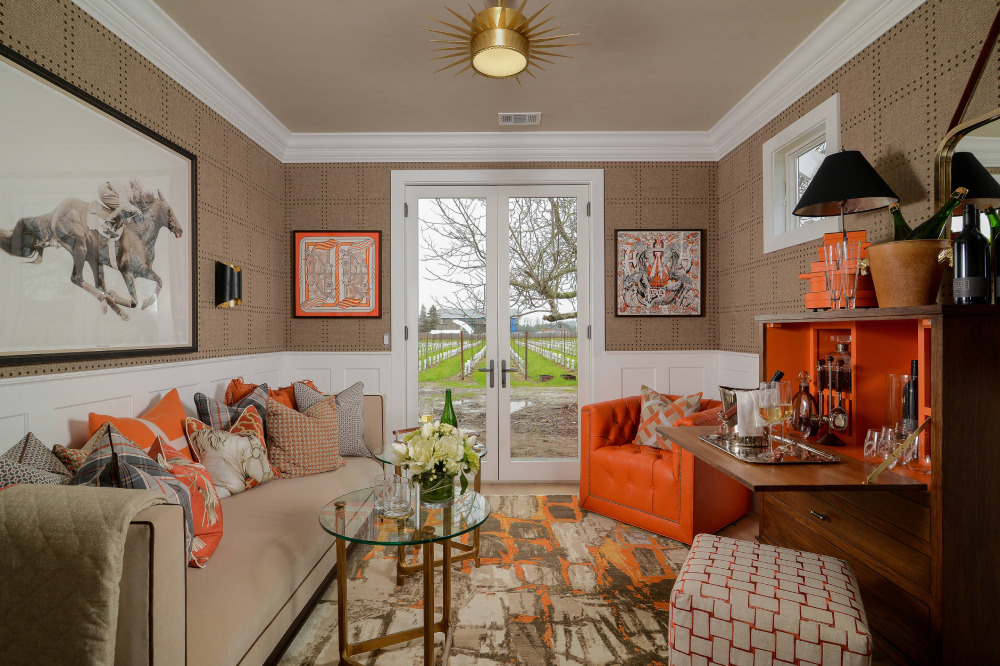
Terracotta, burnt orange, mustard, blush pink and deep red add warmth to brown, while brass, gold and copper add shine.
Orange, yellow and terracotta sit next to brown on the color wheel, which makes the scheme analogous. The room reads cohesive instead of contrasting.
Wayfair’s guide says red deepens the warm undertones in lighter browns and orange blends into an earthy whole, while yellow brightens a room without jarring.
Apartment Therapy’s designers lean on olive, terracotta and ochre for calm rooms, and a deep brown backdrop makes peach read clearly. Hunker adds pink, mauve and peach as a way to soften the heavy, masculine look of brown leather.
Metals follow the same logic.
- Brass and gold echo the warmth of brown and make lamps and hardware stand out.
- Copper looks good over a brown dining table.
- Silver and chrome suit cool browns and a modern gray-and-brown look.
- Matte black on bed frames and side tables balances rustic wood with a contemporary edge.
One limit applies. BHG Australia notes that copper alone can overpower a room, and brown decor lets both copper and brown register.
How should brown and its partner colors be split in a room?

With brown furniture and floors, the split that works is 60% light partner, 30% brown and 10% accent.
Ideal Home quotes Ben Thomson of Promain describing the 60-30-10 rule as 60% dominant hue, 30% secondary color and 10% accent.
Walls carry the 60 in most rooms, so a brown sofa or wood floor falls into the 30. Brown walls reverse the order. Brown takes the 60, and the light partner moves to bedding, curtains and upholstery.
- Pick the 60% color for the walls and other large surfaces, such as cream, warm white or a soft neutral behind brown furniture.
- Give brown the 30% through the sofa, wood floor, cabinetry or a large rug.
- Choose one blue, green or warm accent for the 10%, in cushions, art, ceramics or a throw.
- Hold the accent beside the brown piece in the room’s own light before buying.
The split is a guide, not a law. Trying other ratios in a generator that builds room color schemes costs nothing before any paint is bought.
Which wall colors suit brown furniture, leather and wood floors?

Light neutrals such as cream, beige and warm white suit most brown furniture. Deeper partners work too, once the room gets enough daylight.
Light Reflectance Value (LRV) puts a number on that choice. Resene defines it as the share of light a surface reflects, with black at 0%, and notes that dark, matt and textured surfaces reflect little.
Brown pieces that are dark, matt or textured sit low on that scale, so a low-LRV wall behind them closes the room in. Settling on wall colors that go with brown furniture therefore starts with how much light the room gets.
Sheen counts too. A BNP Media engineering course on paint and light explains that matte, flat and eggshell finishes diffuse light, while satin, semi-gloss and gloss reflect it directionally and make dark colors look darker.
Dark brown furniture

Cream or beige lifts the room. A brown or dark taupe wall gives a tonal, understated look, and charcoal gray with a cool undertone brings contrast.
The tonal route is the quietest of these. Dark brown paneling around dark wood furniture reads as one continuous surface.
Light brown furniture
Light brown and light wood furniture take cooler partners well, and Hunker singles out light blue as a particular match.
The warm route works as well. A rosy wall color picks up the warm undertones in light wood, and brass accents add sparkle.
Brown leather sofas
- A blend of royal blue and teal stands out behind a leather Chesterfield in Hunker’s roundup.
- Domino paired brown leather with Clare’s Current Mood, a deep, shadowy green.
- Domino’s editors also suggest a clean white backdrop for a sculptural vintage leather piece.
- According to Designing Vibes, a charcoal that nearly reads black gives a chocolate leather sofa a lodge-like look.
Brown wood floors
Warm hardwood with warm wall paint reads cozy. Cool gray walls against rich brown floors read more contemporary.
Dark floors are the largest brown surface in a room, so the wall colors that go with dark wood floors deserve a check under evening light before anything gets painted.
Brown color schemes by room
Brown does a different job in every room. Living rooms lean on style and texture, bedrooms want softness, and kitchens need contrast. Dining rooms are mostly about mood.
Living room
Style sets the partner palette in a living room more than any single color rule.
| Style | Where the brown comes from | Partner colors |
|---|---|---|
| Japandi | Light to dark wood, taupe | Muted greens, soft gray-blues, black accents |
| Scandinavian | Lighter woods | White, cream, pale neutrals |
| Mid-century modern | Walnut, teak | Cream or white walls, mustard, burnt orange, teal |
Dunn-Edwards built a Japandi palette around its 2022 Color of the Year, the neutral brown Art & Craft DET682, with darker wood tones set against soft cloudy gray.
Bedroom
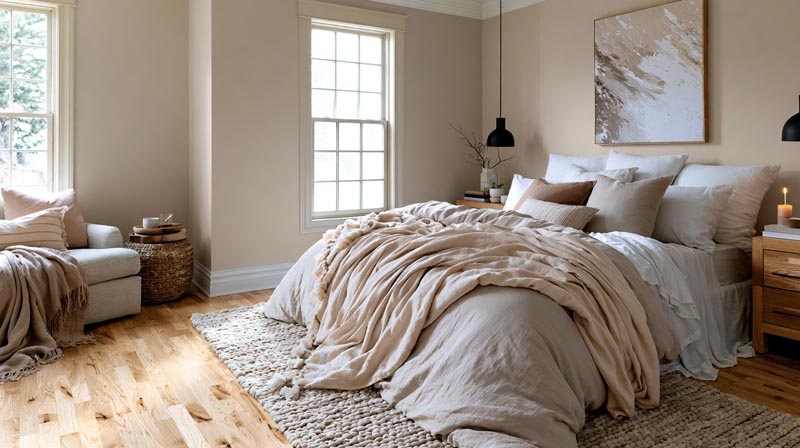
Dulux’s brown bedroom guide includes several schemes. White Cotton walls give a clean backdrop for a statement brown printed headboard, and Malt Chocolate walls take a chunky knit throw.
Another uses Sapphire Salute navy on every wall, with brown curtains, throws, cushions and rugs.
- Designer Grey Joyner (Saatva) says saturated brown walls need lighter colors elsewhere in the room.
- A deep chocolate ceiling or trim looks rich without darkening the walls.
- In Katie DeStefano’s bedroom (Hunker), crisp white bedding balances a chocolate grasscloth wall.
Livingetc suggests an accent wall for anyone nervous about four brown walls, and the accent wall colors that suit a bedroom run well beyond brown.
Kitchen
- Melissa Filter of Meadowlark Design+Build layered brown cabinetry with white details (Apartment Therapy).
- Exquisite Kitchen Design ran a gold backsplash that echoes the hardware on dark brown cabinetry (Hunker).
- One designer quoted by Hunker reaches for shades of green on the backsplash, walls and textiles around natural wood cabinets.
Reversing the roles also works. White cabinets over a brown countertop keep the kitchen bright while the brown stays on the work surface.
Dining room
Amber Interiors set a mid-century table and chairs against dark charcoal walls with cool undertones, and Hunker holds the room up as proof that gray suits brown furniture.
Giancarlo Valle went the other way, with a deep plum or eggplant dining room around brown pieces.
Both rooms keep the table dark and push the contrast into the walls.
How does lighting change brown and its partner colors?

Warm light deepens brown and its warm partners, while cool light drains them toward gray.
Real Homes explains the mechanism. The higher a bulb’s color temperature in Kelvin, the cooler and bluer the light, and the colder every paint color looks.
Window direction sets the baseline before any bulb is on, and the way light works inside a room explains why one brown looks different at noon and at nine at night.
- In a north-facing room, Rust-Oleum Colours advises lighter shades with warm red, orange or yellow undertones, and warns that blue, gray or green undertones turn flat and cool.
- South-facing rooms take most colors, though they read more yellow, and Sanderson notes everything feels warmer and brighter.
- West-facing rooms run cooler in the morning and warm up toward evening (Real Homes).
Sources split on dark browns in north-facing rooms. Rust-Oleum steers them toward lighter warm shades, while Clare’s guide says soft, consistent north light often deepens the richness of moody colors.
The common ground is a warm undertone.
Numbers help a little here. Natural outdoor light scores 100 on the CRI scale, the standard other sources are compared against (Philips), and Philips rates its LED bulbs above 80 CRI. Warm white means 2700 K, the incandescent-like setting on Philips LED bulbs. Cool white at 5000 K and above reads crisp, blue-toned and clinical (Sanderson).
CRI has limits. A January 2008 US Department of Energy technical sheet notes that the International Commission on Illumination does not recommend CRI for white-light LEDs, and it advises comparing CRI only between light sources of the same color temperature.
Paint a swatch and view it in daylight and under the evening bulbs before committing.
When do brown pairings fail?
Brown pairings fail most often when the room is too dark to carry them, when the scheme looks like a matched set, or when the accent outgrows its role.
| Failure | Cause | Fix |
|---|---|---|
| Room shrinks | Dark walls beside dark brown furniture | Lighter walls, brown kept to furniture and floors |
| Scheme looks dated | Matched brown set, muddy brown-beige | Mix materials, add one clear partner color |
| Accent overwhelms | Accent used at large scale | Keep the accent near its 10% share |
Metallbude lists overly dark walls beside brown furniture as a common mistake because they shrink the room visually. A small room is where lighter wall colors chosen for small rooms earn their place.
Designers disagree on whether brown dates a living room. Tom’s Guide cites experts who advise against brown there, while Livingetc’s 2025 advice says muddy browns and dull brown-beiges feel dated but a dramatic brown does not.
The matched set is a separate trap. AOL’s list of dated decorating habits flags the brown velour sofa suite and recommends pairing brown with other colors and materials.
Where looking dated is the worry, Livingetc’s designers point to deep olive green, which gives the same grounding effect with less chance of looking old.
Common Questions About Colors That Go With Brown
Is brown a neutral color?
Yes, in most interior palettes. Decorist designer Rita Schulz, quoted by Hunker, says brown is often treated as a neutral, which is why it tolerates nearly any partner.
How do you brighten a dark brown room?
Start with pale or bright color on the soft surfaces. Hunker suggests brighter curtains and bedding for a dark brown bedroom, and gold or brass lamps bring a warm glow without any repainting.
Which furniture colors go with brown walls?
Light gray, white, beige and sage furniture sit easily against brown walls, according to Roomdsign. Yellow lifts the mood, and charcoal only works in a spacious room with plenty of natural light.
What rug color works with a brown sofa?
Rugs in red, orange and other earth tones suit a warm brown sofa, per Rovelab. For more pairings, see these rug colors that go with brown couches.
Which throw pillows suit a dark brown couch?
Blue and green pillows create a complementary scheme against brown leather, according to Chapin Furniture, and cream ones lift a dark seat. Specific combinations are collected in these throw pillow ideas for a dark brown couch.
Which colors pair with chocolate brown?
Deep chocolate pairs with autumnal reds, soft yellows and deep greens, according to Hunker.
Cream or ivory keeps the room from closing in around that depth.
Is brown still a current interior color?
Yes. In the NKBA 2025 Kitchen Trends Report, as reported by Better Homes & Gardens, 56% of respondents chose brown, behind green at 76% and blue at 63%.
The survey covered more than 500 designers, manufacturers, remodelers and architects.
Which Color to Test First Beside Brown
Start with a cream matched to the brown’s undertone. It changes the room least and costs the least to reverse.
Ordering the decisions by how hard each is to undo gives a sequence.
- A cream or warm white swatch on the largest wall
- One accent in cushions, a throw or ceramics
- Blue, green or dark paint, as a swatch first and a full wall last
Soft goods come second because they can go back to the store. Deep paint comes last because very dark colors can need a primer and an extra coat to cover.
The cost is impact. A matched cream gives the lowest contrast of any partner family, so the accent has to carry the personality of the room.
Once a swatch holds up in the room’s own light, a room paint calculator gives the quantity to buy before the first coat.

- Kitchen Color Schemes by Cabinet Color: What Pairs Well - October 19, 2026
- Curtain Colors for Every Wall Color: Safe vs Bold Picks - October 18, 2026
- Interior Design Styles: Find Your Primary and Secondary - October 14, 2026