Kitchen Island
Stylish Dark Green Kitchen Island Ideas for Every Style
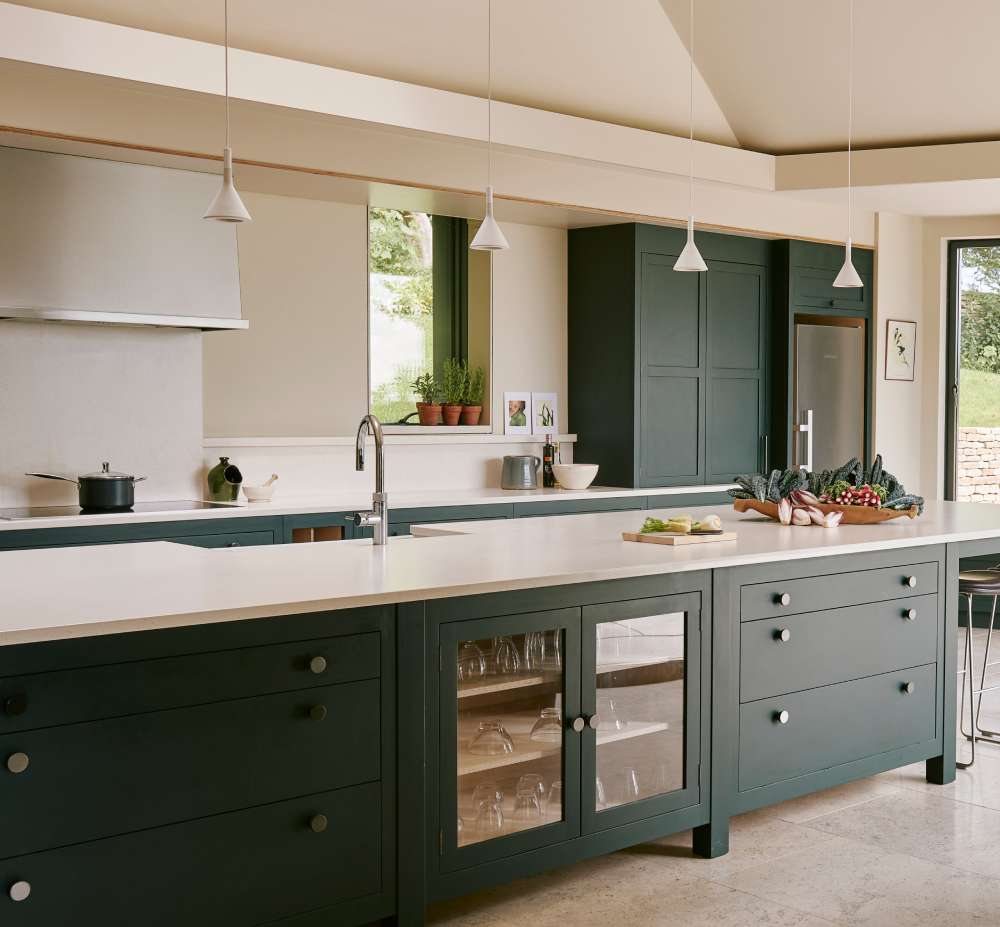
NKBA | KBIS’s 2026 Kitchen Trends Report puts the island at 57% among the places where new statement colors will land. Backsplashes and wallpaper sit ahead of it at 60% each.
Dark green on an island works where the rest of the kitchen stays light, since a deep green finish absorbs most of the light that reaches it. The prep surface, storage and seating stay exactly what they were. Only the color changes.
Island colors are one part of our guide to kitchen color schemes, which also covers cabinets, counters and hardware.
Which dark green paint colors work best on a kitchen island?
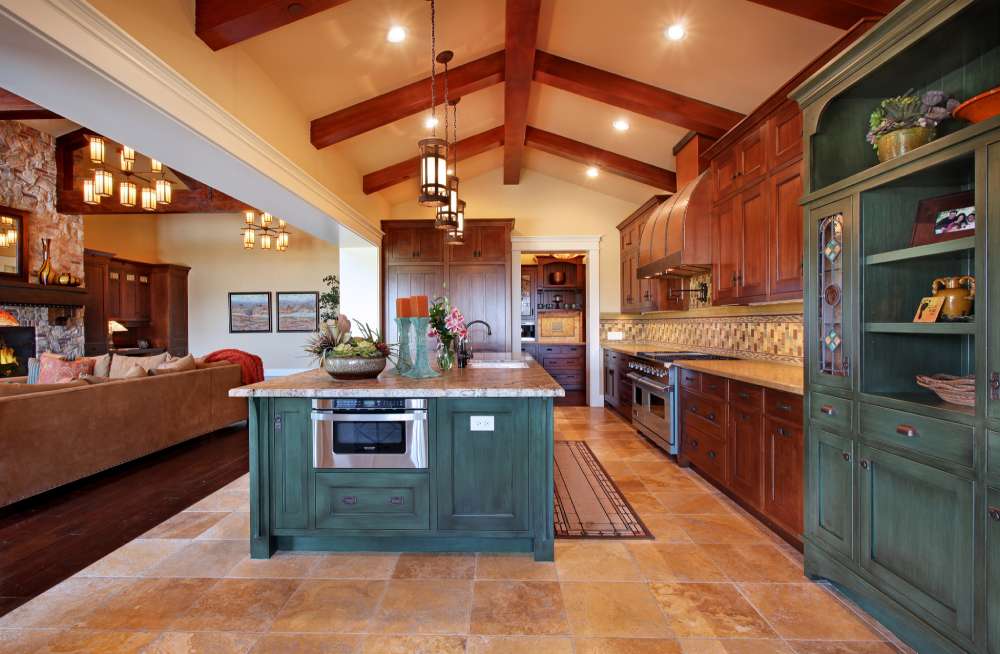
Benjamin Moore Hunter Green and Essex Green go the deepest. Farrow & Ball Studio Green leans gray, and Sherwin-Williams Rookwood Dark Green and Farrow & Ball Calke Green read more olive and earthy.
Which one suits you depends on how dark the island should look next to the perimeter cabinets, and on how much daylight the room gets.
| Shade | Brand | Reads as | Fits best |
|---|---|---|---|
| Hunter Green 2041-10 | Benjamin Moore | Classic dark green, blue-leaning | White or warm-white perimeter cabinets |
| Essex Green HC-188 | Benjamin Moore | Nearly black green | Bright rooms with strong daylight |
| Studio Green No. 93 | Farrow & Ball | Gray-green, near black indoors | Well-lit kitchens with wood or stone tops |
| Rookwood Dark Green SW 2816 | Sherwin-Williams | Olive-leaning mid-dark green | Warm kitchens with brass or oak |
| Calke Green No. 34 | Farrow & Ball | Earthy green, lightest of the five | Smaller or dimmer kitchens |
Blue-green and near-black shades
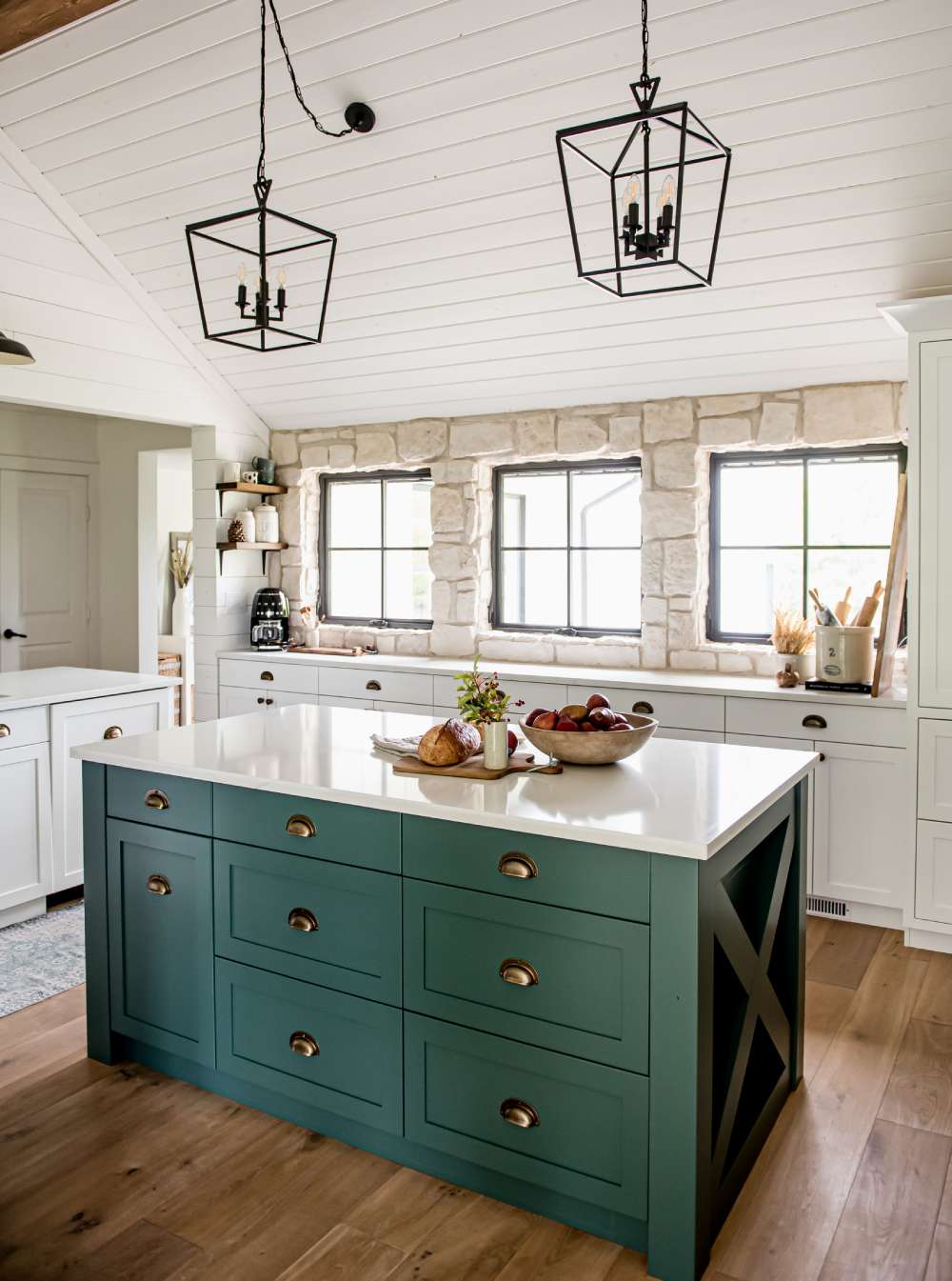
Benjamin Moore lists Hunter Green at an LRV of 6.39 and Essex Green at 5.64. On that scale 0 is absolute black and 100 is pure white, so both sit very close to the bottom.
Hunter Green has a blue-green lean and is what most people picture when they say dark green. Essex Green is described by Benjamin Moore as nearly black, which means on an island it behaves like a soft black with a green cast.
Little Greene Invisible Green is another near-black option. The UK cabinetmaker Willis & Stone finished a Georgian Shaker kitchen in it and added Caesarstone Statuario Nuvo worktops.
Gray-green shades
Studio Green is the darkest green in Farrow & Ball’s range. Indoors it looks almost black unless the room is very well lit.
On exterior surfaces it looks much greener than the color card suggests, so judge it inside the kitchen, not from the card. Farrow & Ball pairs it with its Off-White.
Tom Howley’s hand-painted Shaker kitchen in Studio Green, shown on Houzz, sets Silestone Iconic White worktops against the dark cabinets.
Olive and earthy greens
Rookwood Dark Green pulls olive, which sits better with oak floors and brass pulls than the blue-greens do.
Calke Green is the lightest of the group. If the kitchen is compact or short on daylight, it’s the safer pick.
Once the island shade is settled, the colors that pair well with dark green narrow down the wall and trim decision.
To preview the island against wall and floor colors before ordering sample pots, a room color scheme generator saves a few rounds of guessing.
How light changes a dark green kitchen island
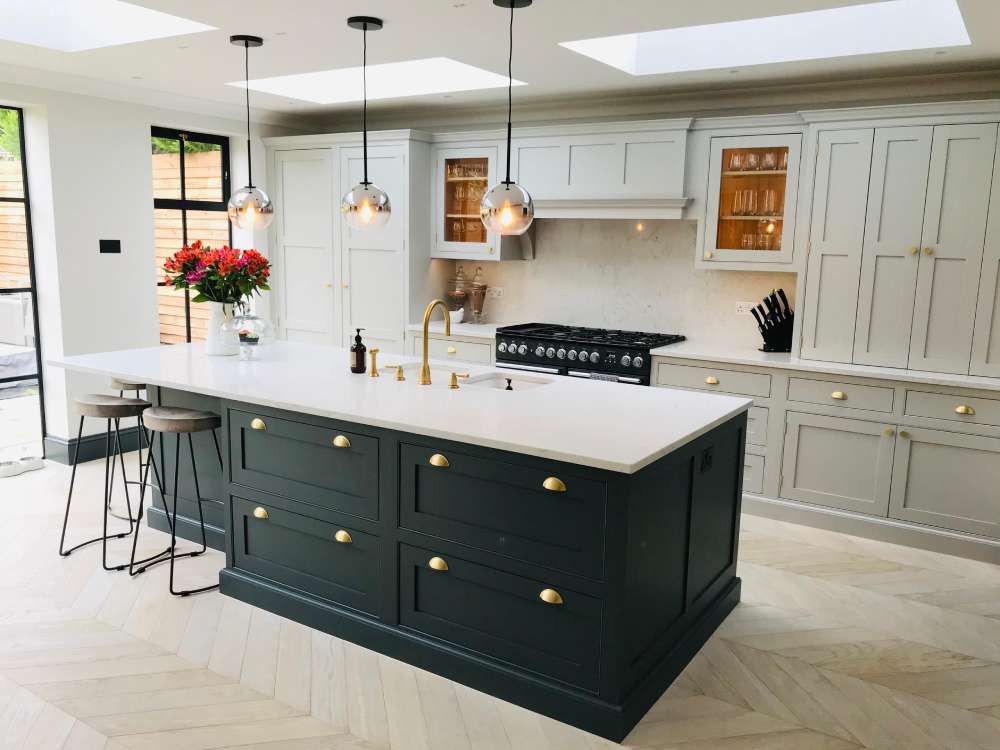
A dark green island reflects very little light, so the daylight and bulbs in the room decide how much green you actually see.
Farrow & Ball says Studio Green reads almost black indoors unless the room is very well lit. Time of day matters too. Farrow & Ball describes the same room as bright in morning sun and cozy by evening, and that holds for its colors in general.
Bulbs change the green as well. Warmer ones pull yellow into it and cooler ones push it toward blue. And pendants light the countertop, not the door fronts below it, so the doors stay darker than you’d expect.
A shade chosen under shop lighting changes at home, and the role light plays in interior design explains why.
Published advice splits on bulb temperature.
Waveform Lighting generally recommends 3000K for kitchens and dining areas. The retailer BLT Direct recommends daylight bulbs of 5000K to 6000K for kitchens, because the crisp light makes prep tasks easier.
Neither source tested dark cabinet colors. Fix the bulb temperature first, then judge paint samples under those bulbs.
Output matters as much as color temperature. An LED light requirement calculator helps size the lighting for the island zone, which counts for more when the door fronts absorb most of what reaches them.
Cabinet material and finish for a painted dark green island
Painted MDF fronts take dark paint most evenly, and a waterborne alkyd or urethane enamel is the usual cabinet-grade coating.
Cabinet material
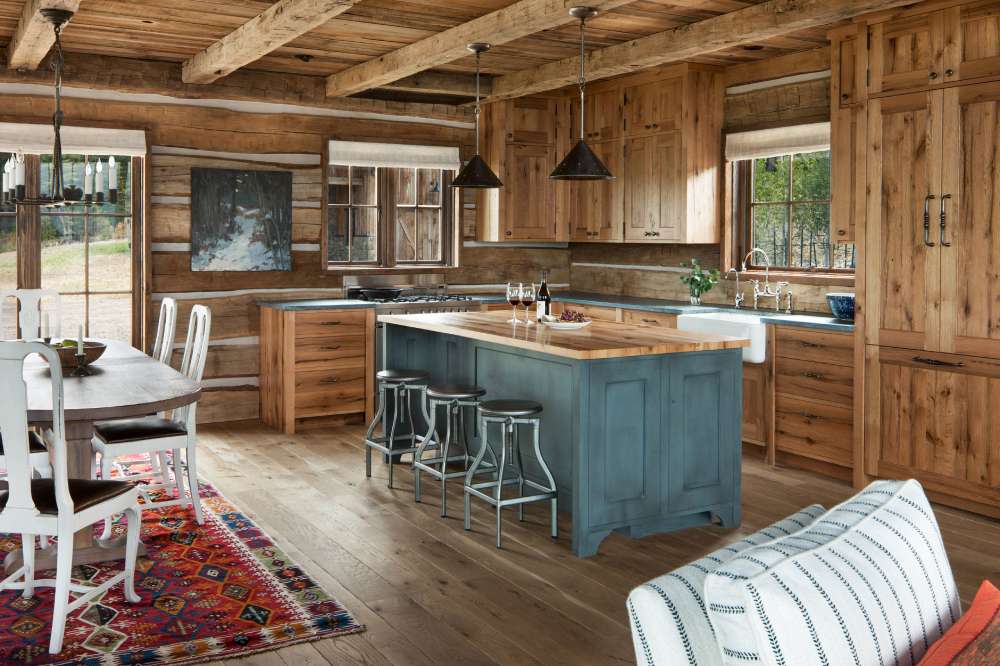
MDF has no grain to show through dark paint. It handles moisture and exposed edges poorly, though.
Plywood makes a stronger box and is the safer choice around a sink or dishwasher.
Grain can telegraph through paint on solid wood over time, which is why paint-grade doors use tight-grained species such as poplar, soft maple, alder or birch.
Laminate comes factory finished, so there’s no paint to chip. The catch is that the dark green range is limited to whatever the maker offers.
IKEA Sektion boxes with factory-painted fronts are a shortcut. Semihandmade makes MDF fronts in a post-catalyzed lacquer with a matte sheen, accepts Benjamin Moore, Sherwin-Williams or Farrow & Ball swatches, and charges no custom color fee.
Sheen and paint
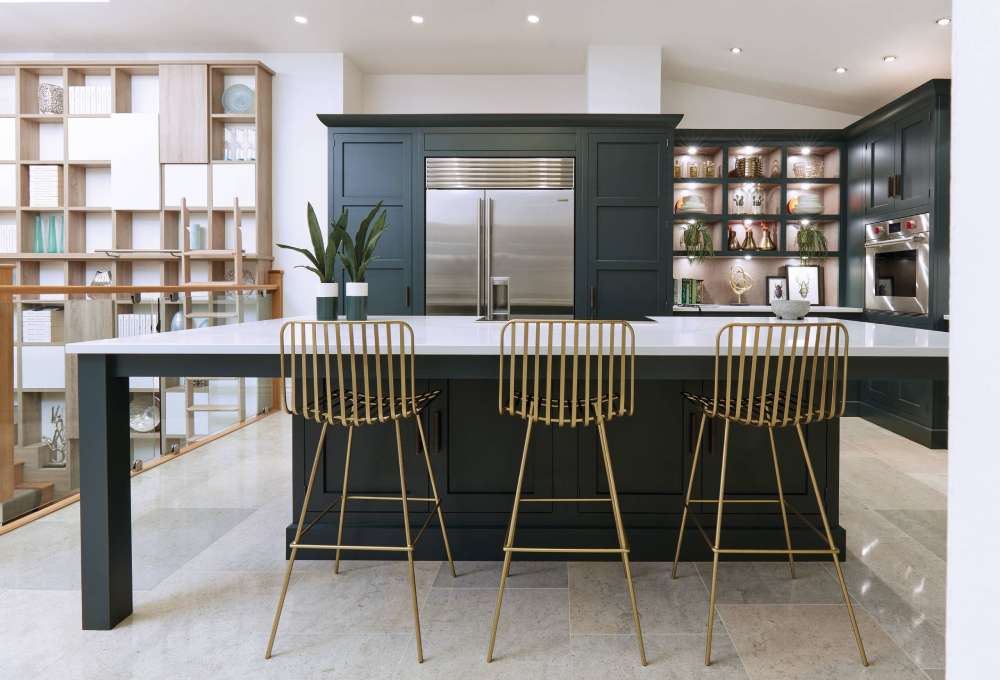
Sheen decides how a dark color wears.
Higher sheen shows surface flaws under raking light, so a semi-gloss island demands careful prep. Cabinet-care guides disagree on matte. One says it minimizes fingerprints on dark cabinets, another says it shows them more easily than gloss.
Paint a test door and handle it for a week before choosing.
Benjamin Moore Advance is a waterborne alkyd sold in satin, semi-gloss and high gloss. The product page lists a full cure of 7 days, and the data sheet says it can take up to 30 days to reach optimum hardness and final sheen. Keep the island on light duty for the first weeks.
Sherwin-Williams Emerald Urethane Trim Enamel is a water-based urethane-modified alkyd that resists yellowing. It comes in satin, semi-gloss and gloss.
Both brands call for tinted primer under dark colors. Benjamin Moore’s Advance system specifies a primer tinted close to the finish color, and Farrow & Ball recommends its Dark Tones primer for Studio Green.
What countertop goes with a dark green kitchen island?
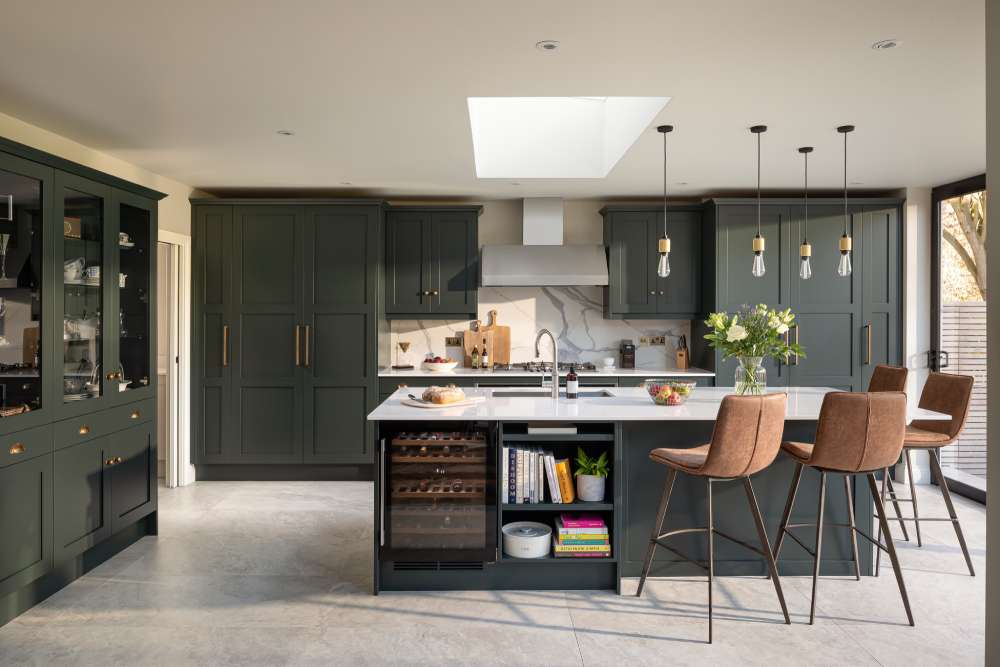
White marble or white quartz gives the strongest contrast against dark green, while soapstone and butcher block keep the island warm and moody.
Quartz is the sensible default for a working island. Marble earns its upkeep only on a showpiece island.
Marble: Carrara and Calacatta
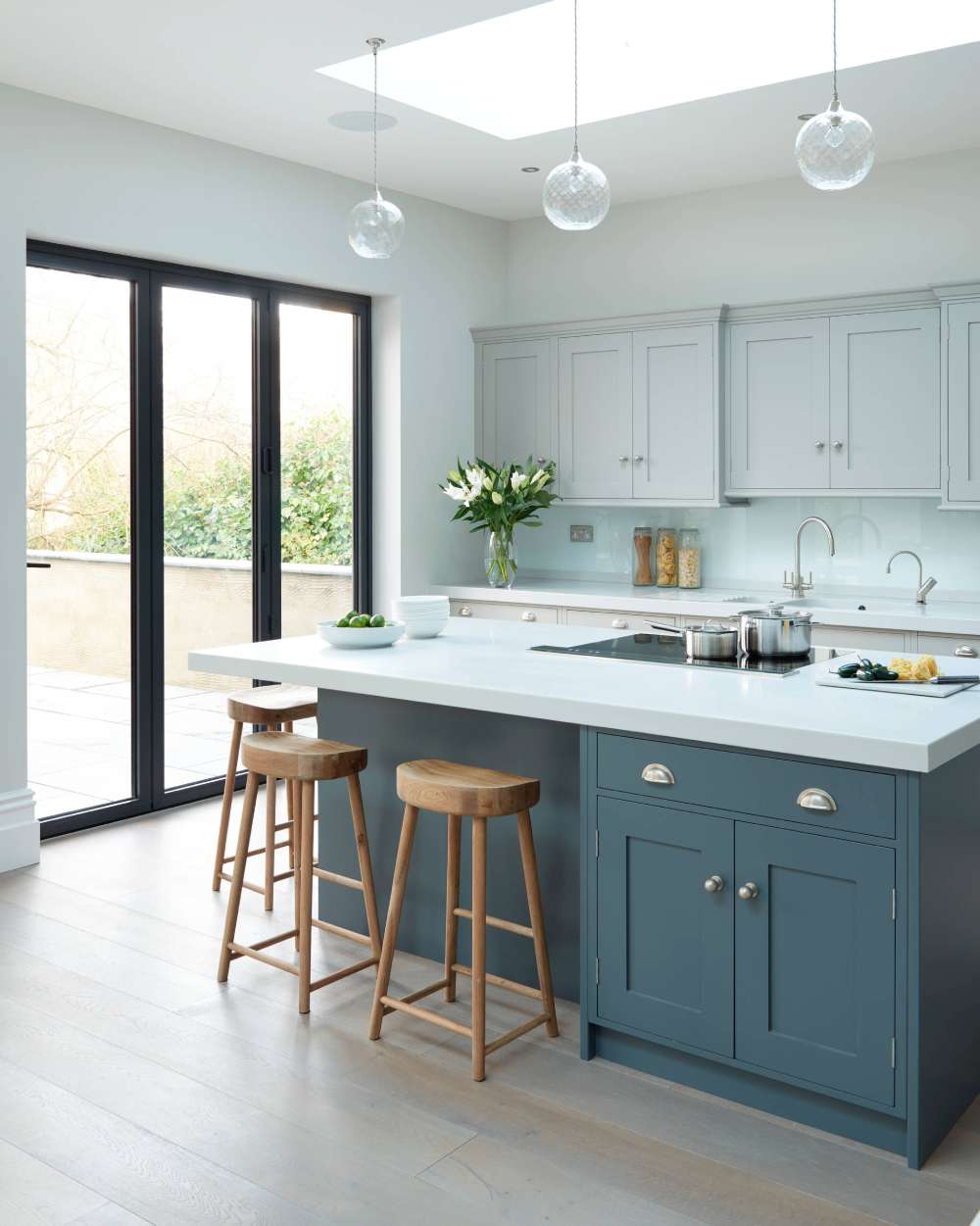
Carrara has softer gray veining and Calacatta has bolder veining. Both read as white against dark green, and the contrast with the fronts is strong.
A honed finish hides etching, and marble can be re-honed when it’s damaged. The upkeep is the catch. Acids etch it, and sealer stops grease and oil stains but not etching. Polished marble etches more, while honed marble stains more easily.
The Marble Institute of America advises against vinegar, lemon juice and bleach cleaners.
Quartz: Caesarstone and Silestone
Caesarstone advises against setting pots hotter than about 300 degrees F directly on its quartz and recommends a trivet for hot cookware.
The brand describes its surfaces as non-porous with no sealing needed. White countertops against green cabinets are the high-contrast route, and Celtic Interiors designer Declan Keane chose white Silestone Calacatta Gold quartz for that reason in a dark green kitchen (Houzz).
Non-porous and sealer-free is the appeal. The downsides are the trivets and a pattern that’s manufactured rather than natural.
Soapstone
Soapstone is a dark natural stone, typically gray with blue or green undertones, that is non-porous and needs no sealing.
It darkens with age, and mineral oil evens out the patina.
| Pros | Cons |
|---|---|
| No sealing needed | Softer than quartz, so it scratches |
| Hot pans fine, per supplier ARC Surfaces | Patina keeps changing the color |
| Scratches sand out | Oiling for an even dark look, and seams on long runs |
Butcher block
Butcher block adds wood warmth to dark green, and scratches sand out at home. Butcher block on green cabinetry shows how warm the pairing runs.
Care advice is where makers disagree. John Boos, a butcher block maker, recommends regular oiling with food-grade mineral oil plus a beeswax board cream. Finish supplier RMP Finishes advises against mineral oil as a wood finish and recommends pure tung oil, a drying oil.
The split comes down to mineral oil never curing. Follow the care sheet of whoever made the top.
Stains sand out along with the scratches, which is a real plus. Water is the weak spot. Boos warns that liquids soak in and make the wood expand and soften, so standing water near a sink island is a problem.
Which hardware, perimeter cabinets and floors pair with a dark green island?
Brass hardware, white or warm-white perimeter cabinets and wood floors suit a dark green island best, because each adds the warmth or light the island absorbs.
Hardware metals
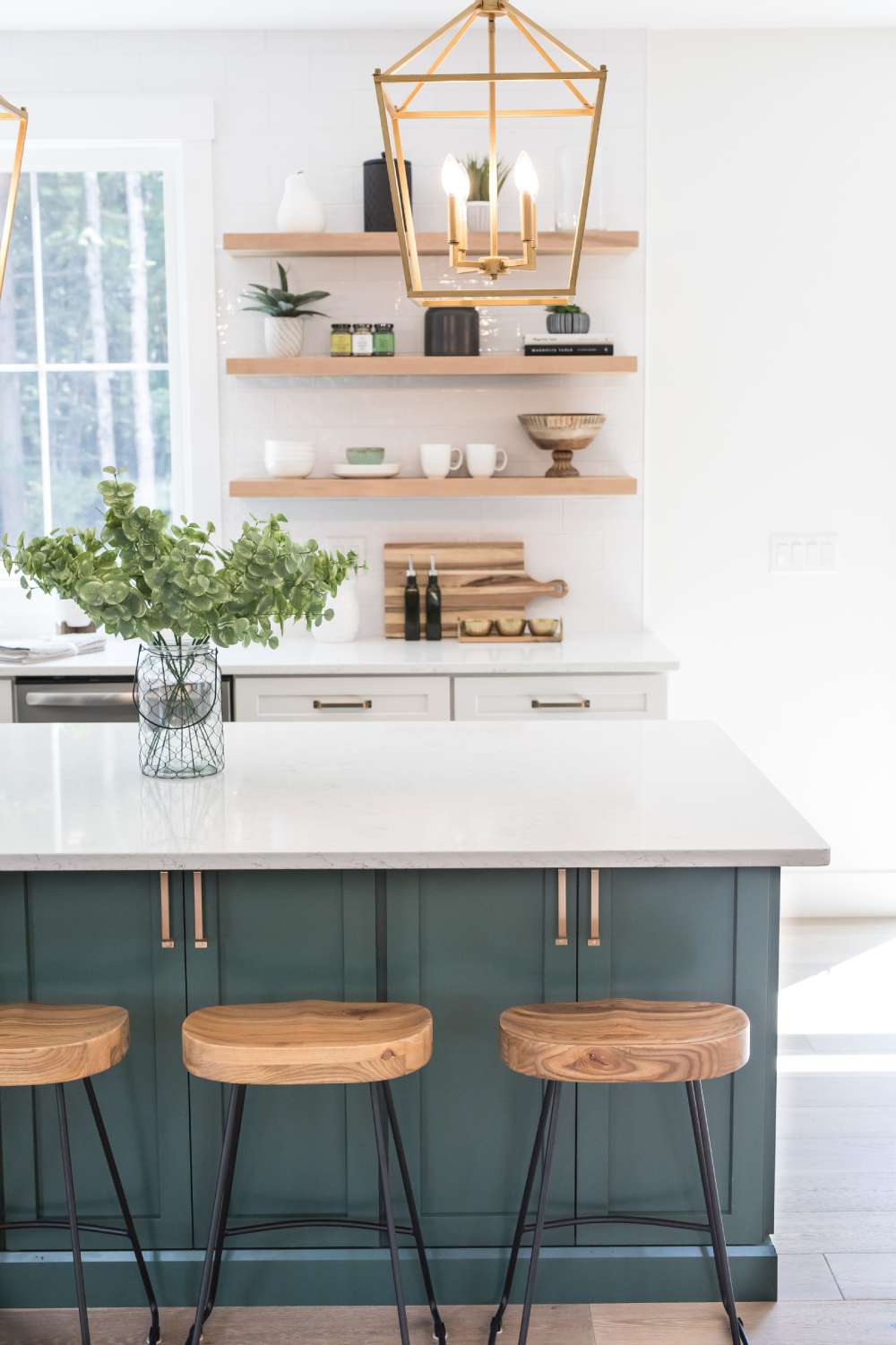
Unlacquered brass is a living finish that darkens with use. HGTV notes it can develop a green patina that echoes the island. Satin or brushed brass is a soft-toned matte brass that Houzz pros say works with darker cabinet colors.
Matte black goes dark on dark, so understated that the pulls nearly disappear.
Polished nickel and chrome are the odd ones out. Houzz’s designer interviews report a move toward brushed, matte or textured metals and away from highly reflective ones.
Brass-toned pulls are the usual choice, and examples of gold hardware on green cabinets show how the warmth reads against different greens.
One thing to watch with unlacquered brass is that it keeps changing. A mix of unlacquered and lacquered pieces drifts apart over the years. Polishing slows the patina but does not stop it.
Perimeter cabinets
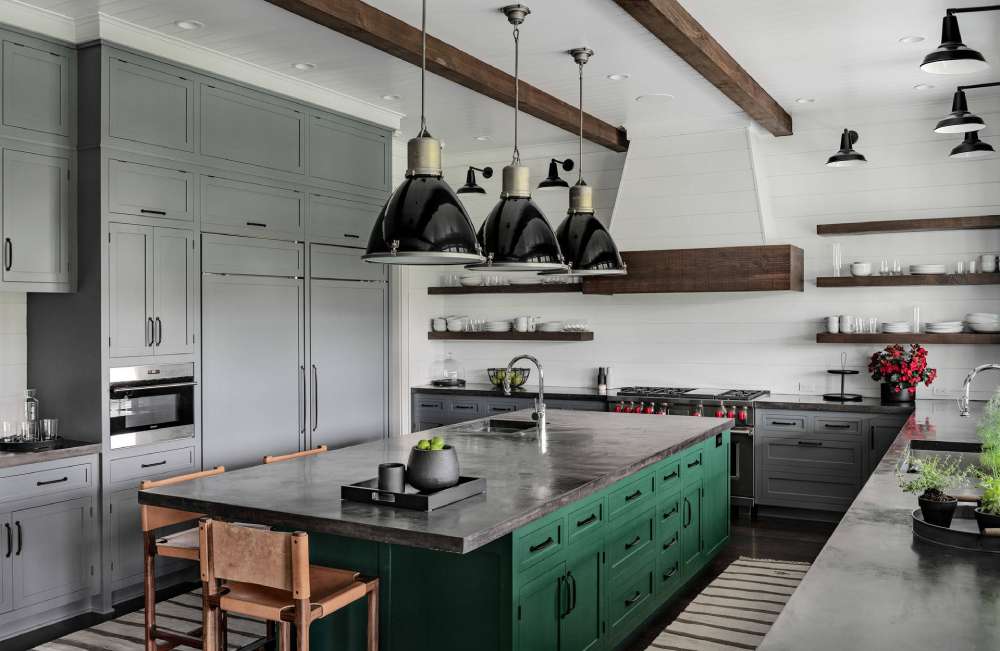
White or warm-white perimeter cabinets leave the island carrying all the color. That’s the most common scheme, and white perimeter cabinets with a green island stretch from modern to farmhouse without changing the logic.
Using the same green all around means the island stops being a focal point and the room feels enveloped. You gain cohesion and lose contrast.
Floors, walls and backsplash
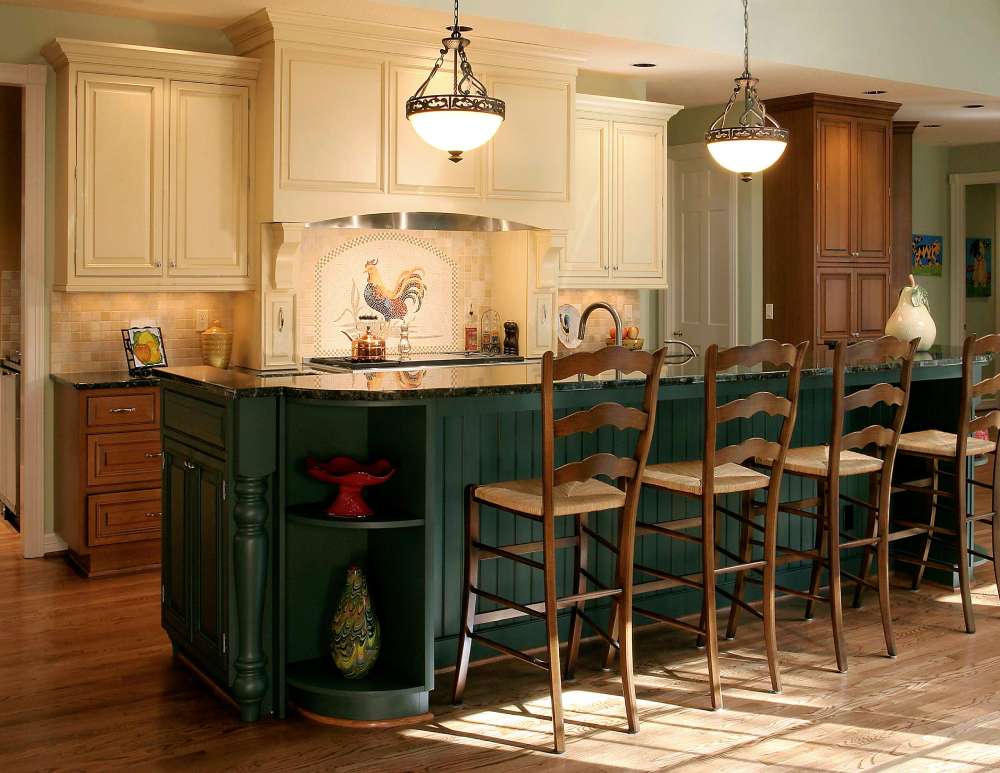
Wood floors warm the green. White oak is the leading wood species in NKBA’s 2026 Kitchen Trends Report, which also has wood-grain cabinetry overtaking painted finishes.
Dark floors swallow the island’s outline, so keep the countertop or the wall behind it light. Warm white walls keep the room open, and the backsplash should stay quieter than the island.
Size, clearance and seating space for a dark green kitchen island
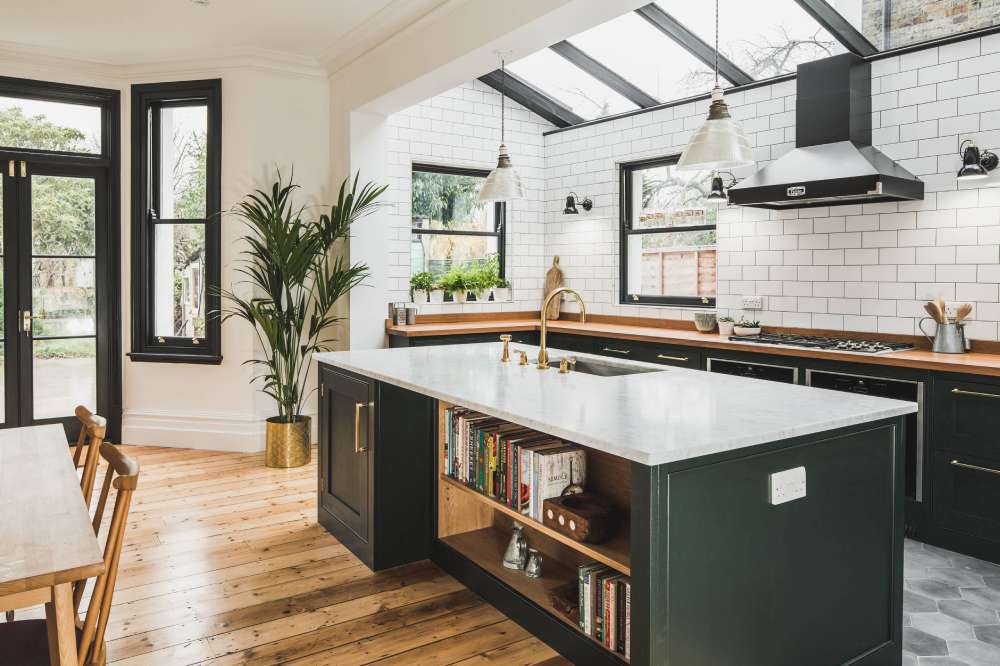
Size the island from the room inward. Aisle and seating clearances set the maximum depth, and the island takes whatever floor is left.
These figures come from NKBA’s Kitchen Planning Guidelines with Access Standards (the edition that references the 2015 International Residential Code), plus one depth formula.
- Work aisle of at least 42 in for one cook and 48 in for multiple cooks
- Knee space per seat of 24 in wide, 15 in deep at 36 in counters and 12 in deep at 42 in bar height
- Space behind the seats of 32 in with no traffic, 36 in to edge past and 44 in to walk past
- Island depth with seating of 41.5 in (1.5 in counter overhang, 24 in cabinet, 1 in end panel, 15 in seating overhang), per a Houzz kitchen FAQ
Overhang numbers conflict across sources. Several cabinet retailers’ size guides quote 12 to 15 inches as the standard, while NKBA sets 15 inches at counter height and allows 12 only at bar height.
At counter height, plan for 15.
Here’s the math for one layout. A 42 in work aisle plus a 41.5 in island plus a 44 in walk-past behind the stools gives 127.5 in, about 10 ft 7.5 in, between the perimeter cabinet fronts and the wall or cabinets on the seating side. If nobody walks behind the stools, 32 in replaces 44 in.
Seats on two sides apply the behind-seat clearance to both aisles, which is why an island with seating on both sides needs a much wider room.
Dark finishes read heavier than light ones, so check the island against scale and proportion in interior design as well as the clearance numbers.
When is a dark green kitchen island the wrong choice?
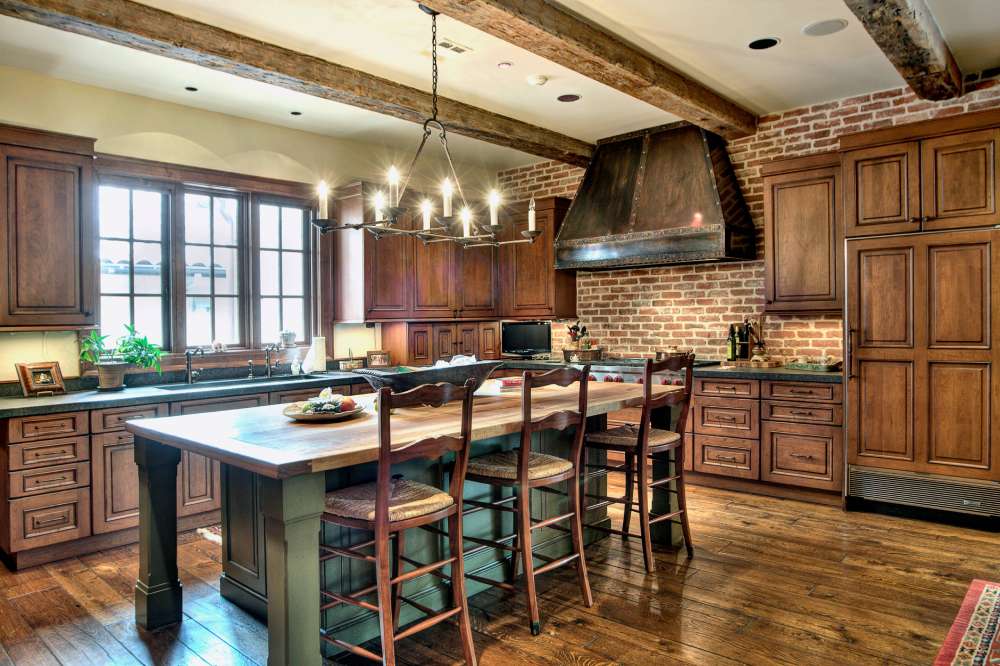
It’s the wrong choice for an island that takes daily knocks, for a household that won’t wipe cabinets often, and for a kitchen too dim to show the green.
Where it fails
An Apartment Therapy editor painted her island dark navy and saw chips at the trash drawer edge, the knife drawer and the bottom corners where the vacuum hits. The lighter wood under the paint made every chip obvious.
A Livingetc writer with Little Greene Obsidian Green cabinets says she wipes them far more often than her pale units. She also finds that green pushed this dark places a kitchen in a particular design era, and says she would not go this dark again.
Sources disagree on whether dark green hides dirt. A cabinet retailer’s guide says green cabinets hide dirt and stains better than light colors, while the Livingetc writer finds dark units show every mark.
Both can be true. Dark finishes hide grime but show dust, fingerprints and chips.
How to lower the risk
- Pick a deep mid-tone green instead of a near-black one, which is the Livingetc writer’s own fix
- Confine the dark green to the island, which cabinet refinisher N-Hance calls a safer place for bold color
- Keep a sealed jar of the same paint batch, because a paint maker quoted by Livingetc says batches can differ slightly once applied
- Pair the island with a lighter countertop, a pale backsplash and layered lighting
How to paint a kitchen island dark green
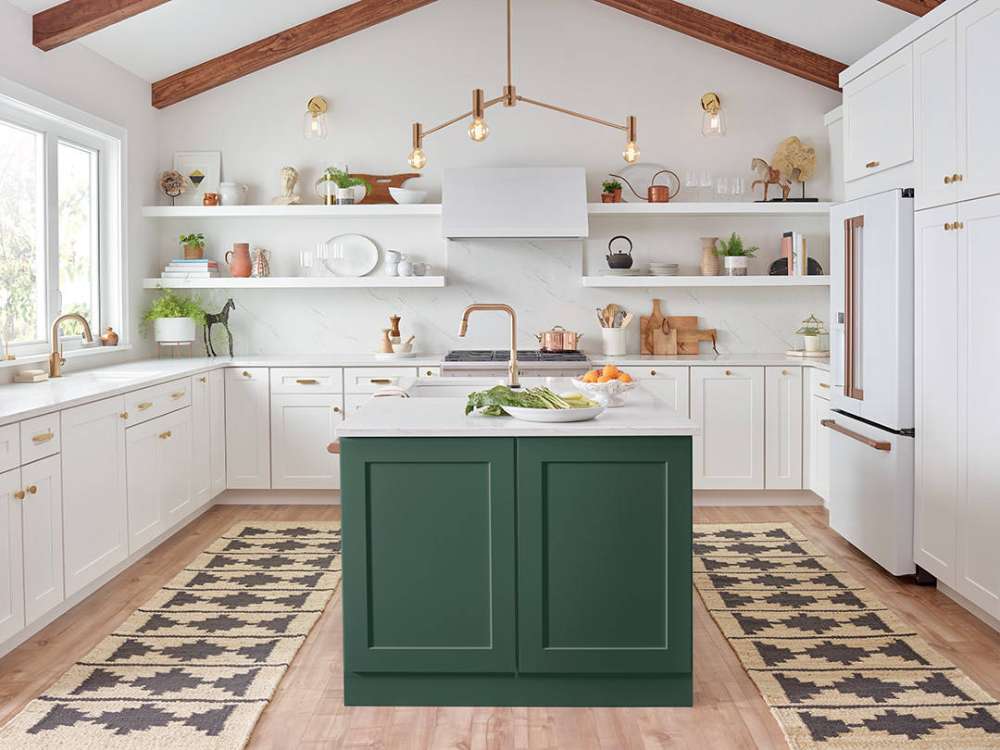
Degrease, sand lightly, prime with a primer in the tone recommended for dark colors, then apply two coats of waterborne enamel with a light sanding between coats.
- Remove doors, drawers and hardware. Painting doors flat gives a self-leveling enamel its best surface.
- Clean off grease and dust, because Farrow & Ball specifies surfaces free of dirt and grease.
- Sand lightly with medium-grit paper to help adhesion. On MDF, sand the edges first to reduce paint absorption.
- Prime in the primer tone recommended for the topcoat, and let it dry completely before sanding (Benjamin Moore’s Advance how-to).
- Sand the primer lightly with fine-grit paper and wipe with a damp cloth.
- Apply the first coat with an angled brush in corners and a foam or microfiber roller on flat areas. Let it dry completely.
- Sand lightly again, wipe, and apply the second coat. On MDF, sand between coats if fibers lift.
- Rehang doors and hardware once dry, and keep the island on light duty while the paint hardens. Benjamin Moore advises waiting at least 24 hours before returning cabinets to service.
Measure before buying. A paint calculator gives the quantity for door fronts, end panels and the toe kick, and two coats plus primer add up.
Most failures trace back to a few causes. Grease left on the doors means the primer cannot bond. Rushed prep, which Young House Love warns leads to scratching and rubbing off in high-traffic areas, causes the same kind of trouble. Raised MDF fibers show as roughness under dark paint, and brush and roller marks are why Benjamin Moore’s extended open time on Advance calls for a light hand on the final coat.
Dark Green Kitchen Island FAQ
How much does a dark green kitchen island cost?
Painting an existing island is the cheapest route, because you pay for primer, enamel and a few days of work. A new island costs the most when it combines custom-finished fronts with a stone countertop, so the countertop often outweighs the color.
Is a painted or stained finish better for a dark green island?
Painted is the better default. It gives an opaque, even green on any material, while a stain shows the grain and works only on solid wood or veneer, where the tone shifts with the species.
Can I use IKEA Sektion boxes with Semihandmade fronts?
Yes. Semihandmade makes custom-finished fronts for Sektion boxes, so the box stays inexpensive and only the visible faces come in green.
Order matching end panels for exposed sides, because an island shows all four faces.
Is a waterfall edge worth it on a dark green island?
It is when the stone is the feature. A light slab running down the sides sets off the green and replaces painted end panels, where chips show most.
If you want the green to dominate, skip it, because the stone covers part of the island.
Which stool finishes suit a dark green island?
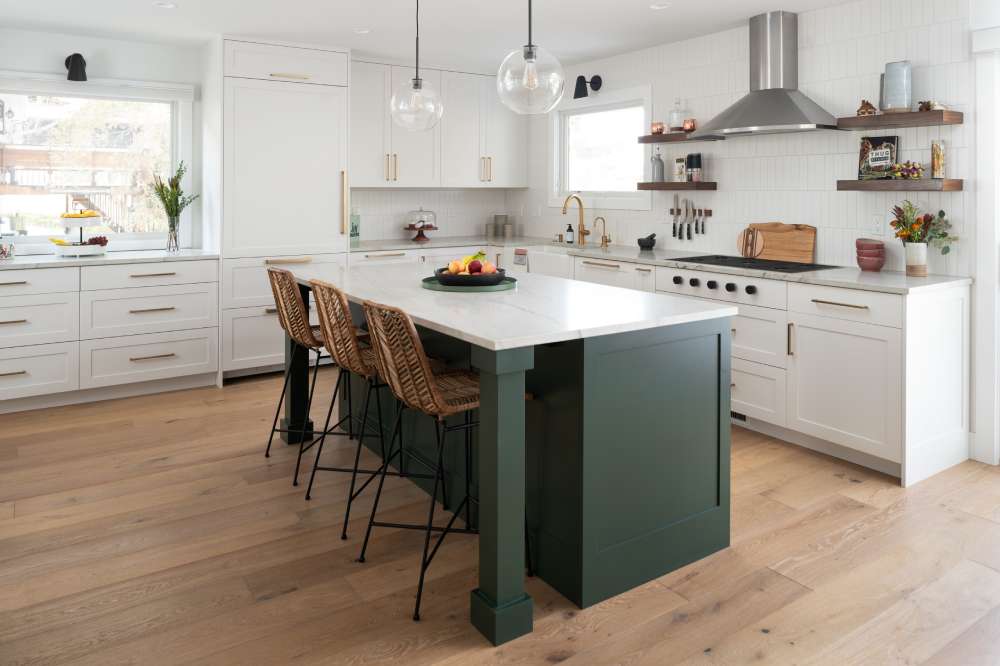
Finishes that echo the hardware work best, such as brass frames, natural wood or rattan. Dark green or black seats merge with the island and lose their outline.
Choosing a Dark Green Kitchen Island in the Right Order
Decide a dark green kitchen island from the costliest, least reversible choice down to the cheapest, and test the shade on a sample board before any cabinet is ordered.
- Island depth and clearances
- Countertop material
- Shade, tested beside the countertop
- Hardware metal
Each choice constrains the next. Stone costs more to replace than paint, and a shade reads true only beside the material it sits against.
The cheapest test is a large painted board set where the island will stand and viewed at morning, noon and evening. One sample pot per shade costs far less than a repaint.
The green follows the countertop, not the reverse. Position verified in October 2026, and a newer edition of NKBA’s guidelines or a local code change would alter the clearance step.
Once the island is settled, colors that go with dark green help set the palette for the adjoining rooms.
More Kitchen Color Guides
- White cabinets and a blue island
- White cabinets with a green island
- White cabinets and a black island
- All kitchen color schemes by cabinet color

- Kitchen Color Schemes by Cabinet Color: What Pairs Well - October 19, 2026
- Curtain Colors for Every Wall Color: Safe vs Bold Picks - October 18, 2026
- Interior Design Styles: Find Your Primary and Secondary - October 14, 2026


