Japanese Interior Design
Japanese Lighting Ideas: Illuminate Your Space with Style

Japanese lighting is low, warm and diffused. The light comes through paper, wood or bamboo, and it almost never comes from the ceiling.
Old rooms relied on small flame-lit sources set near the floor. Modern versions keep the shade and the height and swap the flame for a dimmable LED. The andon, the chochin, the stone toro and Isamu Noguchi’s Akari lamps are where most people start looking.
The shade material gets mislabeled a lot. Washi is not rice paper. It’s bark paper made from kozo, mitsumata or gampi fibers, and UNESCO inscribed hand-made washi on its Intangible Cultural Heritage list in 2014.
The Principles That Define Japanese Lighting

Millennium Gallery, a Japanese lamp retailer, frames the whole approach as low light. The room is dim by Western standards, with light gathered only where something happens. Lamps sit near the floor or on low furniture instead of in the ceiling. And the color leans amber, closer to flame than to daylight.
The position habit comes from the andon, the standard lamp of the Edo period, which stood on the floor or a low stand (Livingetc). Noguchi was drawn to it because it suited a life lived at tatami level.
Rooms use several small sources instead of one bright one. A lamp beside a chair, another on a shelf, one more low in a corner. You end up with pools of light and dark gaps between them.
The primary text behind all of this is Jun’ichiro Tanizaki’s 1933 essay In Praise of Shadows. He describes timber and paper walls, tatami floors, low roofs, and an alcove that gets only indirect garden light through a shoji panel.
Ma, the deliberate empty interval between things, explains why a Japanese room has a few lit spots and long quiet gaps instead of an even wash.
Plain, slightly irregular fixtures follow from the wabi-sabi view that worn, uneven, handmade things carry beauty. A paper shade with visible fibers fits. A polished chrome one does not.
That restraint reaches the fixture count too. One lamp per zone and no decorative clutter, which is how minimalism in the Japanese tradition treats a room.
Dim isn’t really the goal. What matters is control: a low base, a few brighter pools, and shadow left where it falls.
Traditional Japanese Fixtures: Andon, Chochin, Bonbori and Toro

The vocabulary is small. The andon is the fixed paper lamp for interiors, the chochin folds flat and gets hung or carried, the bonbori is the open-topped festival lamp, and the toro is the stone or metal lantern that lives in gardens.
| Fixture | Frame and shade | Traditional setting | Modern use |
|---|---|---|---|
| Andon | Wood frame, washi, oil dish | Indoors, floor or low stand | Floor lamp, bedside light |
| Chochin | Spiral bamboo ribs, paper, folds flat | Hung or carried, entrances, festivals | Pendant, string lights |
| Bonbori | Hexagonal frame, wide open top, paper | Open-air festivals | Floor-standing accent light |
| Toro | Stone, bronze, or metal | Temples, tea gardens, path edges | Garden path marker |
The andon developed in the Edo period (1603-1867) around an oil dish, and kerosene lamps displaced it in the Meiji era, per Millennium Gallery. The chochin’s foldable structure was devised in the Muromachi period and spread among ordinary households in the Edo period, with Gifu the region most tied to its production.
Bonbori echoes Japanese words for faint and dim light. Tea masters adopted stone lanterns as garden pieces in the Azuchi-Momoyama period (1568-1600), according to Japan Objects.
Andon stay low and stay put, while chochin hang. Toro stay outside.
All of them were built around a flame sitting well inside the shade. That spacing is what a modern bulb has to imitate.
How Washi, Shoji Paper and Bamboo Shape the Light

Washi scatters light through a mat of long plant fibers, so the shade glows evenly and the bulb stays hidden. Kozo (paper mulberry) fibers run about 1 cm, which keeps washi strong and flexible even when thin (IFLA).
Kozo is the most common source fiber, with mitsumata and gampi as alternatives. Very thin sheets turn nearly transparent, so paper weight sets how soft the glow reads.
A wood grid holds shoji paper flat, and lamps built on that pattern put paper or fabric behind wooden grids, in pendants, table lamps and wall panels (Fujioh). Akari shades get their skeleton from higo, thin bamboo strips. Ozeki & Co. glues washi over bamboo on wooden molds with rice glue, per the Noguchi Museum.
Fabric and frosted glass still diffuse softly. They just lose the fiber texture that makes paper glow look uneven in a good way.
The translucent shoji screens that divided traditional rooms gave lamp makers their template. A lamp built that way throws a square, even glow instead of a round one.
One caveat on the word washi itself. IFLA notes there’s no clear definition of what can be called washi today, and some versions blend imported kozo or wood pulp.
Shoji-style lamps usually leave the top and bottom open, and a US patent on translucent wood veneer lighting (no. 7090380) explains it. Incandescent bulbs need air circulation, while low-heat LEDs allow a closed top.
Wood, bamboo and paper also sit among the natural materials that run through Japanese interiors. A paper lamp ties into a room of timber and tatami without extra styling.
How Do You Light Each Room in a Japanese Style?
Low warm lamps go where people sit or sleep, wall-washed light goes in hallways, ground-level light goes outdoors, and kitchens get a brighter task layer on top.
| Room | Fixture | Height | Color temperature |
|---|---|---|---|
| Living room | Floor lamp, andon-style light, chochin pendant | Below eye level | 2700K |
| Tatami room | Andon-style floor light | Floor level | 2700K |
| Bedroom | Paper table lamp, indirect light | Bedside or floor | 2700K, dimmable |
| Kitchen | Shoji-style ceiling light plus task lights | Ceiling and under cabinets | 3000K at work zones |
| Dining | Single paper pendant | Low over the table | 2700K |
| Genkan and hallway | Wall washers, sconces | On the wall surface | 2700K to 3000K |
| Garden and engawa | Toro, ground-level lights | At or near ground | 2700K to 3000K |
Living room and tatami room
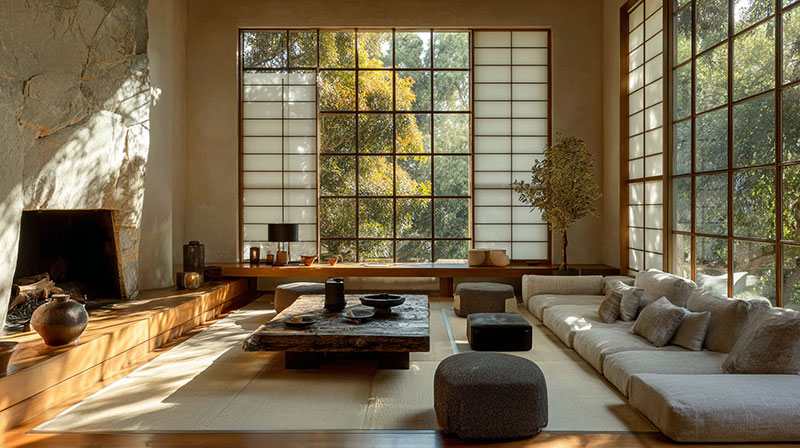
Put a floor lamp or an andon-style light beside the seating. One chochin-style pendant gives the room a center, per Millennium Gallery. Past that, aim for three or more small sources instead of one ceiling fixture.
In a tatami room, set the light at floor level, as the andon was. Sitting height decides everything there.
Tanizaki describes the display alcove as lit only by garden light through a shoji panel. Today, the tokonoma, the display alcove of a traditional room, takes a low-glare accent light aimed at the artwork.
Bedroom
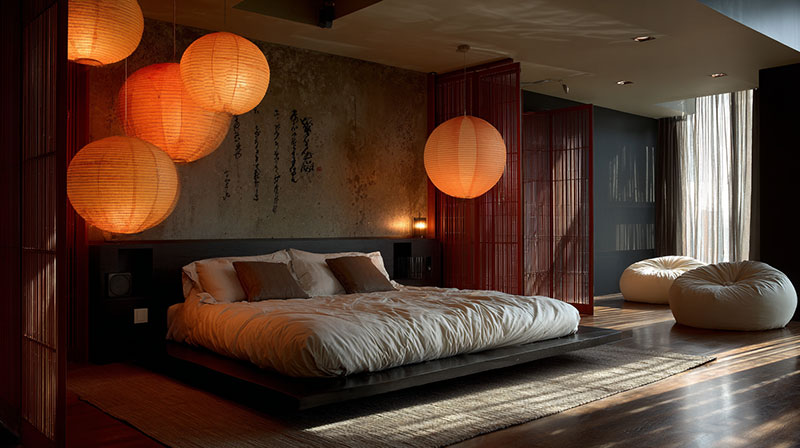
Soft and low wins here.
- Put a paper table lamp at the bedside so the glow stays below the eye line
- Bounced light off a wall beats a bare bulb
- Pick a dimmer, or a bulb that warms as it dims (some LEDs do)
- A separate reading lamp lets the ambient ones stay low
Kitchen and dining

Over the counters and sink, 3000K task lights do the real work, with a shoji-style ceiling panel for even general light. Southern Lights Electric (2026) places 3000K in kitchens and other task areas.
At the table, hang one 2700K paper pendant low. The light pools on the table and the rest of the room recedes.
Genkan and hallway
Wall sconces and washers suit entries and halls, because they lay a warm wash of light across the wall (The Lighting Company).
Light the wall, not the floor. Keep one clear, low light at the step where the floor level changes.
Garden and engawa

Lighting in a Japanese garden is never overhead or direct, according to the North American Japanese Garden Association. Lanterns sit in or on the ground at the start of paths, at bends and junctions, and beside water basins.
Toro mark transitions rather than whole yards. Yukimi-doro, the wide-roofed snow-viewing lantern, goes at the water’s edge. Ikekomi-doro have shafts buried in the ground, so they sit low, and oki-doro are small and movable, set beside stone basins.
That placement logic comes from traditional Japanese garden design, where every lantern marks a moment instead of lighting the yard.
The engawa, the veranda strip between room and garden, is where indoor and outdoor light meet. One low lantern there joins the two.
What Color Temperature and Brightness Suit Japanese-Style Lighting?

Use 2700K to 3000K warm white, a bulb with a color rendering index (CRI) of 80 or higher, and a dimmer. Keep the base brightness low and add brighter pools only where you read, cook, or eat.
JIS Z 9110 (2011 edition) sets living room levels at 50 lx for general use, 200 lx for family gathering and 500 lx for reading. It also calls dimming desirable in living rooms, reception rooms and bedrooms.
On the bulb side, a CRI of 80 is the minimum for ENERGY STAR qualified bulbs (U.S. DOE FEMP, 2026). And 2700K and 3000K land at roughly an incandescent bulb at full brightness and a halogen bulb (Southern Lights Electric, 2026).
Taken together, the sources agree. Millennium Gallery’s low-light principles, Tanizaki’s indirect light, and the JIS gap between 50 lx general and 200 lx gathering all describe a dim base with small brighter pools, not a uniformly dim room.
One caution on the numbers. Published summaries of JIS Z 9110 disagree on bedroom levels, and the standard was revised in 2024, so read the current edition before specifying a figure.
Kelvin sets color and lumens set brightness, and the two don’t move together.
The dim base is the background ambient lighting that carries most of the room. Task and accent lights sit on top of it.
To size the bulbs, use a calculator that works out how many LED lumens a room needs, then dim down from there.
Some LEDs shift warmer as they dim, which suits this look (Downlights.co.uk). Check the bulb’s dim-to-warm label.
Warm, dimmable, high CRI, low in position. Everything else is style.
Isamu Noguchi’s Akari Lamps: History, Models and Authentic Production
Noguchi began designing Akari in 1951, after a visit to Gifu. They’re electric light sculptures of paper and bamboo. He kept the collapsible structure of the chochin and added shaped shades, electric bulbs, and wire bases.
He worked on the series for 37 years and designed more than 200 models (Noguchi Museum, 2026).
Akari is the Japanese word for light, which to Noguchi suggested both illumination and weightlessness. He compared the glow to sun filtered through shoji paper.
The debut was a tea ceremony at the Eames House in 1951. Early models were shown at the Museum of Modern Art, Kamakura in 1952, and an exhibition at the Chuo Koron Gallery in Tokyo followed in 1954.
Ozeki & Co., a family-owned Gifu company founded in 1891, has manufactured the series since 1951. Noguchi also designed the logo, an abstract sun and crescent moon drawn from the kanji for light (Noguchi Museum Shop).
Authorized sales run through the Noguchi Museum Shop in North America and through Vitra in Europe. Buyers in Japan go to Ozeki directly.
| Option | Pros | Cons |
|---|---|---|
| Genuine Akari | Original maker, traceable source, museum-backed catalog | Higher price, some models sold out, partial catalog |
| Akari-inspired lamp | Lower price, easy to find, many shapes | No provenance, paper and ribbing vary by maker, weak resale |
At the Noguchi Museum Shop in 2026, prices start at $175 for the 1P and $195 for the table-scale 1A, and reach $3,000 for the BB3-33S floor lamp. The tall Akari A costs $1,800 and is in stock.
Stock is the catch with the genuine line. Noguchi designed over 200 models, but the shop sells only what remains in production.
The series dates from the early 1950s, so it sits easily in mid-century modern lighting schemes, next to wood furniture and low seating.
How Do You Adapt Japanese Lighting Ideas to a Modern Home?
Fit low-heat LED bulbs to the shades, pair them with a compatible dimmer, and pick a price tier that matches how long the lamp has to last. Then decide whether the room needs one statement lamp or a layered scheme.
LED bulbs and dimmers
ENERGY STAR (2020) says certified bulbs produce about 70 to 90% less heat than incandescents, which is why paper shades suit LEDs.
For dimming, NEMA SSL 7A-2015 (reaffirmed 2021) sets compatibility rules for forward phase-cut dimmers and dimmable LEDs, and DOE’s 2013 phase-cut dimming report recommends a compliant dimmer with compliant lamps.
Compliance does not guarantee smooth dimming. A poor pairing shows up as flicker, pop-on, drop-out, or dead travel on the dial (DOE, 2013).
Brands and price tiers
| Tier | Example | What you get |
|---|---|---|
| Entry | Muji | Plain LED lamps in natural materials |
| Mid-range | Saiko Design | Mino washi pendants on chochin frames |
| Designer | Yamagiwa | Architect and designer collaborations |
Muji USA describes its lighting as soft, balanced light in clean lines and neutral tones. It’s the low-risk start.
Saiko Design, a Gifu studio, builds pendant shades from Mino washi on chochin frames. Yamagiwa, a Tokyo manufacturer founded in 1923, works with international architects and designers.
Akari sits above all of them.
Choosing between one statement lamp and a layered scheme
Start small. One good lamp beats a whole-room rework when the room has a single problem.
One lamp is enough when a flat ceiling light is the only fault, or when one corner or seating spot stays dark.
Go layered if the ceiling fixture is the only source in the room, if the room serves 3 or more activities (dining, reading, TV), or if walls or furniture block light from the one lamp.
A single paper lamp works as an accent light, so it needs plain surroundings. Clutter around it cancels the effect.
Keep the rest of the room to a short minimalist lighting plan: bare surfaces and one or two quiet sources.
How to Build a Shoji-Style Lamp at Home
The build is a wooden grid frame covered in paper and lit by a low-heat LED. Plan on several evenings. In Merritt’s build, the kumiko infill alone took a few evenings after work.
- Design the frame to come apart, so the paper can be replaced later.
- Cut the parts from straight-grained softwood. Clear stock between knots works fine.
- Cut half-lap joints on the frame parts, and mortise and tenon joints where a grid meets the frame.
- Build the grid. Kumiko infill is optional, and a plain square grid works.
- Glue the paper on with water-soluble rice paste. Shoji paper from online retailers works, and so does calligraphy paper from a craft store.
- Add a bulb mount on a board at the top or bottom of the frame.
- Switch it on in a dim room and adjust the bulb height before you call it done.
The water-soluble glue is the detail that matters most, because old paper soaks off cleanly when you replace it. This sequence follows the andon build published by woodworker Greg Merritt on Hillbilly Daiku (2018).
Things go wrong in the usual places. Kumiko stock bows when planed thin, so Merritt cut his from craft sticks. Bulb height changes the light cast more than expected, and Merritt added longer rods to raise the fixtures. Thin paper shows a bright spot at the bulb, per paper maker Works by Shaun (2025).
Test the paper before you commit. A sample sheet over a bare bulb tells you more than any spec.
When Japanese Lighting Ideas Fall Short
Paper-and-wood lighting has real limits. Shades touch hot bulbs, paper ages in sun, damp rooms warp it, and some spaces simply need proper task light.
| Failure | Cause | Fix |
|---|---|---|
| Scorched paper | Hot bulb against or close to the shade | LED bulb, air gap |
| Yellow, brittle paper | Cumulative UV and light exposure | Keep out of direct sun, replace the paper |
| Warped or stained paper | High humidity | Keep to dry rooms |
| Dim work areas | Paper absorbs light, low placement | Add a separate task lamp |
On heat, CPSC’s engineering review of lighting hazards found bulb heat igniting nearby combustibles such as curtains, clothes, and paper. LEDs lower the risk, but ENERGY STAR (2026) notes they shed heat through a heat sink, so keep the paper off the bulb base.
Yellowing is the slow one. The Canadian Conservation Institute (Canada.ca, 2026) finds UV radiation yellows and weakens paper, and that halogen lights emit UV. The damage is cumulative and irreversible, so the only repair is new paper.
Moisture matters too. Relative humidity above 60% accelerates chemical and biological deterioration of paper and distorts it, and the institute recommends staying below 50% for general paper collections (CCI Notes 11/2). Steamy bathrooms and kitchens are where a washi shade is most likely to cross that line.
Brightness is the last limit. A paper shade passes only part of the light, and thin paper lets more through than thick paper (Works by Shaun, 2025).
Skip the low-light rule in kitchens and work areas. Light those with task lamps, and keep the paper lamps for the rest of the room.
Japanese Lighting Ideas FAQ
How is Japandi lighting different from pure Japanese style?
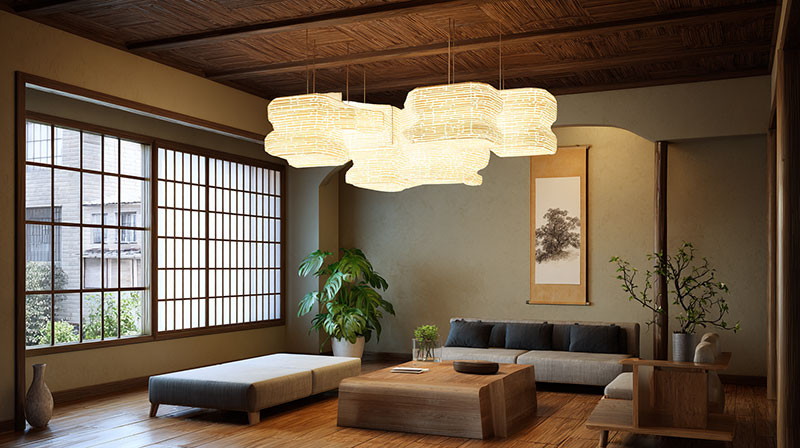
Japandi swaps part of the paper-and-bamboo vocabulary for Scandinavian function. Expect frosted glass or fabric shades, adjustable floor lamps, and dimmable pendants.
The approach is a hybrid of Japanese and Scandinavian interior design. Pure Japanese style stays with washi, bamboo, and low placement.
How do you light a small apartment in a Japanese style?
Use two or three small sources instead of one ceiling light, and get them off the floor. A wall-mounted shoji-style lamp or a hanging chochin pendant frees floor space.
Add a dimmer, so one room can switch between dining, reading, and evening use.
Which colors and finishes go with Japanese lighting?
Neutral tones such as beige, white, and soft earth colors suit it best, as Residence Supply notes. Pair them with light wood and natural fibers.
Keep walls matte. Traditional earth walls were painted neutral so the light would not bounce.
A room color scheme generator can test a palette against your wall and wood tones.
How do you clean or replace the washi paper on a lamp?
Dust it gently and keep it dry, because washi weakens with moisture. Handle the shade with care when moving or installing it.
To replace the paper, soak off the old sheet if it was glued with water-soluble rice paste. Then glue the new sheet on the same way.
What is a kumiko lamp, and how does it differ from a shoji-style lamp?
Think of kumiko as the craft and shoji-style as the shape. Kumiko means fitting thin wood pieces into a decorative lattice. A shoji-style lamp is a frame covered in paper, like a shoji door.
A lamp can be both. Kumiko lattice is the decorative upgrade, and a plain grid works for the basic form.
What to Change First in a Japanese-Style Room
Start with the bulb, not the fixture. In a room adopting Japanese lighting ideas, a warm dimmable bulb in a lamp you already own costs the least and reverses the easiest.
Bulb and dimmer come first, then moving one lamp below eye level. A paper shade comes last. It’s the priciest and most fragile step, and it only makes sense once the first two prove the look works in the room.
The catch is that after the first step the room keeps its shape and only turns warmer. The full effect arrives at the second step, when the light drops.
Verified October 2026, a new bulb that flickers on an old dimmer means replacing the dimmer before buying anything else.
With the light settled, the furniture, materials, and layout of a Japanese-style interior are the natural next step.

- Kitchen Color Schemes by Cabinet Color: What Pairs Well - October 19, 2026
- Curtain Colors for Every Wall Color: Safe vs Bold Picks - October 18, 2026
- Interior Design Styles: Find Your Primary and Secondary - October 14, 2026


