Color Combinations
Colors That Go with Gray Cabinets in Any Kitchen
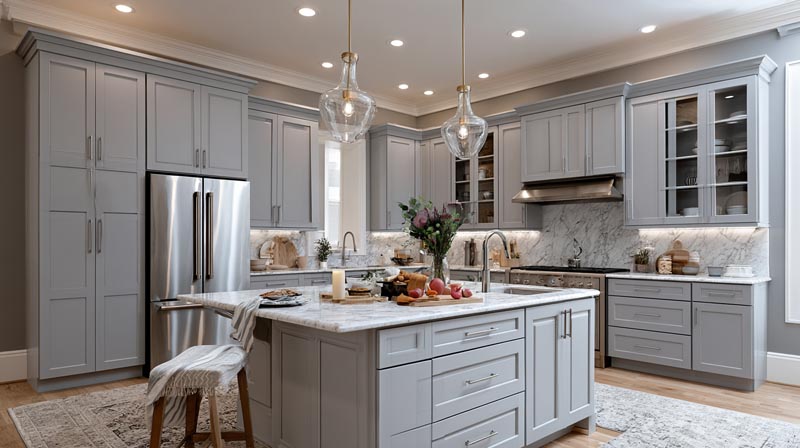
Gray cabinets look right in almost any kitchen, until you pair them with the wrong wall color, countertop, or backsplash.
Choosing colors that go with gray cabinets is not guesswork. It comes down to undertones, contrast, and how each surface in the room interacts with the next.
Get it right and the kitchen feels pulled together. Get it wrong and even quality cabinetry looks flat or mismatched.
This guide covers every pairing decision, from wall paint and countertop color to flooring, hardware, and two-tone accents, so you can build a gray cabinet kitchen color palette that holds together as a complete room.
Our guide to color combinations for every room lines up wood tones and floors with the wall colors that suit them.
What Determines Which Colors Go With Gray Cabinets
Gray cabinet undertone is the single factor that controls every pairing decision in your kitchen. Get this wrong and even an expensive countertop or backsplash will look off.
Gray sits between warm and cool on the color spectrum, but no gray is truly neutral. Every cabinet pulls toward beige, taupe, or brown (warm), or toward blue, green, or purple (cool). That pull is the undertone, and it either clashes with or reinforces the other surfaces in the room.
According to a 2023 Houzz survey of homeowners actively renovating their kitchens, white and gray remain the top 2 cabinet color choices in the U.S., with white at 46% and gray still holding steady at 8% as a primary cabinet color. Gray is also a top pick for kitchen islands, where it serves as a contrast color.
Kitchen cabinet color decisions affect resale value too. The 2025 NAR/NARI Remodeling Impact Report found that kitchen upgrades received a perfect 10 out of 10 Joy Score and ranked as the most in-demand remodeling project among Realtors, cited by 48% of respondents.
Warm Gray vs. Cool Gray: How to Tell the Difference
Warm gray undertones: beige, taupe, brown, or greige. These grays look softer and more organic under natural light. Sherwin-Williams Agreeable Gray and Benjamin Moore Pale Oak are classic examples.
Cool gray undertones: blue, green, or purple. These grays look crisper and more modern. Farrow & Ball Mole’s Breath and Sherwin-Williams Repose Gray lean cool.
The simplest identification method: hold a white piece of paper next to the cabinet in natural light. The undertone becomes obvious against a true neutral. Do this test before buying a single can of wall paint.
Cabinet finish matters too. Matte finishes absorb light and make undertones read softer. Glossy finishes reflect light and make undertones more pronounced, sometimes shifting how a color appears depending on time of day.
Light Gray vs. Dark Gray Cabinet Pairing Rules
Light gray cabinets need contrast to avoid looking washed out. They pair well with darker countertops, bolder wall colors, and strong hardware finishes.
Dark gray cabinets are already heavy in visual weight. They work best with lighter surrounding surfaces. White walls, pale countertops, and light floors prevent the room from closing in.
| Cabinet Tone | Wall Color Range | Countertop Direction | Hardware Finish |
|---|---|---|---|
| Light warm gray | Greige, warm white, sage | Dark or warm wood | Brushed brass, gold |
| Light cool gray | Crisp white, soft blue | White quartz, marble | Brushed nickel, chrome |
| Dark warm gray | Warm white, greige | Light quartz, butcher block | Brass, antique bronze |
| Dark cool gray | White, pale blue-gray | White or light marble | Matte black, chrome |
—
What Wall Colors Go With Gray Cabinets
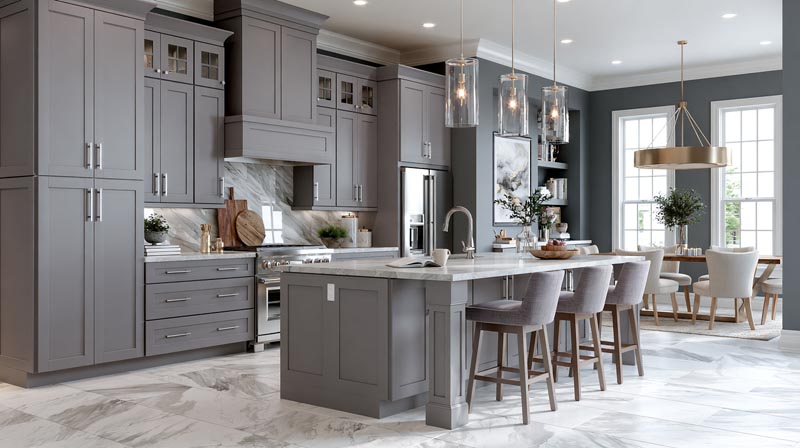
Wall color is the most visible pairing decision in a gray cabinet kitchen. The right choice depends on undertone match, room orientation, and how much contrast you want between the cabinets and surrounding surfaces.
North-facing kitchens receive cooler, bluer light. In these rooms, warm wall colors counterbalance that light. South-facing kitchens get warmer light throughout the day, so cooler wall tones help maintain visual balance (George Cabinetry, 2024).
In 2024, Houzz reported that 86% of homeowners replace their backsplash during a kitchen renovation. Wall color decisions made without considering the backsplash often result in a palette that competes with itself.
White and Off-White Wall Colors
White walls are the most common pairing for gray cabinets. They work across both warm and cool gray tones. The key is matching white temperature to cabinet undertone.
Benjamin Moore Chantilly Lace is a crisp, blue-leaning white. Best with cool gray cabinets.
Benjamin Moore White Dove reads softer and slightly warm. Better with warm gray cabinets.
Stark bright white against warm gray cabinets tends to make the gray look dirty. Most designers reach for off-whites or soft whites rather than pure white in this pairing.
Warm Neutrals: Greige, Beige, and Taupe
Sherwin-Williams Agreeable Gray used as a wall color is one of the most referenced pairings in transitional kitchen design. It works because its own beige undertones echo the warm side of gray cabinet finishes.
According to Main Line Kitchen Design’s 2024 industry analysis, warm neutrals like greige and taupe are overtaking cool-toned walls in kitchen renovation projects, driven by a broader shift away from the blue-gray, white, and black palette that defined the previous decade.
- Greige walls with warm gray shaker cabinets: cohesive, low-contrast
- Taupe walls with medium warm gray cabinets: adds depth without drama
- Warm beige with light gray: softens the cabinet and adds perceived warmth
Avoid pairing warm greige walls with a cool gray cabinet. The undertone clash creates an unresolved, slightly muddy look.
Cool Tones: Soft Blue and Sage Green
Sage green is currently one of the most requested wall colors in gray cabinet kitchens. It works because it shares earthy, muted qualities that align with both warm and transitional gray tones.
The National Kitchen & Bath Association’s 2025 Kitchen Trends Report shows green leading all cabinet and wall color preferences for the second year running, cited by 76% of respondents, with blue close behind at 63%.
Soft blue-gray walls work well with cool gray cabinets because they share the same chromatic direction. The result is a low-contrast, cohesive palette that reads as calm and intentional rather than flat.
Specific paint options that perform well in this category: Sherwin-Williams Sea Salt (a blue-green that bridges both directions), Benjamin Moore Buxton Blue, and Farrow & Ball Mizzle for a muted sage effect.
Dark and Dramatic Wall Options
Navy walls with light gray cabinets create the highest contrast possible in a gray cabinet kitchen. This pairing reads sophisticated and intentional, not accidental. It works best in larger kitchens with strong natural light or high ceilings.
Benjamin Moore Hale Navy and Sherwin-Williams Rookwood Antique Green are both frequently paired with light gray shaker cabinets in transitional and colonial-style kitchens.
Charcoal or near-black walls work with light gray only. Pairing dark walls with dark gray cabinets removes the contrast needed for the cabinets to read as a defined element, and the room loses structure.
—
What Countertop Colors Go With Gray Cabinets
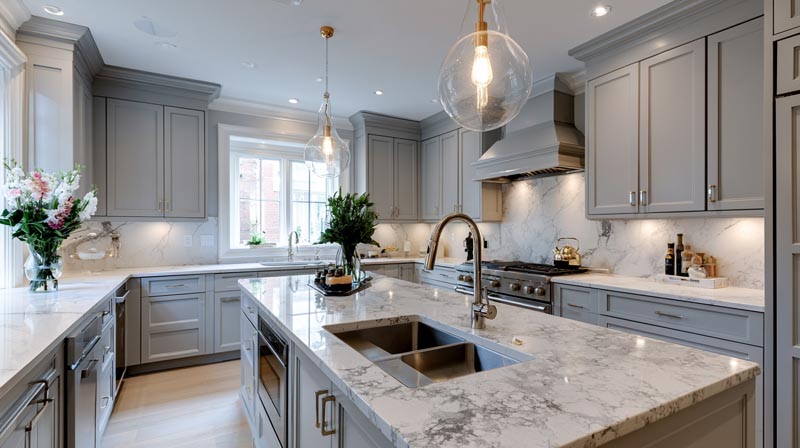
Countertop color has a bigger visual impact than most homeowners expect. It spans the full run of cabinets and sits at eye level when you walk into the room. The wrong choice can make a well-planned cabinet color look flat or mismatched.
Engineered quartz is the dominant countertop material in U.S. kitchens, accounting for roughly 75% of countertop selections as of 2024 (Main Line Kitchen Design industry data). That said, natural stone is gaining ground, particularly Calacatta and Carrara marble in higher-end renovations.
White and Light Countertops
White quartz is the most forgiving countertop choice with gray cabinets. Pure white quartz works best with cool gray cabinets. Veined white quartz, especially Calacatta or Carrara marble patterns with gray veining, connects the two surfaces through shared tonal language.
Carrara marble carries its own cool gray undertone in the veining. Against cool gray cabinets, this creates a cohesive, refined look. Against warm gray, the contrast can feel slightly cold unless warm hardware finishes are introduced.
Light gray countertops paired with gray cabinets require careful value separation. If the cabinet and countertop are too close in lightness and hue, the surfaces merge and the kitchen reads as one undifferentiated plane.
Black and Dark Countertops
Black granite or black quartz creates the sharpest contrast available against light gray cabinets. This is a high-stakes pairing. Done well, it reads as intentional and modern. Done poorly, it can feel harsh.
The rule that holds: light gray cabinets with black countertops need a third element to mediate between them. White subway tile backsplash, warm wood open shelving, or brass hardware all serve this function.
Dark gray cabinets with black countertops remove contrast at the most visible seam in the kitchen. This pairing works only in large kitchens with strong ambient light, or where the backsplash introduces a strong lighter color to separate the two surfaces.
Wood and Warm-Toned Countertops
Butcher block is currently one of the most requested countertop materials in transitional and farmhouse kitchen renovations. It pairs specifically well with warm gray cabinets because the wood’s natural brown and orange tones echo the cabinet’s beige and taupe undertones.
Wood-grain quartz (engineered quartz that mimics wood texture) offers the same warm pairing with the durability of a stone surface. This is the choice many designers make when clients want the warm gray plus wood look without maintenance concerns.
| Countertop Color | Best Cabinet Match | Avoid With |
|---|---|---|
| White quartz | Cool or light gray | Dark gray (too much contrast) |
| Calacatta/Carrara marble | Cool gray | Very warm gray |
| Black granite or quartz | Light gray | Dark gray (no contrast) |
| Butcher block | Warm gray | Cool gray |
| Concrete | Industrial or flat gray | Very warm gray |
—
What Backsplash Colors Go With Gray Cabinets
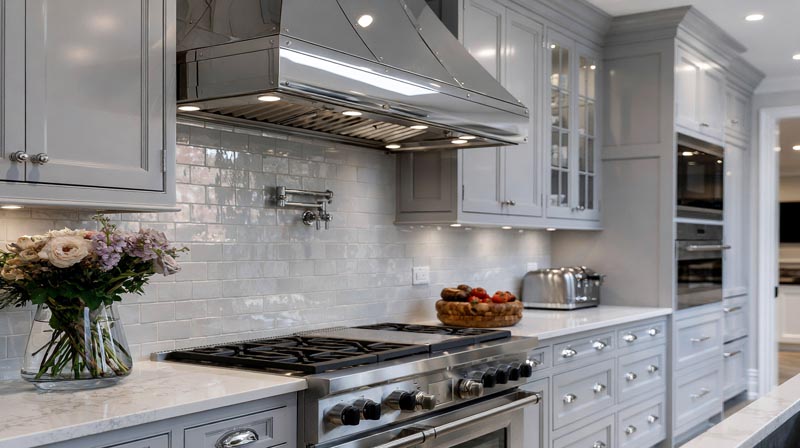
Backsplash decisions in a gray cabinet kitchen involve 3 variables at once: tile color, material, and grout. Each one shifts the pairing outcome. A white tile with dark gray grout reads completely differently than the same white tile with white grout.
The 2024 Houzz Kitchen Trends Study found that 86% of renovating homeowners replace their backsplash during a kitchen project. Ceramic or porcelain tile is the most popular material at 54%, followed by engineered quartz at 11% and natural stone (marble, quartzite, granite) at roughly 19% combined.
Neutral and White Backsplash Options
White subway tile is the most common backsplash pairing for gray cabinets. The outcome depends entirely on grout color.
- White grout: seamless, soft, nearly disappears against the tile
- Gray grout: defines each tile, creates grid-like visual texture
- Charcoal grout: adds contrast and a more graphic, modern look
Matching grout to the cabinet undertone is underused. Warm gray cabinets with a warm beige grout on white tile creates a more cohesive feel than cool-toned gray grout on the same tile.
Mirrored and metallic backsplash options reflect light rather than absorb it. In kitchens with limited natural light, this is a functional advantage alongside light gray cabinets.
Colored Tile Pairings by Undertone
Zellige tile and handmade ceramic tiles have increased significantly in kitchen renovation projects since 2022. Their irregular surface and color variation create movement that flat subway tile cannot.
Cool gray cabinets pair well with blue, teal, or blue-green zellige. The shared cool chromatic direction creates a cohesive, spa-like palette.
Warm gray cabinets pair better with terracotta, warm cream, or sage green handmade tile. The earthy tones in these tiles echo the beige and taupe undertones in warm gray.
Grout color in colored tile installations carries extra weight. A very dark grout on patterned tile competes with both the tile and the cabinet. Most designers recommend a grout that sits one value step lighter or darker than the tile, not two.
—
What Floor Colors Go With Gray Cabinets
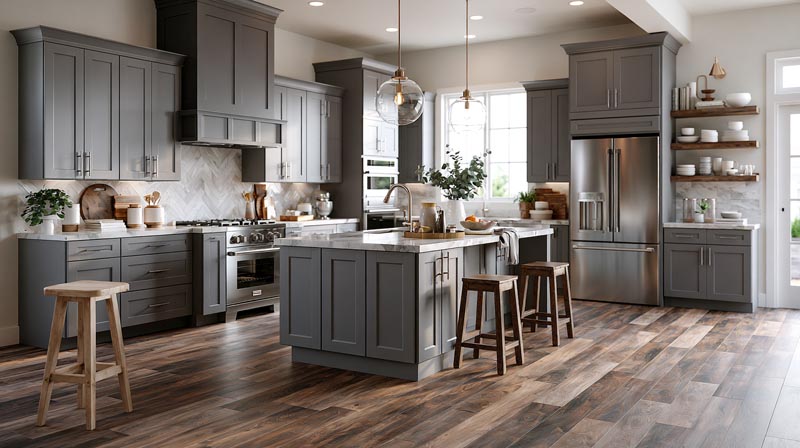
Floor color affects gray cabinets from below, creating either a grounded, high-contrast base or a tonally unified plane. The most common mistake is matching the floor too closely to the cabinet, which removes the visual separation between the two largest surfaces in the kitchen.
According to the 2024 Houzz Kitchen Trends Study, wood or wood-look flooring remains the dominant choice in kitchen renovations. LVP (luxury vinyl plank) with wood-grain finishes has largely replaced traditional hardwood in many renovation budgets, offering similar visual warmth at lower cost.
Wood and Warm-Toned Floors
Light white oak flooring is one of the strongest pairings for warm gray cabinets. The natural honey and beige tones in white oak echo the cabinet undertone, creating a unified palette without monotony.
Dark walnut or espresso floors work specifically with light gray cabinets. The high contrast between the dark floor and the light cabinet creates clear visual separation. This pairing breaks down with dark gray cabinets because the floor and cabinet merge in value.
Avoid matching medium brown floors to medium warm gray cabinets. When the floor and cabinet sit too close in lightness and warmth, the room reads as a single, undifferentiated neutral plane. Contrast, even subtle contrast, is required.
Tile and Hard Surface Floors
Light gray tile creates a monochromatic effect with gray cabinets. This works in contemporary or minimalist kitchens where the intent is tonal cohesion. It fails in smaller kitchens where the lack of contrast makes the floor, cabinets, and walls read as one flat surface.
Warm beige LVP is currently the most versatile floor choice in gray cabinet kitchens. It introduces warmth without committing to a specific wood species. It pairs with both warm and transitional gray tones, and it anchors the room without competing with the cabinets or countertop.
Concrete-look tile floors pair well with flat or industrial gray cabinets. The shared material language between concrete flooring and flat-panel gray cabinetry creates a consistent, modern aesthetic. This pairing requires warm accents (wood, brass, textile) to prevent the room from feeling cold.
—
What Hardware Finishes Work With Gray Cabinets
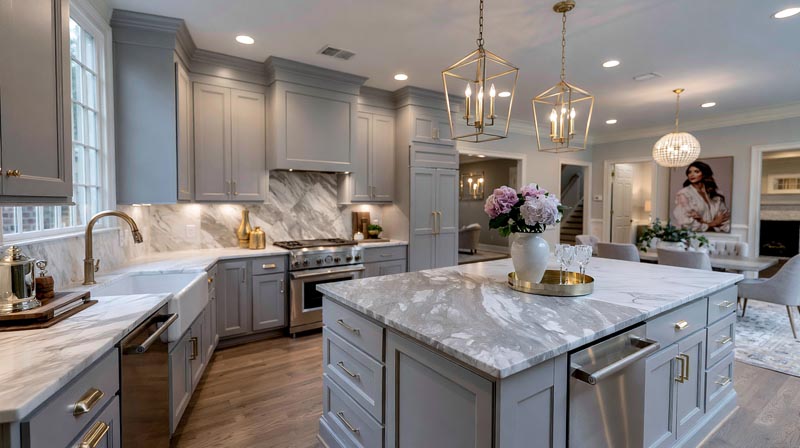
Hardware is the connective layer between gray cabinets, wall color, countertop, and backsplash. The finish you choose either ties the palette together or creates a disconnected room where every element competes for attention.
Two-tone cabinet designs gained strong traction through 2023 and 2024, according to Elite Cabinet Designs. This trend directly increased demand for hardware that bridges 2 different cabinet colors. The same principle applies to single-color gray kitchens where hardware must connect the cabinet to the surrounding palette.
Warm Hardware Finishes for Gray Cabinets
Brushed brass is the hardware finish most associated with warm gray kitchens. It works because the gold tones in brass echo the beige and taupe undertones in warm gray cabinets.
Specific pairings that work consistently: warm gray shaker cabinets with brushed brass bin pulls, white oak floors, and a white quartz countertop with beige veining. This is the transitional kitchen combination that defined a large share of U.S. kitchen renovations from 2022 to 2024.
Unlacquered brass (which patinas over time) adds a more organic, less polished look. It works in farmhouse and eclectic kitchens with warm gray cabinets. Polished brass reads more formal, better suited to traditional or Art Deco kitchen styles.
Cool and Contrast Hardware Finishes
Matte black hardware creates the strongest contrast against light gray cabinets. It reads modern and graphic. It pairs specifically with cool or neutral gray, not warm gray, where it can look disconnected.
Brushed nickel and chrome are the natural matches for cool gray cabinets. They share the same blue-silver chromatic direction. Polished chrome is sharper and more contemporary. Brushed nickel reads softer and more transitional.
The general rule for mixed metals: limit to 2 finishes in the same kitchen. A warm gray kitchen with brushed brass hardware can include brushed nickel in the faucet without conflict, because brass and nickel sit close enough on the warm-to-cool spectrum. Brass and matte black in the same kitchen requires a deliberate design intention to work.
—
What Accent Colors Go With Gray Cabinets in an Island or Lower Cabinet
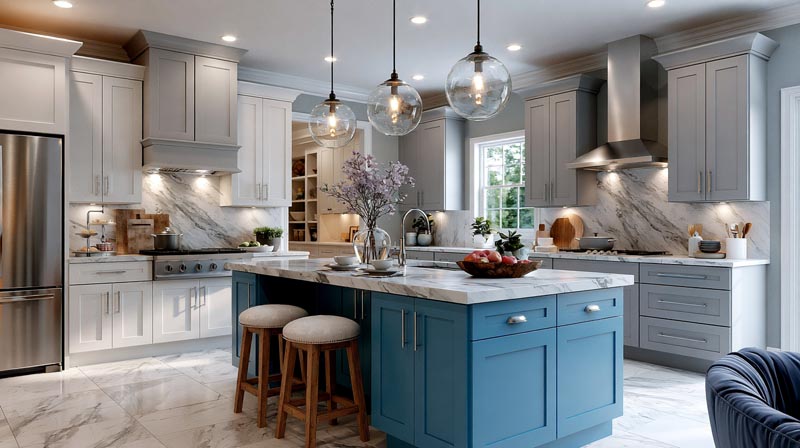
Two-tone cabinet design is one of the most requested finishes in kitchen renovations right now. The island or lower cabinet becomes the color anchor, and the gray upper or perimeter cabinets serve as the neutral backdrop.
According to the 2024 Houzz Kitchen Trends Study, blue remains a top pick for island cabinets that differ from the main cabinets, cited by 25% of renovating homeowners. Green for contrasting island cabinets jumped from 5% to 10% year over year in the same study.
Navy and Deep Blue Accents
Navy blue is the most established island color in two-tone gray cabinet kitchens. Benjamin Moore Hale Navy is referenced more than almost any other color in this specific application.
Navy works against gray because it shares the cool undertone direction while adding significant depth and richness. Light gray perimeter cabinets with a navy island, white quartz countertop, and polished nickel hardware is a combination that appears across transitional and coastal kitchen design at every price point.
The pairing fails when the gray perimeter cabinets are warm-toned. Warm gray plus navy creates an undertone conflict at the island seam that reads as a design error rather than intention.
Green Accents
Forest green lower cabinets with light gray uppers are a more recent two-tone combination, driven by the broader green cabinet trend that has dominated kitchen design since 2022. Sherwin-Williams Rookwood Antique Green and Sherwin-Williams Foxhall Green are 2 of the most cited options in this pairing.
Green island and lower cabinets work with both warm and cool gray perimeter cabinets because green sits between warm and cool on the color spectrum. Warm gray plus an earthy olive green reads organic and grounded. Cool gray plus a saturated forest green reads more graphic and modern.
Wood and Natural Finish Accents
Natural wood base cabinets or island faces are increasingly chosen as an alternative to painted lower cabinets. The combination of painted gray upper cabinets and a wood lower cabinet or island became a major kitchen trend in 2023 and continues through 2025.
Light oak and white oak are the most common wood tones in this pairing against gray uppers. They introduce warmth without the commitment of a bold paint color, and they align with the broader move toward natural materials that the NKBA highlighted in its 2025 trends report.
White lower cabinets remain valid as a high-contrast classic pairing with gray uppers. This is a safer, more timeless option. The two-tone reads clean and structured, particularly in farmhouse and transitional kitchens.
What Colors to Avoid With Gray Cabinets
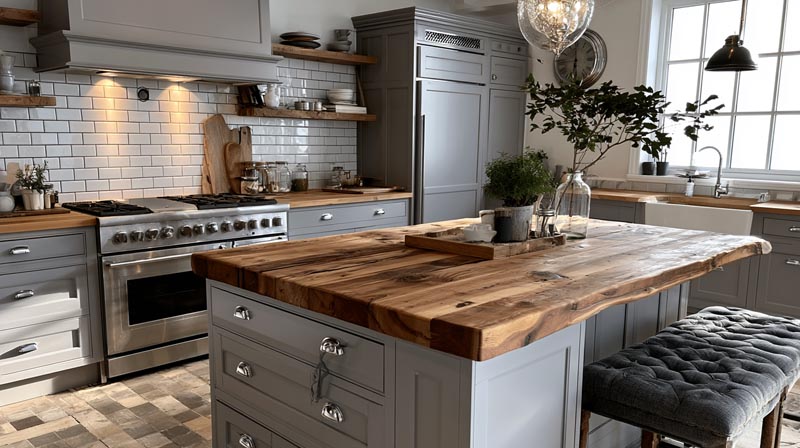
Most gray cabinet color mistakes come from undertone conflict. Two surfaces that each look neutral individually can clash badly when placed side by side because they pull in opposite chromatic directions.
Gray cabinets dropped from 21% to 19% in the 2024 UK Houzz Kitchen Trends Study, with design experts attributing part of that decline to homeowners struggling with color pairing. Getting it wrong is easy. The fixes below are specific.
Undertone Conflicts That Read as Errors
Warm yellow-toned walls with cool gray cabinets. This is the most common mistake. Yellow and orange undertones in a wall color fight directly against the blue or green lean in cool gray. The result looks unresolved rather than intentional.
Bright cool white walls with warm gray cabinets create the opposite problem. The stark white makes warm gray read as dirty or faded rather than soft and intentional.
The rule holds in both directions: warm gray needs warm surroundings, cool gray needs cool or neutral surroundings. Mixing undertone temperature across surfaces is where most gray kitchen palettes fall apart.
Surface Matching That Removes Contrast
Matching gray floors to gray cabinets is a structural mistake, not just a style preference. When the floor and cabinet are the same value and hue, the room loses its visual anchoring and reads as a flat, formless space.
Some specific pairings that cause this problem:
- Medium gray LVP floor with medium gray shaker cabinets
- Gray tile floor with gray flat-panel cabinets and gray countertop
- Gray-painted island against gray perimeter cabinets at the same value
Value separation, meaning a clear difference in lightness between surfaces, is necessary even within a monochromatic gray palette. If all surfaces are the same gray, nothing reads as a cabinet, a floor, or a wall.
Color Overload Across Multiple Surfaces
Bold wall color plus a patterned backsplash plus a colorful island accent all in the same kitchen creates a room with no resting point for the eye. Gray cabinets are neutral enough to work with any of these elements individually. They cannot absorb all of them at once.
The general ceiling: one bold color element per gray kitchen. Navy island, neutral walls and backsplash. Sage green walls, simple white subway tile, standard gray perimeter cabinets. The moment a second bold color appears, the gray stops functioning as a neutral and starts competing.
Beige countertops paired with warm gray cabinets are worth flagging separately. Warm beige and warm gray sit so close together in temperature and value that neither reads clearly. The result is a palette that feels neither deliberate nor cohesive, just murky. Introduce contrast at the countertop level, even subtle contrast, to prevent this.
—
Gray Cabinet Color Palettes by Kitchen Style
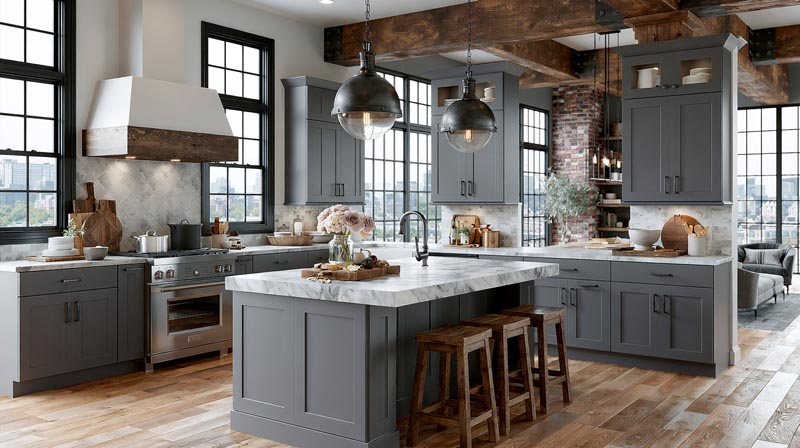
Gray cabinet pairings shift significantly by kitchen style. The same medium gray shaker cabinet works in a modern farmhouse and a contemporary kitchen, but the wall color, countertop material, hardware finish, and backsplash tile that surround it will be completely different in each case.
According to the 2024 Houzz Kitchen Trends Study, 26% of renovating homeowners chose a transitional style after renovation, making it the most popular post-renovation kitchen style in the U.S. Transitional kitchens are the most common context for gray cabinets, which explains why transitional pairings dominate design references for this cabinet color.
| Style | Cabinet Gray | Wall Color | Hardware | Floor |
|---|---|---|---|---|
| Modern farmhouse | Warm gray shaker | Warm white | Brushed brass | Light white oak |
| Contemporary | Dark cool gray flat-panel | White or pale gray | Matte black | Concrete or gray tile |
| Transitional | Medium gray shaker | Greige or soft white | Brushed nickel | Warm beige LVP |
| Coastal | Light gray shaker | Soft blue or white | Polished nickel | Light oak or white tile |
| Industrial | Flat or charcoal gray | Dark charcoal or brick | Matte black | Concrete or dark tile |
Modern Farmhouse Palette
Warm gray shaker cabinets are the default cabinet choice in modern farmhouse kitchens. Sherwin-Williams Agreeable Gray appears more frequently in this specific application than almost any other finish.
Core palette: warm gray shakers, warm white walls (Benjamin Moore White Dove or similar), brushed brass hardware, white quartz countertop with warm veining, light white oak floors, white subway tile backsplash with warm grout.
The farmhouse kitchen depends on warmth and texture over contrast. Shiplap accent walls, open wood shelving, and apron-front sinks all reinforce the palette without adding new colors.
Contemporary Palette
Contemporary kitchens use gray as a vehicle for contrast and structure. Dark gray flat-panel cabinets with white quartz countertop and matte black hardware is the definitive contemporary gray kitchen combination.
Farrow & Ball Mole’s Breath on flat-panel cabinetry, paired with Calacatta marble countertop and integrated matte black pulls, represents the high end of this palette. The same structure works at lower price points with dark gray painted MDF doors and engineered quartz.
Concrete-look tile floors, under-cabinet LED strips, and a minimal backsplash (full-slab quartz that extends from counter to hood) complete the contemporary interior design color language.
Coastal and Transitional Palettes
Coastal gray palette: light gray shakers, soft blue or white walls, polished nickel hardware, white quartz or Carrara marble countertop, white subway tile or zellige backsplash, light oak or white tile floor.
The coastal version of a gray kitchen leans toward Benjamin Moore Revere Pewter or similar putty grays with cool undertones. Interior designer Emily Ruff used this approach in a Seattle-area project, pairing Benjamin Moore Revere Pewter cabinets with wood tone accents to keep the scheme warm rather than cold (Homes & Gardens, 2024).
Transitional gray palette: medium warm gray shakers, greige walls, brushed nickel hardware, white or cream quartz countertop, neutral backsplash tile, warm beige LVP flooring. This is the most commercially successful and resale-friendly gray kitchen combination available.
—
Gray Cabinet Color Combinations for Small vs. Large Kitchens
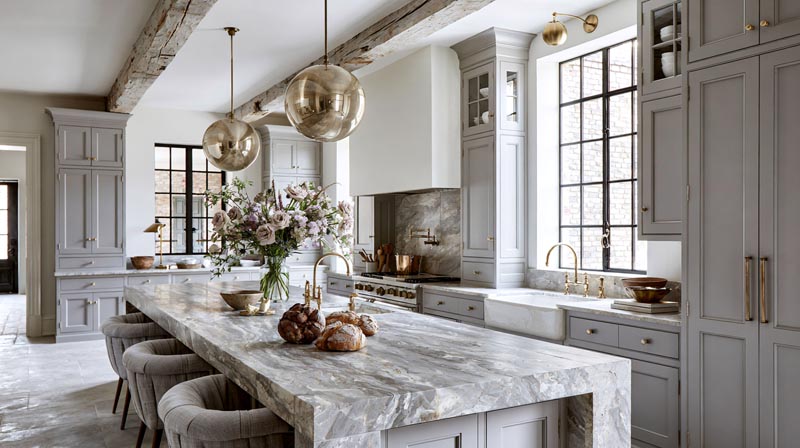
Space size changes which gray cabinet pairings work. A color combination that reads as balanced and sophisticated in a large open kitchen can feel heavy, closed, and dark in a smaller one. The same rules do not apply to both contexts.
Livingetc design research (2024) notes that receding colors, those that lean cool rather than warm, create a perception of depth and expanded space. Cool-toned light gray cabinets are among the most effective for making compact kitchens feel larger, particularly when the wall color and countertop stay light.
Color Strategy for Small Kitchens With Gray Cabinets
Light gray cabinets plus white or warm white walls is the most reliable combination for keeping a small kitchen feeling open. The key is avoiding dark or heavy elements at multiple levels simultaneously.
Specific combinations that work in compact spaces:
- Light gray cabinets, white walls, white quartz countertop, light oak LVP floor
- Light gray cabinets, soft blue-gray walls, white backsplash tile, warm beige floor
- Gray and white two-tone (gray lowers, white uppers) to draw the eye upward
Reflective surfaces help. Glossy backsplash tile, mirrored or metallic backsplash panels, and under-cabinet lighting all increase perceived brightness in small gray kitchens without changing the color palette.
Dark countertops plus dark floors together in a small kitchen with gray cabinets is the pairing to avoid. The visual weight at both the top and bottom of the cabinet run makes the space feel compressed, regardless of the cabinet color.
Color Strategy for Large Kitchens With Gray Cabinets
Larger kitchens tolerate and actually benefit from deeper, bolder pairings that would overwhelm a compact space. Dark gray cabinets with navy walls, a dark stone countertop, and dark wood floors can all coexist in a kitchen with high ceilings and ample natural light.
The 2024 Houzz Kitchen Trends Study found that more than 2 in 5 homeowners opted for islands that are 7 feet or longer, up 10 points since 2020. Large kitchens with extended islands are the primary context where dark gray cabinet palettes thrive, because the island provides a horizontal break that prevents the room from reading as uniformly dark.
Best ceiling color choice in large kitchens with dark gray cabinets: white or near-white ceiling without exception. A dark ceiling plus dark gray cabinets in even a large kitchen reduces the room’s perceived height and removes the vertical breathing room the space needs.
For large kitchens with light gray cabinets, bolder accents become viable. Forest green island against light gray perimeter cabinets, terracotta zellige backsplash, or deep navy accent wall all work in rooms with enough volume to absorb the color without it dominating. These pairings also connect well to the broader principles of color in interior design, where scale and proportion determine how intensely any hue reads in a given space.
FAQ on Colors That Go With Gray Cabinets
What wall colors go best with gray cabinets?
White, greige, soft blue, and sage green are the strongest wall color options. Match the wall undertone to the cabinet undertone. Warm gray needs warm walls. Cool gray pairs with crisp white or muted blue-gray. Contrast matters more than coordination.
What countertop color goes with gray cabinets?
White quartz works with nearly every gray tone. For warm gray cabinets, butcher block or veined quartz with beige tones adds cohesion. For cool gray, Calacatta or Carrara marble with gray veining reinforces the undertone direction cleanly.
Does white go with gray cabinets?
Yes, but undertone match determines the result. Crisp white suits cool gray cabinets. Warm white or off-white suits warm gray. Pairing stark white with warm gray makes the cabinets read as dirty rather than soft.
What hardware finish works with gray kitchen cabinets?
Brushed brass pairs with warm gray. Matte black suits light cool gray for contrast. Brushed nickel and chrome align with cool gray undertones. Avoid mixing more than two metal finishes in the same kitchen color scheme.
What backsplash goes with gray cabinets?
White subway tile is the most versatile option. Grout color shifts the result significantly. For cool gray, blue or green zellige tile works well. For warm gray, terracotta or cream handmade tile echoes the cabinet’s beige undertones naturally.
What floor color goes with gray cabinets?
Light white oak floors pair well with warm gray. Dark walnut suits light gray cabinets through contrast. Warm beige LVP works across both warm and transitional gray tones. Avoid matching floor and cabinet gray too closely, it removes necessary separation.
Do gray cabinets go with navy blue?
Yes. Navy pairs specifically with cool or neutral gray, used as an island accent or wall color. It fails against warm gray because the undertones conflict. Light gray perimeter cabinets with a navy kitchen island is one of the most established two-tone combinations.
What accent colors go with gray kitchen cabinets?
Forest green, navy blue, and warm wood tones are the strongest accent colors for gray cabinet kitchens. These work as island colors, lower cabinet finishes, or open shelving. Limit bold accent colors to one surface to keep gray functioning as a neutral backdrop.
Do gray cabinets go with wood floors?
Yes. Light oak and white oak pair with warm gray through shared undertones. Dark walnut pairs with light gray through contrast. Avoid medium brown floors against medium warm gray, the two surfaces merge in value and the room loses visual structure.
What colors should you avoid with gray cabinets?
Avoid yellow-toned walls with cool gray cabinets. Avoid matching gray floors to gray cabinets. Avoid stark white with warm gray. Beige countertops against warm gray create a murky, low-contrast result. Undertone conflict between surfaces is the root cause of most gray cabinet color mistakes.
Conclusion
This conclusion is for an article presenting the full range of colors that go with gray cabinets, from wall paint and countertop finishes to backsplash tile, flooring, and hardware.
Every pairing decision connects back to one thing: undertone.
Warm gray cabinet color combinations need warm surroundings. Cool gray kitchen palettes need cool or neutral ones. Ignore that rule and no amount of quality material or careful budgeting fixes the result.
The good news is that gray cabinet color schemes are among the most adaptable in kitchen design. Whether you’re working with a light gray shaker, a dark charcoal flat-panel, or a two-tone kitchen layout, the right wall color, countertop, and hardware finish exist for your specific room.
Start with the undertone. Build everything else from there.

- Kitchen Color Schemes by Cabinet Color: What Pairs Well - October 19, 2026
- Curtain Colors for Every Wall Color: Safe vs Bold Picks - October 18, 2026
- Interior Design Styles: Find Your Primary and Secondary - October 14, 2026