Color Combinations
What Color Walls Go with Light Wood Floors
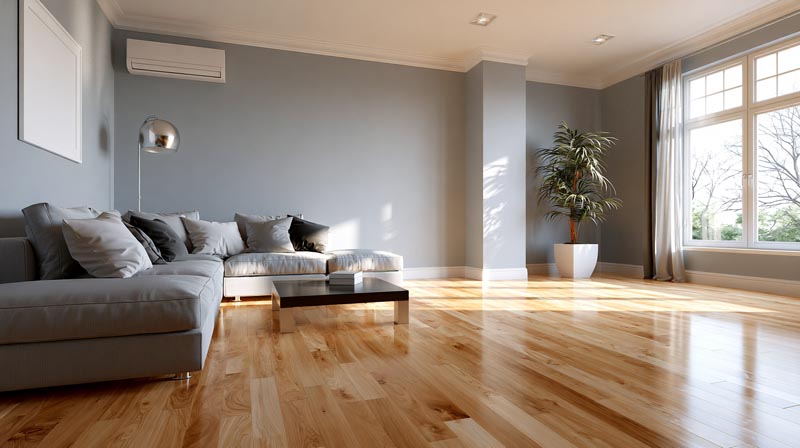
The wrong wall color doesn’t just clash with light wood floors. It makes the entire room look like a mistake.
Knowing what color walls go with light wood floors comes down to one thing most homeowners skip: undertone matching. Honey oak, ash, maple, and birch all sit in the light range, but each pulls a different undertone that changes everything about your paint choice.
Get it right and the floor anchors the room. Get it wrong and even a good paint color looks muddy, washed out, or accidental.
This guide covers the best wall colors by floor species and undertone, what to avoid, how natural light changes your options, and which colors work room by room.
Our handbook for combining colors at home lines up wood tones and floors with the wall colors that suit them.
What Counts as Light Wood Floors?
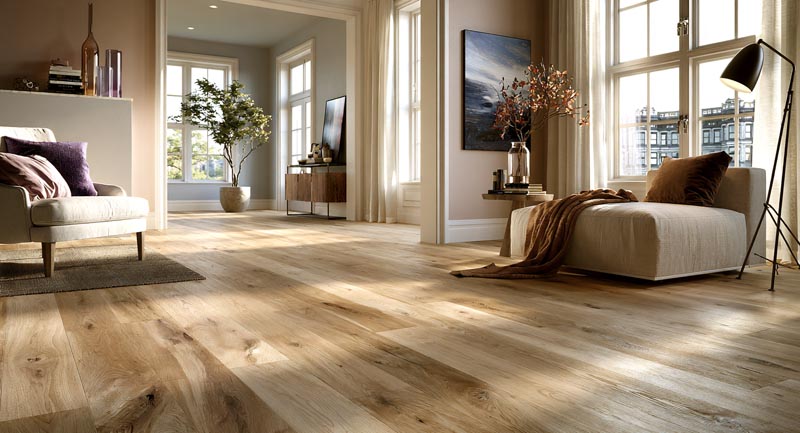
Light wood floors cover a specific tone range, and that range matters before you pick a single paint color. The term applies to honey oak, natural maple, ash, birch, and light pine. Each one has a different undertone, and that undertone drives every wall color decision.
Blonde and honey-toned woods, along with whitewashed finishes, have grown steadily in popularity for their ability to make spaces feel larger and brighter (VANTIA Luxury Hardwood Flooring, 2024).
The 4 main undertone types found in light wood floors are:
- Yellow undertones – common in honey oak and light pine
- Pink undertones – present in natural maple and some birch
- Gray undertones – typical in ash and whitewashed floors
- Neutral/greige undertones – found in white oak and some engineered hardwood
Two floors can both be called “light wood” and still need completely different wall colors. A honey oak floor pulls warm yellow, while an ash floor pulls cool gray. Treating them the same is the most common mistake homeowners make.
According to 50Floor’s 2024 homeowner survey, over 76% of homeowners prefer classic floor colors for their longevity. Light, natural-looking floors were among the fastest-growing choices in 2023 and 2024.
White oak sits in a separate category worth noting. It has a neutral to greige base with very little yellow or pink, which makes it one of the most flexible light wood floors to pair with wall colors.
What Wall Colors Work Best With Light Wood Floors?
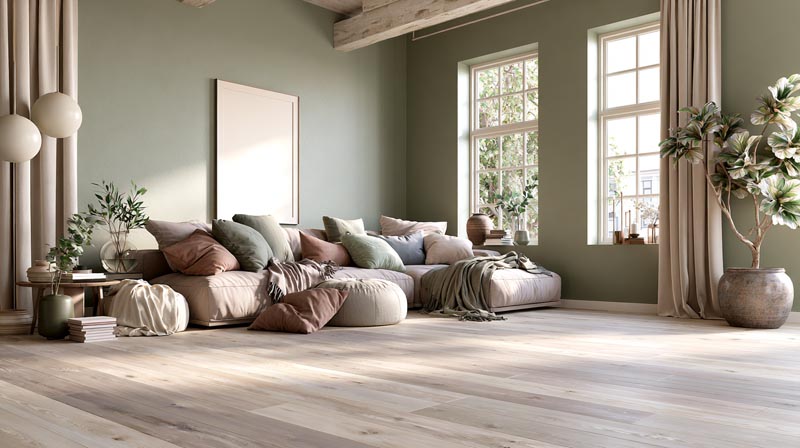
Warm whites, greige, sage green, dusty blue, terracotta, and dark accent tones are the 6 wall color categories that pair most reliably with light wood floors. Each works for a different reason based on floor undertone, room size, and light direction.
A Fixr.com 2024 survey of 71 interior design professionals found that 48% named warm white as the most popular interior paint color, followed by earthy tones at 46%. Both categories work directly with light wood floors.
White and Off-White Walls
Pure white works, but it needs to be the right white. A bright cool white next to a yellow-undertone oak floor makes the floor look dingy and cheap. Warm whites fix this.
Best picks:
- Benjamin Moore Chantilly Lace (LRV 92) for bright, clean rooms with ash or white oak
- Sherwin-Williams Greek Villa (LRV 84) for a warm off-white that reads cozy with honey oak
- Benjamin Moore Soft Chamois (LRV 77) for a greige-leaning off-white that works with most light floors
Paint colors with an LRV above 70 reflect the most light back into the room and work especially well alongside light floors that already brighten a space (Welsh Design Studio).
Warm Greige and Taupe Walls
Greige is arguably the most reliable wall color for light wood floors. It bridges warm and cool, avoids clashing with yellow undertones, and reads as sophisticated in every style from transitional to farmhouse.
Top options used by designers in 2024:
- Sherwin-Williams Agreeable Gray (SW 7029)
- Benjamin Moore Revere Pewter, particularly strong with woods that blend yellow and orange tones
- Benjamin Moore Edgecomb Gray for rooms needing a lighter, softer greige
Revere Pewter’s muddy undertone often complements lighter woods better than the cleaner Agreeable Gray, especially when the floor has a blend of yellow and orange tones.
Sage and Muted Green Walls
Green on walls next to light wood floors is a natural pairing. The color theory is simple: green pulls from the organic tones of wood and sits in the same earthy palette.
36% of design experts surveyed by Fixr.com in 2024 named shades of green as the most popular wall color category, citing their connection to nature and calming effect.
What works: Soft, muted sage (Sherwin-Williams Rainwashed SW 6211, Benjamin Moore Sage Wisdom CSP-775). Desaturated and slightly gray-green reads well against both yellow-toned oak and cooler ash floors.
What doesn’t: Saturated bright greens with high chroma. They compete with the warmth of the wood instead of supporting it.
Dusty Blue and Slate Walls
Blue is the second most popular interior color after neutrals, according to Fixr.com 2024. With light wood floors, the key is choosing blue with low saturation and a warm or gray base.
Benjamin Moore Smoke pairs well with light oak tones and sits at an LRV of 56. Sherwin-Williams Sea Salt (LRV 63) pulls green-blue and works in coastal or Scandinavian-inspired spaces with ash or white oak floors.
Avoid cool, bright blues with yellow-undertone floors like honey oak. The contrast between warm wood and icy blue reads as a mismatch rather than intentional contrast.
Terracotta and Blush Walls
15% of interior design experts surveyed by Fixr.com in 2024 named light terracotta and clay as one of the most popular interior colors. Against light wood floors, it creates warmth without competing.
Terracotta works best with:
- Yellow-undertone floors like honey oak (shared warm base)
- Rooms with south or west-facing light
- Spaces styled in earthy, eclectic, or bohemian palettes
Blush pulls similarly to terracotta but lands softer. It reads well with maple floors that carry a pink undertone, since both sit in the same warm-pink range.
Dark Accent Walls
Hardwood Floors Magazine (2024) confirms the principle directly: dark walls pair with lighter floors. Deep sage, charcoal, and navy used as a single accent wall add contrast without overwhelming light wood floors.
Best combinations:
- Deep navy with ash or white oak floors
- Charcoal gray with whitewashed or blonde floors
- Dark olive green with honey oak floors
A dark accent wall on a single surface is very different from painting the entire room dark. Light wood floors anchor the space and keep the room from feeling heavy when one wall goes deep.
How Does Undertone Matching Affect the Result?
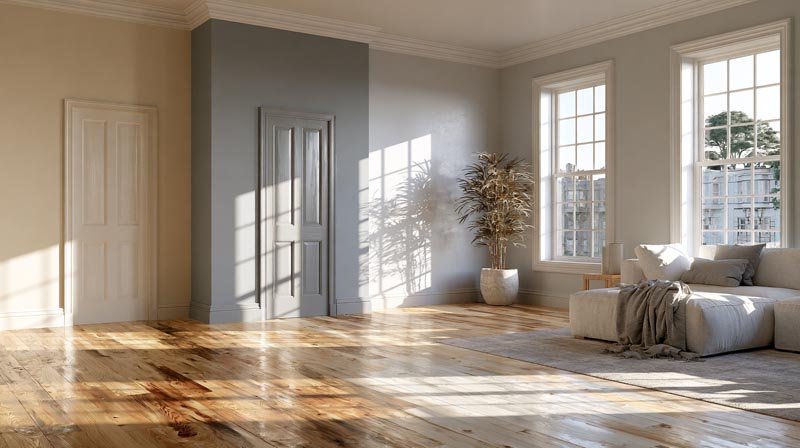
Undertone matching is the single most critical factor in floor-to-wall color pairing. Get it wrong and even a good wall color looks muddy, washed out, or unintentionally clashing. The floor undertone either fights or supports the wall color based on color temperature.
Elmwood Reclaimed Timber (2026) notes that light wood tones with subtle undertones require intentional color coordination rather than broad neutral choices.
Yellow-Undertone Floors: Honey Oak and Light Pine
These floors are the trickiest to work with because yellow clashes with cool colors. A cool bright white next to honey oak makes the floor look orange by comparison.
What works: Warm whites, greige, warm taupe, terracotta, muted warm greens
What fails: Cool gray, icy white, blue-violet, bright cool blues
Sherwin-Williams Shoji White and Benjamin Moore Ballet White are specific off-whites that absorb the yellow without amplifying it. Both sit in the warm-cream range that bridges the floor undertone to the wall without a temperature clash.
Pink-Undertone Floors: Maple and Some Birch
| Wall Color Direction | Effect on Pink Undertone | Best Use Case |
|---|---|---|
| Warm greige or taupe | Neutralizes and calms the pink | Living rooms, open-plan spaces |
| Blush or soft terracotta | Amplifies and leans into the pink | Bedrooms, eclectic spaces |
| Cool medium gray | Clashes, makes the floor look pink-red | Avoid entirely |
| Warm soft sage | Complements via earthy contrast | Kitchens, casual living spaces |
Sherwin-Williams Modern Gray works with pink-undertone woods because its taupe base satisfies the pink rather than amplifying or fighting it.
Gray-Undertone Floors: Ash and Whitewashed
Gray-undertone floors are the most forgiving. They sit closer to neutral and accept both cool and warm wall colors.
Cool wall colors that work: slate blue, soft dusty blue, light gray with blue or green undertones.
Warm wall colors that also work: soft greige, warm white, blush. The gray floor keeps these warm tones from tipping into excess warmth.
One thing to watch: a cool medium gray wall on ash floors can read as flat and monochromatic. Introduce some contrast via warm-toned furniture or textiles to break the single-temperature read.
What Wall Colors Work in Open-Plan Spaces With Light Wood Floors?
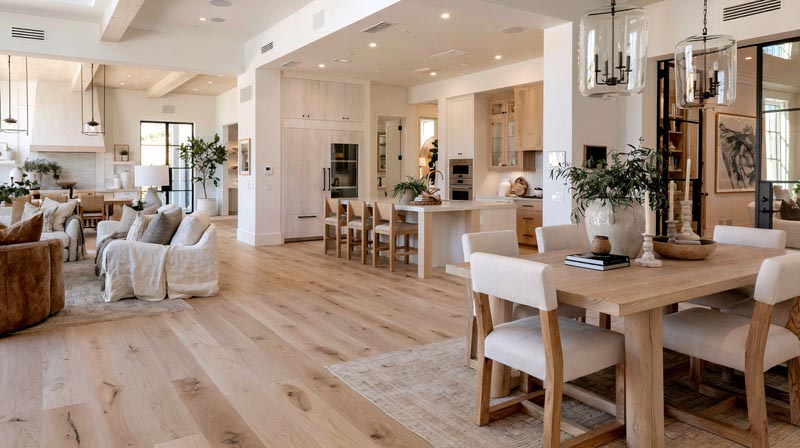
Open-plan spaces with light wood floors need wall colors that stay consistent across connected zones while still defining each area. A color that works beautifully in isolation can look disconnected in an open layout.
Hardwood Floors Magazine (2024) noted a shift back toward individual rooms over open concept, but open plans still dominate new construction, making consistent color strategy essential.
How Color Consistency Affects Open Plans
Light wood floors already create visual continuity across an open plan. The wall color either supports that or interrupts it.
A warm greige or soft white running across connected spaces locks the floor and wall into a coherent palette without making each zone feel identical. Shea McGee’s organic modern aesthetic, which pairs pale wood floors with warm neutral walls, demonstrates this directly: the floor reads as continuous while wall tones shift subtly room to room.
One reliable approach: keep the primary wall color the same throughout, then use accent colors or furniture to distinguish each zone.
Light-Reflecting Colors for Large Open Spaces
Paint colors with an LRV above 65 reflect significantly more light back into the room, which keeps large open-plan spaces from feeling flat under artificial lighting (Kylie M Interiors).
Best options for open-plan walls with light wood floors:
- Sherwin-Williams Alabaster (LRV 82) for a bright warm white
- Benjamin Moore White Dove (LRV 83) for a soft creamy white
- Sherwin-Williams Agreeable Gray (LRV 60) for a neutral greige that still reflects well
Avoid colors below LRV 50 on primary walls in open plans. They absorb light and make the space feel smaller, which works against the main visual benefit of light wood floors.
Zone-Specific Accent Colors in Open Plans
A single accent wall in a dining zone or reading nook can differentiate that space without breaking the color continuity of the open plan.
Kitchen zone: Crisp warm white or light sage on walls, consistent with living area
Dining zone: Same wall color throughout, differentiated by lighting or a pendant fixture rather than paint
Living zone: Optional single accent wall in deep sage or dusty blue
IKEA’s kitchen and living room staging consistently uses this approach: one wall color across connected spaces, one accent surface for depth. It keeps the light wood floor as the visual anchor rather than letting wall color compete.
What Wall Colors Work in Small Rooms With Light Wood Floors?
Light wood floors already do the heavy lifting in small rooms. They reflect more light than dark floors and create the visual impression of more floor space. The wall color choice determines whether that effect is maximized or neutralized.
Light-colored hardwood floors make rooms look bigger by reflecting more light and creating an open, airy feel, according to Eco Flooring USA (2024). They are especially suited for smaller spaces or rooms with limited natural light.
Colors That Amplify the Light-Floor Effect
The most effective wall colors for small rooms with light wood floors are those that extend the light rather than contrast with it.
Best performers:
- Warm whites (LRV 80+): Benjamin Moore Chantilly Lace, Sherwin-Williams Extra White
- Soft off-whites (LRV 70-80): Sherwin-Williams Greek Villa, Benjamin Moore Soft Chamois
- Light greige (LRV 60-70): Sherwin-Williams Agreeable Gray, Benjamin Moore Edgecomb Gray
Paint colors above LRV 70 start making a measurable difference in how open and bright a room feels, especially in rooms with limited natural light (Kylie M Interiors).
Ceiling Color in Small Rooms With Light Floors
Ceiling color is the most overlooked variable in small rooms. A pure white ceiling next to a warm off-white wall creates a hard line that lowers the perceived ceiling height.
The fix: match the ceiling to the wall color or use a slightly lighter version of the same hue. This erases the visual break between wall and ceiling and makes the room read taller and more open.
Color drenching, painting the walls and ceiling in the same color, works particularly well in small rooms with light wood floors because the floor provides the only contrast. The result is a cocooning effect that reads intentional rather than cramped.
How Does Natural Light Change Wall Color Choices?
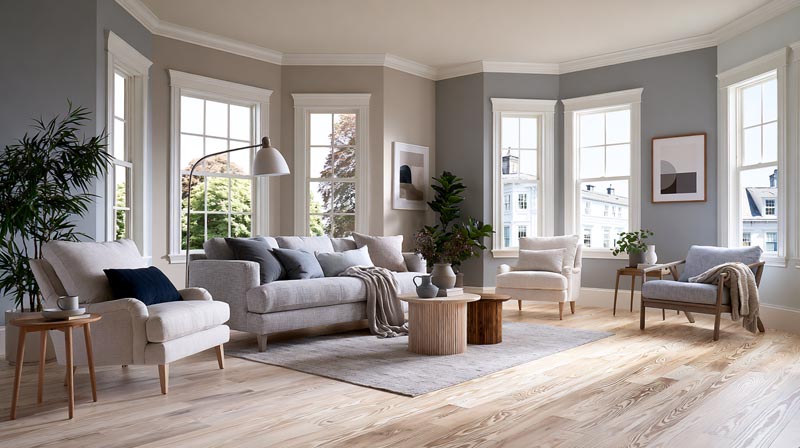
The same wall color looks different in every room depending on which direction the windows face. A warm greige that reads beautifully in a south-facing room can look yellow or muddy in a north-facing one. Light direction changes the undertone you see.
Sherwin-Williams notes this directly in their paint guidance: light sources and their direction affect how wood and paint interact, making swatch testing under actual room conditions essential before committing to a color.
North-Facing Rooms
North-facing rooms get cool, indirect light all day. This makes every color read cooler and slightly gray.
With gray-undertone ash floors, a cool medium gray wall looks flat and cold in a north-facing room. The fix: pull warmer. Use a warm greige or a white with a yellow-cream base to compensate for the cool light.
Avoid in north-facing rooms with light wood floors:
- Cool gray walls
- Bright white with blue undertones
- Slate or blue-gray in medium saturation
South-Facing Rooms
South-facing rooms receive warm, direct light for most of the day. Colors read truer to their paint chip and warm tones are amplified.
Warm whites and sage greens are reliable in south-facing rooms with light wood floors. The natural light brings both to their best version. Soft sage (like Sherwin-Williams Rainwashed) in a south-facing room looks fresh and calm. In a north-facing room, the same color reads more gray-green and flat.
Sherwin-Williams selected Upward, a pale blue, as a 2024 color of the year. It specifically performs best in south-facing rooms where warm light softens its cool base.
How to Test Paint Swatches Against Light Wood Floors
The standard advice is to buy sample pots and paint large swatches directly on the wall. Good advice, but incomplete.
Paint the swatch in 3 spots: near the floor, in the middle of the wall, and near the ceiling. The way light hits each zone varies. Check the swatch in the morning, midday, and at night under artificial light. A color that looks perfect at noon can look completely different at 7 pm under warm LED lighting.
Farrow and Ball, Benjamin Moore, and Sherwin-Williams all offer peel-and-stick large-format samples specifically because small chips misrepresent how a color reads at scale on a wall next to wood flooring.
What Trim and Ceiling Colors Complete the Look?
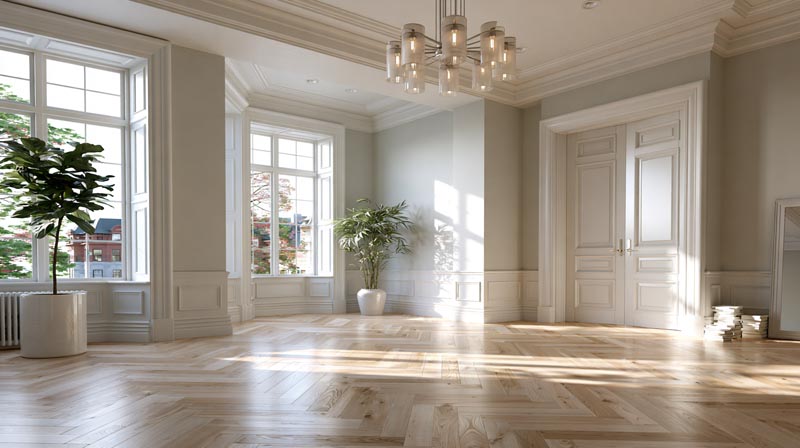
Wall color alone doesn’t complete a room. Trim and ceiling choices either reinforce the wall-floor pairing or undercut it. Most people spend significant time choosing wall colors and then default to bright white on everything else. That default often creates problems.
The trim and ceiling relationship with light wood floors follows one principle: temperature consistency. Warm walls with cold white trim create a jarring contrast that draws attention to the trim rather than the room as a whole.
White Trim With Warm Wall Colors on Light Floors
If the wall color is warm (greige, taupe, terracotta, warm white), the trim needs to match that warmth. A pure cool white on the trim next to a warm wall reads as almost blue by comparison.
| Wall Color Type | Best Trim Color | Avoid |
|---|---|---|
| Warm white / greige | Sherwin-Williams Pure White, Benjamin Moore White Dove | Bright cool white (Benjamin Moore Chantilly Lace) |
| Sage green | Warm white or off-white | Bright white with a blue undertone |
| Dusty blue or slate | Crisp white (LRV 85+) | Off-white or cream |
| Terracotta or blush | Warm cream or linen white | Cool gray or bright white |
Off-White vs. Pure White Ceilings
Pure white ceilings work when the walls are also light or cool-toned. They create clean separation. But in rooms with warm greige or taupe walls and light wood floors, a pure white ceiling floats above the room and reads disconnected.
An off-white ceiling in the same color family as the wall ties the room together. It reads as a soft gradient rather than a hard edge. Sherwin-Williams Alabaster at LRV 82 works as a ceiling color in rooms where the wall is Agreeable Gray, keeping the palette cohesive.
Color Drenching as a Trim and Ceiling Strategy
Color drenching, painting walls, ceiling, and trim in the same color, is seeing adoption in rooms where the light wood floor provides the primary contrast point.
This approach works best with:
- Soft sage green walls, ceiling, and trim with honey oak or ash floors
- Warm greige walls, ceiling, and trim with blonde or whitewashed floors
- Dusty blue throughout with white oak floors
The floor becomes the visual anchor and the walls recede. The room reads as calm, cohesive, and intentional rather than plain. For color in interior design decisions at this level, the relationship between every surface matters, not just the wall alone.
Understanding how contrast in interior design plays out between floor, wall, trim, and ceiling is the difference between a room that looks pulled together and one that looks like separate decisions stacked on top of each other.
What Colors to Avoid With Light Wood Floors?
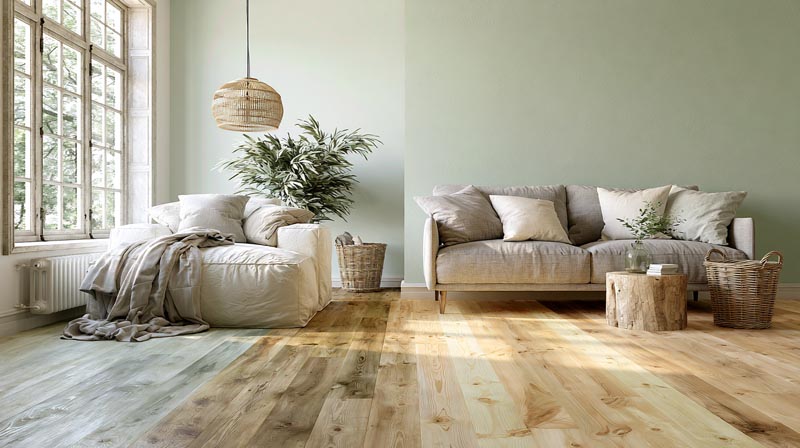
Knowing what fails saves more time than knowing what works. Certain combinations look fine on a mood board or paint chip and fail completely in an actual room with light wood floors. Most failures come from undertone clashes or saturation mismatches.
Cool Bright Whites With Yellow-Undertone Floors
This is the most common mistake. A bright white with blue or cool-gray undertones placed next to honey oak or light pine floors makes the floor look orange. The white’s coolness amplifies the yellow-orange in the wood by contrast.
Specific colors to avoid with yellow-undertone floors: Sherwin-Williams Extra White on rooms with honey oak, Benjamin Moore Chantilly Lace next to warm pine, any white with a visible blue or violet undertone.
The fix isn’t difficult. Swap the cool white for a warm white with a cream or yellow-beige base. The floor reads as wood rather than a problem.
Saturated Oranges and Yellow-Greens
Saturated orange walls amplify yellow undertones in light floors. The room tips into a heavily warm palette that feels overwhelming rather than cozy.
Yellow-green is equally tricky. When paired with a yellow-undertone floor, yellow-green walls create a muddy overall read because both surfaces pull in the same warm-yellow direction. The room needs contrast, not doubling.
Muted, gray-toned greens avoid this completely. Sage works. A vivid lime or yellow-green doesn’t.
Cool Medium Grays on Pink-Undertone Maple Floors
Medium gray (LRV 40-55) with cool undertones reads distinctly blue-gray next to pink-undertone maple floors. The contrast between cool gray wall and warm pink floor reads as a color mistake rather than intentional contrast.
The beige trap is a related problem. Choosing a beige that carries a pink undertone next to pink-undertone maple doubles the pink. The room ends up reading as unintentionally rosy. Benjamin Moore’s color team calls this the undertone echo, where two surfaces accidentally share the same undertone and the result looks accidental rather than designed.
Why Certain Greens Read as Muddy Against Warm Wood
Greens with a high yellow content turn muddy next to yellow-undertone light floors. The yellow in the paint and the yellow in the floor reinforce each other in the worst way, pulling the green toward an olive-brown that reads dirty rather than earthy.
A 2024 analysis from Panel Town and Floors confirms this: with warm-undertone light floors, greens need to be desaturated and slightly gray-toned to avoid the muddying effect. Rainwashed by Sherwin-Williams avoids this because its gray component keeps the yellow in check.
Understanding color theory in interior design prevents these mistakes from happening. The undertone relationship between floor and wall is not intuitive from a paint chip alone. It only becomes clear at scale, on the wall, next to the floor, under actual room lighting.
How Do Paint Finish Types Interact With Light Wood Floors?
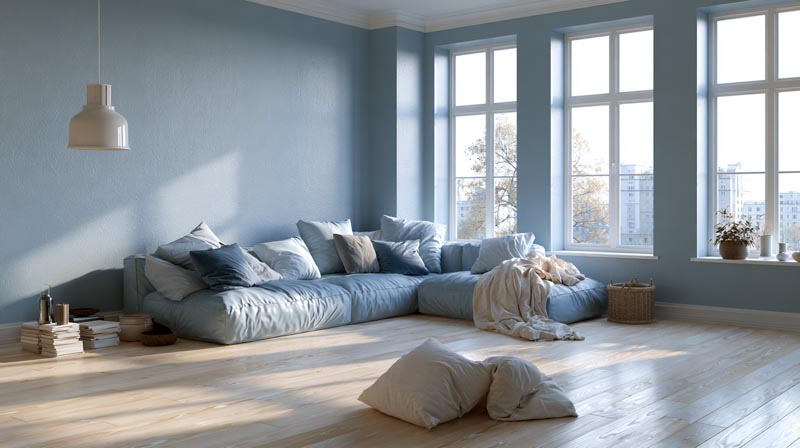
Finish choice changes how a wall color reads next to light wood flooring. The same color in matte versus satin can look like two different paints once natural light hits the wall and reflects off the floor surface beneath it.
The core principle: high-gloss wall finishes compete with the warm sheen of light wood floors. Light bounces between both surfaces and the room ends up reading as restless rather than cohesive.
Matte vs. Eggshell on Walls With Light Flooring
Matte is the preferred finish for walls in rooms with light wood floors. It absorbs light rather than reflecting it, which lets the floor’s natural warmth and texture stay as the focal point.
Designers at Room for Tuesday confirm matte is their go-to for living spaces, dining rooms, and bedrooms, especially when paired with rich pigmented wall colors or warm neutrals next to wood flooring.
Eggshell works as a practical alternative. It has a slightly higher LRV than matte, adds minimal sheen, and cleans easier. Glidden notes eggshell is ideal for living rooms and hallways where a soft glow is desirable without competing with floors.
Bottom line: matte for design-forward rooms, eggshell for family spaces where washability matters.
Satin Finish: Where It Works and Where It Doesn’t
Satin delivers a pearl-like sheen and handles moisture and scrubbing well. It belongs in kitchens and bathrooms, not in rooms where light wood floors are the primary visual element.
In a kitchen with light hardwood flooring, satin on the walls creates too many competing reflective surfaces. The floor, the wall, cabinet hardware, and countertops all bounce light simultaneously. The room reads as visually busy.
Exception: satin works on an accent wall or lower wall section in high-traffic open plans where durability outweighs the reflectance concern.
How Finish Affects Undertone Under Different Lighting
| Finish Type | Effect on Undertone | Best Room Use |
|---|---|---|
| Matte / Flat | Softens undertone, reads truest to the paint chip | Bedrooms, dining rooms, living rooms |
| Eggshell | Slightly brightens color with minimal undertone shift | Living rooms, hallways, kids’ rooms |
| Satin | Amplifies undertones under direct light | Kitchens, bathrooms |
| Semi-gloss | Dramatically shifts undertones; avoid on walls | Trim and doors only |
A warm greige in matte reads as grounded and calm. The same greige in satin reads pinker and warmer under warm LED lighting, which can amplify the yellow or pink undertone in the wood floor below it.
Finish Recommendations by Room Type
Living room: matte or eggshell. The floor needs to dominate visually.
Bedroom: matte. Creates the quiet, cocooning feel that works with light wood floors and soft wall colors.
Kitchen: eggshell or satin on walls, semi-gloss on trim and cabinet exteriors.
Hallway: eggshell. Narrow spaces get heavy use, and eggshell handles scuffs while still reading soft next to light wood flooring underfoot.
What Are the Best Wall Colors by Room Type?
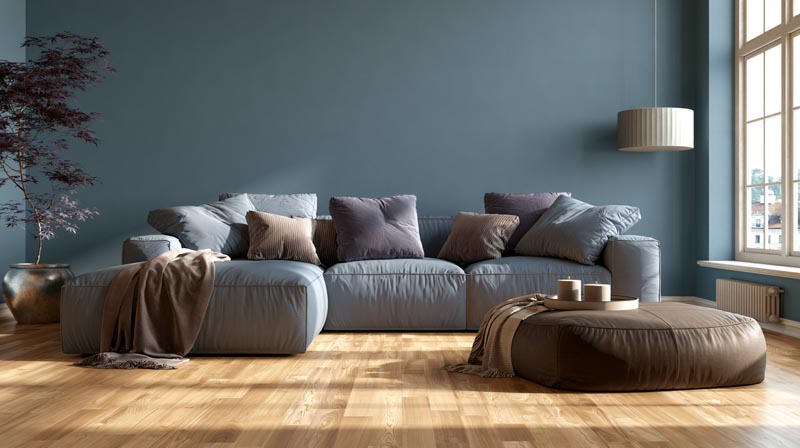
The right wall color changes by room because each room has a different function, different lighting, and a different relationship to the floor. Light wood floors appear in every room type, but the wall color that works in a living room isn’t automatically the right call for a bedroom or kitchen.
Panel Town and Floors (2025) confirms that light brown hardwood floors, which includes most light wood floor tones, are the most popular flooring color and suit virtually any wall paint color when undertone is respected.
Living Room Wall Colors With Light Wood Floors
Living rooms carry the most visual weight in a home. The wall color needs to work with furniture, rugs, and lighting, not just the floor.
Best performers:
- Warm greige (Agreeable Gray, Revere Pewter) as a base for traditional and transitional rooms
- Soft sage green for organic modern and Scandinavian-leaning spaces
- Warm white (Alabaster, Greek Villa) for open, airy layouts with large windows
Earthy tones were named the most popular living room palette by 46% of design experts surveyed by Fixr.com in 2024, a finding that maps directly onto the warm neutral and sage options that pair well with light wood floors.
Houzz data from 2024-2025 shows minimalist open-concept living rooms with light wood floors and white walls remain one of the most saved room configurations, particularly for new construction and coastal homes.
Bedroom Wall Colors With Light Wood Floors
Green is currently the most searched bedroom paint color, with over 168,300 annual searches recorded by Apartment Therapy’s 2024 report. Sage green pairs reliably with light wood floors in bedrooms for exactly the reason those searches suggest: it reads calm and organic rather than loud.
Soft sage: works with ash, white oak, and blonde floors. Reads restful and pulls from the wood’s natural context.
Dusty blue: dusty plum, sage, and deep navy are the three tones homeowners are choosing for saturated-yet-calm bedrooms in 2026, according to Lime Painting’s franchise network data. Dusty blue with light ash or white oak floors hits a clean, contemporary balance.
Warm white or greige: the safe choice. Works in every bedroom configuration, creates a seamless backdrop, and lets textiles and furniture do the talking.
According to a 2024 Travelodge study of 2,000 households, bedroom wall color is one of the largest non-mattress factors influencing perceived sleep quality. Cool blue and soft green bedrooms recorded the strongest positive sleep outcomes, both of which pair naturally with light wood flooring.
Kitchen Wall Colors With Light Wood Floors
Kitchens require wall colors that work with cabinet color, countertops, and backsplash simultaneously. Light wood floors add a warm base that narrows the field.
Crisp warm white is the most reliable kitchen wall color with light wood floors. Sherwin-Williams Alabaster and Benjamin Moore White Dove both work without tipping too cool or too warm. Proximity Mills (2024-2025) specifically recommends natural hardwood floors in main living areas or rooms with white walls for the clean contrast effect.
Sage green as a kitchen wall color with light floors reads fresh and intentional, especially in farmhouse and transitional kitchens. It sits in the same earthy palette as the floor without matching it exactly.
Avoid: saturated yellows and warm oranges on kitchen walls with honey oak or light pine floors. The floor already carries warmth. Adding more via the walls makes the kitchen feel heavy and small.
Hallway Wall Colors With Light Wood Floors
Hallways are the hardest room to get right. Narrow, often low-light, and seen at a glance rather than lived in. Light wood floors already help by reflecting light upward.
Light-reflecting colors above LRV 65 are the practical choice for hallways. They extend the floor’s brightening effect up the walls. Benjamin Moore Chantilly Lace, Sherwin-Williams Extra White, and soft greige like Edgecomb Gray all perform well.
One approach that works in narrow hallways: paint the wall color the same tone as the trim. This removes the visual boundary between wall and trim, making the space read wider. Paired with light wood floors, the hallway feels intentional rather than cramped.
Avoid deep, saturated colors in hallways with light wood floors unless the hallway is wide and has good natural light. The floor provides warmth. The wall should provide space, not close it down further.
For a complete picture of how light in interior design affects every room, including how natural light, artificial light, and finish type interact, the principles involved go well beyond just picking a color chip from a fan deck.
How space in interior design functions depends on color coordination, finish, and undertone working together, not as separate decisions. And if you’re working across multiple rooms, balance in interior design between floor tone, wall color, and natural light becomes the deciding factor in whether a home feels cohesive or inconsistent room to room.
Looking at what color furniture goes with light wood floors alongside wall color choices gives you the full picture. Wall and furniture color decisions are directly linked, and getting both right at the same time produces a more resolved interior than deciding them separately.
FAQ on What Color Walls Go With Light Wood Floors
What is the most popular wall color for light wood floors?
Warm white and greige are the top choices. Sherwin-Williams Agreeable Gray and Benjamin Moore White Dove work across honey oak, ash, and maple floors. Both neutralize undertones without clashing with warm wood tones.
Do gray walls work with light wood floors?
Warm gray works. Cool gray clashes with yellow-undertone floors like honey oak, making the wood read orange. Stick to gray with beige or green undertones, such as Sherwin-Williams Repose Gray, for reliable results.
What wall color makes light wood floors look best in a small room?
Warm whites with an LRV above 70 extend the light-reflecting effect of the floor. Benjamin Moore Chantilly Lace or Sherwin-Williams Alabaster keep small rooms open and airy without washing out the wood grain.
Can you use dark wall colors with light wood floors?
Yes. Deep navy, charcoal, and dark sage create strong contrast against blonde or ash floors. Hardwood Floors Magazine (2024) confirms dark walls pair best with lighter floor tones. Use dark colors on a single accent wall first.
What wall color goes with honey oak floors?
Warm whites, greige, and muted terracotta. Honey oak carries a yellow undertone, so cool grays and bright whites clash. Sherwin-Williams Shoji White and Benjamin Moore Revere Pewter are reliable picks for this floor tone.
What wall color works with ash wood floors?
Ash floors have a gray undertone, making them the most flexible pairing. Dusty blue, soft greige, warm white, and sage all work. Avoid cool medium gray walls, which read flat and monochromatic against ash flooring.
Does sage green work with light wood floors?
Yes, consistently. Muted sage like Sherwin-Williams Rainwashed pairs with ash, oak, and maple floors. Fixr.com’s 2024 survey found 36% of design experts named green the top trending wall color, citing its natural connection to wood interiors.
What wall color should you avoid with light wood floors?
Cool bright white with yellow-undertone floors, saturated orange, and cool medium gray with pink-undertone maple. These combinations amplify undertone clashes. The result looks unintentional rather than designed, regardless of how good the paint color looks on a chip.
Does wall color change depending on the room type?
Yes. Warm greige suits living rooms. Dusty blue and soft sage work better in bedrooms. Crisp warm white performs best in kitchens with light wood floors. Each room’s function, lighting direction, and furniture influence which color reads correctly.
How does natural light affect wall color choices with light wood floors?
North-facing rooms make colors read cooler, so warm greige compensates. South-facing rooms amplify warmth, making soft sage and pale blue reliable. Always test paint swatches next to the floor at different times of day before committing.
Conclusion
This conclusion is for an article presenting wall color pairings for light wood floors, and the core takeaway is simple: undertone matching decides everything.
Warm greige, soft sage, dusty blue, and warm white are the most reliable paint color choices across honey oak, ash, maple, and birch floors.
Finish type matters just as much as color. Matte and eggshell keep the focus on the floor. High-gloss walls compete with it.
Natural light direction, room size, and ceiling color all shift how a wall color reads next to light hardwood flooring. Test large swatches against the actual floor before committing.
Get the floor-to-wall color coordination right and every other design decision in the room becomes easier.

- Kitchen Color Schemes by Cabinet Color: What Pairs Well - October 19, 2026
- Curtain Colors for Every Wall Color: Safe vs Bold Picks - October 18, 2026
- Interior Design Styles: Find Your Primary and Secondary - October 14, 2026