Industrial Interior Design
Types of Concrete Finishes for Floors and Walls

Where a slab sits matters more than what the owner likes the look of. NRMCA’s CIP 2 calls for air-entrained concrete wherever a slab freezes while it is wet, and CIP 14 advises against steel troweling that same mix. So freeze-thaw slabs end up with a float or broom finish, and the smooth troweled floors go indoors.
Contractors mostly choose by exposure and use. Outdoors it comes down to traction, and inside it’s density or sheen.
What are the main types of concrete finishes?
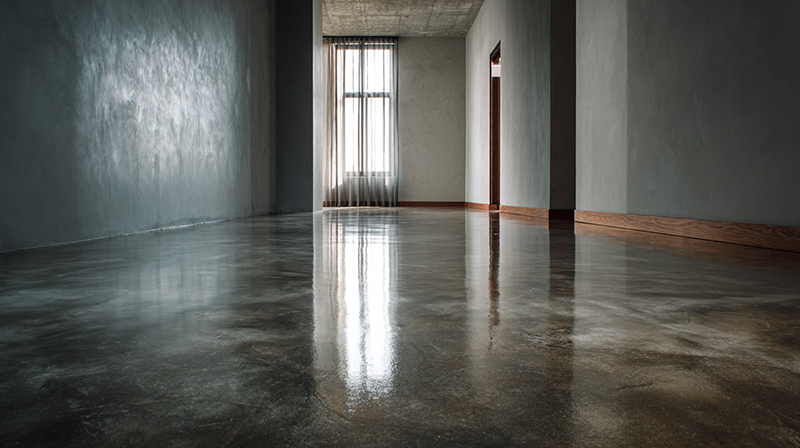
Textured, troweled, decorative, and ground or polished cover nearly everything that gets poured. Whichever family a slab falls into, the finish is what sets its texture, slip resistance, appearance and wear behavior.
Broom, float, swirl and salt finishes give outdoor slabs their traction. Steel and power trowels leave a dense, smooth face. Stamped, exposed aggregate, stained, colored and stenciled concrete make up the decorative group, and diamond grinding takes a slab anywhere from matte to glossy.
The tool points to the family, but timing decides what a given slab can still get. Brooming, troweling, stamping and exposed aggregate all happen on placement day, while the surface is workable.
Hardened concrete can still be stained or ground, and an overlay goes over it. Those are the realistic options for an existing driveway or floor.
Broom, float, swirl and salt finishes for traction
The broom finish is the standard exterior texture. NRMCA’s CIP 14 calls for a coarse or fine push-broom pass after floating on sidewalks, patios and driveways.
Float, swirl and salt finishes cover the same kind of flatwork with a different look.
Broom finish
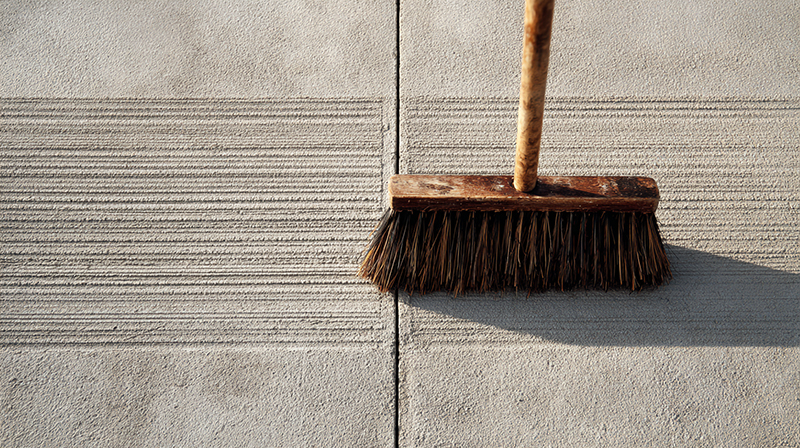
A concrete broom gets dragged across the slab once it has been floated and the bleed water is gone. The stiff bristles cut shallow grooves that shed water and grip a tire or a shoe.
A fine broom suits patios and walkways. A coarse one goes where more grip is needed, and some crews alternate the stroke direction between joints for a patterned look.
The usual mistake is brooming too early. While the surface is still soft the marks fill back in, and working over bleed water pushes that water into the top layer.
Float finish
A float finish is a trowel finish that stops a step early.
A magnesium float, run by hand or by machine, embeds the larger aggregate and levels the surface (NRMCA, CIP 14). What’s left is a lightly textured face with more grip than a troweled one. It works on patios and sidewalks where a broom pattern would look out of place.
Swirl finish
A swirl finish is a float or trowel pattern worked in overlapping arcs. It reads as decorative first and as a traction surface second.
Grip depends on how deep the arcs are cut, so specify the depth when the slab sits near a pool or a drain.
Salt finish
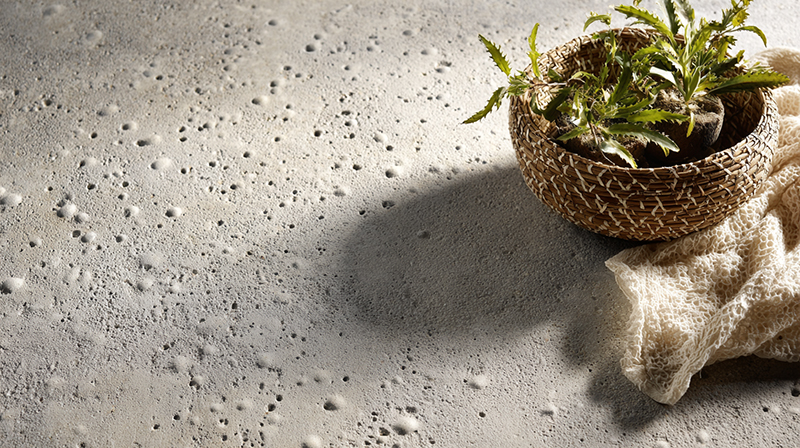
Coarse rock salt gets pressed into the surface after floating, then washed out once the slab has set. That leaves small pits scattered across the face.
Cold climates are where it falls apart. NRMCA’s CIP 2 traces scaling on freeze-thaw slabs to non-air-entrained mixes, over-finishing and finishing over bleed water, and a pitted surface gives winter water more places to collect. I’d skip it anywhere it freezes.
Steel-troweled and hard-troweled finishes

Repeated trowel passes leave a smooth, dense surface, and that finish belongs indoors. NRMCA’s CIP 14 notes that exterior slabs typically take a texture instead.
On large slabs, power trowels do the work. Crews float first, then make multiple passes with trowel blades as the concrete stiffens (ACI 302.1R).
ACI 302.1R matches the finish to the floor. Light steel troweling is meant for slabs that will sit under adhered flooring. Commercial and institutional floors get a normal steel-troweled finish, and hard steel troweling is saved for industrial floors with vehicle traffic.
For heavy hard-wheeled loads, ACI 302.1R adds a dry shake hardener, a mineral or metallic aggregate broadcast onto the slab before final set and troweled in. When a spec asks for a wear number, ASTM C779 is the reference test for abrasion resistance of horizontal surfaces.
NRMCA’s CIP 14 names the usual faults of a troweled floor:
- Slippery when wet after repeated passes
- Dark trowel burns from excessive troweling
- Chatter texture from a tilted blade
- Blisters and delamination when the surface is closed before bleeding stops
The sharper limit is air entrainment. ACI 302.1R says an air-entraining admixture should not go into a slab planned for a smooth, hard-troweled finish, because blistering or delamination can develop once total air content passes 3%.
ASCC’s Position Statement #1 adds that hard troweling air-entrained concrete risks delamination or blistering, lowers the surface air content and alters the air-void parameters.
Freeze-thaw exposure pulls the other way. NRMCA’s CIP 2 calls for good-quality air-entrained concrete at 4,000 psi (28 MPa) where slabs see severe freezing and thawing.
A slab that freezes needs entrained air, and entrained air rules out hard troweling. So freeze-thaw slabs get a float or broom finish, and smooth troweled floors go indoors, where air entrainment isn’t needed.
Decorative finishes: stamped, exposed aggregate, stained and colored concrete
Pattern, color and visible stone are what decorative finishes change. Each one uses a different tool, and each has its own deadline.
Stamped concrete

Stamped concrete copies flagstone, slate, brick or cobblestone by pressing rubber mats into the plastic surface after floating.
A release agent goes down first, a powder broadcast so the mat doesn’t stick, and it doubles as a second color. The base color is either mixed into the batch or applied as a dry shake color hardener.
Stenciled concrete follows the same logic with a stencil in place of a mat. A dry shake color hardener goes on before the stencil comes off, which leaves the look of mortared stone or brick.
Exposed aggregate concrete
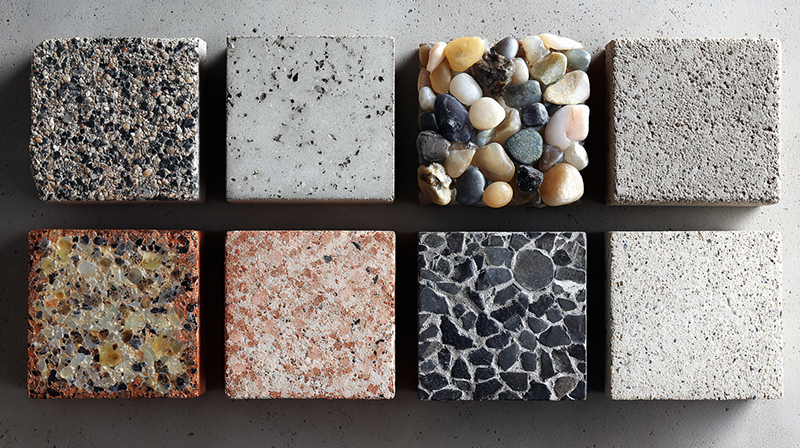
Timing is the tricky part here. Surface retarder gets washed off 12 to 24 hours after application, according to ConcreteNetwork.
The retarder slows set in the top layer of paste, so a hose, stiff broom or pressure washer can remove it and expose the stone. How much stone shows depends on the retarder used and how long it stays on.
Wash too early and stones start to come loose. Wait past 24 hours and exposure gets difficult, sometimes needing sandblasting.
Aggregate can also be broadcast onto the surface and troweled in before the retarder goes on. That exposes stone the mix itself did not contain.
Stained concrete
Stain colors concrete instead of covering it.
Acid stain reacts chemically with minerals in the surface, which produces the mottled, translucent color it is known for. Water-based stains also penetrate the surface rather than sit on it.
Because stain hides nothing, cracks and trowel marks stay visible.
Overlays go the other way. A thin cementitious layer over a hardened slab gives an existing driveway or patio a fresh surface that can then be stained, stamped or textured.
Colored and pigmented concrete
Sources split on the labels. The practical difference is where the color goes.
| Method | Applied | Color depth |
|---|---|---|
| Integral color or pigment | In the batch | Through the slab |
| Dry shake color hardener | On the plastic surface | Top layer |
| Stain | On the hardened slab | Penetrates the surface |
Integral color holds up better under chipping and wear because it is not a surface layer. A dry shake coat colors only the top layer.
How does a polished concrete finish work?

A slab gets ground with diamond discs through progressively finer grits until it reaches the specified sheen. Along the way a densifier hardens the surface, and a guard or sealer finishes the job.
- Coarse grinding with metal-bond diamond grinding discs removes the cream layer and cuts to the aggregate depth specified.
- Medium grits refine the scratch pattern.
- A lithium silicate densifier goes on and reacts with the slab to harden the surface.
- Resin-bond discs polish through finer grits to the target sheen.
- A guard or sealer protects the finished floor.
The Concrete Polishing Council (CPC, formerly the Concrete Polishing Association of America, or CPAA) sorts gloss into 4 levels by the grit where polishing stops, as summarized by ConcreteNetwork.
| Level | Stopping grit | Look |
|---|---|---|
| 1, ground | Below 100 | Flat, no reflection |
| 2, honed | 400 | Low-sheen matte |
| 3, semi-polished | 800 or higher | Reflections visible, edges soft |
| 4, highly polished | 3,000 | Mirror-like |
Published thresholds for the top level differ. Some contractor guides list 1,500 grit and above as highly polished.
Aggregate exposure is rated on its own scale, from Class A (cream, minimal cut depth) through Class B (fine, about 1/16 in) and Class C (medium, 1/8 in) to Class D (large, 1/4 in).
Deeper cuts cost more and expose pits that need filling, while Class A leaves existing blemishes in place (ConcreteNetwork).
Polished surfaces can give up some wet traction, depending on gloss level and on which slip test is used.
Polished slabs are common in industrial loft interiors, where bare concrete is part of the look.
An epoxy coating is a different product. It sits on the slab as a film, where polishing changes the slab itself, and it suits garage and industrial floors that need a sealed, colored surface.
When can each finish be applied after the pour?
Every finishing step after the bull float waits on the same signal. The bleed water has to be gone, and the surface has to carry a finisher without marking. The bull float is the exception, since it runs before bleed water appears (NRMCA, CIP 14).
NRMCA’s CIP 14 sets the order for flatwork:
- Strike off and bull float before bleed water shows, keeping the float flat so the surface is not sealed early.
- Wait until bleeding stops and the water sheen leaves the surface.
- Edge and joint.
- Float by hand or machine.
- Trowel if the end use calls for it.
- Texture: exterior slabs after floating, interior slabs after final troweling.
- Cure.
Each finish adds its own start cue on top of that sequence.
| Operation | Starts when | Cue |
|---|---|---|
| Hand or machine float | Bleeding has stopped | Shallow footprint, no water sheen |
| Steel trowel | After floating, as the surface stiffens | Early passes with flat blades |
| Stamping | Surface is firm but still pliable | A thumb leaves a shallow impression |
| Salt finish | After floating, before the slab sets | Rock salt presses in instead of sitting on top |
| Curing compound | Right after final finishing | Surface water sheen has just disappeared |
The stamping cue is the one most stamping guides give. The flat-blade cue comes from NRMCA’s CIP 13, which ties tilted blades on the second or third pass to blisters.
Temperature and mix move every one of those starts.
On a cold slab or cold subgrade, set slows and bleeding runs long, so the surface can look ready while the concrete below is still plastic (NRMCA, CIP 20). Accelerators or heated concrete are the usual fix.
A hot, dry, windy site does the opposite. The top dries and crusts before the slab below has gained strength, which makes early curing urgent (NRMCA, CIP 3).
Air-entrained mixes bleed less, so the sheen disappears early and the surface looks ready before it is (NRMCA, CIP 20).
ASTM C309 curing compounds go on right after the sheen disappears following final finishing. Euclid Chemical’s data sheets call for application as soon as possible after finishing, immediately after the surface sheen disappears, so a late application leaves the fresh surface losing water unprotected.
Silicate-based densifiers, a lithium silicate densifier included, do not count as curing compounds. ASTM C309 excludes silicate salt solutions because they react with the concrete instead of forming a membrane.
Which concrete finish suits a driveway, patio, pool deck or interior floor?
Broom or exposed aggregate for wet outdoor traffic, stamped or stained for patios where looks lead, troweled or polished for interior floors. Pick the plainest finish that meets the traction and appearance spec.
| Finish | Wet traction | Best fit | Watch for |
|---|---|---|---|
| Broom | Strong | Driveways, sidewalks, pool decks | Texture lost if brushed at the wrong time |
| Exposed aggregate | Strong | Pool decks, patios, driveways | Retarder wash window |
| Stamped | Depends on pattern and sealer | Patios, walkways | Sealer must be specified for traction |
| Steel-troweled | Low when wet | Interior floors | Not for air-entrained slabs |
| Polished | Clears the interior wet minimum in CPC testing | Interior floors, warehouses | Gloss level changes grip |
Slip resistance numbers exist for interior floors but not for most outdoor ones. ANSI A326.3 states that it gives no normative DCOF limits for exterior applications, ramps or pool decks, so a project spec has to set its own target.
Polished floors have better data. The Concrete Polishing Council (formerly CPAA) had the Tile Council of North America test polished sections, and every gloss level came in above the 0.42 wet DCOF minimum for level interior tile (TCNA report 661-14).
Grip varied with gloss level, not with aggregate exposure class.
That result does not carry over to every test. DCOF and pendulum results do not map onto each other, and some slip-testing labs report polished concrete clearing 0.42 DCOF while scoring poorly on the pendulum test. The TCNA test also simulated a spill on a dry surface, and polished interior floors are meant to be kept dry.
Stamped patios carry one more catch. A sealer changes the grip of the surface, so the ASCC Decorative Concrete Council sealer guide wants the traction requirement addressed in the first coat and in every reseal.
How much do concrete finishes cost per square foot?
Broom is the baseline, and every decorative finish adds labor and materials on top of it. HomeGuide’s patio pricing shows the spread. A broom-finished patio runs $6 to $13 per square foot installed, exposed aggregate $7 to $18, and stamped $9 to $30.
Published stamped prices don’t agree. Angi puts stamped concrete at $8 to $28 per square foot, from $8 to $12 for basic patterns through $12 to $18 for mid-range work to $18 to $28 for complex designs, while HomeGuide’s patio range runs $9 to $30.
Design complexity, color work and region explain most of the gap. Treat any one stamped figure as a regional quote and collect local bids.
- Labor drives the price of finishes with tight timing windows, such as stamping and exposed aggregate
- A broom finish adds minimal cost because the regular finisher does the work (HomeGuide)
- Staining an existing patio is priced apart from a new stained pour, with surface preparation and sealer included (HomeGuide)
- Site prep, layout and access move exposed aggregate prices too
Sticker price leaves out upkeep, which is where decorative finishes cost more than plain ones.
How to maintain each finish and when to reseal
Sealed decorative finishes need the most upkeep and broom or float surfaces the least. Polished floors need regular cleaning instead of recoating. The ASCC Decorative Concrete Council sealer guide gives 2 to 3 years as the reseal rule of thumb for high-traffic, sun-exposed areas.
Stamped, stained and exposed aggregate surfaces take an acrylic sealer, which gets cleaned now and then and recoated on schedule. Broom and float surfaces need cleaning, plus a sealer only where stain or deicer protection is wanted. On polished floors the job is keeping grit off the surface and buffing or re-guarding when the shine drops.
Two thin coats of sealer beat one heavy coat, according to the Concrete Sealers USA data sheet. Eagle’s sealer sheet adds a limit on frequency: reseal as needed, but no more often than every two years, to avoid buildup.
Texture changes the sealer bill. Eagle’s coverage chart gives smooth troweled slabs the most area per gallon, about 300 sq ft per gallon, because they are less porous, and exposed aggregate the least, about 100 sq ft per gallon. Eagle also calls for an etch first.
Grit is the main wear driver on polished floors. ConcreteNetwork’s care guide calls for regular dust mopping, occasional damp mopping with a pH-neutral cleaner, and buffing with a polishing compound when shine fades.
Worn garage and industrial floors have another route. An epoxy coating replaces a recoat of sealer with a thicker film.
Deicers are the main outdoor wear driver. NRMCA’s CIP 2 and PACA agree on the basics. No deicers in the first winter, and never ammonium sulfate or ammonium nitrate, which attack concrete chemically.
Guidance splits on chlorides. PACA treats sodium and calcium chloride as generally acceptable on good-quality dense concrete, while municipal guidance, such as the City of Pendleton, Oregon’s, says to avoid rock salt and calcium chloride on concrete less than five years old.
Plain sand gives traction without the chemistry, and sealers add a protective layer (PACA).
What goes wrong with concrete finishes?
Dusting, scaling, blistering, delamination, crazing and trowel burns trace back to finishing timing, water worked into the surface, or weak curing.
Dusting and scaling
Dusting shows up as loose powder that rubs off a hardened slab under traffic or a broom, and a nail scratches the surface easily (NRMCA, CIP 1). Scaling is something else, local flaking or peeling of a hardened surface that froze while saturated (NRMCA, CIP 2).
People mix the two up. Dusting comes from a weak wearing surface, while scaling needs moisture plus freeze-thaw cycles.
Dusting traces to bleed water or dry cement worked into the top layer, troweling over condensation on cold concrete, or a fresh surface left exposed to rain, snow and wind.
A commercial floor hardener, such as a sodium silicate solution, can repair a lightly dusting floor, and severe cases need wet-grinding down to sound concrete (CIP 1).
Blistering and delamination
Blisters are hollow bumps under a thin mortar skin, and delaminations are the same defect across a much larger area (NRMCA, CIP 13 and CIP 20).
Several conditions raise the odds beyond finishing too soon:
- Cool subgrade under warmer concrete
- Set retarded by temperature or admixtures
- Sticky mix with high cementitious or fines content
- Vibrating screed or jitterbug bringing up a mortar layer
- Dry shake hardener, especially over air-entrained concrete
- Slab placed on a vapor retarder or other base that will not absorb bleed water
- Trowel blades tilted too far on the second or third pass
Blisters aren’t easily fixed once the concrete hardens. Delaminated areas get patched after the surface layer comes off and the base is cleaned.
Crazing
Crazing is a net of fine, random cracks on the surface, and it rarely affects structure (NRMCA, CIP 3).
It shows most on steel-troweled slabs, and dirt that settles into the cracks makes them more obvious over time.
The causes are a wet mix, a bull float or darby worked over bleed water, sprinkled cement or sprayed water used to ease finishing, and fast drying in sun, wind or low humidity.
Prevention is moderate slump, a damp subgrade, and curing started as soon as finishing allows.
Never sprinkle water or dry cement on the surface to make finishing easier.
Burn marks and broom-mark loss
A trowel burn is a dark, dense patch left by hard-troweling after the surface has already become too stiff to trowel properly. Portland Cement Association publications give metal rubbed off the trowel blade as the conventional explanation, and NRMCA’s CIP 23 adds that hard troweling lowers the water-cementitious ratio at the surface, which darkens it.
Trowel burns may not respond to any treatment (NRMCA, CIP 23, citing the Portland Cement Association’s 2001 slab surface defects guide, IS177.04T).
Calcium chloride admixtures can discolor concrete too, so a blotchy slab does not always point to the finisher.
Brooming has a late-side failure as well. Once the surface is too firm, the bristles cannot cut clean grooves, as Metal America Concrete’s broom finish guide describes it.
Concrete Finishes FAQ
Can the finish of an existing slab be changed?
Yes, if the slab is structurally sound. Staining, grinding, engraving and overlays all work on hardened concrete.
A stamped overlay can imprint a pattern on an old surface. A broom, float or troweled texture cannot be added after set, so a worn one means resurfacing.
Can old or sealed concrete be stained?
Yes on bare, clean concrete, and no through a sealer. Stain has to penetrate the surface, so a sealer or any other film comes off first.
Test a small patch before committing, since the color depends on the slab underneath.
Is stamped concrete worth the cost compared with pavers?
Often, when the goal is a stone or brick look for less than pavers cost.
The trade-off is repair. HomeGuide lists stamped concrete as difficult to repair, and its color holds only if it is resealed every 2 to 3 years.
Can a homeowner stamp or expose aggregate without a contractor?
On a small slab, yes. Both finishes run on tight timing windows, and a stamped surface cannot be corrected once the concrete sets.
Metal America Concrete rates DIY stamping as realistic only for small areas.
When can a new slab take foot traffic and vehicles?
ConcreteNetwork gives 24 hours for foot traffic on a standard trowel or broom finish and about 7 days for passenger cars. RVs and large trucks wait at least 28 days.
Some contractors ask for two days before anyone walks on it, so the longer wait is the safer one.
Can two finishes share one slab?
Yes. A broom finish usually includes a troweled or tooled edge, according to Burnaby Blacktop, so a mixed slab is already standard practice.
Each finish still has its own start window, so a plan with two textures needs enough finishers to hit both.
What to Settle With the Contractor Before the Pour
Mix design and air content come first, because neither can change after batching. Crew size against each finish’s timing window and the sealer type and application date can still be adjusted on the day.
Sealer timing splits manufacturers. Concrete Sealers USA sells an acrylic that can serve as the curing agent once bleed water is gone, while Southern Stain and Seal specifies its pure acrylic only for concrete cured at least 28 days.
Ask which type the bid assumes. Price ranges in this article were checked in October 2026 and move with local labor rates, so recheck bids within a season.

- Shoji White vs Alabaster: Which Soft White Wins? - October 25, 2026
- Color Combinations for 32 Colors and 10 Wood Tones - October 22, 2026
- Kitchen Color Schemes by Cabinet Color: What Pairs Well - October 19, 2026


