

A breakfast bar can do more for a kitchen than almost any other single addition, short of a full remodel.
The right breakfast bar ideas add casual seating, define zones in an open-plan layout, and give a kitchen the kind of everyday functionality that formal dining rooms rarely deliver.
This guide covers everything from layout and sizing to materials, lighting, storage, style matching, and installation costs, so you can plan a bar that actually fits your kitchen rather than one you’ll work around for years.
What Is a Breakfast Bar?
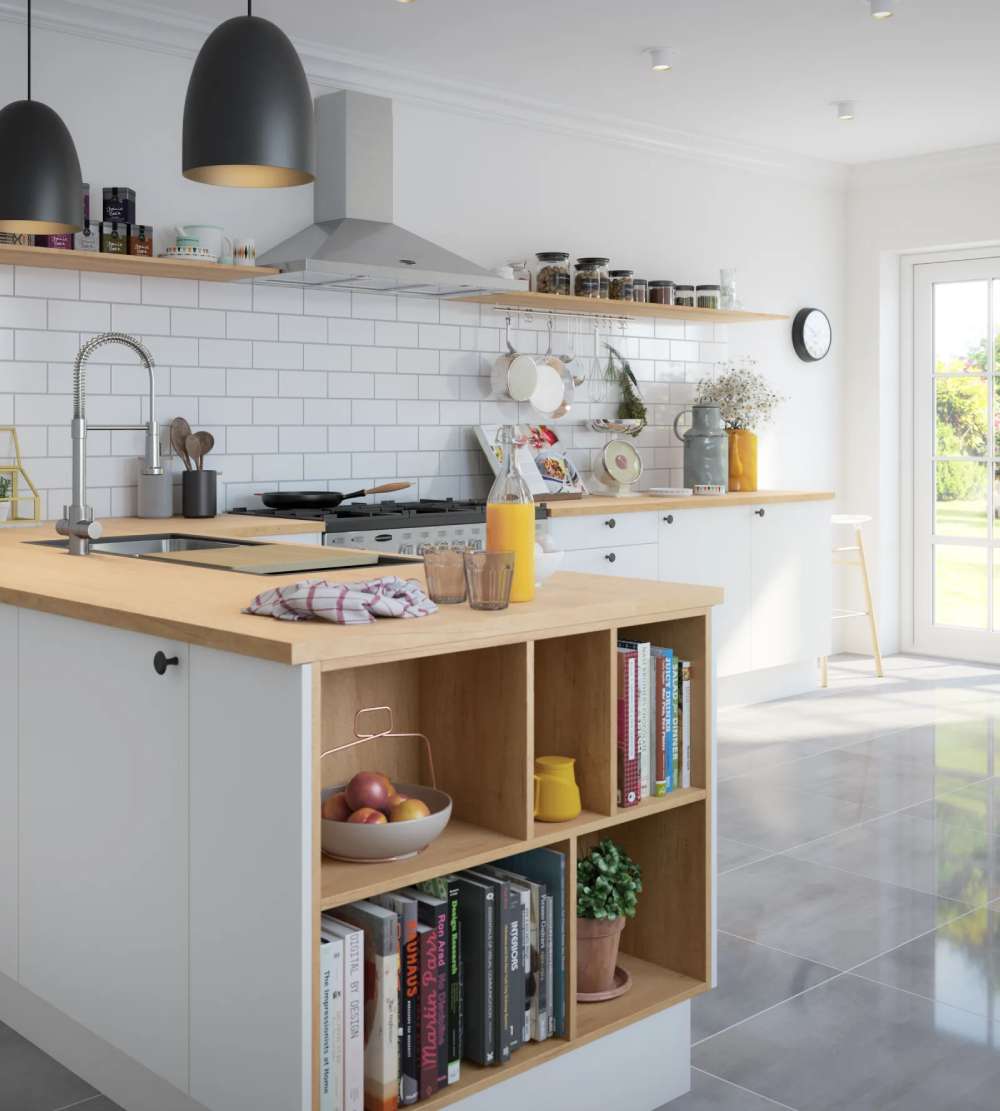
A breakfast bar is a raised or counter-height surface attached to a kitchen counter, island, or peninsula, designed for casual dining and quick meals. It differs from a full dining table and from a kitchen peninsula in one key way: seating runs along just one side, keeping the layout simple and space-efficient.
Standard bar height sits at 42 inches from the floor to the surface. Counter-height bars sit lower, at 36 inches, and pair with counter stools rather than bar stools. The bar top overhang depth should be a minimum of 8.5 inches so knees don’t hit the cabinet face below (Hardwoods Incorporated).
Works in kitchens from roughly 80 square feet upward, depending on the layout type chosen. The structure itself can be a simple worktop extension, a peninsula end, or a freestanding unit.
3 core configurations:
- Counter overhang attached to existing cabinetry
- Peninsula end with seating on the room-facing side
- Freestanding breakfast bar unit positioned in an open-plan space
The space planning decisions you make at this stage affect every other choice: stool height, overhang depth, lighting, and storage all depend on which configuration you go with.
What Breakfast Bar Layout Works Best for Your Kitchen?
The right layout depends on your floor plan, not your style preference. There are 4 main configurations, and each one solves a different spatial problem.
Houzz’s 2024 U.S. Kitchen Trends Study (3,437 respondents) found that 43% of homeowners are now making their kitchens more open to adjacent spaces, up from 38% in 2021. A breakfast bar is one of the most practical ways to do this without removing walls.
| Layout Type | Best For | Minimum Space Needed |
|---|---|---|
| Straight Overhang | Small kitchens and quick, high-impact add-ons. | 12-inch depth clearance for knee space. |
| L-Shaped Peninsula End | Galley and L-shaped kitchen configurations. | 42-inch aisle clearance on at least one side. |
| Freestanding Bar | Open-plan layouts and rental properties. | 48 inches of clearance on all sides for traffic flow. |
| Waterfall Edge Island Bar | Large, luxury open-plan kitchen spaces. | 80+ square feet of dedicated kitchen floor area. |
Straight Counter Overhang Layout
The simplest and least expensive option. An overhang extension added to an existing counter run creates an instant breakfast bar without structural work.
The overhang needs a minimum 12-inch depth for knee clearance, though 15 inches is more comfortable for extended use. This layout suits kitchens where floor space is tight and a 2-seat bar is the goal.
Peninsula End Bar Layout
A peninsula end bar closes one side of a galley or L-shaped kitchen, creating a natural zone division while adding seating. It works without removing walls or adding freestanding furniture.
Key clearance rule: maintain 42 inches between the bar edge and the opposite counter for a single-cook kitchen, or 48 inches if multiple people use the kitchen at once.
IKEA’s kitchen planning service frequently recommends peninsula configurations as the most space-efficient seating solution for kitchens under 150 square feet, pairing SEKTION base cabinets with a custom overhang top.
Freestanding Breakfast Bar Layout
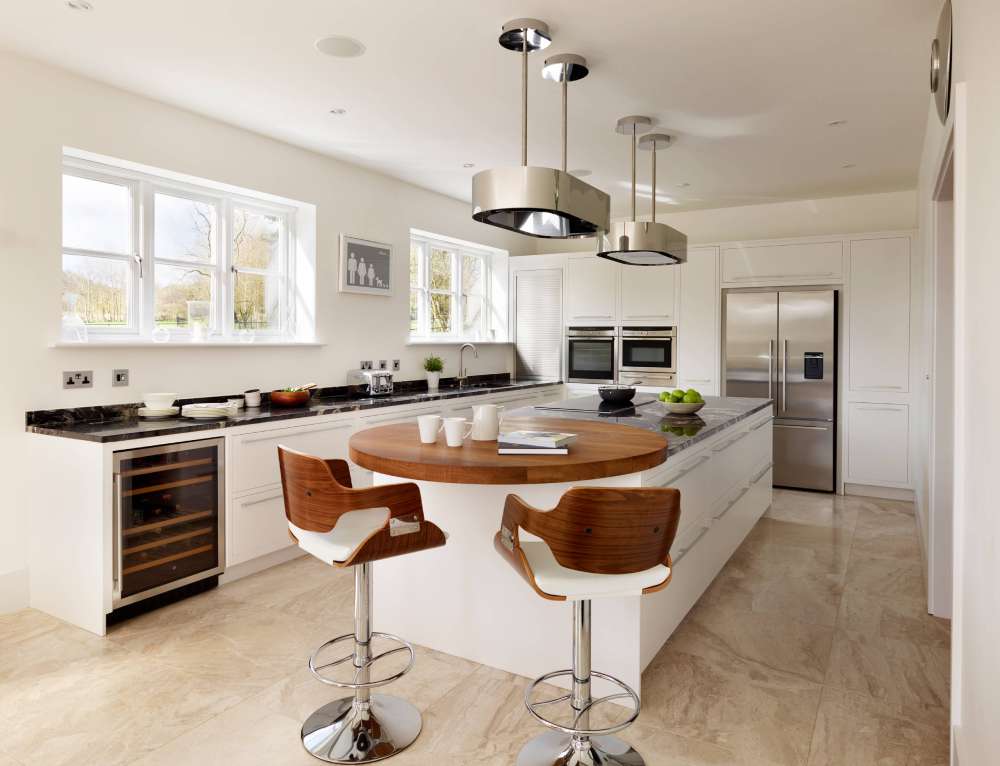
Image source: Harvey Jones Kitchens
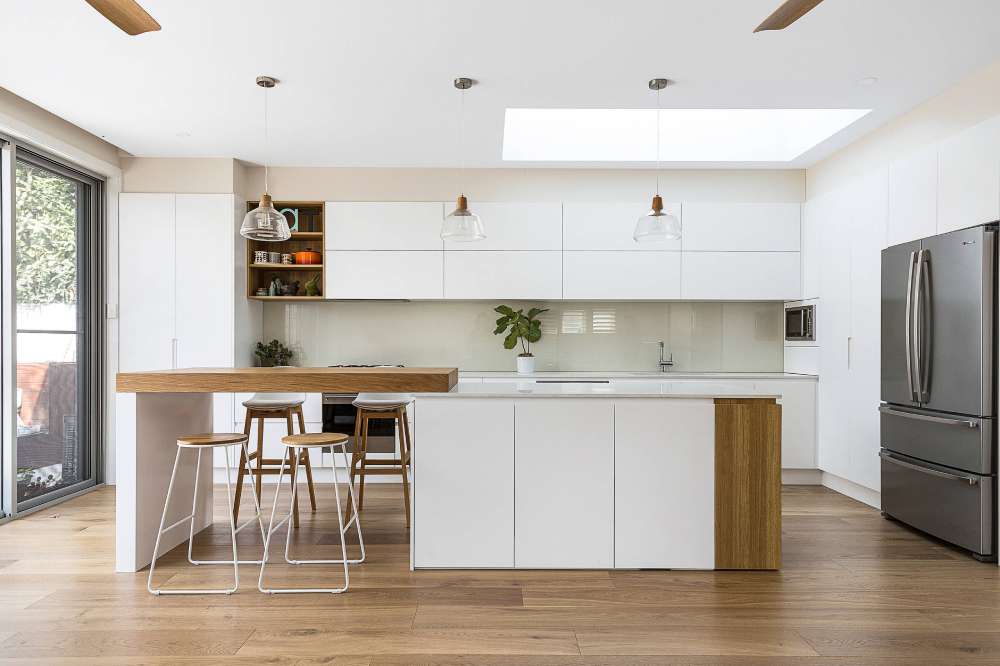
Freestanding bars need no wall or cabinet attachment, which makes them ideal for open-plan spaces or rental homes.
Positioning matters. Place the bar so it reads as a zone separator between the kitchen and living areas, not as a random obstruction in the middle of the floor. Allow 48 inches of clearance on all sides for safe traffic flow.
What Size Should a Breakfast Bar Be?
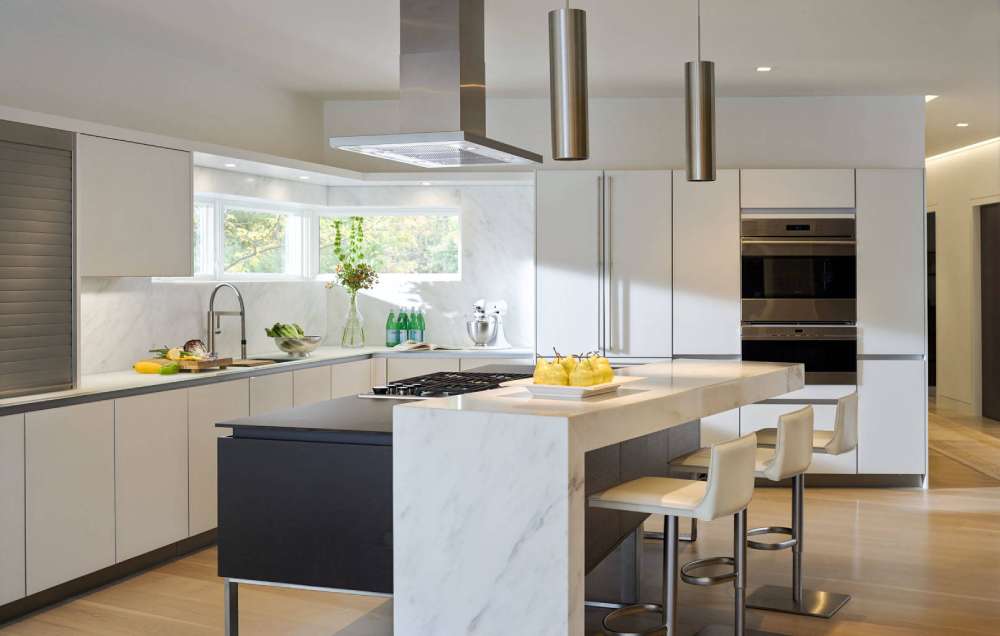
Image source: Roundtree Construction
Allow 24 to 28 inches of linear counter space per seat. At 24 inches, seating is workable but tight. At 28 inches, each person has comfortable elbow room for eating and laptop use.
A 2-seat bar needs at least 48 inches of counter run. A 4-seat bar needs 96 inches minimum. These are absolute minimums based on standard industry dimensions (Hardwoods Incorporated, Upgradedhome.com).
Height and Stool Pairing
Getting the height wrong means uncomfortable seating for anyone who uses it daily. The 12-inch rule applies across all configurations: the seat height should always sit 12 inches below the bar surface.
| Bar Height | Stool Seat Height | Common Use |
|---|---|---|
| 30 inches (Table height) | 18 inches | Low breakfast tables and dining areas. |
| 36 inches (Counter height) | 24 inches | Standard kitchen island counters and peninsula bars. |
| 42 inches (Bar height) | 30 inches | Raised island bars, home wet bars, and peninsula extensions. |
Overhang Depth and Ceiling Height Factors
Overhang depth should be 12 inches at minimum and 15 inches as the preferred target. Any deeper than 20 inches and the bar starts to feel more like a dining table than a casual eating counter.
Ceiling height affects which bar height works. Rooms under 8 feet feel cramped with a 42-inch bar and tall bar stools. In those cases, counter-height configurations (36 inches) keep proportions comfortable.
The scale and proportion relationship between bar height, stool height, and ceiling height is one of the most common sizing mistakes in kitchen design. Get the ceiling height first, then work backward to choose bar height.
Which Breakfast Bar Materials Suit Different Kitchen Styles?
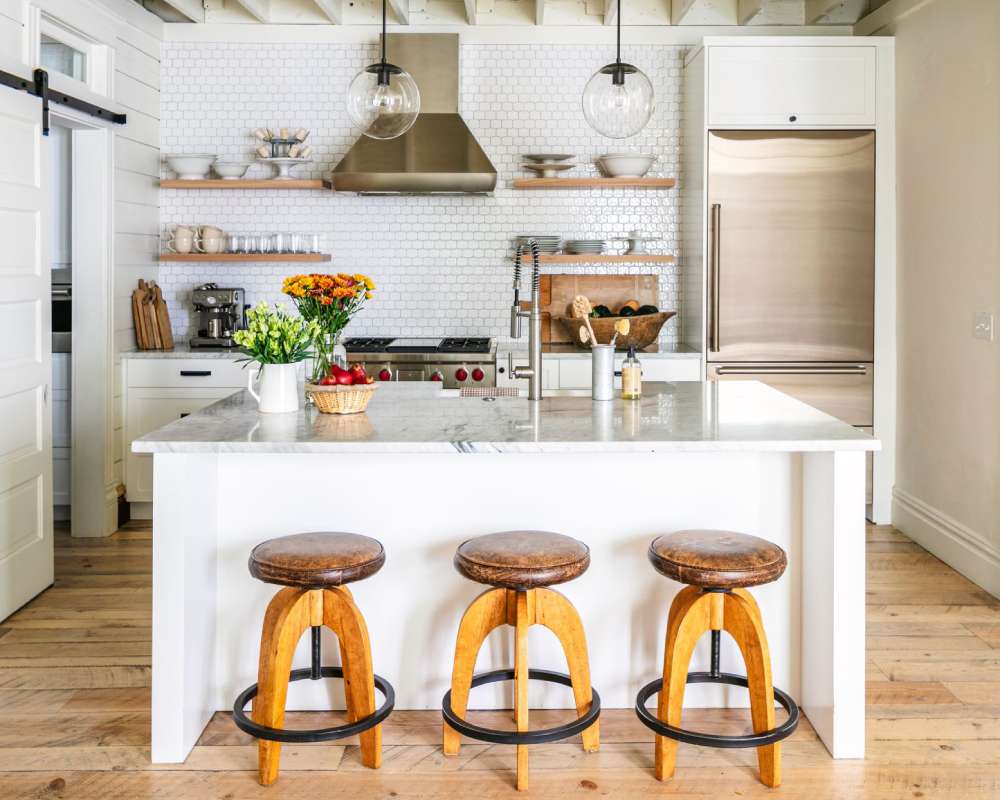
Material choice affects maintenance, durability, and style fit. There are 6 main worktop materials used for breakfast bars, each with a different performance profile and price point.
Houzz’s 2024 UK Kitchen Trends Report found that how the material looks and feels is the top consideration for 71% of homeowners choosing worktops. Durability ranked second.
Quartz and Granite Breakfast Bar Tops
Quartz resists stains and heat without sealing and holds up well in high-use bars. It suits modern, minimalist, and transitional kitchens. Expect to pay $50 to $120 per square foot installed.
Granite needs annual sealing but offers more visual variation and a premium look. Both materials work with the contemporary kitchen island formats that use waterfall edges and handleless cabinetry.
Best for: modern minimalist, transitional, and contemporary kitchen styles.
Wood and Butcher Block Breakfast Bar Tops
Butcher block adds warmth that quartz and granite cannot replicate. It suits farmhouse, Shaker, and rustic kitchen styles particularly well. The trade-off: it needs oiling every 6 to 12 months and can stain if spills are left sitting.
American white oak and hard maple are the most durable species for high-contact bar surfaces. Softwoods like pine dent and scratch too easily for a daily-use breakfast bar.
Cost runs $30 to $60 per square foot installed, making it one of the more affordable natural-material options.
Concrete and Laminate Breakfast Bar Tops
Concrete: suits industrial and minimalist kitchens. Needs sealing every 1 to 3 years. Prone to hairline cracking if the substrate flexes. Laminate: lowest-cost option, starting around $20 per square foot installed. Not heat-resistant. Edges chip over time with heavy use. Best suited to budget renovations or rental properties where longevity is not the priority.
The gap between concrete and laminate in durability is significant. For a bar that gets daily use from 2 or more people, laminate is a short-term fix, not a long-term solution.
What Are the Best Breakfast Bar Ideas for Small Kitchens?
Small kitchens require solutions that add seating without blocking circulation or making the space feel crowded. 5 approaches work consistently in kitchens under 120 square feet.
According to the 2024 Houzz UK Kitchen Trends Report, 60% of homeowners made their kitchens larger during renovation. For those who cannot expand, compact bar solutions are the practical alternative.
Fold-Down and Wall-Mounted Breakfast Bar Ideas
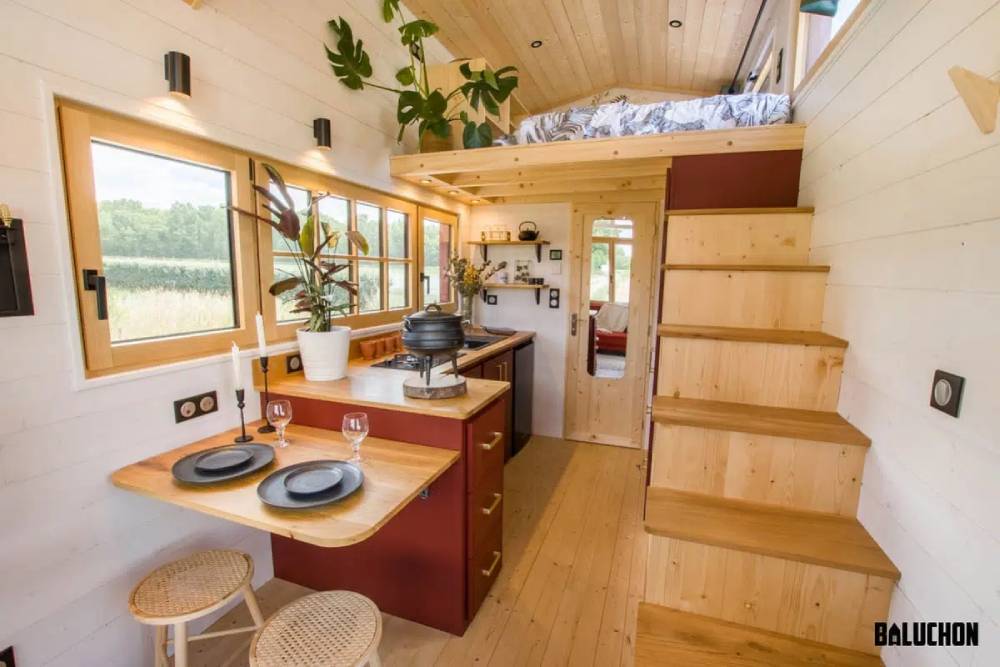
A fold-down wall-mounted bar frees up floor space completely when not in use. It suits kitchens under 100 square feet where a permanent structure would block traffic flow.
- Mounts directly to a wall stud or solid masonry
- Folded-down surface typically 18 to 24 inches deep
- Pairs with backless folding stools that store flat against the wall
- Max load capacity: check manufacturer specs before mounting
IKEA’s NORBO fold-down wall-mounted table is one of the most widely used solutions in this category, supporting up to 110 lbs when properly wall-anchored.
Narrow Overhang Bars for Tight Layouts
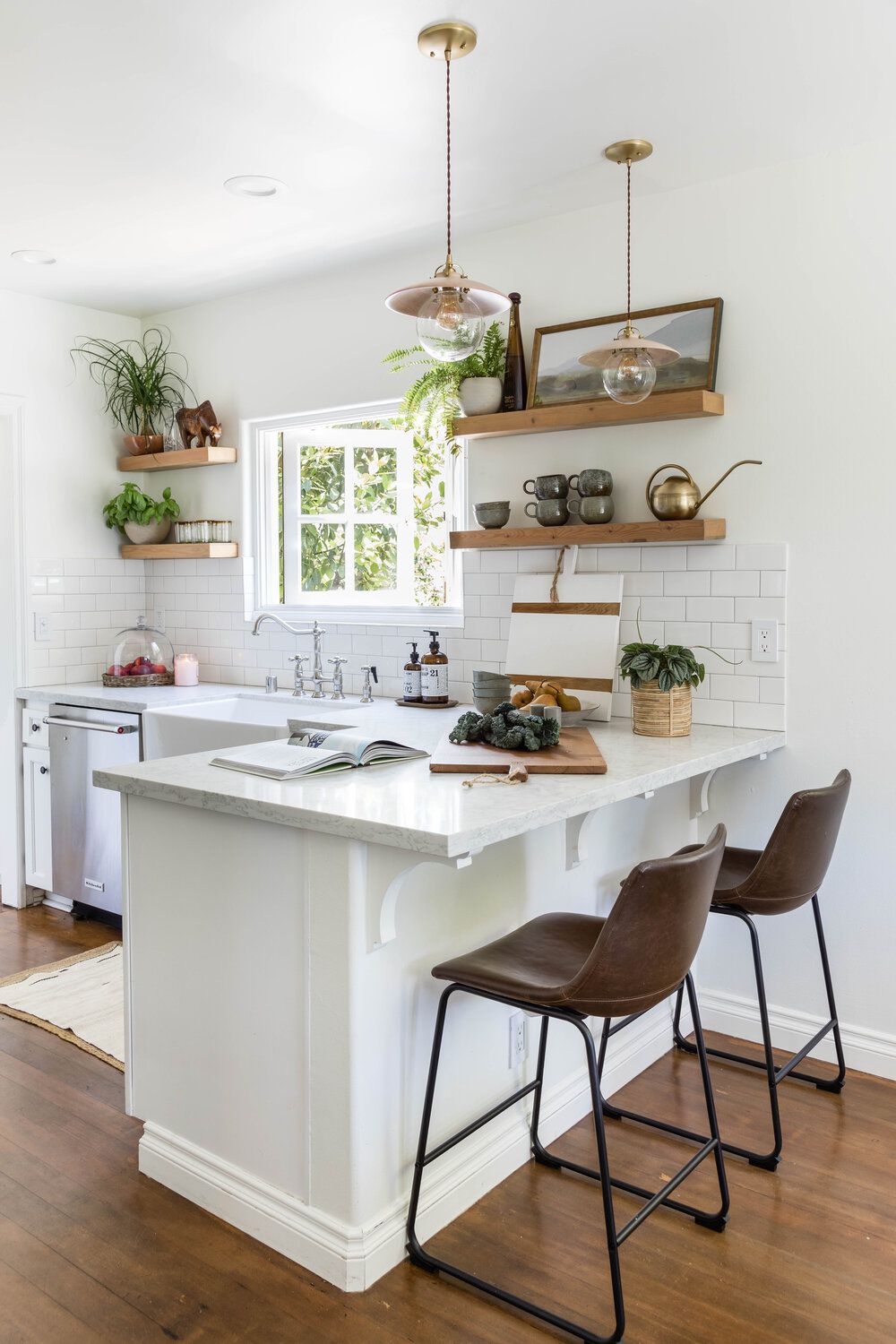
Image source: Vuong Interior Design
A 12-inch overhang attached to an existing counter adds 2 seats without consuming extra floor space. This works because the seating occupies the aisle that already exists between the counter and the opposite wall.
Use backless bar stools so they slide fully under the overhang when not in use. Backed stools protrude into the aisle even when unoccupied, reducing effective circulation width.
Light-colored bar fronts or mirrored panels on the room-facing side of the bar structure reduce visual mass. This is a practical application of light in interior design: reflective surfaces in tight spaces prevent the bar from feeling like a wall.
What Breakfast Bar Ideas Work in Open-Plan Kitchens?
A breakfast bar in an open-plan kitchen does two jobs: it provides seating and it defines the kitchen zone without a physical wall. Getting the positioning right is what separates a bar that works from one that interrupts the room’s flow.
Houzz’s 2024 Kitchen Trends Study found that 64% of homeowners who opened their kitchens cited improved functionality as the primary reason. A well-placed breakfast bar supports that functionality by anchoring the kitchen zone and reducing through-traffic.
43% of renovating homeowners in 2024 are designing open-concept kitchen layouts, compared to 38% in 2021 (Houzz). That shift creates direct demand for zone-defining features like peninsula bars and island seating.
Peninsula Bar as a Zone Divider
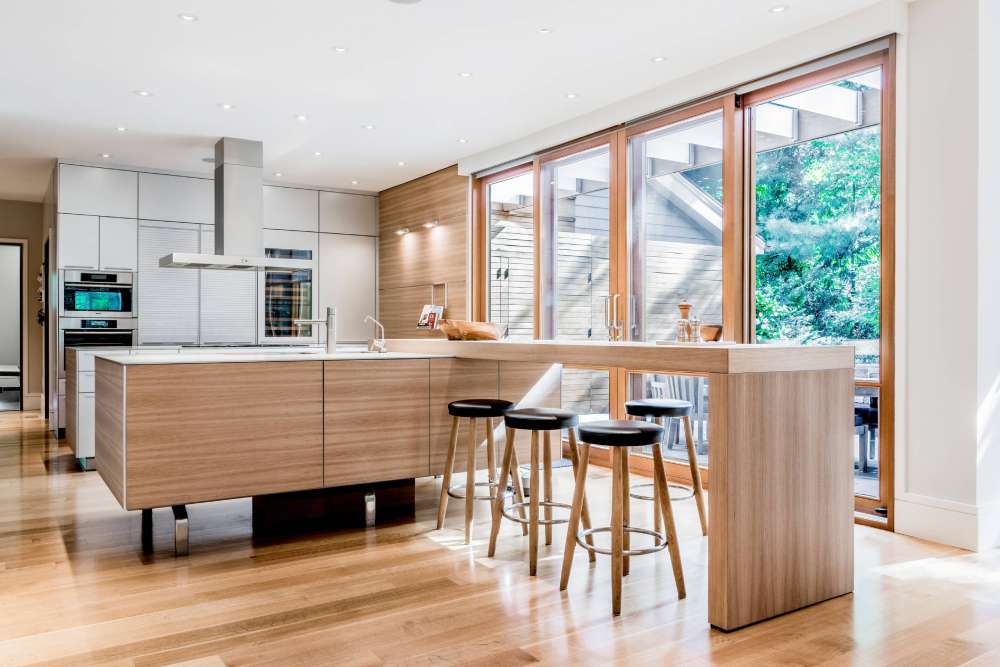
Image source: Koncerted – Home Automation & Home Media
A peninsula bar separates the kitchen from a living or dining zone without closing off sightlines. Seating faces the living space, which means guests can sit at the bar and remain part of the conversation while food is being prepared.
Bar height (42 inches) conceals kitchen prep activity from seated guests. Counter height (36 inches) keeps sightlines fully open. The choice depends on whether privacy during cooking matters in your household.
This is a direct application of open floor plan design logic: use furniture and surface heights to suggest zones rather than enforce them with walls.
Waterfall-Edge Island Bar
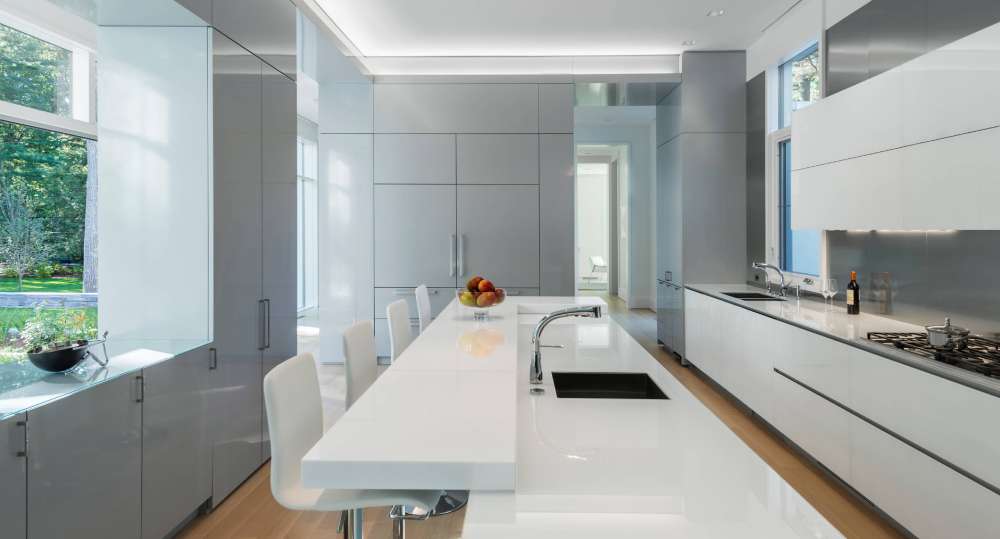
Image source: The Lagasse Group, LLC
A waterfall edge island with bar seating on one side defines zones while keeping the visual line clean. The continuous surface that runs from the countertop down the side of the island creates a strong visual anchor in the room.
Bar seating on the room-facing side, storage cabinetry on the kitchen side. This double-function approach is why 78% of designers cited kitchen islands as their top build priority for 2024, according to the National Kitchen and Bath Association report.
The wrap-around seating trend noted by the NKBA moves away from all-in-a-row seating toward arrangements that encourage more face-to-face conversation. A waterfall island with an L-shaped seating overhang accomplishes exactly that.
Which Breakfast Bar Stool Styles and Heights Fit Each Bar Type?
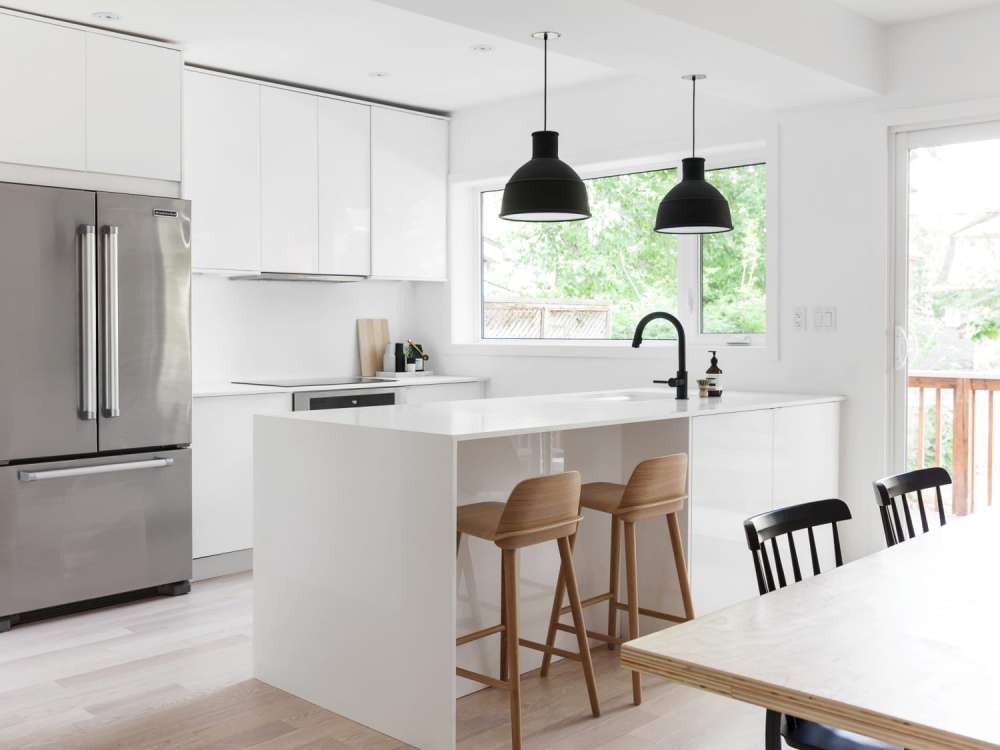
Stool selection is determined by bar height first, kitchen style second. Getting the height wrong makes the bar uncomfortable regardless of how good the stool looks.
The 12-inch rule is non-negotiable: seat height must sit 12 inches below the bar surface. That gap allows enough thigh clearance for comfortable seated posture without hunching or straining.
Counter-Height vs Bar-Height Stool Selection
Counter-height stools (24 to 26-inch seat height) pair with 36-inch bars. Bar-height stools (28 to 30-inch seat height) pair with 42-inch bars. Mixing these up is the single most common breakfast bar purchasing mistake.
| Bar Surface Height | Correct Stool Seat Height | Stool Type |
|---|---|---|
| 36 inches | 24 to 26 inches | Counter stool |
| 42 inches | 28 to 30 inches | Bar stool |
| 30 inches (table height) | 18 inches | Standard dining chair |
Backless, Backed, and Swivel Stool Options
Backless stools slide fully under the bar overhang when not in use, keeping the space visually clean and the aisle clear. Best for small kitchens and narrow bars where every inch of circulation width matters.
Backed stools provide better posture support for extended use, making them the better choice for households where the bar doubles as a workspace or homework area.
Swivel stools suit corner bars and L-shaped configurations where users rotate frequently to face different parts of the room. Fixed stools work better at straight bar runs where movement direction is consistent.
Material matching guidance that holds up across most kitchen styles:
- Upholstered seats: family kitchens with counter-height bars
- Metal frame stools: industrial kitchen and contemporary styles
- Wood stools: farmhouse, Shaker, and Scandinavian kitchens
- Rattan or wicker: coastal and Bohemian interior styles
What Lighting Works Best Above a Breakfast Bar?
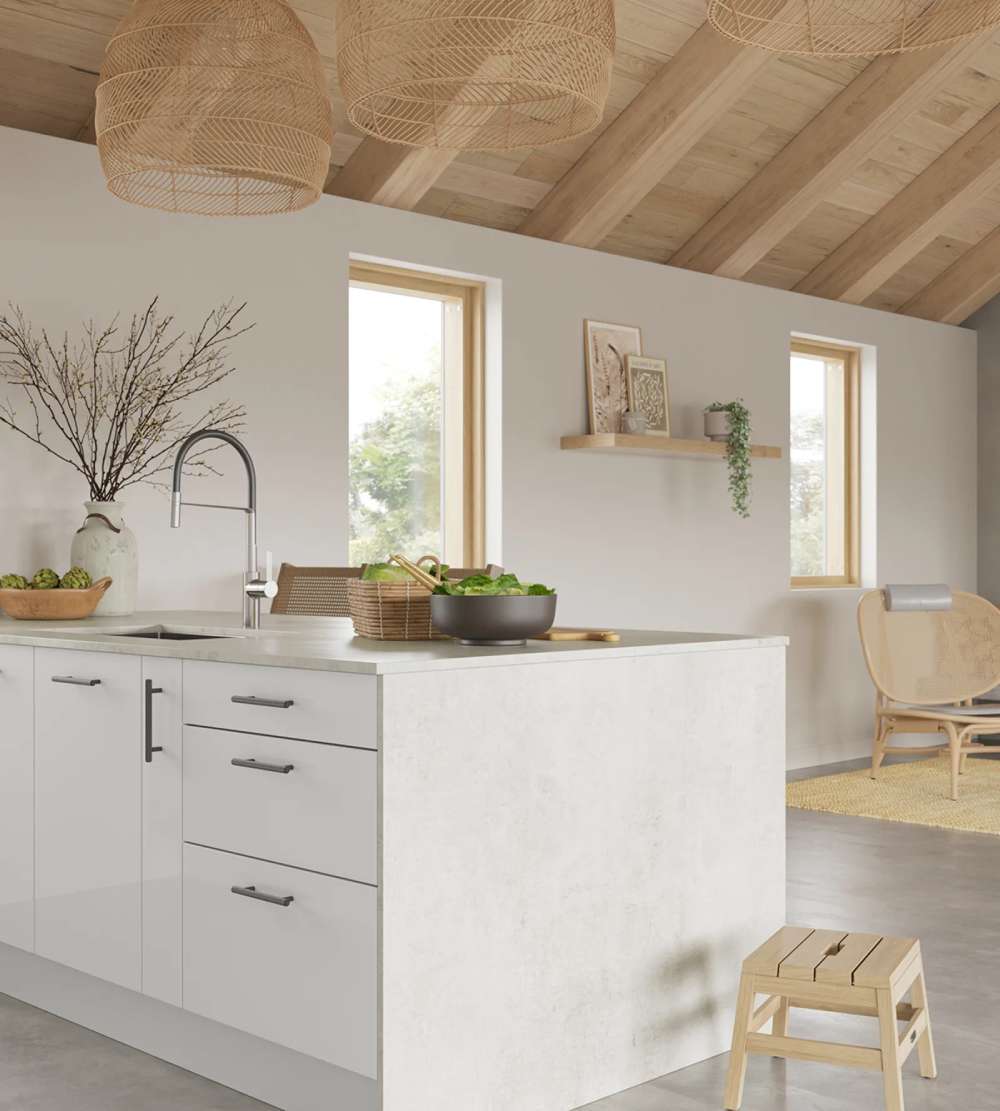
Pendant lights hung 30 to 36 inches above the bar surface are the standard for task lighting over a breakfast bar. That range keeps the light focused on the counter without blocking sightlines or sitting at eye level for someone seated (Visual Comfort, Lightopia).
The Fixr.com 2024 Kitchen Trends survey of 71 design experts found that 28% of pros rank statement lighting as one of the top kitchen trends continuing into 2024 and beyond, with open-plan layouts increasing demand for dramatic fixtures above islands and bars.
Pendant Lights Over a Breakfast Bar
Spacing and count rules:
- Space pendants 24 to 30 inches apart, measured center to center
- Allow at least 6 inches from the bar edge to the center of the nearest pendant
- One pendant per 2 seats is a reliable starting ratio for most bar lengths
- Add 3 inches of hanging height for every foot of ceiling above 8 feet
Pendant diameter should be roughly one-third to one-half the width of the bar overhang. Going too large visually crowds a narrow bar. Going too small makes the fixture look disconnected from the surface below (Seus Lighting, 2024).
Recessed Downlights and LED Strip Lighting
Recessed downlights work as a secondary light layer under a breakfast bar, not as the primary source. They need direct alignment above the bar edge. Off-center placement casts shadows across the work surface rather than illuminating it.
LED strip lighting under upper cabinets adds ambient lighting fill at a color temperature of 2700K to 3000K, which suits most kitchen environments. Cooler temperatures (4000K and above) tend to make the bar feel clinical rather than inviting.
Key rule: layered lighting performs better than a single source. One pendant type alone leaves areas of the bar in shadow during evening use.
Style-Matched Lighting by Bar Type
| Bar Style | Fixture Type | Finish |
|---|---|---|
| Farmhouse | Lantern pendants | Matte black or antique brass |
| Industrial | Cage pendants, Edison bulb fittings | Raw steel, aged metal |
| Scandinavian | Minimal globe or cone pendants | Brushed nickel or white |
| Modern minimalist | Linear suspension or recessed only | Matte white or chrome |
| Coastal | Rattan shades, woven pendants | Natural fiber or brushed brass |
How Do You Add Storage to a Breakfast Bar?
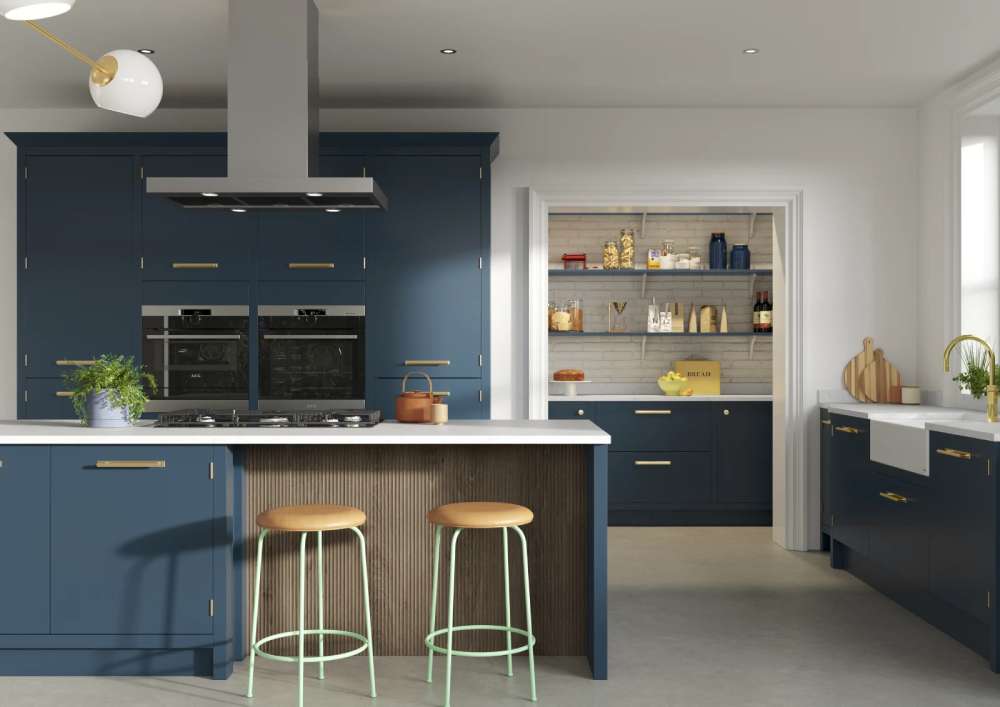
Storage integrated into the bar structure itself removes the need for additional furniture in the kitchen. The room-facing side of any breakfast bar is usable space that most people leave blank.
NKBA’s 2024 Kitchen Trends Report found that usability is the top goal across kitchen categories, with more than 50% of respondents seeking built-in storage solutions and 37% wanting customizable drawer dividers in their kitchen cabinetry.
Open Shelving on the Room-Facing Side
Open shelving on the room-facing side of a peninsula bar stores cookbooks, baskets, and everyday items without adding closed cabinetry bulk. It keeps the bar visually lighter than a full cabinet run would.
Keep shelf depth at 10 to 12 inches maximum. Deeper shelves on the room side of a bar make the structure feel more like a room divider wall than a casual eating counter.
Integrated Drawer Units and Toe-Kick Storage
Drawer units: utensil and napkin storage within the bar base, no footprint increase. Toe-kick drawers: recessed base space holds flat items (baking trays, placemats, cutting boards). Wine rack inserts: standard units fit 9 to 12 bottles in the base cabinet space below a bar overhang.
The Houzz 2024 U.S. Kitchen Trends Study found that drawers and cabinets with doors are the most common island storage features, chosen by 80% of homeowners who updated their island cabinetry.
Cable Management and Countertop Utility
Built-in cable channels routed through the bar top or base keep phone chargers and small appliances organized. Pop-up countertop outlets are now code-compliant under the 2023 NEC update, which removed the requirement for side-mounted receptacles on islands and peninsulas.
This is a meaningful shift for bar design. Clean countertop surfaces are now achievable without sacrificing power access entirely, using listed pop-up assemblies flush with the bar surface.
What Are the Best Breakfast Bar Ideas by Kitchen Style?
Style fit affects long-term satisfaction more than almost any other design decision. A bar that suits the kitchen’s existing aesthetic reads as intentional. One that doesn’t creates a visual conflict that no amount of accessorizing fixes.
Houzz’s 2024 UK Kitchen Trends Report confirmed that how a material looks and feels is the top consideration for 82% of homeowners choosing cabinetry, and 71% for worktop selection. Style coherence drives those decisions more than cost or durability alone.
Farmhouse and Industrial Breakfast Bar Ideas
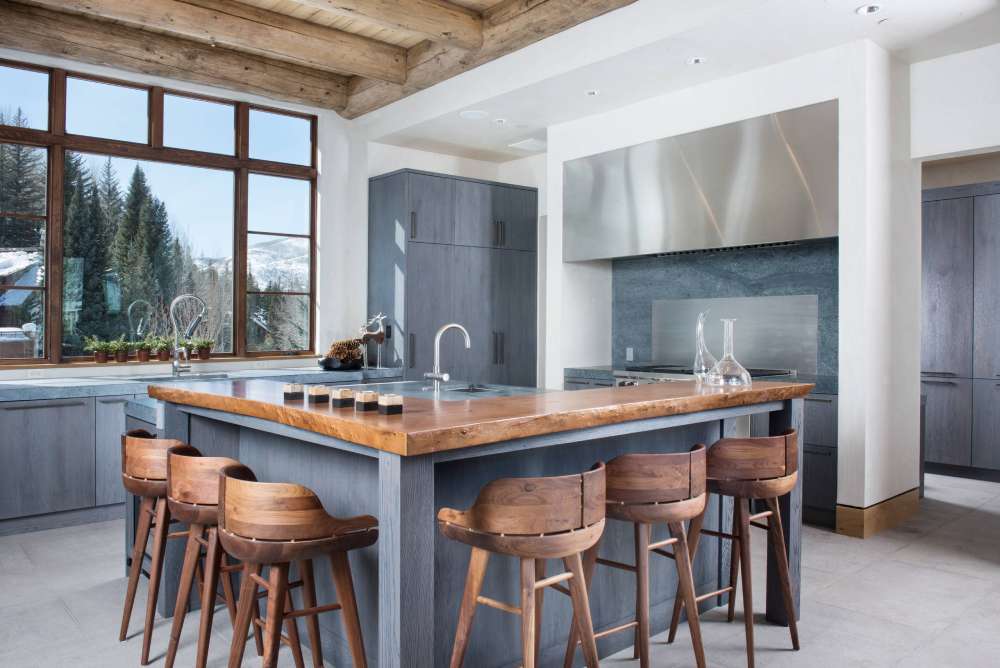
Image source: Reed Design Group
Farmhouse bars work best with butcher block tops, Shaker-style fronts, and matte black hardware. Sage green or white painted finishes are the most consistent color choices in this category. The farmhouse interior design approach prioritizes warmth and lived-in texture over sleek uniformity.
Industrial bars are a different calculation. Concrete or steel tops, exposed bolt hardware, and raw wood or dark metal stools define the look. Edison bulb pendant fittings above the bar reinforce the aesthetic without overpowering it.
Key material contrast: farmhouse leans warm and organic, industrial leans raw and structural. Mixing both in a single bar rarely works unless the kitchen itself is already hybrid in style.
Scandinavian and Minimalist Breakfast Bar Ideas
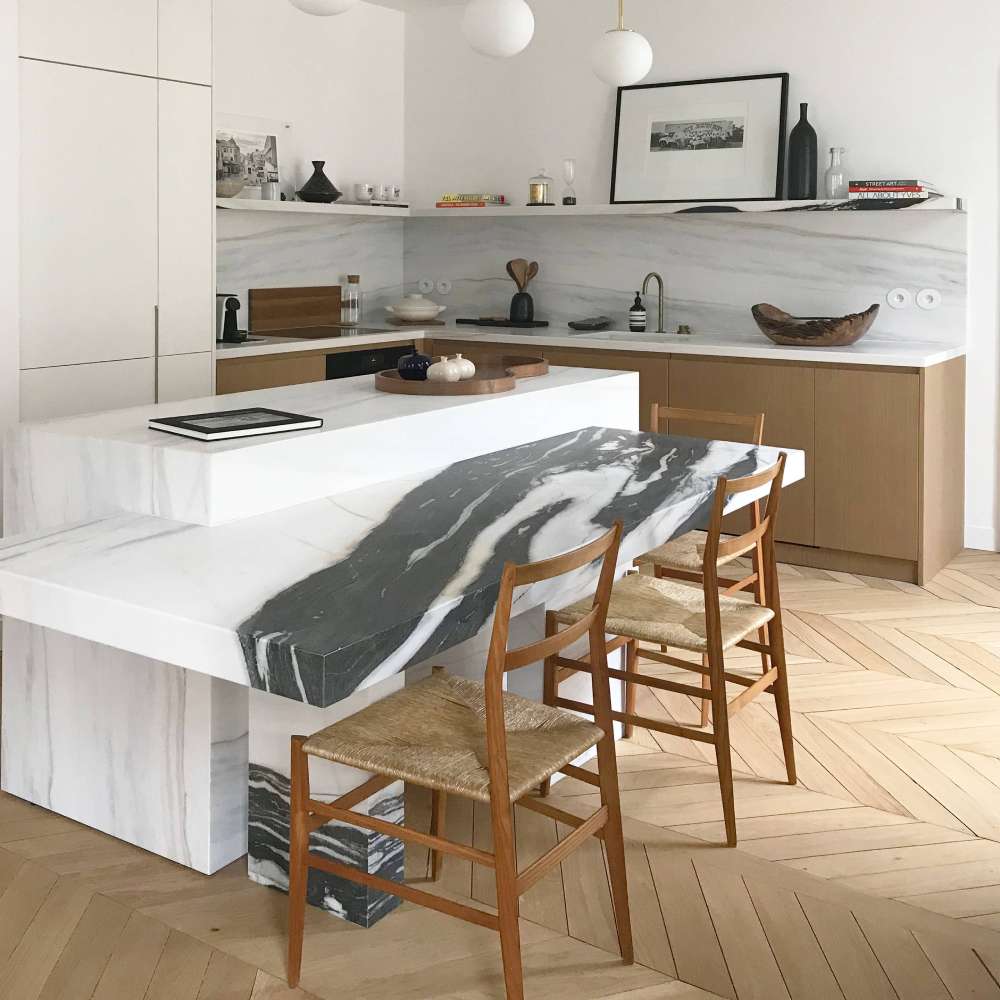
Image source: LISA O. MERCADIER / ARCHITECTE D’INTERIEUR
Nordiska Kök’s Swedish kitchen design projects consistently use light oak or white oak bar surfaces with handleless fronts and simple backless stools. That combination is a direct expression of Scandinavian interior design: functional, uncluttered, and material-led.
Nordiska Kök notes that soft, rounded shapes in worktops and islands are continuing to grow in 2024 and 2025, moving away from hard-edged rectangular profiles toward more organic forms.
- Bar top: light oak, white laminate, or pale quartz
- Front: handleless flat-panel in white or greige
- Stools: simple wood or wire-frame backless designs
For minimalist bars, a quartz top with a waterfall edge and integrated handleless pulls removes all unnecessary visual detail. The bar reads as an extension of the countertop rather than a separate piece of furniture.
Coastal Breakfast Bar Ideas
Coastal bars use white or driftwood-painted finishes, white quartz or marble tops, and rattan or white bar stools. The coastal interior design palette stays within soft blues, sandy neutrals, and warm whites.
Rope-detail or woven-shade pendants above the bar reinforce the nautical reference without crossing into themed territory. The goal is a bar that feels airy and relaxed, not one that looks like a beach gift shop.
One common mistake: using marble in a coastal bar without understanding its maintenance requirements. Marble etches from citrus and acidic foods, which is a real problem in a casual eating environment.
How Much Does a Breakfast Bar Cost to Install?
Costs vary significantly based on structure type, materials, and whether electrical or plumbing work is involved. A simple overhang extension and a fully custom peninsula bar are separated by $10,000 or more.
Angi’s 2024 data puts the average cost of a kitchen island at $4,800, with custom-built islands reaching $10,000 or above. A breakfast bar with seating added to an island runs $5,500 to $7,000 for a standard installation (Fixr.com).
Budget Breakfast Bar Options Under $600
A basic laminate overhang bar, materials and fitting combined, runs $200 to $600. This covers a straight counter extension with no cabinetry, no electrical work, and a standard laminate top.
IKEA’s BESTA and SEKTION base cabinet systems are the most commonly used platforms for DIY budget bars. Pairing a set of base units with a custom worktop top keeps the total under $600 for most 2-seat configurations.
Bar stools add $50 to $400 per seat depending on material and brand, and should be budgeted separately from the bar structure itself.
Mid-Range and Custom Breakfast Bar Costs
Mid-range bars using quartz or granite with new cabinetry fall between $1,500 and $4,000 installed. That range covers materials, a basic counter run, and standard fitting labor without structural changes.
| Bar Type | Estimated Cost Range | What’s Included |
|---|---|---|
| Laminate Overhang (DIY-friendly) | $200 – $600 | Basic materials and DIY fitting components. |
| Mid-range Quartz or Granite Bar | $1,500 – $4,000 | Cabinetry base, worktop surface, and professional labor. |
| Custom Peninsula with Storage | $5,000 – $12,000+ | Structural build, custom cabinetry design, and installation. |
| Electrical Outlet Addition | $200 – $500 extra | Licensed electrician fees for code-compliant installation. |
Plumbing or electrical additions raise costs substantially. A GFCI outlet added to a bar runs $200 per outlet (Thumbtack pro data). Structural changes, such as removing walls to create space for a peninsula, add $1,000 to $5,000 or more depending on load-bearing requirements.
What Building Regulations Apply to Breakfast Bar Installations?
Most simple bar additions require no permits. Once structural changes, plumbing, or electrical work enter the picture, regulations apply and ignoring them creates real problems at resale.
The 2024 U.S. Houzz Kitchen Trends Study found that 55% of homeowners hired general contractors for kitchen renovations in 2024, up from 50% in 2023, partly driven by growing complexity in structural and electrical work during kitchen remodels.
When No Permit Is Needed
A straight counter overhang extension with no plumbing and no new electrical circuits does not require a permit in most US jurisdictions or under UK Building Regulations. The bar is treated as furniture or a surface modification rather than structural work.
Freestanding breakfast bars also fall outside permit requirements in virtually all cases. Move them in, position them, done.
When Permits and Compliance Apply
Structural changes are the most common trigger. Removing a load-bearing wall to create space for a peninsula bar requires building control approval in the UK and a structural permit in the US. The wall type determines the cost and complexity.
Electrical requirements depend on what work is being done:
- The 2023 NEC update made receptacles optional on islands and peninsulas, but provisions for future outlets are still required during new construction
- Side-mounted outlets below the countertop are no longer permitted under 2023 NEC (safety-driven change)
- Pop-up countertop outlets must carry UL listing for kitchen/countertop applications
- All kitchen countertop outlets remain GFCI-protected, no exceptions
In the UK, any electrical work in a kitchen must comply with Part P of Building Regulations. Most homeowners use a registered electrician under the Competent Person Scheme to self-certify the work without requiring a local authority inspection.
Listed Buildings and Historic Homes
Listed buildings in the UK and historic homes in the US face additional layers of consent before structural changes. A peninsula bar that requires wall removal in a listed property needs Listed Building Consent before any work starts, regardless of how minor the structural impact appears.
The home renovation statistics consistently show that permit-related issues are among the top causes of project delays and resale complications. Pull the permit where required. It is far cheaper than retroactively certifying unpermitted work when selling.
FAQ on Breakfast Bar Ideas
What is the standard height for a breakfast bar?
The most common breakfast bar height is 42 inches, which pairs with 30-inch bar stools. Counter-height bars sit at 36 inches and use 24-inch stools. Always maintain a 12-inch gap between seat height and bar surface for comfortable seating.
How much overhang does a breakfast bar need?
A minimum overhang of 12 inches provides basic knee clearance. Fifteen inches is more comfortable for extended use. Anything beyond 20 inches starts to feel more like a dining table than a casual kitchen bar.
How many seats fit at a breakfast bar?
Allow 24 to 28 inches of linear counter space per seat. A 48-inch bar seats 2. A 96-inch bar seats 4. Go with 28 inches per person if the bar doubles as a workspace or homework area.
What is the best material for a breakfast bar top?
Quartz is the most practical choice for daily use. It resists stains and heat without sealing. Butcher block suits farmhouse kitchens but needs annual oiling. Laminate works on a budget but chips along edges over time.
Do I need a permit to add a breakfast bar?
A simple counter overhang with no plumbing or new electrical circuits needs no permit in most jurisdictions. Structural changes, wall removal, or added circuits require permits. Always check local building regulations before starting work.
What bar stool height do I need for my breakfast bar?
Match stool seat height to bar height using the 12-inch rule. Counter-height bars (36 inches) need 24-inch stools. Bar-height counters (42 inches) need 30-inch stools. Buying the wrong height is the most common breakfast bar seating mistake.
Can you add a breakfast bar to a small kitchen?
Yes. A fold-down wall-mounted bar works in kitchens under 100 square feet. A narrow 12-inch overhang on an existing counter adds 2 seats without consuming floor space. Use backless stools so they slide fully under when not in use.
How high should pendant lights hang above a breakfast bar?
Hang pendant lights 30 to 36 inches above the bar surface. Space them 24 to 30 inches apart, center to center. Add 3 inches of hanging height for every foot of ceiling height above 8 feet.
What is the difference between a breakfast bar and a kitchen island?
A kitchen island is freestanding and multi-functional, with access on all sides. A breakfast bar is a raised counter surface with seating along one side only. Islands tend to be larger; breakfast bars prioritize compact casual dining.
How much does a breakfast bar cost to install?
A basic laminate overhang bar costs $200 to $600 installed. Mid-range quartz or granite bars with cabinetry run $1,500 to $4,000. Custom peninsula builds with integrated storage reach $5,000 to $12,000 or more depending on materials and structural work.
Conclusion
This conclusion is for an article presenting the full range of breakfast bar ideas, from compact fold-down wall-mounted bars to custom peninsula builds with integrated storage and waterfall-edge countertops.
The decisions that matter most are the ones made early: bar height, overhang depth, and layout configuration determine everything else, including stool selection, pendant light placement, and how well the bar fits your kitchen’s circulation.
Material choice and kitchen style should align. A butcher block top in an industrial kitchen creates conflict; in a farmhouse kitchen, it belongs.
Get the counter height seating right, match the bar to your floor plan, and the result is casual dining space that earns its place in the kitchen every single day.

- Paint Colors That Go with Gray Floors - August 20, 2026
- What Color Bedding Goes with Dark Wood Furniture - August 18, 2026
- What Color Walls Go with Oak Floors - August 16, 2026


