

Most kitchens already have the space for proper wine storage. It is just sitting behind the wrong cabinet door.
A kitchen cabinet wine rack turns unused base cabinets, wall cabinets, or even toe-kick space into functional, horizontal bottle storage without a renovation or a standalone wine cooler.
This guide covers everything you need to make a smart choice:
- The 5 main types and which fits your cabinet layout
- Sizing, materials, and bottle capacity by cabinet width
- The best ready-made products and DIY build options
- Where to place a rack and what locations to avoid
- Small kitchen solutions that use dead space most homeowners ignore
What Is a Kitchen Cabinet Wine Rack?
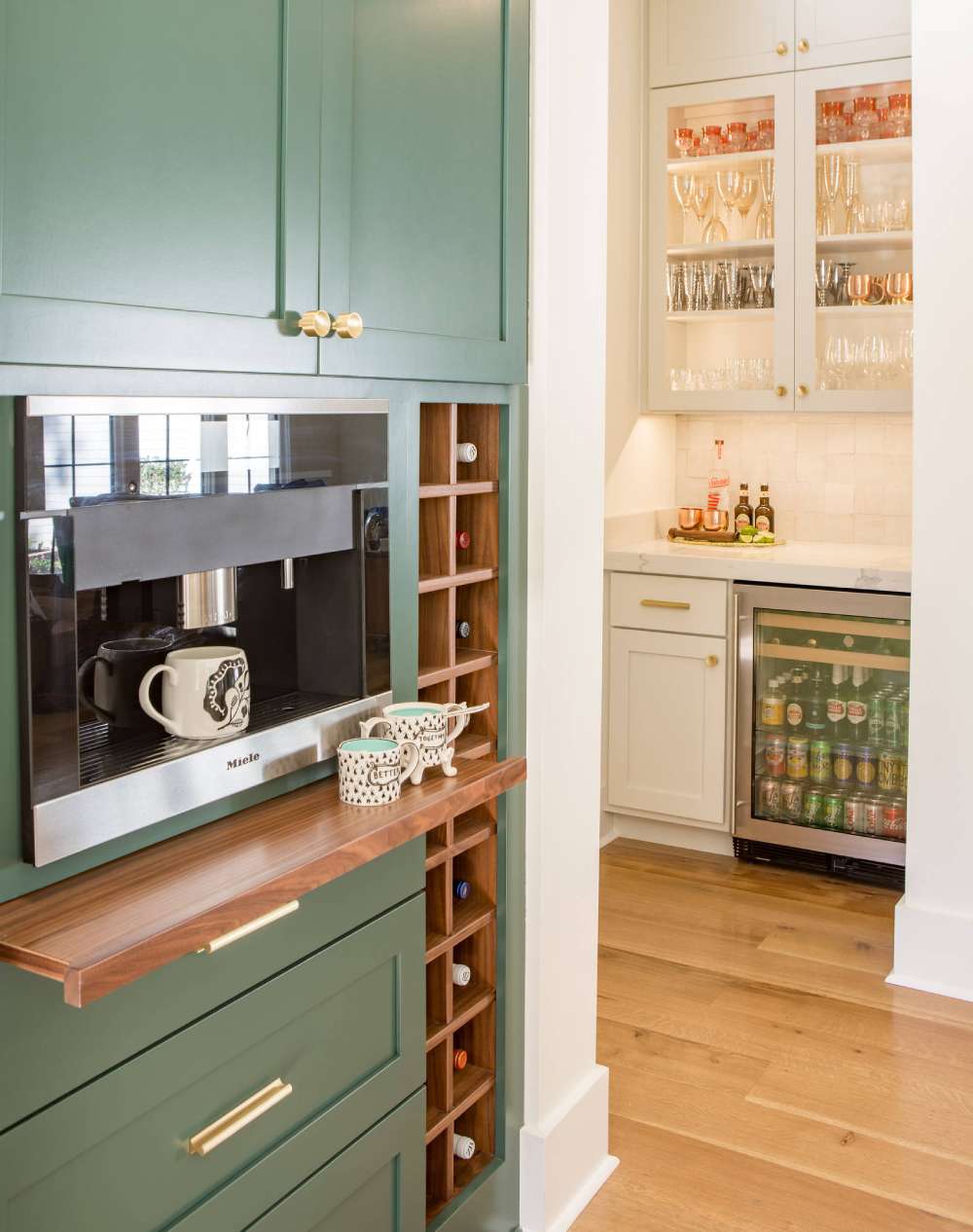
Image source: Lindsey Black Interiors
A kitchen cabinet wine rack is a built-in, mounted, or inserted storage unit that holds wine bottles inside an existing kitchen cabinet. It is not a standalone wine cooler, not a wine bar cabinet, and not a freestanding floor unit.
The defining feature: bottles sit horizontally. That position keeps corks moist and prevents oxidation, which is the main reason horizontal bottle storage matters for anything beyond a few days.
The global wine storage cabinets market was valued at $4.6 billion in 2023 and is projected to reach $4.9 billion by 2030 (Verified Market Reports, 2024). Residential usage is forecast to capture 35.5% of wine rack market revenue in 2025, driven largely by homeowners integrating storage directly into kitchen cabinetry (Future Market Insights, 2025).
3 primary forms exist:
- Integrated cabinet insert (fixed inside a base or upper cabinet)
- Pull-out drawer rack (mounted on drawer slides in a base cabinet)
- Door-mounted rack (attached to the inside face of a cabinet door)
Key difference from a wine cabinet: A wine bar cabinet is a standalone furniture piece with temperature control, UV-resistant glass, and humidity regulation. A kitchen cabinet wine rack uses the ambient environment of the kitchen. It suits short-term storage under 6 months, not long-term aging.
A wine cabinet also costs between $300 and $3,000+. A built-in cabinet rack runs $20 to $200. That gap matters when the goal is accessible daily storage, not a cellar.
What Are the Main Types of Kitchen Cabinet Wine Racks?
5 distinct types exist, each defined by mounting position, bottle capacity, and the cabinet configuration it requires. Picking the wrong type for your cabinet layout is the most common mistake.
| Type | Cabinet Position | Typical Capacity | Best For |
|---|---|---|---|
| Pull-out rack | Base cabinet (12–18″ wide) | 6–20 bottles | Frequent access, daily drinkers |
| Upper cabinet insert | Wall cabinet (30–42″ tall) | 6–12 bottles | Short-term storage, smaller collections |
| Corner cabinet rack | Corner base cabinet | 8–16 bottles | Reclaiming dead corner space |
| Under-cabinet hanging rack | Below wall cabinet | 4–9 bottles | Small kitchens, counter-height access |
| Cabinet door rack | Door interior (base or pantry) | 4–6 bottles | Overflow storage, limited cabinet space |
Upper Cabinet Wine Rack Inserts
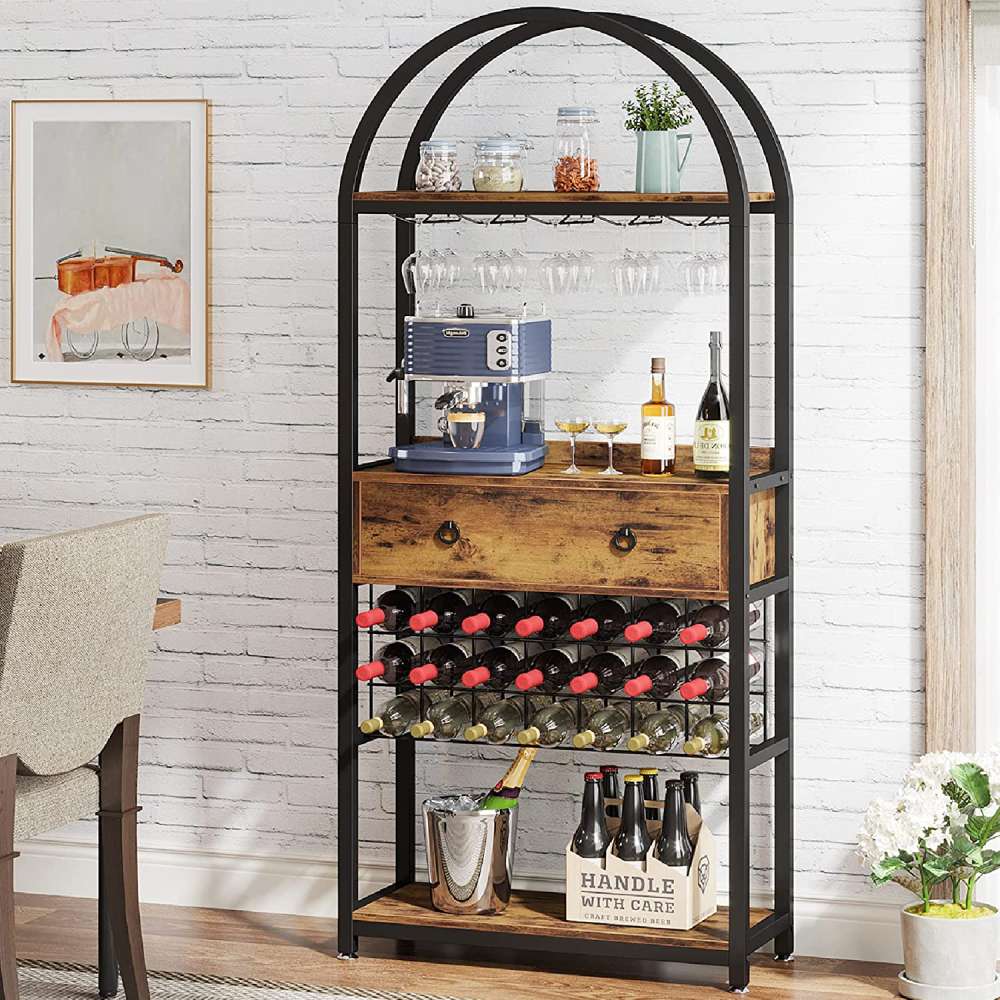
Best for: kitchens with 30 to 42-inch wall cabinets and bottles consumed within 1 to 3 months.
Upper cabinet inserts slot between or replace existing shelves. Omega National Products makes wood inserts in multiple finish options that match painted or stained cabinetry. Installation requires no drawer slides, just accurate interior width measurements.
One practical note: upper cabinets sit closer to ceiling heat. Avoid placing inserts directly above the refrigerator or oven where ambient temperatures stay above 70 degrees F.
Lower Cabinet Pull-Out Wine Racks
The Rev-A-Shelf 5375 series is the most widely installed pull-out wine rack in base cabinets. It holds up to 20 bottles, requires a minimum 15-inch cabinet opening, and uses a gas-spring soft-open and soft-close mechanism with a 75 lb weight limit (Richelieu Hardware specs).
Pull-out racks give full visibility of every bottle. You pull, you see the labels, you grab. That is genuinely more convenient than reaching into an upper cabinet insert.
Critical requirement: the cabinet door must open a full 90 degrees. Pull-out racks cannot extend with a partially blocked door swing. Check this before ordering.
Under-Cabinet Hanging Wine Racks
These mount to the underside of a wall cabinet and hold bottles horizontally using suspended slots. They use space that otherwise sits empty.
- Typical capacity: 4 to 9 bottles
- Mounting: toggle bolts into studs or cabinet base plate
- Minimum clearance needed: 18 inches above the countertop
Spectrum Diversified makes combination stemware and bottle hanging racks that combine wine glass storage with horizontal bottle slots on the same rail, saving space in minimalist kitchen setups where every square inch counts.
Cabinet Door Wine Racks
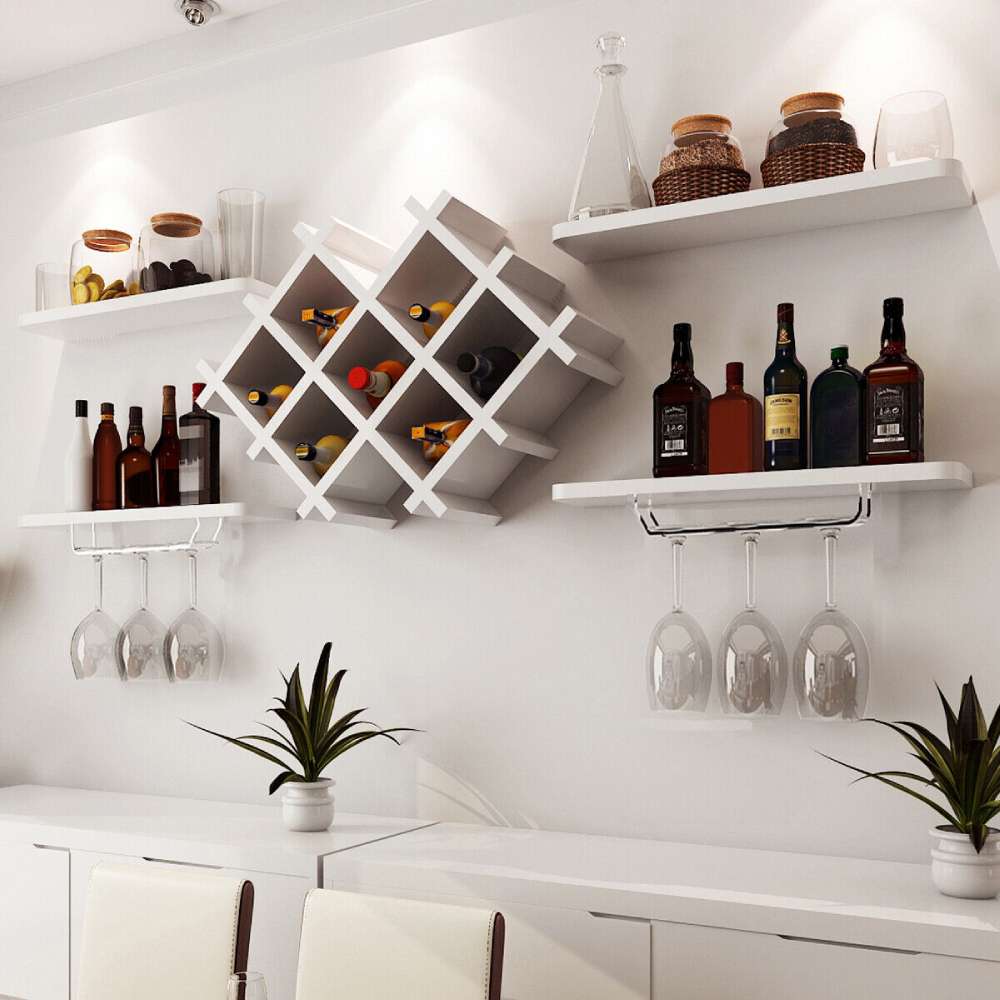
Only works on doors with sufficient structural depth. Full-overlay and inset doors provide enough clearance. Partial overlay doors often do not.
Capacity tops out at 6 bottles on most door-mounted racks because the door hinge hardware limits weight. Exceeding this strains hinges and causes the door to sag over time. Not ideal as a primary storage option, but fine for a secondary 4-bottle rotation rack on a pantry cabinet door.
Corner Cabinet Wine Racks
Corner cabinets waste a significant amount of usable interior space in most kitchens. A diagonal wine rack insert reclaims this dead zone, typically holding 8 to 16 bottles depending on corner depth.
This configuration requires removing the lazy Susan (if installed) or using a cabinet that never had one. Custom-built diagonal inserts from Omega National or purpose-built corner pull-out systems from Rev-A-Shelf are the 2 most practical options.
What Sizes Do Kitchen Cabinet Wine Racks Come In?
Cabinet wine rack sizing is driven by 3 measurements: cabinet interior width, cabinet depth, and bottle slot diameter. Getting any one of these wrong means the rack either does not fit or cannot hold standard bottles.
Standard Cabinet Width Compatibility
Standard U.S. base cabinet widths run in fixed increments. Each size determines which pull-out wine rack models are compatible.
| Cabinet Width | Pull-Out Rack Fit | Approximate Capacity |
|---|---|---|
| 12 inches | Tight fit, limited models | 6–9 bottles |
| 15 inches | Rev-A-Shelf 5375 minimum | 9–12 bottles |
| 18 inches | Most pull-out racks fit | 12–18 bottles |
| 24 inches | Full-capacity pull-outs | 18–24 bottles |
Bottle Slot Diameter Requirements
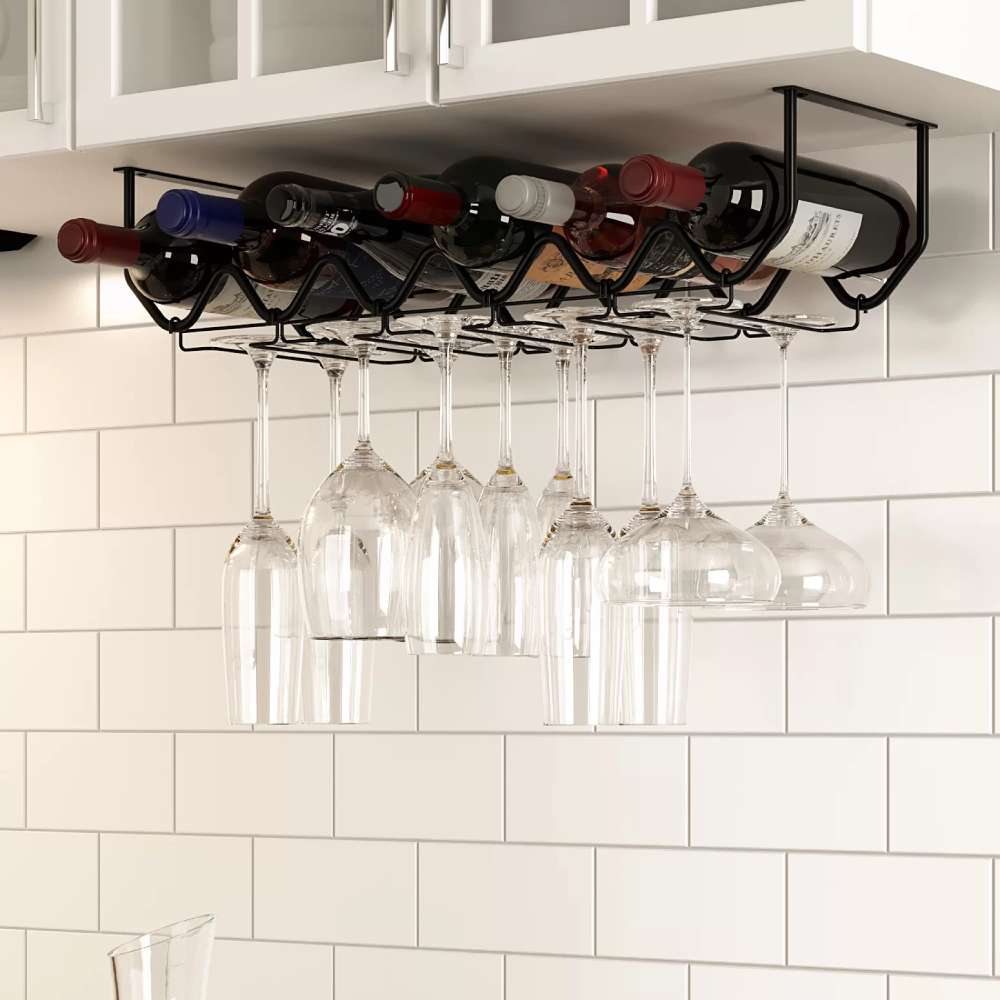
Standard 750ml Bordeaux bottles require a minimum slot diameter of 3.5 inches. Most off-the-shelf wire racks use 3.5 to 3.75-inch slots.
Burgundy bottles, Champagne bottles, and some Pinot Noir formats are wider. They need 4.25 inches minimum per slot. Check the bottle format before buying if your collection includes these.
Wine Hardware (2024) recommends a slot diameter of at least 3.75 inches as a universal starting point to handle most standard and slightly wider bottle formats without issue.
Cabinet Depth Clearance
Most base cabinet wine pull-outs require 11 to 14 inches of interior depth to accommodate standard bottle length (approximately 12 inches for a 750ml bottle).
Standard U.S. base cabinets run 24 inches deep, so depth is rarely the constraint. Upper wall cabinets, typically 12 inches deep, cannot fit pull-out systems. They only support fixed insert racks where bottles extend horizontally from front to back within the available depth.
What Materials Are Used for Kitchen Cabinet Wine Racks?
Material choice affects moisture resistance, weight capacity, finish matching, and cost. 4 materials dominate the market: solid wood, wire metal, stainless steel, and MDF with veneer.
Wire and Chrome Metal Racks
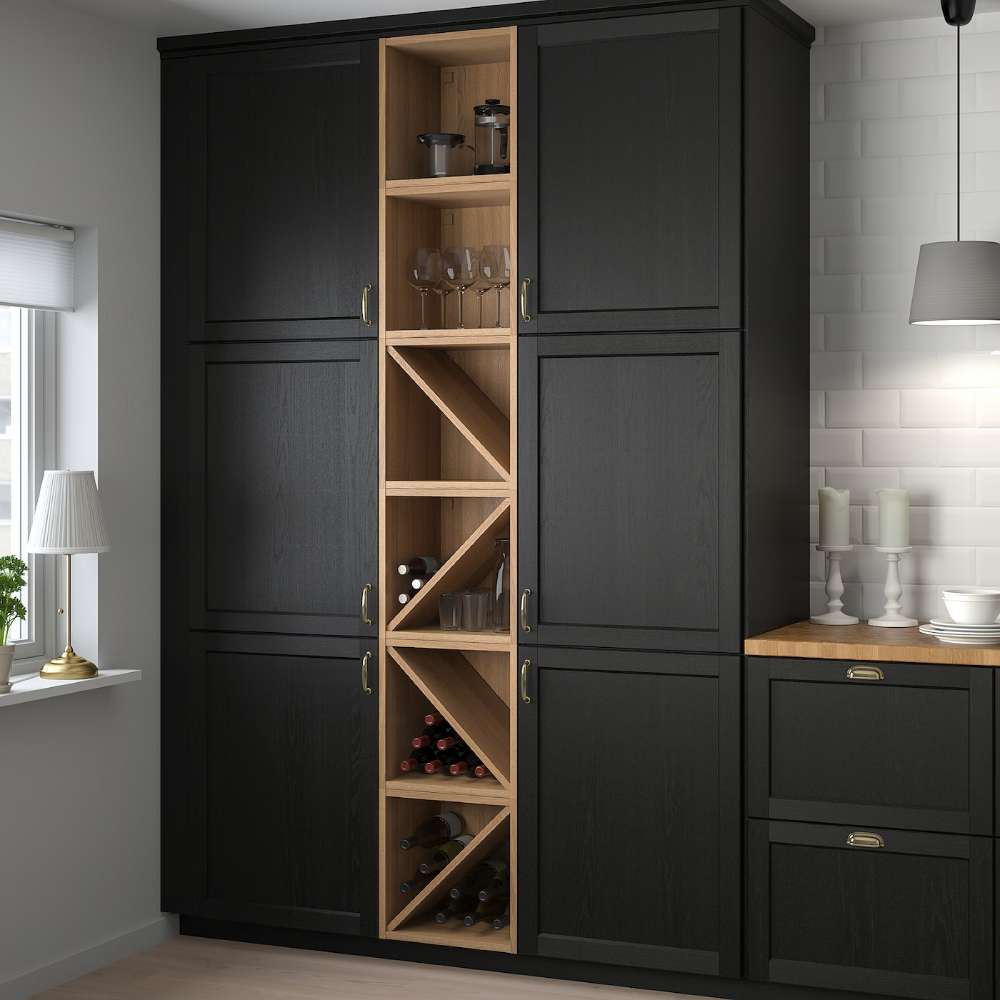
Wire racks, either chrome or powder-coated steel, are the most common material for pull-out cabinet wine organizers. The Rev-A-Shelf 5WBR series uses chrome-finished steel throughout.
- Moisture-resistant
- Easy to clean
- Lower cost: $20-$80 average
- No warping with temperature changes
- Less visually warm than wood
Chrome wire racks work best in contemporary kitchen designs or stainless-dominant kitchens where the metallic finish blends rather than contrasts.
Solid Wood Inserts
Best visual match for traditional, farmhouse, or wood-cabinet kitchens. Pine cuts and shapes easily, costs less, and paints well. Poplar is the better choice for a smooth painted finish. Walnut adds a premium look at a noticeably higher material cost.
The practical issue with solid wood: it expands and contracts with humidity. Kitchens have moisture fluctuations. A rack built tight will stick; one built with clearance will rattle. Sealing with 2 coats of wipe-on polyurethane reduces movement significantly.
Stainless Steel
Stainless handles temperature fluctuation without warping and does not react to moisture. It is the right material for kitchens with heavy steam exposure near the dishwasher or sink zone.
Cost runs higher than wire chrome or painted MDF. Stainless inserts from brands like Wine Cellar Innovations start around $80 and go up depending on configuration.
MDF with Veneer
Avoid near moisture-heavy zones. MDF swells with prolonged water exposure. A cabinet door rack or insert positioned near a dishwasher or sink is a poor candidate for MDF construction.
MDF works acceptably in dry upper cabinet positions far from the cooking zone, where the finish match to painted cabinets is the priority and moisture contact is minimal.
How Many Bottles Can a Kitchen Cabinet Wine Rack Hold?
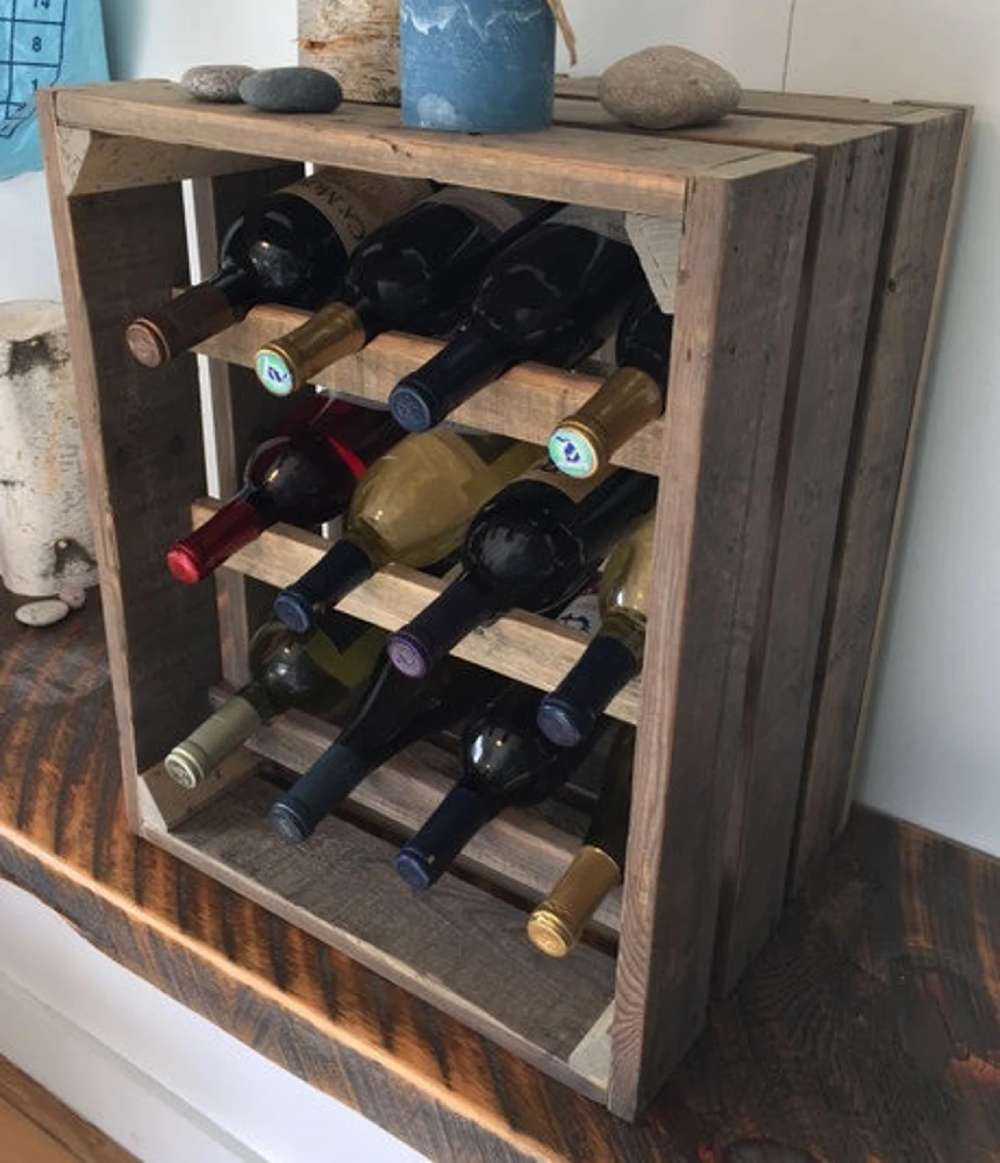
Image source: Esty
Capacity is determined by 3 factors: cabinet width, rack type, and whether the design uses single-depth or staggered double-depth rows.
Capacity by Cabinet Size
Residential usage of integrated wine racks is growing precisely because homeowners want accessible storage scaled to their actual consumption, not a dedicated cellar. The Wine Institute reports U.S. wine consumption reached 3.18 gallons per resident in 2024, supporting demand for convenient in-kitchen bottle storage.
| Cabinet Width | Single-Depth Capacity | Double-Depth Capacity |
|---|---|---|
| 12 inches | 6–9 bottles | 10–14 bottles |
| 18 inches | 12–18 bottles | 20–28 bottles |
| 24 inches | 18–24 bottles | 28–36 bottles |
Double-Depth Staggered Rows
Staggered double-depth racks position a second row of bottles between the gaps of the front row. This increases capacity by 40 to 60% in the same cabinet footprint.
The tradeoff: you cannot see or access the rear row without removing front bottles first. This works fine for a rotation rack where bottles turn over regularly. It does not work well as a reference collection where label visibility matters.
Upper Cabinet Insert Capacity
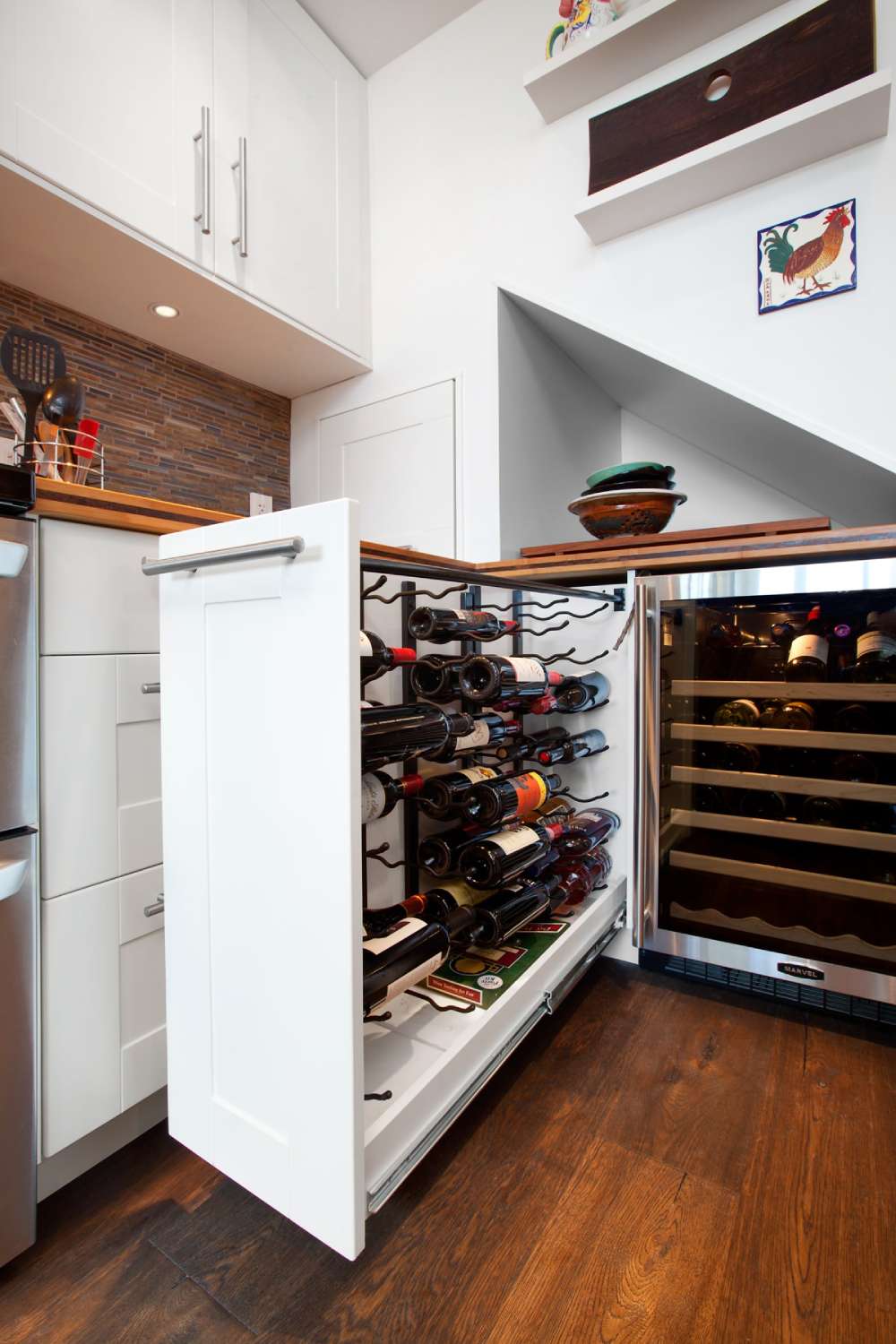
Image source: Alair Homes West Vancouver / North Vancouve
Upper cabinet inserts are constrained by the 12-inch depth of wall cabinets. A single insert spanning the full 30-inch height of a standard wall cabinet, divided into 3 shelf rows, holds 6 to 9 bottles comfortably.
Adding a second insert unit side-by-side doubles this. Two 12-inch-wide wood inserts in a 24-inch upper cabinet hold 12 to 18 bottles and cost roughly $40 to $80 in materials if built as a DIY project.
Which Kitchen Cabinet Wine Racks Are Best for Built-In Installation?
The best pull-out for a base cabinet is not the same as the best insert for an upper cabinet. Product selection depends on cabinet width, installation type, and how frequently the rack is accessed.
Best Pull-Out Cabinet Wine Racks
The Rev-A-Shelf 5375 series is the most installed pull-out wine rack in North American residential kitchens. It holds 20 bottles across 5 removable rack units, uses soft-open and soft-close gas-spring hardware, and fits cabinets with a 15-inch minimum opening (Richelieu Hardware, product specs).
The Rev-A-Shelf 5WBR series (available in 18, 24, and 30-inch widths) is a simpler, lower-cost alternative. Chrome wire construction, full-extension ball-bearing slides, and an angled design that keeps corks facing downward. It fits 14-inch deep or greater cabinetry, holds 6 to 7 bottles depending on size, and runs $60 to $90 retail (Amazon product listing).
Knape and Vogt pull-out racks are adjustable for 12 or 15-inch cabinets and hold 8 bottles. A good option when cabinet width is tighter than the Rev-A-Shelf minimum.
Best Upper Cabinet Wine Rack Inserts
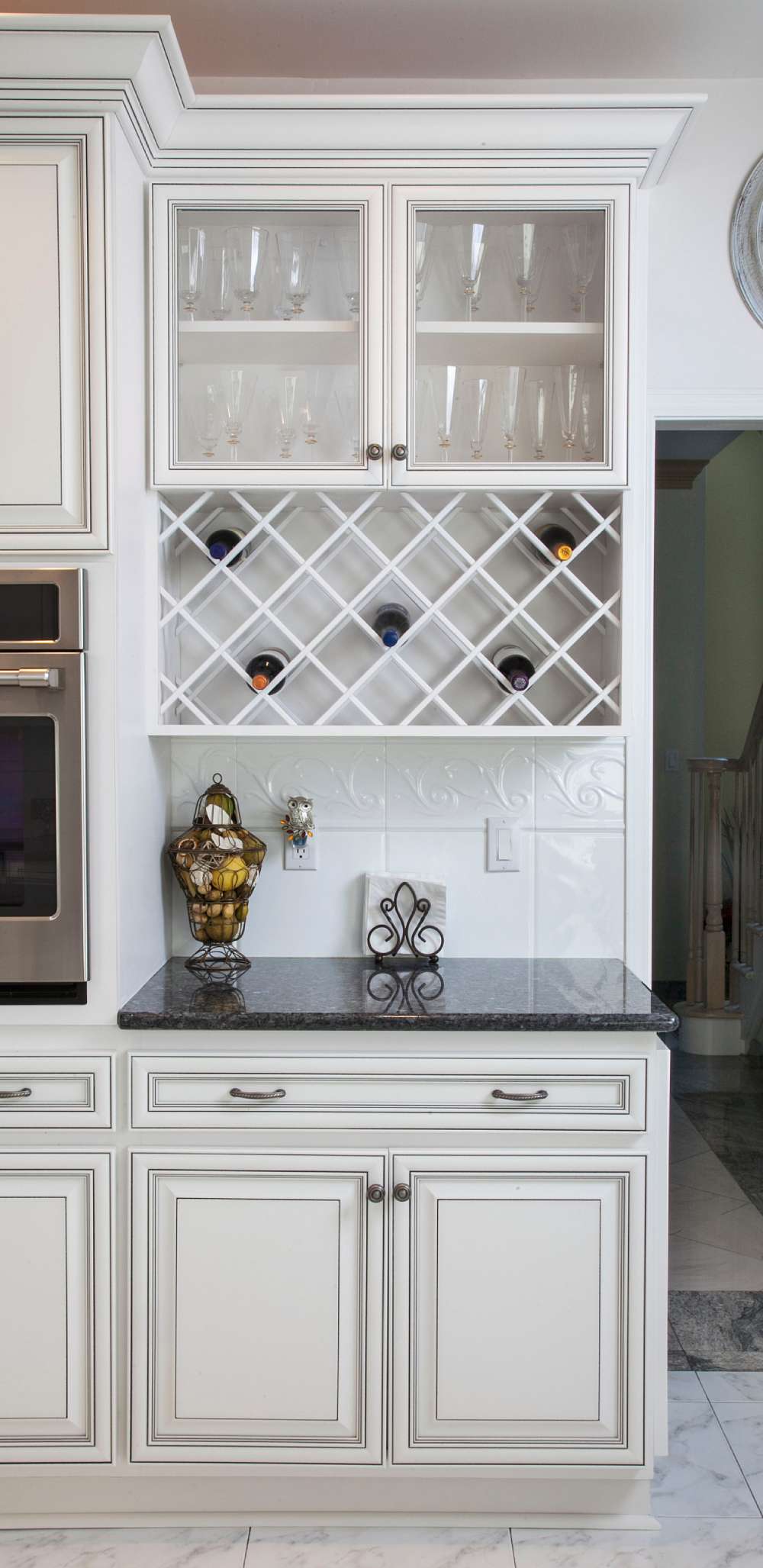
Omega National Products makes wood insert racks specifically sized for upper cabinet interiors. Multiple finish options, including natural pine and primed MDF, allow matching to painted or stained cabinet interiors.
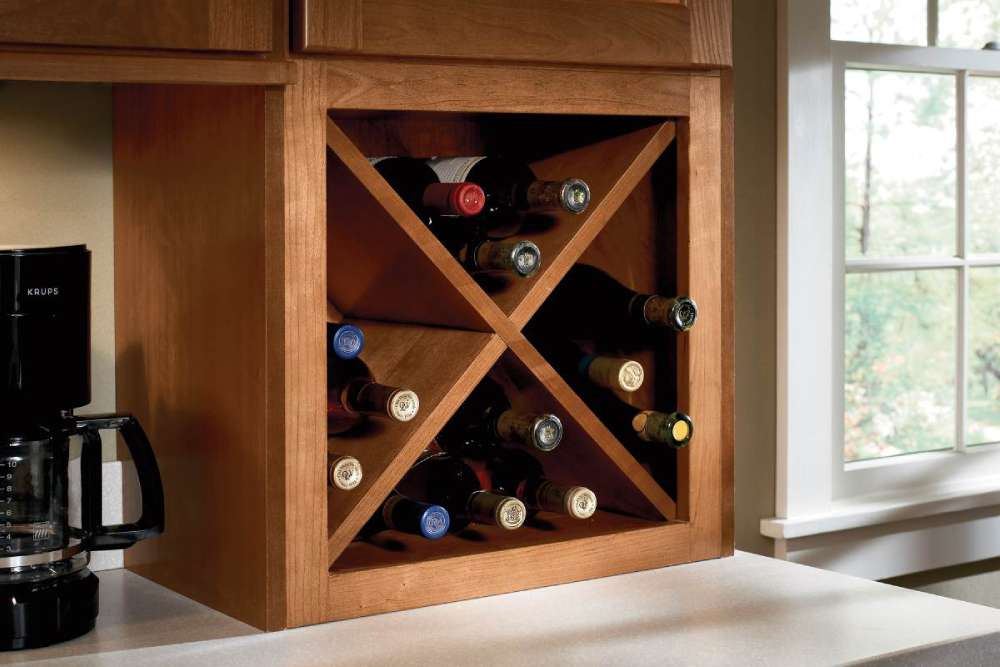
For a budget DIY insert, a diamond X-pattern rack built from pine costs $15 to $40 in materials and holds 8 to 12 bottles depending on cell count. This is the most cost-effective option for upper cabinet integration.
Best Under-Cabinet Hanging Racks
Spectrum Diversified’s combination hanging racks mount to the underside of wall cabinets and combine horizontal bottle slots with stemware rails. Total under-cabinet footprint: approximately 12 to 20 inches wide depending on model.
These work best paired with kitchen appliance storage ideas that reclaim unused vertical space between the countertop and the bottom of wall cabinets, a zone that most kitchens leave empty.
How Do You Install a Kitchen Cabinet Wine Rack?
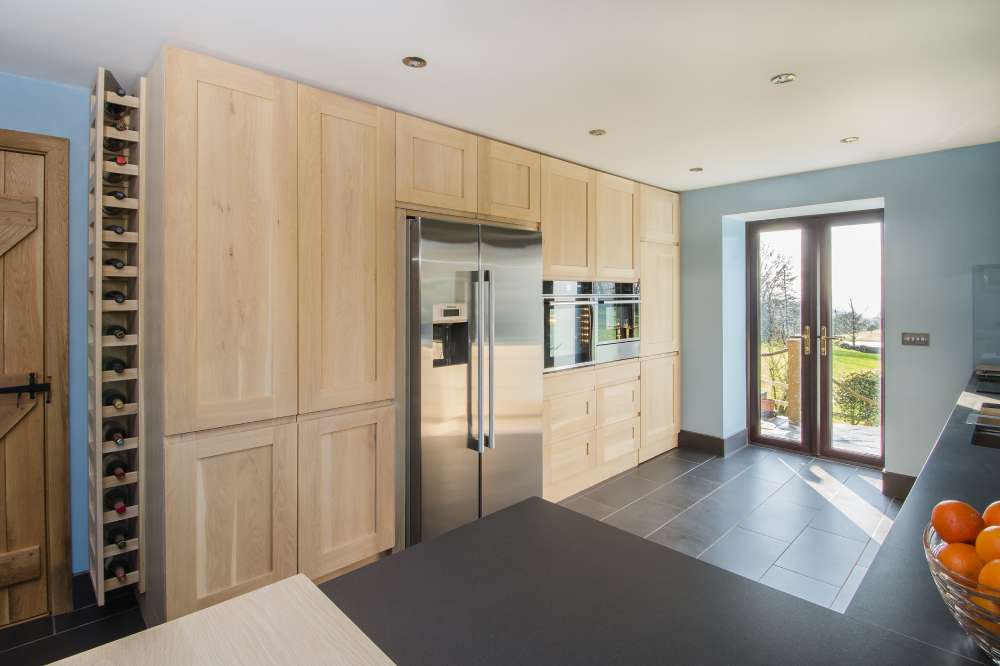
Installation varies by rack type. The 3 most common types each require different tools, preparation steps, and hardware. Getting the cabinet door clearance and slide alignment right the first time avoids the most common installation failures.
Installing a Pull-Out Wine Rack in a Base Cabinet
Tools needed: drill, level, measuring tape, wood screws (#8 x 1.25 inch), and a square.
The process for a standard bottom-mount pull-out rack:
- Remove cabinet contents and existing shelf if present
- Measure interior width and mark slide mounting positions on the cabinet floor
- Mount drawer slides level, parallel, and square to each other
- Attach rack frame to slide hardware per manufacturer specs
- Test full extension and close cycle before loading bottles
- Confirm 90-degree door opening clearance before final load
The most common mistake: mounting slides slightly out of parallel. Even 2mm of misalignment causes the rack to bind on extension. A simple way to avoid this is to cut a spacer block from scrap wood to the exact interior width and use it as a jig when positioning both slides simultaneously.
Installing an Insert Wine Rack in an Upper Cabinet
A fixed insert requires accurate interior width and depth measurements first. The insert should fit with 1/8 inch of clearance on each side. Too tight and it will not slide in; too loose and it shifts when bottles are removed.
Steps for a wood or wire insert installation:
- Remove or relocate existing shelf
- Test-fit the insert without bottles
- Secure with 2 screws through the insert frame into the cabinet side walls
- Check level before final tightening
Omega National wood inserts and most third-party upper cabinet wine inserts use this basic process. No slide hardware needed.
Installing an Under-Cabinet Hanging Wine Rack
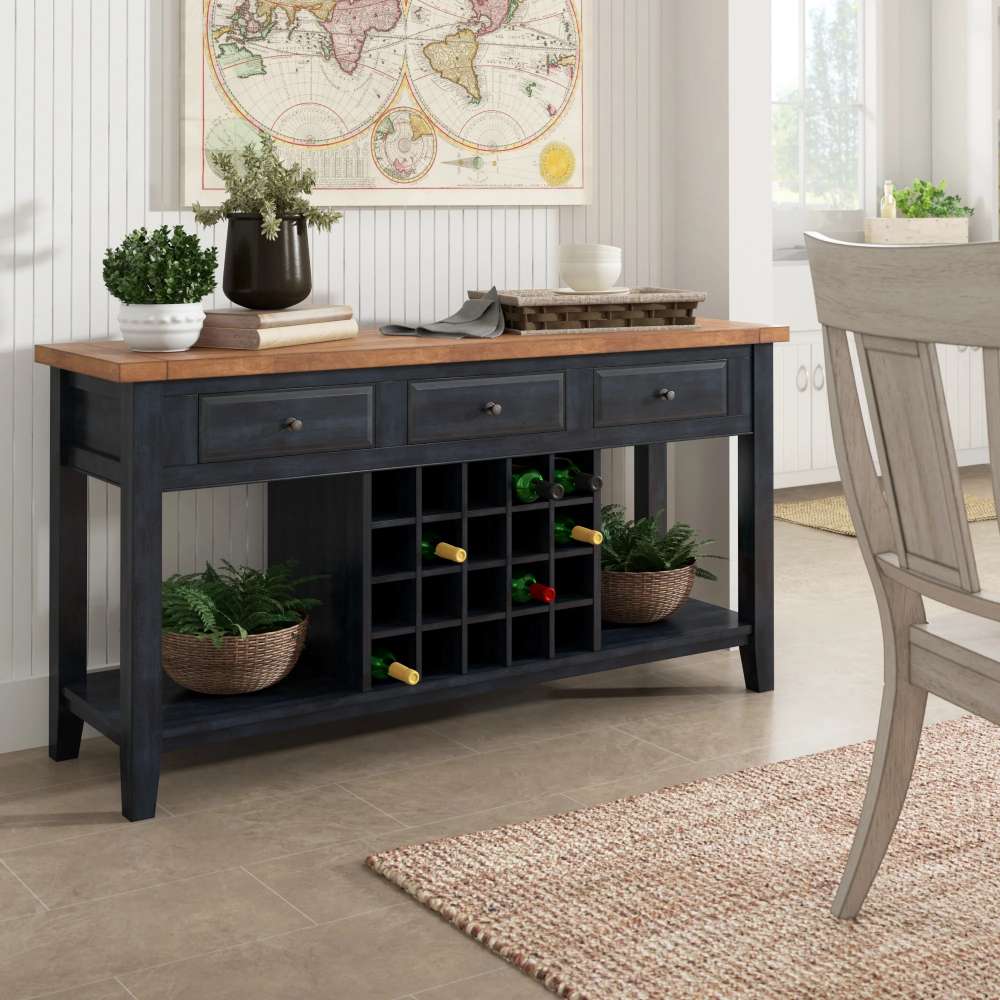
Under-cabinet hanging racks mount to the underside of the wall cabinet frame. The critical measurement here is counter clearance: the rack bottom must sit at least 18 inches above the countertop to allow bottles to hang freely without touching the counter surface.
Fastener choice matters. If the mounting location hits a cabinet stud or the wall cabinet’s base plate directly, standard #8 wood screws hold well. If mounting to drywall between cabinet anchors, use toggle bolts rated for at least 20 lbs. A 9-bottle hanging rack loaded with full 750ml bottles weighs approximately 18 to 20 lbs.
Houzz’s 2024 U.S. Kitchen Trends study found that 35% of homeowners hired cabinetmakers during kitchen renovations, up from 32% in 2023, reflecting growing demand for fitted, built-in storage solutions including integrated wine racks.
How Do You Build a DIY Kitchen Cabinet Wine Rack?
A DIY wood wine rack insert is the most cost-effective way to add built-in wine bottle storage to an upper or base cabinet. Material cost runs $15 to $40 for a 12-bottle insert built from pine or poplar (Wine Hardware, 2024).
The diamond X-pattern is the most practical design for a cabinet insert. 4 diagonal cuts at 45 degrees create interlocking cells, no joinery or pocket screws needed.
Best Wood Choices for a Cabinet Insert
Pine: cheapest option, stains unevenly without pre-stain conditioner, cuts easily with a miter saw.
Poplar: cleaner grain, better for painted finishes, slightly more expensive than pine. Poplar handles a vinegar-and-steel-wool stain well for a darker, warmer tone (Jen Woodhouse, DIY Wine Rack).
Plywood: most dimensionally stable, resists warping in humid kitchen environments, paint-grade finish. Wine Hardware (2024) recommends plywood or pine as the two most cost-effective choices for budget DIY builds.
Build Process for a Diamond Insert
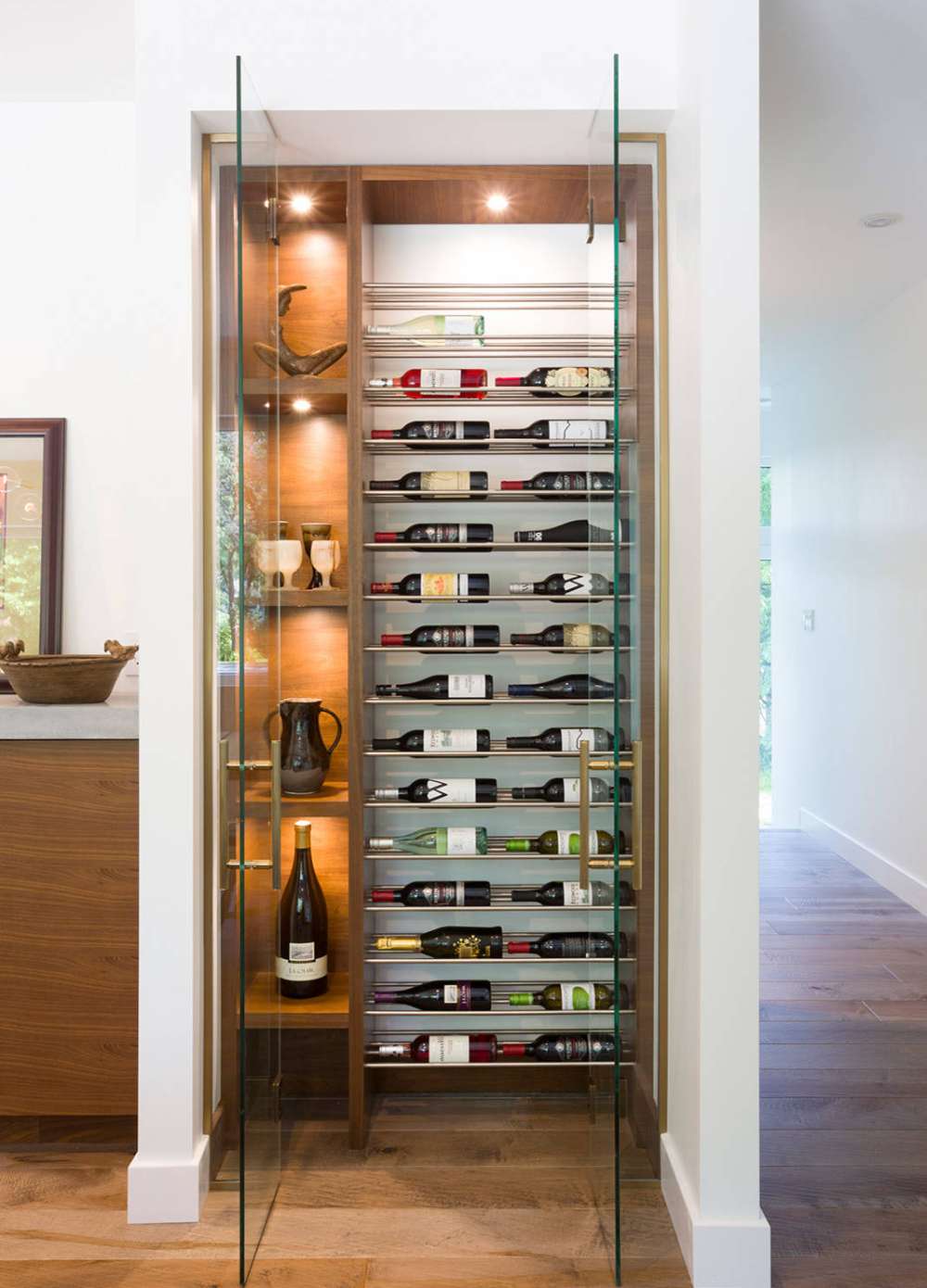
Image source: Harwood Design Builders Ltd.
Cut each cell at 4 inches wide x 4 inches tall for standard 750ml Bordeaux bottles. Wider cells (4.25 inches) accommodate Burgundy and Champagne formats.
- Cut 2 sets of parallel diagonal boards at 45 degrees
- Notch the intersection points at half-depth to allow interlocking
- Dry-fit inside the cabinet before gluing
- Sand to 220 grit, apply 2 coats of wipe-on polyurethane for moisture resistance
Jeff’s DIY Projects documents a cube-format variant that holds 12 bottles in a 16-inch square footprint, sized specifically to fit beneath standard 18-inch upper kitchen cabinets.
Finishing and Protection
Pine is notoriously splotchy when stained directly. Always use a pre-stain wood conditioner first. Apply conditioner, let dry for 15 minutes, then add stain.
2 coats of wipe-on polyurethane protect the wood from kitchen moisture without adding significant bulk to the insert dimensions. Avoid thick brush-applied poly finishes, as they add measurable thickness that can make a tight-fitting insert bind inside the cabinet.
Where Should a Wine Rack Be Placed in a Kitchen Cabinet?
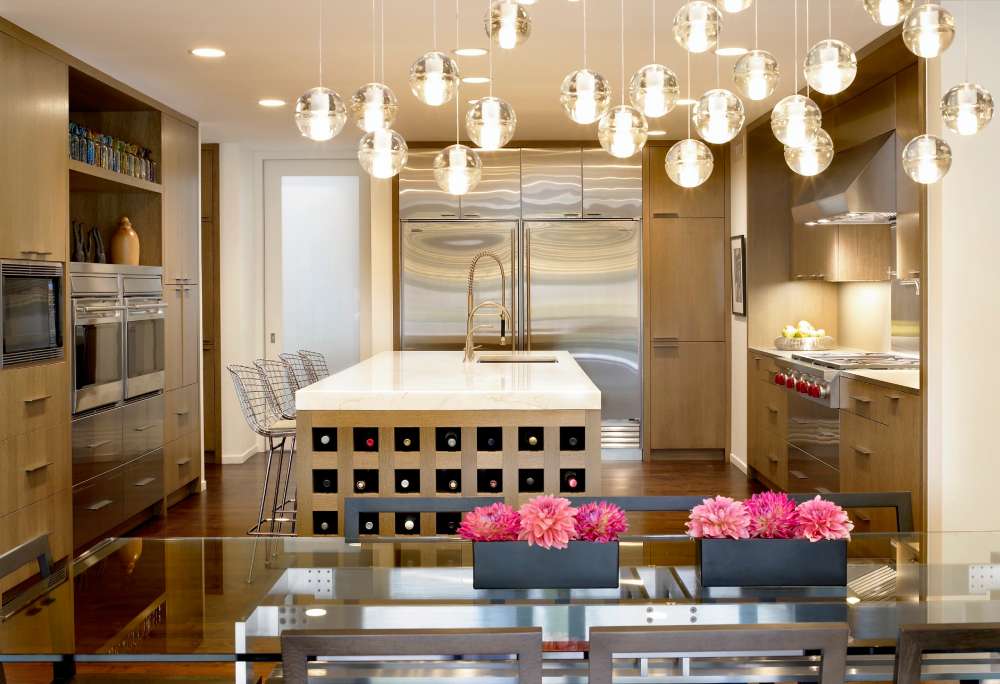
Image source: Scott Simpson Design + Build
Cabinet location determines wine quality over time. Most homeowners make the same mistake: putting the rack wherever there is space rather than wherever the temperature is most stable.
Research on wine storage published in PMC (National Institutes of Health) confirms that temperatures above 20 degrees Celsius (68 degrees F) accelerate oxidative reactions, degrading aromas and flattening flavor profiles even in sealed bottles.
Locations to Avoid
Above the refrigerator: compressor heat rises directly into the cabinet above. Ambient temperatures in this cabinet regularly exceed 75 degrees F during use.
Adjacent to the dishwasher: 2 problems at once. Steam and heat infiltrate neighboring cabinets during cycles. Vibration from the motor disturbs wine sediment, which accelerates aging in the wrong direction.
Above the oven or cooktop: obvious. The NIH bottle aging review (PMC, 2021) specifically identifies heat and UV light as the 2 dominant spoilage factors for kitchen-stored wine.
Best Cabinet Locations
The ideal position is a lower base cabinet on a wall away from appliances, ideally on an exterior wall on the north or shaded side of the home. These walls stay cooler than south or west-facing walls in most residential layouts.
| Cabinet Location | Temperature Risk | Suitable For |
|---|---|---|
| Base cabinet, exterior wall (north) | Low | Up to 6 months storage |
| Upper cabinet, away from appliances | Low to moderate | 1–3 months max |
| Cabinet adjacent to dishwasher | High (heat + vibration) | Not recommended |
| Cabinet above refrigerator | High (compressor heat) | Not recommended |
Short-Term vs. Long-Term Storage Logic
Kitchen cabinet wine racks suit wines consumed within 1 to 6 months. That covers most everyday drinkers just fine.
For anything aged beyond 6 months, ambient kitchen temperatures, which average 68 to 75 degrees F in most U.S. homes, will accelerate aging faster than intended. The ideal long-term wine storage temperature is 55 to 59 degrees F, with 60 to 70% relative humidity (Wine Cellar Authority, 2025). A kitchen cabinet hits neither target consistently.
What Is the Difference Between a Kitchen Cabinet Wine Rack and a Wine Cabinet?
These are two different products solving two different problems. Confusing them leads to buying the wrong thing.
A kitchen cabinet wine rack is a storage component added to an existing cabinet. A wine cabinet is a standalone appliance built specifically for wine storage, with temperature and humidity control as core features.
| Feature | Cabinet Wine Rack | Wine Cabinet |
|---|---|---|
| Temperature control | No | Yes (45–65 degrees F range) |
| Humidity control | No | Yes (50–70% RH) |
| UV protection | No | Yes (UV-resistant glass) |
| Suitable storage period | Up to 6 months | Years to decades |
| Price range | $20–$200 | $300–$3,000+ |
When a Cabinet Rack Is Enough
If the collection turns over in under 3 months, kitchen cabinet bottle storage is genuinely sufficient. Most household wine consumption follows this pattern. The Wine Institute data shows U.S. per-resident consumption at 3.18 gallons annually (2024), which translates to roughly 16 bottles per person per year, or about 1 to 2 bottles every 3 to 4 weeks.
At that pace, no bottle sits long enough for ambient kitchen temperature to cause meaningful degradation. A $50 pull-out wire rack handles this just fine.
When a Wine Cabinet Is Necessary
3 situations justify stepping up to a wine cabinet:
- Any bottle intended for aging beyond 6 months
- Investment wines or vintage bottles where value depends on storage conditions
- Collections exceeding 30 bottles, where a dedicated unit is more space-efficient than multiple cabinet modifications
The U.S. wine cooler market hit $360 million in 2024 and is growing at 4.7% annually (Grand View Research, 2024), showing clear demand for the temperature-controlled category as wine culture grows at home.
How Do Kitchen Cabinet Wine Racks Affect Cabinet Organization?
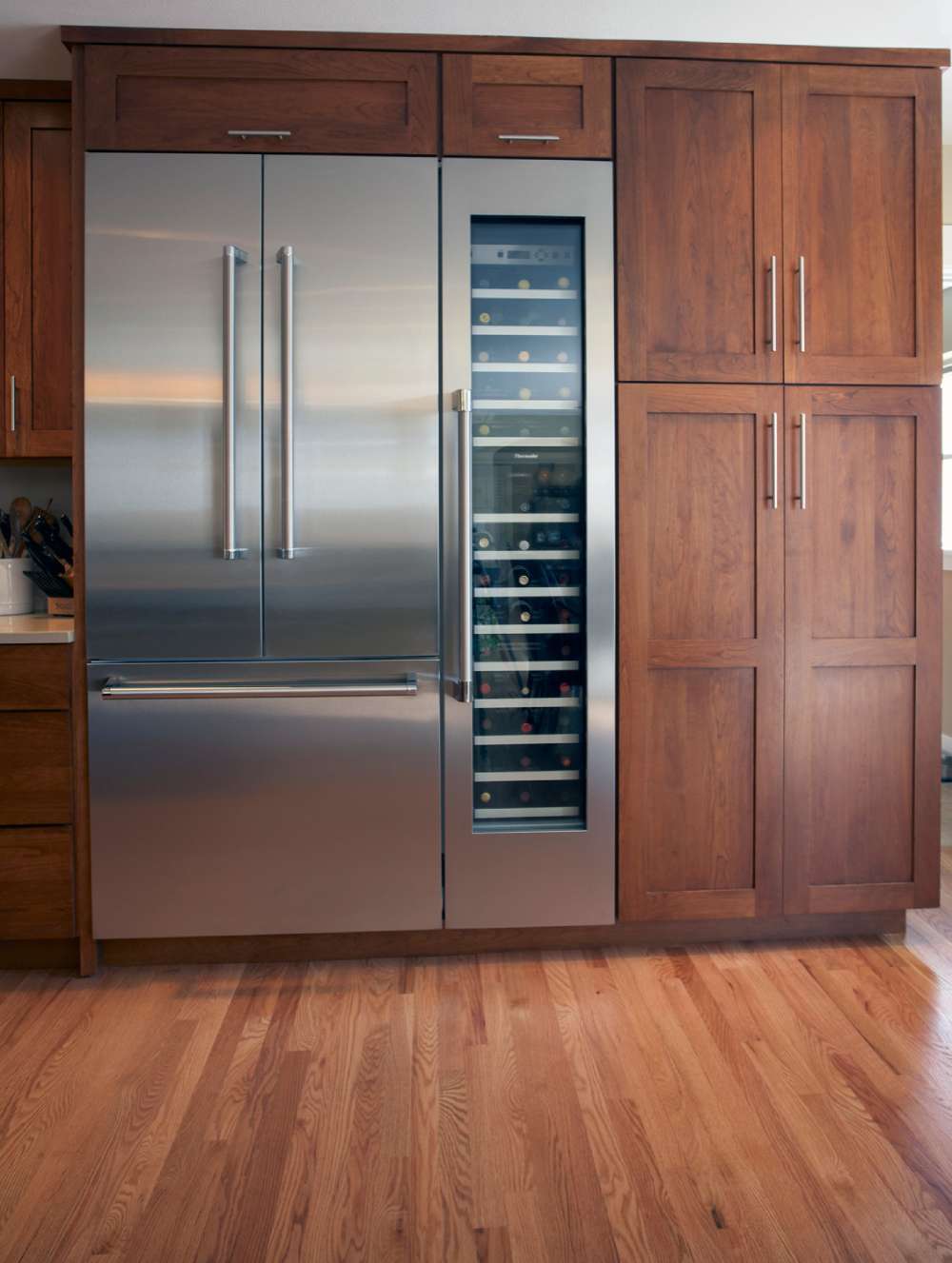
Image source: Melton Design Build
A wine rack insert occupies cabinet space that would otherwise hold something else. That tradeoff needs a deliberate decision, not an afterthought.
Houzz’s 2023 U.S. Home Study found that 33% of homeowners invested in storage and organization as part of home projects, underlining how seriously buyers weigh functional storage layout against other priorities.
Space Tradeoffs by Cabinet Type
Base cabinet pull-out: takes the full 12 to 18-inch footprint. Replaces pot, pan, or dry goods storage entirely. Worth it when that cabinet was underused or poorly configured to begin with.
Upper cabinet insert: shares shelf space better. A 6-bottle insert in one section of a 30-inch upper cabinet still leaves room for glasses or pantry items in the remaining sections.
Door rack: adds storage without losing any shelf space. But it caps at 4 to 6 bottles and strains hinges if overloaded.
Dual-Purpose Options
Spectrum Diversified and Organize It both make combination hanging racks that pair horizontal bottle slots with stemware rails on one mounting system. A single under-cabinet unit handles both wine and glassware storage simultaneously.
This matters in small-space layouts where every storage element needs to earn its footprint. A combined unit doing 2 jobs beats 2 separate systems taking up 2 zones.
Planning Rule
Reserve the wine rack cabinet at least 24 inches from the primary cooking zone. This keeps heat exposure low and prevents the rack location from conflicting with active prep and cooking traffic flow.
Interior designer Caroline Levenson (Homes and Gardens, 2024) recommends positioning wine storage toward the end of the kitchen run, away from the main prep zone, so it does not compete with high-frequency-use storage near the cooktop and sink.
What Are the Best Kitchen Cabinet Wine Rack Ideas for Small Kitchens?
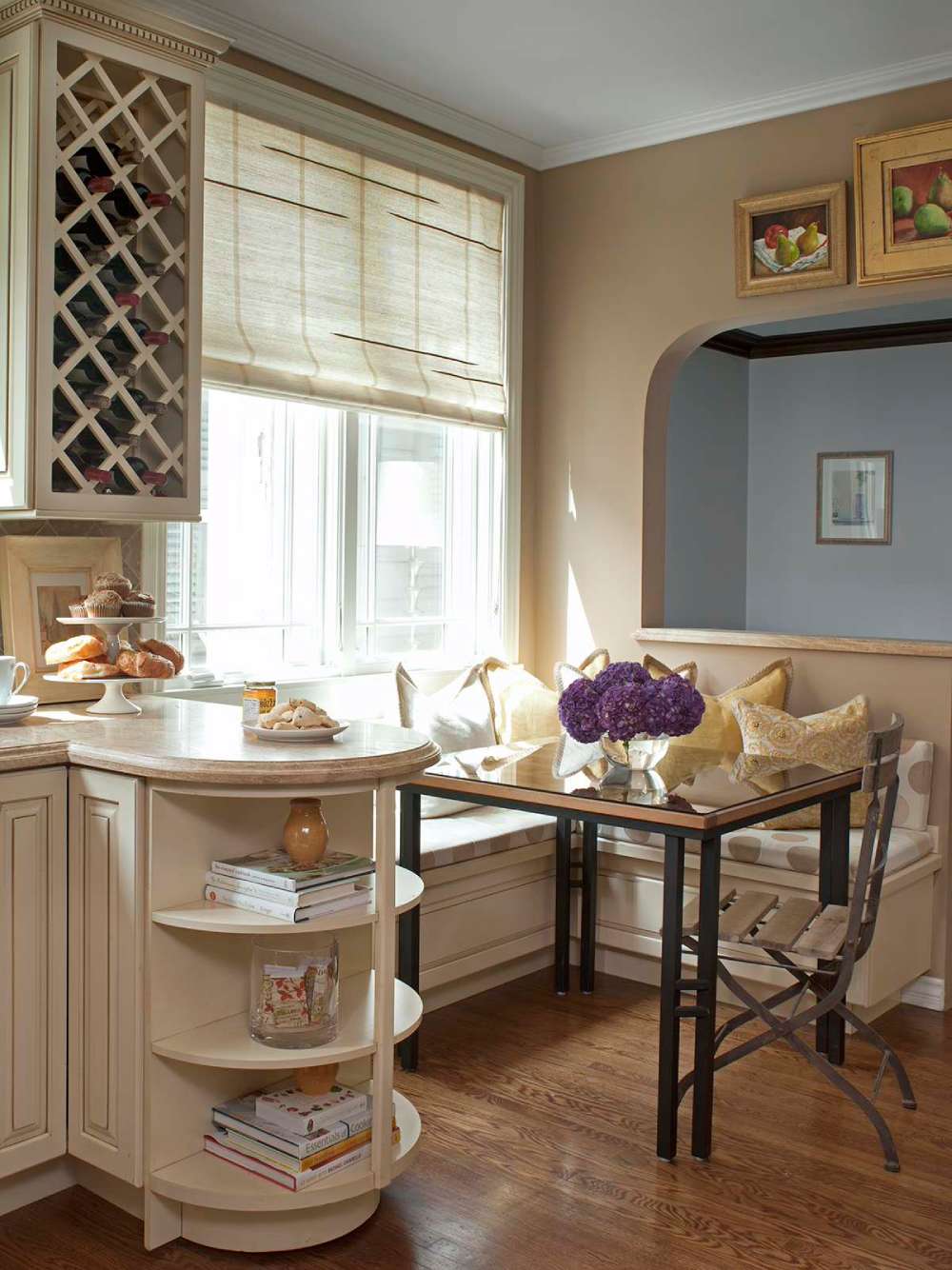
Image source: Ken Gutmaker Architectural Photography
Small kitchens force better decisions. The right wine storage idea here is not the same as what works in a large kitchen with dedicated cabinet runs.
5 approaches work specifically in tight layouts, each using a different type of dead space that most kitchen designs leave untouched.
Under-Cabinet Rail Systems
The space between the countertop and the bottom of wall cabinets is almost always empty. A hanging rail system mounts to the cabinet’s underside and holds 4 to 9 bottles horizontally in that dead zone without consuming any shelf space above or counter space below.
Minimum clearance needed: 18 inches from countertop to bottle bottom. Most standard kitchens have 18 to 20 inches of clearance here.
Toe-Kick Pull-Out Drawers
The 4-inch toe-kick space running along the base of kitchen cabinets is wasted in virtually every standard kitchen. A custom pull-out drawer built into this space holds 3 to 4 bottles horizontally and costs approximately $100 to $200 in hardware and materials.
This is the most space-neutral wine storage solution available. It adds 3 to 4 bottles of capacity without touching a single usable cabinet above.
Pantry or Utility Cabinet Door Rack
A door-mounted wine rack on a full-overlay pantry cabinet door adds 4 to 6 bottles without reducing any shelf capacity inside the cabinet. The pantry door is a large surface that typically holds nothing. The only requirement is a solid-core or face-frame door with enough structural depth for the mounting hardware.
6-Inch Filler Cabinet Pull-Out
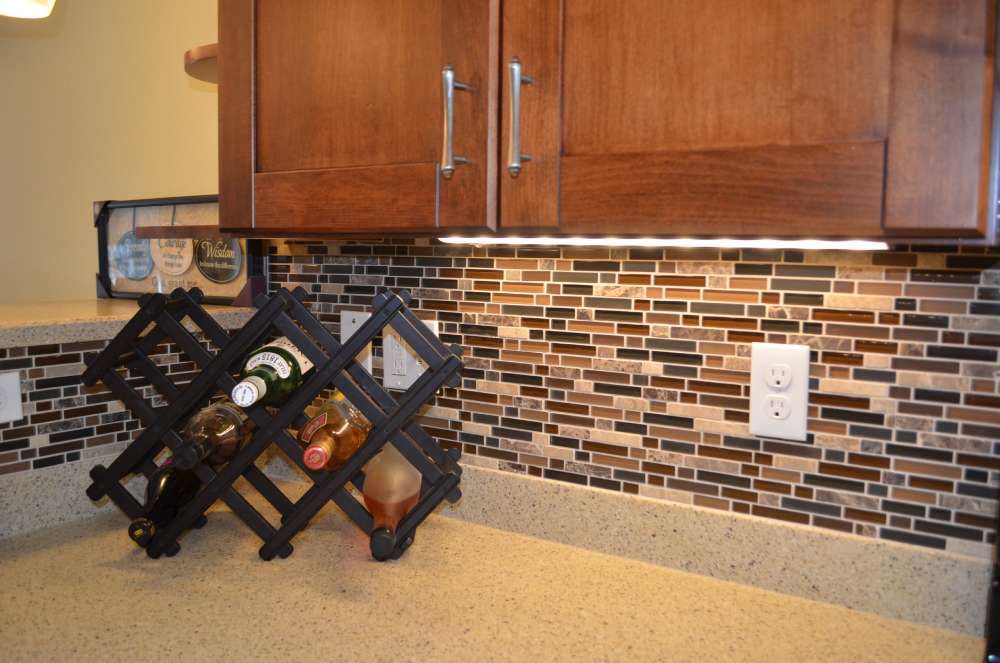
Image source: Big Street Construction, Inc.
The narrow filler strip between a refrigerator and adjacent cabinet, typically 3 to 6 inches wide, is usually left empty or used only for a cutting board. A custom pull-out in this filler gap holds 8 to 10 bottles vertically, standing upright rather than horizontal.
One caveat: vertical storage with corks exposed to air is only suitable for bottles consumed within 2 to 4 weeks. Beyond that, the cork dries and oxidation risk increases (Coravin, 2025).
Corner Cabinet Diagonal Insert
Corner cabinets consistently rank as the most underused storage zone in a kitchen. A diagonal diamond insert placed into a blind corner or lazy Susan cabinet reclaims this space for 8 to 16 horizontal bottles.
This works best in large kitchen configurations where the corner was allocated to a lazy Susan that never got full use, as well as in smaller kitchens where the corner cabinet currently holds almost nothing worth keeping there.
Knape and Vogt make a specific corner pull-out wine rack designed for this application, fitting cabinets from 15 to 24 inches wide with adjustable bracket positioning.
FAQ on Kitchen Cabinet Wine Rack
What is a kitchen cabinet wine rack?
A kitchen cabinet wine rack is a storage unit built into, mounted inside, or attached to an existing kitchen cabinet. It holds bottles horizontally to keep corks moist, preventing oxidation. It is not a wine fridge or standalone wine cabinet.
How many bottles does a kitchen cabinet wine rack hold?
Capacity depends on cabinet width. A 12-inch base cabinet holds 6 to 9 bottles. An 18-inch cabinet holds 12 to 18. Double-depth staggered racks increase capacity by 40 to 60% in the same footprint.
What is the best cabinet for a built-in wine rack?
A base cabinet at least 15 inches wide, positioned away from the oven, refrigerator, and dishwasher. Lower cabinets on exterior walls stay coolest. Avoid cabinets above heat-producing appliances entirely.
Can I install a wine rack in an upper cabinet?
Yes. Fixed insert racks fit standard 12-inch-deep wall cabinets. Upper cabinet inserts hold 6 to 12 bottles. Use them for wine consumed within 1 to 3 months, not long-term storage.
What materials are kitchen cabinet wine racks made from?
4 main options: chrome wire, solid wood, stainless steel, and MDF with veneer. Chrome wire racks resist moisture and cost $20 to $80. Solid wood matches cabinet interiors but expands with humidity fluctuations.
What is the best pull-out wine rack for a base cabinet?
The Rev-A-Shelf 5375 series is the most widely installed option. It holds 20 bottles, requires a 15-inch minimum cabinet opening, uses soft-close hardware, and has a 75 lb weight limit.
How do I build a DIY kitchen cabinet wine rack?
Use pine or poplar. Cut a diamond X-pattern with 4-inch cells at 45-degree angles. Sand to 220 grit, apply wipe-on polyurethane for moisture protection. Total material cost runs $15 to $40 for a 12-bottle insert.
What is the difference between a wine rack and a wine cabinet?
A wine cabinet is a standalone appliance with temperature control (45 to 65 degrees F) and humidity regulation. A cabinet wine rack is a passive insert with no climate control. It suits storage under 6 months only.
Can I add wine storage to a small kitchen?
Yes. Use under-cabinet hanging racks, toe-kick pull-out drawers, or pantry door racks. These options use dead space without reducing existing shelf capacity. A toe-kick drawer holds 3 to 4 bottles in a 4-inch gap.
Does a kitchen cabinet wine rack affect cabinet organization?
A base cabinet pull-out takes the full cabinet footprint, replacing pot or pan storage. Upper cabinet inserts share shelf space more easily. Dual-purpose racks combining bottle slots and stemware rails maximize function per cabinet zone.
Conclusion
This conclusion is for an article presenting kitchen cabinet wine rack options as practical, built-in bottle storage solutions that work within existing cabinet layouts.
The right choice comes down to 3 things: your cabinet width, how often you rotate bottles, and how much of your storage footprint you can dedicate to wine.
A pull-out wine rack suits daily drinkers with base cabinets 15 inches or wider. A fixed wood insert works for upper cabinet integration on a budget. Toe-kick drawers and under-cabinet hanging rails solve the small kitchen problem without sacrificing a single shelf.
Material, slot diameter, and cabinet position all affect how well the rack performs over time.
Get those 3 variables right, and horizontal bottle storage fits into almost any kitchen without a renovation.

- Paint Colors That Go with Gray Floors - August 20, 2026
- What Color Bedding Goes with Dark Wood Furniture - August 18, 2026
- What Color Walls Go with Oak Floors - August 16, 2026


