

The right tile can make an outdoor kitchen look deliberate and last two decades. The wrong one cracks after its first winter.
Choosing outdoor kitchen tile ideas involves more than picking a color or pattern you like. Material performance, slip resistance, freeze-thaw ratings, and grout selection all determine whether the installation holds up or fails within a few seasons.
This guide covers every decision point, from porcelain and natural stone material trade-offs to backsplash heat clearance, countertop grout specs, tile sizing, installation mistakes, and real cost ranges for projects of every size.
What Makes a Good Outdoor Kitchen Tile?
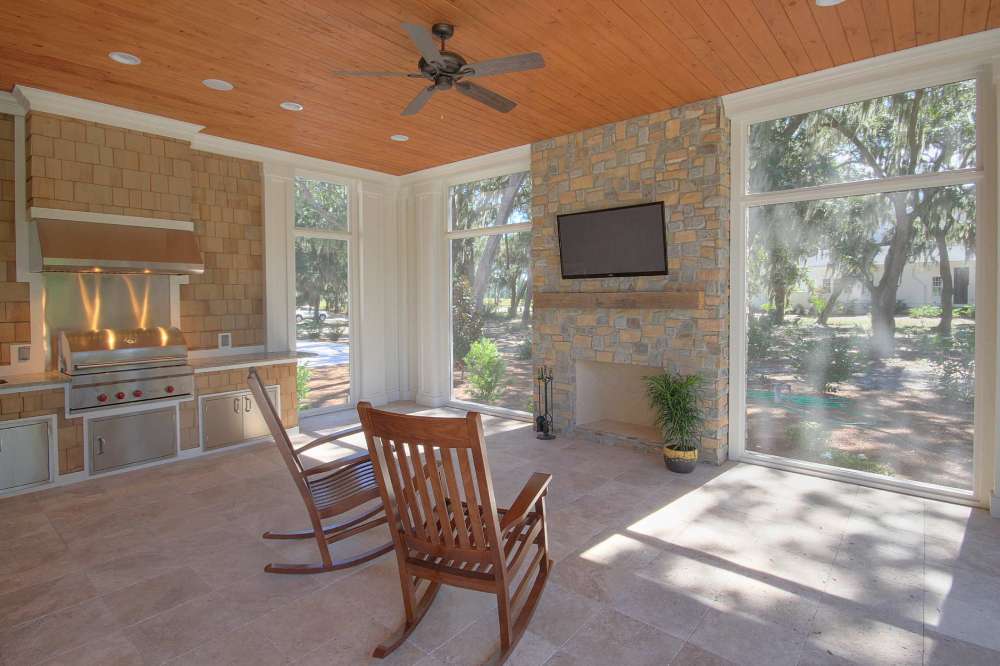
Image source: Element Construction Partners
A good outdoor kitchen tile resists moisture, handles temperature swings, and stays slip-free when wet. These 3 requirements work together. Miss one and the tile will fail, crack, or become a safety hazard within a few seasons.
The outdoor kitchen market was valued at USD 27 billion in 2025 and is projected to reach USD 60 billion by 2034 (Straits Research). More homeowners are building permanent outdoor cooking spaces, which means tile selection matters more than it ever did before.
Four performance factors determine whether a tile is actually suitable outdoors.
| Performance Factor | Standard to Meet | Why It Matters Outdoors |
|---|---|---|
| Water absorption rate | 0.5% or less (impervious) | Prevents freeze-thaw cracking |
| Slip resistance (DCOF) | 0.42 minimum; 0.60+ for outdoor wet zones | Prevents slips on rain-wet surfaces |
| PEI wear rating | PEI 4 minimum for floor use | Handles outdoor foot traffic and grit |
| UV stability | Manufacturer-rated for exterior use | Stops color fading from sun exposure |
Why Water Absorption Defines Tile Longevity
Tiles rated at 0.5% water absorption or below are classified as impervious (American Tile Depot, 2025). This is the threshold that separates tiles that survive freeze-thaw cycles from ones that crack within 2 to 3 winters.
Water expands by roughly 10% in volume when it freezes. If it has entered the pores of a tile, that expansion creates bursting pressure from the inside. Porous tiles like standard ceramic, with absorption rates above 3%, cannot handle this.
- Porcelain: 0.5% or less, impervious, freeze-thaw safe
- Natural stone (granite): 0.5% or less depending on density
- Ceramic: 3% to 7%, not suitable for freeze-thaw climates
- Travertine: typically 3% to 5%, requires sealing
What DCOF and PEI Ratings Actually Mean
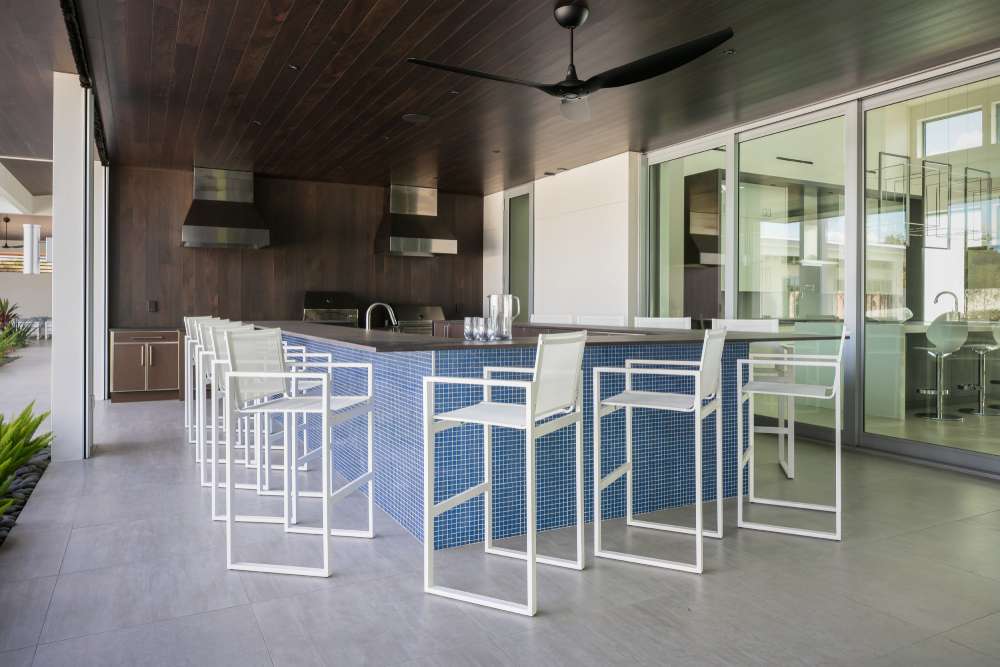
DCOF (Dynamic Coefficient of Friction) measures how slippery a tile is when wet and in motion, not just when stationary. The ANSI A137.1 standard sets a minimum wet DCOF of 0.42 for interior floors. Outdoor wet zones require a higher threshold: 0.60 or above, per D&B Tile’s EW (Exterior Wet) classification.
PEI ratings work differently. They measure surface wear resistance on glazed tiles from 0 to 5. For an outdoor kitchen floor, PEI 4 is the minimum. PEI 5 applies to commercial and heavy-traffic applications like airports and schools.
Polished finishes fail both tests. They drop DCOF below safe thresholds when wet and wear down faster than matte or textured surfaces under outdoor grit and UV exposure.
Thermal Expansion and UV Fade
Outdoor tiles cycle through heat and cold daily. This constant expansion and contraction requires two installation accommodations: polymer-modified thinset that stays flexible, and proper expansion joints spaced every 8 to 12 feet to absorb movement without cracking the grout or tile.
UV fade is less of a concern with through-body porcelain, where the color runs through the full thickness of the tile. Glazed ceramic is more vulnerable. The glaze sits on the surface and will show fading after sustained sun exposure, especially in south-facing outdoor kitchens in high-UV regions like California, Texas, and Florida.
What Are the Best Tile Materials for Outdoor Kitchens?
Porcelain is the safest all-around choice for outdoor kitchens. Every other material involves trade-offs. Understanding those trade-offs before choosing a tile saves expensive repairs later.
According to the Houzz 2024 U.S. Outdoor Trends Study, porcelain and ceramic tiles remain the most-used materials for outdoor kitchen surfaces. But ceramic is frequently misapplied outdoors, leading to premature failure in climates with seasonal frost.
Porcelain vs. Natural Stone for Outdoor Kitchens
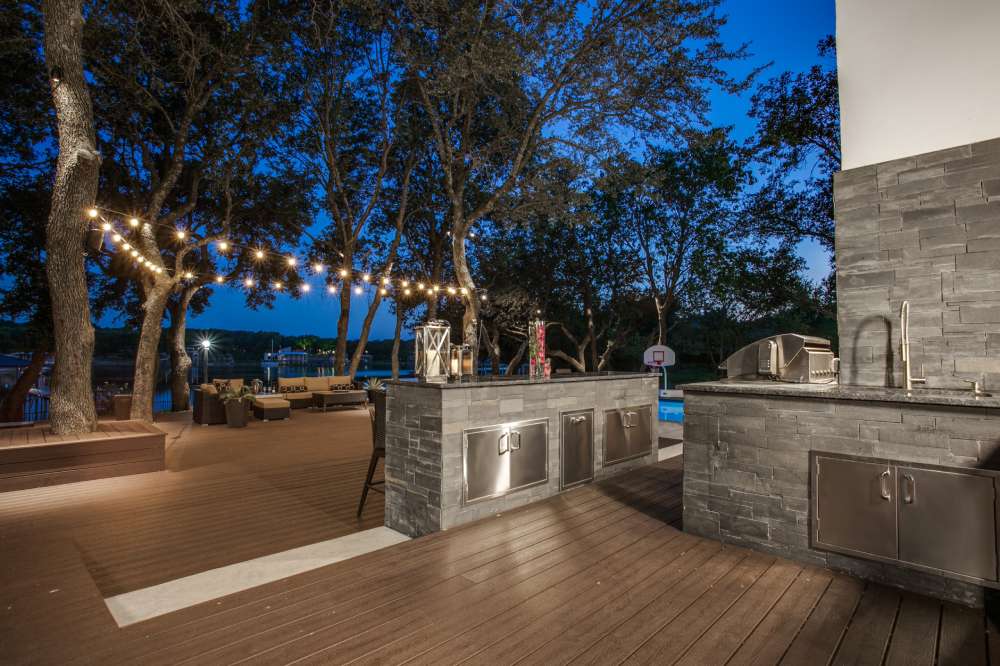
Image source: One Specialty Landscape Design, Pools & Hardscape
Porcelain wins on performance. Natural stone wins on feel.
Porcelain is fired at higher temperatures than ceramic, making it denser and less porous. Its water absorption rate stays consistently at 0.5% or below. It handles freeze-thaw cycles without sealing, resists grill grease, and comes in large-format sizes up to 24×48 inches that reduce grout lines.
Natural stone requires more maintenance but delivers a look that porcelain imitations haven’t fully replicated. Slate and granite are the strongest natural stone options outdoors. Travertine and limestone carry higher absorption rates and need annual sealing in wet climates.
| Material | Water Absorption | Sealing Needed | Best Application |
|---|---|---|---|
| Porcelain | 0.5% or less | No | Floor, wall, countertop |
| Slate | 0.4% to 0.8% | Annually | Floor, accent wall |
| Granite tile | 0.1% to 0.4% | Every 2 to 3 years | Countertop, floor |
| Travertine | 3% to 5% | Twice yearly | Covered patios only |
| Ceramic | 3% to 7% | No (but limited use) | Mild climates, walls only |
When Ceramic Tile Works Outdoors (and When It Fails)
Ceramic can work in outdoor kitchens located in mild climates, specifically zones that don’t experience hard frost. Think coastal Southern California, South Florida, or Hawaii.
The failure mode is predictable: water enters the tile body through micro-pores, freezes, expands, and fractures the tile from the inside. This usually appears as surface spalling or full tile cracks within 2 to 3 freeze-thaw seasons.
Even in frost-free climates, ceramic should stay on vertical surfaces (backsplashes, walls) rather than floors. The PEI wear rating on most ceramic tiles tops out at PEI 3, which isn’t built for the grit and abrasion of outdoor cooking traffic.
Quarry Tile and Cement Tile
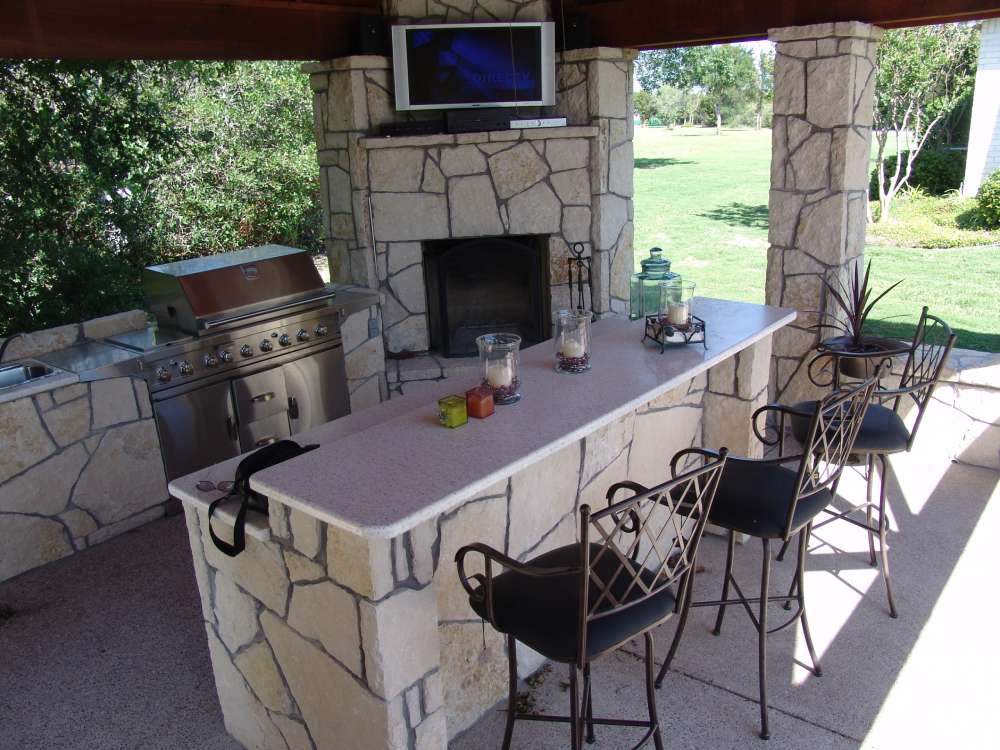
Image source: Fort Worth Custom Pools
Quarry tile is unglazed, dense, and vitreous with absorption rates between 0.5% and 3%. It performs well in semi-exposed outdoor kitchens and holds up in commercial settings. The design range is limited: earthy reds, grays, and browns are the main options. Daltile’s quarry line is a widely available example used in covered outdoor kitchen builds.
Cement tile is a different story. It’s porous, absorbs liquids quickly, and requires sealing every 6 to 12 months outdoors. The bold geometric patterns are attractive, but the maintenance commitment in an outdoor cooking environment with grease and heat exposure is high. Best used sparingly on a covered vertical surface with minimal water contact.
Which Tile Finishes Work Best for Outdoor Kitchen Floors?
Finish selection on outdoor kitchen floors is a safety decision as much as a design one. The wrong finish causes slipping. The right finish handles rain, grease, and daily barefoot traffic without becoming a hazard.
Outdoor EW-rated tiles (Exterior Wet) require a minimum DCOF of 0.60, per D&B Tile’s classification system. That immediately eliminates polished and high-gloss finishes from floor use in any outdoor kitchen.
Matte and Textured Finishes
Matte finishes are the standard for outdoor kitchen floors. They maintain consistent DCOF ratings above 0.60 wet, don’t show grease smears as readily as polished surfaces, and fade more uniformly under UV exposure.
- Brushed porcelain: natural grip, works well near grill zones
- Honed stone (slate, granite): non-reflective, slip-resistant when dry and wet
- Grip-embossed porcelain: raised texture pattern adds traction on sloped surfaces
- Anti-slip pressed surfaces: micro-groove patterns, used in commercial outdoor kitchens
Daltile’s SlipShield line is designed specifically for outdoor and pool-adjacent applications with DCOF ratings that exceed the 0.60 EW standard. Atlas Concorde’s outdoor porcelain collection also rates its floor tiles to DCOF above 0.65 for consistent wet performance.
Why Polished Finishes Fail on Outdoor Floors
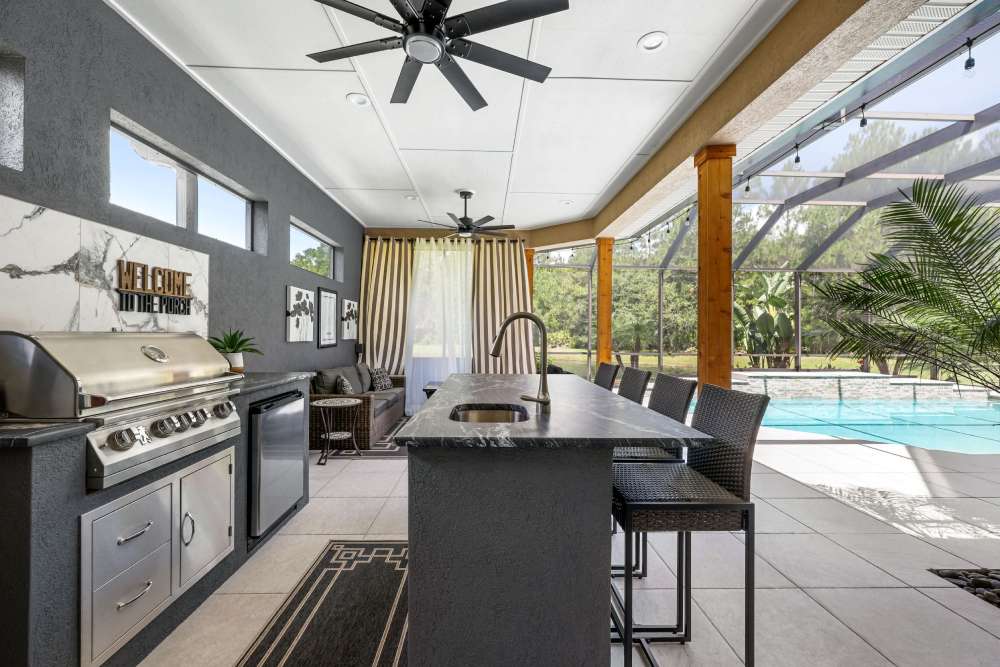
Image source: Deb’s Inviting Interiors LLC
Polished tiles look sharp. They also become dangerously slippery the moment they’re wet. The surface friction drops significantly once moisture is introduced, putting polished DCOF ratings well below the 0.42 interior standard, let alone the 0.60 outdoor requirement.
Surface wear is the second failure point. Polished glaze erodes under outdoor grit and UV exposure faster than through-body matte porcelain. Within a few seasons, the polish dulls unevenly, and the floor looks worn rather than refined.
Reserve polished tile for vertical surfaces: backsplashes, accent walls, and decorative panels that don’t see foot traffic.
What Tile Ideas Work Best for Outdoor Kitchen Backsplashes?
The backsplash in an outdoor kitchen handles 3 distinct threats that indoor backsplashes don’t: grease splatter near a live grill, direct rain or sprinkler exposure, and UV fading. Tile selection needs to account for all three.
Backsplash installation costs range from $15 to $40 per square foot for combined materials and labor (HomeAdvisor, 2025). Outdoor backsplash costs typically run 15% to 25% higher due to substrate waterproofing requirements and weather-rated grout specifications.
Mosaic vs. Large-Format Backsplash Tiles
Mosaic tile adds visual interest but multiplies grout lines. In an outdoor kitchen, more grout lines mean more maintenance. Standard cement grout absorbs grease and cooking residue quickly outdoors. Epoxy grout solves this but costs more and is harder to install evenly on small mosaic formats.
Glass mosaic tile looks clean and modern, but has one hard limit: placement near the grill. High heat from a built-in burner or grill hood can crack or discolor glass tiles at close range. Maintain at minimum a 12-inch clearance from direct heat sources.
Large-format porcelain slabs (18×36 inches and above) are gaining traction in contemporary outdoor kitchen backsplash builds. Fewer grout lines mean less maintenance, cleaner visual lines, and fewer entry points for outdoor moisture. Brands like Porcelanosa and Atlas Concorde produce large-format outdoor-rated slabs specifically suited to this application.
Heat-Resistant Tile Options Near the Grill
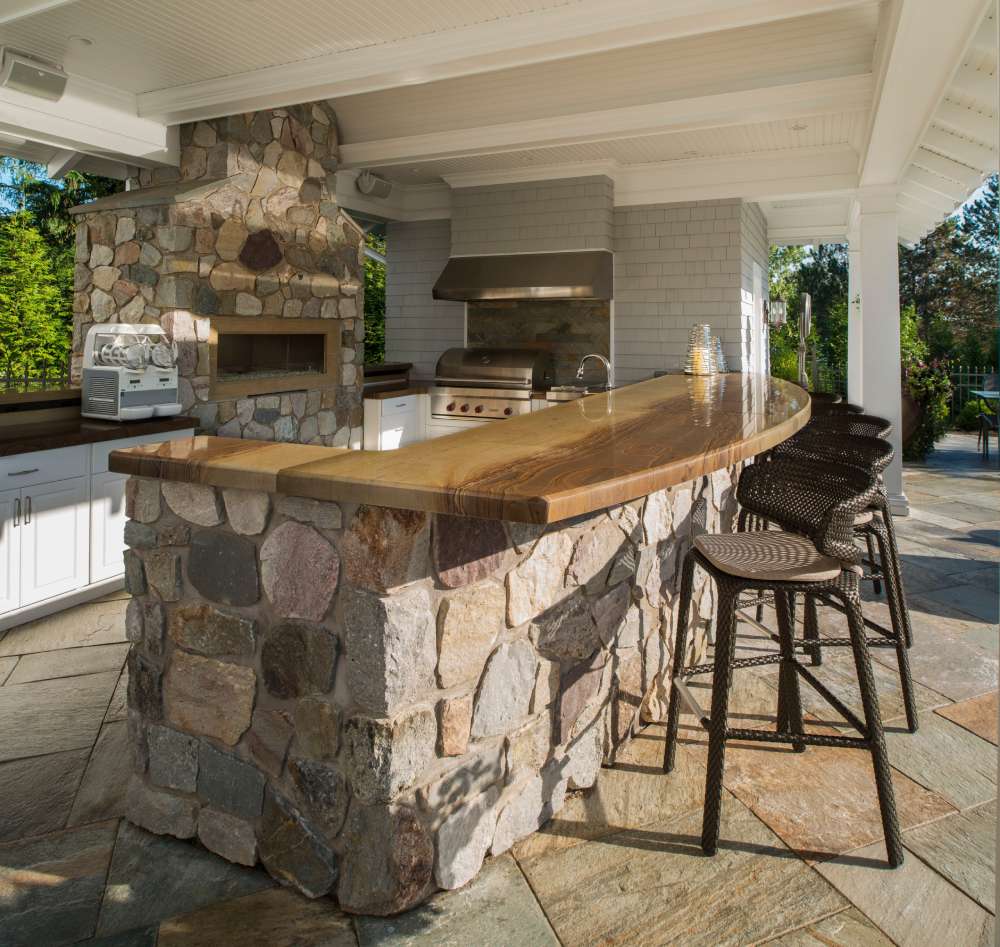
Image source: Cutri Construction
Not all tiles handle grill heat at close range. The 3 best options for backsplash areas directly behind or beside a grill are porcelain, natural slate, and quarry tile.
- Porcelain: fired at 2,200 to 2,400 degrees F during manufacturing, making it highly heat-tolerant in normal grilling conditions
- Slate: natural heat resistance, commonly used in fireplace surrounds and outdoor kitchen walls
- Quarry tile: unglazed, no glaze layer to crack or blister from radiant heat
Cement tile, glass mosaic, and glazed ceramic are not suitable directly behind a grill. The glaze can blister under sustained heat exposure, and cement tile will absorb grease aggressively in a cooking-adjacent location.
Stacked stone veneer panels are popular in Mediterranean-style outdoor spaces, but their weight load on a vertical substrate needs to be checked before installation. Real stacked stone panels run 6 to 10 pounds per square foot. The backer board and framing must be rated for that load.
What Are the Most Popular Outdoor Kitchen Tile Styles Right Now?
5 styles are seeing consistent use in outdoor kitchen builds through 2024 and 2025. Each reflects a different design direction and pairs with specific cabinet, appliance, and countertop finishes.
Design experts at TileCloud note a strong shift toward natural stone materials and earthy tones across kitchen tiles and backsplashes in 2024, with matte and organic finishes gaining over high-gloss surfaces. The same trend is visible in outdoor applications.
Wood-Look Porcelain Planks
Wood-look porcelain planks are the most-requested outdoor kitchen floor tile in deck-adjacent builds right now. The format typically runs 6×36 or 8×48 inches, mimicking hardwood plank dimensions while delivering the frost resistance, slip rating, and stain resistance that real wood cannot provide outdoors.
The current trend leans Scandinavian rather than rustic, according to Family Handyman’s home design contributors: light finishes, clean grain patterns, and minimal knot variation. This works particularly well alongside stainless steel grills and contemporary outdoor furniture.
Concrete-Look Large-Format Tiles
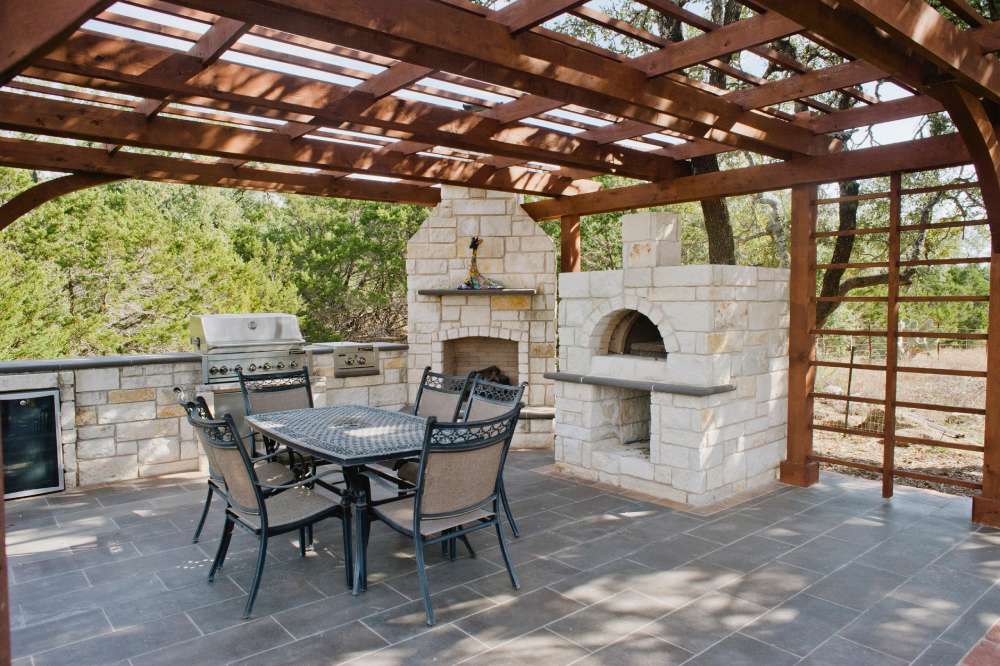
Image source: Rustico Tile & Stone
60×60 cm and larger concrete-look porcelain is the dominant choice in modern and minimalist outdoor kitchen designs. The large format reduces grout joints to near-invisible lines, giving the surface a monolithic appearance that reads expensive even at mid-range price points.
Gray tones are the most common, ranging from light ash to deep charcoal. These pair directly with stainless steel appliances and dark powder-coated cabinet frames. Atlas Concorde’s Boost line and Marazzi’s Plaster series are widely specified in this category for outdoor builds.
Terracotta and Warm Earth Tones
Terracotta is back. Not the soft, crumbly handmade version of 30 years ago but modern terracotta tiles with sealed, vitrified bodies that handle weather and staining.
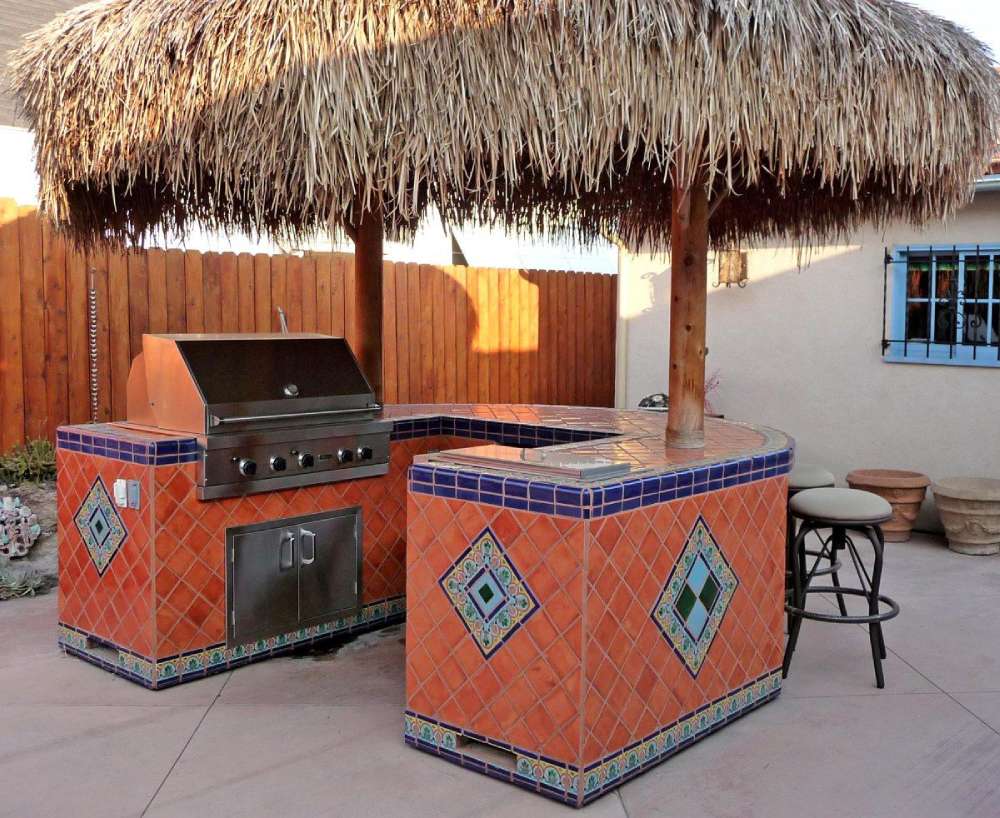
The warm orange-to-red tones work well in Mediterranean kitchen design layouts and Spanish revival outdoor spaces. Tile Club’s 2024 trend report identifies earthy oranges and sun-kissed browns as among the top-performing colorways for kitchen tile this year, a trend that applies directly to outdoor builds.
Black and Charcoal for Modern Builds
Black tile in outdoor kitchens polarizes people. Those who use it tend to commit fully, covering both the floor and the backsplash to create a cohesive dark palette that anchors the space.
The heat absorption issue is real. Dark tile surfaces in direct sun can reach surface temperatures 30 to 40 degrees higher than light tile in the same conditions. For a covered or partially shaded outdoor kitchen, this is manageable. For a fully exposed south-facing installation, light-colored grout at minimum can help break up the surface and reduce visible heat shimmer and thermal stress over time.
Zellige-Inspired Handmade-Look Tiles
Zellige tile was the most talked-about kitchen tile of 2024, according to Jennifer Verruto of Blythe Interiors. The handmade Moroccan clay tiles feature varying thickness, imperfect edges, and unique glaze variation on every piece.
For outdoor use, authenticity matters. True zellige is not frost-proof and is best reserved for covered outdoor kitchen walls in mild climates. Porcelain interpretations that replicate the surface texture and glaze variation of zellige are a better fit in cold-climate or fully exposed outdoor kitchens. The look reads the same at a few feet of distance, with none of the freeze-thaw risk.
How Do Tile Colors Affect Outdoor Kitchen Design?
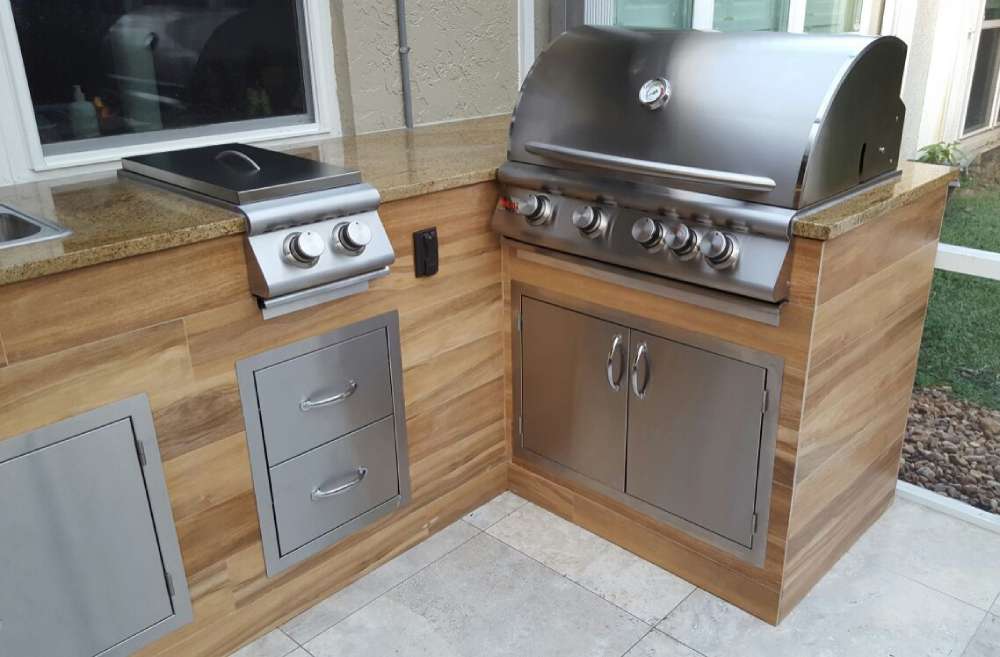
Image source: Arcadia Outdoor Kitchens
Tile color in an outdoor kitchen is not just an aesthetic decision. It directly affects heat absorption, stain visibility, and how the space reads against the surrounding landscape.
According to the Houzz 2024 Outdoor Trends Study, 41% of Gen X and 38% of Millennials are actively upgrading outdoor spaces, with aesthetics and personalization ranking among top priorities. Color selection is where most people make the costliest mistakes, and the errors don’t show up until the space is in daily use.
Dark Tiles and Heat Absorption
Dark outdoor tile surfaces absorb significantly more solar radiation than light-colored ones. In direct sun, black or charcoal tiles can reach 140 to 160 degrees F on the surface during summer afternoons, compared to 90 to 110 degrees F for white or cream tile under identical conditions.
This has 3 practical effects:
- Uncomfortable to walk on barefoot during peak sun hours
- Higher thermal expansion and contraction cycles, which stresses grout joints
- Potential for accelerated UV-related color shift in lower-grade tiles
For covered outdoor kitchens where direct sun is minimal, dark tile performs fine and delivers the dramatic contrast that looks strong against stainless appliances and light cabinetry.
Light Tiles and Stain Visibility Near Cooking Zones
White, cream, and light gray tiles show grease, soot, and cooking residue clearly. This matters most on backsplash surfaces directly behind the grill. A white subway backsplash that looks clean in a product photo will show charring and grease spatters after a single season of regular use in an outdoor kitchen.
Practical solution: use lighter tones on the floor where grease pooling is less likely, and darker or mid-tone tile on the backsplash behind the cooking area. Mid-range grays, warm taupes, and terracotta tones hide residue better than stark white without requiring heavy daily cleaning.
Connecting Indoor and Outdoor Color Continuity
One of the strongest design moves in outdoor kitchen builds is matching or closely complementing the interior kitchen palette. This is called indoor-outdoor visual harmony, and it makes smaller homes feel larger by extending the visual flow of the interior to the outside.
The 2023 tile trend report from Why Tile identified indoor-outdoor continuity as one of the top tile directions that year: using the same stone-look porcelain inside and extending it to the patio and outdoor kitchen floor with matching 2 cm pavers. The format difference (thinner for interior, 2 cm thick for exterior) accounts for structural load without breaking the visual pattern.
What Tile Sizes Work Best in an Outdoor Kitchen?
Tile size affects grout density, maintenance load, thermal performance, and installation complexity. The right size depends on the surface (floor vs. wall), the style direction, and whether the outdoor kitchen sits on a stable concrete slab or a surface with flex.
Larger tiles reduce grout lines, which is generally good outdoors. But larger tiles also need a perfectly level substrate and a large-heavy-tile mortar (LHTM) to prevent lippage and hollow spots.
Small Mosaic Formats
x2 tiles and penny-round mosaics multiply grout joints dramatically. A 10-square-foot backsplash in 2×2 mosaic generates roughly 8 times more grout lines than the same area in 12×12 tile.
More grout lines outdoors mean more maintenance. Epoxy grout is strongly recommended for mosaic outdoor applications because cement grout in small joints absorbs grease and organic matter quickly in a cooking environment. Laticrete Spectralock Pro is a widely used epoxy grout product for outdoor mosaic installations.
Standard 12×12 and 18×18
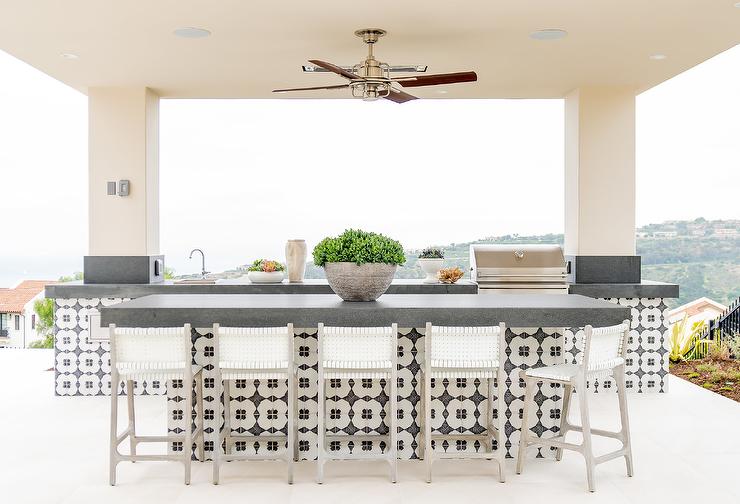
Image source: Patterson Custom Homes
The 12×12 and 18×18 formats remain the most practical for outdoor kitchen floors. They’re easy to cut around obstacles (drains, post footings, appliance bases), widely available in outdoor-rated porcelain lines, and balanced in grout joint density.
For a contemporary patio build, the 18×18 format in a concrete-look matte porcelain hits the right proportion for most mid-size outdoor kitchens (100 to 200 square feet of floor area).
Large-Format 24×24 and Above
Large-format tile looks impressive when done correctly. It also fails spectacularly when done incorrectly on an outdoor slab with any deflection or unevenness.
The 3 installation requirements for large-format outdoor tile are specific:
- Large-and-heavy-tile mortar (LHTM), not standard thinset
- Back-buttering the tile fully, not just the substrate
- Leveling clip system to prevent lippage across large tile faces
Grout joint width on large-format outdoor tile should not go below 3/16 inch. Narrower joints don’t allow for the thermal expansion movement that outdoor tile cycles through between summer and winter temperatures.
Plank Formats for Wood-Look Installations
The 6×36 and 4×24 plank formats are the standard dimensions for wood-look porcelain in outdoor kitchens. Installation follows the same offset or staggered pattern as real hardwood, with a maximum 33% end-joint offset to prevent cracking patterns from concentrating at regular intervals.
Mapei’s Keraflex Maxi or Laticrete’s Platinum thinset are the two most commonly specified mortars for plank-format large-format outdoor tile. Both are polymer-modified and designed for the thermal movement that outdoor installations require.
How Do You Tile an Outdoor Kitchen Countertop?
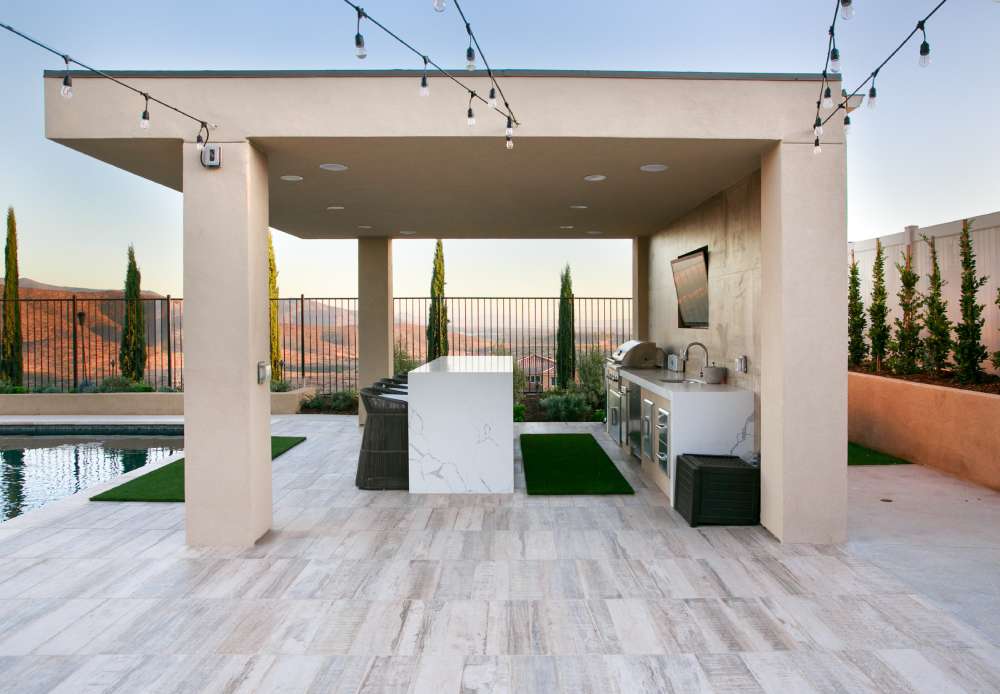
Image source: California Smartscape
Outdoor kitchen countertop tile takes more abuse than any other surface in the space. It handles food prep, grill grease, spilled liquids, direct UV exposure, and thermal cycling from hot cookware placed directly on the surface.
The substrate build-up matters as much as the tile itself. Cement board over outdoor-rated framing is the baseline. For countertops that will see regular wet use, a trowel-applied or sheet waterproof membrane between the plywood and cement board is worth the cost (JLC Online).
Best Tile Types for Outdoor Countertops
Tile thickness is the first filter. Tiles under 3/8 inch can crack under the weight and thermal stress of an outdoor countertop. Most porcelain tiles rated for countertop use run 3/8 to 1/2 inch thick.
3 materials that hold up on outdoor countertops:
- Granite tile (3/4 inch): hardest natural stone option, water absorption below 0.4%, handles heat from cookware
- Through-body porcelain: no glaze layer to chip, color runs full depth, impervious at 0.5% absorption
- Quarry tile: unglazed, dense, suitable for heavy outdoor cooking use in covered kitchen setups
Polished marble and glazed ceramic both fail outdoors over time. Marble etches from acidic food contact (lemon juice, tomato, vinegar), and glazed ceramic chips at edges under normal outdoor countertop use.
Grout and Sealer Selection for Food-Adjacent Surfaces
IRC 2024 code (Section R702.4) requires or strongly recommends epoxy grout on countertops and in areas with food contact or chemical exposure. Standard cement grout on an outdoor countertop absorbs cooking oils and organic material within a season, staining permanently.
Laticrete Spectralock Pro and Mapei Kerapoxy are 2 widely specified epoxy grouts for outdoor kitchen countertop applications. Both meet ANSI A118.3 for chemical resistance and are non-porous once cured.
Grout joint width on countertops: narrow joints (1/8 inch or less) are easier to clean than wide joints, per JLC Online’s countertop tiling guidelines. Keep expansion joints at every change of plane, including where the countertop tile meets the backsplash and around any sink or cooktop cutouts.
What Grout and Mortar Should You Use for Outdoor Kitchen Tile?
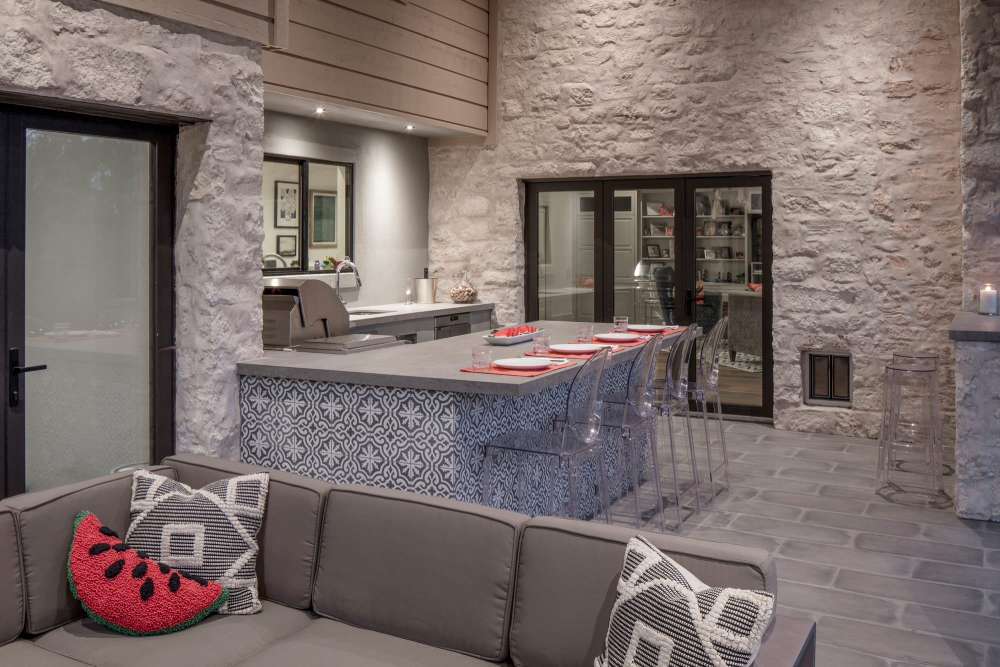
Image source: CG&S Design-Build
The tile you choose gets most of the attention. The grout and mortar fail first. Outdoor kitchen tile installations collapse at the installation layer before the tile itself shows problems.
Outdoor tile installation costs rose roughly 7% in 2025 compared to 2024 (Skyscapes Urban Outdoor Flooring), driven partly by higher-spec mortar and waterproofing requirements that contractors now include as standard line items in outdoor bids.
Epoxy Grout vs. Cement Grout Outdoors
| Grout Type | Stain Resistance | Freeze-Thaw Performance | Outdoor Kitchen Use |
|---|---|---|---|
| Epoxy grout | Excellent (non-porous) | Excellent (flexible) | Countertops, cooking zones |
| Polymer-modified cement | Good (with sealer) | Good in mild climates | Floor, wall in frost-free zones |
| Standard cement grout | Poor outdoors | Fails in freeze-thaw | Not recommended outdoors |
| Urethane grout | Excellent (flexible) | Very good | Floor joints, movement zones |
Labor for epoxy or urethane grout runs 40% to 60% higher than cement grout (TileForeman, 2025). Worth it on countertops and backsplash areas. On a large outdoor floor where grease exposure is low, polymer-modified cement grout sealed twice yearly is a practical middle ground.
Polymer-Modified Thinset for Outdoor Work
Standard thinset does not belong in an outdoor kitchen installation. Full stop.
Outdoor tile cycles through temperature extremes daily. Standard thinset becomes brittle under this movement. Polymer-modified thinset (ANSI A118.4 or higher) stays flexible enough to absorb thermal expansion and contraction without cracking the bond layer.
For large-format tiles (any tile exceeding 15 inches in one dimension), ANSI A118.15 improved polymer-modified mortar is required, per TCNA Handbook specifications. Laticrete 254 Platinum and Mapei Keraflex Maxi both meet this standard and are commonly specified on outdoor kitchen projects.
Expansion Joint Spacing Outdoors
Outdoor divider (expansion) joints are needed every 9 to 15 square meters (roughly 97 to 161 square feet) of tile surface, per Mapei’s EpoxyElite installation guidelines. That is significantly tighter spacing than indoor work, which can often go 20 to 25 square meters between joints.
Fill expansion joints with urethane sealant, not grout. Grout is rigid. When thermal movement forces the tile assembly to shift, rigid grout in expansion joints cracks and opens a water entry point.
How Do You Maintain Outdoor Kitchen Tiles?
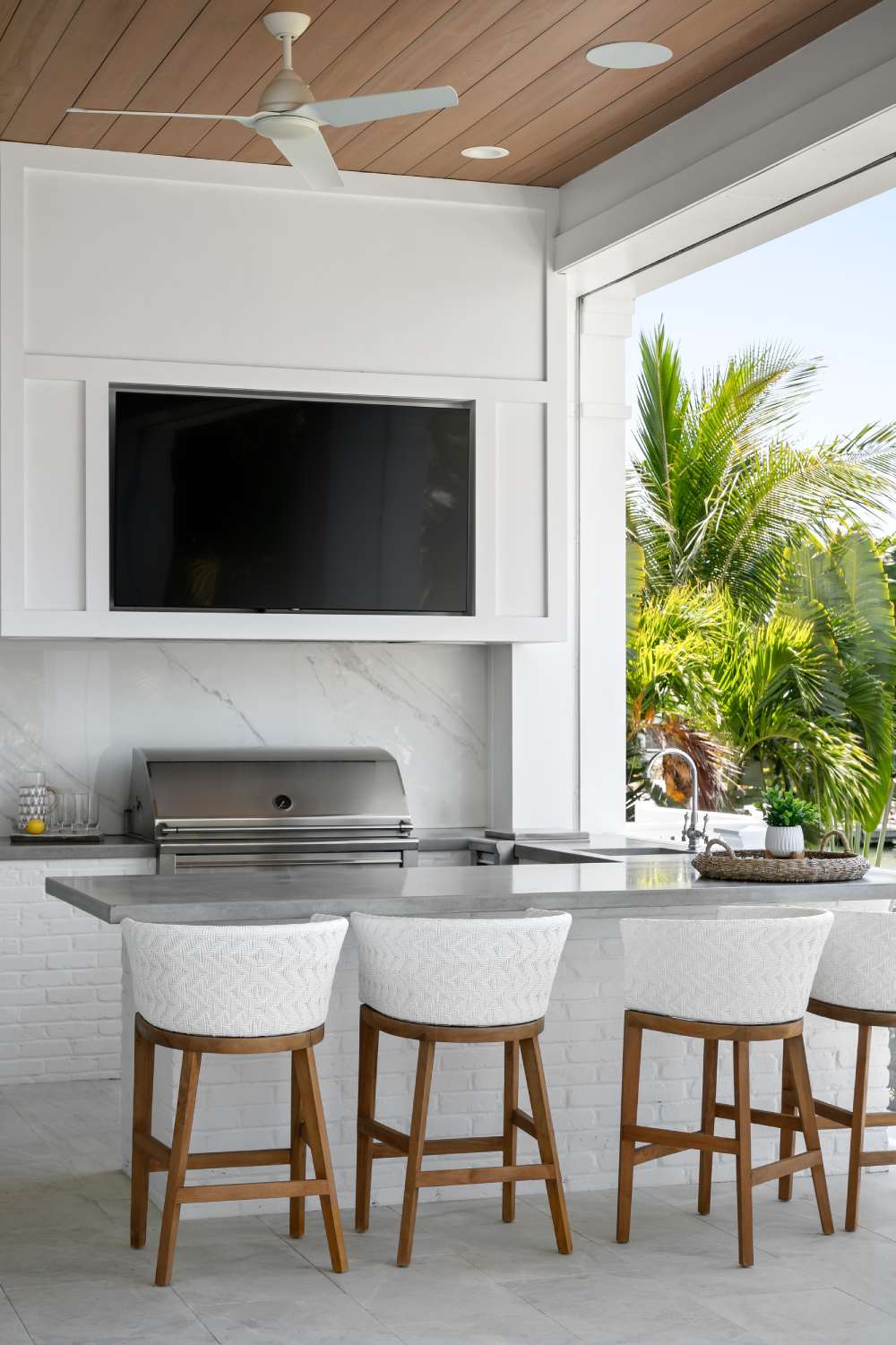
Image source: Trinity Construction and Design
Porcelain needs almost no maintenance. Natural stone needs consistent attention. The gap between these two materials widens significantly in an outdoor cooking environment where grease, UV exposure, and seasonal weather add up fast.
Professional outdoor tile maintenance services charge $2 to $5 per square foot for annual deep cleaning and sealing. For a 300-square-foot outdoor kitchen surface area, that puts professional annual upkeep at $600 to $1,500 (Skyscapes, 2025).
Sealing Schedules by Tile Type
Porcelain: no sealing required. Its water absorption rate below 0.5% makes it non-porous by nature (Bedrosians, 2025).
Natural stone (granite, slate): seal once after installation, then every 1 to 2 years with a penetrating impregnating sealer. Daltile’s natural stone care guide specifically recommends penetrating sealers over topical ones, as they allow the stone to breathe while protecting the pore structure.
Cement tile: seal every 6 months in an outdoor cooking environment. The porous cement body absorbs grease aggressively near cooking zones.
Travertine: seal twice yearly outdoors. Its absorption rate of 3% to 5% makes it particularly vulnerable to grease staining and organic matter penetration in outdoor kitchen conditions.
Pressure Washing and Grease Removal
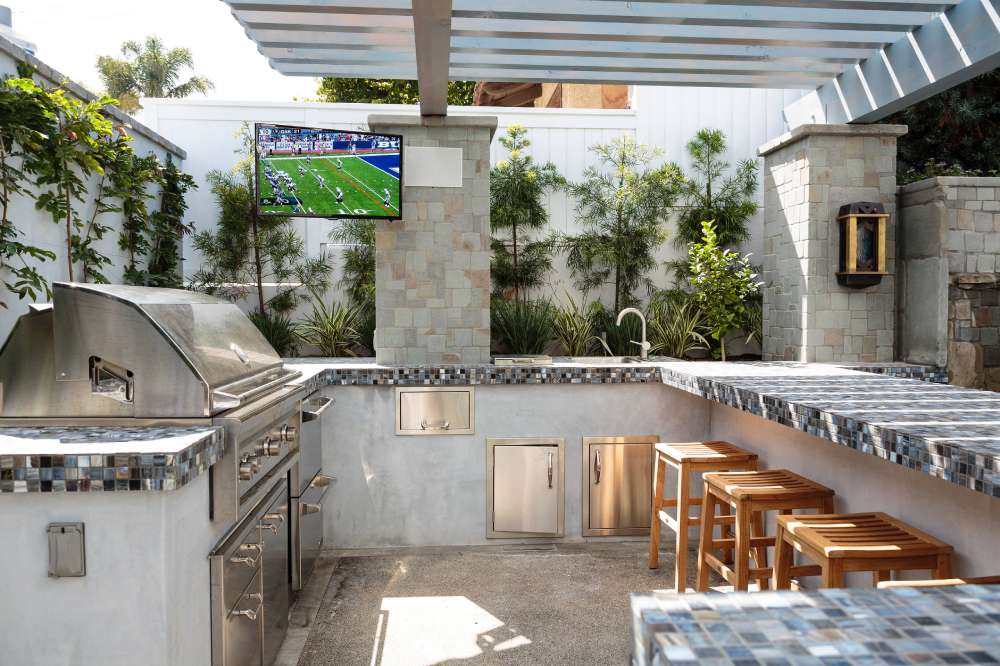
Image source: GDM Landscape Inc
Pressure washing is the fastest way to clean outdoor kitchen tile floors. The safe range varies by material.
- Porcelain: up to 2,000 PSI, no damage risk
- Slate and granite: 1,200 to 1,500 PSI maximum
- Travertine: 800 to 1,000 PSI only, high pressure strips sealer and opens pores
- Cement tile: avoid pressure washing entirely, use a stiff brush and pH-neutral cleaner
For grease and cooking residue on backsplash tile, use a pH-neutral stone cleaner (Stone Tech BulletProof Cleaner, Aqua Mix Stone & Tile Cleaner) rather than degreasers containing acids or bleach. Both products damage natural stone sealers and can etch softer stones. Even on porcelain, acid-based degreasers degrade epoxy grout color over time with repeated use.
Freeze-Thaw Inspection and Regrouting
In freeze-thaw climates, inspect outdoor kitchen tile every spring before the first use of the season. Look for 3 specific failure signs:
- Grout joint cracking or missing sections (water entry point)
- Tile surface spalling or surface lift at corners
- Hollow sound when tapping tile (bond failure beneath)
Regrouting cracked outdoor joints with polymer-modified cement grout is a straightforward DIY repair. Replacing hollow or lifted tiles requires removing the failed tile, re-flattening the substrate mortar, and resetting with fresh polymer-modified thinset. Do not regrout over cracked or hollow tile. The underlying bond failure will continue to worsen regardless of surface patching.
What Is the Cost of Tiling an Outdoor Kitchen?
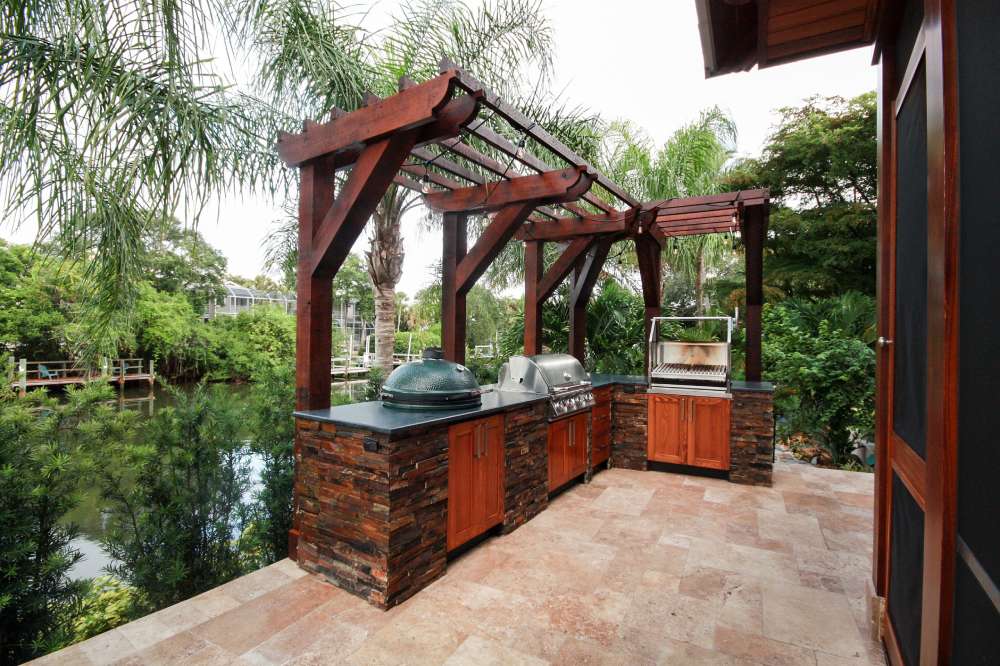
Image source: Ocean Builders of S W Florida Inc
Outdoor tile costs run higher than indoor equivalents. The premium comes from material specifications (frost-rated, higher-grade porcelain or stone), substrate prep (waterproof membrane, anti-fracture layer), and mortar upgrades (polymer-modified, large-format mortar). Budget for all three, not just the tile.
The national average outdoor tiling cost in 2025 ranges from $15 to $40 per square foot, all-in (Skyscapes Urban Outdoor Flooring, 2025). A standard 200-square-foot outdoor kitchen floor runs approximately $5,000 at mid-range material and labor.
Tile Material Cost Ranges
Budget tier:
- Ceramic (mild climates, wall use only): $6 to $12 per sq. ft. installed
- Quarry tile: $8 to $14 per sq. ft. installed
Mid-range tier:
- Porcelain (matte, standard format): $8 to $18 per sq. ft. installed
- Terracotta (sealed, modern vitrified): $10 to $20 per sq. ft. installed
- Wood-look porcelain planks: $18 to $30 per sq. ft. installed
Premium tier:
- Natural slate or granite tile: $15 to $35 per sq. ft. installed
- Large-format premium porcelain (24×48 and above): $25 to $50 per sq. ft. installed
Hidden Costs That Move the Budget
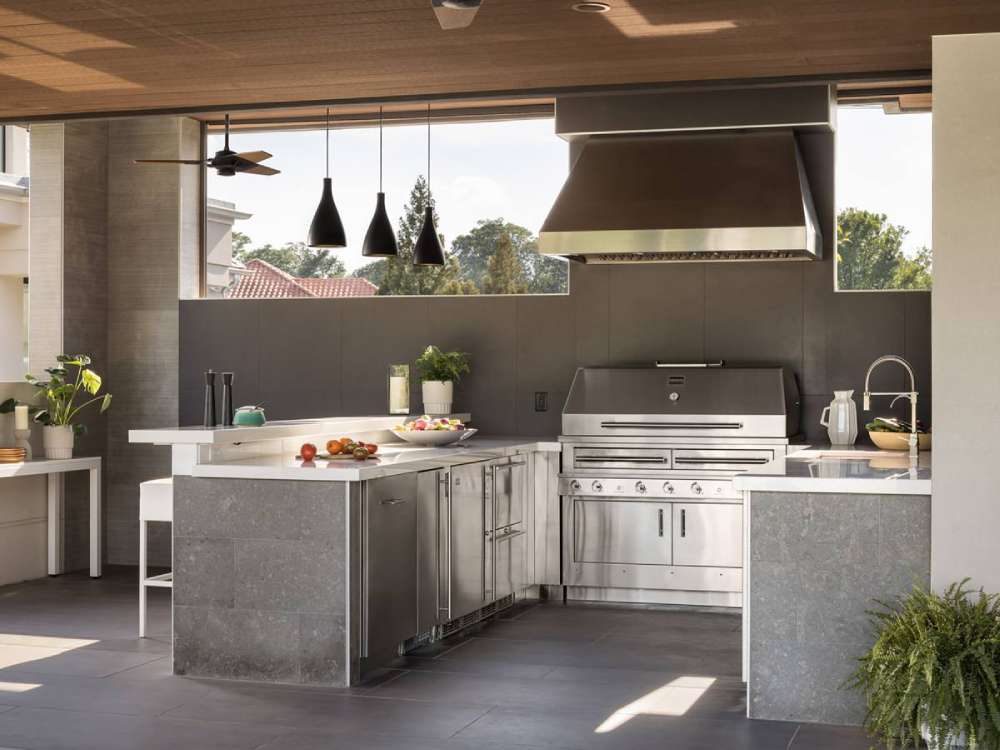
Image source: Kalamazoo Outdoor Gourmet
Tile material is only part of the number. These 4 line items catch most homeowners by surprise on outdoor kitchen tile projects.
Waterproof membrane: $1 to $3 per sq. ft., applied under floor tile on concrete slabs, non-negotiable on elevated deck installations.
Large-format mortar upgrade: ANSI A118.15 polymer-modified mortar costs more than standard thinset. On a 200 sq. ft. floor with 24×24 tile, the mortar upgrade adds $200 to $400 to the base labor quote.
Post-install sealing: $1 to $2 per sq. ft. for natural stone and porous tile (TileForeman, 2025). Required for travertine, slate, quarry tile, and cement tile in outdoor kitchen conditions.
Edge and trim pieces: Bullnose edge tile at countertops and step nosings at floor-level transitions runs $15 to $25 per linear foot for stone or premium porcelain edge profiles.
Cost by Outdoor Kitchen Size
| Kitchen Size | Floor Area | Mid-Range Tile Cost | Total Budget (materials + labor) |
|---|---|---|---|
| Small (island + grill) | 50 sq. ft. | $400 to $900 | $1,500 to $3,000 |
| Medium (full L-shape) | 100 to 150 sq. ft. | $800 to $2,700 | $3,000 to $6,000 |
| Large (full outdoor kitchen room) | 200+ sq. ft. | $1,600 to $6,000+ | $6,000 to $12,000+ |
These figures cover floor tile only. Outdoor kitchen ideas on a budget often combine porcelain floor tile with a simpler backsplash material (quarry tile or standard porcelain subway) to keep the total project cost toward the lower end of the range.
What Installation Mistakes Shorten the Life of Outdoor Kitchen Tile?
Most outdoor tile failures trace back to installation errors, not material defects. The tile was fine. The system around it wasn’t.
Tile failures on exterior deck and patio installations are well-documented in trade literature: water enters through cracked grout joints or perimeter edges, freezes, expands, and causes tiles to lift or crack (Construction Specifier). Every one of the common failure modes below maps to a preventable installation error.
Skipping the Waterproof Membrane
Water gets under outdoor tile. Full stop. This is not a question of whether it happens but when.
Even impervious porcelain tile allows water entry through grout joints, perimeter gaps, and penetrations. A waterproof membrane applied to the concrete substrate before tile installation captures this water above the structure and routes it to drainage. Without a membrane, water sits against the substrate, causes efflorescence, and in freeze-thaw climates forces tiles off their bond within a few seasons (Floor Trends & Installation).
Laticrete Hydro Ban and Schluter Ditra are 2 widely used membrane systems for outdoor tile applications. Both also function as crack-isolation membranes, breaking the transmission of concrete substrate cracks up through the tile surface.
Using Indoor-Rated Thinset Outdoors
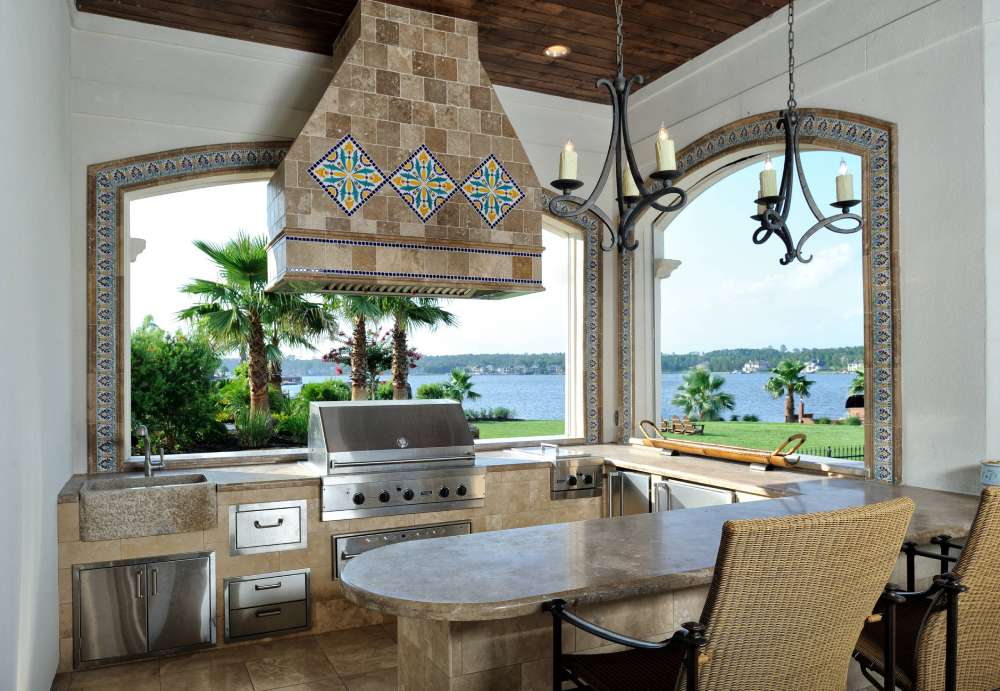
Image source: Gary Keith Jackson Design Inc.
Standard premixed mastic and non-modified thinset mortars are drying-type products. They cure by evaporation, not chemical reaction. When sandwiched between an impervious tile and a waterproofed substrate outdoors, they can take months to dry, or never fully cure.
This produces hollow spots, bond failure, and tile that rocks underfoot. The fix is always the same: use polymer-modified thinset (setting type, powder-and-water mixed) rated to ANSI A118.4 or A118.15 for large-format outdoor work. Do not use premixed thinset outdoors, period.
Missing Expansion Joints
Interior tile floors in smaller rooms often skip expansion joints without consequence. Outdoor tile cannot.
Temperature swings between summer and winter create enough thermal expansion in a tile assembly to buckle the field if expansion joints are absent. The TCNA standard EJ-171 governs movement joint placement. Key locations for outdoor kitchens: every 9 to 15 square meters of field tile, at all perimeter walls and post footings, and wherever tile transitions from horizontal to vertical surfaces.
Fill these joints with urethane sealant, not grout. Grout in an expansion joint cracks under the first thermal cycle and defeats the purpose entirely.
Grouting Too Soon After Setting
Rushing the cure between tile-setting and grouting is one of the most common DIY errors in outdoor kitchen installations. Polymer-modified thinset in outdoor conditions needs a full cure before grout is applied. At temperatures between 60 and 80 degrees F, that means a minimum of 24 hours, often 48.
Cold conditions (below 50 degrees F) slow cure significantly and can push required wait time to 72 hours or more. Grouting over uncured thinset traps moisture, weakens the bond layer, and produces hollow-sounding tile that will need re-setting within a season. Do a finger-press test before grouting: the thinset should show zero transfer when pressed firmly before any grout is applied.
Installing Polished Tile on Horizontal Surfaces
Polished tile on an outdoor kitchen floor is a safety and durability failure waiting to happen.
The slip risk is immediate: polished surfaces drop well below the 0.60 DCOF threshold required for outdoor wet zones the moment rain hits them. The wear issue compounds over time: UV and outdoor grit degrade polished glaze unevenly, producing a surface that looks worn and dull within 2 to 3 seasons.
Reserve polished finishes for kitchen accent wall panels and vertical backsplash surfaces where foot traffic and weather exposure are minimal. For floors and countertops, matte and textured finishes are the only practical choice outdoors.
FAQ on Outdoor Kitchen Tile Ideas
What is the best tile for an outdoor kitchen floor?
Porcelain tile is the best all-around choice for outdoor kitchen floors. It has a water absorption rate of 0.5% or less, handles freeze-thaw cycles without cracking, and meets the minimum DCOF 0.42 slip resistance standard when specified in a matte or textured finish.
Can you use ceramic tile in an outdoor kitchen?
Ceramic tile works outdoors only in frost-free climates. Its water absorption rate of 3% to 7% makes it vulnerable to freeze-thaw damage. In mild regions like coastal Southern California or South Florida, ceramic is acceptable on vertical surfaces but not recommended for outdoor kitchen floors.
What PEI rating do I need for outdoor kitchen tile?
A minimum PEI 4 rating is required for outdoor kitchen floors. PEI measures surface wear resistance on glazed tiles from 0 to 5. PEI 3 and below are not built for the grit, foot traffic, and UV exposure that outdoor cooking areas receive daily.
What tile is best for an outdoor kitchen backsplash?
Large-format porcelain slabs and natural slate are the strongest backsplash options. Keep glass mosaic and glazed ceramic at least 12 inches from direct grill heat. Both materials can blister or crack from sustained radiant heat exposure at close range near burners or grill hoods.
Do outdoor kitchen tiles need to be sealed?
Porcelain requires no sealing. Natural stone needs a penetrating sealer applied after installation and every 1 to 2 years outdoors. Cement tile needs sealing every 6 months in an outdoor cooking environment due to its porous body absorbing grease aggressively near cooking zones.
What grout should I use for outdoor kitchen tile?
Epoxy grout is the best choice for countertops and cooking-adjacent surfaces. It is non-porous, stain-resistant, and chemical-resistant once cured. For outdoor floors with low grease exposure, polymer-modified cement grout sealed twice yearly is a practical, lower-cost alternative to full epoxy application.
How much does it cost to tile an outdoor kitchen?
Outdoor kitchen tiling costs $15 to $40 per square foot all-in for materials and labor (Skyscapes, 2025). A standard 200-square-foot floor runs around $5,000 at mid-range specifications. Premium large-format porcelain or natural stone with full waterproof membrane prep pushes totals to $8,000 or more.
What size tile works best for an outdoor kitchen floor?
The 18×18 and 24×24 formats work best for most outdoor kitchen floors. Large-format tiles reduce grout lines and maintenance. They require a perfectly level substrate, large-and-heavy-tile mortar, and a leveling clip system to prevent lippage across the wider tile face during installation.
Can you use wood-look tile in an outdoor kitchen?
Yes. Wood-look porcelain planks in 6×36 or 8×48 formats are among the most popular outdoor kitchen floor choices right now. They deliver the warmth of wood grain with the frost resistance, slip rating, and stain resistance that real hardwood cannot provide in an exposed outdoor cooking environment.
What are the most common outdoor kitchen tile installation mistakes?
The 4 most common failures are: skipping the waterproof membrane under floor tile, using indoor-rated thinset outdoors, omitting expansion joints, and grouting before the thinset has fully cured. Each one leads to cracked grout, hollow tile, or full bond failure within a few seasons.
Conclusion
Good outdoor kitchen tile ideas start with the right material spec, not the finish catalog.
Water absorption rate, DCOF slip resistance, and PEI wear rating determine whether your tile lasts a decade or fails after two winters.
Porcelain handles most outdoor cooking environments without sealing. Natural stone delivers character but requires consistent maintenance. Large-format concrete-look and wood-look planks cover both performance and style when specified correctly.
Pair every tile choice with polymer-modified thinset, epoxy grout at food-contact surfaces, a waterproof membrane under floor tile, and properly spaced expansion joints.
Get those four installation elements right, and the tile style becomes a long-term design decision rather than a repair schedule.

- Paint Colors That Go with Gray Floors - August 20, 2026
- What Color Bedding Goes with Dark Wood Furniture - August 18, 2026
- What Color Walls Go with Oak Floors - August 16, 2026


