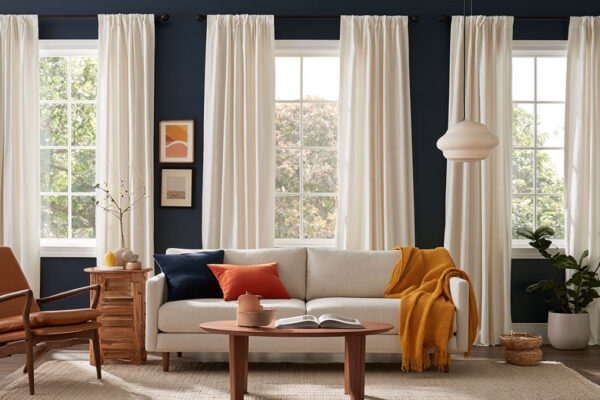
Curtain Colors
Bedroom Curtains Ideas to Block Light and Add Style
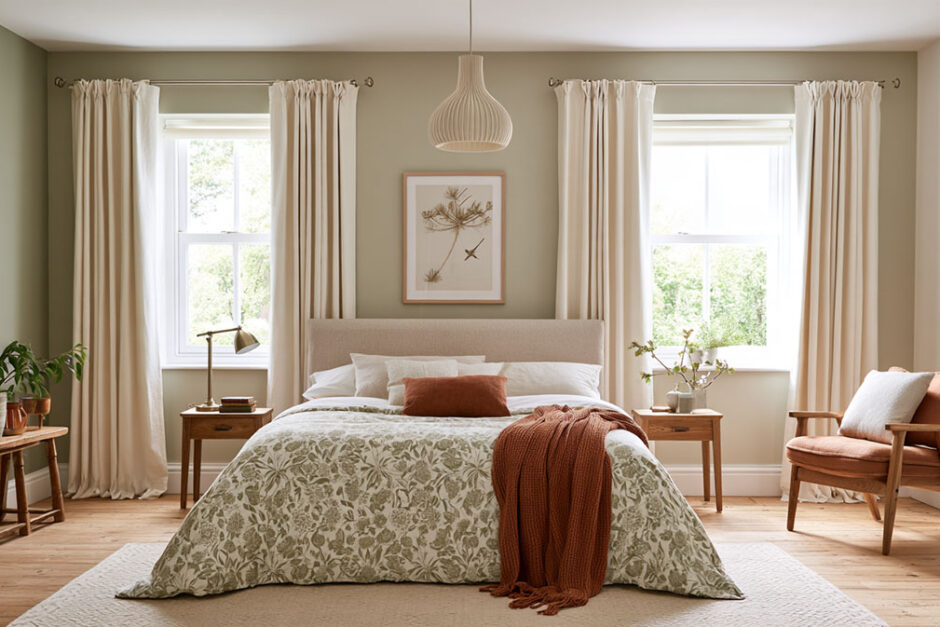
Most people shop for bedroom curtains by color and only find out about light control after the panels are hung. It works better the other way around. Sheer, light filtering, room darkening and blackout are the ratings you’ll see on the label, and the one you pick decides what the room feels like at 6 a.m.
Curtains hang closer to your sleeping head than any other fabric in the house, so the details count. Rod height and fullness decide whether a panel looks expensive, while the header and fabric decide whether it darkens the room at all.
“Dark enough” is a lower bar than most people think. A 2022 Northwestern University study in PNAS found that one night of sleep at 100 lux, moderate room lighting, raised heart rate and next-morning insulin resistance compared with about 3 lux.
How to Choose Bedroom Curtains by Light Control
Settle the light rating first and worry about color and fabric afterward, since both change how well a rating actually performs.
Curtains are only one family among the many types of window treatments, but in a bedroom they carry the heaviest job. They set how dark the room gets at night and how much sun hits the bed at 6 a.m.
| Light rating | Light blocked | Privacy at night | Best for |
|---|---|---|---|
| Sheer | Very little, softens glare | Low, silhouettes show with lamps on | Daytime privacy layer |
| Light filtering | Diffuses sun, room stays bright | Medium | People who wake with daylight |
| Room darkening | Most light, a soft glow remains | High | Guest rooms, napping |
| Blackout | Nearly all, when fitted well | Full | Shift workers, light sleepers, streetlights |
Why darkness matters for sleep
The Sleep Foundation calls light the most important outside factor in how ready the body is for sleep, because light exposure blocks melatonin production.
And the bar for “too bright” is lower than most people expect.
A 2022 Northwestern University study in PNAS compared sleeping at 100 lux (moderate room lighting) with about 3 lux (dim light). A single night at 100 lux raised nighttime heart rate and increased insulin resistance the next morning.
Streetlights, car headlights and a neighbor’s porch lamp all reach the bed through an uncovered window. In most city bedrooms that alone is reason enough for blackout or room darkening fabric.
Matching the rating to the sleeper
- Night shift workers and anyone sleeping in the daytime should go blackout, no debate.
- A light sleeper near a streetlight needs blackout, or room darkening fabric with a lining.
- If you wake better with the sun, light filtering works, or a sheer paired with a heavier panel you leave open.
- East-facing window? Sunrise lands straight on the bed, so go darker than you think you need.
Total darkness isn’t always the goal. Some people sleep fine but struggle to wake up in a pitch-black room, and a light filtering panel suits them better.
Bedroom Curtain Ideas by Style and Color
Curtains one or two shades off the wall color are the safe choice. A patterned panel against plain walls and bedding is the bold one. Both work, and the middle ground is where rooms start looking busy.
Before buying, scan a few proven curtain color ideas against your actual wall paint, in daylight and again under lamps at night.
Neutral and tonal
Tonal curtains disappear into the wall and let the bed take over the room. Oatmeal linen on warm white walls is the classic version, and soft gray cotton on pale gray paint does the same thing.
White is having a moment, too. Pantone picked PANTONE 11-4201 Cloud Dancer as its 2026 Color of the Year, the first white chosen since the program started in 1999.
The catch with white and ivory is how they glow when the sun hits them. Without a blackout lining, a white panel will not darken a room.
Bold color and pattern
A strong pattern works in neutral rooms with solid bedding and plain walls. It falls apart in a room that already has a patterned rug and a statement headboard, never mind printed sheets.
Floor-length curtains cover a lot of surface, so a strong print reads as the room’s main focal point whether you planned it or not. Pick one pattern to lead and keep everything else quiet.
Deep green or navy velvet suits a moody room, and small-scale florals or stripes fit a cottage-style bedroom. For boho, muted earth tones like rust and terracotta are the usual route, with olive if you want it greener.
Dark panels on dark walls make a small bedroom feel tighter. In a room under about 10 by 10 feet, keep at least one of the two lighter.
Contrast linings and trims
A contrast lining shows only at the leading edge and folds. Taupe face fabric with a rust or ochre lining is a quiet way to add color without committing a whole wall to it.
Banded trims do a similar job. A 2- to 3-inch border along the leading edge, in a shade pulled from the bedding, ties the window to the bed.
Scandi and minimalist rooms skip trims entirely. Plain linen, no pattern, hung high.
Which Fabric Works Best for Bedroom Curtains?
For most bedrooms, lined cotton or a cotton-linen blend is the sensible pick. Velvet is better if you care about darkness and sound. Unlined linen looks great but blocks almost nothing.
Fabric sets how the panel hangs and how much light gets through. It also decides how often you’ll be washing or steaming it.
| Fabric | Pros | Cons |
|---|---|---|
| Linen | Relaxed drape, natural texture, breathable | Wrinkles, fades in sun, needs lining for darkness |
| Cotton | Easy to wash, medium weight, wide color range | Can shrink, thin weaves let light through |
| Velvet | Blocks light and muffles sound, rich look | Heavy, collects dust, needs a sturdy rod |
| Polyester / triple-weave | Built-in blackout, cheap, holds color | Stiffer drape, can look flat |
| Voile / sheer | Daytime privacy, soft light | No night privacy with lamps on |
Linen deserves its own note. The slub weave is what gives a bedroom that lived-in, soft look, and it’s one of the easiest ways to add texture to a room without adding pattern.
But it creases at the fold line and lets light through at the seams. Most people who love linen end up adding a blackout liner behind it.
Linings change the fabric
A standard lining adds body and protects the face fabric from sun. Thermal versions are heavier and slow drafts. Blackout lining can turn almost any face fabric into a blackout panel, which is why I’d put money there before upgrading the fabric itself.
A lined cotton panel often outperforms a cheap unlined “blackout” polyester, simply because the extra layer hangs fuller.
Labels worth checking
OEKO-TEX Standard 100 certification means every component, down to thread and buttons, is tested against a list of over 1,000 harmful substances, according to OEKO-TEX. Reasonable to look for in a room where you spend eight hours a night.
NFPA 701 is the National Fire Protection Association’s flame propagation test for curtains and draperies. It’s mostly required in hotels and public buildings, though some residential panels carry it too.
Curtain Header Styles and Rods
For everyday bedroom use, grommet and back tab headers are the easy ones. Pinch pleat and ripplefold look more tailored. Rod pocket and tab top look fine, but opening and closing them every morning gets old fast.
Header is just the name for the top edge of the panel where it meets the rod. It shapes the folds and decides how easily the curtain slides, and it also controls how much light slips over the top.
| Header | Look | Daily use | Light over the top |
|---|---|---|---|
| Grommet | Casual, deep even folds | Slides easily | Gap above rod |
| Rod pocket | Gathered, cottage | Sticky, hard to draw | Small |
| Tab top / back tab | Relaxed, flat | Fair | Small to medium |
| Pinch pleat | Tailored, formal | Smooth on rings or a traverse rod | Depends on mount |
| Ripplefold | Modern, uniform wave | Very smooth on a track | Minimal with ceiling mount |
Pinch pleat versus grommet
Pinch pleat panels hang from rings or hooks, so the fabric sits below the rod in crisp, uniform folds. It’s what most people picture when they hear the word drapes (the difference between drapes and curtains is mostly about weight, lining and this kind of tailoring).
Grommets are cheaper and easier. What you give up is a visible rod and that strip of light above it.
Rods, tracks and mounts
Double rods hold a sheer in back and a heavier panel in front, so one rod does two jobs.
Ceiling tracks make a standard window look taller and leave no gap at the top. I’d pick one over a rod in most bedrooms. Mount it into a joist or with proper anchors, because a pair of lined velvet panels is heavy.
A traverse rod opens pinch pleat drapes with a wand or cord, so you never handle the fabric at all.
Renters have options too. Tension rods and adhesive hooks cover most of the ways to hang curtains without drilling, though they top out at light panels.
How to Layer Bedroom Curtains With Sheers and Blinds
Layering makes sense when one fabric can’t cover everything. A sheer handles daytime privacy and a lined panel handles the night. If you want more darkness or warmth, a shade underneath takes over from there.
The simplest version is a double rod with the sheer on the back rod and the heavy panel in front. Another puts a blackout roller or cellular shade inside the window frame, with curtain panels hung outside it.
A Roman shade with fixed side panels suits small or narrow windows where full panels would swallow the wall. Pairing Roman shades with curtains also lets you spend more on the panel fabric, since those panels rarely move.
The shade does more than the curtain
This part surprises people. The U.S. Department of Energy puts the heat-loss cut from closed conventional draperies at up to 10% in cold weather.
Tightly installed cellular shades cut heat loss through windows by 40% or more, per the same DOE guidance.
So if the bedroom runs cold, the shade behind the curtain does most of the insulating. The curtain mostly finishes the look.
Cords and kids
Any blind added under bedroom curtains in a child’s room should be cordless. Since December 15, 2018, the ANSI/WCMA A100.1-2018 standard from the Window Covering Manufacturers Association has called for stock window coverings sold in the U.S. and Canada to be cordless or have short or inaccessible cords.
In the U.S., federal rules from the Consumer Product Safety Commission now back that up. Noncompliant cords on stock and custom window coverings count as a substantial product hazard, and a separate rule (16 CFR 1260) applies the same operating-cord requirements to custom window coverings made after May 30, 2023.
Older corded blinds are still in plenty of homes and secondhand listings, so check the cord details before you buy for a child’s room.
Still deciding between fabric and hard treatments? The trade-offs in blinds versus curtains come down to light control at the edges, cleaning and how much softness the room needs.
How High and Wide to Hang Bedroom Curtains
Mount the rod 4 to 6 inches above the window frame and extend it past the frame on both sides. Buy panels with a combined width of about 2 to 2.5 times the window, then pick a length that clears the floor by about half an inch, or just kisses it.
Bob Vila’s hanging guide sets a limit on height, too. On ceilings 10 feet or higher, stay within 8 inches of the top of the window frame. Go above that and the curtain starts to look like it slipped off a different window.
The measuring sequence
- Measure the window from outside edge to outside edge of the trim, then the height from floor to top of trim and from trim to ceiling.
- Set the rod height. Start at 4 to 6 inches above the trim, and if the trim-to-ceiling gap is under 12 inches, go higher or mount at the ceiling.
- Set the rod width. Add enough on each side that open panels stack on the wall, not over the glass. Bob Vila suggests at least 1 to 3 inches per side, and up to 6 inches per side if you want the window to look larger. Go wider if you want the glass fully clear when the panels are open.
- Calculate fullness by multiplying the rod width by 2 for standard panels, 2.5 for a lush look, and up to 3 for thin sheers.
- Choose the length. Measure from the rod (or from the bottom of the rings) to the floor, then subtract for the hem style you want.
Skipping the math? A curtain size calculator runs the same width and length numbers from your window measurements.
Worked example: a 36-inch bedroom window
| Measurement | Value | How it was set |
|---|---|---|
| Window width (with trim) | 36 in | Measured |
| Rod width | 48 in | 6 in past each side, the top of Bob Vila’s range for a larger-looking window |
| Total panel width | 96 in | 48 in x 2 fullness |
| Rod height | 86 in | Trim top at 80 in, plus 6 in |
| Finished length | 85.5 in | Rod to floor, minus 0.5 in float |
That works out to two 48-inch panels. Stock panels come in 84 and 96 inches long, so buy 96 and hem them, because an 84-inch panel would hang short of the floor.
Curtain lengths
- Sill length stops at the windowsill. Practical over a radiator or a desk.
- Apron length ends a few inches below the sill, which is common on short windows.
- A float sits about half an inch off the floor. Clean, and easy to vacuum around.
- A break rests on the floor with a slight bend, which forgives an uneven floor.
- Puddle length pools 2 inches or more. It looks romantic and collects dust and pet hair fast.
Tall rooms change the rules a bit. Many of the tricks in these high ceiling room ideas rely on long, uninterrupted fabric to fill the extra wall height.
Curtains for Small Bedrooms and Awkward Windows
Small rooms and odd windows call for less fabric and slimmer hardware, plus some thought about where everything mounts.
Small bedrooms
Crate and Barrel’s measuring guide recommends 1 to 1.5 times the window width for panels in smaller spaces, compared with 2 to 2.5 times in larger rooms.
Less fabric means less bulk when the curtains are open. In a 10-by-10 room, that stacked fabric can eat 8 or more inches of wall on each side.
A ceiling-mounted track works well here, or a slim rod in a finish close to the wall color. Light colors in a single tone with the walls help, and valances, swags and tiebacks should stay out of the picture.
Color does a lot of the work. The same principles that decide which colors make a room look bigger apply to the fabric, since floor-length panels cover nearly as much surface as a painted wall.
Short or high windows
Hang high and wide, then go floor length anyway. A short window reads as tall when the fabric starts near the ceiling and runs to the floor.
The exception is a bed pushed under the window. Then a Roman shade or apron-length cafe curtain beats long panels that drape across the headboard.
Bay and corner windows
On a bay window, use a bendable rod or a ceiling track that follows the angles. One panel per window section closes the bay fully, while one panel on each far end just frames it.
Corner windows take two rods meeting at a corner connector, with a panel on each outer end and a double-width panel at the corner.
Wide windows
A center split with two panels works up to a point. Bob Vila advises adding a center support to any rod longer than four feet, and on very wide windows, roughly 8 feet and up, pinch pleat panels on a track handle the width better than grommets on a pole.
IKEA’s bedroom curtain guide recommends ceiling-mounted rails for a taller-looking window and less air escaping above it, with a warning to mount them firmly and account for the total weight of the curtains. That weight warning matters most on wide windows.
Why Blackout Curtains Still Let Light In
The fabric is rarely the culprit. Light sneaks in around the edges, and the gaps around the fabric are behind most “my blackout curtains don’t work” complaints. Those are installation problems, not fabric problems.
Light finds its way past a blackout panel in a few spots, and each one has its own fix.
| Leak | Cause | Fix |
|---|---|---|
| Top | Gap between rod and wall, worst with grommets | Ceiling mount, cornice or valance board |
| Sides (halo) | Panel stands off the wall | Wraparound rod, magnetic or Velcro side strips |
| Center seam | Panels meet but do not overlap | Overlap arms, magnets sewn into leading edges |
Sealed versus loose
Sealing matters for heat as much as light. The DOE says draperies hung close to the window, sealed at both sides, with a cornice or ceiling mount at the top and overlap in the center, can cut heat loss by up to 25%.
Cornell Cooperative Extension’s guidance lands on the same split. Unsealed draperies hold window heat loss reductions to no more than 10%, while lined draperies installed with seals reach up to 25%.
Not everyone agrees loose curtains help at all. Green Building Advisor’s Martin Holladay argues that curtains without perimeter seals can set up a convection loop between fabric and glass, losing more heat than leaving them open.
The two positions differ on the baseline. DOE figures assume typical closed draperies, while Holladay’s point targets panels with open tops and sides. Either way the fix is to close the gaps.
When blackout is the wrong call
- You wake up groggy in a dark room and rely on daylight as an alarm.
- The bedroom faces a dark yard or courtyard with no light at night.
- The window is the room’s only light source and the curtains stay closed by habit.
- A sunny window with a dark panel can trap heat between fabric and glass in summer.
In those cases, room darkening fabric or a light filtering panel over a blackout roller shade gives you the option without making the room fully dark all day.
Bedroom Curtains FAQ
What is the difference between curtains, drapes and blinds in a bedroom?
Unlined or lightly lined panels are what most people mean by curtains. Drapes are heavier, lined and often pleated, so they block more light.
Blinds are hard slats or fabric shades mounted at the window, and many bedrooms use one behind the other.
Do blackout curtains reduce noise?
Yes, a little. Dense blackout and velvet panels absorb some echo and soften street sound, but they do not soundproof a room.
For real noise cuts, the window itself (seals, glazing) matters far more than the fabric.
Which curtains work best in a kids bedroom?
Washable blackout panels on a sturdy rod suit most kids rooms, because daytime naps need darkness and small hands pull on fabric.
Skip long tieback cords and floor-puddling panels that turn into toddler tents.
Are motorized bedroom curtains worth it?
For hard-to-reach or very wide windows, often yes. Motors from brands such as Somfy and Lutron run on tracks and can open on a schedule, which turns morning light into an alarm clock.
For a single standard window, a manual rod does the same job for far less.
How often should bedroom curtains be cleaned?
Vacuum them with a brush attachment every few weeks and wash or dry clean a couple of times a year. Bedrooms collect dust, and curtains near the bed hold it.
Check the care label first, since linen shrinks in hot water and coated blackout linings crack in a hot dryer.
Can you use living room curtains in a bedroom?
You can, but most living room panels are light filtering or decorative. In a bedroom, they usually need a blackout liner or a shade behind them to darken the room at night.
Where to Spend First on Bedroom Curtains
On a fixed budget, put the money into hardware and mounting first, lining second, and face fabric last. A well-hung cheap panel outperforms an expensive one on a short rod, for both looks and darkness.
The order follows the numbers. Sealing the same drapery at the top and sides lifts its heat-loss cut from about 10% to as much as 25%, so the mount adds roughly 15 points on top of the fabric’s 10, and those same gaps are where light leaks in.
The downside is choice. Budget stock panels come in fewer colors and fixed lengths, so expect to buy an extra pair for fullness and hem them yourself.
Once the curtains are settled, the wall behind them is next, and these bedroom wall color ideas pair well with the tonal and bold looks above.

- Bedroom Curtains Ideas to Block Light and Add Style - November 4, 2026
- Living Room Rug Ideas That Anchor Your Whole Space - November 1, 2026
- Shoji White vs White Duck: Which Neutral Wins? - October 28, 2026