Japanese Interior Design
Japandi Bedroom Essentials for a Calm, Restful Retreat
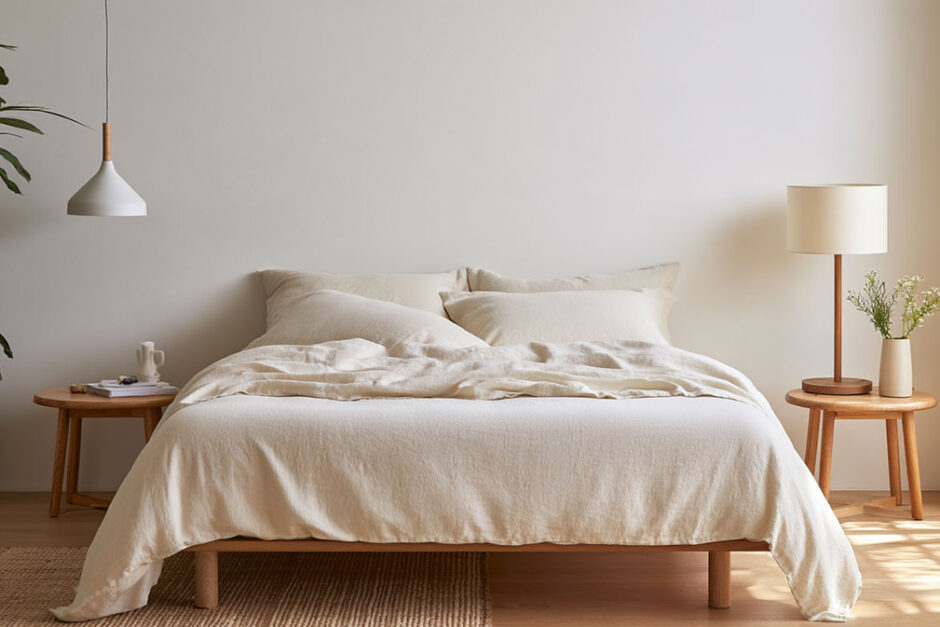
Low wooden bed, warm neutral walls, washed linen and not much else in sight. That’s the usual picture of a Japandi bedroom, a style that pairs Japanese restraint with Scandinavian warmth.
Wabi-sabi and ma come from the Japanese side, ma being the habit of treating empty space as part of the design. Hygge, light oak and soft layered textiles come from the Scandinavian side.
People clearly want quieter rooms right now. Pinterest’s Fall 2024 Trend Report logged a 405% year-over-year jump in “zen house” searches.
Most copies get the bed wrong, though. A futon left on the floor traps moisture, so Japanese bedding makers advise airing it daily or raising it on slats.
What Is a Japandi Bedroom?
Low wooden furniture, a muted natural palette and very few objects. That’s the short version of a Japandi bedroom, which mixes Japanese minimalism with Scandinavian comfort.
Wabi-sabi gives the Japanese half its tolerance for imperfect, aged materials. Ma handles the empty space. Kanso goes a step further and strips out anything decorative that has no job to do.
Warmth is the Scandinavian contribution. Wool throws, light oak, rounded edges, and the cozy, lived-in feeling that hygge-style interiors are known for.
People tend to mix up Japandi and wabi-sabi. Japandi limits how many things sit in the room, while wabi-sabi cares more about which things you pick (aged, handmade, a bit irregular). Amerisleep’s Japandi bedroom guide draws the line in the same place.
| Style | Palette | Bed height | Decor density |
|---|---|---|---|
| Japandi | Warm neutrals, muted accents | Low platform | Very low |
| Scandinavian | White, pale grey, light wood | Standard | Low to medium |
| Japanese minimalist | Natural wood, paper, off-white | Floor level | Minimal |
| Wabi-sabi | Earth, clay, stone | Varies | Low, all handmade |
Japandi sits in the middle. Warmer than a strict Japanese room, sparser than a typical Nordic one.
Choosing the Bed: Platform, Floor Bed or Futon
For most people a low wooden platform bed is the right call. You get the grounded, close-to-the-floor look without the moisture and mobility problems that come with sleeping directly on the floor.
Low Platform Bed
A conventional bed sits around 25 inches from the floor, according to Casper’s bed height guide. Japandi frames drop well below that, which makes the mattress the main height variable.
Look for solid oak, ash or walnut, oiled rather than lacquered. A slatted base lets the mattress breathe, and rounded corners or a slightly overhanging deck suit the style.
The upsides are airflow under the mattress, compatibility with any standard mattress, and an easy time getting in and out. On the downside, solid hardwood frames cost more than they look like they should, and very low models still strain stiff knees.
Floor Bed and Futon
The most authentic option is also the riskiest one.
In Japan, a traditional futon gets rolled out at night on tatami and folded away each morning. The daily airing is the part most Western copies skip.
Ikehiko, a Japanese bedding maker, warns against leaving a futon on the floor because moisture has nowhere to escape, and recommends slatted boards underneath.
The EPA advises keeping indoor humidity below 60%, ideally 30 to 50%. A mattress pressed against a cold floor traps sweat at its underside, and that’s where mold starts.
| Option | Pros | Cons |
|---|---|---|
| Mattress on floor | Cheapest, minimal look | Mold risk, dust, voids some warranties |
| Futon on tatami | Authentic, breathable base | Needs daily folding and airing |
| Futon on slats | Floor look, better airflow | Still very low for older sleepers |
Tatami helps because the rush straw absorbs and releases moisture. If you want that layer, read up on how tatami mats are made and cared for before buying a cheap foam imitation.
My rule is simple. Pick a futon only if you’ll air it every day or you live somewhere dry. Everyone else should get the platform.
Nightstands and Headboards
A low bed changes the bedside table. Keep its top roughly level with the mattress, otherwise it towers over the bed and crowds the wall. A floating wall shelf works, and so does a low wooden stool or a single-drawer oak cube.
Headboards stay simple. Vertical wood slats, a linen-upholstered panel, or nothing at all. One with a shallow shelf can replace the nightstand completely.
Japandi Bedroom Color Palette
Warm neutrals on the walls, wood as the middle tone, one muted accent. That’s the whole palette.
Pure white reads cold here. Greige, sand and soft putty shades do the work instead, which is why Japandi often gets described as a warmer take on the neutral palette.
For base walls, Benjamin Moore White Dove OC-17, Pashmina AF-100 and Revere Pewter HC-172 all hold up well. If you’d rather have a hint of green, Benjamin Moore Wind Chime AF-465 is a light celadon that sits nicely next to oak. Farrow and Ball Skimming Stone and Elephant’s Breath cover the stony end.
For something darker, there’s Benjamin Moore’s 2026 Color of the Year, Silhouette AF-655, an espresso brown with charcoal undertones (announced October 2025). It suits the “dark Japandi” variant. Use it on the wall behind the bed only, with oak furniture against it so the room doesn’t close in.
One wall color covers most of the room. The bed and main furniture share a single wood tone, and the accent shows up two or three times, in textiles or ceramics.
Test samples at night under your own bulbs, not only in daylight. Greige drifts toward grey under cool light, and that’s a common reason Japandi rooms end up looking flat.
If you’re stuck between shades, a color scheme generator for your room lets you preview wall, wood and accent combinations side by side.
Finish matters too. Matte or flat paint absorbs light softly, while eggshell and satin bounce it around and make walls look plastic next to raw wood.
Materials and Wood Tones
Two wood tones at most, and let one of them lead.
Light wood carries the Scandinavian side: white oak, ash, birch, mostly on the bed frame and other large pieces. Dark wood carries the Japanese side. Walnut, smoked oak and black-stained ash work best on smaller things like a nightstand, a picture frame or a stool.
Shou sugi ban deserves a mention. It’s a Japanese method of charring cedar to darken and seal it, and a charred wall panel or headboard gives you deep black texture without any paint.
Mixing both tones in roughly equal amounts looks unplanned. A 70/30 split reads as deliberate, and that controlled contrast between light and dark surfaces keeps the room from going beige.
Wood is only half the material list. The rest comes from fibers and earth:
- Linen and cotton for bedding
- Jute, sisal or wool for rugs
- Rattan and cane on chairs and headboards
- Washi or rice paper for lamps
- Stoneware and unglazed clay for small objects
- Wool or cotton knits for throws
Most of these come straight from the natural materials of Japanese interiors, chosen because they age visibly instead of just wearing out.
An oiled finish shows the grain, lets you spot-repair scratches, and wants re-oiling every year or two. High-gloss lacquer is durable but flattens the grain and looks out of place in this style.
Skip glass tops, chrome legs and polyester velvet. They fight the matte, tactile surfaces the rest of the room is built on.
How to Light a Japandi Bedroom
Warm, low light does most of the work. A paper shade handles the ambient glow, a lamp goes on each side of the bed, and one soft accent near the floor rounds it out.
Nothing bright overhead after dark. A single ceiling fixture on full power flattens the wood grain and the textures the room depends on.
Paper shades are the signature fixture. Isamu Noguchi designed the Akari light sculptures in 1951, handmade from washi (paper from mulberry bark) stretched over bamboo ribs in Gifu, Japan, and Vitra distributes them in Europe with The Noguchi Museum.
Some numbers worth knowing. Energy Trust of Oregon says people usually prefer 2700K soft white for bedrooms. A lighting designer quoted by Livingetc suggests 2200K to 2700K for table, floor and wall lamps, which is a bit warmer. Put a dimmer on the main fixture so the room never jumps from dark to fully lit.
For ambient light, use a rice paper pendant or a large paper floor lantern in the corner. Hang a pendant low enough that you see the shade from the bed, not the bulb.
Beside the bed, small linen or paper table lamps work, or wall-mounted swing arms if the nightstand is a narrow shelf. For the accent, put a low lamp on the floor next to a plant or ceramic piece. One is enough.
To work out how bright each fixture should be for your floor area, run the numbers through an LED lighting requirement calculator before buying bulbs.
Daylight matters as much as lamps. Translucent panels modeled on Japanese shoji screens soften harsh sun, and so do unlined linen curtains or slatted wooden blinds.
Cool white bulbs, a grid of recessed downlights and exposed filament bulbs all pull the room toward a different style, so leave them out.
Bedding, Rugs and Decor That Complete the Look
Washed linen on the bed, one heavier throw, a flatweave rug and only a handful of objects in view.
Linen is the default because it breathes, softens with every wash and looks better slightly creased. That rumpled texture is the point, so skip the iron.
Pick bedding from the wall palette. An oatmeal, clay, stone or muted sage duvet works, while bright white sheets look clinical against oak.
Add weight with a chunky wool or cotton knit throw folded at the foot of the bed. Two or three pillows, and no pile of decorative cushions.
Rugs are mostly a texture decision. Jute or sisal feels rough under bare feet but looks great, a wool flatweave is softer beside the bed, and a jute-wool blend gives you a bit of both.
Whatever you pick, it should reach well past both sides of a low bed, or it looks like a bath mat. A rug size calculator gives the right dimensions for your bed and room.
On the keep list: one handmade ceramic vase, a single artwork above the bed, one plant, a stack of two books. On the cut list: framed photo collections, matching lamp sets, mirrored trays and anything with a printed slogan.
For flowers, use a few stems or one branch in a narrow vase. That restraint comes from the Japanese art of ikebana, where the empty space around the stem counts as much as the stem.
Kintsugi pieces (ceramics repaired with gold-dusted lacquer) fit here too. They carry the wabi-sabi idea of visible repair without adding clutter.
Place objects off-center. A vase pushed to one end of a shelf looks considered, while two matching items at each end look staged.
Layout and Storage for a Calm, Clutter-Free Room
Hide almost everything behind doors and leave at least one wall nearly empty. That empty wall is ma in practice.
A standard Japandi bedroom needs a bed, two bedside surfaces, one closed storage piece and, at most, a chair. Anything beyond that has to earn its place.
- Clear the room completely, including wall art and rugs.
- Place the bed against the longest uninterrupted wall, with clear walking space on both sides.
- Add closed storage: a fitted wardrobe, bed drawers or lidded baskets.
- Install lighting and window treatments.
- Bring in bedding and the rug.
- Add decor last, then take one piece away.
Step 2 decides everything that follows. Good space planning starts with walking routes from the door to the bed and wardrobe, then fits furniture around them.
Open shelving is the usual mistake. It fills up within weeks, and a full shelf undoes the calm faster than any wrong paint color.
Small Japandi bedrooms
Small rooms suit the style well because it already asks for less furniture.
- A bed with built-in drawers replaces a dresser
- Floating shelves replace nightstands
- Sliding wardrobe doors save the swing space
- Floor-length curtains in the wall color make the window wall feel taller
More ideas for tight footprints are in our guide to small bedroom decor.
What a Japandi Bedroom Costs
The bed sets the budget. Everything else can be bought cheap, found secondhand or added over months.
| Item | Example | Listed price |
|---|---|---|
| Bed frame (full) | IKEA Tonstad with storage, oak veneer | $759 regular (IKEA US) |
| Paper table lamp | Vitra Akari 1A | GBP 315 regular (UK retailers) |
| Bedroom chair | Carl Hansen and Son CH24 | US$1,340 regular, oiled oak (Finnish Design Shop) |
Prices were checked in October 2026 and change with sales and region.
IKEA and Muji cover the basics on a tight budget. The Tonstad has the right look, but IKEA’s own spec lists particleboard and fiberboard under the oak veneer, finished in clear acrylic lacquer.
That’s the trade-off. It reads as oak from across the room, but you can’t sand scratches out the way you can on solid, oiled wood.
For more ways to work with flat-pack pieces, see these IKEA bedroom ideas.
One step up, you’re looking at solid oak or ash platform beds from smaller furniture makers, linen bedding sets and handmade stoneware from local potters. At the top end sit designer originals such as Akari lamps and Hans Wegner’s Wishbone chair, which Carl Hansen and Son has produced since 1950.
Put the money into the bed frame and the linen bedding. Ceramics and vases can come from thrift stores, and unbranded rice paper shades look almost identical to the pricey ones once lit. Paint and baskets don’t need a big spend either.
A secondhand solid wood bed, refinished with oil, often beats a new veneer frame on both price and longevity.
When a Japandi Bedroom Doesn’t Work
The style struggles in humid homes with floor-level beds, in dark rooms, for sleepers with limited mobility, and in households that can’t keep surfaces clear.
| Situation | What goes wrong | Fix |
|---|---|---|
| Humid climate, floor bed | Mold under the mattress | Raised slatted platform, dehumidifier |
| North-facing or dark room | Neutrals turn flat and grey | Warmer whites, more lamps |
| Stiff knees or hips | Low bed is hard to leave | Taller mattress on a low frame |
| Busy household | Clutter returns in days | Double the closed storage |
Humidity first. The moisture risk covered in the bed section gets worse in coastal and tropical homes. If the bedroom regularly feels damp, treat a futon or floor mattress as a guest option only.
Dark rooms are tricky. Greige and stone shades need daylight to look warm, so in a north-facing room, move one step warmer on the paint card and add a second floor lamp rather than fighting the gloom with brighter bulbs.
A deeper wall color can also help. One dark wall behind the bed gives depth, where pale paint everywhere just looks dim.
Older sleepers and anyone recovering from knee or hip surgery should sit on the bed edge before buying. Feet flat on the floor with knees at about a right angle is the target, even if that means a taller bed than the style suggests.
The look survives an extra few inches of mattress. A bad fall does not.
Kids, pets and shared rooms are the last problem case. Japandi depends on clear surfaces, so it collapses when toys, laundry and chargers have nowhere to go.
If closed storage isn’t realistic, the warmer, more forgiving rules of Scandinavian interior design tolerate everyday mess far better.
Japandi Bedroom FAQ
Where does the name Japandi come from?
It blends “Japanese” and “Scandinavian.” The two traditions share a respect for natural materials, craftsmanship and uncluttered rooms.
That overlap is why the mix works without looking like two themes forced together.
Is a Japandi bedroom better for sleep?
No study tests the style itself. But its core habits line up with standard sleep advice: warm, dim light in the evening, breathable linen bedding and a room without visual clutter competing for attention.
How do you stop a Japandi bedroom from feeling cold?
Add texture, not more objects. A wool throw, a knit cushion, a jute rug and oiled wood bring warmth that plain neutrals lack.
Warm bulbs matter just as much. A cool white bulb turns greige walls grey within minutes.
Which plants suit a Japandi bedroom?
Sculptural, slow-growing plants with clear shapes. A snake plant, a ZZ plant or a potted olive tree in an unglazed clay pot all fit.
For a small surface, a bonsai tree adds the Japanese side in one object. Skip trailing plants spilling off shelves.
What curtains work in a Japandi bedroom?
Unlined linen or cotton curtains in the wall color, hung close to the ceiling and reaching the floor. Add a separate blackout blind behind them if you need full darkness.
A curtain size calculator gives the right width and drop for your window.
Can you put a TV or desk in a Japandi bedroom?
Yes, as long as it disappears when not in use. Mount the TV inside a closed cabinet or behind sliding panels.
A desk can be a narrow wall-mounted shelf in matching wood, cleared every evening. Cable trays and a single task lamp keep it from turning into a home office.
What to Change First in a Japandi Bedroom
The first change costs almost nothing: remove objects and swap the bulbs. Furniture comes last, because a cleared room shows which pieces actually need replacing.
In week one, clear the surfaces and put in warm bulbs. Within a month, add linen bedding and a flatweave rug. The bed frame can wait until the budget allows solid wood.
That order puts the changes you notice every evening up front and delays the one purchase that’s hardest to undo.
The catch is patience. For a few months, a standard-height bed will sit in a room styled for a low one, and the proportions will look slightly off.
Buying the frame first reverses the risk. A cheap veneer bed bought in a hurry often outlasts the patience to replace it.
Prices quoted here were checked in October 2026. Once the bedroom settles, the same palette and materials carry easily into a Japandi living room.

- Japandi Bedroom Essentials for a Calm, Restful Retreat - November 7, 2026
- Bedroom Curtains Ideas to Block Light and Add Style - November 4, 2026
- Living Room Rug Ideas That Anchor Your Whole Space - November 1, 2026


