Color Combinations
Colors that go with green: Great color combinations

A green that looks calm on a paint chip can turn muddy the moment the wrong neutral sits next to it. Undertone is usually the cause. Sage leans gray, olive leans golden and emerald carries a blue cast, so none of them want the same partners.
Light changes the result again. Behr’s 2025 lighting guide reports that 5000K daylight bulbs enhance blue, green and gray tones, while 2700K soft white bulbs cast a peach tone and make a space feel warmer.
To see how green compares with the partners other colors take, browse our roundup of safe and bold color pairings.
To see how green compares with the partners other colors take, browse our guide to color pairings by shade, wood tone and room.
What colors go with green?
White, cream, beige, brown, gray, black, blue, pink, yellow and other greens all work with green. The catch is the undertone of the specific green you’re using, since the hue name alone settles nothing.
Green sits between warm yellow and cool blue, which is why a golden olive and a blue-cast emerald behave like two different colors.
Every pairing in this guide traces back to the color wheel. Green with red or pink is complementary. Yellow-green, blue-green and blue sit beside it, so they count as analogous. Orange and violet make a triadic scheme with green, and green on green is monochromatic, like Behr’s palette of Bitter Sage, Jojoba and the off-white Unwind.
Paint, fabric and wallpaper follow the traditional red-yellow-blue wheel, and there red sits opposite green. Adobe’s color guidance lists red as green’s partner on that wheel and magenta on the RGB wheel used for screens.
That gap is why a monitor mockup and a paint chip disagree about green’s opposite. For a room, use the traditional wheel.
A deeper read on interior color theory covers how hue, value and saturation shift each of these schemes.
Matching colors to sage, olive, emerald, forest and mint green
Undertone sets the partners for each shade. Benjamin Moore describes its sage as cooled with gray and its olive as flecked with golden undertones. Its emerald carries a cool blue cast.
| Green shade | Undertone | Partners | Example paint (Benjamin Moore) |
|---|---|---|---|
| Sage | Gray-cooled | Off-white, blush, navy, plum | Saybrook Sage HC-114, LRV 45.46 |
| Olive | Golden | Warm white, stone, pale gray | Mediterranean Olive 2142-10, LRV 11.05 |
| Emerald | Cool, blue cast | Brass, cream, blush pink | Erin Green 608, LRV 23.46 |
| Forest and dark | Deep and cool | Cream, ochre, burnt orange, black | Hunter Green 2041-10, LRV 6.39 |
| Mint | Blue-green | White, soft gray, pale wood | Soft Mint 2041-60, LRV 73.94 |
LRV values come from Benjamin Moore’s color pages as of October 2026. Sherwin-Williams lists Evergreen Fog, a gray-green in the same sage range, at LRV 30, about 15 points below Saybrook Sage.
Two paints sold as sage do not behave alike.
Sage green

Behr builds around Bitter Sage N390-4 with Ash Rose for the blush and Medieval Wine for the plum. Midnight Blue covers the navy option, and Unwind is the off-white.
Graham & Brown steers sage toward other earth tones.
Plenty of other combinations exist, and the sage green pairings guide lists them.
Olive green

Benjamin Moore’s coordinating colors for Mediterranean Olive show how the shade is meant to be built out.
- White Dove (OC-17), a warm white that suits walls and trim
- Gray Mirage (2142-50), a lighter tint from the olive’s own color strip, which keeps the room tonal
- Fieldstone (1558), if you’d rather push the mix warmer and earthier with a stone neutral
Brown and cream carry olive well, and so does black. The full set of olive green pairings is worth a look.
Emerald green
Emerald needs warm partners and restraint.
Benjamin Moore calls Erin Green an intense emerald with a cool blue cast, so brass and cream balance the chill and blush pink adds softness. Pick one bold partner and keep everything else neutral.
Forest and dark green

Farrow & Ball calls Studio Green its darkest green and says it reads almost black indoors unless the room is very well lit.
Melodie Violet of Studio Design Imagine told Livingetc that forest green works with neutrals like creams and grays and with livelier accents such as oranges and yellows. Soft cream or a grayed white keeps the room readable around it.
The darker the green, the more light neutrals the room needs. That’s the cost of going dark.
Mint and pale green

Benjamin Moore classes Soft Mint as a blue-green, so its wheel neighbors are blue and teal. Crisp white and soft gray keep it fresh.
Ground mint with a deeper green or pale wood, or it reads as a nursery shade.
Neutrals that work with green, from white to black

White, cream, beige, gray and black all pair with green. The neutral has to match the green’s undertone, so warm greens take warm neutrals and cool greens take cool ones.
Graham & Brown calls white the easiest way to strengthen a green. Livingetc’s designers favor a soft or grayed white over a brilliant white with forest green, so the contrast does not startle the color.
Benjamin Moore picks White Dove, a warm white, for its olive. A crisp white suits cooler greens like mint better.
Beige adds warmth without competing, and the colors that work with beige show how to carry it into the rest of the room. Living Spaces points to beige, tan and gray as the natural, earthy partners for green.
Gray works when the undertones agree, and the colors that go with gray fill in the rest of that palette. Furniture in Fashion warns that cool blue-grays can make olive look tired, because the blue undertone fights the yellow.
Livingetc suggests black with forest green for an elegant, moody look and says to avoid bright, yellow-leaning greens there. Greens with blue, black or gray undertones work best.
Trim follows wall depth. Pale and mid greens take warm white trim, as in Behr’s own sage rooms. Very dark greens can take trim in the same green for a wrapped look, and white trim against a very dark wall gives the high-contrast version.
Which accent colors pair with green?

Blue, pink, yellow, orange, terracotta, plum and burgundy all work as accents. Each maps to a color wheel relationship, which also tells you how hard to push it.
Blue and teal

Blue and teal are green’s analogous neighbors, so the pairing blends instead of contrasting. Living Spaces calls blues and greens natural companions because they sit next to each other on the color wheel, and Livingetc notes that green and navy are both found together in nature.
Depth sets the mood. Navy beside dark green is the moody version, while the range of colors that pair with blue offers lighter options for brighter rooms.
Pink and red

Pink is the softer complementary. Livingetc quotes color consultant Amy Krane calling pink and green a classic combination that feels right because it appears all over nature. She advises varying the saturation and value of the two, such as a muted mid-tone pink with a deep olive.
Full-strength red against green is a statement, as designer Katie Paulsen of Maestri Studio told Livingetc. Living Spaces warns it overwhelms a room unless the tones are balanced.
Yellow, orange and terracotta

- Yellow works as a pop against dark green and neutral walls (Graham & Brown)
- Orange and yellow accents suit forest green (Livingetc, quoting Melodie Violet of Studio Design Imagine)
- Terracotta sits in the same warm family and plays the same role
Orange and violet with green form a triadic scheme. It works only when one of the three leads and the other two stay small.
Purple and burgundy

Graham & Brown suggests green and purple on a feature wall or a color-blocked wall, where the drama stays contained.
A deep plum such as Behr’s Medieval Wine sits beside its Bitter Sage. Burgundy belongs to the same wine family, so the colors that go with burgundy carry over.
Wood tones and metal finishes that go with green

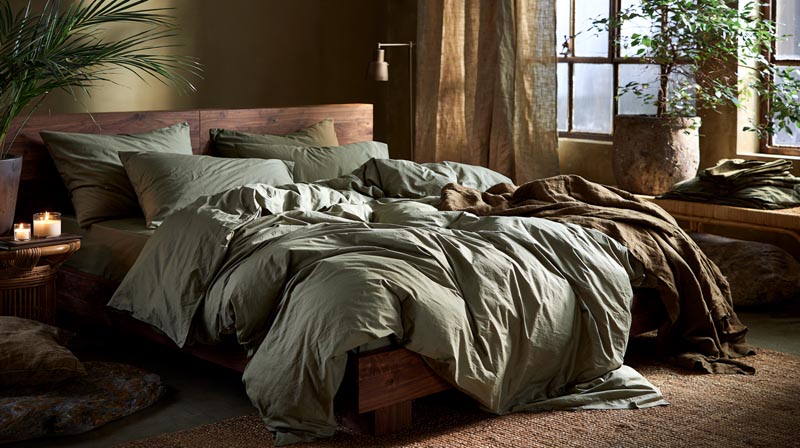
Walnut and other brown woods suit olive, sage and forest green. Brass and gold suit emerald and dark green, and black metal fits modern dark-green rooms.
- Walnut and brown wood deepen olive and forest green
- Natural and light wood keep sage airy, as in Behr’s sage rooms with wood desks and tables
- Brass and gold sharpen emerald and dark green
- Black metal gives high contrast against dark green
Livingetc quotes Laetitia Laurent of Laure Nell Interiors, who calls green and brown an incredibly grounding combination and likes how deep greens play up the warmth of rich wood tones. Walnut is the richest version, and the guide to colors that go with walnut wood works in reverse when a walnut table or floor is already in the room.
Living Spaces pairs emerald with charcoal gray, deep navy or creamy beige, plus accents of brushed brass or antique gold. Kelly Wearstler specified emerald cabinetry with a brass backsplash for a Manhattan kitchen, according to Temple & Webster (2021).
Warm metal against a cool green adds contrast, and warm metal on a warm olive blends in. Black hardware or window frames against a dark green wall are enough black.
Brass is an accent. A room full of it reads gaudy.
How does room light change which colors work with green?
Light direction and bulb temperature decide whether a green reads fresh or flat. Cool light dulls the cool-leaning shades, while warm light lifts the golden ones.
A few figures are worth keeping on hand when you compare paints under different bulbs.
- LRV runs from 0 (absolute black) to 100 (pure white), per Benjamin Moore’s color pages as of October 2026
- LRV is measured on a flat, no-gloss surface, so sheen does not change it (Homebuilding, 2026, citing COAT Paints)
- 2700K soft white bulbs cast a peach tone on walls (Behr, 2025)
- 3500K true white bulbs give a balanced look, neither cool nor warm (Behr, 2025)
- 5000K daylight bulbs enhance blue, green and gray tones (Behr, 2025)
North-facing rooms
Benjamin Moore UK describes north light as cool and blue-toned, and says it makes colors with gray, blue or lavender undertones look duller.
Sage and emerald, the two cool-leaning shades in the table above, are the ones at risk. A golden olive holds its character better.
Annie Sloan, quoted by Homebuilding in 2026, recommends a mid-to-high LRV with a warm undertone here, so the room does not read flat or cold.
In north light, pick the warm side of whichever green you like.
South-facing rooms
Deeper, cooler greens hold up well here. Sloan says south-facing rooms can often carry cooler or deeper colors, and a low-LRV color that feels oppressive in a dim room can read as rich and intentional in a well-lit one.
Golden olive needs a closer look. Sherwin-Williams warns against choosing a color that is too warm for a south-facing room, because it turns too bold at some point in the day.
West-facing rooms get amber light, and Benjamin Moore recommends cool-toned colors to even it out. That favors emerald and mint.
Small rooms and artificial light
Sources disagree on small rooms, and the split comes down to available light.
Tikkurila advises lighter or muted greens in smaller or less bright rooms so the space stays open. Sloan goes the other way and says a small room painted in a deep color can be atmospheric if the light supports it.
Make light the variable and the two positions agree. A dim small room takes mint, a bright one can take forest.
Sherwin-Williams treats a room with warm bulbs like a south-facing room, and a room with white or cool bulbs like a north-facing one. For green, 2700K bulbs flatter olive and warm sage, while 5000K bulbs sharpen emerald and mint and can push sage toward blue-gray.
Bulbs are one layer of a room’s lighting, and light in interior design covers the rest.
Green pairings for the living room, bedroom, kitchen and bathroom
Living rooms take green wall to wall with warm materials, bedrooms treat sage as a neutral, kitchens put green on cabinets against white or wood, and bathrooms pair it with brass and tile.
Living room
Living rooms are where green can run wall to wall.
Livingetc notes that many designers use olive as a neutral, and that drenching walls and ceiling in one olive makes a cocooning room. For a small living room, Tikkurila suggests an accent wall instead.
Warm materials do the balancing either way. Tikkurila lists wood, linen, rattan and brass as the ones that keep green walls from reading cold.
Bedroom

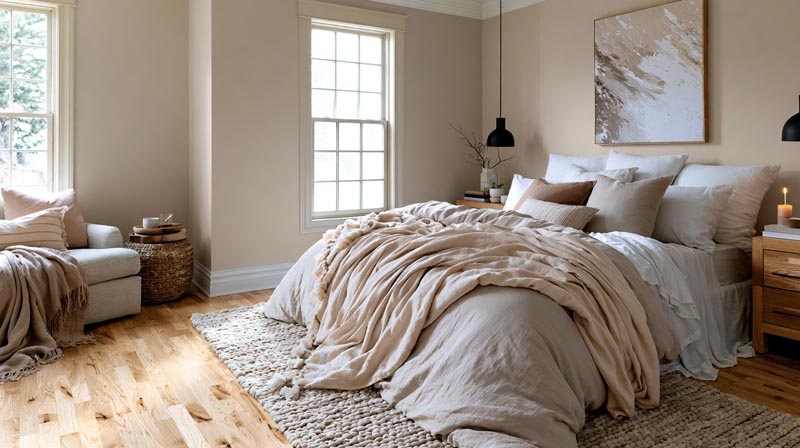
Interior designer Melissa Hutley of Hutley & Humm told Ideal Home (2026) that sage behaves almost like a neutral on bedroom walls.
That frees the accents to carry the personality.
- Rust adds contrast (Livingetc)
- Black works well in chairs or a wardrobe (Livingetc)
- White bedding is the failsafe, with color added through throws and cushions
Livingetc also advises limiting color blocking to three colors, or the bedroom feels busy.
Kitchen
Kitchens put green on cabinets, so the partners are countertops, hardware and backsplash.
Houzz’s guide to green kitchen cabinets shows white quartz and Carrara marble both working. Green cabinets against white countertops stay crisp because the white handles the contrast.
- European oak countertops, or Carrara marble with oak
- Satin brass, matte black or polished stainless hardware
- A white-painted brick backsplash, or soft pink zellige
Camilla Masi of Otto Tiles pairs muted apple green cabinets with brass hardware and a soft pink zellige backsplash, per Martha Stewart Living. Gold hardware on green cabinets adds warmth without adding another color.
Bathroom

Mark Cooper of Tile Expert pairs sage wall tiles with terracotta floors or other neutral shades for a calm, minimal feel. The Boston Globe (2024) shows sage tile balanced by a cerused white oak vanity.
Deeper greens need a different approach. Mark Cooper suggests wood-effect floor tiles with dark forest and emerald, to add texture and warmth, and Livingetc suggests pairing bold green tiles with antique-style fixtures.
Warm materials work at both ends of the range. Wood-look surfaces matter more as the green gets darker.
How to build a green palette with the 60-30-10 rule
The 60-30-10 rule splits a room into 60 percent dominant color, 30 percent secondary and 10 percent accent. Behr puts the 60 on walls, large furniture or flooring, uses the 30 to support it and add depth, and keeps the 10 as the pop that gives the space character.
Benjamin Moore’s Helen Shaw calls it a guiding structure rather than a restriction (Stylist, 2026).
Green can fill any of the three roles. Sage and olive take the 60 easily because designers use them like neutrals, while a very dark green takes the 60 only in a bright room and works better as the 30 or the 10 in a dim one.
Say the walls are sage. Cream built-ins and oak furniture make up the 30, and terracotta in a vase, a throw and a lamp base covers the 10.
Homes & Gardens notes the rule limits a room to three colors, though each can appear in many tones.
This is the order I’d work in.
- Read the green’s undertone: gray-cooled, golden or blue-cast.
- Set the 60, usually the walls, and measure the surface.
- Set the 30 with wood, built-ins or large furniture in a neutral that shares the green’s undertone.
- Pick one accent for the 10 from the wheel relationships.
- Choose one metal finish and repeat it.
- Check the 60 against the room’s light direction and bulbs.
A room paint calculator works out how much paint the 60 needs before the first can is bought.
A color scheme generator built for rooms previews the 30 and the 10 on screen, which saves repainting the wrong split.
When do pairings with green fail?
Green pairings usually fail because of the room’s light, or because one color is too loud, or because the pick was made without looking at the room. The hue itself is rarely the problem.
| Failure | Trigger | Fix |
|---|---|---|
| Dark and dingy | Two dark tones, dim room | Light neutrals, more light |
| Loud pairing | Red at full strength, equal share | Red-orange plus red-violet |
| LRV misread | Judging a green by LRV alone | Compare saturation too |
| Isolated pick | Choosing from a photo | Judge against floor and windows |
Sloan says the same low LRV that feels oppressive in a dim room can read as rich in a well-lit one. Dark green fails on light, not on hue.
Computer Hope lists red-violet and red-orange as green’s split complements on the traditional wheel, and Adobe’s guidance advises trying a split-complementary scheme alongside the direct complement. Terracotta and plum sit on exactly those two hues, which is why they soften what straight red cannot.
LRV measures light reflectance, not intensity or saturation (Homebuilding, 2026), so two greens at the same LRV can differ sharply in loudness. How loud a color feels also depends on contrast in interior design, which turns on saturation as well as lightness.
Sloan names the most common mistake in the same Homebuilding piece, which is choosing a color without considering the room around it. She lists aspect, windows, flooring, furniture and the colors in adjoining rooms.
Common Questions About Colors That Go With Green
What color curtains go with green walls?
Cream or white linen is the safest choice.
Match the undertone. Warm cream sits well beside olive, and crisp white beside cool mint or emerald. The guide to curtain colors for green walls covers more options.
Which sofa color works with green walls?
In a color-drenched olive room, Livingetc says a sofa in a similar tone looks best. The walls and the seating then read as one calm block.
With a single green wall, a neutral or contrasting sofa works better, so the wall stays the focus.
Does a rug need to match the green in the room?
No. A cream, beige or wood-toned rug suits most green rooms.
A rug is a large surface, so it usually counts toward the secondary 30 percent of the 60-30-10 split. A second bold color there competes with the green, and the advice on rug colors for green walls follows the same logic.
Does paint finish change how green looks?
Yes, a little. Homebuilding (2026) notes that a satin or eggshell finish makes a color read slightly differently than its LRV suggests, because LRV is measured on a flat, no-gloss surface.
Check the green in the finish you will buy.
Testing Colors That Go With Green Before You Paint
Colors that go with green need a test on the actual wall, under the actual bulb, before any full coat goes on. A swatch judged on a white card reads differently once green surrounds it.
- Paint the green on two walls
- Hold trim, wood and fabric samples against it
- Check both walls in morning, midday and evening light
The green goes first because its undertone sets the standard every partner is judged against. Reverse the order and the green gets compared to a partner chosen in isolation.
It costs time. Each sample needs to dry and then a full day of changing light to read properly, which delays the first coat, but that delay costs less than repainting a wall.

- Kitchen Color Schemes by Cabinet Color: What Pairs Well - October 19, 2026
- Curtain Colors for Every Wall Color: Safe vs Bold Picks - October 18, 2026
- Interior Design Styles: Find Your Primary and Secondary - October 14, 2026