Color Combinations
Colors that go with purple and how to decorate with this color

Purple isn’t one color, which is most of why it’s tricky to pair. Benjamin Moore’s U.S. catalog (2026) files 256 paint colors under purple, and some of them are named for blues. A partner that flatters one can look wrong beside the next.
The undertone sorts it out. Plum and aubergine lean red, periwinkle and indigo-violet lean blue, and the neutrals, metals and accents that suit each side are mostly different. Light adds a second variable, since a pairing that holds in one room can fall apart in another.
Our color matching guide for interiors puts purple side by side with every other color we cover.
Our decorating color combinations guide puts purple side by side with every other color we cover.
How does purple’s undertone decide which colors go with it?
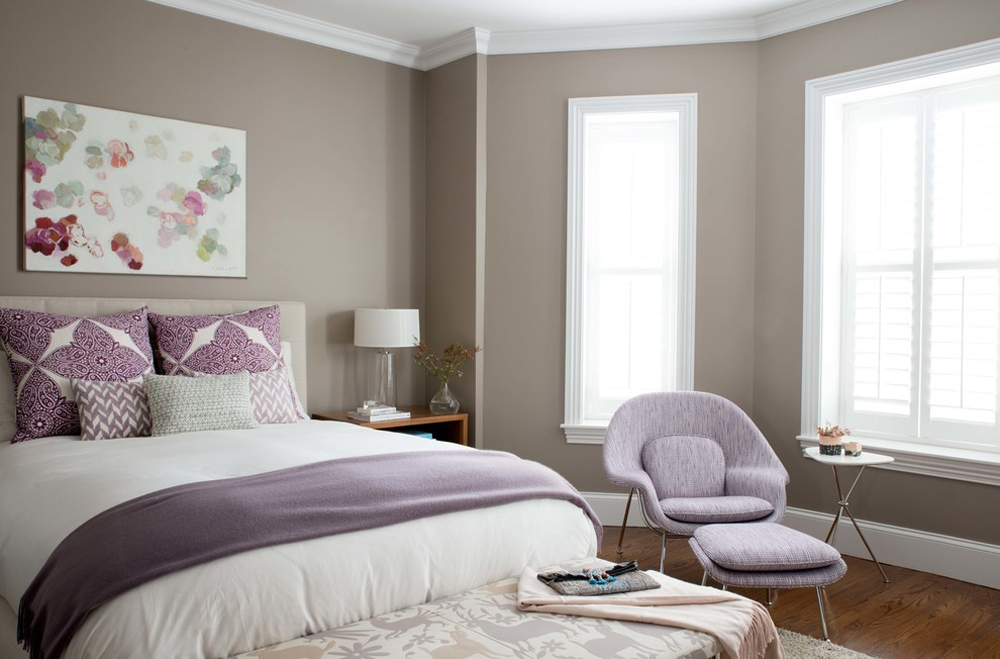
Every purple sits somewhere between red and blue, and that lean sets which neutrals, metals and accents look right next to it. Red-leaning shades like plum and aubergine take warm partners. Blue-leaning ones like periwinkle and indigo-violet do better with cooler ones.
| Shade | Undertone | Partners that work |
|---|---|---|
| Lavender, lilac | Varies by swatch | White, pale gray, sage |
| Mauve | Muted, gray-pink | Cream, warm gray, marble |
| Plum, aubergine | Red-leaning, deep | Warm white, brass, rich brown |
| Periwinkle, indigo-violet | Blue-leaning | Cool gray, silver, soft blue |
| Saturated violet | Blue-based, intense | Neutral walls, green accents |
Red-leaning and blue-leaning purples in practice
The blue end is easy to document. Pantone (2017) called Pantone 18-3838, Ultra Violet, a blue-based purple, and described Very Peri (17-3938) as a periwinkle blue with a violet-red undertone, which puts it right at the edge of the family.
Benjamin Moore lists Violet Stone 2069-40 as a medium purple with soft blue-violet undertones and an LRV of 29.35.
On the red side, Farrow & Ball’s Brinjal is the reference point. Its suggested schemes pair it with All White, Elephant’s Breath and Charleston Gray, trimmed in Strong White, Skimming Stone or Dove Tale.
Mauve is the quiet one. The gray in its mix makes it act almost like a neutral, up to a point. A full look at pairing mauve with other colors covers where that stops being true.
Should you match the undertone or contrast it?
Designers give both answers. Benjamin Moore’s purple page tells shoppers to consider hues with matching undertones, then pairs deep mulberry with pale yellow as a complementary scheme on the same page.
Artem Kropovinsky told Homes & Gardens to start with the undertone, and in the same piece he recommends opposites such as yellow and green.
Match the undertone on walls, trim, large furniture and neutrals.
Save contrast for the small stuff. A cushion, a lamp, one chair.
That division is my own reading of the two rules, not something either source states outright, but it holds up better than picking a side.
Which color harmonies work with purple?

Each harmony trades contrast for calm in a different amount, so it helps to see them side by side.
- Complementary schemes use yellow and gold, which sit opposite purple. Benjamin Moore describes deep mulberry against pale yellow as an eye-catching scheme that adds warmth and contrast.
- Analogous means the blue and red-violet neighbors. Benjamin Moore says violet tones paired with blues create a harmonious, tranquil palette.
- Triadic brings in green and orange, though green does the work and orange stays a single object at most.
- Split-complementary is purple plus the two hues on either side of yellow, a looser version of the straight complement.
- Monochromatic schemes stay in tints and shades of one purple. Some designers treat each depth as its own color under the 60-30-10 split, according to Homebuilding.
Green is the contrast pick designers cite most. Helen Shaw of Benjamin Moore told Homes & Gardens that green faces purple on the color wheel, which makes the pairing more contrasting than the analogous options.
The logic behind all of these comes straight off the wheel, and how color theory plays out in a room is worth a skim before you commit to a swatch.
Analogous schemes go flat when every purple shares the same depth, so vary the light and dark. Complementary pairs give the sharpest result, which is why how contrast shapes a room matters before you set yellow next to a purple wall.
What are the best colors to pair with purple?

Depth decides most of it. Deep purples take gold and dark green, while pale ones take white, sage and gray. Pinks and blues (teal included) fit in at either end if you keep them controlled.
Neutrals
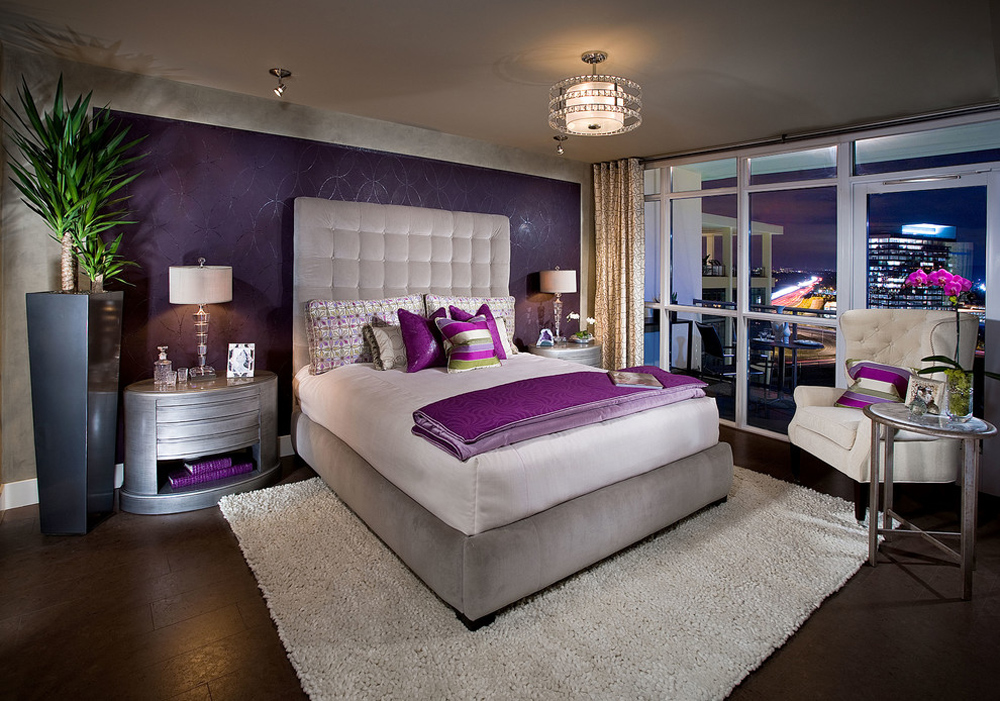
Joa Studholme, color curator at Farrow & Ball, told Homes & Gardens that purple can be hard to decorate with and usually needs tempering by softer neutrals.
- White gives purple room to breathe and keeps it the focal point of the room (Hillarys).
- Warm grays such as Dove Tale or Skimming Stone suit purple, per Livingetc, while a cool dove gray makes a calm bedroom (Graham & Brown).
- Taupe and beige are the warm-palette route, and Hunker shows beige and purple linens against espresso wood paneling.
- Rich browns work too. Benjamin Moore suggests Night Shade 2116-10 and Wenge AF-180, and Homes & Gardens names natural wood browns as a top pairing.
Black works in small doses. Petra Arko of Bergman and Mar told Livingetc that balance decides whether black and purple look deliberate.
Greens

Green is the strongest contrast purple has.
Soft greens calm a light purple, while deep greens suit deeper ones. Graham & Brown says dark green with purple feels opulent and works best in smaller rooms where coziness is the goal.
Sage is the quiet option. Heidi Caillier Design used it with purple in a dining room featured by Hunker, and the colors that sit well with sage green help when a third hue joins the scheme.
Yellows and golds

Graham & Brown calls purple and gold metallics an unexpected power couple, in brass finishes, accessories or wallpaper.
Brass lamps and frames are the easy route, and Make My Blinds suggests gold curtains against purple walls. Hillarys goes brighter, with acid yellow cushions on deep violet.
Gold is the safer yellow because it reads as a metal, and what else pairs well with gold helps once a third color enters. Bright yellow works as a small hit, not a wall. Elizabeth Sesser of Ike Kligerman Barkley, quoted by Apartment Therapy, loves lavender with lemon and suggests white or cream accents as breathing room between the two.
Pinks, blues and teal
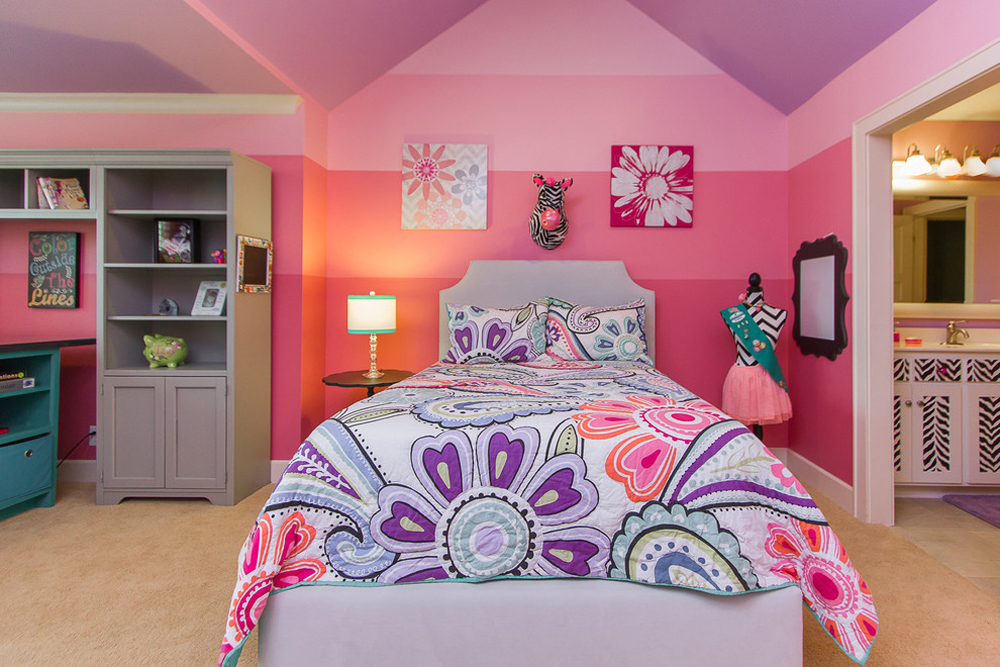
Dusty pink is the classic feminine pairing (Hunker). Deep blue beside berry tones works with white walls giving both room to breathe (Hillarys), and teal adds interest without chaos (Apartment Therapy).
Pink and purple get loud fast. Apartment Therapy shows a London living room that mixes the two and stays elegant by keeping the pink to a few bold pieces.
How much purple should a room have?
The usual guide is the 60-30-10 split: 60 percent dominant color, 30 percent secondary, 10 percent accent. Purple takes the 60 only when it is muted or deep, and the 10 when it is saturated.
Behr puts the 60 on walls, large furniture or flooring, and the 30 on supporting pieces. The 10 goes to accents such as lamps, artwork, throw pillows or a rug.
Helen Shaw of Benjamin Moore told Homebuilding it is a reference point, not an exact equation.
Saturated purple as accent, muted purple as wall
Saturated purple belongs on cushions, one chair, a lamp. A gray-leaning purple can cover far more wall.
Designer Flynn gave that rule to the Spokesman-Review in 2011, and it still matches how the 60-30-10 split plays out. Flynn added that purple wallpaper lands very differently than a solid wall.
The 10 percent is the cheapest layer to change, so pillow combinations make a low-risk test of a new purple.
Accent wall or full immersion
Farrow & Ball says Brinjal gives a warm, highly sophisticated finish on all walls, but it is more often used as a feature wall against Skimming Stone, or on the underside of a bath or kitchen island.
One purple wall becomes the focal point of the room, so choose the wall the eye lands on first.
Trim and ceiling color
Trim stays quiet. Farrow & Ball’s Brinjal schemes use Strong White, Skimming Stone or Dove Tale, all light enough to frame a deep wall without competing with it.
What colors go with purple in each room?
Bedrooms lean on lilac, lavender-gray and mauve with soft neutrals. Living rooms can handle deep plum with gray, gold or green. Bathrooms take lilac with white or marble, kitchens take aubergine on islands or cabinets, and home offices take a muted purple against warm wood.
Bedroom

Benjamin Moore calls light purples such as lilac and lavender a refined alternative to gray, with a soft calming effect suited to modern bedrooms.
Hillarys pairs lilac with blush pink and white bedding, and deep plum walls with sage-green curtains. Graham & Brown goes quieter, muted purple with dove gray for a serene scheme.
For more on colors that calm a bedroom, compare lilac against the other low-saturation options.
Living room
Homes & Gardens says purple living rooms often work best in deep shades matched with contrasting colors such as yellow.
Hillarys shows a looser take: dark gray furniture with flashes of bright purple.
When only one wall carries the purple, living room accent wall colors narrow the partner choices.
Bathroom

Lilac with blue undertones gives a bathroom a fresh feel, as with Earthborn’s Lily Lily Rose, according to Homes & Gardens.
Mauve works on tile too. Interior Fox used mauve floor tiles beside marble veining, a project Livingetc featured.
Kitchen
Aubergine stays in small, deliberate doses. Farrow & Ball suggests Brinjal on the underside of a kitchen island, set against Skimming Stone.
Full cabinet runs are possible, but a deep purple that dark will absorb most of the light in a small room.
Home office
Edward Bulmer’s Tyrian purple, a warm shade made from natural earth pigments, brings energy to a home office without overpowering it, per Homes & Gardens.
Warm wood desks and shelves suit it, since the same publication names natural brown wood as a top pairing for purple.
What color curtains, rugs and furniture go with purple walls?
Furniture should mostly stay neutral so the walls lead. Curtains can run tonal or contrast in navy, and rugs and floors do best in gray or brown. The floor sets the mood: gray reads contemporary, brown reads warm.
Furniture
Homes & Gardens (2023) advises neutral pieces so the walls stay the feature.
Neutral sofas and tables are the safe choice. A single yellow or green sofa works as the one contrast, and a purple chair or painted chest can echo the walls.
Pick one lead. A yellow sofa and a purple chest in the same room give you two stars.
Curtains and blinds
Saffron Hare of James Hare told Homes & Gardens to use purple boldly on curtains, then repeat the tone or shift its depth on cushions and upholstery.
Tonal curtains in a deeper or lighter purple than the wall make the window read as part of one scheme. For contrast, Make My Blinds says navy pencil pleat curtains give a purple bedroom a relaxing yet dramatic effect.
Wall depth changes the curtain call, and a guide to which curtain colors suit purple walls sorts the options by shade.
Rugs and flooring
Katherine Cohen of the rug brand FLOR says to pair purples and lilacs with neutrals such as grays and browns, which adds energy while keeping the room subdued.
| Floor | Effect with purple walls |
|---|---|
| Gray | Sleek, contemporary |
| Brown | Warm, rustic |
| Beige | Soft, inviting |
| White | Bright, energetic |
Those floor effects come from flooring retailer Wood & Beyond, so treat them as starting points, not rules.
How does light change the way purple and its partners look?
Light direction and bulb temperature shift purple’s undertone, and the partners beside it shift too. North light cools everything, south light warms everything, and bulbs add their own cast on top.
Room direction
In a north-facing room, Little Greene says colors look consistently flatter and cooler. Creative director Ruth Mottershead calls north light cooler and blue-toned, and recommends warm undertones (yellow, brown or pink).
South light is warmer, and colors read more yellow, according to Little Greene.
East and west rooms change sharply through the day, so check samples in the morning and the evening.
The neutrals move too. The Southern Star (2025) notes that gray paint in a north-facing room can read slightly purple or blue, which makes gray an easy partner to over-cool beside a blue-leaning purple.
For the basics, how light behaves in a room explains why one swatch looks different at 9 a.m. and at dusk.
Should dark purple go in a dim room?
Helen Shaw of Benjamin Moore told Homes & Gardens (2022) that saturated purples envelop a room, so they suit spaces with natural light and an interplay of light and dark.
Mylands CEO Dominic Myland sees it the other way. Empire Violet No. 80, a deep purple with a hint of black, works particularly well in rooms with little natural light, he says.
The disagreement comes down to intent. Shaw treats an enveloping dark purple as something light has to balance, and Myland treats it as the point of a dim room.
Finish and reflectance
Finish decides how much of the undertone the surface throws back. Nerolac says a smooth finish helps lilac read even and tranquil across large walls.
LRV (light reflectance value) runs from 0 for black to 100 for white, and Benjamin Moore lists it on its color pages. A purple with a low LRV absorbs most of a room’s light, so its partners have to carry the brightness.
How to test a purple sample before committing
- Make a sample board or a large painted patch, and keep it in the exact lighting of the room (Nerolac’s advice).
- Look at it in the morning, afternoon and evening. Little Greene notes that a single color seems to shift in hue over one day.
- View it under the bulbs you use at night. Little Greene says artificial light alters the color too, and that this matters most in bedrooms and living rooms.
- Set the planned partners beside it, meaning fabric swatches, the wood and the metal.
- Check it on the wall facing the window and the wall opposite, because the two will not match.
Which materials and metals suit purple?
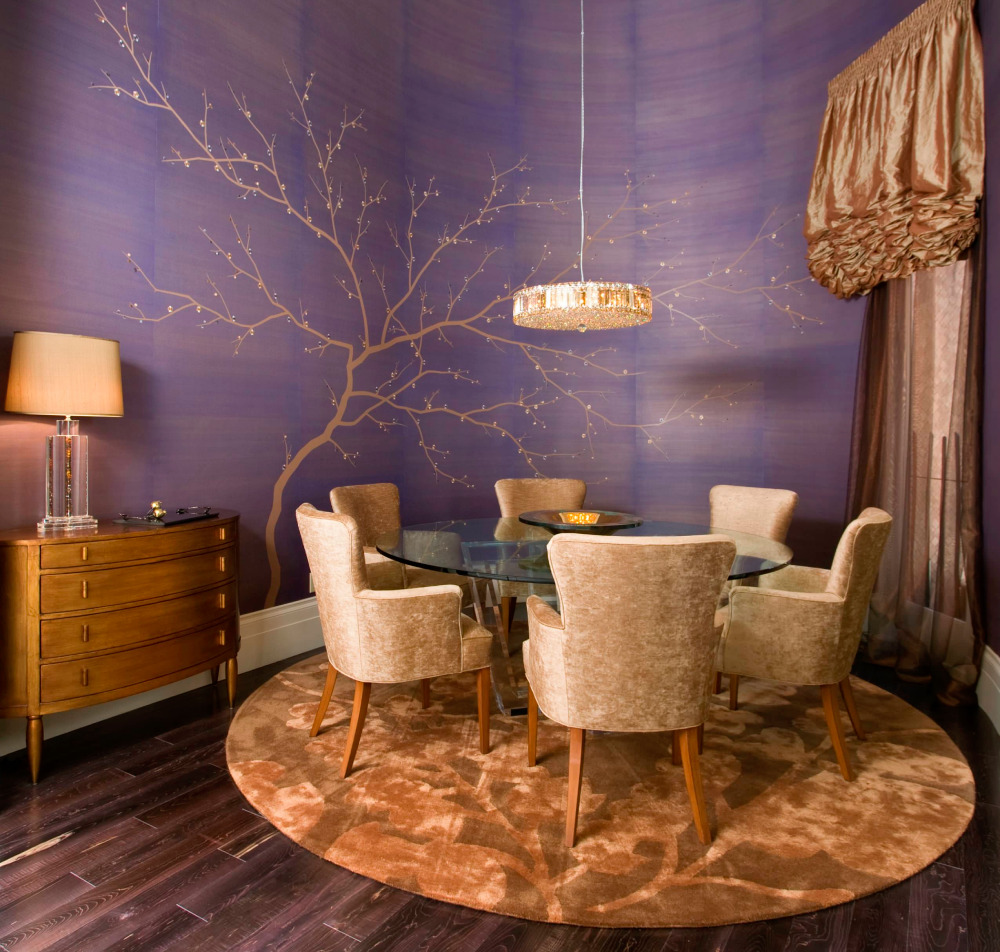
Velvet, brass and natural wood suit deep purples, while silver and pale oak suit cool lilacs. Material changes how a purple reads as much as the paint does.
| Material | Pairs with | What it does |
|---|---|---|
| Velvet | Damson, aubergine | Adds depth and drama |
| Brass | Lilac, plum | Warms a cool shade |
| Silver | Gray-leaning purples | Keeps it modern |
| Wood, cane, bamboo | Muddy purples | Earthy, elegant |
| Pale oak | Cooler lilac | Ties the palette together |
Emma Deterding of Kelling Designs recommends deep damson and aubergine with velvet, and says a statement velvet headboard can anchor a whole scheme. Domino (2018) flagged lilac bathroom cabinets with brass as a chic palette, and Homes & Gardens points to wood, cane and bamboo for muddy purples.
Velvet’s pile shifts the color with the angle of light, which is why how texture works in a room matters as much as the swatch on the wall.
For metals, brass and gold go on red-leaning purples, silver and satin nickel on blue-leaning ones.
Dark woods such as walnut sit at the deep end of the brown range, and what pairs well with walnut wood carries over once purple joins the room.
Which design styles use purple, and what palettes go with each?

Traditional rooms pair deep purple with navy and wood, modern rooms pair muted purple with gray and metal, boho and maximalist rooms layer it with mustard, olive and pink, and Scandinavian rooms use pale lilac with white and light wood. The style changes the purple’s depth more than its hue.
- Benjamin Moore’s Helen Shaw links purple with royalty and tradition, and navy and dark wood carry that weight in a traditional room.
- FLOR’s Katherine Cohen calls purple playful and modern, set against grays and browns.
- Hunker says even a bohemian room benefits from a purple accent here and there.
- Apartment Therapy shows a London living room that stays elegant while mixing pink and purple, which is the maximalist version.
- Scandinavian rooms get dusty lilac on white walls with light wood.
Scandinavian rooms already run on pale, low-contrast neutrals, so a soft lilac slots in as one more quiet tone. The full range of Scandinavian color palettes shows which neutrals suit it.
Bohemian maximalism tolerates the loudest purple schemes, since layered pattern absorbs the color.
Which colors do not go with purple?
Bright orange and red clash with purple in most rooms, and too many bold colors at once overwhelm it. Undertone can also sink a pairing that otherwise works, like a gray that leans the wrong way.
| Pairing | Why it fails | Fix |
|---|---|---|
| Bright orange or red | Clashes, reads jarring | Keep to playrooms or one small object |
| Strong purple with strong black | Absorbs a lot of light | Use a lighter gray, add black furniture touches |
| Gray with the wrong undertone | Undertone fights the purple | Pick a gray with a pink or lilac lean |
| Several bold colors at once | Overwhelms the room | Keep one contrast color |
Homes & Gardens (2023) quotes Artem Kropovinsky on orange, red and crowded schemes, and Helen Shaw on black. Ruth Mottershead of Little Greene supplies the gray rule.
Orange is limited by area, not banned. A separate Homes & Gardens roundup (2022) suggests contrasting orange piping on a purple velvet headboard, which works because the orange stays a thin line.
Deep purple also pulls walls in, which Homes & Gardens credits for the cocooning feel of a dark living room or bedroom. In a small room that needs to feel larger, the color choices that suit small rooms start lighter.
Common Questions About Colors That Go With Purple
Why do designers call purple a calming color for bedrooms?
Soft purples read as calm to most designers. Saffron Hare of James Hare calls purple calming and comforting, and Benjamin Moore says light purples such as lilac bring a soft, soothing effect.
No sleep study turned up in the research for this article, so the claim rests on designer experience, not measured results.
Can purple work in a small room?
Yes, starting with a lighter shade. Earthborn founder John Dison says a lighter purple is much less dominating, which leaves room to play with other colors.
A deep purple suits a small room mainly as a single feature, such as one wall or a kitchen island.
Which purples has Pantone picked as its Color of the Year?
Pantone’s 2018 pick was Ultra Violet (18-3838), a blue-based purple. Its 2022 pick, Very Peri (17-3938), is a periwinkle blue with a violet-red undertone.
Very Peri was the first color Pantone created new for the program (Pantone, 2021).
Is purple back in style for interiors?
Yes, as of October 2026. Homes & Gardens’ fall 2026 coverage puts purple ahead of maroon and calls aubergine 2027’s newest neutral.
The same publication noted in 2022 that purple has gone in and out of fashion over the years.
What are the most popular purple paint colors?
Benjamin Moore’s U.S. site (2026) lists six as its most popular: New Age 1444, Winter Gray 2117-60, Lavender Mist 2070-60, Lily Lavender 2071-60, Hazy Lilac 2116-40 and Shadow 2117-30.
That is one brand’s ranking, and other paint makers rank their purples differently.
Building a Palette Around Purple You Already Own
A purple sofa, rug or tile already in the room sets the palette, so read its undertone first and choose walls and large surfaces from that. Paint is the cheapest element to change, which is why the fixed piece leads.
Read the undertone in the room’s own light and pick walls and flooring in a matching neutral. Add one contrast color last, in a small object.
A saturated purple piece means neutral walls, because a second saturated purple surface competes with it. That costs you some drama, but I’d take it over a room where two purples fight.
This advice holds as of October 2026, and a new window, new bulbs or a replaced piece reset the test.
A color scheme generator for rooms gives a quick starting set of partners for that shade, and a sample board makes the final call.

- Kitchen Color Schemes by Cabinet Color: What Pairs Well - October 19, 2026
- Curtain Colors for Every Wall Color: Safe vs Bold Picks - October 18, 2026
- Interior Design Styles: Find Your Primary and Secondary - October 14, 2026