Industrial Interior Design
Industrial Furniture Design: Key Elements to Use

Welded steel frames and cast iron bases, usually under a reclaimed wood top, now furnish homes, cafes and offices.
Whether any of it is strong enough is a separate question, and the answer rests on voluntary standards. BIFMA, the industry body behind ANSI/BIFMA X5.1-2017 for chairs and stools, describes its test standards as voluntary, so a maker is not required to test a piece (BIFMA, 2026).
What Is Industrial Furniture Design?
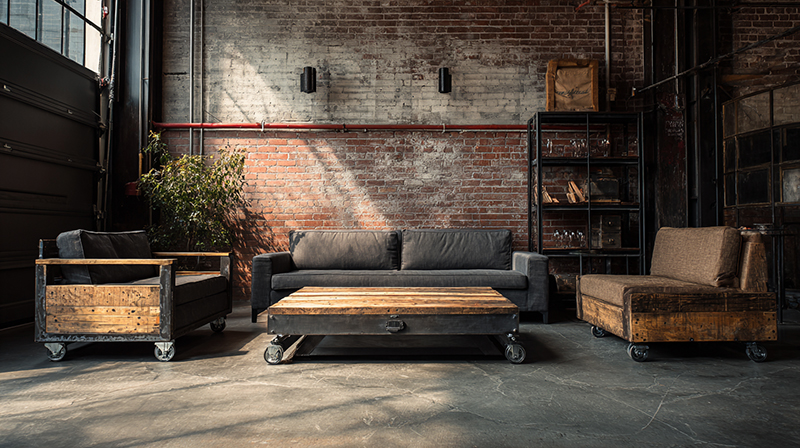
The look comes from leaving things visible. Load-bearing structure, raw materials and hardware stay on show as the look of the piece, where other styles would hide them or decorate over them.
The forms were borrowed from workshops and warehouses as much as from factories. Welded steel, bolted joints, wood tops that carry the marks of use.
Ornament is minimal. The welds and rivets do the visual work, along with the grain of the wood.
Industrial furniture design versus industrial design
Search results blur the two phrases, but they don’t mean the same thing. As a profession, industrial design covers a wide range of products, not only furniture, and Indeed listings for “industrial furniture designer” ask for product design and 3D modeling experience, not a style.
The furniture style describes appearance and construction instead. What a piece is made of, and how it is joined.
Industrial versus rustic and mid-century modern furniture
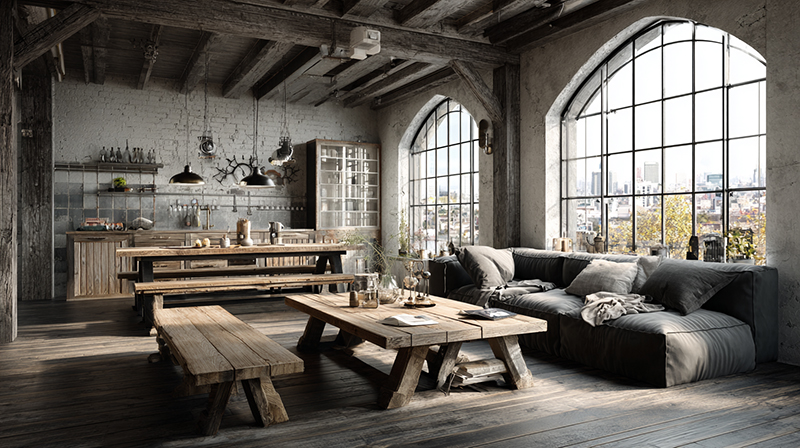
Rustic and industrial furniture can share a wood top, but the warmth comes from different places. Rustic interiors rely on natural wood and stone, while industrial pieces set accent colors against cooler metal, according to Samsen Furniture.
Steel and wood also appear in mid-century modern work, which is why 1stDibs lists vintage Tolix pieces under both French industrial and mid-century modern.
To sort a single piece, check its main detail. Exposed welds, rivets or bolts point to industrial. Hand-worked edges and tool marks on solid wood point to rustic, and molded curves with a smooth, finished surface point to mid-century modern.
Origins of Industrial Furniture Design, From Factory Floors to Lofts
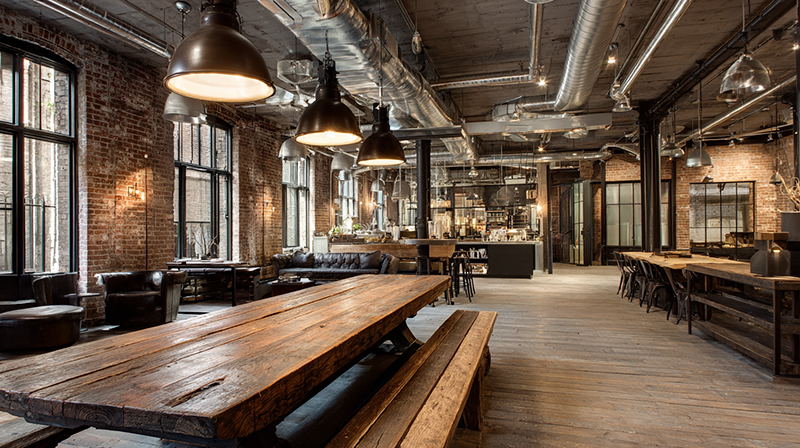
The style grew out of factory furniture and the tubular and sheet steel designs of the 1920s and 1930s, and it reached homes through the loft conversions of 1960s New York.
From the late 18th century, factories and warehouses in Europe and the United States were built around open production floors of brick, steel and concrete (Love That Design). The furniture inside was built to survive daily use, not to look good (Chairish).
Tubular steel arrived at the Bauhaus. Marcel Breuer designed the first version of his club chair in 1925 while teaching in Dessau, taking the idea from the bent steel handlebars of his bicycle, MoMA records. Within a year designers elsewhere were experimenting with tubular steel, and Thonet bought Breuer’s firm in 1929 and produced the chair (Harvard Art Museums).
Galvanized sheet came out of Burgundy. Xavier Pauchard, a zinc roofer, found that dipping sheet metal in molten zinc stopped it rusting, and he built household goods and then furniture on that process at Autun. Sources disagree on when his A chair appeared.
Usine Nouvelle places its invention in the 1920s and records the Tolix trademark in July 1927. Pamono and Trent Furniture give 1934, while 1stDibs describes a mid-1920s design and a slimmer 1934 revision.
They also split on the version that stacks 25 high. Chairblog and Trent Furniture credit Jean Pauchard’s A56 of 1956, while 1stDibs credits the 1934 revision.
Treat any single date for the A chair as a seller’s claim. The 1927 trademark is the anchor that several independent sources share.
In 1944 Emeco built the 1006 Navy chair for the US Navy, a lightweight chair for ships and submarines that would not corrode and would resist fire. It is anodized and hand brushed, a clean surface instead of a worn one, which makes it the exception to the weathered look of most factory-style pieces.
Then came SoHo. Artists started moving into its cast-iron loft buildings in the 1960s. New York legalized residence there for certified artists in January 1971, and the Landmarks Preservation Commission designated the Cast-Iron Historic District in August 1973 (Urban Omnibus).
Sociologist Sharon Zukin’s Loft Living, as the SoHo Broadway Initiative summarizes it, describes a later wave of residents who turned the industrial setting into a decorating style. Today industrial loft interiors are a design category of their own.
Materials Used in Industrial Furniture
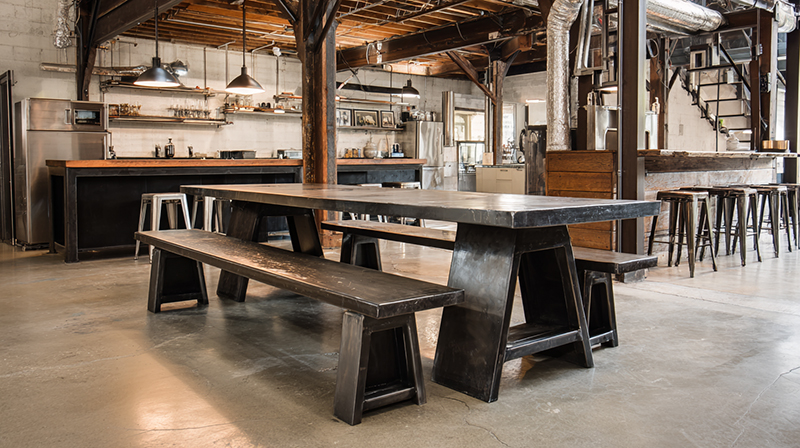
Steel and reclaimed wood carry most of the style. Cast iron, black iron pipe, leather, glass and concrete fill supporting roles.
Steel comes as bent tube, stamped sheet or flat bar. It is strong for its weight, but bare steel rusts without a coating.
Cast and wrought iron turn up in heavy bases and legs, and they need paint or another coating to stay rust-free.
Threaded black iron pipe and fittings make shelf frames and table legs, and the pipe is often reclaimed steel (Corin Weiss Designs).
Aged, distressed leather counts as part of the look, and wear reads as patina (Fireclay Tile).
Tops are commonly reclaimed wood, salvaged from sources such as pallets and barrels. The appeal is the grain and the nail holes, plus whatever color variation the source wood had.
Wood also moves with humidity, and a coating does not stop it. The USDA Forest Products Laboratory’s Wood Handbook says protective coatings slow dimensional change without preventing it, and that little movement occurs when wood is fabricated at the moisture content it will meet in service.
The handbook’s dimensional change coefficients apply between 6% and 14% moisture content.
A reclaimed top screwed rigidly across its width to a steel frame has nowhere to go, so the fasteners should let the top slide across the grain. Slotted holes do that job.
Concrete shows up in tabletops and counters, and in the floors these pieces sit on. The type of concrete finish decides how stains and wear show. Glass appears as tops and shelves set against dark metal for contrast.
Which Finish Protects Industrial Steel Furniture Best?
A two-coat powder system over galvanized steel is the most protective option in the table below, and it is the one to specify for anything damp or outdoors, coastal sites included. Dry indoor rooms tolerate simpler finishes, and a worn steel surface is part of the look there.
| Finish | How it protects | Main failure mode | Best setting |
|---|---|---|---|
| Raw or waxed steel | Oil or wax film only | Rust where the film wears or scratches | Dry indoor rooms |
| Single-coat powder | Barrier film | Blistering and delamination around damage | Indoor, low humidity |
| Galvanized, unpainted | Zinc layer protects the steel | White rust on damp, stacked parts | Utility and workshop pieces |
| Powder over galvanizing (duplex) | Zinc plus barrier coat | Delamination around damage | Damp, outdoor, coastal |
Salt spray hours are the usual way to compare coatings, but the schemes that certify powder coatings do not agree on how many hours count.
EN 13438 requires 750 hours of neutral salt spray. GSB-ST asks for 480, and Qualisteelcoat sets 240 to 720 hours depending on corrosivity class, C2 to C4 (Kunce, Krolikowska and Komorowski, Materials, 2021).
ISO 12944, the corrosion standard for paint systems on steel, excludes powder coatings from its scope, so the schemes share no baseline. The same paper reports that powder systems on road noise barriers often corrode after a few years, which makes an hour count a screening result, not a lifespan.
Indoor and dry rooms
Raw, waxed or blackened steel works indoors because the moisture load is low, and the patina that develops belongs to the look. Fireclay Tile’s style history notes that designers accept rust and oxidization, even visible layers of paint, as character.
Patina turns into damage when rust takes hold at a weld or bolted joint, or when it runs off onto the floor. Flaking that exposes bare metal on a seat or tabletop edge counts too.
Damp, outdoor and coastal use
In the 2021 comparison, a single-coat polyester system on galvanized steel showed 3.55 to 5.17 mm of delamination around a scribe after 750 hours of salt spray, against an EN 13438 limit of 5 mm. The two-coat epoxy and polyester system measured 1.07 to 1.83 mm.
The added epoxy primer coat separates the two. The test panels were also zinc-phosphated before coating, so the results do not cover powder applied over bare or merely degreased steel.
ISO 12944-2 classes industrial and coastal areas as C4 (high corrosivity), which is where a coastal terrace or a workshop lands. Pieces for those sites need the duplex system.
Emeco skips paint on its 1006 Navy chair. The aluminum is anodized, and the brushed version is sold as an outdoor-approved finish.
Tolix took a similar route with galvanized sheet steel and drainage holes in the seat, so rain runs through.
How Industrial Furniture Is Built: Joints, Frames and Load Ratings
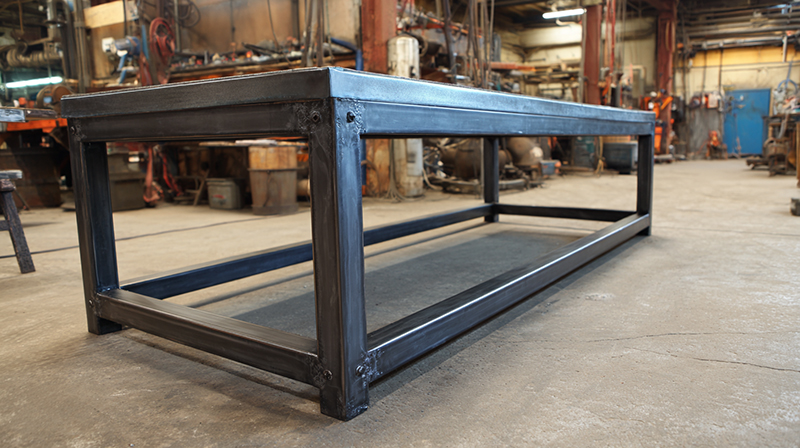
Frame joints carry the load in industrial furniture, and the top, seat or shelf only spans between them. Joint quality, more than the look of the surface, decides how long a piece lasts.
Welds are permanent and continuous, and a bad weld is the classic failure. A vintage industrial dealer at retro.net lists it first among steel problems.
Bolted joints are part of the look, can be retightened or replaced, and let a piece ship flat. Rivets come from sheet-metal and machine-shop work and read as visible hardware.
Frame type follows the material. Tube bends into continuous frames and sheet gets stamped into seats and shells, while pipe and fittings assemble into grids.
Usine Nouvelle describes the Tolix A chair as 15 stamped, galvanized sheet-steel parts welded together.
Whether a frame is strong enough is answered by a test report, not by how heavy a piece feels. BIFMA’s standards are voluntary, so a maker has no obligation to test to them.
The BIFMA standards page, as listed in 2026, includes these:
- ANSI/BIFMA X5.1-2017 (R2022) covers general-purpose office chairs, including stacking chairs and stools
- ANSI/BIFMA X5.11-2015 (R2020) runs the same tests on a 181 kg (400 lb) occupant basis
- ANSI/BIFMA X5.5-2021 is for desks and tables
- ANSI/BIFMA X5.9-2019 applies to freestanding, mobile and wall-mounted storage units
- ANSI/BIFMA X6.4-2021 covers occasional-use seating, which BIFMA says can be used at home
A stool maps to X5.1 and a table to X5.5. For a freestanding shelf it’s X5.9. Ask the maker which one a piece passed, and ask to see the report.
These standards give a comparable test baseline, not a guarantee for a handmade reclaimed-wood top on a pipe frame.
Design Principles Behind the Industrial Look
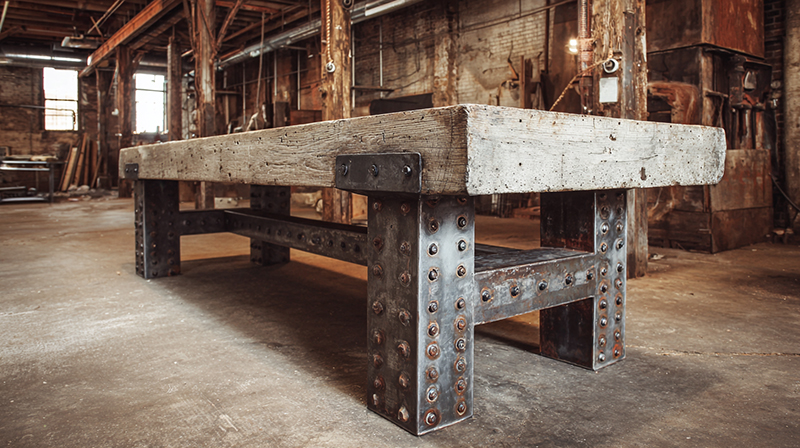
Industrial pieces let the structure show and leave the hardware visible. Every part is sized to its load, and metal gets set against warmer materials. A piece that hides its structure is a styled lookalike, not industrial furniture.
Load sets the proportions. Jean Prouve built the Standard chair (1934) around one observation, that the rear legs carry far more load than the front.
Vitra’s reissue keeps that logic visible, with hollow sheet-steel rear legs and thin tubular front legs, according to its product text as SCP carries it. Anyone looking at the chair can see where the weight goes.
Hardware and production marks stay in view. Twentytwentyone describes the Magis Steelwood chair as showing every joint and component, and smow’s listing for the same chair notes that grinding marks and surface irregularities on the galvanized sheet are normal, not defects.
And the metal sits against something warmer. Steelwood pairs a stamped steel backrest with solid beech, and Hivemodern’s product text says it is meant to gain a patina over the years.
The steel-against-beech pairing applies the same logic as contrast in interior design, at the scale of one chair.
Traditional pieces are period or repurposed factory furniture, and the wear on them is real. The neo-industrial kind is newer, with current manufacturing applied to the same rules. The Steelwood chair (Ronan and Erwan Bouroullec for Magis, 2008) won the Compasso d’Oro in 2011, per Lumens.
Petalwood Interiors notes that such pieces usually carry cleaner lines than period originals, which is the territory of modern industrial design.
Strip the finish from any piece and the structure should still explain the design.
Signature Industrial Furniture Pieces and What Each Was Built For
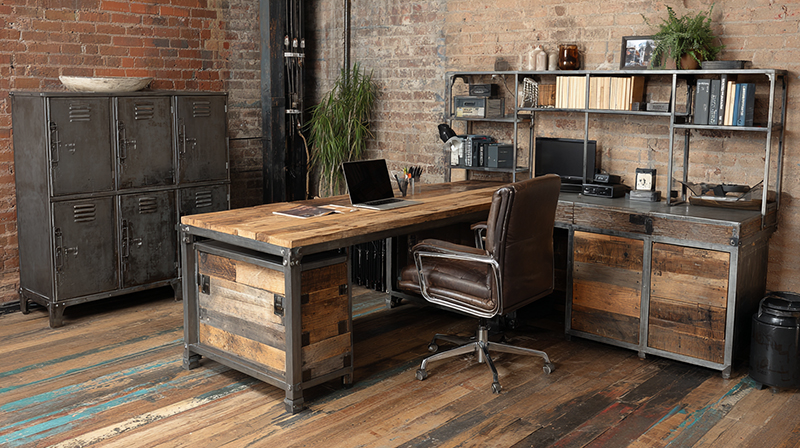
Beyond the chairs, the style leans on drafting tables, Anglepoise lamps, factory carts and pipe shelving. Every one of them came out of a workplace.
| Piece | Original setting | Build | Date and makers |
|---|---|---|---|
| Drafting table | Architect and engineer drawing offices | Wood top on adjustable cast iron base | 1900s to 1960s; Hamilton, Keuffel & Esser, Mayline |
| Anglepoise lamp | Assembly benches, then desks | Steel arm balanced by springs | Patented 1932; Herbert Terry & Sons |
| Factory cart | Moving goods on factory floors and rail docks | Plank deck, iron frame, cast iron wheels | 1890s to 1940; makers such as Gopher Floor Truck |
| Pipe shelving | Utility piping reused as shelf frames | Black iron pipe, wood planks | No single maker or date |
The adjustment mechanism is the design of a drafting table. A 1stDibs listing for one cherry-topped table describes a cast iron pedestal base that adjusts in height and tilts from horizontal to vertical.
The cranks and knobs that served the draftsman are the visible hardware buyers want now.
The Anglepoise began at the workbench. George Carwardine, an automotive engineer working on suspension systems, patented the spring arrangement in July 1932 (the Design Museum gives 7 July, the Science Museum Group 4 July).
Herbert Terry & Sons launched the four-spring 1208 and 1209 first, initially for industrial use. Terry’s management then judged the design too industrial for homes, and the three-spring 1227 followed, according to the V&A.
That origin is why an articulated task lamp fits industrial interior lighting better than a decorative fixture.
Harp Gallery describes one signed Gopher Floor Truck, made to load and unload railroad cars in a Wisconsin factory about 1900. Its deck is oak and maple planks, and the four wheels are original cast iron. Dealers also call these cotton bale or railroad carts (1stDibs).
Pipe shelving is the one piece with no factory original. Stock pipe and fittings make the frame, with wood planks laid across for shelves.
Builders working out frames and spacing can start from these pipe shelving ideas.
How to Design an Industrial Furniture Piece
The order matters here, because each step narrows the next.
- Write down what the piece carries, who uses it and where it stands, then name the BIFMA test family it should pass (seating, tables or storage).
- Put the mass where the load goes. Prouve’s Standard chair is the model, with heavier hollow sections in the rear legs and light tube in front.
- Specify the stock by standard. For black iron pipe frames, ASTM A53 covers black and hot-dipped zinc-coated welded and seamless steel pipe, so the drawing names the type (F, E or S) and the grade (A or B).
- Pick weld, bolt or rivet for each connection, and finish the visible ones as carefully as the hidden ones.
- Match the finish to the wettest room the piece will stand in. Coat the underside and hidden faces too, and where steel legs meet a wood floor, fit glides with felt applied at the factory (Somerset Floors).
- Build one and load it. Check joints, stability and floor contact on a prototype before committing to a run.
How to Judge Quality, Authenticity and Price
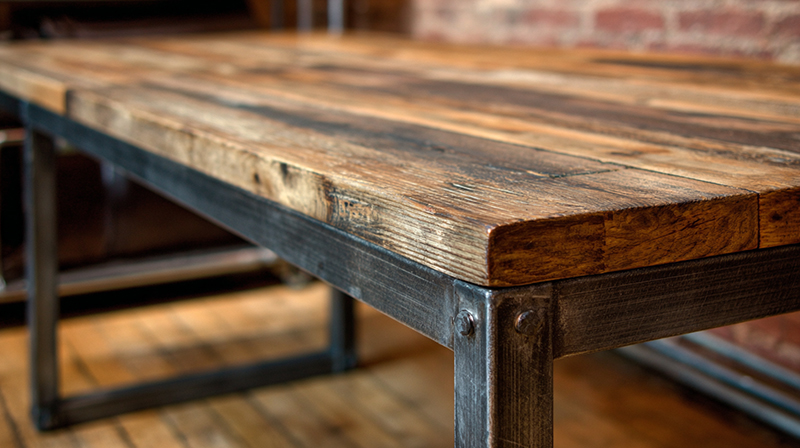
A good piece has a maker’s mark or documented origin and clean joints, with a finish that suits its room. Its price should match its category, though price alone does not sort vintage originals from reissues and copies, because the bands overlap.
Look for a mark first, whether a plaque, label or signature, such as the La-Del plaque on one dealer’s factory cart or the Gopher Floor Truck signature above.
Period cues help too. The Anglepoise 1208 and 1209 carry four springs and the 1227 three (V&A). On floor contact, Vitra’s Standard chair ships with felt glides and the Steelwood with felt pads, per SCP and Lamptwist.
Grinding marks on galvanized sheet are normal. Cracked welds and loose joints are not.
smow listed Vitra’s Standard chair at 865 euros on 23 September 2026 and the Magis Steelwood chair at 618 euros on 1 August 2026.
Marketplace asking prices in October 2026 included $745 and $995 for factory carts on 1stDibs, and $1,185 to $4,499.50 for cast iron drafting tables on Etsy.
Maker, labor and provenance move the price more than weight does.
Vintage originals bring real patina and a documented maker, but nobody knows their fatigue history and there is no test report.
Reissues and reproductions come with a new finish, fitted glides and a maker’s warranty. The catch is that licensed reissues cost as much as good vintage, and unlicensed copies carry no maker record.
Custom-built pieces are sized to the room, with stock and finish chosen to specification. They have no track record, so ask for the weld procedure and a load test.
For a first piece on a hardwood floor, a reissue with factory felt glides carries the least risk.
Where Industrial Furniture Design Fails
Industrial furniture runs into trouble in damp rooms and on hardwood floors. Air that swings between dry and humid is a problem too, and so is any space that needs to feel soft and quiet.
Rust and moisture
The UK National Physical Laboratory’s guide to atmospheric corrosion, following ISO 9223, counts a surface as wet enough to corrode when relative humidity is above 80 percent. It adds that salt contamination lowers that threshold sharply, to about 35 percent for sea salt.
The National Wood Flooring Association recommends 30 to 50 percent relative humidity for wood floors. A clean, conditioned home stays below the 80 percent band, so raw steel survives there. Salt on the surface is the exception.
Rust risk concentrates in rooms that leave that range, such as kitchens, bathrooms, basements and unheated garages, plus coastal homes.
Weight, floors and noise
Cast iron bases and plank-deck carts are heavy, and the NWFA advises against sliding heavy furniture across wood floors. It recommends pads on every leg that touches the floor, and Somerset Floors warns that felt stuck under metal tips can come loose.
Steel and glass tops feel cold and clatter under dishes. A wood insert, some leather or a layer of felt softens that.
Pads need upkeep. An NWFA flooring inspector writing in Hardwood Floors magazine rates felt above hard plastic glides, which tend to leave scuff marks, and advises vacuuming grit off felt from time to time.
Wood movement
Wood swells and shrinks with moisture, the NWFA notes, and floors show it as cupping, splitting and gapping. A tabletop shows the same failures when humidity swings.
A vintage industrial dealer at retro.net ranks wood movement as the more common problem, ahead of bad welds or unsealed steel.
When another choice fits better
Skip the style if the room is wet and the budget excludes stainless steel or a duplex coating. Skip it on a hardwood floor nobody will maintain pads for, and in a space that needs quiet and softness more than a workshop look.
Industrial Furniture Design FAQ
What colors go with industrial furniture?
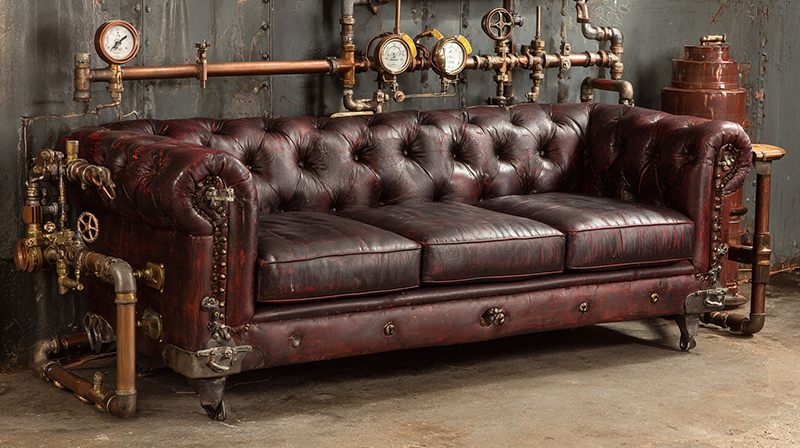
Neutral grays, black, white and metal tones work best, with wood and leather adding warmth. IKEA suggests drawing the palette from the exposed brick, pipe and concrete already in the room, and this industrial color palette guide offers more shades.
How do you mix industrial furniture with modern pieces?
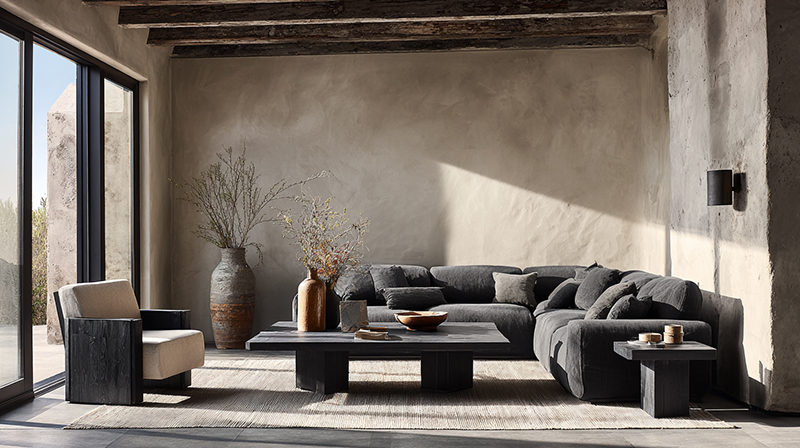
Anchor the room with one or two industrial pieces and soften them with fabric. IKEA’s style page recommends contrasting hard metal and wood with textiles, and keeping the rest simple and streamlined with clean lines.
Can industrial and rustic furniture share a room?
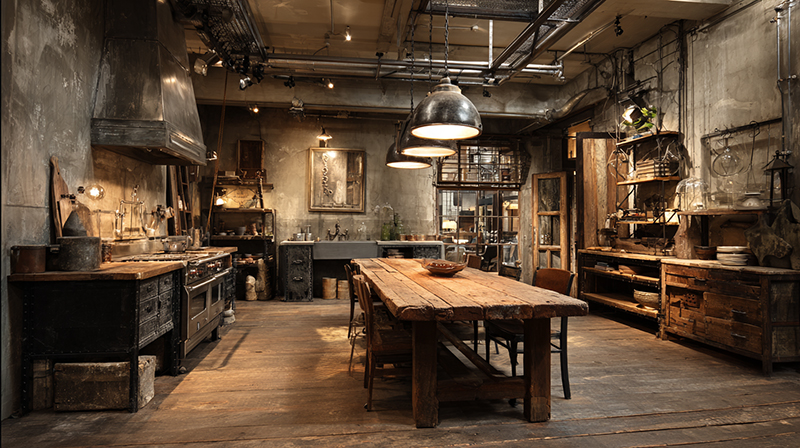
Yes, since both lean on wood. Industrial brings cooler metal, while rustic contributes natural, hand-worked surfaces. The blend is usually called rustic industrial.
DutchCrafters sells its industrial line as wood and metal combined with rustic elements.
Which rooms suit industrial furniture best?
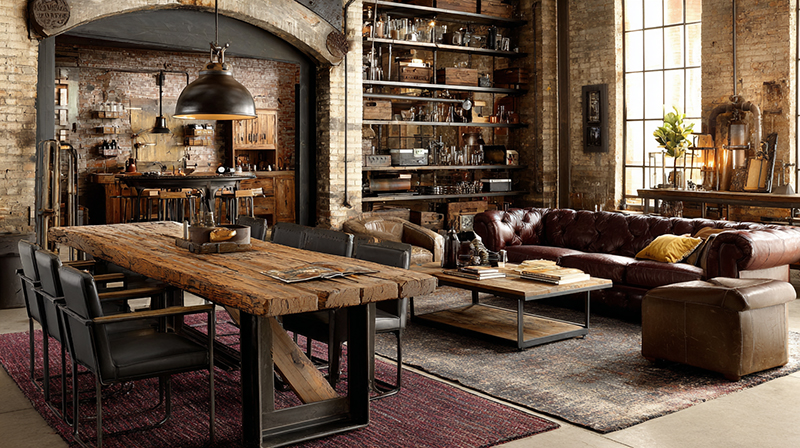
Lofts and urban apartments, according to DutchCrafters, along with open-plan living areas.
Flowyline adds that industrial pieces keep a space open without leaving it looking empty, which helps in smaller rooms.
Can you build industrial furniture at home?
Yes, if the design avoids welding. Threaded black iron pipe and wood planks assemble with hand tools into shelving and table bases.
Welded frames need welding skill. Load-test the first piece before anyone sits on it or stacks books on it.
Which Industrial Piece to Buy or Build First
The first piece of industrial furniture design should be small and cheap to get wrong, like a stool, side table or single shelf, and chosen for the room before the look.
Start with the room, meaning its humidity and its floor, since that is the only variable that cannot be changed later. Finish and joints come next, picked to suit that room, and the maker and test report after that.
The trade-off sits in the finish. A damp room needs a coated frame, which gives up the bare-steel patina that a dry room keeps.
A new edition of the BIFMA chair standard would reset what a test report proves, and that would change this order. The position was verified in October 2026.

- Kitchen Color Schemes by Cabinet Color: What Pairs Well - October 19, 2026
- Curtain Colors for Every Wall Color: Safe vs Bold Picks - October 18, 2026
- Interior Design Styles: Find Your Primary and Secondary - October 14, 2026


