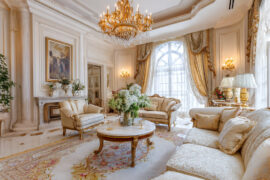
Few styles have shaped traditional Italian interior design over centuries the way Renaissance humanism, Baroque grandeur, and regional craft traditions have, and yet most rooms attempting this style get it wrong.
The confusion usually starts with materials. Or regional identity. Or both.
This guide covers what the style actually is, how it differs across Tuscany, Venice, Rome, and the South, and what it takes to apply it correctly, whether you are working with an original Italian property or a contemporary home looking for something with real historical weight.
What is Traditional Italian Interior Design

Traditional Italian interior design is a residential and architectural style rooted in the Renaissance, Baroque, and neoclassical periods that flourished across the Italian peninsula from the 14th century onward.
It is defined by three principles that set it apart from broader European classical styles: a deep commitment to artisanal craftsmanship, a heavy reliance on natural regional materials, and a visual language inherited directly from ancient Rome.
This is not the same thing as Mediterranean home decor. People mix them up constantly. Mediterranean design pulls from multiple coastal cultures including Greek, Spanish, and North African influences. Traditional Italian design is far more specific, rooted in identifiable historical movements and regional craft traditions.
It also differs significantly from generic rustic interior design. Rustic can mean almost anything. Traditional Italian has a defined vocabulary: pietra dura inlay, frescoed ceilings, Venetian plaster walls, hand-carved walnut furniture, Carrara marble floors.
The Italy interior design market was valued at USD 3,139.3 million in 2024 (Grand View Research), a figure that reflects sustained global demand for authentic Italian aesthetics far beyond Italy’s borders.
How it Differs from Other Classical European Styles
Key distinctions:
- French classical design favors gilded ornament applied to furniture surfaces. Italian classical design integrates ornament into the architecture itself, via carved stone, fresco, and inlaid wood.
- British Georgian interiors prioritize symmetry and restraint. Italian interiors accept and even celebrate asymmetrical decoration within a formally symmetrical room plan.
- Spanish colonial classical design uses strong Moorish geometry. Italian classical design draws from Roman humanism, not Islamic geometric traditions.
The other defining feature is regional identity. Traditional Italian design is not one style. It is a family of styles, each tied to a specific city or region, each with its own materials, color preferences, and craft traditions. Understanding this matters a lot when trying to recreate it.
The Role of Craftsmanship
Artisanal production is not decorative in traditional Italian interiors. It is structural.
Historical records show that by 1500, Venice alone had over 100 workshops producing luxury furniture, a concentration of specialized craft that shaped how Italian interiors developed for the next 500 years.
Craft traditions that remain central to the style:
- Pietra dura, an inlay technique using cut polished stones, originating in Florence during the late Renaissance
- Marquetry woodwork, developed by Florentine craftsmen using walnut, ebony, ivory, and tortoiseshell
- Venetian plaster (marmorino), a wall finish using marble dust and slaked lime that produces a stone-like surface
- Murano glassblowing, concentrated on the island of Murano since 1291 by Venetian law
Today, authentic Murano chandeliers made by master glassblowers on the island can exceed 100,000 euros per piece (YourMurano). That price point signals something important: traditional Italian craftsmanship occupies the luxury tier because it always has.
The Regional Styles Within Traditional Italian Design

“Italian interior design” describes a country, not a single aesthetic. The style fractures along regional lines, and those regional differences are not subtle.
A Venetian palazzo and a Tuscan farmhouse share almost nothing visually, yet both are authentically, historically Italian. A 2023 Houzz survey found that 62% of homeowners seeking luxury inspiration cited Italian design as their top influence. Most of them, probably, are picturing very different rooms.
Tuscan Style
Material palette: exposed stone, rough-hewn chestnut beams, terracotta floor tiles, wrought iron fixtures, aged plaster walls in ochre and sienna tones.
Tuscany’s design identity grew out of its agrarian economy. The Medici family shaped the urban palazzo style in Florence, while the countryside farmhouse developed its own parallel tradition centered on durability and warmth.
Venetian plaster and limewash finishes are the standard wall treatment. Colors are desaturated, mimicking sun-faded pigment. The goal is a room that looks like it has absorbed decades of Italian light, not like it was decorated last year.
What distinguishes Tuscan rooms from other warm, rustic styles is the specific combination of materials. Terracotta tiles with natural pitting, visible grain in chestnut wood, linen curtains that diffuse light rather than block it. These are not approximations of Italian style. They are Italian style. See also: Tuscan interior design for a full breakdown of how to apply this regional style correctly.
Venetian Style

Venice built its aesthetic on trade. The Republic of Venice sat at the crossroads of European and Eastern commerce for centuries, and its interiors show it.
Defining characteristics:
- Murano glass chandeliers, the most internationally recognized element of Venetian interiors
- Rich silk and velvet upholstery, often imported from Asia through Venetian trade networks
- Gilded furniture and ornate carved frames on mirrors and paintings
- Soft pastels and gold accents, inspired by the lagoon’s light quality
- Lacquered furniture with Eastern influences, particularly evident in green and gold finishes
Venetian Baroque furniture was anchored to walls with undecorated backs, a detail that shows how these pieces were designed for specific architectural positions, not for flexible arrangement. That tells you something about how seriously Venetians took the relationship between furniture and room.
The Venetian mirror industry became Europe’s most sophisticated in the 16th century. Techniques were kept secret under penalty of death, per Republic of Venice historical decrees. The secrecy worked: Venetian mirrors remain among the most identifiable objects in traditional Italian interiors.
Southern Italian Style
Naples, Sicily, and the broader Mezzogiorno operate on a completely different visual register than the North.
Color is bolder. Ceramic tilework is more dominant. The Baroque influence arrived later and stayed longer in the South, producing an ornamental density that Northern Italian regions never fully embraced.
Key elements of Southern Italian interiors:
- Hand-painted majolica floor and wall tiles from Deruta, Vietri sul Mare, and Sicily
- Strong ochre, cobalt, and terracotta combinations in color palettes
- Heavier Baroque ornamentation on furniture and architectural moldings
- Ceramic Capodimonte porcelain used as display objects
The Deruta pottery tradition in Umbria, just north of Naples’s cultural sphere, has been producing majolica since the 15th century. Authentic Deruta pieces carry painted geometric and floral patterns that are immediately recognizable. Reproductions exist everywhere. Real ones do not look perfect.
Roman and Neoclassical Style

Rome’s contribution to traditional Italian interior design is neoclassicism, a movement that began after 1765 as a reaction against Baroque excess and drew directly from the rediscovery of Pompeii and Herculaneum.
Italy’s major neoclassical design centers were Rome, Milan, Naples, Turin, and Genoa. Venice was last to adopt the style, still producing Rococo interiors well into the 1790s (Wikipedia, Italian Neoclassical Interior Design).
Roman neoclassical rooms are defined by: Carrara marble surfaces, symmetrical room plans, coffered and decorated ceilings, classical column references in plasterwork and furnishings, and a deliberate sense of architectural gravitas.
Giuseppe Valadier, Rome’s most significant neoclassical designer, made marble tables that were often gilded in gold, an explicit reference to the wealth displays of ancient Rome. His approach set a template that Roman interior design has followed, more or less, ever since.
Worth noting: Milanese neoclassical design deliberately went in the opposite direction. Walnut furniture, no gilding, restrained surfaces. Milan was always the cooler, more Northern-leaning Italian city in aesthetic terms, and that shows in its traditional interiors.
Key Materials in Traditional Italian Interiors

Materials are not background choices in traditional Italian design. They are the design. Get the materials wrong and no amount of furniture or color can fix it.
Italy’s home furniture market reached USD 17.07 billion in 2024 (Mordor Intelligence), with a significant share driven by demand for natural material pieces carrying the “Made in Italy” designation, a label that signals specific material standards and craft methods.
Marble and Stone Surfaces
Carrara marble has been quarried from the Apuan Alps in Tuscany for over 2,000 years. Michelangelo sourced material from these same mountains for his sculptures. In traditional Italian interiors, it appears on floors, column surrounds, fireplace mantels, and tabletops.
The main stone materials and their applications:
| Material | Origin | Primary Use in Italian Interiors |
|---|---|---|
| Carrara Marble | Apuan Alps, Tuscany | Flooring, fireplace surrounds, and intricate column details. |
| Calacatta Marble | Carrara Region, Tuscany | High-impact feature surfaces, luxury tabletops, and book-matched bathroom walls. |
| Travertine | Tivoli (near Rome) | Large-format flooring, wall cladding, and seamless exterior-to-interior transitions. |
| Pietra Serena | Firenzuola, Florence | Renaissance-style architectural trim, window/door surrounds, and structural stairs. |
Travertine, a limestone variety quarried near Rome, delivers a texture that Carrara marble does not: visible natural pitting and a warmer, slightly amber tone. Romans used it for the Colosseum. It remains among the most authentic flooring choices for traditional Italian interiors.
A Venetian plaster fireplace combines two of traditional Italian design’s most important material traditions: stone-derived plaster and the fireplace as the room’s central architectural feature.
Wood Types and Their Role

Walnut was the dominant wood of Italian Renaissance and Baroque furniture. It carves well, takes finish without losing grain definition, and ages beautifully. Most of what survives from this period in museum collections is walnut.
Chestnut appears primarily in ceiling beams and rural Tuscan furniture. Its visible grain and warm brown tone are inseparable from the Tuscan farmhouse aesthetic.
Ebony and rosewood arrived in Italian workshops via Venetian trade routes, used as contrast inlays in Baroque and later neoclassical furniture. Milanese cabinetmaker Giuseppe Maggioloni worked extensively with fruitwoods and exotic inlays to produce some of the most refined Italian neoclassical furniture of the 18th century.
Olive wood appears in Southern Italian and Sicilian contexts, used for smaller decorative objects and carved details rather than large case furniture.
Ceramic and Artisan Materials
Majolica is tin-glazed earthenware with painted decoration, and it has been produced in Italy since the Renaissance. Authentic Deruta pieces, hand-painted with geometric and figurative patterns, appear as floor tiles, wall panels, decorative vases, and tableware in traditional Italian interiors.
Murano glass is the other signature artisan material. Concentrated on the island of Murano since 1291, the craft uses techniques including cristallo (ultra-clear glass), lattimo (milk glass), and intricate filigree work. These methods were passed down through family dynasties, many of which, including Barovier and Toso, still operate today.
The Como region in Lombardy has produced silk since at least the medieval period, and Como silk remains the standard reference for traditional Italian brocade and velvet upholstery fabrics.
Color Palettes Used in Traditional Italian Interiors

Traditional Italian color is not bright. That is probably the most common mistake people make when attempting this style.
The palette is warm, saturated, and desaturated at the same time. Colors look as if they have been aging in sunlight for decades. They carry depth without gloss.
Earth Tones and Regional Variations
Ochre, sienna, raw umber, terracotta, and burnt orange form the core of the Tuscan and Southern Italian palette. These are not paint-deck colors. They are direct references to the clay soil, stone quarries, and sun-dried plaster of the Italian landscape.
Understanding color in interior design helps here. The way these tones function together follows a specific logic: warm mid-tones on walls, darker values in wood and stone, gold accents as punctuation. It is a restrained system that looks rich because of texture, not brightness.
Regional palette differences at a glance:
| Region | Dominant Tones | Accent Colors |
|---|---|---|
| Tuscany | Terracotta, ochre, and warm cream. | Olive green and deep burgundy. |
| Venice / Veneto | Soft pastels (peach/mint), gold, and ivory. | Deep red, forest green, and cobalt blue. |
| Rome / Lazio | Warm white and travertine beige. | Imperial purple and bronze gold. |
| Southern Italy | Cobalt blue, sunflower yellow, and burnt orange. | Stark white and deep terracotta. |
Venetian Plaster as a Color Medium
Venetian plaster is not a color in the conventional sense. It is a finish that creates color through layering. Three or four coats, each slightly different in tone, produce a surface depth that flat paint cannot replicate.
The standard Venetian plaster palette runs from warm white and aged cream through soft gold, faded ochre, and dusty rose. These are the colors of aged Roman and Florentine walls. That is the reference. Not a paint chart.
Warm cream and ivory tones in Venetian plaster are not neutral. They carry warmth. Placed against walnut furniture, terracotta floors, and silk drapes in deep red or forest green, they create the visual equilibrium that defines a traditionally finished Italian room.
Jewel Tones in Upholstery and Textiles

Rich jewel tones appear in Italian traditional interiors not on walls, but on fabric surfaces. Deep red (crimson and cardinal), forest green, navy, and royal purple are the dominant upholstery colors across all regional styles.
These colors have specific historical associations. Crimson velvet was the standard fabric for Venetian Baroque armchairs signaling aristocratic status. Deep green damask appears throughout neoclassical Roman interiors. These choices were not arbitrary. They were coded.
Gold accents connect directly to Baroque influence, appearing in gilded furniture frames, mirror surrounds, and the gold thread woven into brocade fabrics. Colors that go with gold in a traditional Italian context are always warm. Cool silvers and grays do not belong here.
Furniture Characteristics and Iconic Pieces
Traditional Italian furniture is heavy, carved, and built to last for generations. Comfort existed, but it came second to visual authority and structural permanence.
The global interior design market shows traditional design remains consistently popular, holding a significant share within the broader USD 145.3 billion market (Credence Research, 2024).
Baroque and Rococo Furniture Influence
Italian Baroque furniture shares a set of characteristics that hold across regional variations: large scale relative to the room, elaborate surface carving, and a preference for walnut with occasional ebony or rosewood inlays.
Characteristic Baroque furniture features:
- Cabriole legs on chairs and case pieces, curving outward at the knee and tapering to a foot
- Pietra dura tabletops, using cut polished stones set in geometric and figural patterns
- Gilded carved frames on mirrors, paintings, and case pieces, particularly in Rome and Venice
- Genoese armchairs upholstered in velvet or silk with gilded structural elements
Venetian Baroque furniture added Eastern influences to this mix. Rich silks imported from Asian trade networks, green and gold lacquer, and decorative motifs incorporating animals, angels, and allegorical figures.
The armadio (wardrobe), credenza (sideboard), and cassapanca (chest bench) are the three Italian furniture pieces that recur across all regional styles and historical periods. These were not decorative objects. They were the primary storage furniture of Italian households from the Renaissance through the 19th century, and they carried the full weight of the craftsman’s skill.
Neoclassical Italian Furniture
Italian neoclassical furniture broke from Baroque ornamental density and returned to cleaner architectural references: straight legs, restrained surface decoration, and a deliberate reference to Roman forms.
Giuseppe Maria Bonzanigo of Turin produced what historians consider some of the finest Italian neoclassical furniture, working with elegant proportions and luxurious materials in a style that leaned toward the French Louis XVI model. His Piedmont contemporaries were essentially working in a French idiom.
Milan went its own way. Milanese neoclassical furniture stayed with walnut, avoided gilding, and favored the marquetry work of cabinetmaker Giuseppe Maggioloni, who used fruitwood inlays to create precise pictorial surfaces on drawer fronts and table tops. It is the most restrained, and arguably most sophisticated, expression of traditional Italian furniture.
Roman neoclassical furniture, by contrast, was grander and more monumental. Giuseppe Valadier’s carved and gilded marble tables were explicit status objects. That contrast between Milanese restraint and Roman grandeur maps directly onto the broader regional character differences that define traditional Italian design as a whole.
Architectural Features That Define the Style

Traditional Italian interiors are inseparable from the architecture that contains them. The built-in elements are not backdrop. They are primary.
Italy’s interior fit-out market is projected to grow from USD 1,663.59 million in 2023 to USD 2,666.44 million by 2032 (Credence Research), driven partly by sustained demand for renovation of historic Italian residential properties, many of which carry original architectural features.
Ceilings as Design Surfaces
The ceiling is where traditional Italian design makes its most dramatic statement. Three ceiling types recur across regional and historical variations.
Coffered ceilings use a grid of recessed panels, often painted or gilded, that create geometric rhythm overhead. The technique comes directly from Roman architecture. Renaissance palazzi in Florence and Rome used it to signal classical learning and wealth simultaneously.
Frescoed ceilings turn the overhead surface into a painting. The Farnese Palace in Rome used fresco techniques to simulate architecture and mythological scenes on ceiling and wall surfaces. Annibale Carracci’s work there, completed around 1600, set the template for Italian domestic fresco painting for the following century.
Exposed beam ceilings in chestnut or walnut appear primarily in Tuscan rural contexts. These are structural elements left visible as a deliberate aesthetic choice, not as a budget shortcut. The grain, color, and aged surface of old chestnut beams are not replicable with new timber.
Arches, Doorways, and Wall Treatments
Arched openings are the single most persistent architectural element across all traditional Italian regional styles. They appear in doorways, window frames, loggia openings, and built-in niches.
The semicircular arch is the Roman reference. Pointed arches signal Gothic influence and appear in Venetian Gothic contexts. Traditional Italian design uses the semicircular arch as its baseline architectural grammar.
Wall treatments beyond paint and plaster:
- Decorative plasterwork cornices at ceiling-wall junctions, elaborated in Baroque rooms into carved swags, cartouches, and figural elements
- Stone or brick exposed in Tuscan and Southern Italian rural contexts
- Trompe-l’oeil painting, used to simulate architectural depth, stone surfaces, or outdoor landscapes on flat walls
- Wood paneling with pilasters and molded friezes, particularly in Venetian Renaissance council chambers
The Marble Fireplace as Focal Point
The marble fireplace surround is the most significant focal point in interior design within the traditional Italian canon. It anchors the main reception room and establishes the material and visual hierarchy for everything else in the space.
Carrara and Calacatta marble are the standard materials for formal Italian fireplace surrounds. The surround itself is carved, ranging from restrained neoclassical molding profiles to fully sculptural Baroque compositions incorporating caryatids, swags, and figural reliefs.
For reference on how these look in contemporary applications, marble fireplace surround ideas show how this traditional element translates into modern rooms. The form is consistent. The material is non-negotiable. Substitute materials read as imitations in this context because they are.
Stone fireplace surrounds in Tuscan rural interiors follow a different template: larger scale, rougher stone, sometimes travertine or local pietra serena, with a heavy lintel rather than a carved surround. Both are authentically Italian. They come from completely different architectural traditions within the same country.
Textiles, Fabrics, and Decorative Layers

Fabric in traditional Italian interiors is not decorative filler. It carries visual weight and historical coding that colors and materials alone cannot deliver.
Italy’s textile market reached USD 25.67 billion in 2024 (Expert Market Research), with Como’s silk production remaining among the country’s most prestigious exports, still used by leading fashion and interior houses for upholstery and drapery.
Silk, Velvet, and Brocade
Como silk has been produced in Lombardy since the 16th century. The mild climate and mulberry trees necessary for silkworm farming made it an ideal production center. Artisans there became masters of silk weaving and dyeing, combining strength, sheen, and intricate pattern in a way that remains unreplicated at scale.
Venetian velvet, Milanese lace, and Tuscan brocade were among the most prized luxury textiles across Europe during the Renaissance, decorating palaces, churches, and royal wardrobes (Italy Gifts Direct).
Brocade uses a supplementary weft technique to produce raised patterns on the fabric surface. The word itself comes from the Italian “broccato,” meaning embossed cloth. Authentic silk brocade upholstery belongs primarily to formal reception rooms, chairs with high carved backs, and drapery panels that frame arched doorways.
Damask is the more versatile option. First woven on Italian draw looms in the 14th century, it uses a reversible jacquard pattern in a single or polychrome color scheme. In traditional Italian rooms it appears on cushions, tablecloths, bed linens, and lightweight curtains where brocade would be too heavy.
Drapes, Curtains, and Window Treatments
Heavy drapes with tassel and fringe trim are the signature window treatment in formal Italian interiors. Floor-to-ceiling silk or velvet curtains in deep red, forest green, or gold silk operate on a different visual scale than functional window coverings. They define the room’s proportions.
Key features of traditional Italian window treatments:
- Tassel and fringe trim at hem and tieback, often in matching or contrasting metallic thread
- Drapery hardware in gilded or wrought iron, with decorative finials at the rod ends
- Interlined panels for weight and drape, creating clean columns of fabric rather than limp curtains
Understanding what window treatments work in a historically informed space matters here. Sheer panels can appear beneath heavy drapes in Venetian rooms, softening natural light while the outer drapes frame the opening. Plantation shutters and wooden louvered shutters are more typical in Tuscan rural contexts, used to manage strong afternoon light without blocking the window’s architectural frame.
Layering Rugs Over Stone Floors

Traditional Italian stone and terracotta floors are never fully covered. The floor material is part of the room’s identity.
Persian and hand-knotted rugs were originally imported by Venetian and Genoese merchants in the medieval period, and they remain the standard rug choice in traditional Italian interiors. Placed at the center of a seating group or under a dining table, they add warmth without competing with the floor below.
Silk or wool rugs in deep red, navy, or ivory with geometric or floral patterns are most consistent with the style. Flat-woven or machine-made rugs are visible substitutes. The difference shows most clearly on stone floors, where the pile height and color depth of a quality hand-knotted rug provide a visual contrast that synthetic alternatives cannot match.
Lighting in Traditional Italian Interiors

Lighting in this style does two things at once. It illuminates. And it is, itself, an object to look at.
Italy’s commercial LED lighting market was valued at over USD 1 billion in 2024 (Grand View Research, via Griseo Interior), a figure that reflects how deeply Italian lighting manufacturers have integrated modern efficiency into historically rooted fixture designs.
Murano Glass Chandeliers
The Murano glass chandelier is the most internationally recognized lighting element in traditional Italian design. No other fixture carries the same combination of historical weight and visual impact.
Glassmaking was relocated to the island of Murano by Venetian law in 1291, concentrating the craft on a single island where the Republic could protect its trade secrets. By the 15th and 16th centuries, Murano had become Europe’s luxury glassmaking center (Wikipedia, Venetian Glass).
Authentic Murano chandeliers are identified by their hand-blown glass components: arms, flowers, and pendant drops shaped individually, each carrying slight variations that confirm handmade production. Price range for monumental pieces can exceed 100,000 euros (YourMurano). That cost is not just for the object. It is for the centuries-deep craft behind it.
Brands like Venini, Barovier and Toso, and Berengo Studio continue producing from the island using methods that have changed very little since the 18th century. Their work appears in historic Italian villas and hotel lobbies worldwide.
Wrought Iron and Candle-Style Fixtures
Tuscan and Southern Italian contexts use wrought iron rather than glass as the primary fixture material. Forged by hand, not cast, wrought iron has an irregular surface quality that distinguishes it from manufactured metal.
Candelabra-style sconces, ceiling-mounted iron chandeliers, and torch-style wall brackets appear throughout rural Tuscan interiors. The reference is candlelight, and the fixtures are designed to recall it even when electric.
Fabric-shaded sconces appear in more formal Roman and Venetian rooms, placed symmetrically on either side of doorways or above console tables. This accent lighting approach highlights specific architectural or decorative elements rather than filling the room with undifferentiated light.
Natural Light and Shutter Management

Traditional Italian rooms were designed before electric light, and the management of natural daylight is built into the architecture itself.
Ambient light in Italian interiors comes through arched windows and openings, then bounces off polished marble floors and Venetian plaster walls. Understanding ambient lighting in this context means working with reflective surfaces, not supplementing them with additional fixtures.
Layered light matters. A single chandelier in the center of a coffered ceiling is insufficient for daily living. Wall sconces, table lamps with ceramic or painted bases, and candelabra-style floor lamps complement the central fixture and vary the room’s mood between day and evening use.
| Fixture Type | Regional Context | Primary Role |
|---|---|---|
| Murano Glass Chandelier | Venice, formal palazzos and dining rooms. | The “Jewel” of the room; a high-impact focal point that refracts light. |
| Wrought Iron Chandelier | Tuscany and rural Umbrian interiors. | Provides “Rustic Gravity” and overhead ambient light. |
| Fabric-Shaded Wall Sconce | Rome and neoclassical urban apartments. | Creates soft, eye-level accents and establishes architectural symmetry. |
| Ceramic-Base Table Lamp | Southern Italy and coastal regions. | Adds pops of color and pattern while providing warm task lighting. |
Decorative Objects and Art Placement
Objects in traditional Italian interiors are not collected randomly. They follow a system of placement that reflects the compositional rules of the style itself.
Oil Paintings and Framed Art
Large-scale oil paintings in gilded frames are the standard wall art in traditional Italian formal rooms. Subjects are typically religious, mythological, or landscape. Portrait paintings appeared in the private rooms of noblemen. Allegorical and mythological scenes, taken from classical and biblical sources, occupied the grander public rooms.
Placement follows symmetry. Pairs of paintings of similar scale are hung at equal heights on either side of a fireplace or doorway. A single large painting is centered above a console table or sideboard, with matching objects placed symmetrically on the surface below it. The symmetry in Italian interior design is not incidental. It is the underlying compositional grammar of the style, traceable directly to Renaissance architectural theory.
Gilded frames are not interchangeable with other frame styles. The warm gold of a traditional Italian frame ties the painting to the gilded furniture hardware, chandelier arms, and decorative moldings in the same room. Pull that thread and the room’s coherence weakens noticeably.
Ceramic, Sculpture, and Display Objects
Majolica pottery, Capodimonte porcelain, and classical sculpture references form the three main categories of display objects in traditional Italian interiors.
Majolica vases and urns in blue, white, and yellow with hand-painted figural or floral patterns appear on console tables, fireplace mantels, and open shelving. Authentic Deruta pieces carry pattern variations that confirm hand-painting. Perfect uniformity is the giveaway for reproductions.
Classical sculpture references appear as marble busts on pedestals, plaster casts of antique fragments, and bronze figures on tabletops. These are not purely decorative. They signal the room’s historical orientation: the occupant knows classical history and values its material culture.
Pairs of ceramic urns flanking a fireplace, a marble bust on a pedestal in a corner, and a collection of majolica plates arranged on a painted wooden rack: these are specific compositional moves, not accidental accumulation. The pattern in interior design here is hierarchical display, objects arranged by scale from largest at center to smaller at the periphery.
Trompe-l’oeil and Fresco as Wall Art
Wall painting at the scale of architecture is traditional Italian design’s most technically demanding decorative element. And most people skip it entirely, which is why finished rooms often feel incomplete.
Trompe-l’oeil creates the illusion of three-dimensional space or objects on flat surfaces. In Italian formal rooms it simulates architectural niches, window openings onto imaginary landscapes, or relief sculptures. The technique requires a skilled specialist. Done correctly, it adds perceived depth to a room without changing its physical dimensions.
Fresco technique, used on ceilings and upper wall sections, integrates painting into the plaster surface itself. Pigment applied to wet lime plaster bonds permanently as it dries. The Farnese Palace in Rome and Palladio’s Villa Barbaro in the Veneto remain the reference points for how this looks at its best, ceiling compositions that make the architecture feel like a frame for the sky above it.
How to Apply Traditional Italian Design in a Modern Home
Most people try to do too much at once. That is the mistake.
Traditional Italian design works in a modern home when you select a few high-impact elements and give them room to register rather than filling every surface with period references. The Italy interior design market growing at 4% CAGR through 2030 (Grand View Research) reflects how many homeowners globally are making exactly this kind of selective investment.
Wall Finishes and Surface Treatments That Scale Down
Venetian plaster is the most accessible entry point into this style. It can be applied to drywall, gypsum board, brick, and tiling. Made from lime and marble dust, it hardens over time, resists mold, and requires minimal maintenance (Chromatist, 2024).
Three Venetian plaster variants to know:
- Marmorino: coarser texture, slightly stone-like surface, good for accent walls and fireplace surrounds
- Grassello: high-polish, near mirror-like sheen when burnished, best in entryways and formal rooms
- Lucidato: the most polished finish, multiple layers, intensive burnishing, suited to high-end residential contexts
Limewash paint is the budget alternative. It does not replicate the depth of genuine Venetian plaster but produces similar tonal variation and a matte surface that reads as aged without the cost of a specialist application. Use it in secondary rooms where the full plaster treatment is not justified.
An accent wall in Venetian plaster behind a fireplace or bed is the single highest-impact low-commitment move in this style. One well-executed wall communicates more about the room’s intention than four walls painted in an approximation of the right color.
Furniture: What to Source and What to Avoid
Authentic Italian furniture pieces, antique or reproduction, are available from specialist dealers in the US and Europe. Poltrona Frau, Molteni, and Natuzzi are established Italian manufacturers whose catalogs include traditional and transitional pieces that carry genuine craft pedigree.
What works in a modern home:
- A carved walnut credenza as a media console or sideboard
- A gilded mirror in a Baroque frame above a fireplace or console table
- An armchair in velvet or silk brocade as an accent piece in a neutral room
- A hand-knotted rug in deep red or navy under a seating arrangement
What to avoid: Mixing regional styles without understanding their differences. A Venetian gilded console table next to a Tuscan terracotta floor and wrought iron chandelier does not read as “Italian.” It reads as confused. Pick a regional reference and stay consistent.
The biggest mistake in applying this style, according to interior professionals, is overreliance on clichés: fake arches, mass-produced faux-rustic furniture, generic terracotta paint on perfectly smooth drywall. Authenticity here means choosing fewer elements and making sure they are correct.
Mixing Traditional Italian Elements with Contemporary Rooms
The contrast approach works. A Murano glass chandelier above a simple, unornamented dining table creates more visual tension and interest than the same chandelier in a room full of competing period details.
Griseo Interior, a specialist in Italian design integration, recommends letting a single statement Italian fixture anchor the room and keeping surrounding furniture subdued. The fixture owns the spotlight. Everything else supports it.
Elements that scale well into smaller contemporary spaces:
- Venetian plaster or limewash on one wall
- Silk or velvet throw pillows in deep jewel tones on a neutral sofa
- A pair of majolica ceramic lamps on bedside tables
Elements that do not scale down: coffered ceilings, full-room fresco painting, heavy architectural cornices. These require the room volume of a historic palazzo to work. In a contemporary apartment with standard ceiling heights, they compress rather than elevate the space.
For a broader context on where traditional Italian design sits within the full range of residential styles, the overview of interior design styles shows how this style relates to other classical and heritage-based approaches. Traditional Italian shares vocabulary with traditional interior design broadly but applies it with a specificity of material and craft reference that general traditional style does not require.
If you’re looking at adjacent styles for comparison, European interior design covers the broader classical European context, while luxury interior design addresses the high-end application of materials and craftsmanship that traditional Italian style has always represented at its formal best.
FAQ on Traditional Italian Interior Design
What is traditional Italian interior design?
Traditional Italian interior design is a style rooted in Renaissance, Baroque, and neoclassical periods. It centers on artisanal craftsmanship, natural regional materials like Carrara marble and walnut wood, and a visual language inherited directly from ancient Rome.
What are the key features of traditional Italian interior design?
The defining features include coffered or frescoed ceilings, terracotta or marble floors, carved walnut furniture, Venetian plaster walls, arched doorways, stone fireplaces, Murano glass lighting, and rich silk or brocade upholstery in deep jewel tones.
How is traditional Italian design different from Mediterranean style?
Mediterranean design draws from multiple coastal cultures including Greek, Spanish, and North African influences. Traditional Italian design is more specific, tied to identifiable historical periods and regional craft traditions like Murano glassblowing and Deruta majolica ceramics.
What materials are used in traditional Italian interiors?
Carrara and Calacatta marble, travertine, terracotta tiles, chestnut and walnut wood, wrought iron, hand-painted majolica ceramic, Como silk, and Murano glass are the core materials. Authenticity depends on using real regional materials, not substitutes.
What colors are typical in traditional Italian interior design?
Earth tones dominate: ochre, sienna, terracotta, and burnt orange. Venetian plaster adds warm white and aged cream. Upholstery uses deep jewel tones like crimson, forest green, and navy. Gold accents connect to the Baroque influence throughout.
What is the difference between Tuscan and Venetian interior style?
Tuscan style is rustic and grounded, using exposed stone, chestnut beams, and terracotta tiles. Venetian style is ornate and refined, with Murano glass chandeliers, gilded furniture, silk upholstery, and soft pastels inspired by the lagoon’s light quality.
What furniture pieces are central to traditional Italian interiors?
The credenza, armadio, and cassapanca recur across all regional styles. Baroque chairs feature cabriole legs and velvet upholstery. Neoclassical pieces use walnut with marquetry inlay. All share a commitment to hand-carved construction over mass-produced manufacturing.
How do you incorporate traditional Italian design in a modern home?
Start with Venetian plaster on one wall, a gilded mirror above a fireplace, or a hand-knotted rug on a stone floor. One well-chosen Italian piece communicates more than a room full of approximations. Avoid mixing regional styles without understanding their differences.
What lighting is used in traditional Italian interiors?
Murano glass chandeliers are the signature choice in formal Venetian rooms. Wrought iron candelabra-style fixtures appear in Tuscan contexts. Fabric-shaded wall sconces provide accent lighting in Roman neoclassical rooms. Layering all three creates the most authentic result.
Is traditional Italian interior design the same as old world European design?
Not exactly. Old world European design is a broad category covering multiple national traditions. Traditional Italian design is more specific, defined by regional craft identities, historical periods from the Renaissance through neoclassicism, and materials sourced from particular Italian locations.
Conclusion
This conclusion is for an article presenting traditional Italian interior design as a style that rewards precision, not approximation.
The difference between a room that reads as authentically Italian and one that merely suggests it comes down to material honesty. Carrara marble, hand-painted majolica, Como silk, and genuine Venetian plaster are not interchangeable with their substitutes.
Regional identity matters too. Tuscan terracotta and Venetian gilding belong to completely different visual traditions.
Whether you are sourcing a carved walnut credenza, selecting a Murano glass chandelier, or applying a Venetian plaster finish to a single accent wall, the approach is the same: fewer elements, done correctly, always outperform a room full of approximations.

- Exploring the Rich History of Interior Design - September 30, 2026
- IKEA Shoe Storage Ideas for Compact Areas - September 23, 2026
- What is Interior Design? A Beginner’s Guide - September 19, 2026