Summarize this article with:

Most apartment decorating ideas fail because they ignore the one thing that makes apartments different from houses: you can’t change the bones. The walls aren’t yours. The layout is fixed. And you’re probably working with under 900 square feet.

That’s not a limitation, though. It’s a filter. It forces better decisions about furniture scale, renter-friendly decor, and where your budget actually goes.

This guide covers what works in real apartments, from budget breakdowns and small space layouts to style-specific strategies and the mistakes that waste the most money. Whether you’re furnishing your first place or refreshing a rental you’ve lived in for years, every section is built around reversible, practical solutions that hold up when the lease ends.

What Is Apartment Decorating?


Image source: Décor Aid

Apartment decorating is the process of styling a rental or owned apartment using methods that work within fixed layouts, lease restrictions, and limited square footage. It is not the same as decorating a house.

Houses let you tear down walls, swap flooring, and install built-in shelving without a second thought. Apartments don’t give you that freedom. You’re working with someone else’s floor plan, someone else’s paint, and sometimes someone else’s appliances.

That constraint is actually what makes apartment decorating its own thing. Every decision has to account for reversibility. Will this damage the walls? Can I take it with me when I move? Does it even fit through the door?

About 45.3 million U.S. households are renters, according to 2024 Census data. That number hit a record high, with rental households growing 1.9% year over year. And over half of all U.S. household growth in 2024 came from renters, not homeowners.

The average apartment in the U.S. measures 908 square feet, per RentCafe’s 2024 data. Studios average just 457 square feet. That’s roughly the size of a two-car garage.

So when people search for apartment decorating tips, they’re dealing with real physical limits. It’s not about picking the prettiest couch from a catalog. It’s about figuring out which couch fits your living room without blocking the hallway.

Budget plays a bigger role here, too. Opendoor’s 2024 report found that Americans spend an average of $1,599 per year on home decor. That might cover a sofa and a rug at IKEA, or half a sofa at West Elm. Renters tend to spend less because they know they might move in a year.

Apartment decorating also leans heavily on renter-friendly products. Think temporary wallpaper from brands like Tempaper and Chasing Paper. Peel-and-stick backsplash tiles from Art3d. Command strips from 3M instead of nails. These products exist because the rental market created demand for them.

Understanding the core principles of interior design still matters here. Scale and proportion become even more critical when your living room is 12 feet wide. The same rules apply, just in a tighter box.

How to Decorate an Apartment on a Budget


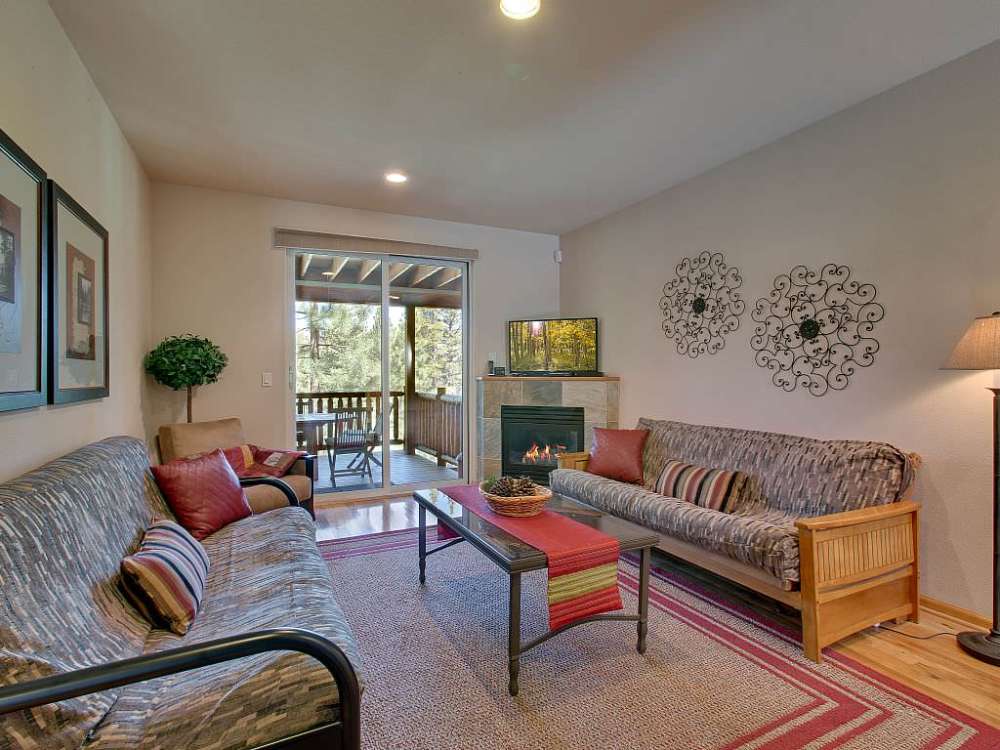
Image source: Urban Futons – Dr. Futonberg

Budget is the single biggest factor for most apartment renters. RubyHome’s 2025 data shows that 93% of renters say budget is their top priority when making housing decisions. Decorating falls under that same mindset.

The good news: you don’t need thousands of dollars to make a rental feel like home.

Where to Spend vs. Where to Save

Spend on the sofa. Save on the side table.

That’s the basic formula. The pieces you use every day (seating, mattress, lighting) should get the bulk of your budget. The things you look at but rarely touch (wall art, decorative objects, throw pillows) can come from budget sources without anyone noticing.

Here’s a rough breakdown of how apartment budgets typically shake out:

Budget Tier What It Covers Best Sources
Under $500 One room refresh (rug, art, textiles) Dollar Tree, HomeGoods, Amazon
$500 – $1,000 Living room or bedroom overhaul IKEA, Target Threshold, H&M Home
$1,000 – $2,500 Full apartment furnishing basics Wayfair, Facebook Marketplace, Article

Millennials tend to spend more. Opendoor’s report showed they invest about 23% more on home decor than Baby Boomers, averaging around $1,771 per year. But they also shop smarter, with 47% buying furniture online after weeks of comparison research.

Best Stores for Affordable Apartment Furniture


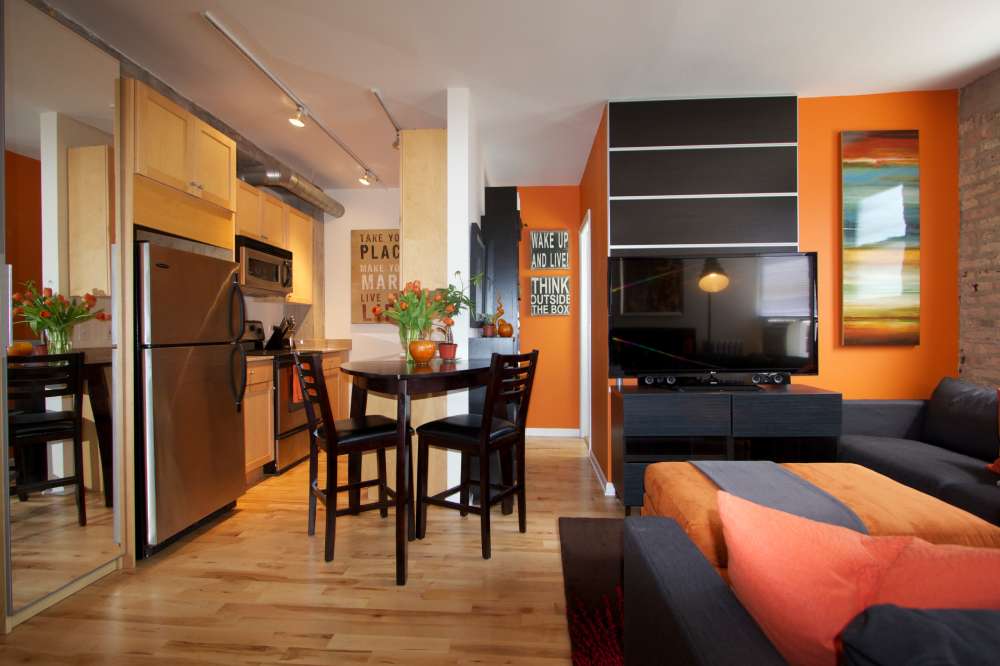
Image source: moment design + productions, llc

IKEA remains the default starting point for most apartment dwellers. The KALLAX shelf unit does double duty as a room divider and storage. The MALM bed frame has built-in drawers that eliminate the need for a separate dresser.

Facebook Marketplace is where the real deals happen. People moving out of apartments dump nearly-new furniture for a fraction of retail. I’ve seen Article sofas listed for $300 that originally cost $1,400.

Target’s Threshold line punches above its price point for decorative items. HomeGoods is a gold mine for vases, frames, and candle holders, though inventory is unpredictable. For area rugs, Ruggable has become popular with renters because their rugs are machine-washable.

The 2025 Houzz study found that rugs topped the list of decor purchases at 49%, followed by pillows and throws at 45%, and artwork at 41%. Those three categories are where affordable apartment decor makes the biggest visual impact.

DIY Apartment Decor Projects That Look High-End

The 2023 American Housing Survey reported that homeowners completed over 50 million DIY projects. Renters are doing them too, just with more restrictions.

Projects that work well in apartments:

  • Floating shelves with removable brackets (no stud required if you use heavy-duty anchors)
  • Painted thrift store frames grouped as a gallery wall
  • Contact paper applied to countertops or cabinet fronts
  • Washi tape accent borders around door frames or windows

The key with DIY in a rental is making sure everything reverses. If you can’t undo it on move-out day, it’s probably not worth doing.

Small Apartment Decorating Ideas That Actually Work


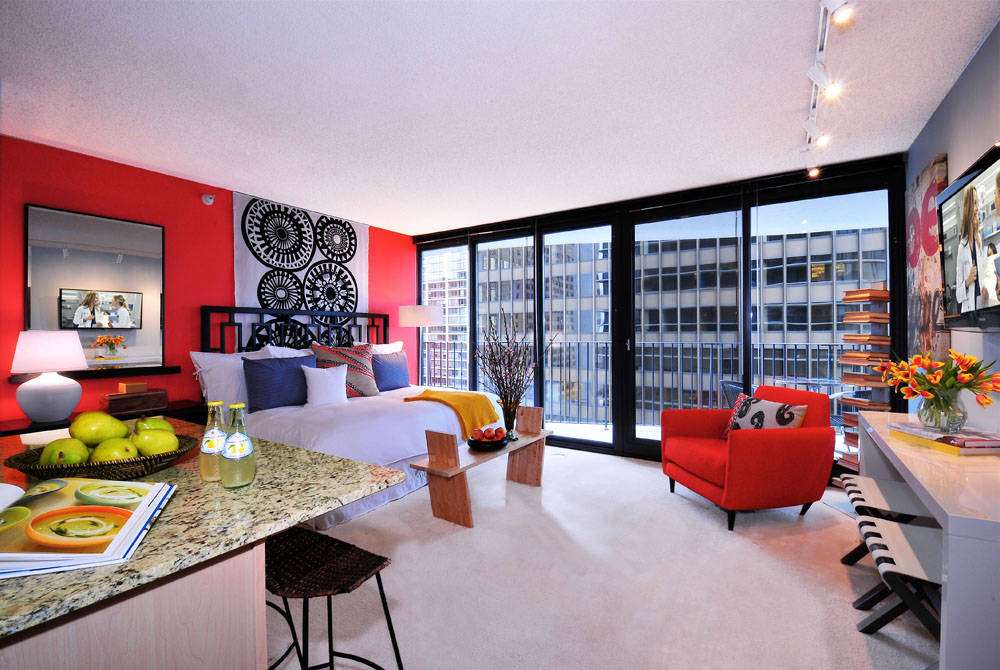
Image source: Sara Bengur Interiors

Small apartments are the norm, not the exception. Studios average 457 square feet. One-bedrooms sit at 735 square feet. And in cities like Seattle, new apartments average just 649 square feet across all unit types, according to RentCafe.

So the question isn’t whether your apartment is small. It’s how you deal with it.

Studio Apartment Layout Strategies

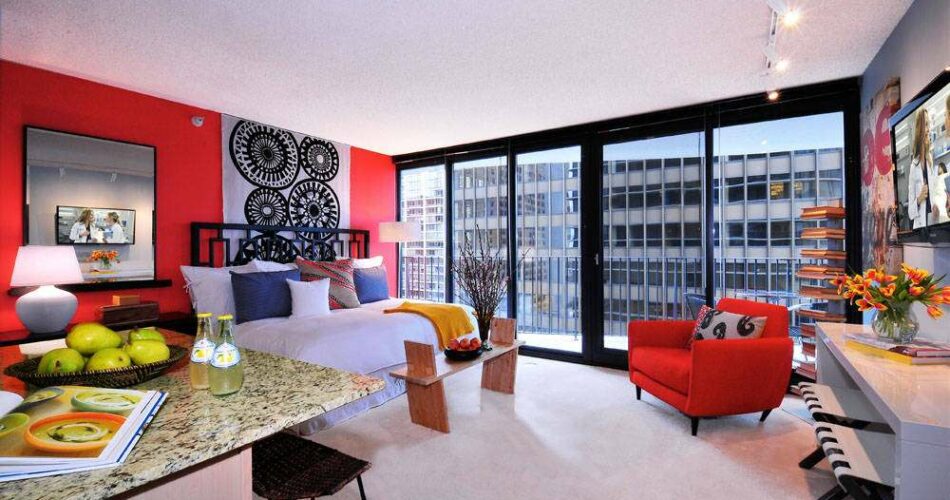
A studio is one room pretending to be four. Your bed, living room, dining area, and sometimes your office all share the same space. Space planning is everything here.

Zone with furniture, not walls. A bookshelf placed perpendicular to the wall creates a visual divider between sleeping and living areas. A rug defines the “living room” zone. A small desk pushed against a wall carves out an office corner.

Avoid pushing all furniture against the walls. I know it feels like it opens up floor space, but it usually makes the center of the room feel empty and the edges feel cluttered. Pulling the sofa even six inches from the wall gives a more intentional feel.

The multifunctional furniture market was valued at $15.9 billion in 2024, per GM Insights, and it’s growing at nearly 5% annually. That growth is driven almost entirely by apartment and studio living. Sofa beds, storage ottomans, and lift-top coffee tables exist because people in 450-square-foot studios need them.

Furniture Sizing for Compact Rooms

This is where most people get it wrong.

A full-size sectional in a 10-by-12 living room doesn’t just look awkward. It blocks traffic, makes the room feel smaller, and usually ends up getting sold on Marketplace six months later. Understanding proper scale and proportion saves money and frustration.

Apartment-size sofas are a real category. Burrow, Article, and IKEA all make sofas under 72 inches wide that still seat two adults comfortably. Loveseat-size is often the better call for studios.

Round dining tables work better than rectangular ones in tight spaces. They seat the same number of people but take up less visual real estate. A 36-inch round table fits in most apartment dining areas without crowding.

Vertical storage beats horizontal storage every time. Tall, narrow bookshelves hold more than short, wide ones and take up less floor space. Wall-mounted shelves eliminate the footprint entirely. The goal is to use wall height, not floor area.

Living Room Decorating Ideas for Apartments

The living room gets the most foot traffic and the most eyeballs. If you’re decorating one room first, this is the one. For more comprehensive inspiration, check out these living room design ideas.

Sofa Selection for Apartment Living Rooms


Image source: Robeson Design

The sofa is the anchor piece. Everything else in the room relates to it.

A 2024 consumer survey by Home News Now found that 36% of furniture shoppers planned to buy a sofa or sectional, making it the number one planned furniture purchase across all age groups and income levels.

For apartments, look at these factors before style:

  • Width: Measure your doorways first. Many apartment doors are 28 to 30 inches wide. A sofa with removable legs and detachable arms gets through easier.
  • Depth: Anything over 36 inches deep eats into a small living room fast.
  • Leg height: Sofas with visible legs make a room feel more open than skirted styles that sit directly on the floor.

IKEA’s FRIHETEN sleeper sofa works for studio apartments where the couch doubles as a guest bed. For something nicer, Burrow’s Nomad sofa ships in modular pieces, which means it fits through tight hallways and stairwells.

Gallery Walls Without Drilling


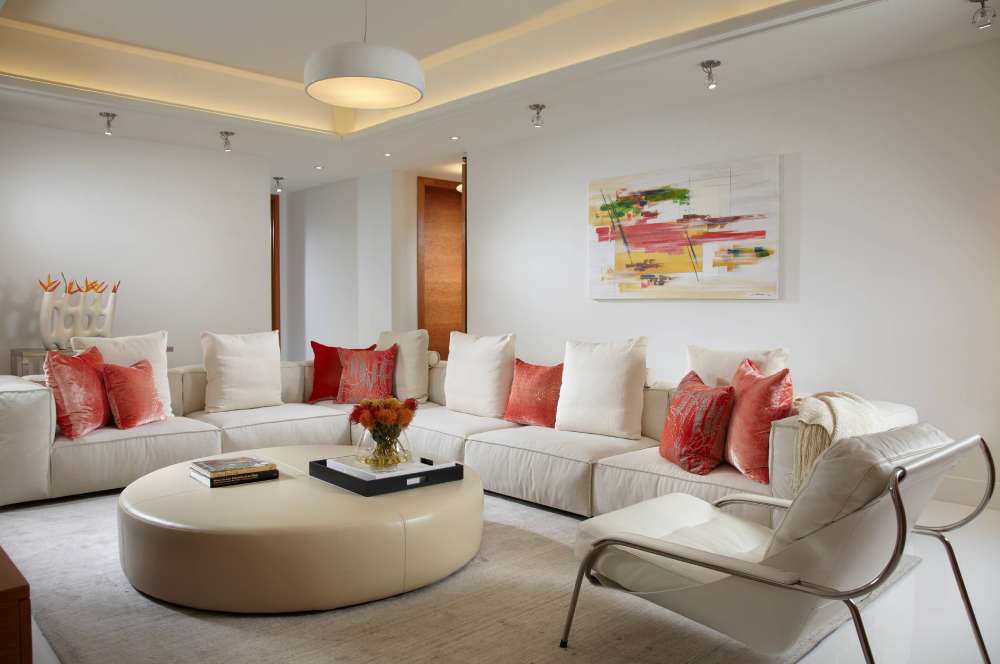
Image source: J Design Group – Interior Designers Miami – Modern

Command strips changed apartment decorating. But they have limits. The large strips hold up to about 16 pounds per pair. That’s enough for most framed prints but not for a heavy mirror.

Picture ledges are the smarter play. Mount one ledge (even with Command strips), and you can swap art in and out without putting new holes in the wall. IKEA’s MOSSLANDA ledge is under $15 and holds several frames.

When arranging a gallery wall, establish a clear focal point first. Pick one larger piece for the center, then build outward with smaller frames. Lay everything out on the floor before you commit to anything on the wall.

Leaning art against the wall on a console table or shelf is another option that involves zero wall damage. It looks casual and intentional at the same time.

Lighting When You Can’t Install Fixtures

Most apartments come with one overhead light per room. It’s usually a flush-mount dome or a bare socket. Neither does the room any favors.

Ambient lighting is the base layer. A floor lamp in the corner of the living room handles this without any wiring. Arc lamps work well behind sofas, casting light downward into the seating area.

Plug-in wall sconces are the renter’s best kept secret. Brands like Novogratz and CB2 make sconces that mount with two screws and plug into a standard outlet. The cord runs down to the baseboard. It’s not invisible, but it beats that overhead dome by a mile.

For task lighting, a desk lamp or reading lamp near the sofa adds a second layer. LED strip lights under shelves or behind a TV create a soft glow that makes the room feel warmer at night. Accent lighting like this costs almost nothing and transforms the mood of a room after dark.

Apartment Bedroom Decorating Ideas


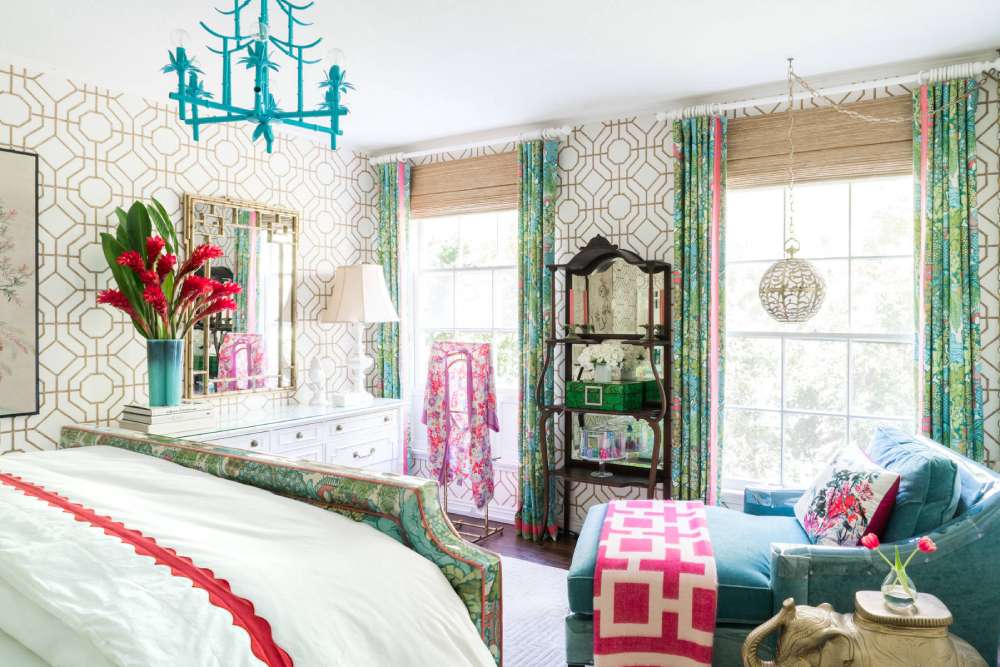
Image source: Mary Cook

The bedroom in an apartment almost always does double duty. It’s where you sleep, sure. But it’s also where the closet is too small, the desk doesn’t fit anywhere else, and the laundry basket lives permanently. For a deeper look, explore these bedroom decorating ideas.

Bed Frames With Built-In Storage

Storage beds are not optional in a small apartment. They’re a requirement.

The multifunctional furniture segment for beds is one of the fastest-growing categories in furniture right now. IKEA’s MALM frame with four drawers underneath has been the budget standard for years. Thuma’s The Bed offers a cleaner look with a Japanese-inspired platform design. Both eliminate the need for a separate dresser, which is one fewer piece of furniture on the floor.

A rug under your queen bed should extend at least 18 inches on each side. In a small bedroom, this grounds the bed visually and makes the room feel more intentional. An 8×10 rug works for most queen setups.

Bedding as the Focal Point

When you can’t paint the walls, the bed becomes the center of the room. Throw pillows on the bed do a surprising amount of work here. Three to five pillows in coordinating (not matching) fabrics add depth without clutter.

Understanding how color works in design helps here more than anywhere else. A white duvet with sage green pillows and a textured cream throw reads as calm and cohesive. A busy patterned comforter with clashing pillow colors reads as messy, even when the bed is made.

Look, sage green pairs well with warm neutrals like beige and cream. Navy blue works with white, gold, and blush. Pick two or three colors maximum and stick with them across bedding, curtains, and any wall art.

Closet Organization as Decor Strategy

Apartment closets are almost always too small. But a well-organized closet actually functions as part of the room’s design when the doors are open (and in studios, there might not even be doors).

Matching hangers are the cheapest upgrade with the biggest visual payoff. Slim velvet hangers save about 30% more space than plastic ones and make everything look uniform.

Shelf dividers, stackable bins, and over-the-door shoe storage keep things visible and accessible. The goal isn’t to hide everything. It’s to make the inside of the closet look intentional enough that it doesn’t wreck the vibe when it’s open.

Apartment Kitchen Decor Without a Renovation


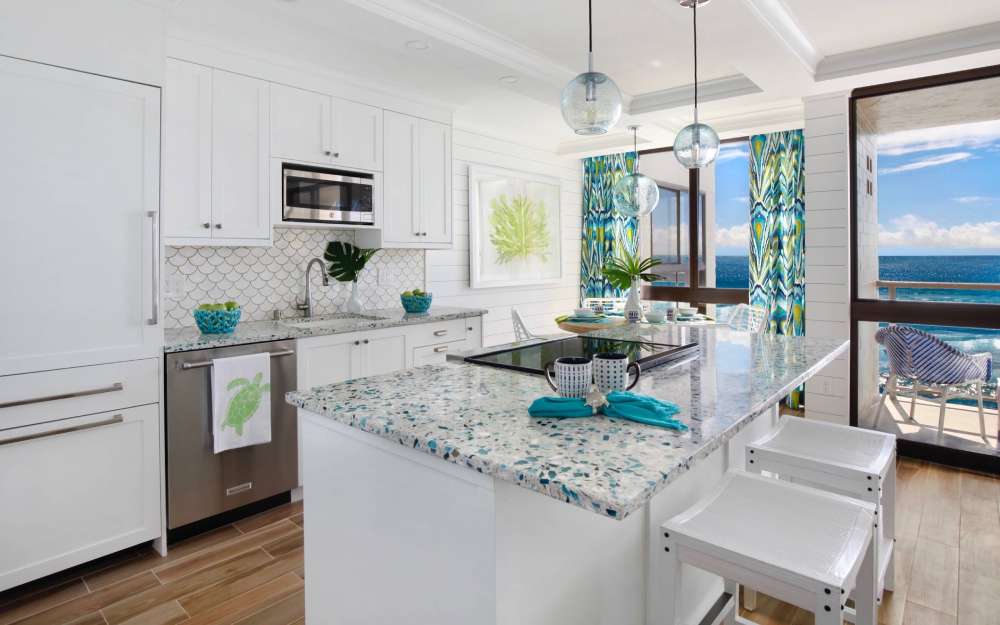
Image source: Kala Interior Design

The kitchen is typically the room renters feel most stuck with. You can’t rip out cabinets. You can’t replace countertops. And you’re probably dealing with white appliances from 2009. For broad kitchen inspiration, see these kitchen decorating ideas.

But you can change a lot more than you think, and all of it can be undone before move-out.

Peel-and-Stick Backsplash Tiles

Art3d and Tic Tac Tiles dominate the renter-friendly backsplash market. These are adhesive tiles that look surprisingly close to real ceramic or subway tile when installed properly.

A few things to know before you buy:

  • Measure your backsplash area and add 10% for cuts and mistakes
  • Clean the wall with rubbing alcohol first, as grease kills adhesion
  • Keep tiles at least 3 inches from the stove to avoid heat damage

Peel-and-stick tiles typically cost between $5 and $15 per square foot, depending on the brand and style. A standard kitchen backsplash runs about 15 to 20 square feet, so you’re looking at $75 to $300 total. Compare that to a real tile installation, which can easily exceed $1,000.

Contact Paper and Cabinet Hardware Swaps

Contact paper on countertops is divisive. Some people love the marble-look film. Others think it looks obviously fake. The trick is choosing a matte finish rather than a glossy one. Glossy screams “this is contact paper.” Matte, at least from across the room, passes.

Cabinet hardware is the real game changer. Most apartment cabinets come with cheap brass or white plastic knobs. Swapping them for matte black or brushed nickel pulls takes 10 minutes and costs about $30 to $50 for a standard kitchen. Just keep the original hardware in a bag so you can switch it back before moving out.

For kitchens with white cabinets, understanding which color schemes work best can help you pick the right accents. A few well-chosen items, like a dark cutting board, a brass soap dispenser, and a green plant, can shift the look completely.

Open Shelving and Wall-Mounted Storage

If your kitchen has a dead wall above the counter, open shelving is a quick fix. Removable brackets from Command or similar brands hold lightweight shelves for mugs, spices, and small plants.

Magnetic spice racks attach to the side of the refrigerator. Pegboards can be leaned against the backsplash rather than mounted. And a simple tension rod inside a cabinet creates a second hanging layer for towels or spray bottles.

The Houzz 2025 study found that 24% of homeowners renovated their kitchens in 2024, tying with bathrooms for the most popular project type. But renters don’t have to renovate to get results. Small, reversible changes like these create the same sense of freshness without any permanent alterations. That’s small kitchen decor done right.

Renter-Friendly Wall Decor Ideas

“I can’t put holes in the wall” is the sentence that stops most apartment decorating before it starts. But it shouldn’t.

The renter-friendly decor market has grown significantly over the past few years. Products from 3M’s Command Brand, Tempaper, and Chasing Paper exist specifically because 45.3 million renter households in the U.S. need damage-free options. The demand is real and the products have gotten much better.

Command Strips and Their Actual Weight Limits

Small strips: up to 4 pounds per pair. Fine for lightweight frames and small canvases.

Medium strips: up to 12 pounds. Works for most standard framed prints.

Large strips: up to 16 pounds per pair. Enough for larger gallery frames but not heavy mirrors.

The catch is surface prep. These strips fail when the wall is dusty, humid, or has a textured finish. Clean the surface with rubbing alcohol, press firmly for 30 seconds, and wait an hour before hanging anything. Skip this step and your art will be on the floor at 3 AM.

Temporary Wallpaper and Accent Walls


Image source: Robeson Design

RentCafe’s 2024 trend analysis found that mid-century modern led Google search volumes for interior design styles, followed closely by minimalism with over 20,000 monthly searches. Temporary wallpaper lets renters follow these style trends without permanent commitment.

Tempaper offers peel-and-stick wallpaper that removes cleanly from smooth, painted walls. Chasing Paper uses a poly-woven fabric material that feels more like traditional wallpaper. Both cost between $40 and $90 per roll.

You don’t have to do a full room. One accent wall behind the sofa or bed makes enough impact. Understanding how pattern works in design helps here: large-scale patterns make small rooms feel bigger, while small busy patterns can make tight spaces feel claustrophobic.

Leaning Art and Textile Hanging

Not everything needs to go on the wall.

Leaning framed prints against the wall on a shelf, console table, or even the floor creates a relaxed, gallery-like look that requires zero holes. Stack two or three frames at different sizes for depth. Apartment Therapy featured this technique in multiple budget makeovers throughout 2024.

Woven tapestries and textured wall hangings can be mounted with a single nail or even a removable adhesive hook. They add warmth and absorb sound, which matters in apartments with thin walls.

Apartment Decorating Ideas by Style

Picking a style and sticking with it is the single biggest shortcut to making an apartment look pulled-together. Mixing three or four styles in 908 square feet usually ends up looking like a yard sale.

The 2025 Houzz study found that more than three-quarters of millennials redecorated in 2024, with Gen Xers close behind at 70%. Those numbers suggest people are actively thinking about how their spaces look, not just what fills them.

Here’s how the most common apartment styles compare in practice:

Style Key Pieces Color Base Budget Level
Minimalist Low-profile sofa, simple shelving White, beige, grey Low to mid
Mid-century modern Tapered-leg furniture, statement chair Walnut, mustard, teal Mid to high
Boho Layered textiles, plants, rattan Earthy warm tones Low to mid
Scandinavian Light wood, functional pieces White, pale blue, grey Low to mid

Minimalist Apartment Decorating

Minimalist design is the most apartment-friendly style because it thrives on constraint. Less furniture. Fewer objects. A tight color palette.

The new minimalism in 2024 shifted away from stark, empty rooms. It’s now about quality over quantity: a few well-made pieces rather than a bare space that looks unfinished. Havenly designers noted that “successful minimalism is incredibly hard to achieve” because you want the room to feel calm, not incomplete.

For minimalist apartment decor, start with a neutral base, then add one or two considered details. A single piece of artwork. One plant. A textured throw on the sofa. That’s it.

Mid-Century Modern on an Apartment Budget

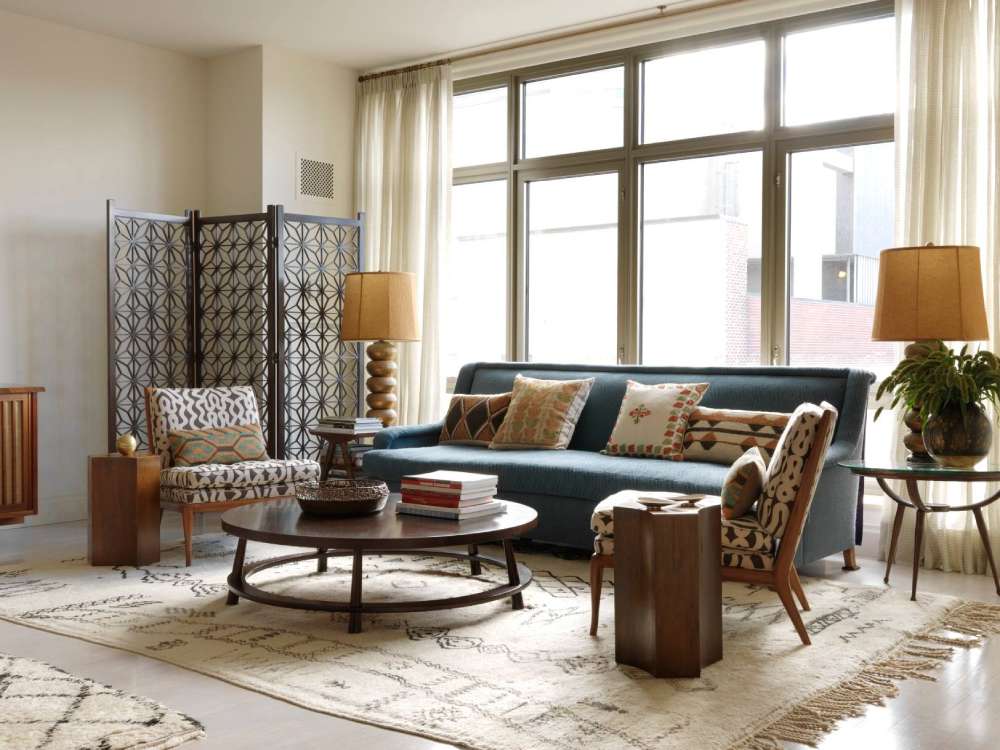
RentCafe data confirmed that mid-century modern once again led all styles in net monthly search volume throughout 2024. The style’s clean lines, organic shapes, and mixed materials translate well to apartment living.

The problem is price. Original Eames chairs sell for thousands. But West Elm, Article, and even IKEA carry affordable reproductions and inspired pieces that capture the same silhouettes. A walnut-finished credenza, a low-profile sofa with tapered legs, and a Sputnik-style light fixture establish the look for under $1,500.

Pair this with mid-century modern home decor accents like geometric throw pillow combinations and a teal accent to ground the room in the era’s palette without going full retro.

Boho Apartment Styling Basics


Image source: Adeeni Design Group

Bohemian style works well in apartments because most of the look comes from layering affordable textiles, not buying expensive furniture.

  • Throw blankets draped over the sofa and bed
  • Woven baskets used as planters and storage
  • Macrame wall hangings (one nail, maximum impact)
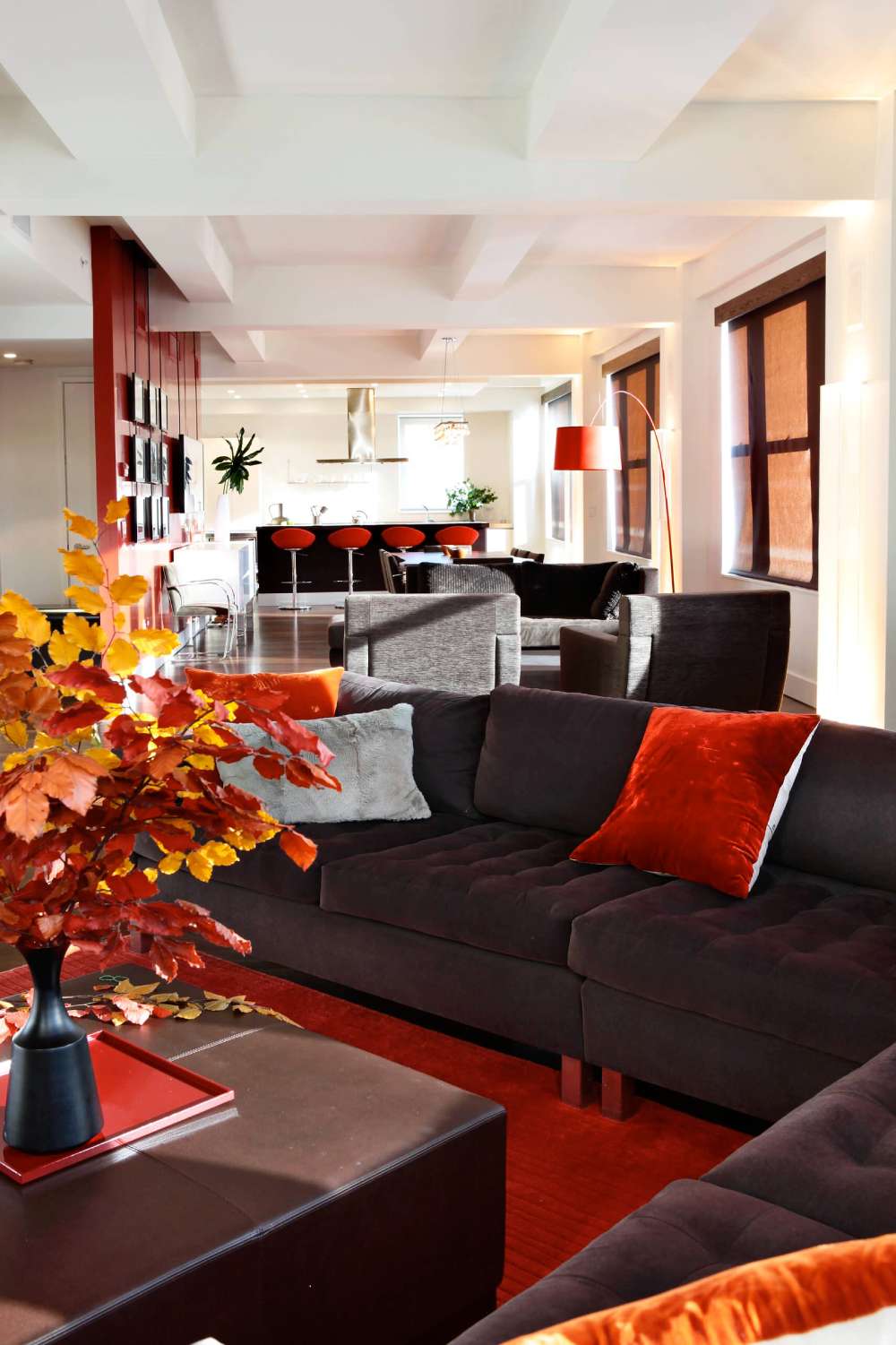
  • Mix of warm colors like burnt orange with cream and terracotta

Houseplants are central to bohemian home decor. Even a few pothos in simple pots adds the greenery this style needs. Biophilic design principles, which focus on connecting indoor spaces with nature, overlap heavily with boho aesthetics.

Apartment Decorating Mistakes to Avoid

These aren’t opinions. These are the errors that designers at Apartment Therapy, Havenly, and Houzz flag repeatedly in client consultations and editorial roundups.

Buying Furniture Before Measuring

This is the number one mistake. Full stop.

Designer Marie Cloud of Indigo Pruitt put it clearly: oversized furniture in a small living room overwhelms the space, while tiny accessories get lost in a larger area. The fix is obvious but constantly ignored: measure first, shop second.

Key dimensions to check before buying anything:

  • Doorway width (most apartment doors are 28 to 30 inches)
  • Hallway and stairwell turning radius
  • Distance between walls where furniture will go

Relying on a Single Overhead Light

One flush-mount dome light in the center of the ceiling. That’s what most apartments give you. And that’s what most renters live with, even though it makes every room look flat and uninviting.

Light in design should come from at least three sources: a general fill (floor lamp or overhead), a focused task source (desk or reading lamp), and an accent layer (LED strips, candles, or a pendant fixture). This layering creates warmth and depth for almost no money.

Pushing All Furniture Against the Walls

Designer Gabrielle Reinhardt calls this the “doctor’s waiting room” effect, where the sofa sits against one wall, chairs against another, and the coffee table floats unreachable in the middle.

Pulling the sofa even six inches off the wall and angling chairs toward each other creates a conversation zone. It feels counterintuitive in a small apartment, but it actually makes rooms look bigger than they are.

Choosing Style Over Function

B2C Furniture’s social media analysis found that young adults frequently buy trendy pieces that look great online but don’t hold up to daily use. Chipboard furniture, for instance, has “a very short lifespan” and can’t even be reassembled after a move because the joints pull apart.

Invest in solid construction for items you sit on, sleep on, or use daily. Save the trendy stuff for accents like decorative sofa pillows, vases, or window treatments that cost less to replace when tastes change.

First Apartment Decorating Checklist

Moving into your first apartment is exciting and overwhelming in equal measure. The instinct is to buy everything at once. Don’t.

A 2024 Numerator survey found that Gen Z conducted the highest number of home projects per person, averaging 10 per homeowner. But they also spent the least overall ($9,592 vs. Boomers’ $14,140), suggesting they’re tackling lots of small projects rather than one big overhaul. That’s the right approach for a first apartment.

Priority Order for Furnishing

Month one: Bed frame and mattress, basic bedding, one set of towels, a lamp. These are the non-negotiables.

Month two: Sofa or loveseat, a small dining table or desk (pick whichever you’ll use more), and a rug for the living area.

Month three onward: Side tables, shelving, wall art, curtains, and decorative accents. This is where personal style starts to show up.

The reason for spacing it out isn’t just budget. Living in the space for a few weeks before committing to furniture tells you what you actually need versus what you thought you needed.

What to Buy New vs. Secondhand

Buy New Buy Secondhand
Mattress (hygiene, warranty) Dining table and chairs
Bedding and towels Bookshelves, side tables
Sofa (if budget allows) Frames, mirrors, decorative objects
Shower curtain, bath mat Lamps, planters, baskets

Facebook Marketplace, estate sales, and thrift stores are where secondhand apartment furniture moves fast. Etsy and Society6 work well for affordable art prints if you want something more curated than what HomeGoods carries.

Room-by-Room Measurements to Take First

Before you buy a single thing, grab a tape measure and record these numbers:

Every room: Length and width of the floor, ceiling height, window dimensions (including distance from floor to sill).

Kitchen: Counter depth, distance between counter and upper cabinets, refrigerator alcove dimensions.

Entryways: Width of every doorway, hallway width, and any tight corners between the front door and each room. This last one saves you from ordering a sofa that physically can’t get inside.

Write all of this down and keep it in your phone. You’ll reference it dozens of times while shopping, and it prevents the most common (and most expensive) first-apartment mistake: buying things that don’t fit.

FAQ on Apartment Decorating Ideas

How do I decorate my apartment on a tight budget?

Start with thrift stores, Facebook Marketplace, and stores like IKEA and Target’s Threshold line. Spend more on pieces you use daily (sofa, mattress) and save on decorative items like frames, vases, and throw pillows from HomeGoods or H&M Home.

What is the best furniture for a small apartment?

Multifunctional furniture is the answer. Storage beds, sleeper sofas, lift-top coffee tables, and nesting side tables save floor space. Look for apartment-size sofas under 72 inches from brands like Burrow or Article.

How can I decorate my apartment without damaging the walls?

Use Command strips, temporary wallpaper from Tempaper or Chasing Paper, and leaning art on shelves. Peel-and-stick backsplash tiles work in kitchens. Velcro mounting and removable adhesive hooks handle lightweight frames and textiles without leaving marks.

What color scheme works best in a small apartment?

Light neutrals like white, beige, and soft grey make rooms feel larger. Pick two or three colors that pair well with beige or similar warm tones, then add depth through textiles rather than wall paint.

How do I make a studio apartment feel like separate rooms?

Zone the space with furniture placement, area rugs, and shelving used as dividers. A bookshelf placed perpendicular to the wall creates a visual barrier between sleeping and living areas without blocking light or airflow.

What should I buy first for my first apartment?

A bed and mattress come first. Then basic bedding, a lamp, and towels. Add a sofa and area rug in month two. Wall art, curtains, and decorative accents can wait until month three.

How do I add personality to a rental apartment?

Layer textiles like throw blankets and pillows in coordinating colors. Add houseplants, swap out cabinet hardware in the kitchen, and create a gallery wall using removable hanging solutions. Small vintage decor finds add character fast.

What lighting works best when I can’t install fixtures?

Floor lamps handle ambient light. Plug-in wall sconces from CB2 or similar brands add a second layer. LED strip lights behind shelves or TVs create accent glow. Three sources minimum per room makes all the difference.

How do I choose the right rug size for my apartment?

The front legs of your main furniture should sit on the rug. For living rooms, a 5×8 or 8×10 works for most apartment layouts. Too-small rugs make rooms look disjointed. Place rugs under seating groups, not floating in the center.

What are the most common apartment decorating mistakes?

Buying furniture without measuring, relying on one overhead light, pushing everything against the walls, and picking style over durability. Measure doorways and room dimensions before shopping. Layer lighting. Pull furniture off the walls to create conversation zones.

Conclusion

Good apartment decorating ideas come down to working with what you have, not fighting against it. Fixed layouts, rental restrictions, and compact square footage aren’t obstacles. They’re the starting point.

Every section in this guide points back to the same principle: measure first, buy intentionally, and keep it reversible. Whether that means choosing a storage bed from IKEA, adding peel-and-stick backsplash tiles in the kitchen, or layering plug-in sconces with floor lamps to fix bad overhead lighting.

Style matters, but function matters more in a small space. A well-placed area rug, a few colors that complement grey tones, and furniture scaled to your room will always outperform expensive pieces that don’t fit.

Start with one room. Get it right. Then move to the next.

Andreea Dima
Author

Andreea Dima is a certified interior designer and founder of AweDeco, with over 13 years of professional experience transforming residential and commercial spaces across Romania. Andreea has completed over 100 design projects since 2012. All content on AweDeco is based on her hands-on design practice and professional expertise.

Pin It