Living Room Decor
Living Room Design Ideas for a Comfortable Home
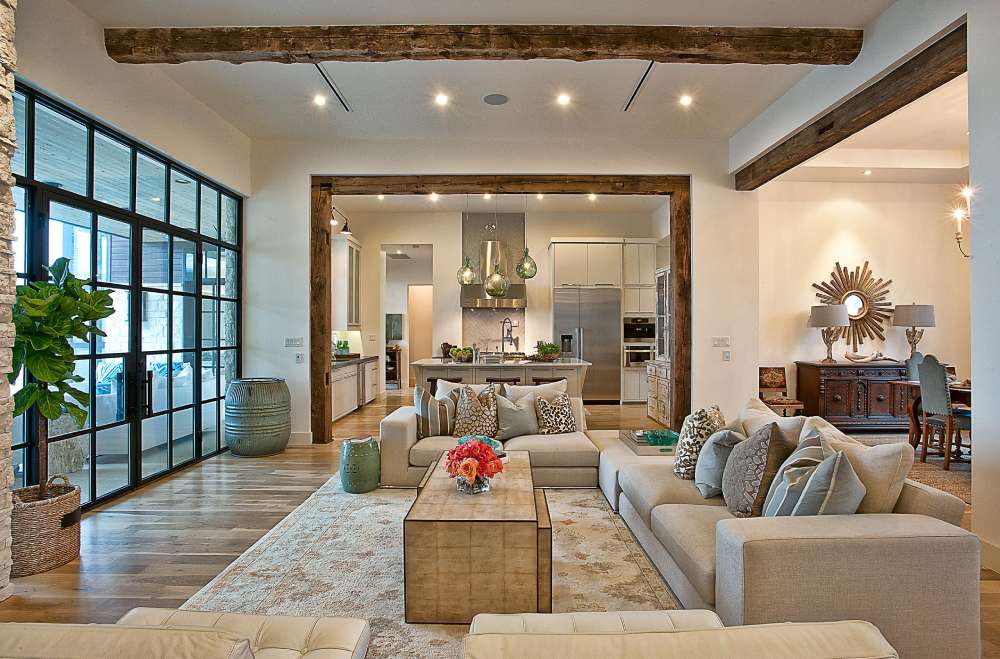
Most living room mistakes get made before anything is bought. Someone falls for a style, orders a sofa, and only then finds out it doesn’t fit the room.
A style gives you the look. Measurements and budget decide whether it holds up once the furniture is in, so layout, furniture sizing, focal point, color and lighting all need checking against the room’s dimensions and what the household can spend.
Rugs top the list of decor purchases. In the 2026 U.S. Houzz & Home Study published by Houzz, 48% of U.S. homeowners who renovated in 2025 bought one, ahead of pillows and throws (47%) and artwork (42%).
That’s money well spent, because a rug also sets the footprint of the seating group. Its size affects every piece placed on it.
Living Room Layouts by Room Shape
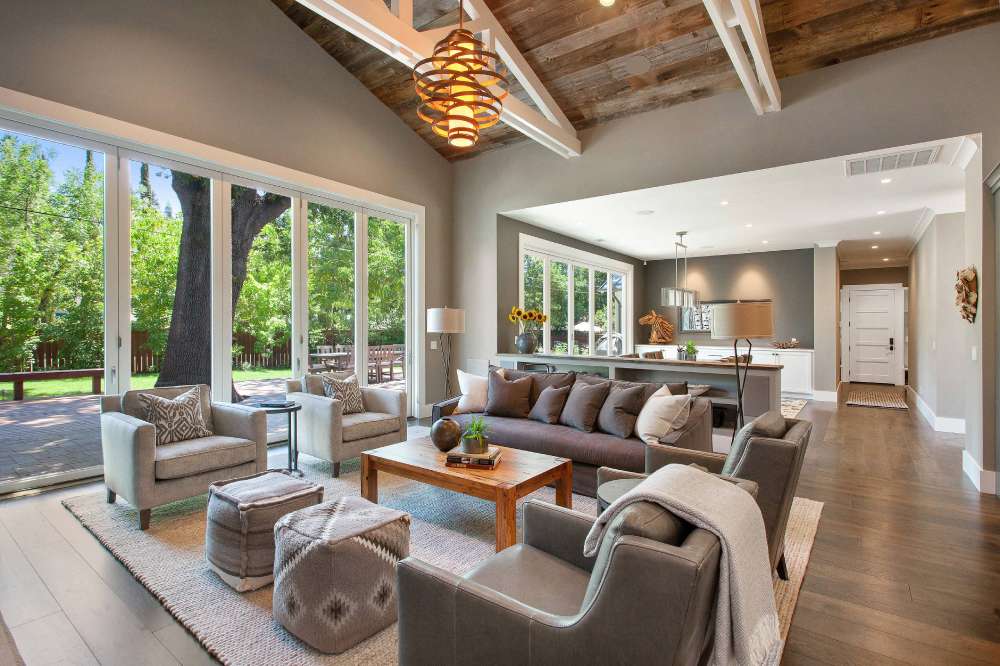
The shape of the room does most of the layout work. Open plan rooms want the seating floated, L-shaped rooms want two zones, narrow rooms want the sofa along the long wall, and square rooms want everything centered on a single focal point.
| Room shape | Seating arrangement | Traffic path | Common failure |
|---|---|---|---|
| Open plan | Sofa and chairs floated on a rug | Walkway behind the sofa | No edge, so the zone drifts |
| L-shaped | Seating in one arm, a second job in the other | Along the inner corner | Zones face away from each other |
| Narrow rectangle | Sofa on the long wall | One clear lane opposite | Sofa across the short end blocks the lane |
| Square | Group around a central rug | Loop around the group | Pieces pushed against the walls |
Plan the paths first. The same space planning logic applies to every shape: decide where people walk, then place furniture around that.
Emily Henderson’s layout guide puts walkways between large pieces at 30-36 inches. If the room can’t spare that, 18-24 inches is the minimum.
Open plan and L-shaped rooms
In an open plan room, anchor the seating with a rug and let the back of the sofa mark where the zone ends.
L-shaped rooms work better when each arm has one job. Seating in one, a reading corner or desk in the other.
Broken plan layouts, a 2026 trend named by Dowsing and Reynolds, carve an open space into smaller, purposeful areas. Rugs, shelving and lamps do the dividing, and there are plenty of ways to divide a large living room without building a wall.
Narrow and square rooms
Narrow rooms punish the wrong table shape.
A rectangular coffee table amplifies the narrowness, while a round one softens it, according to UNFNSHED’s sizing guide. If the sofa runs the full length of the room, a rectangle still fits better.
Square rooms go wrong differently. Victoria Foster of ScS, quoted in Ideal Home, says sofas, armchairs and the coffee table should sit fairly close together to support conversation, so pull pieces off the walls.
Testing a layout before buying
Painter’s tape on the floor shows a sofa’s real footprint before anyone pays for it (Emily Henderson, UNFNSHED).
- Measure the room and every piece you plan to keep or buy.
- Tape each footprint on the floor, including the coffee table and rug.
- Walk the doorways and window paths for a day.
- Move the tape until the 30-36 inch lanes stay clear.
D planners such as Roomstyler and SketchUp do the same job on screen once furniture dimensions are entered.
How Big Should the Sofa, Coffee Table and Rug Be?
Leave 16-18 inches between the sofa and coffee table, and let the rug stick out 6-8 inches past the sofa on each side. The table itself should run about two-thirds of the sofa length.
Every guide below overlaps at that 16-18 inch gap.
- Wayfair puts the sofa to coffee table gap at 12-18 inches, Living Spaces at 14-18 inches, and Emily Henderson at 16-18 inches.
- Wayfair sizes the coffee table at two-thirds of the sofa length. UNFNSHED turns that into numbers, so a 90-inch sofa takes a 54-66 inch table.
- Table height should sit level with the sofa seat cushions, or 1-2 inches lower (Wayfair).
- Emily Henderson wants the rug 6-8 inches wider than the sofa on both sides, which usually means an 8×10 or 9×12.
- She also leaves about 24 inches between rug and wall in a large room, and 10-18 inches in a small one.
Where the guides disagree
On table length, Wayfair and UNFNSHED say two-thirds of the sofa, while Emily Henderson says at least half. The sofa gap splits the same way, with Wayfair starting at 12 inches and Emily Henderson at 16.
The rules describe a floor and a target, not opposite answers. Both come down to scale and proportion, so a tight room starts at half the sofa length and stops at two-thirds.
Deep seats are the exception. Casa Padrino puts sofas with a seat depth of 60 centimetres or more at a slightly greater distance from the table.
Rug size and placement
The rug should run at least 12 inches past every side of the coffee table, because a rug the same size as the table looks cut off (UNFNSHED).
The usual mistake is a 5×8 rug that sits under the coffee table but not under the seating. Emily Henderson caps the gap between sofa and rug at 5 inches.
A rug size calculator turns the sofa width and room dimensions into a target size before anything is ordered.
What Makes a Good Focal Point in a Living Room?
Pick one feature for the eye to reach first, then face every seat toward it or angle the seats in. Fireplaces, media walls, windows and art walls all work, as long as only one of them wins.
Designers treat the focal point as the anchor the rest of the room is arranged around.
Fireplace
The sofa sits opposite the hearth, with two chairs angled in to close the group. Guides on arranging furniture around a fireplace follow the same pattern.
Built-in shelves on both sides frame the hearth nicely. A TV above the mantel usually ends up higher than seated eye level, so mount a screen where its center lands at eye level when seated.
TV and media wall
Two approaches give very different TV sizes for the same room.
Decorating rules of thumb divide the seat-to-wall distance by 2 or 3, so 120 inches gives a 40-60 inch TV.
SMPTE’s 30-degree minimum and THX’s 40-degree angle put the same 120 inches at roughly 75-100 inches, a viewing distance of 1.2 to 1.6 times the screen diagonal (Sound & Vision).
The decorating rule is about how a screen looks on the wall. The standards are about how much of your view the picture fills. Rooms used mainly for conversation stay near the smaller figure, and rooms built around movies move toward the standard.
Window view, art wall and accent chair
With a window or bay, keep the view clear and angle one seat toward it.
An art wall works with one large piece or one contrasting wall, not both. A sculptural accent chair can act as a secondary focal point, which Dowsing and Reynolds lists among 2026 trends.
A TV on one wall and a fireplace on another split the room in two. Choose one as primary and, as Livingetc advises, angle seating toward each other rather than toward the screen.
Which Living Room Style Fits Your Space?
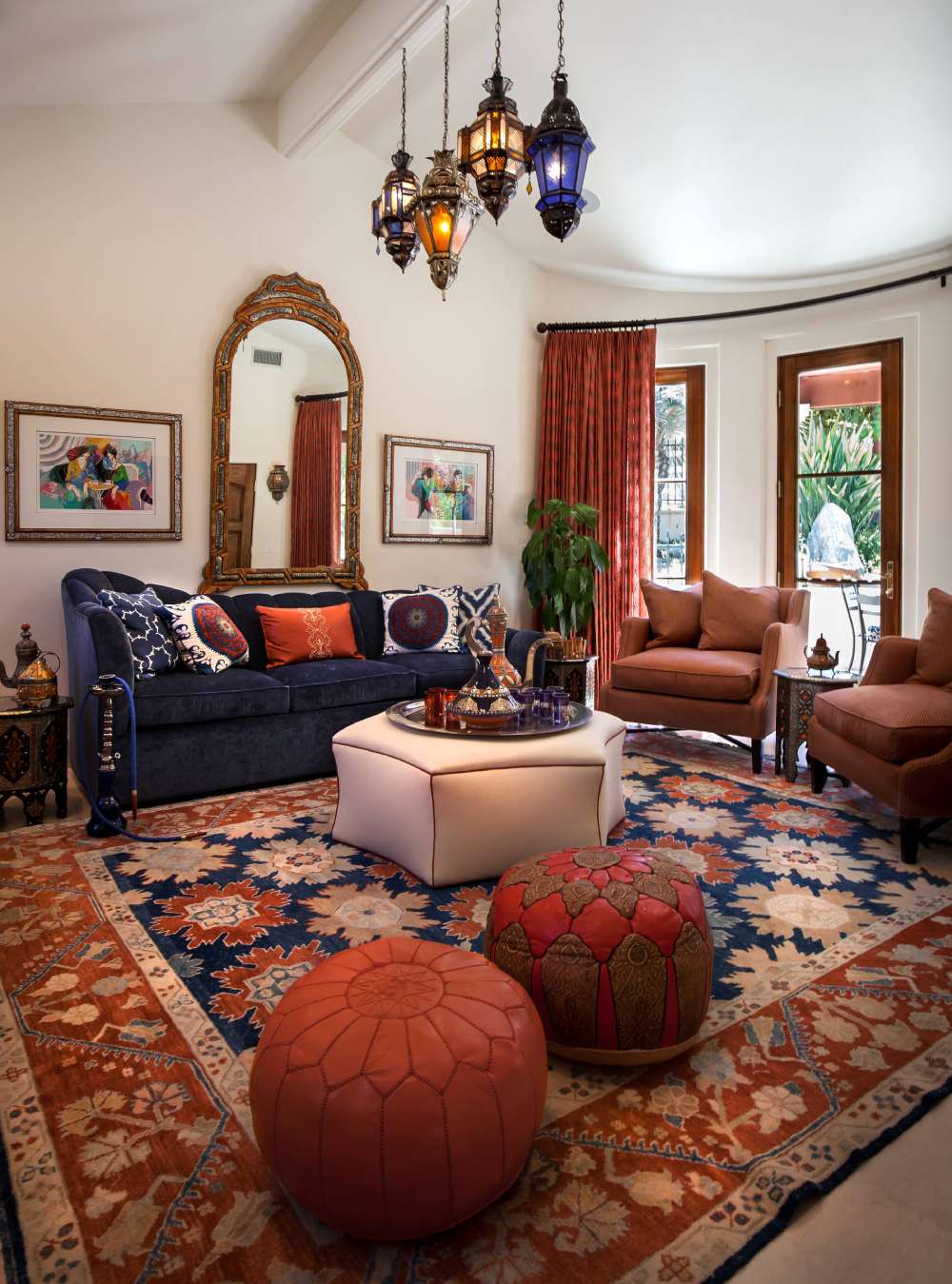
Let the room choose. Small or dim ones lean Scandinavian or Japandi. If you already own a lot of wood furniture, mid-century modern is the easier fit, and exposed brick or high ceilings point toward industrial.
Modern and Scandinavian
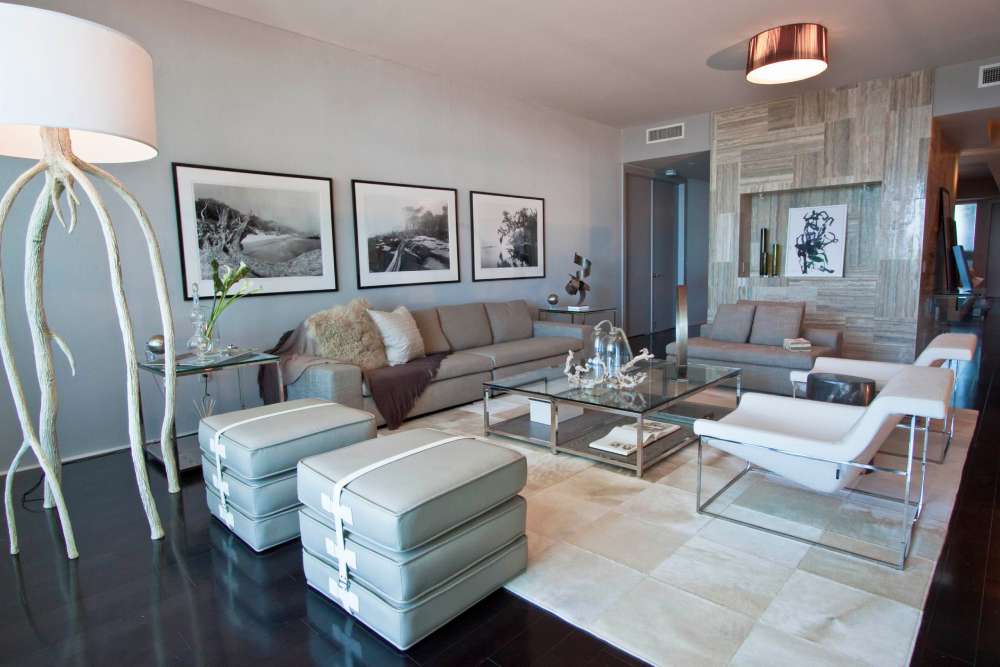
Both styles work from clean lines and little ornament. Scandinavian adds light oak or ash furniture against white or pale walls, and wool, linen and sheepskin bring in texture.
Without that texture, the look turns cold.
Mid-century modern
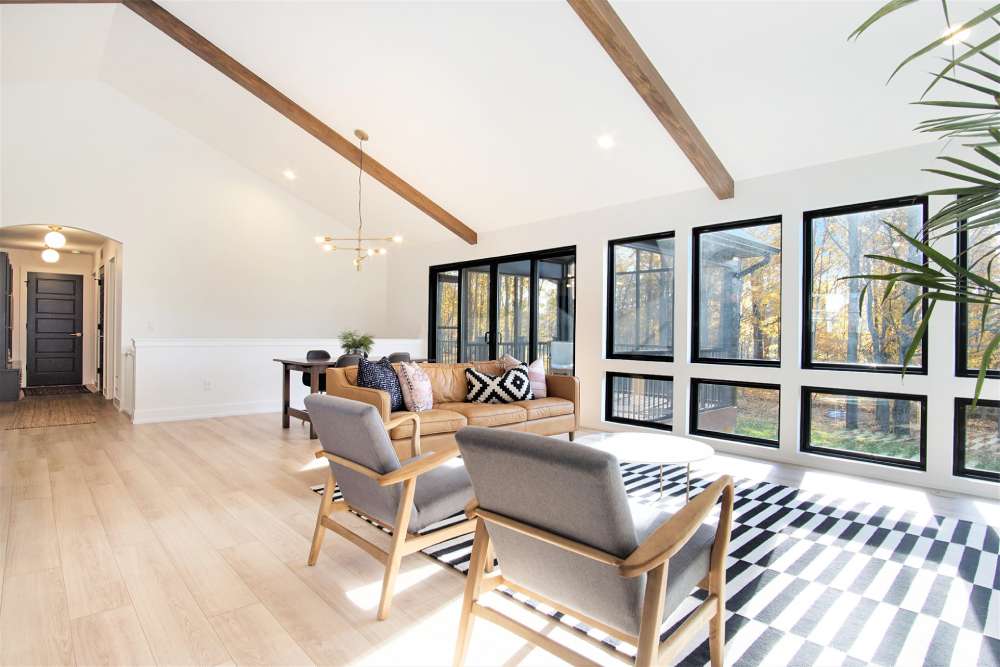
The era runs roughly 1945 to 1969. Sofas, credenzas and tables stand on slim, tapered legs, and the wood is usually walnut or teak. The palette leans on mustard, teal, olive and burnt orange, and the signature seat is the Eames lounge chair with ottoman.
The look depends on restraint. Mid-century modern interior design works when one statement piece carries the room and the upholstery stays solid.
A bulky sectional drowns the slim legs.
Japandi
Japandi takes low furniture, handcrafted natural materials and deliberately empty space from Japan. The Scandinavian half is mostly light wood and soft textiles, with shapes that stay functional.
Dowsing and Reynolds calls Japandi a firm favourite for 2026. The Japanese and Scandinavian blend suits small rooms with few objects, but a room packed with collections will fight it.
Farmhouse
Farmhouse is the most forgiving style for mixed furniture.
Shiplap, reclaimed wood and painted cabinets carry the look, and a worn table sits comfortably beside a new sofa. In a small, dark room the heavy wood reads cluttered.
Industrial
| Element | Typical choice |
|---|---|
| Walls | Exposed brick or concrete |
| Metal | Black steel shelving and frames |
| Lighting | Warm bulbs in open fixtures |
Dowsing and Reynolds notes that in 2026 industrial design is moving from stark and utilitarian toward softer, more refined rooms. Lighting does most of that softening, so warm bulbs matter more than the brick.
How to Pick Wall and Sofa Colors With the 60-30-10 Rule
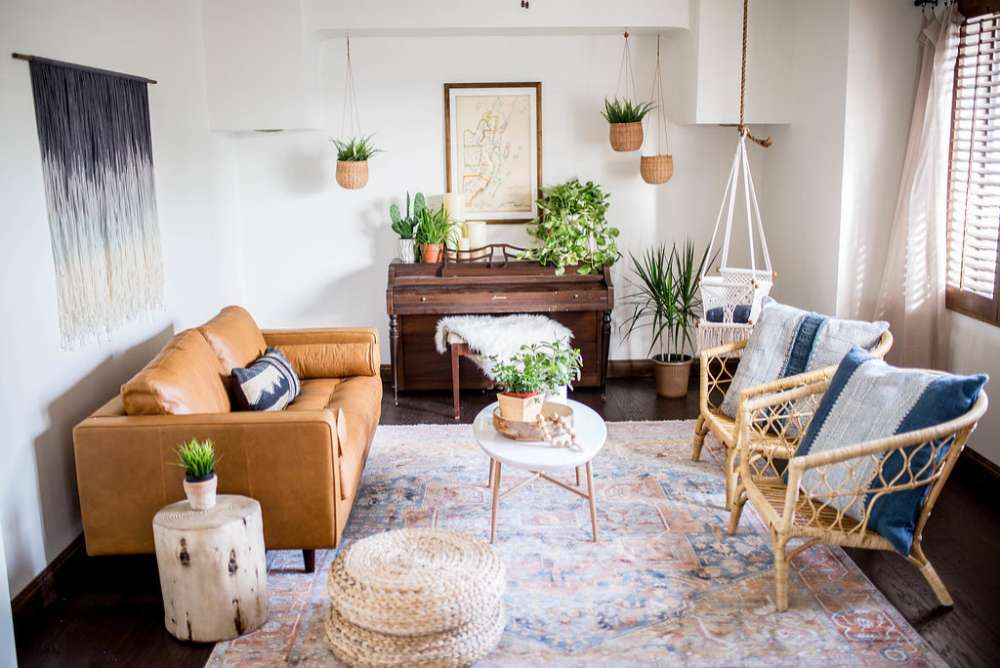
The 60-30-10 rule splits a room’s color by proportion. Walls usually take the 60, or the sofa does in a room with a bold upholstery color. The 30 goes to a second color in curtains, a rug, a feature wall or armchairs. Cushions, picture frames and vases share the last 10.
Start with the 60. Walls cover more area than anything else (Martin Waller, quoted in Ideal Home), so browse the best living room wall colors before buying sample pots.
Palettes in practice
| Palette | 60 percent | 30 percent | 10 percent |
|---|---|---|---|
| Neutral | Cream | Grey | Brown |
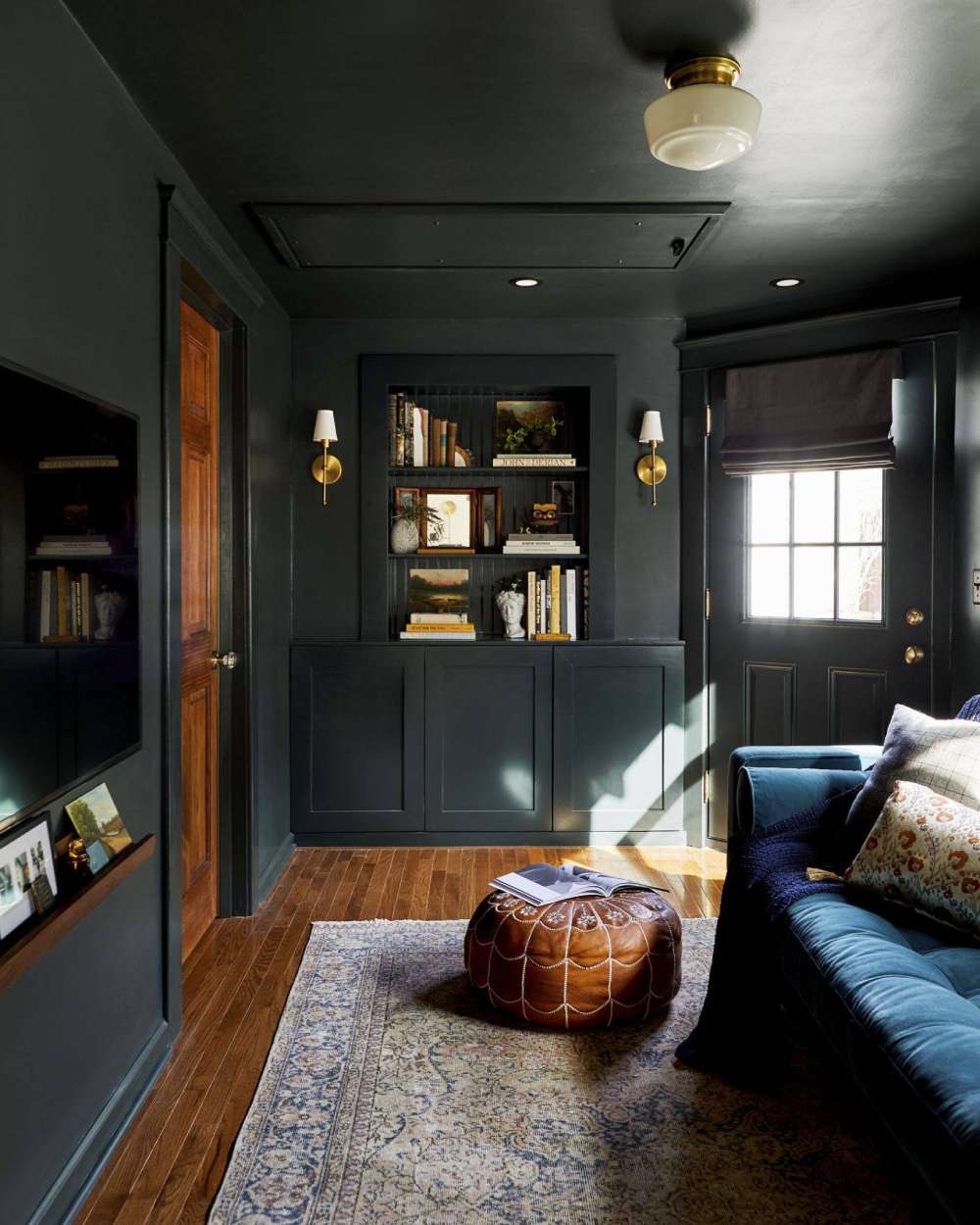
| Earthy | Dark green | Bright white | Wood and cane |
| Bold | Navy | Mid blue | Orange |
| Monochrome | White | Grey | Black |
Neutral and monochrome rooms follow the ratio by varying tone instead of hue, according to Ideal Home and Homes & Gardens.
Light Reflectance Value in dark rooms
Light Reflectance Value (LRV) rates how much light a paint reflects, from 0 for black to 100 for white. Paint makers print it on the chip.
Sherwin-Williams lists Agreeable Gray at LRV 60 and Tricorn Black at 3, so the gray returns about 60 percent of the light that hits it and the black about 3 percent.
Any color below LRV 20 absorbs more than 80 percent of the light. That is why a bold accent wall fails in a room with little natural light.
Paint runs $2 to $6 per square foot, according to Block Renovation’s 2026 cost guide.
When to bend the rule
Treat 60-30-10 as a starting ratio, not a law.
Designers quoted by Apartment Therapy and Homebuilding both call it a reference point. Homes & Gardens suggests adding one extra 10 element at a time, and a room color scheme generator shows how a second accent sits with the first before any paint is bought.
How to Layer Lighting in a Living Room
Ambient light goes in first, task lamps at seated height come second, and accent light finishes the job. All of it should be warm white and dimmable, with each layer on its own switch.
- Size the ambient layer first, with a ceiling fixture or chandelier at the lumen target for the room.
- Add task light at seated height with floor and table lamps beside each seating group.
- Add accent light on art, shelves or the fireplace.
- Give each layer its own switch or dimmer, and pick one color temperature for all of them.
Ambient lighting is the base layer, and one ceiling fixture on one switch is how most living rooms get it wrong, says Rick Kovac of Golden Lighting.
How bright should the ambient layer be?
Pooky’s lighting guide puts living rooms at 10-20 lumens per square foot, so a 100-square-foot room needs 1,000-2,000 lumens in total.
The retailer Lumens plans around 20 lumens per square foot instead. Golden Lighting adds that no ANSI/IES standard covers general ambient light in a living room.
Every figure here is a planning heuristic, not code. Buy to the top of the range and fit dimmers, because a dimmer lowers output and nothing raises it.
An LED light requirement calculator turns the floor area into a lumen target for a specific room.
Color temperature and dimmers
MOD Lighting’s help center puts living rooms at 2700K-3000K warm white.
Lighting designers quoted in Livingetc, including Bruce Weil, go lower for living spaces (2200K-2700K) and use about 3000K for task areas, with a CRI of 90 or higher.
Whatever you choose, stick to one temperature per room. Mixing 2700K and 4000K looks more obvious than either alone (MOD Lighting).
The dimmer has to match the bulbs too. Trailing-edge (ELV) dimmers suit LED fixtures, while leading-edge TRIAC dimmers, built for incandescent bulbs, cause most of the flicker and buzzing, so check the dimmer before the bulb.
Fixtures for each layer
| Layer | Typical fixtures | Placement |
|---|---|---|
| Ambient | Flush or semi-flush mount, chandelier, wide-beam recessed downlight | Ceiling |
| Task | Floor and table lamps | Beside each seating group |
| Accent | Picture lights, shelf lights, wall sconces | On art, shelves, the fireplace |
A wall sconce can do accent and task work at once (1000Bulbs).
Ways to Make a Small Living Room Feel Bigger
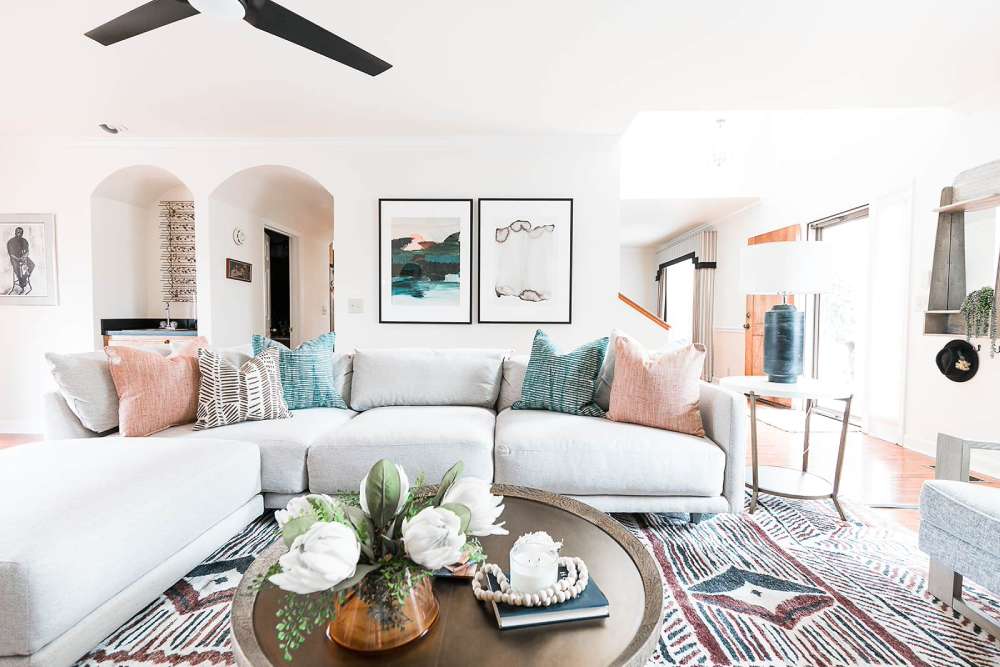
Show as much floor as you can. Then add a mirror for daylight, push storage up the wall, and pick furniture that does two jobs.
Scale, legs and wall space
Camilla Clarke of Albion Nord says a small room does not need small furniture, and she fits a large sectional. A designer quoted by Parade says oversized sectionals overwhelm a small room while dainty pieces look fussy.
The two agree on proportion. One substantial seat, then lighter pieces around it.
Interior designer John McClain says raised legs let the eye travel under furniture, which gives the illusion of more floor.
On wall space, Parade’s designers pull furniture off the walls, while Sundays’ guide lines the walls in very small rooms to free the center. Float a sofa only when a clear lane stays open behind it.
Furniture that does two jobs
| Piece | Gains | Gives up |
|---|---|---|
| Storage ottoman | Hidden storage, spare seat | A steady tabletop without a tray |
| Nesting tables | Surface area only when needed | One tidy anchor in the room |
| Sofa bed | Guest bed in the same footprint | Seat comfort, set by the mechanism |
Mirrors and light
Hang a large mirror opposite a window, or close to one, so daylight bounces around the room (Camilla Clarke, quoted in Homes & Gardens). On the long wall of a long room, a large mirror also makes the width feel bigger.
Pale walls extend the effect, since soft tones reflect more light than dark shades (William Wood Mirrors), and a guide to which colors make a room look bigger shortens the sample-pot list.
Vertical storage
Floating shelves and built-ins move storage off the floor and onto the wall. IKEA’s small-space storage ideas are a budget starting point.
Open shelves fail when they fill up and never get edited. A designer quoted by Parade says clutter dressed as decor shrinks a room instantly.
How Much Does It Cost to Redo a Living Room?
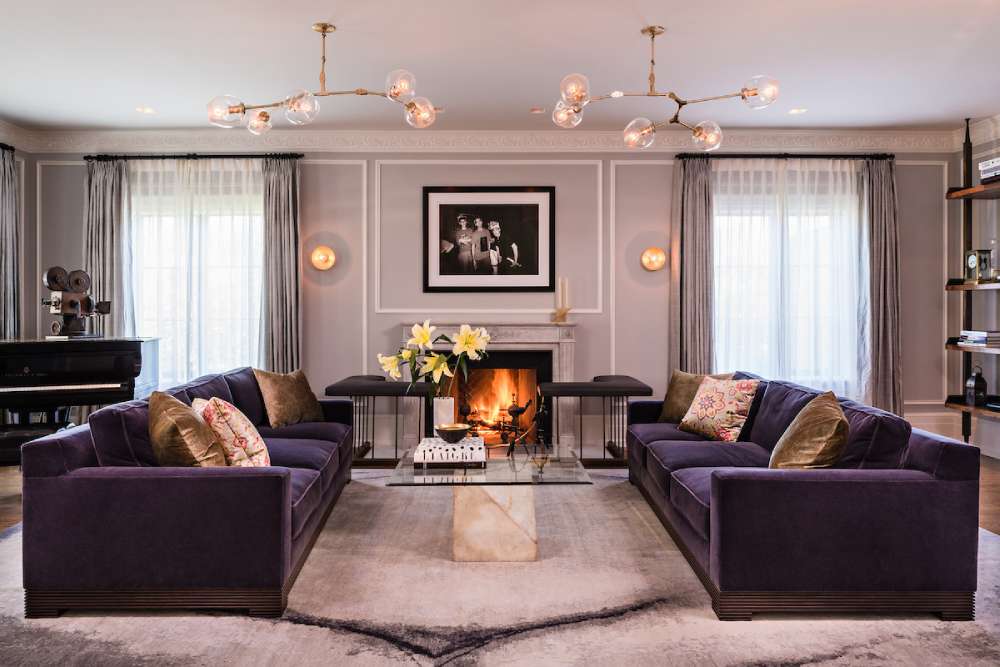
A living room remodel averages $8,000 according to Angi data reported by Chase in March 2025, and a refresh without structural work costs far less.
| Measure | What it describes | Figure | Source |
|---|---|---|---|
| Median living room spend | What homeowners reported spending on living room renovations in 2025 | $5,000, up from $4,000 in 2024 | Houzz & Home Study, 2026 edition |
| Project range | Remodel cost from small to high-end | $2,500-$15,000 | Angi data via Chase, March 2025 |
| Per square foot | Materials and labor combined | $10-$60 | Angi |
Why the figures differ
Houzz reports the median of what homeowners say they spent, while Angi reports an average project cost.
Averages rise when a few expensive remodels enter the data, which is why $8,000 sits 60 percent above $5,000. A home renovation cost calculator applies the per-square-foot band to a specific room size.
Lower-cost changes
New bulbs and lamps, a larger rug, curtains and cushions all cost little. So do plants, which add color cheaply, and these indoor plants ideas help match species to the room’s light.
If the problem is color and lighting, refresh. Spend on structure only when the layout itself fails.
When walls move
Block Renovation puts structural changes, such as opening the room to the kitchen, at $75-$150 per square foot of the affected area (2026). Angi’s average to convert a living room to open plan is $1,200-$5,000.
The two figures price different things. One scales with the opened area and its finishes, the other is a flat average. Have a contractor confirm whether the wall carries load before choosing finishes.
When Popular Living Room Ideas Stop Working
Some popular ideas fail under conditions the guides rarely mention.
A mirror opposite the window fails when the glass faces clutter, a closed door or an unshielded bulb, because it doubles the mess, reflects a dead end or throws glare (Nestasia, Lazada Decor guides). Move it to an adjacent wall, or to one that reflects open space or daylight.
All-neutral rooms read flat when every surface has the same finish. Layering texture across wood, wool and linen fixes it, and Houzz’s fall 2025 trends report lists layered textures among five emerging trends.
Inspiration photos on Pinterest or Houzz show a finished room, not its ceiling height or dimensions. Compare the photo’s furniture sizes to your own room before copying the layout.
Renters are more limited, since paint, built-ins and hardwired fixtures need landlord approval. A leaning floor mirror, plug-in wall sconces and freestanding shelving need none.
Living Room Design Ideas FAQ
How high should a gallery wall hang above a sofa?
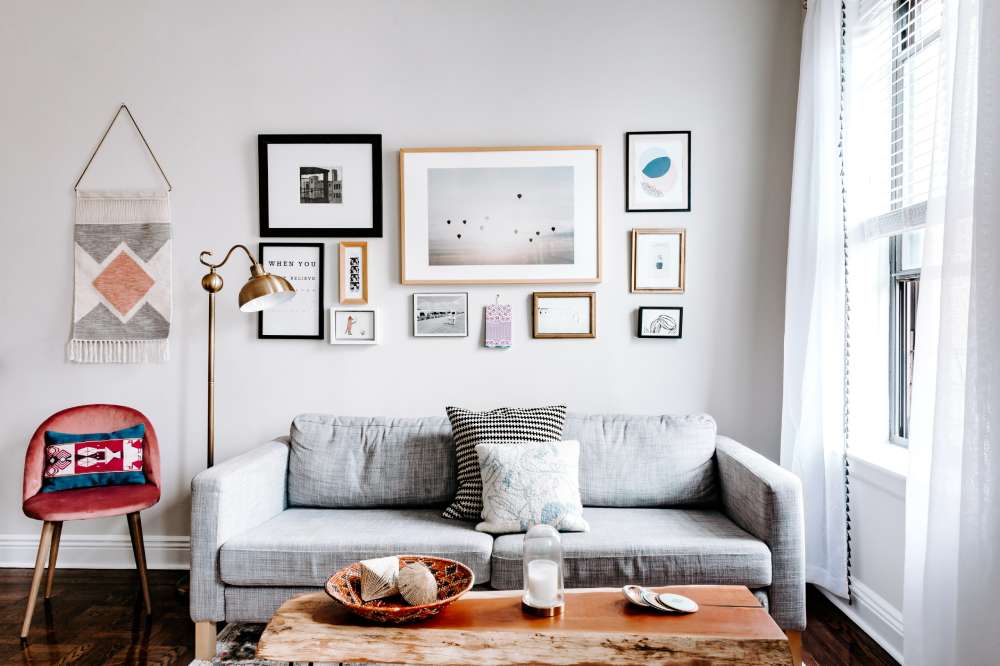
Set the bottom frame 6 to 8 inches above the sofa back, and center the whole group near 57 inches from the floor, the museum eye-level standard. Keep 2 to 3 inches between frames, per Frameology’s gallery wall guide.
How long should living room curtains be?
Floor length suits most living rooms, with the hem about half an inch above the floor (Bali Blinds). Bob Vila puts the rod at least 4 to 6 inches above the window frame and 3 to 6 inches past each side, which makes the window look larger.
Which plants suit a living room with little natural light?
Snake plants, ZZ plants and pothos tolerate low light. University of Illinois Extension says ZZ plants grow best in low, indirect light, and snake plants need the soil to dry out completely between waterings.
Can a living room and dining area share one space?
Yes, if each zone gets its own rug and light source, such as a pendant over the table and a floor lamp by the sofa (Byflou). The dining rug should extend about two feet beyond the table so chairs stay on it when pulled out (Chapin Furniture).
Which is better, a sectional or a sofa with two chairs?
It depends on how the room gets used. A sectional seats a group along one side, and a round coffee table pairs well with a corner sofa (Ideal Home).
A sofa with two chairs fits households that want seats facing each other.
Which living room trends lead in 2026?
Ideal Home’s 2026 list favors curved furniture, natural materials and warming accents such as amber glass. Dowsing and Reynolds adds natural fibers like linen, jute and rattan.
The Right Order for Living Room Changes
Living room design ideas go in from hardest to reverse to easiest. Layout and furniture sizes first, lighting second, wall color third, and decor last.
Warm white bulbs intensify warm-toned paint, according to BLT Direct, so samples belong under the final fixtures.
Houzz’s 2026 U.S. Houzz & Home Study found that 37% of renovating homeowners exceeded their planned spend in 2025, while 35% stayed on budget. Keep the buffer for the early, costly steps.
The catch is that decor, the most visible payoff, arrives last.
The sequence assumes the walls stay put. If a wall is coming down, get it assessed before anything else.

- Shoji White vs Alabaster: Which Soft White Wins? - October 25, 2026
- Color Combinations for 32 Colors and 10 Wood Tones - October 22, 2026
- Kitchen Color Schemes by Cabinet Color: What Pairs Well - October 19, 2026


