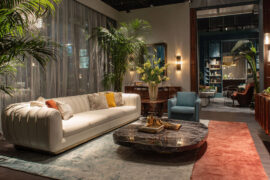
A well-designed home bar does more than hold bottles. It changes how you use your space.
Contemporary home bar design sits at the intersection of function and finish quality, where flat-front cabinetry, sintered stone countertops, and layered lighting come together in a built-in bar that actually works for how people entertain today.
But getting the details right, from layout type and material selection to appliance placement and bar stool height, requires more than inspiration images.
This guide covers every decision involved in a residential bar build: layouts, materials, lighting, storage, appliances, backsplash treatments, color palettes, seating, technology integration, and real cost ranges by scope.
What Is Contemporary Home Bar Design?
Contemporary home bar design is a residential bar style defined by clean lines, flat-front cabinetry, mixed materials, and layouts built around function first. Unlike modern interior design, which refers to a fixed mid-century aesthetic, contemporary design reflects what is current right now. It shifts with trends rather than holding to a single period.
The bar cabinet market was valued at USD 1.5 billion in 2024 and is projected to reach USD 2.5 billion by 2033, growing at a CAGR of 6.0% (Verified Market Reports). That growth is driven largely by demand for home entertainment and custom residential bar setups.
The clearest way to understand contemporary style is to compare it against the design types it is most often confused with:
| Style | Period | Key Trait | Bar Application |
|---|---|---|---|
| Contemporary | Now, evolving | Fluid, current trends | Mixed materials, flat fronts |
| Modern | 1920s–1970s | Fixed historical aesthetic | Warm woods, organic forms |
| Traditional | 18th–19th century | Ornate, symmetrical | Raised panels, dark stains |
| Transitional | Blended | Bridge between styles | Shaker cabinets, neutral tones |
North America held 40% of the global bar cabinet market revenue in 2023 (Verified Market Reports). That share reflects how deeply residential bar culture is embedded in American home design, particularly in open-plan and entertainment-focused layouts.
What Settings Suit a Contemporary Home Bar?
Contemporary home bars work across 4 primary residential settings: built-in living room bars, basement wet bars, open-plan kitchen bar zones, and dedicated bar rooms.
Each setting changes how the bar integrates with surrounding space and circulation. A basement bar operates as a standalone room with full appliance suites. A living room bar must read as furniture-grade millwork, not a utility zone.
The residential bar design budget typically runs $3,000 to $15,000 at the entry and mid range, with high-end custom builds starting at $25,000 and scaling past $60,000 depending on materials, plumbing scope, and appliance tier.
How Does Contemporary Differ from What Came Before?
Contemporary bar design dropped raised-panel doors, decorative corbels, and crown molding. What replaced them: handleless flat-front cabinetry, sintered stone countertops like Dekton and Lapitec, and bar fronts clad in fluted wood panels or reeded glass.
The shift is also in color. All-white cabinetry paired with chrome hardware reads as dated in 2025. Charcoal, warm black, and deep earth tones now anchor most contemporary bar builds, often with brushed brass or matte black hardware to match.
What Are the Main Contemporary Home Bar Layout Types?

There are 4 core layout types for a contemporary home bar: straight/linear, L-shaped, U-shaped, and peninsula. Each suits a different room footprint and hosting style.
The U.S. home remodeling market hit $503 billion in 2024 (RubyHome, citing Houzz data). Basement and entertainment room upgrades, including bar installations, are among the lifestyle-driven projects driving that spend.
What Is a Straight Bar Layout?
The straight bar runs along a single wall. It fits rooms with limited floor area or where the bar needs to read as a feature wall rather than a room divider.
Standard dimensions:
- Bar counter height: 42 inches
- Counter depth: 20-24 inches
- Minimum wall run: 6 feet for a functional single-zone bar
This layout suits open-plan living rooms where the bar backs onto a kitchen or media wall. It keeps traffic flow open and puts the backlit bottle display directly in the sightline of guests.
What Is an L-Shaped Bar Layout?

Two walls, two work zones. The L-shape separates the cocktail prep area from the storage run, which matters when more than one person is working behind the bar.
It works well in basement bars and dedicated bar rooms where corner space is available. The corner junction typically houses the under-counter refrigerator or wine cooler, making use of the dead zone that a straight layout leaves unused.
Best for: basements with 150+ sq ft, homes that host regularly, builds including both a kegerator and a beverage center.
What Are U-Shaped and Peninsula Bar Layouts?

U-shaped and peninsula layouts are the most functional but also the most space-demanding. Both require at least 200 sq ft of dedicated room to avoid cramped sightlines and poor traffic flow.
U-shaped bar: 3 wall runs, maximum storage and prep zones, works in purpose-built bar rooms only.
Peninsula bar: 3 sides with one open face, allows seating on the guest-facing side, common in open-plan homes where the bar bridges the living and kitchen zones. The peninsula form is the closest residential equivalent to a commercial bar counter.
What Materials Define a Contemporary Home Bar?
The material choices on a contemporary bar are where the design either holds together or falls apart. Sintered stone, quartz, fluted wood panels, and blackened steel are the 4 material categories currently driving the look.
According to Fixr’s 2025 Interior Design and Color Trends Report, 51% of design experts cited mixing materials as a top trend, with homeowners specifically requesting combinations that read as both tactile and architectural.
What Countertop Materials Work Best?

Quartz and sintered stone are the 2 most used countertop materials in contemporary home bar builds. Both are non-porous, alcohol-resistant, and available in large-format slabs that allow waterfall-edge details without visible seams.
Sintered stone brands used most often: Dekton (Cosentino) and Lapitec. Both handle heat from cocktail preparation, resist staining from spirits, and come in matte finishes that read as contemporary without looking clinical.
Concrete countertops remain a strong third option. They require sealing but deliver a raw material quality that polished quartz cannot replicate. Waterfall edges in concrete are tricky to execute well. Most fabricators suggest quartz or sintered stone for waterfall details unless the rest of the bar is deliberately industrial in feel.
What Cabinet and Millwork Finishes Read as Contemporary?
Flat-front cabinetry in matte lacquer is the baseline. Everything else is a variation on that starting point.
Finish directions that work right now:
- Matte lacquer in charcoal, greige, or warm black
- Handleless integrated pulls (J-pull or push-to-open mechanisms)
- Two-tone millwork: dark base cabinets, lighter upper shelving
- Natural oak veneer paired with matte black hardware
Gloss lacquer finishes show fingerprints and bar-use wear quickly. Most designers move clients away from high-gloss in bar applications unless the room is low-traffic and the client is committed to regular maintenance.
What Bar Front and Wall Cladding Materials Are Used?

The bar front and back wall behind the shelving are the two highest-visibility surfaces in the room. Both carry the most design weight per square foot.
Fluted wood panels on the bar front face add depth and texture without overpowering the countertop material. They read as warm and crafted in a way flat lacquer panels cannot.
Reeded glass on upper cabinet doors and smoked mirror panels on bar back walls both use light reflection to add perceived depth to the space. Smoked mirror in particular doubles the visual presence of the bottle display without adding floor area.
Blackened steel used as bar front cladding or as shelf brackets takes the build into contemporary industrial territory. It pairs well with concrete countertops and sealed concrete flooring, or with warm oak millwork where contrast is the goal.
What Lighting Approaches Work Best in Contemporary Home Bars?

A contemporary home bar needs 3 lighting layers: ambient, task, and accent. Running all 3 from a single dimmer circuit is the most common mistake. Each layer should operate independently.
The global smart home market is projected to grow by USD 188.3 billion between 2024 and 2028, at a CAGR of 21.21% (Technavio). Lighting control integration, including systems like Lutron Caseta used in bar zones, is a core driver of that growth.
What Is Ambient Lighting in a Home Bar?
Ambient lighting sets the base illumination level for the entire bar area. In most contemporary home bar builds, this means recessed lighting on a dimmer circuit, positioned to avoid hot spots directly over the bar counter.
Color temperature matters more here than fixture choice. The standard for bar ambient lighting is 2700K to 3000K, which renders warm skin tones and makes glassware read better than cooler 4000K sources do. Using 4000K recessed lights in a bar zone is a frequent error that makes the space feel like a kitchen, not a lounge.
What Task Lighting Works in a Contemporary Bar?
Task lighting in a bar context covers 2 zones: the prep counter surface and the bottle display behind it.
Under-cabinet LED strips address the counter zone. They eliminate shadows from the overhead ambient layer and make ingredient prep and pouring significantly easier at night.
Backlit shelving for the bottle display is technically accent lighting but serves a task function, making it easy to read labels and locate bottles quickly. LED strip lighting inside shelving recesses at 2700K-3000K creates the warmth that makes a backlit bar display feel curated rather than commercial.
What Pendant Lighting Works Over a Contemporary Bar Counter?
The pendant lighting over a bar counter is the most visible fixture in the room. It has to carry both functional and decorative weight.
Current fixture styles that read as contemporary:
- Fluted glass pendants in smoked or clear glass
- Minimal metal pendants in matte black or brushed brass
- Sculptural ceramic pendants with exposed filament sources
Spacing rule for pendants over a bar counter: one pendant per 24-30 inches of counter run, hung 28-34 inches above the counter surface. Lower than 28 inches creates glare. Higher than 34 inches loses visual connection to the counter.
Lutron Caseta and Philips Hue both integrate with pendant circuits to allow scene-based dimming. Running bar pendants at 60-70% output during entertaining and dropping to 30% for ambient-only settings is a simple two-scene setup that most smart lighting systems handle natively.
How Is Liquor and Glassware Storage Designed in a Contemporary Home Bar?
Storage design in a contemporary home bar resolves a single tension: what to show, and what to hide. Open bottle display signals confidence and abundance. Closed cabinetry for glassware, tools, and backup stock keeps the visual clean.
The bar tools market was valued at USD 1,711.8 million in 2023 and is growing at a CAGR of 3.6% through 2032 (GMInsights). The residential segment is growing steadily, driven by the home bartending trend that accelerated through 2020-2022 and has held.
How Are Bottles Stored in a Contemporary Home Bar?

Floating open shelves behind the bar counter are the primary storage format for spirits in a contemporary build. They put the collection on display and anchor the backlit bar back wall.
Shelf configuration for a functional bottle display:
- Bottom shelf height: 18 inches clearance minimum for tall bottles (handles of spirits)
- Middle shelves: 12-14 inches clearance for standard 750ml bottles
- Upper shelves: 10-12 inches for liqueurs and half-bottles
- Shelf depth: 10-12 inches to allow double-row staggering on deeper shelves
Wine rack integration into the cabinetry is common but not universal. Many contemporary builds separate wine storage into a dedicated under-counter dual-zone wine cooler rather than building a static rack, which limits flexibility as the collection changes.
How Is Glassware Stored?
Glassware belongs behind closed doors or in overhead cabinet runs, not on open shelves. Open glassware collects dust and looks crowded.
2 primary options:
- Closed upper cabinets with glass-front doors in reeded or smoked glass, visible but protected
- Ceiling-mounted hanging glass racks, common in bar rooms with exposed ceiling structure or high ceilings above 9 feet
Drawer configurations for bar tools (jiggers, strainers, muddlers, bottle openers) sit best in a dedicated drawer stack within reach of the prep zone. One 18-inch deep drawer with a tool organizer insert handles most cocktail setups without cluttering the counter.
What Refrigeration and Appliances Belong in a Contemporary Home Bar?

A fully functional contemporary home bar build includes at minimum 3 appliances: an under-counter bar refrigerator, an ice maker, and a bar sink. Everything beyond that depends on the scope and how seriously the homeowner entertains.
Homeowners spent $485 billion on renovations in 2024 (Clever Real Estate). Lifestyle-driven upgrades including home bars are a growing share of that, particularly among homeowners who opt to improve rather than move in a high-rate housing market.
What Bar Refrigerators Are Used in Contemporary Builds?
Under-counter bar refrigerators come in 2 standard widths: 15-inch and 24-inch. The 15-inch unit fits into tight millwork runs without disrupting the cabinet rhythm. The 24-inch unit holds enough for serious entertaining without needing a separate beverage center.
Brands used in high-end contemporary builds:
- Marvel: residential-grade, front-venting, available in stainless and panel-ready finishes
- True Residential: commercial-derived quality, glass door units, strong in open-plan bar applications
- Perlick: panel-ready under-counter units, used most in custom cabinetry builds where the appliance face needs to match millwork exactly
Panel-ready units are worth the premium in a contemporary build. A stainless steel appliance face interrupts flat-front millwork visually. Panel-ready units disappear into the cabinet run and let the countertop material carry the design.
What Ice Maker Works in a Home Bar?
Clear ice makers are the current standard for serious contemporary home bars. Clear ice (also called “craft ice” or “directional freeze ice”) melts slower than cloudy ice and looks significantly better in a glass.
Scotsman and Hoshizaki both make residential-grade clear ice machines in under-counter configurations. The Scotsman Brilliance line produces gourmet-style cubes that are now standard in high-end home bar specs. Hoshizaki’s residential units are quieter and better suited to open-plan environments where the bar is adjacent to living space.
What Bar Sink Configuration Works Best?
A 9-inch single-basin bar sink is the standard. Larger sinks interrupt the counter run and make the bar feel more utilitarian than residential.
Placement: set the sink at the end of the counter run opposite the primary prep zone, or center it if the bar has two separate work positions.
Faucet finish needs to match bar hardware throughout the build. Brushed brass faucet on a matte black hardware cabinet is a conflict that reads immediately. Pick one finish family and hold it across faucet, pulls (where used), and pendant fixtures.
What Color Palettes Are Used in Contemporary Home Bar Design?
Color in a contemporary home bar is not decorative. It is structural. The palette determines whether the bar reads as a contemporary interior or slips into a different style category entirely.
The 2025 Fixr Interior Design and Color Trends Report found that 60% of design experts agree integrating nature-inspired tones and earthy color approaches is the biggest interior design trend in 2025. That directional strongly influences contemporary bar palette choices right now.
What Are the Dominant Color Directions for 2025?
Deep neutrals lead. Charcoal, warm black, and greige are the 3 most used cabinet colors in contemporary home bar builds currently.
Active palette directions:
- Warm black: pairs with brushed brass hardware and natural oak shelving
- Charcoal gray: works with matte black hardware and concrete or sintered stone countertops
- Rich earth tones: deep terracotta, warm chocolate brown, olive (used as accent walls or bar front panels)
- Monochromatic greige: tonal variations of the same warm neutral across cabinetry, countertop, and wall surface
What Hardware Finishes Read as Contemporary?
3 hardware finishes dominate contemporary bar builds right now: brushed brass, matte black, and satin nickel.
Brushed brass reads warmer and pairs with darker cabinet colors. Matte black is the most versatile and pairs with almost any palette direction. Satin nickel sits between the two in warmth and suits pale or greige cabinet colors.
Polished chrome and oil-rubbed bronze are both exits from contemporary territory. Chrome reads as dated. Oil-rubbed bronze reads as traditional or rustic depending on context.
What Color Combinations Now Read as Dated?
All-white cabinetry with chrome hardware is the clearest example. It was the dominant look in residential bars from roughly 2010 to 2020 and now reads as a decade old.
Combinations to avoid if the goal is a contemporary build:
- All-white flat-front cabinetry with subway tile backsplash
- Light oak everywhere (cabinets, flooring, and shelving in the same blonde tone)
- Polished chrome fixtures with white quartz countertops
- High contrast black and white without any warm material to soften it
The difference between contemporary and simply “not traditional” often comes down to whether warm materials are present. A bar built entirely in cool tones and reflective surfaces reads sterile, not contemporary.
What Backsplash and Wall Treatments Fit a Contemporary Home Bar?

The bar back wall and backsplash zone carry more design weight per square foot than any other surface in the build. Large-format tile, stone slab, fluted wood panels, and textured plaster are the 4 treatments that consistently read as contemporary in 2025.
According to the 2024 Houzz Kitchen Trends Study, more than 56% of homeowners who renovated a kitchen replaced their backsplash, making it the second most common renovation after countertops. That same decision pattern applies directly to home bar builds.
What Tile Works on a Contemporary Bar Backsplash?
Subway tile is not the answer here. It reads fine in a kitchen. In a bar context, it instantly signals budget renovation rather than deliberate design.
What works instead:
- Large-format porcelain tiles (24×48 or larger), which reduce grout lines and create a surface that reads more like a slab than a tile assembly
- Zellige-style handmade ceramic in a single deep color, often used as a full bar back wall treatment behind open shelving
- Stone slab backsplash that continues the countertop material up the wall, eliminating the visual break at the counter-to-wall junction
Large-format tiles have fewer grout lines, a seamless contemporary look, and are significantly easier to clean behind a bar counter (Apollo Tile, 2024). That last point matters more in a bar setting than most homeowners expect.
What Non-Tile Wall Treatments Work in a Contemporary Bar?
Fluted wood panels installed vertically on the bar back wall are the most-used non-tile treatment right now. They add depth and texture without the maintenance demands of natural stone and without the permanence of tile.
Venetian plaster in muted earth tones works well in bar alcoves and dedicated bar rooms where the wall treatment needs to recede rather than compete with the bottle display. It reads as intentional and craft-driven without over-decorating the space.
Grasscloth wallcovering in deep neutral tones suits bar rooms where softness is needed to balance hard countertop and cabinetry surfaces. It absorbs ambient light instead of reflecting it, which helps the bottle display read more dramatically against the wall.
What Role Do Mirror and Glass Play on the Bar Back Wall?
Smoked mirror panels behind open shelving are a consistent feature in high-end contemporary bar builds. They double the perceived depth of the bottle display and add visual emphasis to the bar zone without adding floor area.
Clear mirror reads as dated in this context. Smoked or bronze-tinted mirror is the current choice, particularly paired with warm-toned LED backlighting at 2700K.
Reeded glass on cabinet doors adjacent to the bar back works on the same principle. It suggests what is behind the door without fully revealing it, which keeps the visual cleaner than open shelving for glassware storage.
How Are Bar Stools Selected for a Contemporary Home Bar?
Bar stool selection is where a lot of otherwise well-designed home bars fall apart. The wrong stool height, the wrong material, or 3 mismatched stools in a row undoes the rest of the build.
The global bar stools market was valued at USD 2.5 billion in 2023 and is projected to reach USD 3.7 billion by 2032 at a CAGR of 4.5% (DataIntelo). The residential segment is growing as contemporary interior design investments in home entertainment spaces increase.
How Is Bar Stool Height Calculated?
The height formula is fixed: bar stool seat height = bar counter height minus 10 to 12 inches.
A standard contemporary bar counter sits at 42 inches. That means bar stool seat height should fall between 28 and 30 inches. Counter-height stools (24-26 inch seat height) are for 36-inch kitchen island surfaces, not bar counters. Using counter stools at a bar counter is the single most common sizing error in home bar builds.
What Stool Styles Read as Contemporary?
Slim-profile stools with swivel bases and minimal back structures are the dominant contemporary form. Upholstered seat pads in performance velvet, bouclé, or vegan leather add warmth without making the stool heavy or ornate.
Material combinations that work:
- Matte black metal base with upholstered bouclé seat
- Brushed brass base with performance velvet seat pad in warm earth tone
- Natural oak seat and legs with no upholstery (works in bars with softer overall palette)
CB2, Blu Dot, and West Elm consistently offer contemporary bar stool lines that hit the right proportions without requiring custom fabrication. All 3 brands produce swivel counter and bar height options in the finish combinations listed above.
What Spacing and Quantity Rules Apply?
26 to 30 inches center-to-center per stool is the standard spacing. Tighter than 26 inches makes the seating feel crowded. Wider than 30 inches leaves visible gaps that make a bar counter feel under-utilized.
For a 6-foot straight bar run, that means 2 stools comfortably, 3 if the stools are slimmer and the homeowner accepts tighter spacing during entertaining. A 9-foot run accommodates 3 stools cleanly at standard spacing.
| Counter Run | Stool Count | Center-to-Center Spacing |
|---|---|---|
| 5 to 6 feet | 2 stools | 28–30 inches |
| 7 to 9 feet | 3 stools | 27–28 inches |
| 10 to 12 feet | 4 stools | 28–30 inches |
What Technology Integration Applies to a Contemporary Home Bar?

Technology in a home bar build is useful when it disappears. Visible cable management failures, standalone Bluetooth speakers sitting on the countertop, and mismatched control systems all signal that the tech was added after the design was finished rather than planned from the start.
The home audio equipment market was valued at USD 1.50 billion in 2023 and is expected to reach USD 2.35 billion by 2032 at a CAGR of 5.15% (SNS Insider). Wireless systems, specifically Sonos architectural series and similar multi-room platforms, lead residential adoption in entertainment spaces.
What Audio System Works in a Contemporary Home Bar?
In-ceiling speakers are the correct choice for any bar zone that is not a fully dedicated room. Surface-mounted speakers or standalone units interrupt the millwork and visual unity of the build.
Sonos architectural in-ceiling speakers integrate with the Sonos app and Lutron Caseta systems, allowing scene-based control where bar lighting and audio adjust together from a single input. That integration is the standard setup in high-spec contemporary builds right now.
For dedicated bar rooms with higher ceilings (9 feet and above), invisible speaker systems from brands like Sonance embed behind drywall and push audio through the surface itself. No visible grille, no trim ring. The wall looks like a wall.
How Is Smart Lighting Control Integrated in a Bar Zone?

Lutron Caseta and Lutron RadioRA 3 are the 2 most specified residential lighting control systems for home bar zones. Caseta works for simpler single-zone bar setups. RadioRA 3 handles multi-zone builds where the bar, adjacent living area, and outdoor space all need coordinated scene control.
Scene setup for a bar zone: a single keypad or app scene press should dim the bar pendant circuit to 60-70%, drop recessed lighting to 30-40%, and activate the audio system at preset volume. That is 3 separate circuits controlled by 1 scene. It takes under 2 hours to program and changes how the space is actually used.
What In-Counter Technology Is Standard in a Contemporary Bar Build?
Pop-up power stations flush-mounted into the bar countertop handle USB and AC power without exposed outlet boxes on the wall or trailing cables. Mockett and Hafele both make countertop-flush units in brushed stainless and matte black that align with contemporary bar hardware finishes.
Technology items that belong in a contemporary bar build:
- Flush pop-up power station in counter (USB-A, USB-C, AC)
- In-ceiling speakers wired to a multi-room audio system
- Smart lighting dimmer circuit for each lighting layer
- Under-counter refrigerator with Wi-Fi temperature monitoring (available on Marvel and Perlick residential models)
Wine inventory apps like CellarTracker and Vinocellar work as standalone phone apps requiring no in-wall hardware. They are worth mentioning to clients who are building bars around serious wine collections, but they do not affect the physical build in any way.
What Does a Contemporary Home Bar Cost to Build?
Cost is where clients consistently underestimate. The materials cost is visible and quotable. The hidden costs, plumbing rough-in, electrical subpanel capacity, permit fees, and flooring transitions at the bar zone, are what push projects over budget.
Labor typically accounts for about 50% of the total cost of building a home bar, with rates varying significantly by region (HomeAdvisor, 2024). Custom cabinetry runs $500 to $1,200 per linear foot in 2025, with bar-specific millwork at the higher end of that range (Angi, 2025).
What Are the Cost Ranges by Scope?
3 cost tiers cover the full range of contemporary home bar builds in the U.S. market as of 2025:
Entry level ($3,000 to $7,000): stock or semi-custom cabinetry, quartz countertop, under-counter beverage refrigerator, LED strip lighting, no plumbing rough-in. This is a dry bar setup. It looks contemporary if the material selections are right but lacks sink and ice functionality.
Mid range ($8,000 to $25,000): semi-custom cabinetry, sintered stone or waterfall quartz countertop, bar sink with new plumbing rough-in, under-counter refrigerator, clear ice maker, pendant lighting on dimmer circuit. This is the range where most homeowners land when they want a fully functional wet bar with contemporary finish quality.
High end ($30,000 to $60,000+): fully custom millwork with panel-ready appliances, natural stone slab countertop with waterfall edge, dedicated electrical subpanel capacity for ice maker and wine cooler, in-ceiling audio, smart lighting system, and bar sink with concealed drain. Turan Designs (2026) cites built-in ice maker, wine reserve, and kegerator combinations alone adding $5,000 to $8,000 to any build.
What Are the Primary Cost Drivers?
New plumbing rough-in for a wet bar is the single largest variable cost. Plumber rates run $45 to $200 per hour depending on market and job complexity (HomeAdvisor, 2024). Running supply and drain lines across a basement or to an exterior wall can add $1,500 to $4,000 before any cabinetry is touched.
The 4 items that push builds into higher cost tiers:
- Custom millwork: $500-$1,200 per linear foot vs. $150-$400 for semi-custom
- Natural stone countertop with waterfall edge: adds $800-$2,500 over standard quartz pricing
- Panel-ready appliances: Marvel, Perlick, and True Residential panel-ready units cost 30-50% more than comparable stainless models
- New electrical circuit: dedicated circuit for ice maker and wine cooler runs $300-$800 depending on panel distance
What Is the Cost Per Linear Foot Benchmark?
The bar industry uses a linear foot benchmark to quickly scope builds. $1,200 to $3,500 per linear foot covers the full range from entry-level to high-spec contemporary builds.
A 6-foot straight bar at mid-range finish quality ($1,800-$2,200 per linear foot) runs $10,800 to $13,200 before plumbing and electrical rough-in costs. That is the most useful single number for initial client conversations about scope and budget.
| Build Tier | Total Cost Range | Cabinet Type | Appliance Level |
|---|---|---|---|
| Entry | $3,000 – $7,000 | Stock / semi-custom | Single beverage fridge, no ice maker |
| Mid range | $8,000 – $25,000 | Semi-custom | Refrigerator + ice maker + bar sink |
| High end | $30,000 – $60,000+ | Fully custom, panel-ready | Full suite, wine cooler, kegerator |
39% of homeowners exceeded their renovation budget in 2024, and 24% never set one at all (Houzz 2024 U.S. Home Study). A 15-20% contingency built into any home bar budget is not optional. It is standard practice, particularly on wet bar builds where plumbing and electrical surprises are common once walls are opened.
FAQ on Contemporary Home Bar Design
What makes a home bar “contemporary” vs. modern?
Contemporary means current, not fixed to a historical period. Modern design refers to a mid-century aesthetic with warm woods and organic forms. Contemporary bars use flat-front cabinetry, mixed materials, and evolving finishes that reflect what is trending right now.
What is the standard height for a home bar counter?
The standard bar counter height is 42 inches. Bar stools should have a seat height 10 to 12 inches lower, placing them between 28 and 30 inches. Counter-height stools at 24 to 26 inches are sized for kitchen islands, not bar counters.
What countertop material works best for a home bar?
Quartz and sintered stone are the top choices. Both are non-porous and alcohol-resistant. Brands like Dekton and Lapitec handle heat and staining well. Concrete works for industrial-leaning builds but requires regular sealing to hold up under bar use.
Do I need plumbing for a home bar?
Not necessarily. A dry bar has no sink and needs no plumbing rough-in. A wet bar includes a sink and requires supply and drain lines. Adding plumbing increases cost by $1,500 to $4,000 depending on how far lines need to run.
What lighting do I need in a home bar?
Three layers: ambient, task, and accent. Run each on a separate dimmer circuit. Under-cabinet LED strips handle prep zone task lighting. Pendants over the counter add accent value. Aim for 2700K to 3000K color temperature throughout for a warm, inviting feel.
What is the best ice maker for a home bar?
Clear ice makers produce slow-melting, visually clean cubes ideal for cocktails. Scotsman and Hoshizaki both make residential-grade under-counter clear ice units. Scotsman’s Brilliance line is the most specified in high-end contemporary home bar builds currently.
How much does it cost to build a home bar?
Entry-level dry bars run $3,000 to $7,000. Mid-range wet bars with semi-custom cabinetry and quality appliances cost $8,000 to $25,000. Custom builds with panel-ready appliances, natural stone, and smart lighting typically start at $30,000 and scale well past $60,000.
What bar stool upholstery works best in a contemporary bar?
Performance velvet, bouclé, and vegan leather are the three most used upholstery materials in contemporary bar seating right now. All handle regular use well. Avoid standard cotton or linen fabrics near a bar counter where spills are frequent.
What backsplash tile is best for a contemporary home bar?
Large-format porcelain tiles at 24×48 inches or larger read most contemporary. Fewer grout lines create a cleaner surface. Stone slab backsplash continuing from the countertop is the highest-end option. Standard subway tile reads as dated in a bar context.
Can a home bar include smart technology?
Yes. Lutron Caseta handles multi-scene lighting control across pendant, recessed, and accent circuits. Sonos architectural in-ceiling speakers integrate with lighting scenes. Flush pop-up power stations in the countertop manage USB and AC access without exposed wall outlets.
Conclusion
This conclusion is for an article presenting contemporary home bar design as a build that rewards careful planning at every stage, from layout type and custom bar cabinetry to appliance selection and lighting layers.
The difference between a bar that looks designed and one that looks assembled comes down to material combinations, proper counter dimensions, and storage decisions made before construction starts.
Sintered stone countertops, fluted wood panels, panel-ready refrigeration units, and scene-based smart lighting control are not luxury additions. They are the baseline for a built-in bar that holds its quality over time.
Get the dimensions right, choose finishes that work together, and budget honestly including plumbing and electrical rough-in costs.
The result is a residential cocktail station that functions as well as it looks.

- Paint Colors That Go with Oak Floors - August 22, 2026
- Paint Colors That Go with Gray Floors - August 20, 2026
- What Color Bedding Goes with Dark Wood Furniture - August 18, 2026