Home Decor
High Ceiling Rooms Decorating Ideas

Most decorating problems in a high ceiling room come from the upper wall, which standard art, curtains and fixtures never reach.
Height also changes how people process a room. In Meyers-Levy and Zhu’s 2007 Journal of Consumer Research studies, a 10 foot ceiling primed concepts of freedom while an 8 foot ceiling primed confinement, when participants noticed the height.
Paint and curtain rod height decide how much of that height people actually notice. Fixture size matters too.
What counts as a high ceiling, and where do the problems start?
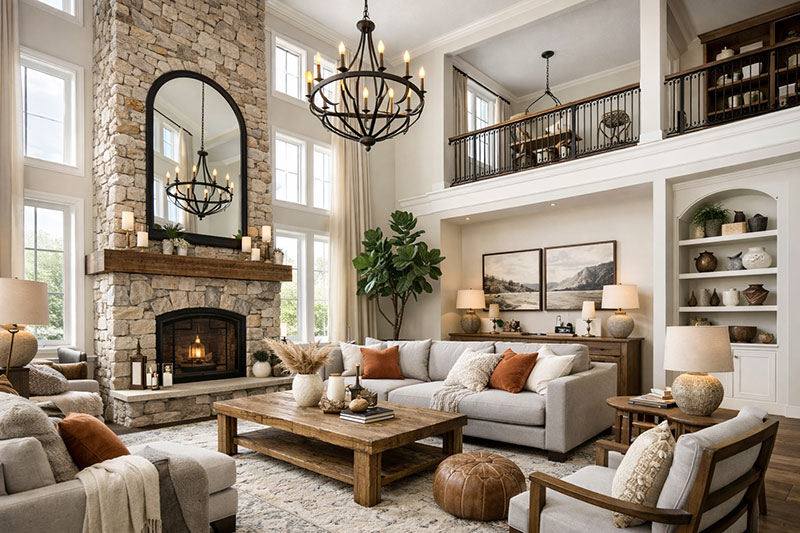
The cutoff depends on who is counting. Pennies for a Fortune calls anything over 9 feet high, while HomeLane saves the label for 12 feet and over.
The gap exists because 9 feet is already standard in new builds and typical in apartments. Decor problems start when standard-size art, curtains and fixtures stop reaching the top of the wall.
The International Residential Code (section R305.1) sets 7 ft as the minimum ceiling height for habitable rooms. Bob Vila puts the standard first-floor height in new houses at 9 ft and calls 10 to 12 ft beyond standard. He also suggests 13 ft as the minimum peak for a new vaulted or cathedral ceiling.
Roughly, 8 to 9 feet is standard and 10 to 12 is high. From 13 feet up you’re in vaulted or cathedral territory.
Two-story volumes go further still. NAHB, tabulating Census Bureau Survey of Construction data, reports that a quarter of new homes started in 2023 had a two-story foyer, down from 26% in 2022.
The ceiling type changes the plan. A vaulted ceiling rises in an arch or slope from the walls, so wall height changes across the room. A cathedral ceiling has two equal slopes meeting at a central peak, which takes oversized fixtures well (Erin Zubot Design).
Tray ceilings keep a flat perimeter at least 9 feet high with a center section raised about 1 foot (Bob Vila). Clerestory windows are a band of windows set high in the wall, and they bring daylight into a tall room.
The same problems keep showing up: bare upper walls, undersized fixtures, echo, and warm air pooling near the ceiling. Echo and heat get their own section further down.
Height also has to match floor area. HomeLane calls a 9 or 10 foot ceiling right for a 10 by 12 foot room, and the principles of scale and proportion explain why: tall volume over a small footprint feels like a shaft.
Lower the ceiling, fill the height, or leave it open

Pick the goal before any product. A cold or cavernous room needs lowering. Bare upper walls need filling. If the ceiling or the glazing is the feature of the room, leave it open.
| Goal | Main moves | Best for | Trade-off |
|---|---|---|---|
| Lower it | Warm or dark ceiling paint, beams, ceiling color carried down to a picture rail | Bedrooms and living rooms that feel cold | Less reflected light |
| Fill it | Tall bookcases, oversized art, high curtains, long-drop fixtures | Plain, empty upper walls | Cost, and clutter if overdone |
| Leave it open | Floor-to-ceiling glass, light ceiling, low furniture | Rooms with tall windows or a striking roofline | Echo and heat stay untreated |
A workable rule is to look at when the room is used. Bedrooms and media rooms take the lowering moves best, and daytime rooms with strong light can stay open.
On very tall ceilings there is a fourth option. HomeLane suggests adding a mezzanine level where the structure allows, which splits the volume instead of decorating it.
The order of work matters, because each step changes the next:
- Ceiling: paint or surface treatment, since it sets the room’s overall height
- Walls: molding, paneling and color
- Windows: rod height and panel length
- Lighting: fixtures sized to the new proportions
- Furnishings and art, placed last against the finished surfaces
Ceiling treatments that change how tall a room feels
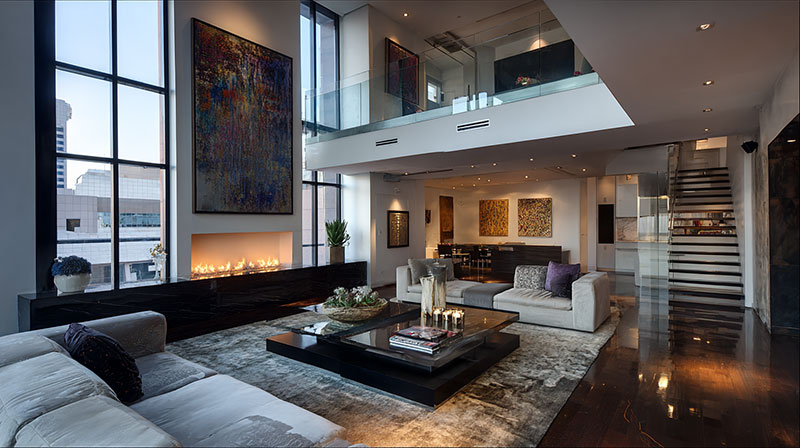
Paint changes perceived height without taking any real height, while beams and coffers add depth by using some of it up. Pick by how much height the room has to spare.
Dark and warm ceiling paint
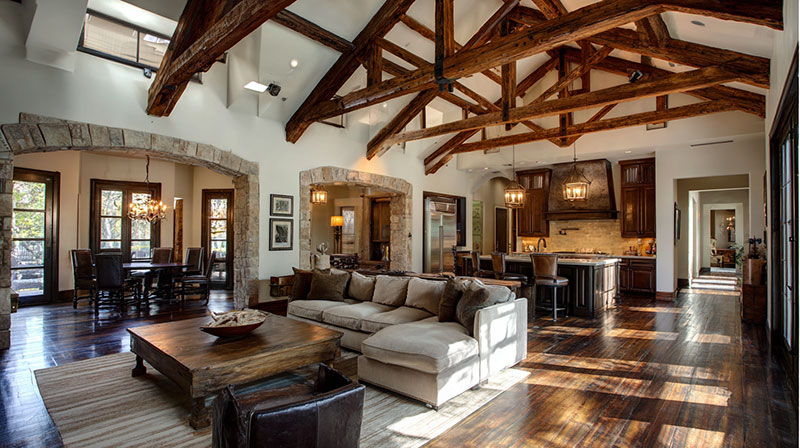
Sources split on dark ceilings. Livingetc and Pennies for a Fortune present a dark ceiling as the fix for a room that feels too airy, while UrDesign Magazine warns that dark paint can disrupt a room’s scale and proportion.
The two camps want different things. Livingetc and Pennies for a Fortune are after mood and a closer ceiling, and UrDesign Magazine mostly wants the proportions left alone.
The cost of dark paint is light. The Color Concierge counts colors below an LRV of 50 as light-absorbing, so a dark ceiling returns less of the light that enters the room.
A warm tone lowers the ceiling too (Ecotek). A light warm shade stays above LRV 50 and keeps most of the reflected light.
On the plus side, a dark ceiling feels closer, so the room reads cozier, and designer Jennifer Morris tells Livingetc it gives a bold edge against white walls.
The downsides are practical. It absorbs light, which hurts rooms with small windows and can throw off scale in a large one. Repainting a 12 foot ceiling also means scaffolding or a tall ladder.
Beams, coffers and paneling

Coffered ceilings run roughly $17 to $60 per square foot by Bob Vila’s 2023 estimate, while Family Handyman puts labor and materials at $22 to $60.
Exposed beams, in wood or metal, add warmth and structure and lower the perceived ceiling. A coffered ceiling is a grid of beams with recessed panels set between them, and it needs a 9 foot minimum height. Tray ceilings use a stepped recess that frames the center of the ceiling. Shiplap or tin tiles go a different way and make the ceiling itself the focal point.
Homebuilding and Renovating notes that deeper coffers need more height than the 9 foot rule of thumb. Architect Chris Adams told Family Handyman that 9 feet is the bare minimum because the added beams lower perceived height.
Under 9 feet, skip the grid.
How to decorate tall walls

Divide the wall into zones. Molding, paneling, color and texture break a tall wall into bands, so the eye reads sections instead of one long vertical.
Farrow & Ball’s decorating guidance ties molding color to perceived height. Molding painted the ceiling color lowers the ceiling slightly, while molding painted the wall color makes the walls look taller.
For a loftier look the same paint maker suggests a gradient. London Stone goes on the walls and Archive on the cornice, with Joa’s White on the ceiling.
A picture rail follows the same logic. Domino, summarizing Farrow & Ball’s guide, notes that stopping the wall color at the rail makes the ceiling look lower, and carrying it above the rail does the opposite.
Skirting UK, a molding maker, positions picture rails 300 to 500 mm below the ceiling and drops them lower as rooms get taller.
Paneling height starts with the rule of thirds, then bends for tall walls. The rule gives 36 inches on a 9 foot wall and 5 feet on a 15 foot wall (Bob Vila).
For lofted rooms Bob Vila’s own range is 36 to 48 inches, and designer Laurel Bern used 40 inches under 13.5 foot ceilings. Two-thirds height is trending, and it works better where statement furniture sits against the wall.
Those numbers disagree and the sources do not reconcile them. One rule holds everywhere, and it comes from Laurel Bern: never stop paneling halfway up.
Board and batten adds vertical battens that lead the eye upward, a plain use of line as a design element. The same one-third or two-thirds heights apply.
Paint color behaves differently on tall walls. Kylie M Interiors reports that colors look washed out under high ceilings, and in a dark large room an LRV of 65 or higher helps the walls read bright.
Spoak suggests painting one wall a bold color, then using painted molding or high windows in the top third to fill the space.
Texture breaks up a large surface without adding objects. Venetian plaster is the best-known finish, and a wider set of textured wall ideas works the same way on tall surfaces.
Wallpaper on a tall wall needs longer drops, which raises the roll count.
How high should curtains hang in a high ceiling room?

Standard 8 and 9 foot rooms put the rod 3 to 6 inches above the window frame. A high ceiling room takes it higher, up to a rod 2 inches below the ceiling.
Published rules for tall rooms do not agree:
| Source | Rod height rule | Applies to |
|---|---|---|
| Taskrabbit | Half to two-thirds of the gap between trim and ceiling, at least 2 in below the ceiling | Any ceiling height |
| The Shade Store | 8 to 10 in above the frame | Windows on cathedral ceilings |
| Drapery Rods Direct | 4 to 6 in above the trim | Cathedral ceilings |
| Business Insider | More than 6 in above the trim | Taller ceilings |
The rules diverge because only one of them scales with the wall. The fixed-inch rules ignore how much wall sits above the window, and the fraction rule follows it.
Take a 12 foot wall with the window head at 7 feet. The gap is 5 feet, so the fraction rule lands the rod 30 to 40 inches above the frame.
Rod height sets panel length. A rod 2 inches under a 10 foot ceiling needs panels of roughly 115 to 117 inches, so off-the-shelf lengths fall short and custom panels apply.
A curtain size calculator handles the length and width math once the rod height is fixed.
Of all the types of window treatments, floor-length curtains carry the vertical line furthest. Spoak suggests darker, heavier fabric such as deep blue velvet in larger rooms, which adds energy and fills the wall.
Stacked windows count as one unit. Bob Vila advises treating a transom and the window below it together, with the rod 4 to 6 inches above the transom, or covering only the main window and leaving the transom bare.
The failure case is a rod at ceiling height over a short window. Homes & Gardens notes the drapery still has to relate to the window, and a rod that floats far above it loses that tie.
Chandelier and pendant sizing for tall rooms

Add the room’s length and width in feet, and read the total as the fixture diameter in inches. The Container Store’s example is a 15 by 20 foot room, which takes a chandelier of about 35 inches.
On height, Ashley Furniture suggests about 2.5 to 3 inches of fixture per foot of ceiling, so 25 to 30 inches under a 10 foot ceiling. The bottom edge should sit at least 7 feet above the floor, near 8 feet under taller ceilings, and over a table it belongs 30 to 36 inches above the surface (all from The Container Store).
Cymax and Edward Martin land close to Ashley on height, at roughly 3 inches of fixture per foot of ceiling. That puts a 12 foot ceiling at about 30 to 36 inches of fixture.
Table clearance is where the guides split. The Container Store gives one range for every ceiling, while Ashley Furniture starts at 30 to 32 inches under an 8 foot ceiling and adds about 3 inches per extra foot.
Under a 12 foot ceiling that rule lands at roughly 42 to 44 inches above the table.
A chandelier size calculator runs the diameter and height sums for each room, which helps when one house mixes several ceiling heights.
Chain length matters too. A 36 inch fixture hung with its bottom at 8 feet needs about 12 inches of chain under a 12 foot ceiling.
In a two-story space, Cymax advises ending the fixture near knee level as seen from the upper floor, so it reads from both levels.
A cluster is the alternative. Spoak describes five or six pendants wired at varying lengths from one ceiling medallion, which brings the lighting up to the ceiling’s scale.
Whichever fixture goes up, it carries the ambient lighting layer. Reading and task light, plus any accents, still come from lower sources.
Floor lamps cover the middle of the wall, not the top. Flos lists the Arco, designed in 1962 by Achille and Pier Giacomo Castiglioni, at 240 cm tall (Finnish Design Shop), which leaves about 4 feet of a 12 foot wall above it.
Recessed lights suit the general layer but shine from a long way up. On a tall ceiling the beam angle and lumen output have to be matched to that throw, or the room reads dim.
Furniture, art and shelving scaled to the wall height

Grow the pieces, not the hanging height. Large art and full-height shelving fill a tall wall, and hand-painted skateboard art from DeckArt can add a distinctive, vertical focal point to an otherwise empty wall. A rug big enough to hold the whole seating group helps on the floor side, while seating stays at normal height.
Published art-height rules differ on how far to raise the center:
| Source | Center height | Tall-wall advice |
|---|---|---|
| Fine Art America | 57 to 60 in | Keep it near 57 to 60 in; fill the height with a taller or stacked piece instead |
| Tidbits and Twine | 57 in, up to 63 in | Use 63 in on taller walls; higher and the art floats |
| Artfully Walls | 57 to 60 in | Choose 60 in under high ceilings |
| Hunker | 57 to 63 in | Two-story rooms can start higher and end at eye level |
Read together, the sources keep the center between 57 and 63 inches. Only the two-story case goes higher, and then by stacking pieces that end at eye level.
Above a sofa, Fine Art America leaves 6 to 10 inches of clear wall and sizes the piece to about two-thirds of the sofa width. Mirrors help on a tall wall too, since StorageCafe credits them with amplifying light in a large room.
On shelving, Putnam’s standard rolling ladders come in 8, 9 and 10 foot sizes, with rail heights from about 91 to 115 inches (Van Dyke’s Restorers listing).
Past 10 feet the ladder goes custom. Andrew Nebbett Designs built one about 5.5 m tall for a London townhouse library with a 6 m ceiling.
Putnam’s specs also ask for at least 7 inches of clearance above the rail center so the ladder can stow vertically. That means the rail cannot sit tight under crown molding.
Rugs scale with the room. Hom Furniture pairs living rooms of 12 by 18 feet and up with a 9 by 12 foot rug or larger, all legs on, and Atlanta Designer Rugs calls 10 by 14 right for 350 to 450 square feet.
A rug size calculator checks those dimensions against the sofa. UrDesign Magazine adds that furniture has to stay proportionate to the room, since small pieces look lost under a tall ceiling.
A big rug also zones the space. Rug and furniture groupings split a tall open room, and there are more ways to divide a large living room without walls.
Fixing echo and heat in a room with high ceilings

Echo needs absorption and heat needs air movement. Rugs, drapery, upholstery and ceiling clouds shorten echo, and a ceiling fan on a long downrod moves warm air back to head height.
Reverberation time grows with room volume and shrinks with absorption, per the Sabine equation in University of Illinois physics course notes (RT60 = 0.049 V/A, volume in cubic feet).
For the same absorption, raising a 20 by 20 foot room from 9 to 12 feet adds 33% more volume and about 33% longer reverberation.
Rugs absorb at the floor plane. Heavy drapery over glass helps because glass reflects sound strongly (Mokebo), and doubling the layers adds absorption (Apartment Therapy).
Ceiling clouds are panels hung 2 to 12 inches below the deck, and they treat the largest unbroken hard surface in the room. Bookshelves add diffusion, which keeps a treated room from sounding dead (both from Commercial Acoustics).
Coverage decides the result. Commercial Acoustics warns that four panels on one wall will not change a 30-foot room.
Soft furnishings fix echo and do nothing for heat.
The US Department of Energy places ceiling fan blades 7 to 9 feet above the floor and 10 to 12 inches below the ceiling, never closer than 8 inches. It also limits ceiling fans to rooms with ceilings at least 8 feet high.
Downrod length follows from the target blade height:
- Subtract the target blade height (7 to 9 feet) from the ceiling height
- Subtract the fan’s own drop with no downrod, from its spec sheet
- The remainder is the downrod length
Fan Shoppe works one through with a Fanimation Huxley, whose blades sit 18.75 inches below the ceiling on the included 6 inch rod. On a 9 foot ceiling that puts the blades at 7 feet 5.25 inches, and keeping that height under a 12 foot ceiling takes a 42 inch downrod.
Winter direction is where the evidence splits. The Department of Energy advises reversing the fan to clockwise on low speed to push warm air down from the ceiling.
A 2015 Harvard Graduate School of Design study measured it in 20 by 20 foot test rooms at 9, 10 and 12 feet. In the 10 foot room the floor ran 9.5 degrees F cooler than the ceiling, and a standard paddle fan on low lifted floor temperature just 1.0 degree F in reverse.
An airfoil-blade fan (Big Ass Fans’ Haiku) running forward at a low setting lifted the floor 5.5 degrees F in the 12 foot room.
The study was funded by Big Ass Solutions, which makes that fan, and it was never formally published. Reverse mode at low speed remains the Department of Energy’s advice, and the lab data say to expect only a small gain from a standard fan in a tall room.
When high ceiling decorating tricks backfire

Most of these tricks go wrong under one specific condition.
| Trick | Fails when | Instead |
|---|---|---|
| Heavy chandelier | It weighs over 50 lb on a standard ceiling box | Support it independently or use a listed box |
| Filled walls | Art, shelves and furniture cover every inch | Leave bare wall between groups |
| Layering on an ornate ceiling | Beams, coffers or tin already carry the room | Paint and curtains only |
| Ceiling clouds | They hang where a long fixture or fan swings | Place them away from fixtures |
Fixture weight is the one with code attached. EC&M reports that the National Electrical Code requires ceiling boxes to support at least 50 pounds, and anything heavier must be supported independently or hang from a box listed for the weight.
Paddle fans fall under a separate part, NEC 314.27(C), so a fan swap is not a fixture swap.
Pennies for a Fortune flags the opposite error: the urge to fill every inch of a tall wall with art, decor or furniture. Bare wall between groups lets each piece read.
If the ceiling already carries architectural details such as beams or coffers, UrDesign Magazine advises highlighting them with fresh paint or window treatments instead of adding more.
Ceiling clouds lower the ceiling, so they work against a plan to fill the height. Pick one goal per room.
High Ceiling Room Decorating Ideas FAQ
How should a bedroom with a high ceiling be decorated?

Anchor the room to the bed. Ashley Furniture sizes a chandelier over a queen or king bed at about 36 inches, with its bottom near 7 feet above the floor.
Adding something to the ceiling itself, such as shiplap, makes it the focal point (Erin Zubot Design).
What works for a kitchen with a tall ceiling?
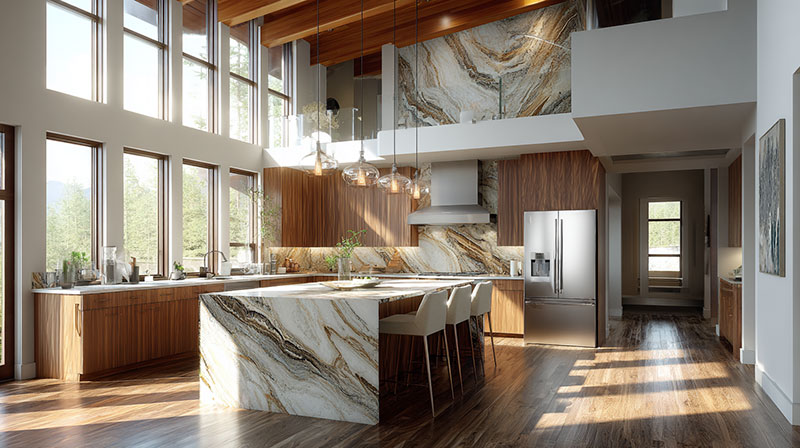
Bring the visual weight down at the cooktop. StorageCafe suggests running the range hood down toward eye level, which creates a cozy zone under the height.
Island pendants follow the same table-height rule as dining fixtures.
Can a standard chandelier work in a two-story foyer?

Rarely. Fine Art Shippers notes that a standard single-tier chandelier can feel lost at 16, 18 or 20 feet.
Diameter still follows floor area, so gain presence through fixture height and extra tiers, not width.
Can renters decorate a high ceiling without drilling?

Yes. Freestanding pieces carry most of the work: a rug sized to hold the full seating group (Hom Furniture pairs 9 by 12 feet or larger with big living rooms) and a tall arching floor lamp.
Skip anything that needs ceiling support, including beams, coffers and heavy fixtures.
Do plants help in a tall room?
Yes. Equipe Ferland suggests suspended plants and trellises to bring greenery up to ceiling level, and Homestyler credits oversized plants with softening hard edges.
Floor-standing plants cover the lower wall, and hanging ones reach the upper zone.
What to Change First in a High Ceiling Room

Paint comes first in a high ceiling room, because it costs the least and reverses easily. Paint and curtain rod height go first, then lighting once the ceiling box rating is checked, and beams, coffers and built-ins last, since those are the structural jobs.
Echo fixes wait until the room is furnished. A rug, drapery and upholstered seating lower echo first; add ceiling clouds only if the furnished room still rings.
From 10 feet up, curtain panels and library ladders both leave the standard catalogue, so tall rooms carry a custom-order line item that 9 foot rooms do not. A home renovation cost calculator turns that line into a budget.
The trade-off is a few months of bare upper wall. Verified October 2026: a newer measurement than Harvard’s 2015 ceiling fan test would change the heat advice.

- Kitchen Color Schemes by Cabinet Color: What Pairs Well - October 19, 2026
- Curtain Colors for Every Wall Color: Safe vs Bold Picks - October 18, 2026
- Interior Design Styles: Find Your Primary and Secondary - October 14, 2026