Home Decor
Stylish Brick and Stone Wall Ideas for Your Home
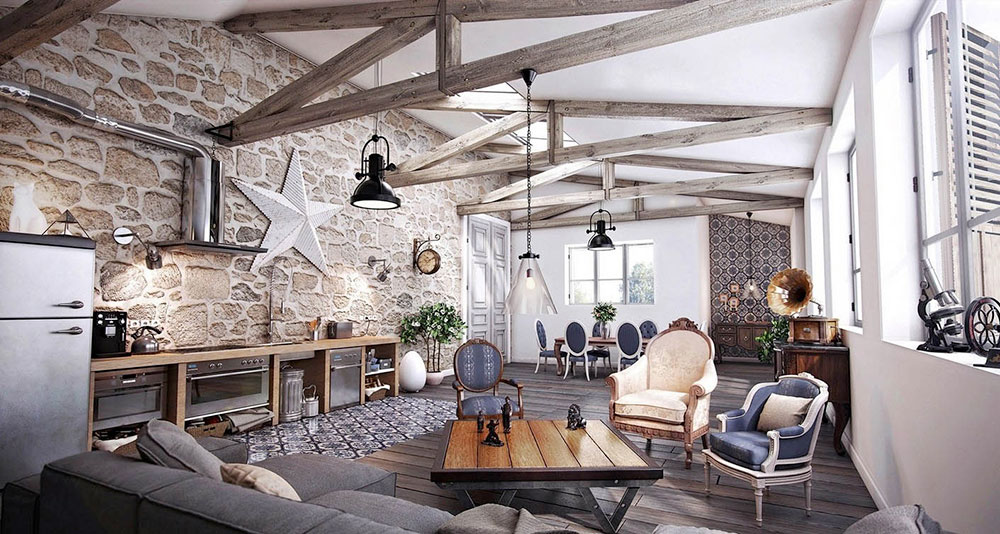
Where a wall goes settles the material question long before color or pattern comes up. Outside, a garden wall can be solid brick with a stone cap, and a house front takes brick veneer or adhered stone. Indoors it’s thin brick or stacked stone.
Brick is far more common than stone on new houses. It was the principal exterior wall material on 18.5 percent of new single-family homes started in 2023, while stone, rock or other stone materials filled 1.2 percent, according to NAHB’s 2024 analysis of Census Bureau Survey of Construction data.
In mixed designs, brick usually carries the surface while stone handles the base and the caps, and columns where there are any.
Which brick and stone wall ideas work in a garden?
A low brick wall with a stone cap is the simplest mix. Brick piers with stone infill, a curved serpentine wall, or a half wall that doubles as a raised bed or seat all work too.
Gardens Illustrated recommends local stone where possible so the wall belongs to its surroundings. It also says repeating the brick in steps and other details ties the whole plot together.
Low brick wall with a stone cap
A clean brick body with a contrasting stone top catches the light well. The cap can be natural stone, cast stone, slate, terra cotta, metal or brick, and it should overhang the brick face by at least 1/2 in. on both sides, with a drip edge. Metal anchors or bolts are the usual fixing.
Those details come from BIA Technical Notes 29A. The same note says a non-brick coping needs a check of its thermal and moisture expansion against the brick, with room left for the difference in movement.
Brick piers with stone panels
A pier and panel wall covers length cheaply. BIA describes panels only 4 in. thick, braced by masonry piers, with foundations needed under the piers alone.
BIA’s detail uses brick panels. Dry stack stone between brick piers is a design idea, not a published detail, so a mason or engineer should size the piers and the infill before digging starts.
Fieldstone is the natural fit. Landscape designer Jan Johnsen, quoted by Livingetc, built a wall from local fieldstone that looks dry stacked but is mortared and sits on a concrete footing.
Serpentine and curved walls
Thomas Jefferson designed serpentine walls for the University of Virginia, adapting an older English form. The shape still works in brick because the curve supplies the lateral strength.
A 4 in. serpentine wall only holds if the curve is deep enough. The radius of curvature should be no more than twice the wall height, and the curve depth no less than half the wall height.
BIA limits that rule to minor garden walls (Technical Notes 29A, reissued 1999). Don’t carry the 4 in. figure over to stone, since Gardens Illustrated warns that skimping on the thickness of the stone makes a wall look cheap.
Half walls for beds and seating
A half wall sets out the floor plan of a garden: raised flowerbeds, a pond edge, a seating area. Brick faces with a broad stone top give you a bench without a separate piece of furniture.
A wall that holds back soil is a different structure with different rules. Those are covered in the structural sections further down.
How do you combine brick and stone on a house facade?
Start with the dominant material, which is usually brick, and bring stone in low on the wall and around the entry. Glen-Gery’s example split is 60 percent brick and 40 percent stone for a traditional, cozy look.
Where the materials change matters as much as the ratio. Glen-Gery points to gables, columns and entryways as natural stopping points, so the switch reads as planned and not as a patch.
A brick field can sit on a stone foundation band, and stone veneer columns look good against a brick front. Stoneyard’s examples pair the two materials at stone-tread steps and entryways. They also show stacked stone rising about a third of the way up one wall.
The roof is the largest surface above the wall, so its color gets decided alongside the brick. This guide to roof colors that suit red brick covers the usual matches.
On an existing brick house, thin stone veneer can go over the brick without removing it (Stoneyard). Glen-Gery’s advice holds either way. Play up the difference between the two materials, don’t disguise it.
How do brick and stone work indoors?

Weight is the limit indoors, so the work gets done with thin brick and adhered stone veneer instead of full-size units.
US Brick lists its modular thin brick at about 1.0 to 1.05 lb per unit, against 3.6 lb for a full modular brick (US Brick, 2025).
Adhered manufactured stone follows the same logic. Evaluation reports written to ICC-ES criteria AC51 typically cap the saturated weight of the veneer units at 15 lb per square foot, and ASTM C1670 sets the unit requirements.
The definition of thin brick has moved, which is worth knowing. ASTM C1088 defines it as a clay unit under 2-5/8 in. thick in the 2023 edition, where earlier editions capped it at 1-3/4 in., and units over 1-3/4 in. may exceed prescriptive weight limits.
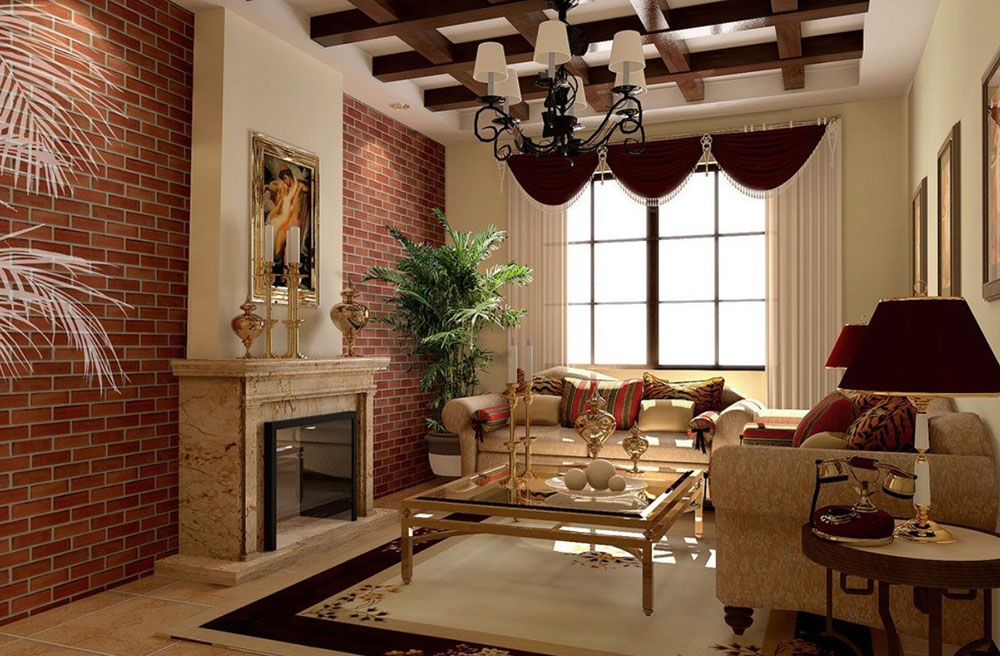
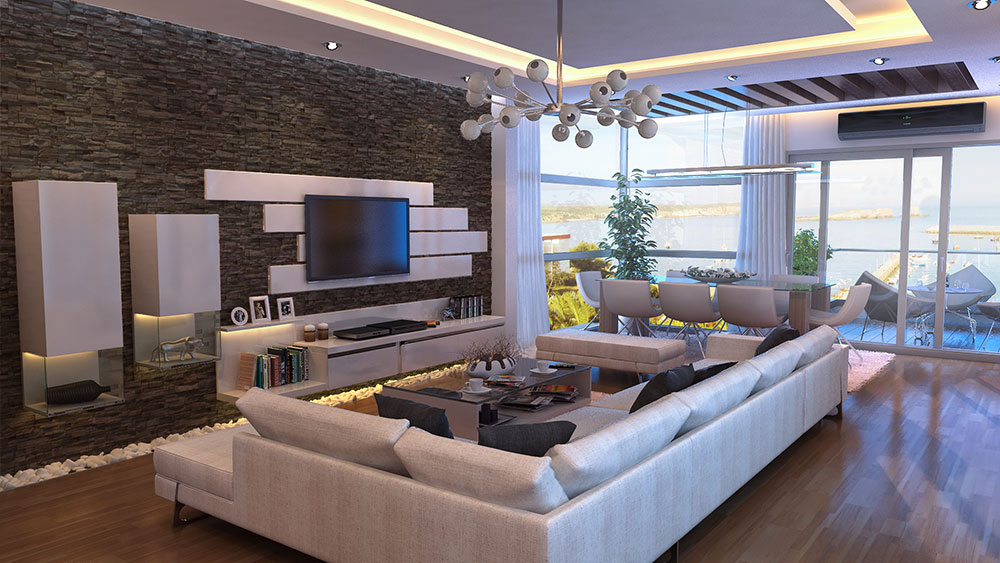
Thin brick suits a kitchen backsplash behind the range or sink, and it works as an accent wall too, either alone or as ledger stone on one wall. Interior stacked stone veneer adds natural texture and depth to living rooms, entryways and feature walls without requiring full-size stone. Stacked stone or brick facing is also a common choice around a fireplace, while a dual texture wall sets smooth stone against rough stone.
For the kitchen version, see how a red brick backsplash behind white cabinets plays out.
Stone around a firebox sets the palette for the room, so wall color gets chosen after the stone. These paint colors that suit a stone fireplace are a starting point.
Clearances around the firebox come from the fireplace manufacturer and local code, not from the veneer supplier.
How do you match brick and stone colors?
Pick the dominant material, find one undertone in it, and choose the second material to either echo or contrast with that tone. Glen-Gery’s examples are dark brick with a light stone, and painted white brick with dark gray or black stone.
Do brown brick and gray stone go together?
Two sources disagree here. LP Building Solutions says brown brick and gray stone should never share an exterior and tells readers to stick with one.
Glen-Gery goes the other way and says to choose the stone from a hue already in the brick. Its example is a brown brick with gray shades paired with gray stone.
The test I’d use is simple. Look for gray inside the brick. If it’s visible, gray stone repeats it. If the brick is plain brown, LP’s warning applies.
Pairings that work
Outercle lists these pairings, and the last row comes from Glen-Gery.
| Pairing | Look | Where it works |
|---|---|---|
| Red brick, warm sandstone | Classic, warm | Exterior walls, pathways |
| Charcoal brick, slate | Minimalist, monochrome | Urban-inspired exteriors |
| Weathered gray brick, split-face stone | Modern industrial | Accent walls, outdoor kitchen backsplashes, garden walls |
| Painted white brick, dark gray stone | High contrast | House fronts with painted brick |
Order swatches of both materials and look at them side by side outdoors before buying. Outercle suggests mockups for the same reason.
Trim and siding then follow from the brick and stone, and these exterior house color combinations help with that step.
Finishes that unify a mixed wall
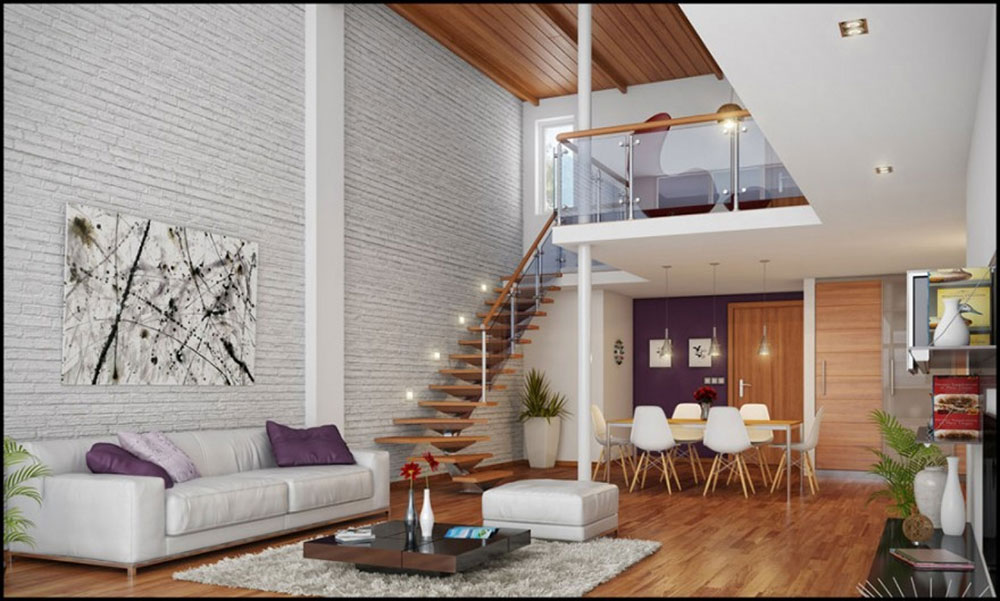
Breathable masonry paint gives a solid color that hides the brick texture. BIA Technical Notes 6 (August 2024) warns that paint and similar treatments can compromise brickwork if they trap moisture in the wall, and that paint is no substitute for choosing the right brick.
Limewash is thin and paint-like, so the brick texture stays visible.
German smear is wet mortar applied and partly wiped off the face. It is permanent and needs bare brick, because it will not grip painted surfaces. For houses mixing brick, stone and siding, Brick&Batten says smearing the brick ties the textures together.
If you are weighing paint instead, exterior paint colors for brick homes narrows the shades.
Which bond patterns and joint finishes suit each style?
For brick, running bond is the usual pick. Stone goes in coursed or rubble layouts, and any exterior wall should get a tooled concave joint.
Brick bond patterns

BIA Technical Notes 30 covers the structural bonds in use today. Running bond offsets each course by half a brick. It’s the simplest basic pattern, and BIA says it is used largely in cavity and veneered walls.
Common (American) bond is running bond with a header course added at intervals. English bond alternates whole courses of headers and stretchers, while Flemish bond mixes headers and stretchers within each course. Stack bond lines the joints up vertically and is a pattern only.
BIA says a pattern can be purely decorative and unrelated to structural bonding. Stack bond has no overlap between units, so BIA calls it purely a pattern bond. It is normally tied to the backing with rigid steel ties and should be reinforced in large wall areas and load-bearing construction. That makes stack bond a choice that needs ties or reinforcement behind it, however modern it looks.
Stone laying styles
Gardens Illustrated contrasts the traditional dry-stone look with crisp coursing of cropped stone, which it says can feel immediately modern.
Dry laying has a vocal defender. Brian Post, a master waller certified by the Dry Stone Walling Association of Great Britain, argues in Fine Homebuilding that dry-laid walls flex with ground movement while mortared walls crack.
He adds that dry stone can sit on native soil, while mortared work needs a concrete foundation below the frost line. Mortared walls can also trap moisture that destroys them when it freezes.
BIA’s guidance for brick garden walls also puts the foundation below the frost line, which matches his mortared case.
Joint profiles and mortar type
Mortar joints can make up roughly 15 to 17 percent of a wall’s surface (GCP Applied Technologies says up to 15 percent, Tobermore about 17 percent). Profile changes both the look and the weather resistance.
| Joint profile | Water resistance | Use |
|---|---|---|
| Concave | Good | Exterior walls |
| Vee | Good | Exterior walls |
| Weathered | Average | Some exterior walls |
| Flush | Average | Interior walls, or exterior walls that will be rendered |
| Struck | Poor | Interior walls |
| Raked | Poor | Interior walls |
The ratings are Tobermore’s, whose guide says a concave joint reduces water penetration while raked joints increase the risk. GCP, another mortar manufacturer, is stricter. It recommends a V or concave joint for exterior walls and rates weathered, flush, raked and struck profiles as poor.
Tool the joint while the mortar is thumbprint hard, meaning it holds a thumb imprint (GCP Applied Technologies). Mortar color matters too, since light mortar reads as a grid around dark brick while matched mortar reads as one surface.
ASTM C270 sets the minimum compressive strength at 750 psi for Type N and 1,800 psi for Type S. BIA recommends Type S for brick garden walls, at 1 part portland cement, 1/2 part hydrated lime and 4-1/2 parts sand by volume.
The standard’s appendices also caution against mortar stronger than the masonry units. The softer the masonry, the more the mortar choice matters.
Is veneer or solid masonry the right construction?
Solid masonry stands on its own. Veneer never does, because it is adhered or fastened to a structure behind it.
ICC-ES evaluation report ESR-2836, which covers one manufacturer’s adhered stone veneer, describes that veneer as nonload-bearing, and ASTM C1088 defines thin brick as a unit for adhered or fastened veneer.
| Option | Stands alone? | Best fit | Limit |
|---|---|---|---|
| Solid brick or mortared stone | Yes, on a footing | Garden walls, piers, retaining walls | Footing, labor, weight |
| Brick veneer | No, tied to a backing wall | House fronts | Needs structure behind it |
| Thin brick | No, adhered | Interior accent walls, facades | Needs a sound substrate |
| Manufactured stone veneer | No, nonload-bearing | Facades, columns, fireplaces | Flashing and a weep screed at the base |
Veneer on a freestanding wall
A veneer can still give a freestanding wall the stone look. The ASTM C1780 installation practice for adhered manufactured stone veneer covers walls, columns and landscape structures that can receive it.
The qualifier matters. A concrete or block core on its own footing qualifies, while a thin brick skin over a wall with no foundation does not.
When solid wins
Choose solid masonry when the wall must stand alone or hold back soil. Choose veneer when a sound structure already exists and only the face changes.
Retaining walls and tall straight walls fall in the first group. The limits that decide it are covered in the structural section below.
How much does a brick and stone wall cost?
Brick costs less than stone cladding on a house front, and the gap widened between two editions of the same study.
The 2017 edition priced adhered manufactured stone at $19.34 against $9.45 for brick, per square foot of installed cladding (RSMeans for the Brick Industry Association, as reported by Concrete Products). By the 2020 edition it was $29.68 for stone against $10.06 for clay brick, per square foot of wall area (RSMeans for BIA).
Across a whole house in 2020, total construction cost came out 17.2 percent higher with stone cladding than with clay brick.
Resale looks different. In 2025 a manufactured stone veneer project averaged $11,702 in job cost and $24,328 in resale value, which is 208 percent recouped (Zonda Cost vs. Value).
Compare the ratios, not the dollars, since the two editions measure cladding on different bases, and the 2020 sheet lists the material only as “stone” where the 2017 figure is for adhered manufactured stone. Stone ran about double the brick price in 2017 and about triple in 2020.
The two sources do not conflict, they answer different questions. BIA’s study asks what is cheapest to build, and Zonda asks what a veneer exterior returns at sale.
Keep one limit in mind. BIA commissioned the RSMeans work, and both studies price house exteriors, not freestanding walls.
Where to spend on stone
Put stone where eyes and hands land, which means the cap, the piers and the base. Let brick carry the length.
That split keeps stone quantity down without losing the contrast. For the wider budget around a facade project, a home renovation cost calculator helps frame the total.
Why no per-square-foot price for freestanding walls
Published ranges for freestanding walls come mainly from contractor-marketplace cost guides, not from primary sources, so this article does not print them.
Ask three local masons for a price at your height, footing depth and cap detail, and make sure each quote lists drainage.
When does a brick and stone wall need a footing, an engineer or a permit?
Every mortared garden wall needs a footing. A retaining wall also needs drainage, and past 4 ft measured from footing to top it needs a permit under the model code, with the building department deciding what drawings come with it.
How tall can a straight garden wall be?
BIA Technical Notes 29A gives a rule for a free-standing straight wall under 10 psf of wind. Height above grade should not exceed three-fourths of the thickness squared, with both in inches.
Worked from that rule, a 4 in. wall can stand 12 in. high and an 8 in. wall 48 in. A 12 in. wall gets to 108 in.
The rule assumes equal grade on both sides and no bond to the foundation. Steel dowels tying the wall to its footing, or heavier loads, push the design into BIA’s engineered masonry standards.
Garden wall or retaining wall?
The difference is soil. BIA’s garden wall rule assumes the same grade on both sides, so only wind and impact act on it, while a retaining wall resists earth pressure.
A retaining wall needs weep holes through the wall and a layer of crushed stone or gravel between the wall and the backfill, so water drains out instead of building up behind it. Ask the mason or engineer for the weep hole spacing and height.
Permit thresholds
Section R105.2 of the 2024 IRC exempts fences up to 7 ft and retaining walls up to 4 ft from a permit. The retaining wall figure runs from the bottom of the footing to the top of the wall, and the exemption is lost when the wall supports a surcharge.
A wall showing 3 ft above grade on a 1.5 ft footing measures 4.5 ft, so it crosses the line. A driveway or other load above the wall counts as a surcharge.
The exemption also does not excuse code compliance, local amendments can set lower thresholds, and local zoning rules on fence height are separate from the IRC.
Where the rules stop protecting you
- Thin, tall, unreinforced straight walls
- Retaining walls built with no drainage behind them
- Veneer treated as if it were structure
- A driveway or slope added above the wall after the permit exemption was assumed
How to build a brick and stone garden wall
This sequence is for a freestanding wall below the permit thresholds.
- Check local zoning and permit rules against the planned height.
- Mark the line and dig for the footing to the local frost depth, into undisturbed earth.
- Pour the concrete footing, reinforced if the soil is active (BIA).
- Build corner or pier leads first, then run the courses to a string line.
- Fill every head, bed and collar joint completely.
- Add the stone panel or stone course between the brick elements.
- Install through-wall flashing under the cap, then set and anchor the cap.
- Tool the joints, then protect the wall from rain and fast drying while it cures.
What goes wrong
BIA warns against treating garden walls as lesser work, since they are not weather barriers like a house wall. Any defect can start deterioration.
- A footing set above frost depth
- Joints that were not fully filled
- No flashing under the cap
- Stone and brick laid with no plan for the point where they meet
DIY or hire a mason
DIY fits a low wall with equal grade on both sides, under the permit limits, built from brick or stone you have handled before.
Hire someone when the wall retains soil past 4 ft, carries a surcharge, needs veneer with flashing details, or stands tall enough that the thickness rule comes into play.
How do you maintain and repair brick and stone walls?
Fix water first, then mortar, then the surface. Sealing comes last, because a coating over a wet or cracked wall traps the problem.
Efflorescence
BIA Technical Note 23A says efflorescence is usually not harmful to brick masonry. Find the moisture source and correct it before any cleaning starts.
Not every white stain is efflorescence either, a point BIA makes in Technical Note 23, which is why the stain should be identified before it is treated.
Repointing
New mortar must be softer and more vapor permeable than the masonry units, and old mortar should be removed to a minimum depth of 2 to 2-1/2 times the joint width (National Park Service, Preservation Brief 2). The new joint should also match the old one in color, texture and tooling.
The Type S recipe BIA gives for new garden walls does not carry over to old, soft brick. Match the mortar to the units in the wall, not to the recipe on the bag.
The Brief also separates the terms. Repointing replaces deteriorated mortar, while tuckpointing is mainly a decorative raised joint laid over flush mortar.
Sealing
BIA Technical Note 6A (2008) says to use only breathable colorless coatings on brick, with anti-graffiti work the exception. It also discourages colorless coatings on most exterior brick and says clear water repellents are not necessary on properly designed and built brick masonry.
Some stone needs it more than brick does. Outercle notes that natural stone such as travertine may need sealing.
Frost damage and weep holes
Water that freezes inside masonry expands and can crack and spall it, according to PROSOCO. Weep holes and base flashing give water a way out of the wall.
Check them each season and clear any that are blocked.
Signs a wall needs attention
- Disintegrating mortar
- Cracks in joints
- Loose bricks or stones
- Damp wall faces
The list follows the Park Service’s, minus its plasterwork entry. Any one of them means looking for the water source before touching the mortar.
Common Questions About Brick and Stone Wall Ideas
Is reclaimed brick safe to use in a garden wall?
Only if it meets grade SW (severe weathering) of ASTM C216 for visible facing brick. BIA Technical Notes 29A says used or salvaged brick should stay out of garden walls unless it meets the SW requirements, since used brick is often non-uniform in degree of burning.
Can brick and stone in one wall crack from different movement?
Yes, wherever the two materials meet and expand at different rates. BIA’s garden wall guidance sends designers to its Technical Notes 18 on differential movement, so ask the mason how the junction is detailed before building.
Can thin brick be used outdoors?
Yes, if it is exterior grade. ASTM C1088 covers thin veneer brick in two grades, Interior and Exterior, so check the grade on the carton before buying for a garden wall or facade.
Can you add stone veneer over an existing brick wall?

Yes, provided the wall can carry the added load. ICC-ES report ESR-2836, which covers one manufacturer’s veneer, requires the weight of the supporting wall, veneer included, to be determined, and says installation over concrete or masonry must comply with IBC Section 1404.10.1.5 (numbered 1405.10.1.5 in the 2015 IBC).
How should you light a brick and stone wall?
Graze it with light from above or below. Gardens Illustrated says this picks out the rough texture of stone and brickwork.
Which plants look good against brick and stone?
Color helps a gray stone wall (Livingetc), and bright plants stand out against lighter brick (Real Homes).
On a reclaimed stone wall, Gardeningetc shows native plants set into the gaps, including ferns, Campanula and Ajuga.
Choosing a First Wall Before You Order Material
The best first build among brick and stone wall ideas is a low brick wall with a stone cap, sized below the local permit thresholds. I’d start there before anything fancier.
Sequence matters, because frost depth and height limits set the budget while color stays cheap to change. Find the local frost depth and permit limits first, then get three quotes that cover footing, cap and flashing. Brick and stone samples can be compared outdoors once those numbers are in.
A low wall gives no privacy and holds no soil, but in exchange it stays clear of permit thresholds.
This position was verified in October 2026 against the 2024 IRC. A local amendment or a newer adopted edition changes the thresholds, so confirm which edition the building department enforces.

- Kitchen Color Schemes by Cabinet Color: What Pairs Well - October 19, 2026
- Curtain Colors for Every Wall Color: Safe vs Bold Picks - October 18, 2026
- Interior Design Styles: Find Your Primary and Secondary - October 14, 2026