Home Decor
Steampunk Interior Design Ideas You Could Try
The light most people picture in a steampunk room is a Victorian invention too. Thomas Edison’s carbon-filament lamp first burned for 13.5 hours on 22 October 1879, during the Victorian era (1837 to 1901), according to the Engineering and Technology History Wiki.
Brass fittings, copper pipework, gears and pressure gauges handle the rest, set against Victorian furnishings. Designers use the look in living rooms, studies, kitchens and bathrooms, mostly in brown, sepia, dark green and burgundy.
What Is Steampunk Interior Design?
Victorian furnishings and exposed machinery share one room. That’s the short version. The retro-futuristic feel comes from leaving the brass, copper, gears and pipework in plain view instead of hiding them.
Straight Victorian decor tends to conceal the mechanism, and industrial style stripped the ornament out long ago. Steampunk keeps both in view.
The furniture and ornament come from the Victorian era, and the machinery comes from the Industrial Revolution. On the Victorian side you get tufted leather, dark wood, antiques, lace and patterned surfaces. The machine side brings exposed pipes, gears, gauges, riveted metal and filament bulbs.
Steampunk sits among the lesser-known interior design styles, and nothing official defines it. A 2011 Tor.com feature calls it open to interpretation, as theatrical or as subdued as the owner likes.
Where the Style Comes From
Sources disagree on when steampunk started, mostly because they’re dating different things. Proto-steampunk stories by Jules Verne and H.G. Wells were written long before the label existed. K.W. Jeter coined the word itself in an April 1987 letter to Locus magazine, as a tongue-in-cheek cousin of cyberpunk. The interior style came later, as a design movement of the late 2000s that Tor.com described in 2011 as gaining attention.
The first museum show of steampunk art ran at the Museum of the History of Science in Oxford from 13 October 2009 to 21 February 2010, per the museum’s exhibition programme.
Curator Art Donovan set new pieces beside historic scientific apparatus from the museum’s collection. The show drew more than 70,000 visitors, according to Donovan’s book Art of Steampunk (2011). The museum’s own 2010-11 annual report puts the total higher, at more than 80,000.
The label goes back to 1987 and museum recognition to 2009, while the room style is younger and looser than either. Two designers can call a room steampunk and build opposite things.
Steampunk vs Industrial, Neo-Victorian and Dieselpunk Style
Steampunk adds Victorian ornament and visible machinery to industrial surfaces. Neo-Victorian keeps the ornament and drops the machinery, while dieselpunk moves the period to the years between the World Wars.
| Style | Period reference | Surfaces and materials | Mood |
|---|---|---|---|
| Steampunk | Victorian era, steam-age machinery | Brass, copper, leather, dark wood, iron | Ornate, theatrical or scholarly |
| Industrial | Factories and warehouses | Concrete, brick, exposed ducting | Raw, stripped back |
| Neo-Victorian | Victorian period, modernized | Period furnishings, flat black cast-iron looks, textiles | Formal, restrained |
| Dieselpunk | Between the World Wars | Machine-age metal, Art Deco geometry | Gritty, glamorous |
Steampunk borrows from industrial, but only selectively. Houzz describes it taking exposed pipes and brick or concrete walls from industrial chic and pairing them with moodier, classic accessories.
That blend now has its own label, the steampunk industrial look. Another Houzz feature, from Singapore, says it keeps the raw shell and warms it with older, refurbished pieces.
Sugarbakers, a Singapore design firm, defines industrial style by mass-produced furniture rather than hand-built pieces. Steampunk goes the other way, since 1stDibs describes it as favoring bespoke, recycled and handmade work.
Designers don’t agree on how much machinery the style needs. One interior designer writing for Tor.com in 2011 builds industrial neo-Victorian rooms and puts finishes, furnishings and textures ahead of technology. Home World Design treats exposed gears, pipes and mechanical features as the core.
Here’s a quick test. Remove the gears and gauges in your head. If the room still reads Victorian, it’s neo-Victorian, not steampunk.
Dieselpunk sits on the other side. Game designer Lewis Pollak coined the term in 2001, according to The Encyclopedia of Science Fiction, and its visuals lean on Art Deco styling from the interwar period.
Mixed rooms are common. Pick the dominant layer and cut whatever contradicts it.
Which Colors and Materials Define a Steampunk Interior?
Brown, sepia, dark green and burgundy do most of the work, with cream as the light note, according to American Tin Ceilings. Brass, copper and black iron supply the metal, and leather and wood bring the warmth.
Palette
Deep brown, dark green, burgundy, cream and sepia cover most of the palette, with a flat black standing in for cast iron. The metal side brings brass gold and copper red-brown, with bronze somewhere in between.
Dark green is the trickiest base tone to pair with warm metals, and a page on what goes with dark green covers the safer combinations.
Keep the palette to three or four tones. The metals and wood bring the variation.
Metals
Brass brings the gold and copper the red-brown, and black iron adds weight underneath both.
Brass: Lacquered or Bare
A clear coating keeps lacquered brass shiny. Leave it off and the metal reacts to air, moisture and touch, darkening unevenly.
Mixing the two in one room reads as a mistake. The Building Conservation Directory describes church brasswork where lacquered pieces stay bright while unprotected pieces tarnish comparatively fast, leaving a patchwork.
Unlacquered brass fits the style better, because the worn look is the point. The price is permanent fingerprints and an occasional polish.
Copper and Verdigris
Copper roofs start turning green after 5 to 7 years in coastal or heavy-industrial air and after 10 to 14 years in rural air, according to Copper Development Association timelines published by World Coppersmith.
A New Zealand roofing guide (metalroofing.org.nz) gives 18 years for a moderate climate, 10 for industrial and 5 for marine. It adds that in dry environments copper may never turn green.
The two sets disagree on mild climates and agree that coastal and industrial air works fastest. Both describe roofs, though.
Indoors, copper meets far less rain and pollution, so a green finish on an interior pipe or lamp is usually applied, not grown. Strictly, the green on aged copper is patina, and the same guide notes that true verdigris forms from acetic acid and dissolves in water.
Keep applied green finishes away from splash zones such as sinks and showers.
Iron and Black Finishes
Black iron pipe and wrought iron give brass and copper a dark counterweight. Tor.com’s 2011 feature singled out flat black as a convincing stand-in for cast iron.
Wood and Leather
Leather matters more than most guides admit. Home Grail calls it almost more important than metal in defining the look.
Choose worn leather over glossy. New, bright leather fights aged metal, and Edison Light Globes pairs worn leather with antique furniture in its steampunk styling advice.
Dark, salvaged wood wins. Boards recovered from old buildings count as reclaimed wood, and Houzz lists salvaged wood and distressed metal among the materials that suit the style.
Glass
Glass does not patina. It adds color and sheen, usually amber or smoked glass for shades and bottles, and clear panes over gauge faces.
Tinted glass cuts light output, so keep it for accents and not task lighting.
How to Treat Walls, Floors and Ceilings
Work from the shell inward. Dark or brick-textured walls come first, then a dark wood floor, then a metal or pipe feature overhead or along one wall. Wainscoting adds the Victorian layer, and the floor should stay the darkest surface in the room.
Walls
Exposed brick shows up a lot. Otherwise it’s wainscoting under dark paint or patterned wallpaper, or just sepia and dark-green paint.
When the structure does not allow exposed brick, brick-effect wallpaper gives the same texture, according to Home Grail. Real brick comes in many finishes, and ideas for brick and stone walls show the range.
Wainscoting is lower-wall paneling. It gives the room its Victorian base, and dark paint above it keeps the mood.
Floors
Dark wood planks suit the style best. AIBD cites Deavita’s advice that the floor should be the darkest surface in the home.
Dark planks ground the warm metals and suit low light. Go pale and the room gets brighter, but you lose some of the dark base the palette depends on.
A patterned rug softens all that metal.
Ceilings and Pipework
Decorative metal ceilings spread in the late 1800s as a cheaper stand-in for plaster. Most survivors are steel, not tin, according to Designing Buildings.
American Tin Ceilings, founded in 2002, replicates late-1800s Victorian tiles and asks designers and demolition crews to send in samples of historic tiles to copy.
Pattern shortens a low ceiling visually. Pick a plain tile or paint it dark if the room is under standard height.
Black iron pipe works as shelf brackets and as visible runs along a wall. For builds, see these ideas for pipe shelving.
Books are heavy, so anchor pipe brackets into studs or masonry, not drywall alone.
Which Furniture Fits a Steampunk Room?
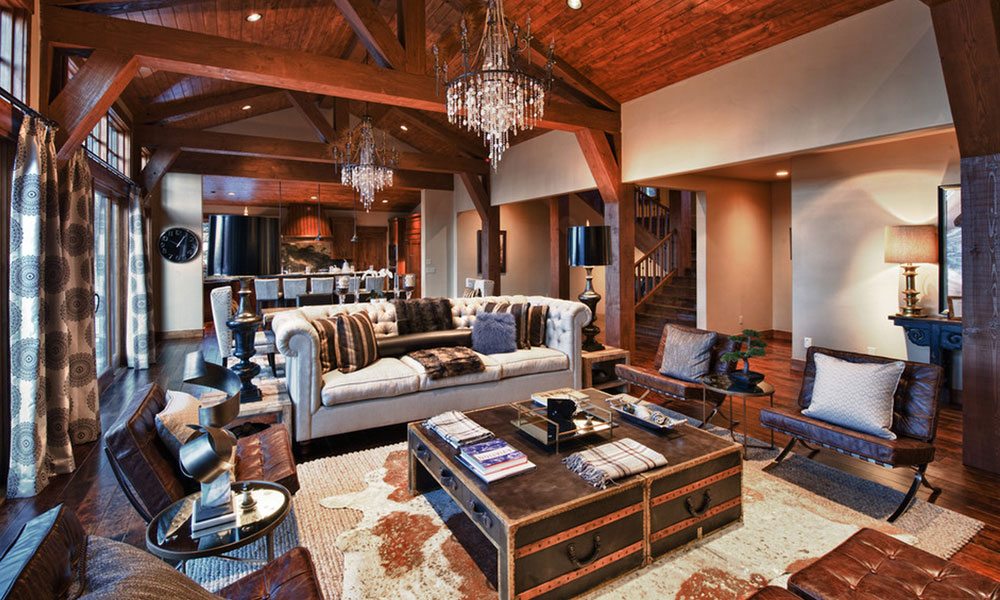
Furniture with a Victorian silhouette fits best. Chesterfield sofas, wingback chairs and dark wood cabinets all work, in worn leather or dark upholstery. Metal-framed tables and salvaged storage add the machine layer.
Seating
A Chesterfield sofa, with its deep-buttoned leather, anchors a living room. The wingback chair brings the Victorian high back and looks best in leather or fabric in a dark tone.
stDibs sees two moods in the style: a stately Victorian drawing room, or the lair of a mad scientist. Seating decides which one you get.
A Chesterfield is bulky. In a small room, one wingback does the job.
Tables
Metal and wood carry the machine layer.
A round wood-and-iron side table was enough to hint at steampunk in a Singapore apartment featured by Houzz. Frames from industrial furniture designs, usually metal legs under a wood top, sit well beside Victorian seating.
Storage
Storage doubles as display.
- Trunks and old travel cases
- Cabinets with glass doors
- Pipe-and-board shelving
- Salvaged-wood wine racks
Reworked pieces suit the style better than showroom stock, and ideas for upcycling furniture cover the basics. Buy one real antique as the anchor and fill the rest with reproductions or reworked finds.
How to Light a Steampunk Interior
Warm light works best in layers. A pendant or chandelier goes overhead, brass sconces or desk lamps sit at working height, and a low filament glow handles accents. Put the main fixtures on dimmers.
Fixture Types
Factory pendants in caged or shaded metal hang low over tables and counters. Brass sconces add light without using table space. Chandeliers bring the Victorian ornament and look best with exposed bulbs and dark metal. For reading and work, desk lamps handle the task light.
Industrial fixtures set the machine tone and the chandelier supplies the ornament. A room needs both, or it drifts toward one of the neighboring styles.
Edison Bulbs and Color Temperature
Filament lamps in the Edison bulb style run between 2200K and 2700K and put out roughly 250 to 720 lumens, according to Industville’s technical guide.
That output is low on purpose, so one fixture rarely lights a room.
Go with 2200K for bulbs you look at, since the filament glow is the point. Reading bulbs belong at 2700K, with a shade between bulb and eye.
Shape and filament style change the look, and this guide to Edison bulbs lays out the options.
Check the kelvin number, not the label. Montreal Lighting defines soft white as 2700K and warm white as 3000K, while LED maker Signlite uses the two names the other way round.
Layering Ambient, Task and Accent Light
Dark palettes absorb light. One overhead fixture is never enough.
Pendants or a chandelier, dimmed, handle the general work of ambient lighting. A desk lamp or a swing-arm sconce at the reading chair takes care of task light, and a low glow on the gauge wall or the shelf of instruments covers accents.
Edison bulbs alone leave a dark-walled room dim after dusk. Add one task lamp per seat before adding another pendant.
Nixie Tubes as a Glow Accent
Nixie tubes are cold-cathode neon displays that glow orange-red, and the Computer History Museum traces the Nixie name to Burroughs.
A Nixie clock makes a good lit accent on a desk or shelf. The technology is mid-20th-century electronics, so it postdates steam, and steampunk tolerates that anachronism where purists do not.
Gears, Gauges, Clocks and Globes as Accents
Gauges, clocks and maps carry the style best, and gears work as one statement piece, not as filler.
| Accent | Role | Watch for |
|---|---|---|
| Gears and cogs | One statement piece, or bookends | Repetition reads as cliche |
| Pressure gauges | Proof of the machine | Printed dials that only look real |
| Clocks | Function plus mechanism | Decorative gears, battery movement |
| Globes and maps | Navigation and travel theme | Glossy modern prints |
| Orrery, astrolabe, sextant | Scientific instruments | Antique pricing, reproductions |
Framed sepia photographs and technical drawings suit the walls, along with vintage maps with nautical embellishments, according to Houzz.
Eugene Bourdon patented his tube pressure gauge in 1849, after accidents on high-pressure steam locomotives showed the need for one, per WIKA. German railway engineer Rudolf Eduard Schinz had found the same effect in 1845 and was already fitting gauges to locomotives, Chemistry World reports.
A salvaged gauge with a real dial and needle ties the room to that steam history. A printed dial does not.
Clocks need the same scrutiny. One Howard Miller wall clock states plainly that its visible gear assembly is decorative while a quartz movement runs the hands.
Decorative is fine for a clock. Just don’t pay a working-mechanism price for it.
Credit for the orrery, a mechanical model of the solar system, is shared. Britannica says George Graham probably invented it for the 4th Earl of Orrery, while the Linda Hall Library says London instrument maker Rowley built the first one, to Graham’s design.
Astrolabes model the sky for navigation and timekeeping, and a sextant simply measures the angle between the horizon and a star.
One oversized clock or gear sculpture can act as the focal point of a wall, so everything else near it stays quiet.
Scale decides how many pieces a surface holds. A mantel can take a cluster, a shelf two or three, and a wall one large piece, which is the logic behind scale and proportion in a room.
How Do You Apply Steampunk Style Room by Room?
Start in the living room or study, where leather, wood and gauges fit naturally. Go lighter in the bedroom and more moisture-tolerant in the kitchen and bathroom. Every room keeps the same palette and only changes the metal finishes and the accent count.
Living Room
The living room carries the heaviest layer of the style.
Face the Chesterfield sofa or the wingbacks toward one feature wall in brick or dark paneling, and hang the biggest accent there. A dark patterned rug goes underneath, with a dimmed pendant and two lamps for light.
Kitchen
Unlacquered brass pulls and faucets suit a kitchen, since Kallista notes the metal tarnishes into a patina but does not corrode or rust.
Over the sink or the island, a factory pendant works well. For layouts, see these ideas for lighting over a kitchen sink.
Bathroom
Moisture changes how brass ages. Aston Matthews lists humidity, sunlight and cleaning among the factors that shape a living finish.
Some manufacturers suggest patting brass fixtures dry after use to avoid water spots, per Houzz.
A Houzz bathroom feature shows a low-tech shower set with exposed piping, which is the simplest way to bring the machine layer into a bathroom. Shower design ideas cover the tile and layout around it.
Bedroom and Home Office
A bedroom only needs one machine piece, sepia and brown tones, and warm bedside lamps.
A home office can take full commitment. Think a leather chair, a wooden desk, a banker’s lamp and a gauge or map wall, and Houzz Singapore agrees a study suits the style.
Order of Work for One Room
Work from the shell to the objects, so late changes stay cheap.
- Fix the shell: wall color, brick or wallpaper, and floor.
- Place one anchor seat, a Chesterfield sofa or a wingback chair.
- Hang the main light, then add task lamps.
- Add wood-and-metal tables and storage.
- Layer accents one at a time, starting with the largest.
- Remove one piece before calling the room done.
How Much Does Steampunk Interior Design Cost?
A room can cost anything from the price of a lamp kit to thousands of dollars per fixture, and the spread comes down to authenticity. Real unlacquered brass, working mechanisms and antique pieces cost the most. Decorative reproductions cost the least.
A few listed prices show the gap. CB2’s Halen unlacquered brass pendant lists at CAD 379, while The Future Perfect lists the Bell Pendant 02 by Post Company with Roll & Hill at US$4,920.
On the cheap end, a UL-listed antique bronze socket and 8-foot cord set sold by Antique Lamp Supply was $15.11 on Walmart. Gear clocks vary just as much, with a 10-inch gear-theme clock at $12.50 against a 24-inch moving-gear clock at $151.99 (marked down from $177.99), both Walmart listings.
Pay for what is touched or lit, and fake what is hung. Hands meet pulls, faucets and lamps, so real brass pays off there, while a wall clock with decorative gears does the same job as an expensive one.
Budget the shell before the decor. A home renovation cost calculator gives a baseline for walls, floors and ceilings.
Measure before committing to dark walls, too. A room paint calculator gives quantities for four walls before you buy.
DIY or Bought?
DIY gets you the lowest cost per piece and an exact fit to the room, but lamps need wiring skill and sourcing takes time.
Bought pieces come with finished quality and a consistent finish across the room. They cost more, and hardwired fixtures such as the CB2 pendant are listed as needing professional installation.
When Steampunk Interior Design Does Not Work
It fails in small or dark rooms, where upkeep outruns patience, and wherever accents outnumber furnishings.
In a small, dark room, a deep palette plus warm filament bulbs removes light the room never had. Lighter walls with one dark wall keep the style, and these suggestions on colors that suit small rooms help pick the lighter tones.
Upkeep is the other problem. UK supplier Brass Works notes that buyers who wanted lasting brightness often find regular polishing tedious. If you will not polish, commit to lacquered brass throughout the room or let every piece darken.
A room furnished from one catalog reads as a set, not a home. Unity comes from repeating a few materials and finishes across the space, as covered in what makes a room feel unified.
Brick veneer, pipe runs and metal ceiling tiles are hard to reverse, so think twice in a home you plan to sell. Paint, lamps and furniture move with you. Put the style in movable pieces.
If a room fails two of these, switch to neo-Victorian. Keep the leather and dark wood, and drop the machinery.
Steampunk Interior Design FAQ
Can you use steampunk decor in a rental?
Yes. Renters can carry the style in movable pieces such as lamps with filament bulbs, a wingback chair, framed vintage maps and a gear clock.
Leave brick veneer, metal ceiling tiles and pipe runs alone, because removing them damages walls.
Is a DIY steampunk lamp safe to build?
Yes, when you build from UL-listed parts. Lamp kits supply a listed socket and cord set, and one Creative Hobbies antique brass kit lists a 75-watt maximum bulb, far above the roughly 2 to 7 watts of a typical LED Edison bulb.
Fixtures wired into the ceiling are a different job and belong to an electrician.
How do you age copper or brass at home?
Unlacquered brass ages without help, darkening with touch, air and humidity. Copper needs a spray-on patina solution, and Coppa Gutta says its verdigris fluid gives a light green in about 2 hours.
A second coat darkens and evens the color, and a hand-applied wax coat seals it.
Does steampunk mix with modern decor?
Yes. Home World Design describes a minimalist steampunk trend built on fewer, well-chosen industrial elements.
Keep the room plain and add one machine accent, one metal finish and one leather or dark wood piece.
Which books and films show the style best?
Tor.com’s 2011 feature names The Golden Compass, Stardust, Wild Wild West and the Sherlock Holmes films for their set design, and recommends the novel The Difference Engine by William Gibson and Bruce Sterling.
Watch the sets, not the plots. They show how brass, leather and exposed machinery sit together in one room.
Where to Stop Adding Steampunk Pieces
Steampunk interior design needs one machine accent per surface and one in sight from each seat, and every piece beyond that count dilutes the strongest one.
When money allows only three changes, start with warm lighting, then one leather anchor seat, then one real gauge or map.
Lighting changes every surface at once, a seat sets the weight of the room, and accents come last because they are the easiest to move.
Light-first buying leaves the walls bare, so the room reads as styled rather than themed. That trade-off suits anyone who may move or repaint.
Deciding which single piece leads is a question of hierarchy, covered in how emphasis works in a room.

- Kitchen Color Schemes by Cabinet Color: What Pairs Well - October 19, 2026
- Curtain Colors for Every Wall Color: Safe vs Bold Picks - October 18, 2026
- Interior Design Styles: Find Your Primary and Secondary - October 14, 2026