
A bedroom that feels calm the moment you walk in. No clutter fighting for attention, no colors screaming from every surface. Just quiet materials, low furniture, and space to breathe. That’s what Japanese bedroom decor actually delivers when it’s done right.
This style is built on wabi-sabi, kanso, and ma, three philosophies that treat simplicity, natural imperfection, and empty space as design tools rather than problems to fix. It’s not about buying less. It’s about choosing better.
This guide covers the specific color palettes, furniture, materials, lighting, and layout strategies that make a Japanese-style bedroom work. Whether you’re starting from scratch or reworking an existing room, every section gives you something you can actually use.
What Is Japanese Bedroom Decor
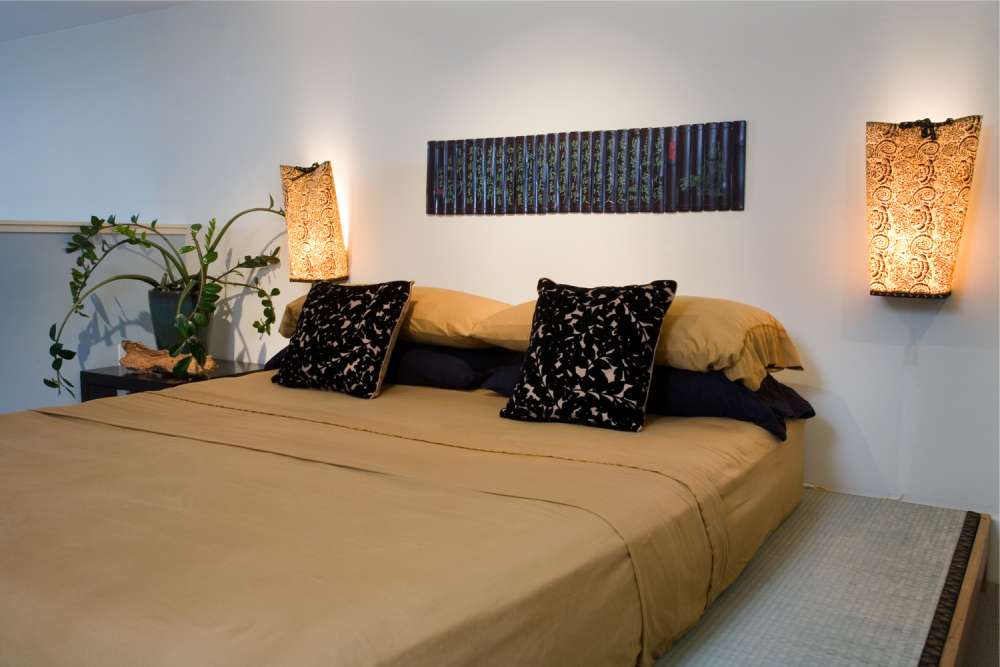
Image source: Kimball Starr Interior Design
Japanese bedroom decor is a design approach built on three core philosophies: wabi-sabi (the beauty of imperfection), kanso (simplicity), and ma (the intentional use of negative space). It prioritizes low-profile furniture, natural materials, muted tones, and rooms that feel open rather than filled.
This is not just “less stuff in a room.” There’s a big difference between Western minimalism and the Japanese approach to a bedroom. Minimalist interior design tends to strip things away for the sake of visual cleanliness. Japanese bedroom styling chooses every object with purpose. A single ceramic vase on a low shelf isn’t there because you removed everything else. It’s there because that’s all the room needs.
Renub Research projects Japan’s interior design market will grow from $6.39 billion in 2024 to $9.06 billion by 2033, reflecting a strong cultural investment in thoughtful living spaces.
And the global appetite for this look is growing fast. Pinterest reported a 135% increase in searches for “Japanese living room design” between June 2023 and June 2024. Searches for “zen house” jumped 405% in the same period. The interest goes beyond a passing trend. People are looking for bedrooms that feel calm, grounded, and honest.
What pulls people toward this style, at least in my experience, is how quiet it feels. You walk into a Japanese-styled bedroom and the room isn’t competing for your attention. The walls, the bedding, the wood grain on a platform bed. Everything just sits there, doing its job.
The Philosophy Behind the Aesthetic

Image source: Friedman & Shields
Wabi-sabi teaches that imperfection has value. A ceramic bowl with a rough edge. A wood surface showing its age. These aren’t flaws. They’re features.
The global wabi-sabi home decor market hit roughly $1.5 billion in 2024, growing at a 6% annual rate, according to ConsaInsights. That number tells you something about how many people are moving away from polished, “perfect” interiors.
Kanso pushes for simplicity without emptiness. Ma is the space between objects, treated as a design element rather than wasted area. Together, these three ideas shape everything from color choices to furniture placement in a Japanese bedroom.
Japanese Decor vs. Japandi
Japandi blends Japanese and Scandinavian design principles. It’s become a huge search term. But it’s a hybrid, not the source.
Pure Japanese bedroom decor leans heavier on asymmetry, natural imperfection, and cultural references like shoji screens and tatami mats. Japandi smooths those edges with Scandinavian warmth and lighter wood tones.
Both work well. But if you’re trying to create something authentic, know which lane you’re in.
Color Palettes That Define Japanese Bedrooms
The default palette for a Japanese-style bedroom sits in the warm neutral range. Think sand, taupe, soft warm whites, and light grays. These aren’t boring. They’re the background that lets everything else breathe.
Understanding color theory matters here more than in most styles, because you’re working with such a tight range. A slight shift from cool gray to warm beige completely changes how a room feels when the rest of the palette is this restrained.
Base Tones

Image source: Ana Donohue Interiors
Warm whites and creams cover most of the wall space. Not stark, hospital white. Something closer to rice paper or unbleached cotton.
Benjamin Moore’s “White Dove” and Farrow & Ball’s “Pointing” are two specific shades that land in the right zone. They read as white but carry enough warmth to avoid feeling clinical.
If you pair these with colors that complement beige, you get a room that feels layered without adding visual noise. Sand tones, pale clay, soft putty. All safe territory.
Accent Colors From Nature
Japanese bedrooms pull accent colors directly from the natural world. But sparingly. Like, one element per room sparingly.
| Color | Japanese Reference | Where to Use It |
|---|---|---|
| Indigo (Ai-zome) | Traditional natural dye technique | Textile Accents: Best for a single throw pillow or a linen wall hanging. |
| Moss Green | Forest floors and temple gardens | Natural Organic: Incorporate via small potted plants or a textured ceramic tray. |
| Persimmon | Ripe autumn fruit and lacquerware | Vibrant Focal Point: Use for one distinct decorative object to break a neutral palette. |
| Charcoal (Sumi) | Traditional ink wash painting | Grounding Elements: Ideal for a dark bed frame or a minimalist floor rug. |
The key mistake people make is using too many accents at once. Pick one. Maybe two if you’re experienced with contrast in design. A single indigo shibori-dyed cushion on a linen bed does more work than five different “zen” accessories scattered around.
What to Avoid
High-contrast walls. Saturated jewel tones. Anything that pulls attention away from the room’s materials and forms.
If you find yourself reaching for bold charcoal gray combinations, keep it to one surface or element. A charcoal-stained wood bed frame against warm white walls works. Charcoal walls with charcoal bedding does not.
Furniture for a Japanese-Style Bedroom
Every piece of furniture in a Japanese bedroom sits low. That’s the first rule, and it’s non-negotiable. High headboards, tall dressers, and bulky nightstands break the entire feel of the room.
Muji, the Japanese retailer known for its no-brand minimalism, saw revenue surge 20-25% in 2024 compared to 2023. The parent company Ryohin Keikaku now operates over 1,474 stores globally. That tells you the demand for simple, functional furniture is real and growing.
Platform Beds vs. Floor Futons
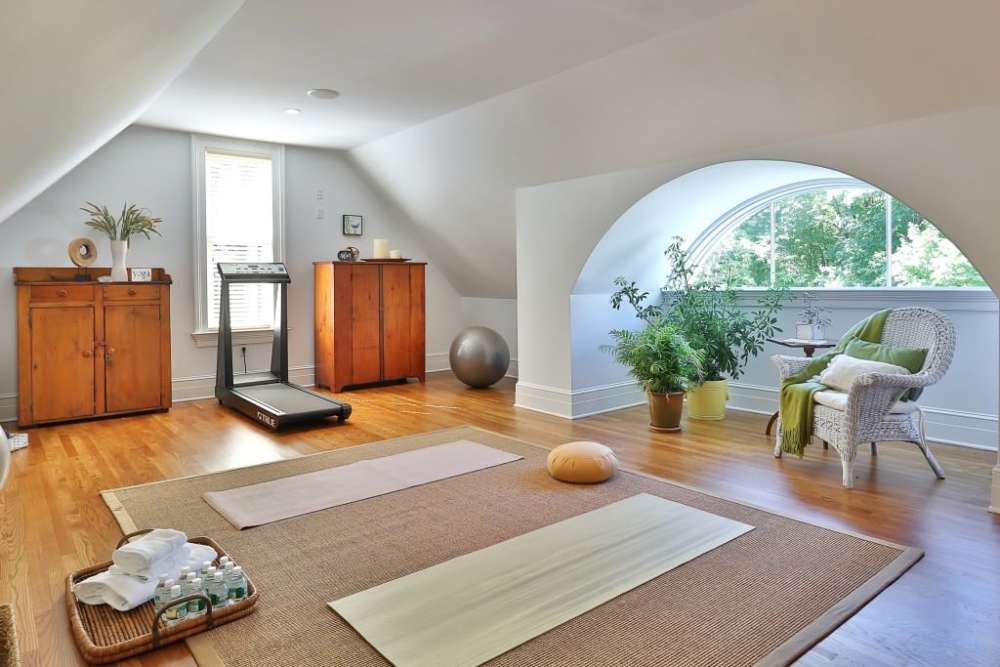
Image source: DeGraw & DeHaan Architects
This is the central choice. Both are authentic. Both work. The decision comes down to your lifestyle and your floor.
Platform beds keep your mattress 6 to 14 inches off the ground. Solid wood frames in white oak, hinoki cypress, or paulownia are the go-to materials. Thuma and Karup Design both make platform beds that hit the right proportions without overdoing it.
Floor futons (shikibuton mattresses paired with kakebuton comforters) are the traditional Japanese setup. You roll them out on tatami mats at night and store them during the day. It’s the most space-efficient option, and it forces you to keep the room clean. No bed means no under-bed clutter.
One thing that took me a while to figure out: floor futons need airflow underneath or they develop mold. A tatami mat base helps, but you still need to hang the futon to air it out regularly. Most Western floors aren’t designed for this.
Storage Without Clutter
Japanese bedrooms handle storage differently. Tansu chests, the traditional stepped wooden storage pieces, offer drawers and compartments in a compact footprint. They’re functional and look like they belong.
Low dressers replace tall wardrobes. Everything stays below eye level, which preserves the sense of open space that makes this style work.
Chabudai tables (low, sometimes foldable) serve as nightstands. They sit just a few inches off the ground. Western nightstands tower over a platform bed. A chabudai sits beside it at the right height.
IKEA’s LACK series, while not Japanese, hits close to the right scale and proportion for bedside use in this style. Sometimes the right piece comes from unexpected places.
Natural Materials and Textures
You can’t fake the material palette in a Japanese bedroom. Plastic, laminate, and synthetic fabrics stand out immediately. The whole approach depends on surfaces you can actually feel, things that age and change over time.
The Spruce reported that 68% of homeowners in 2024 prioritized sustainable, natural materials in their interiors. Japanese bedroom decor has been doing this for centuries, long before “sustainable” became a marketing term.
Wood Species That Work
Hinoki cypress is the gold standard. It’s light-colored, naturally aromatic, and resistant to moisture and decay. Traditional Japanese baths (ofuro) are made from hinoki for exactly these reasons. In a bedroom, it shows up in bed frames, shelving, and small accent pieces.
Paulownia wood is extremely lightweight and commonly used in tansu chests. White oak gives you a similar visual tone with wider availability outside Japan. Bamboo works for smaller accessories and flooring.
The thing all these woods share is a visible, honest grain. No heavy stains. No glossy lacquer. A textural quality that you notice when you run your hand across the surface.
Tatami, Linen, and Washi
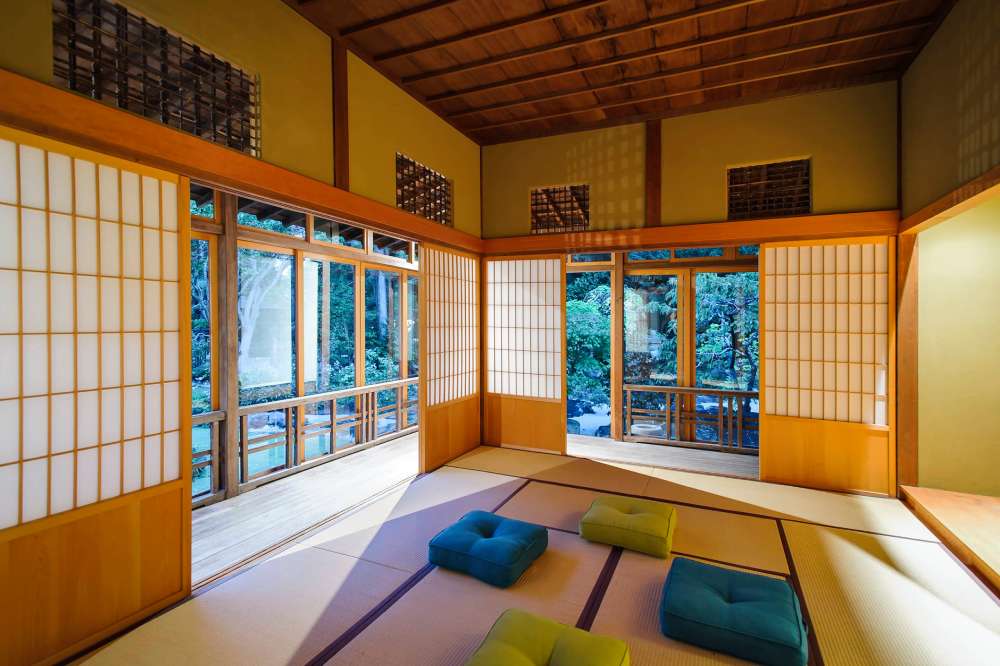
Image source: Dennis Mayer – Photographer
The global tatami mat market was valued at roughly $847 million in 2024 and is projected to reach $1.32 billion by 2033, according to Data Horizon Research. That growth is driven by people outside Japan adopting tatami for its look, its feel, and its natural humidity regulation.
Tatami mats are woven from rush grass (igusa) over a compressed rice straw core. They provide natural insulation, absorb sound, and release a subtle grassy scent that fades over months. You don’t need to cover an entire floor. Even a single mat beside a platform bed changes the room.
Linen and organic cotton handle bedding and window treatments. Hemp shows up in heavier textiles. The common thread: nothing shiny, nothing synthetic.
Washi paper, handmade from plant fibers, appears in lamp shades and wall panels. It diffuses light in a way that no other material quite matches. Isamu Noguchi built his entire Akari Light Sculptures series around this property.
Lighting in Japanese Bedroom Design
Lighting does more heavy lifting in a Japanese bedroom than in almost any other style. The goal is soft, diffused, warm light that fills the room without a visible source screaming at you from the ceiling.
If there’s one thing that ruins a Japanese bedroom instantly, it’s a grid of recessed ceiling lights. They’re fine in a kitchen. In a bedroom going for this look, they create a commercial, office-like vibe that fights everything else in the room.
Paper Lanterns and Pendants
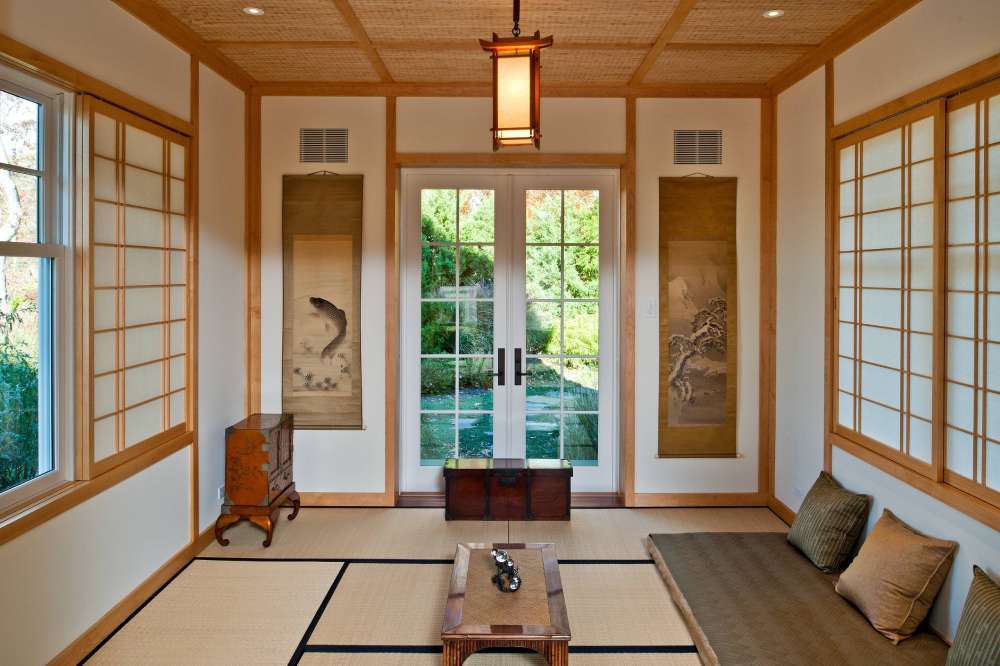
Image source: Thompson Raissis Architects
The Noguchi Akari series is the reference point here. These washi paper and bamboo pendant lights have been in production since the 1950s, and they still look right in a contemporary Japanese bedroom.
They work because of how washi paper handles light. It scatters it evenly, removes harsh shadows, and creates a warm glow that fills the room from a single fixture. No lamp shade made from fabric or glass does quite the same thing.
You don’t need a genuine Noguchi piece (they’re pricey). But you need something that does the same job. Paper lantern pendants from various makers hit the same note at a fraction of the cost.
Shoji Screens as Light Diffusers
Shoji screens aren’t just decorative room dividers. In a Japanese bedroom, they function as light control.
Placed over a window, a shoji screen filters direct sunlight into an even, soft wash across the room. The quality of light changes completely. Harsh morning sun becomes something you actually want to wake up to.
Traditional shoji use a wooden lattice frame with translucent washi paper panels. Modern versions sometimes substitute rice paper with synthetic alternatives for durability, but the effect on light remains similar.
Where to Place Light Sources
Floor-level lighting is underused in Western bedrooms but common in Japanese ones. A small lamp on the ground near a wall washes light upward, creating ambient warmth without any overhead glare.
Color temperature matters. Stay in the 2700K to 3000K range. Anything above 3500K starts feeling cold and clinical, which fights the natural materials around it.
And skip the multiple-source approach where every corner has its own lamp. One or two well-placed accent lights, plus a pendant, is usually enough. Japanese bedrooms don’t need to be bright. They need to feel warm.
Wall Decor and Art in Japanese Bedrooms
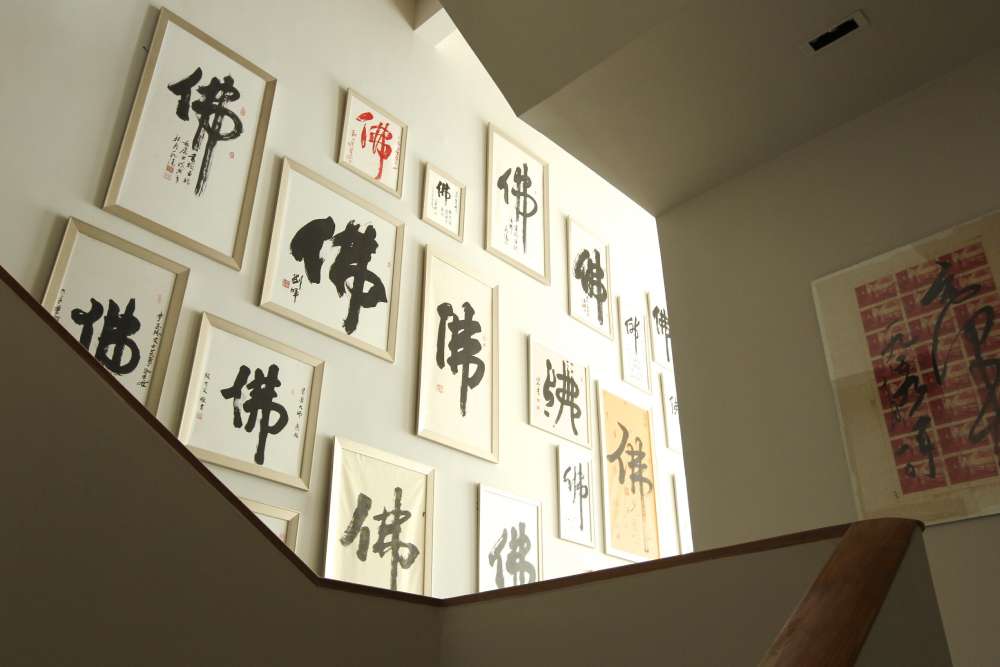
Image source: Blake Civiello Architecture
The walls in a Japanese bedroom are mostly empty. That’s not laziness. That’s the point.
Ma, the concept of meaningful empty space, treats blank walls as a design element. The space between objects matters as much as the objects themselves. So when you do place something on a wall, it carries weight. It becomes the focal point of the entire room.
Kakejiku and Hanging Scrolls
A kakejiku (hanging scroll) is the most traditional wall piece in a Japanese bedroom. It typically features calligraphy, a sumi-e ink painting, or a seasonal nature scene. One scroll. Centered in a visible area or hung in a tokonoma (display alcove) if the room has one.
The scroll changes with the seasons in traditional practice. Cherry blossoms in spring. Bamboo in summer. Autumn leaves. Snow scenes in winter. That rotation keeps the room feeling alive without adding more objects.
What Goes on the Walls (and What Doesn’t)
Gallery walls don’t belong here. Neither do large framed collections or photo clusters. The asymmetric placement of a single piece is more aligned with this style than a balanced grid of frames.
Ukiyo-e woodblock prints (reproductions, obviously) work well as a single statement piece. A Hokusai wave print or a Hiroshige landscape in a simple wooden frame, hung with breathing room on all sides.
Noren curtains, the short fabric panels that hang in doorways, also double as wall decor. They add subtle pattern and textile warmth without crowding the visual field.
Honestly, the hardest part of decorating a Japanese bedroom wall is restraint. The instinct to “fill the space” runs deep. But leaving that wall 80% bare is what gives the one piece you do hang its power.
Plants and Natural Elements
Greenery in a Japanese bedroom follows rules most Western plant styling ignores. You don’t fill a shelf with six succulents and a trailing pothos. You place one bonsai on a low stand and let it be the only living thing in the room besides you.
Research published in Frontiers in Physiology found that biophilic design (bringing natural elements indoors) increased well-being by 47% and creativity by 45% in studied environments. Japanese bedrooms have been doing this instinctively for centuries, just with far fewer plants than a typical Western approach.
What to Grow and Where to Put It
Bonsai is the obvious choice, and for good reason. A single specimen on a wooden stand near a window says more than a dozen houseplants crammed onto a windowsill.
Kokedama (moss ball plants) work well hung near a window or placed on a ceramic dish. Ikebana arrangements, the Japanese art of flower arranging, use seasonal cuttings in asymmetric compositions. Three stems. Maybe five. Never a full bouquet.
The indoor plants market hit $2.1 billion in 2024 and is projected to reach $4.3 billion by 2034, according to Emergen Research. The residential segment accounted for 58% of that market. People are buying plants. The Japanese approach just asks you to buy fewer of them and place them better.
Placement Logic
Odd numbers. Always.
One plant is fine. Three grouped at different heights works. Two feels incomplete, and four feels cluttered in this context. The Japanese concept of asymmetric arrangement applies directly here, though note that asymmetry has already been covered in our wall decor discussion, so I’ll keep this focused on greenery.
Actually, scratch that second link. The real point is simpler than any design principle: if your bedroom has a plant in every corner, it stops being a Japanese bedroom and starts being a greenhouse. Pick a spot. Commit to it.
Seasonal Rotation
Spring: cherry blossom branches (even dried ones)
Summer: a single fern or bamboo cutting in water
Autumn: dried maple branches, persimmon-colored leaves
Winter: a bare branch in a ceramic vase. Just the branch.
This rotation keeps the room alive without adding objects. The vase stays. The contents change. That’s how traditional Japanese rooms have handled seasonal details for hundreds of years.
Textiles and Bedding Choices
The bed is the largest surface in any bedroom. In Japanese decor, that surface needs to look calm, feel natural against skin, and not compete with anything else in the room.
Grand View Research valued the global organic bedding market at $936.4 million in 2023, growing at 5.4% annually through 2030. Linen is the fastest-growing segment at 6.0% CAGR. Both of those numbers reflect what’s happening in Japanese-style bedrooms: people choosing natural fibers over synthetic ones.
Authentic Japanese Bedding
| Item | What It Is | Best For |
|---|---|---|
| Shikibuton | Thin floor mattress (typically 3–4 inches thick) | Authentic floor sleeping: Best used on tatami mats or firm surfaces; easy to fold and store. |
| Kakebuton | Lightweight, hand-stitched Japanese comforter | Breathable warmth: A year-round top layer that regulates body temperature naturally. |
| Makura | Traditional pillow filled with buckwheat hulls | Firm support: Provides stable, cool neck alignment; ideal for those who dislike soft foam. |
| Sobakawa | Smaller-scale buckwheat-filled pillow | Precision support: Excellent for side sleepers needing specific neck height or as a travel companion. |
These pieces are designed for floor sleeping. If you’re using a platform bed instead, you can still use a kakebuton as your top layer. It’s lighter than a Western duvet and drapes differently, with a softer, less puffy silhouette.
Western-Accessible Alternatives
Not everyone wants to sleep on a three-inch-thick floor mattress. That’s fine.
Linen sheets in oatmeal, sand, or warm white hit the right visual tone. They wrinkle naturally, which actually works in this style. A perfectly smooth, hotel-crisp bed fights the wabi-sabi philosophy. COYUCHI and Boll & Branch both offer GOTS-certified organic linen that fits the look.
For accent textiles, look at sashiko-stitched fabrics (the geometric running-stitch pattern used in Japanese mending), kasuri (ikat-style woven patterns), or shibori-dyed pieces. One shibori throw pillow on the bed is plenty.
The Layering Philosophy
Western bedding piles it on. Fitted sheet, flat sheet, duvet, throw blanket, four decorative pillows, two Euro shams.
Japanese approach: fewer layers, higher quality. A fitted sheet. A kakebuton or linen duvet. One pillow per person. Maybe a single throw pillow combination for daytime. Done.
The bed should look like someone actually sleeps in it, not like a catalog shoot. If you’re spending less on quantity, put that money into better materials.
Small Japanese Bedroom Layouts
Japanese design was built for small rooms. The average apartment in Tokyo offers around 20 to 30 square meters of total living space. Bedrooms inside those apartments might be six tatami mats wide, roughly 100 square feet. So when someone says this style “works well in small spaces,” that’s an understatement. It was invented for them.
Credence Research projects Japan’s interior design market will reach $12.6 billion by 2032, with Tokyo, Osaka, and Kyoto leading demand. Small-space design drives a huge chunk of that growth.
Floor Plans That Work
10×10 room: Platform bed centered against one wall. One low nightstand. Nothing else on the floor. Wall-mounted shelf for a single plant or object. That’s the whole room.
10×12 room: Platform bed with a chabudai on one side. A low tansu chest against the opposite wall. Shoji screen or curtain covering the closet opening instead of a swing door, which saves roughly 8 square feet of clearance space.
The trick with small bedroom layouts in this style: you’re not trying to fit more in. You’re trying to keep things out. Every piece of furniture earns its place or it goes.
Vertical Storage and Built-Ins
Good space planning means thinking vertically when floor area runs tight.
- Floating shelves in light wood, mounted at varying heights
- Built-in closets with sliding panels instead of hinged doors
- Wall-mounted hooks (bamboo or wood) for items used daily
The goal is to keep the floor visible. In Japanese rooms, seeing the floor is part of the experience. The more floor you can see, the larger the room feels. This is how you make a small room feel bigger without any visual tricks.
Doors and Dividers
Swing doors eat space. Sliding doors don’t.
Shoji-style sliding panels, noren curtains in doorways, or even a simple linen panel on a tension rod all do the same job: they separate areas without consuming square footage. In a 10×10 bedroom, switching from a swing door to a slider or curtain can free up enough room for a small side table. It seems minor. It’s not.
Common Mistakes in Japanese Bedroom Styling
Most failed attempts at Japanese bedroom decor share the same root problem. People treat it like a theme instead of a set of design principles. There’s a difference between decorating with Japanese objects and designing with Japanese thinking.
Overcrowding With “Zen” Accessories
This is the number one mistake, and I’ve seen it dozens of times.
A Buddha statue on the nightstand. A bamboo fountain on the dresser. A rock garden in the corner. Incense holder. Three different bonsai. Suddenly the room looks like a gift shop in a tourist district, not a bedroom.
The whole point of this style is restraint. If removing an object wouldn’t change how the room feels, the object shouldn’t be there. Period.
Mixing Conflicting Styles
| What Clashes | Why It Doesn’t Work |
|---|---|
| Industrial metal frames | Material Tension: Hard, cold, and machine-perfect edges fight the soft, organic warmth and “honest” aging of wabi-sabi. |
| Bold maximalist patterns | Sensory Overload: High-contrast geometric or floral prints overwhelm the quiet, muted palette intended to foster serenity. |
| Glossy lacquer finishes | Surface Friction: Reflective, “new-forever” surfaces are too polished and artificial for an aesthetic that celebrates the patina of time. |
| Heavy upholstered headboards | Visual Weight: Oversized, foam-heavy structures feel “filled” and bulky, clashing with the lean, airy, and grounded nature of minimalist design. |
| Mass-produced “sets” | Lack of Soul: Identical, factory-perfect furniture lacks the unique story and subtle imperfections found in handcrafted or vintage pieces. |
Some styles blend well with Japanese decor. Scandinavian design is the obvious partner (that’s literally what Japandi is). Modern design can work if you keep it restrained. But industrial aesthetics, exposed pipe shelving, and raw steel don’t belong here.
Ignoring the Floor
In most Western bedrooms, the floor is an afterthought. Carpet or hardwood, throw a rug down, move on.
In Japanese design, the floor is a primary surface. You sit on it. You sleep near it. You might eat at a chabudai placed directly on it. Choosing the wrong flooring, or ignoring it entirely, undercuts everything else you’ve done in the room.
Tatami mats, natural jute, sisal, or at minimum a light-toned hardwood that shows its grain. Paint colors that pair well with wood floors become especially relevant when the floor takes up this much visual real estate.
Going Too Dark
Dark walnut. Espresso stain. Black-stained furniture.
These tones weigh a room down and work against the airy, open feeling that defines Japanese bedrooms. Stick with light to medium wood tones. White oak, ash, birch, or the lighter Japanese species like paulownia and hinoki. The room should feel like it has air in it, not like the walls are closing in.
Look, getting this style right isn’t about perfection. (That would actually go against wabi-sabi.) It’s about understanding why the room should feel a certain way and then making choices that support that feeling instead of fighting it. Start with less. Add only what the room asks for. And if you’re not sure whether something belongs, it probably doesn’t.
FAQ on Japanese Bedroom Decor
What defines Japanese bedroom decor?
It’s a design approach rooted in wabi-sabi, kanso, and ma. Low-profile furniture, natural materials like hinoki wood and tatami, muted earth tones, and intentional empty space. Every object in the room serves a clear purpose.
What colors work best in a Japanese-style bedroom?
Warm whites, sand, taupe, and soft grays form the base. Accent sparingly with indigo, moss green, or charcoal. Avoid saturated or high-contrast walls. The palette should feel quiet and drawn from nature.
Should I use a futon or a platform bed?
Both are authentic. A shikibuton on tatami mats is traditional and saves space. A wooden platform bed (under 14 inches high) in white oak or paulownia offers the same low profile with more Western comfort.
What is the difference between Japanese decor and Japandi?
Japandi blends Japanese and Scandinavian aesthetics. Pure Japanese decor leans heavier into asymmetry, wabi-sabi imperfection, and cultural elements like shoji screens and kakejiku scrolls. Japandi smooths those edges with lighter Scandinavian warmth.
How do I light a Japanese bedroom?
Use soft, diffused light. Washi paper lanterns or Noguchi Akari-style pendants work well. Stay in the 2700K to 3000K color temperature range. Floor-level lamps and indirect sources beat overhead recessed grids every time.
What materials are used in Japanese bedroom furniture?
Hinoki cypress, paulownia, bamboo, and white oak are common. Tatami mats cover floors. Linen, organic cotton, and hemp handle textiles. Washi paper shows up in lighting. Everything stays natural, uncoated, and honest in its grain.
Can Japanese bedroom decor work in a small room?
It works better in small rooms than most styles. The design was built for compact Japanese apartments. Negative space scales down naturally. Low furniture, sliding doors, and vertical storage keep even a 10×10 room feeling open.
What wall art fits a Japanese bedroom?
One piece, placed with breathing room. A kakejiku hanging scroll, a sumi-e ink painting, or a single ukiyo-e woodblock print. Noren curtains also double as wall decor. Skip gallery walls entirely. Blank space is the design.
What plants belong in a Japanese bedroom?
Bonsai, kokedama, and ikebana arrangements are the most fitting choices. Use odd numbers. One well-placed plant beats five scattered ones. Rotate seasonal cuttings (cherry blossom in spring, bare branches in winter) to keep things fresh.
What are common mistakes in Japanese bedroom styling?
Overcrowding with “zen” accessories like Buddha statues and bamboo fountains. Mixing in industrial or maximalist elements. Choosing dark, heavy wood tones. Treating it like a theme rather than a set of design principles built on restraint.
Conclusion
Japanese bedroom decor isn’t a trend you follow for a season and replace. It’s a way of thinking about your space that stays useful long after the Pinterest boards move on to something else.
The platform bed, the tatami mat, the single bonsai on a wooden stand. These aren’t decorative choices. They’re decisions rooted in wabi-sabi and kanso that prioritize how a room feels over how it photographs.
Start with one change. Swap your tall nightstand for a low chabudai table. Replace synthetic bedding with organic linen. Remove three things from your bedroom that serve no function.
A room built on natural wood, muted earth tones, and honest materials doesn’t need much to feel complete. Give it less. It’ll give you more back.

- Paint Colors That Go with Gray Floors - August 20, 2026
- What Color Bedding Goes with Dark Wood Furniture - August 18, 2026
- What Color Walls Go with Oak Floors - August 16, 2026


