Color Combinations
Best Colors for Bedroom Walls to Rest and Recharge

Your wall color is working on your nervous system every night before you fall asleep. Most people never think about it.
The best colors for bedroom walls are not simply a matter of taste. Research in color psychology consistently shows that specific shades lower heart rate, reduce cortisol, and support melatonin production. Others do the opposite.
A 2024 survey of 2,674 U.S. respondents found that 38% reported better sleep after changing their bedroom wall color. That is a significant result from a single paint job.
This guide covers which calming bedroom colors perform best, which shades to avoid, and how room size, paint finish, and light direction affect every decision.
Our color combination guide covers the same decisions for every other room.
What Are the Best Colors for Bedroom Walls?

The best colors for bedroom walls are soft blue, sage green, warm gray, pale beige, and off-white. These five shades consistently produce the lowest physiological arousal levels, the highest melatonin support, and the most favorable sleep outcomes across color psychology studies and large-scale surveys.
A 2024 BedroomZZ and Houszed survey of 2,674 U.S. respondents found that 38% reported improved sleep quality after changing their bedroom wall color (BedroomZZ/Houszed, 2024). That is a significant return on a single paint job.
Each color below has a distinct physiological reason for its effect. Picking the right one depends on your room’s light direction, size, and your specific sleep challenge.
| Color | Avg. Sleep | Primary Effect | Best For |
| Soft blue | 7h 52min | Lowers heart rate; calms ganglion cells | Insomniacs, anxiety, high-heat sleepers |
| Sage green | 7h 36min | Activates parasympathetic nervous system | High-stress sleepers, “Biophilic” rooms |
| Soft yellow | 7h 40min | Warm comfort without overstimulation | North-facing rooms, naturally dark spaces |
| Warm gray | ~7h 30min | Low arousal; neutral visual weight | Shared bedrooms, transitional styles |
| Off-white | ~7h 25min | High LRV; minimal visual noise | Small rooms, minimalist sanctuaries |
The colors to avoid are purple, bright red, saturated orange, and electric yellow. These shades increase heart rate variability and cortisol production, working against the body’s natural pre-sleep wind-down process.
Why Does Wall Color Affect Sleep Quality?
Wall color affects sleep quality by triggering measurable physiological responses in the nervous system before you close your eyes. The process begins the moment you enter the room.
The human retina contains specialized photoreceptors called intrinsically photosensitive retinal ganglion cells. These cells are highly sensitive to specific wavelengths of light and send signals directly to the suprachiasmatic nucleus, the brain structure that governs the body’s circadian rhythm. Cool-toned colors with short wavelengths activate a calming response. Warm, saturated colors with long wavelengths increase arousal.
Research published in the journal Color Research and Application found that colors in the red, purple, and yellow areas of the color spectrum produced the highest heart rate variability arousal levels, while gray and blue produced the lowest (Kuller et al., 2006).
How Color Connects to Cortisol and Melatonin
Cortisol is the body’s primary stress hormone. Melatonin is the hormone that signals sleep onset. These two operate in opposition.
Overstimulating colors keep cortisol elevated longer into the evening, which delays melatonin production. A bedroom painted in a high-arousal color effectively extends your body’s alert state past the point where sleep should begin.
Studies suggest that muted, cool-toned wall colors reduce sympathetic nervous system activity and support the transition into parasympathetic dominance, the physiological state the body needs for sleep (Ulrich, Stress Reduction Theory, 1982).
The Role of Color Saturation
Saturation matters more than hue in many cases. A muted, grayed version of almost any color will produce less arousal than a saturated version of the same hue.
This is why a soft dusty blue works for sleep but an electric cobalt does not. Both are blue. The difference is saturation level, not the color family.
The practical takeaway: when selecting any bedroom wall color, choose the most muted, grayed, or softened version of that hue available. High-chroma paint, regardless of color, increases visual stimulation.
What Makes Blue the Top Choice for Bedroom Walls?

Blue is the top bedroom wall color because it directly activates the retinal ganglion cells that signal the brain to lower heart rate, reduce blood pressure, and begin the pre-sleep physiological wind-down. No other color has this specific neurological pathway.
The Travelodge survey of 2,000 British homes found that blue bedroom occupants averaged 7 hours and 52 minutes of sleep per night, the highest of all colors tested. That is nearly 2 full hours more per night than those sleeping in purple rooms (Travelodge, 2013).
Which Shades of Blue Work Best?
Powder blue, slate blue, and dusty sky blue are the most effective shades for sleep. These share one characteristic: low saturation with a slight gray or silver undertone.
- Benjamin Moore “Quiet Moments” (HC-158) – gray-blue, LRV 58
- Sherwin-Williams “Sleepy Blue” (SW 6225) – soft, muted medium blue
- Farrow & Ball “Lulworth Blue” – warm, chalky blue with depth
Each of these reads as calm rather than clinical. The gray undertone prevents the color from feeling cold, which is a common problem with cooler blues in north-facing rooms.
Which Blue Shades to Avoid in a Bedroom?
Electric blue, cobalt, and navy in full saturation all increase visual stimulation rather than reducing it. Navy works only when its LRV sits below 20, which limits it to rooms with generous natural light and warm artificial lighting at 2,700-3,000K.
Professor Anna Franklin at the University of Sussex identified dark blue as the world’s most relaxing color, but specifically referenced muted, desaturated versions rather than high-intensity jewel tones.
How Does Green Perform as a Bedroom Wall Color?

Green is the second strongest sleep-supportive color, averaging 7 hours and 36 minutes per night in the Travelodge study. Its mechanism differs from blue: where blue works neurologically through ganglion cell stimulation, green works psychologically through its connection to natural environments.
According to Attention Restoration Theory (Kaplan & Kaplan, 1989), human cognitive systems recover faster in environments that reference nature. Green walls activate this restoration response, reducing the psychological fatigue and mental alertness that delay sleep onset.
Research published in Frontiers in Psychology (2025) confirmed that biophilic design elements, including green color schemes, measurably improve perceived restorativeness and reduce sympathetic nervous system activity in indoor spaces.
Sage Green vs. Other Green Shades
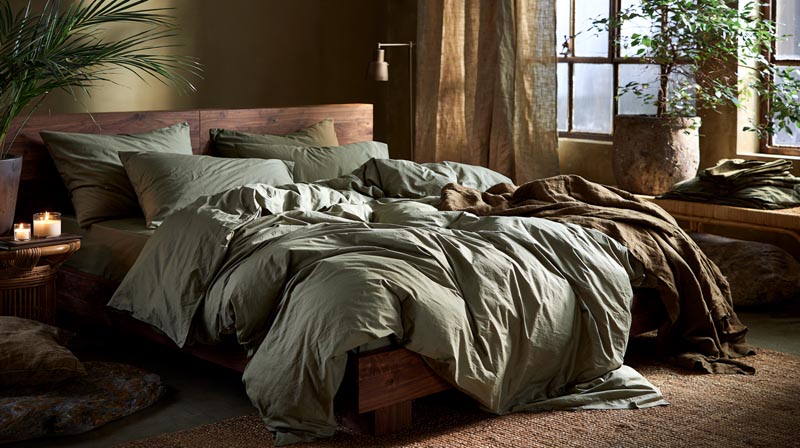
Sage green is the standout choice. It combines gray and brown undertones with the green base, producing a warm, earthy tone that reads as neutral from a distance but delivers the nature-connection benefit up close.
| Green Shade | Effect | Use |
| Sage green | Calming, grounding, low stimulation | All bedroom types; the “universal” sleeper |
| Forest green | Rich, cocooning, adds visual weight | Large, well-lit bedrooms; “Moody Luxe” style |
| Lime / Chartreuse | High stimulation, increases alertness | Avoid in bedrooms; best for gyms or offices |
| Olive green | Warm, earthy, grounding | South-facing rooms; pairs well with oak/walnut |
| Mint green | Refreshing, airy, cool | Small rooms; north-facing “brightening” effect |
Paint references: Farrow & Ball “Mizzle” (No.84) and Benjamin Moore “Pale Sage” (CSP-820) are the two most consistent performers across different light conditions and room sizes.
Green pairs well with natural wood furniture, linen bedding, and warm white trim. This is a combination that supports biophilic interior design principles in a bedroom without requiring structural changes.
When Is Gray a Good Bedroom Wall Color?

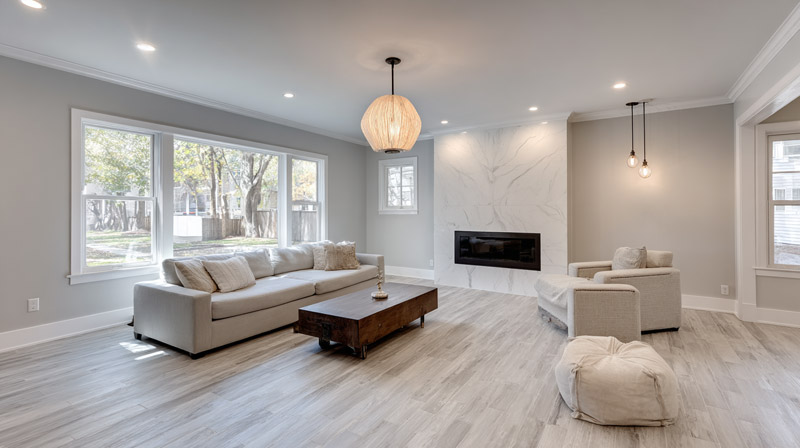
Gray works in a bedroom when it is warm-toned and paired with warm lighting. Cold gray, used without intentional warmth correction, produces the opposite of the intended result.
The Travelodge study found that gray bedroom occupants averaged only 6 hours and 12 minutes of sleep per night, placing it near the bottom of tested colors. The reason: pure cool gray is perceived as emotionally flat and isolating, raising mild background stress rather than reducing it.
Warm Gray vs. Cool Gray
Warm gray (greige) reads differently from cool gray at a neurological level. The brown or beige undertone in greige adds perceived warmth to the room, shifting the emotional association from isolation toward comfort.
- Sherwin-Williams “Agreeable Gray” (SW 7029) – warm, brown-undertoned greige
- Benjamin Moore “Pale Oak” (OC-20) – warm gray with pink-beige undertone
- Farrow & Ball “Elephant’s Breath” – complex warm gray with green-pink shift
Cool grays like Sherwin-Williams “Repose Gray” or Benjamin Moore “Stonington Gray” need warm lighting (2,700K bulbs maximum) and warm-toned textiles to avoid reading as cold and clinical at night.
Room Size Consideration for Gray
Light gray expands perceived space. Dark gray contracts it. In a bedroom under 150 square feet, dark gray will feel oppressive regardless of lighting.
The LRV of any gray selected for a bedroom should sit between 35 and 65. Below 35, the room loses its sense of space. Above 65, the gray reads as off-white and loses its tonal identity.
What Role Does White Play in Bedroom Wall Color?

White is not a default safe choice for bedrooms. Bright white reflects a high proportion of blue-spectrum light, which increases alertness rather than promoting relaxation. The version of white matters enormously.
A BedroomZZ/Houszed survey showed that among respondents who reported worse sleep after repainting, a significant portion had moved toward stark, bright whites, particularly in rooms with south-facing windows (BedroomZZ/Houszed, 2024).
Bright White vs. Soft White
Key difference: The LRV determines how much light a white reflects, and in a bedroom, high-LRV whites can amplify existing light to the point of disrupting the visual calm needed for sleep onset.
| White Type | LRV Range | Bedroom Suitability |
| Bright white | 88–94 | Poor: High light bounce; feels clinical at night |
| Soft white / off-white | 75–87 | Good: Best for small, dark, or north-facing rooms |
| Warm white / cream | 65–78 | Best: Minimal glare; provides “visual warmth” |
| Antique / Bone white | 60–70 | Excellent: “Cozy” baseline for traditional rooms |
Benjamin Moore “White Dove” (OC-17, LRV 83) and Dulux “Jasmine White” are the most used soft whites in bedroom design because both carry a warm undertone that shifts the room’s feel away from clinical brightness.
Where White Works in a Bedroom
White works best as a ceiling color in any bedroom, and as a full wall color only in rooms that receive limited natural light. It is also a useful tool for small bedrooms where other calming colors would make the space feel smaller.
The paint finish matters here. Matte white absorbs light rather than bouncing it around the room, making it far more suitable for a sleep environment than eggshell or satin white finishes.
How Do Warm Colors Like Beige and Terracotta Affect Bedroom Mood?

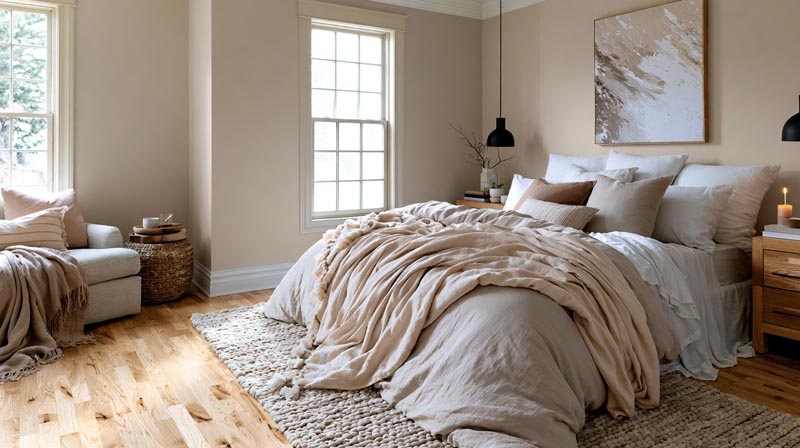
Warm neutrals and earthy tones produce a sense of comfort and low stimulation when used in their muted forms. Beige, warm sand, and pale terracotta are among the most forgiving bedroom colors because they work across a wide range of light conditions and furniture styles.
Color psychology research by Faber Birren established that warm-toned interiors increase perceived room temperature by approximately 3-4 degrees Fahrenheit compared to cool-toned rooms of identical size. In a bedroom, this translates to a physically cocooning sensation that supports sleep onset.
Beige and Warm Sand
Beige is consistently underrated as a bedroom color. Its combination of low saturation, warm undertones, and mid-range LRV (typically 45-65) produces one of the least stimulating visual environments possible.
Sherwin-Williams “Toasted Coconut” and Benjamin Moore “Pale Straw” are specific shades that sit in this range. Both pair well with linen, natural wood, and warm white trim without requiring a full redesign of existing furniture.
People rebuilding sleep environments after insomnia often gravitate toward beige and warm neutrals because the color reads as visually quiet. There is no bold decision to process when you walk into the room.
Terracotta in a Bedroom
Terracotta is higher-risk. Its orange-red base sits in the portion of the color spectrum associated with increased physiological arousal, and at full saturation, it can work against sleep quality.
How to use it effectively:
- Limit terracotta to a single accent wall behind the bed, not all four walls
- Choose a dusty, muted version with significant gray or brown in the base (Farrow & Ball “Dead Salmon” is the benchmark here)
- Pair with cool-toned bedding and soft white ceiling to balance the warmth
- Avoid in rooms under 130 square feet where the color will dominate
The earthy color palette approach in interior design recommends using terracotta as part of a layered neutral scheme rather than as a dominant wall color in spaces intended for rest.
Which Colors Hurt Sleep Quality and Should Be Avoided?
High-saturation colors increase physiological arousal before sleep by elevating heart rate variability and delaying melatonin onset. The colors below do this most reliably.
The Travelodge survey found that purple bedroom occupants averaged just 5 hours and 56 minutes of sleep per night, nearly 2 full hours less than blue bedroom occupants (Travelodge, 2013). That gap is not aesthetic preference. It is a measurable physiological difference.
Colors That Actively Disrupt Sleep
Red: raises physiological arousal and increases skin conductance (Buechner & Maier, PeerJ, 2016). The most consistent high-arousal color in clinical color research. Avoid as a primary wall color in any bedroom.
Bright purple: mentally stimulating, associated with creativity and imagination. The Travelodge data shows it produces the worst sleep outcomes of any tested color. Deep, saturated purples are the most problematic version.
Electric yellow and bright orange: both increase serotonin and alertness. Soft butter yellow works in bedrooms. Saturated versions do not. The distinction is saturation level, not hue family.
Lime green and neon tones: high-saturation greens trigger the visual system rather than calming it. The nature-restoration benefit green provides disappears at high chroma.
A 2018 study published in Psychological Research (Wilms & Oberfeld) confirmed that saturation level predicts emotional arousal more reliably than hue across most color families. This means any highly saturated color, even a nominally “calm” hue like blue, can disrupt sleep when used at high chroma.
The Saturation Rule
Saturation is the single variable that determines whether a color supports or disrupts sleep. Not the color family.
A muted, grayed navy can be appropriate for a bedroom. A vivid cobalt cannot. A dusty mauve can work. A saturated violet will not. The practical test: if the color reads as vibrant or intense from across the room, the saturation level is too high for a sleep environment.
The Casper-Gallup 2022 American Sleep Status Report found that one in three Americans rates their sleep quality as “average” or “poor.” Wall color is one controllable variable in a sleep environment that requires no behavioral change to address.
How Does Room Size and Light Change the Best Color Choice?
Room orientation and size change how every paint color reads on a wall. The same soft blue that works perfectly in a south-facing bedroom can feel cold and flat in a north-facing room with limited natural light.
LRV (Light Reflectance Value) is the practical tool for making these decisions. It measures the percentage of light a paint color reflects, on a scale from 0 (black) to 100 (white). Colors with LRV above 50 reflect more light than they absorb. Colors below 50 absorb more than they reflect.
Best Colors for Small Bedrooms

Small rooms under 150 square feet need wall colors with LRV of 55 or higher. This prevents the room from feeling cramped while still delivering the calming effect needed for sleep.
- Soft white or off-white (LRV 75-85): the highest-expansion option
- Pale sage green (LRV 60-70): adds color without reducing perceived space
- Powder blue with gray undertone (LRV 58-65): calm and spatially generous
- Light warm greige (LRV 55-65): neutral expansion with warmth
Avoid any color with LRV below 40 in a small bedroom. Dark tones absorb light and visually contract the space, which increases psychological tension rather than reducing it.
Best Colors for Large or Bright Bedrooms
Large, well-lit bedrooms can absorb deeper tones without feeling oppressive. In fact, large rooms with pale colors sometimes feel clinical rather than calming, because the scale of the wall surface amplifies the brightness.
Key principle: in a room over 200 square feet with south or east-facing windows, a color with LRV of 35-55 often produces a more restful result than a high-LRV pale.
| Room Orientation | Light Quality | Best Color Direction |
| North-facing | Cool, flat, limited | Warm greige, soft yellow, warm white |
| South-facing | Warm, bright, intense | Cool blues, sage green, slate gray |
| East-facing | Bright morning, dim PM | Mid-tone neutrals, warm blue-gray |
| West-facing | Warm PM, dark morning | Muted cool tones to balance heat |
Farrow & Ball has long recommended testing paint colors at different times of day before committing, specifically because north-facing rooms make cool tones read significantly colder than they appear on a chip in store lighting.
How Does Paint Finish Affect the Final Color Result?
Paint finish changes how a color reads in a bedroom by controlling how much light the surface bounces back. Two walls painted in identical colors but different finishes will look and feel different.
Matte paint reflects 3-10% of light. Eggshell reflects 10-25%. Satin reflects 25-35%. Semi-gloss reflects 35-70% (Angi, 2024). In a bedroom, the difference between matte and eggshell is the difference between a wall that absorbs ambient light and one that gently throws it back.
Matte Finish in a Bedroom

Matte is the default recommendation for adult bedrooms. It absorbs light rather than reflecting it, which reduces visual stimulation and enhances the saturation and depth of the wall color. Blues look moodier, greens feel more grounded.
Trade-off: matte is harder to clean. A single scuff often requires repainting the entire section rather than spot-wiping. Not ideal for households with children.
Mylands paint CEO Dominic Myland recommends matte specifically for bedrooms, noting that living spaces exposed to less moisture benefit from the finish’s imperfection-hiding properties as well as its visual calm (Homes and Gardens, 2022).
Eggshell Finish in a Bedroom
Eggshell adds a soft warmth that matte does not. Its slight sheen catches light gently, making the room feel more alive during the day while remaining calm at night under lower artificial lighting.
Works best for:
- Bedrooms with limited natural light that need more perceived brightness
- Rooms used by children or teenagers (easier to clean)
- Walls in good condition (eggshell shows imperfections that matte hides)
Semi-gloss is not appropriate for bedroom walls. Its reflectivity is too high, it amplifies every surface irregularity, and it actively works against the calm visual environment that supports sleep onset.
How Many Wall Colors Work in One Bedroom?
One color used consistently across all four walls produces the lowest visual complexity and the strongest sleep-support environment. Every additional color adds a decision for the brain to process when entering the room.
That said, an accent wall done correctly adds depth without meaningfully increasing visual stimulation. The key is the relationship between the accent and the main wall color.
Single Color vs. Accent Wall
Single color: all four walls in the same muted tone. Produces the most cocooning, low-stimulation environment. Best for insomnia sufferers and anyone prioritizing sleep quality over design interest.
Accent wall: one wall (almost always the wall behind the headboard) in a deeper or richer version of the primary wall color. This adds a focal point without introducing a contrasting color family.
The most common mistake with accent walls in bedrooms is choosing a contrasting hue rather than a deeper tone of the same hue. A soft blue room with a deep navy accent wall works. A soft blue room with a terracotta accent wall creates visual tension that disrupts the calm the blue was meant to produce.
Two-Tone Color Schemes

Two-tone schemes work in bedrooms when both colors share the same undertone family.
Same undertone, different depth: sage green walls with a deep forest green headboard wall. Both have green-brown undertones. The scheme reads as cohesive.
Contrasting undertones: cool gray walls with a warm terracotta accent. These undertones pull against each other. The room will feel unresolved rather than calm.
A 2018 study in Psychological Research confirmed that color consistency across a space reduces arousal more effectively than single bold color choices, because the brain stops processing the environment as novel and shifts into a relaxed baseline state (Wilms & Oberfeld, 2018).
What Are the Best Bedroom Wall Colors by Sleeping Pattern?
The right bedroom wall color depends on what is actually disrupting sleep. A person with insomnia has different physiological needs from a shift worker trying to sleep in daylight, or a child who struggles to wind down.
According to the Casper-Gallup 2022 American Sleep Status Report, one in three Americans reports poor or average sleep quality. Most are not addressing the environmental variables that reinforce poor sleep, including wall color saturation and its effect on pre-sleep cortisol.
Insomnia and Chronic Light Sleep
Soft blue is the most consistently supported color for insomnia. The ganglion cell response it triggers lowers heart rate and blood pressure measurably before sleep, reducing the time-to-sleep-onset.
Recommended approach:
- Pale blue or powder blue, LRV 55-65, matte finish
- Lowest possible saturation within the blue family
- Warm white ceiling (not bright white) to avoid contrast stimulation
- No accent wall, single consistent color across all four surfaces
Shift Workers Sleeping in Daylight
Shift workers face a fundamentally different problem. They need to sleep during hours when the body expects to be awake, and natural light through windows actively fights that process.
Deeper wall tones (charcoal, deep navy, dark sage) absorb daylight more aggressively than pale tones, reducing the light intrusion that signals “wake up” to the circadian system. This works alongside blackout window treatments, not instead of them.
A 2024 meta-analysis in Scientific Reports confirmed that light intensity and spectral composition are the primary environmental factors disrupting sleep in shift workers. Dark wall colors reduce the effective intensity of ambient light that penetrates blackout layers (Scientific Reports, 2024).
Children’s Bedrooms
Stimulating primaries. The default children’s bedroom palette of bright red, yellow, and primary blue is the worst possible choice for sleep.
Soft green is the most consistently recommended color for children because it supports the nature-connection restoration response (Kaplan, Attention Restoration Theory) while remaining visually engaging enough to avoid feeling institutional.
Light blue works equally well. The key for a child’s bedroom is the same rule that applies to adult bedrooms: low saturation, warm undertone, matte finish. Pale versions of any calm hue outperform bright, vivid colors regardless of the child’s age. Understanding how color works in interior design at a basic level saves the cost of repainting six months after a child declares they no longer want their fire-engine-red walls.
Couples with Different Color Preferences
Warm gray (greige) is the most reliable shared neutral for bedrooms where two people have conflicting color instincts. Its mid-range LRV, warm undertone, and low saturation produce a restful environment without reading as either “cold” or “bold.”
Sherwin-Williams “Agreeable Gray” has been the best-selling interior paint in the United States for multiple consecutive years precisely because it resolves exactly this conflict: it reads as warm enough to feel comfortable but neutral enough to satisfy people who want something close to white.
FAQ on The Best Colors For Bedroom Walls
What is the best color for bedroom walls to improve sleep?
Soft blue is the top choice. A Travelodge study of 2,000 homes found blue bedroom occupants averaged 7 hours 52 minutes of sleep per night. It lowers heart rate through ganglion cell stimulation. Muted, low-saturation shades work best.
What bedroom wall colors should I avoid for better sleep?
Avoid saturated red, bright purple, electric yellow, and neon tones. Purple produced the worst sleep outcomes in research, averaging under 6 hours per night. High-saturation colors raise cortisol and delay melatonin production regardless of hue.
Does wall color actually affect sleep quality?
Yes. A 2024 survey of 2,674 U.S. respondents found 38% reported improved sleep after changing bedroom wall color. Color triggers measurable physiological responses including changes in heart rate, blood pressure, and cortisol levels.
What is the most calming color for a bedroom?
Soft blue and sage green consistently rank as the most calming bedroom colors in color psychology research. Both lower sympathetic nervous system activity. Muted, grayed versions of either shade outperform vivid or saturated alternatives.
Is gray a good bedroom wall color?
Warm gray works. Cool gray carries risk. The Travelodge study found gray bedroom occupants averaged only 6 hours 12 minutes of sleep. Greige with brown undertones, like Sherwin-Williams “Agreeable Gray,” performs significantly better than pure cool gray.
What paint finish is best for bedroom walls?
Matte finish is the standard recommendation for adult bedrooms. It reflects only 3-10% of light, absorbing ambient brightness rather than bouncing it. Eggshell works in lower-light rooms or children’s bedrooms where washability matters more.
What is the best wall color for a small bedroom?
Choose colors with an LRV of 55 or higher. Soft white, pale sage, and powder blue all expand perceived space while keeping stimulation low. Avoid any shade with LRV below 40, which visually contracts the room.
Can I use an accent wall in a bedroom?
Yes, if done correctly. Place it behind the headboard and use a deeper tone of the same color family, not a contrasting hue. A soft blue room with a slate blue accent wall works. Blue walls with a terracotta accent create visual tension.
What bedroom wall color works for insomnia?
Pale blue at low saturation, applied in matte finish across all four walls. No accent wall. Warm white ceiling. This setup produces the lowest visual complexity and the strongest melatonin-supportive environment for people with chronic sleep difficulty.
What wall color works for a north-facing bedroom?
Avoid cool grays and bright whites, both read flat and cold without direct sunlight. Warm greige, soft yellow, or warm white with a yellow undertone correct the color temperature naturally. Farrow & Ball “Elephant’s Breath” is a reliable north-facing choice.
Conclusion
This conclusion is for an article presenting the best colors for bedroom walls, and the core takeaway is simple: color saturation matters more than hue.
Soft blue, sage green, and warm neutrals support melatonin production and lower physiological arousal. Vivid reds, saturated purples, and bright yellows do the opposite.
Paint finish, Light Reflectance Value, and room orientation all shift which shade performs best in a specific space. There is no universal answer, only well-matched ones.
Your bedroom color scheme is one of the few sleep environment variables that requires no ongoing behavioral effort. You paint once. It works every night.
Start with a matte finish in a muted, low-saturation tone. Test it under artificial light at night, not just in daylight. That single step eliminates the most common repainting mistake.

- Kitchen Color Schemes by Cabinet Color: What Pairs Well - October 19, 2026
- Curtain Colors for Every Wall Color: Safe vs Bold Picks - October 18, 2026
- Interior Design Styles: Find Your Primary and Secondary - October 14, 2026