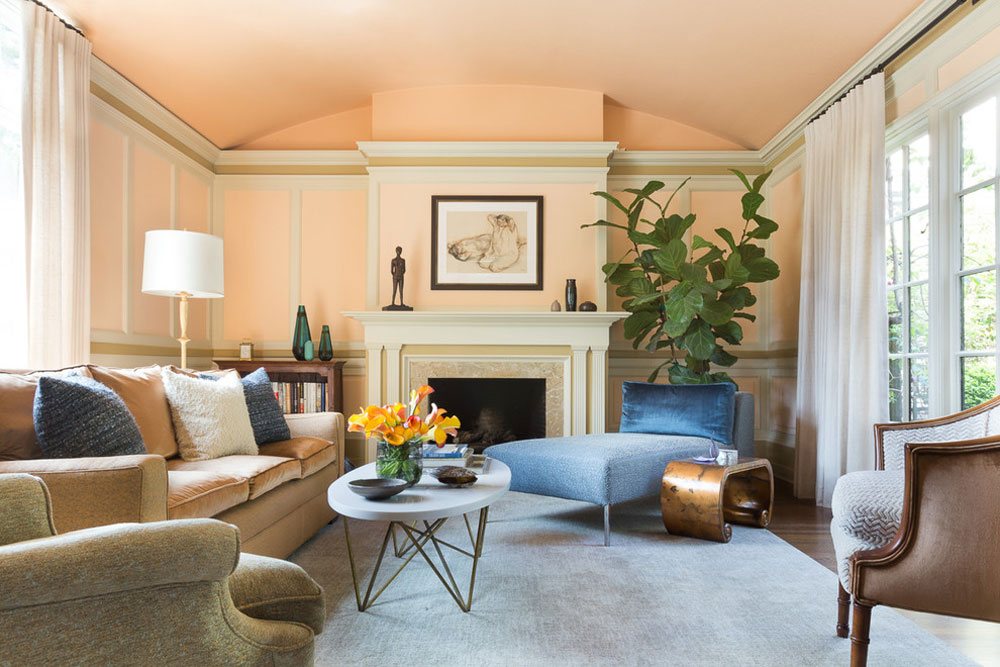
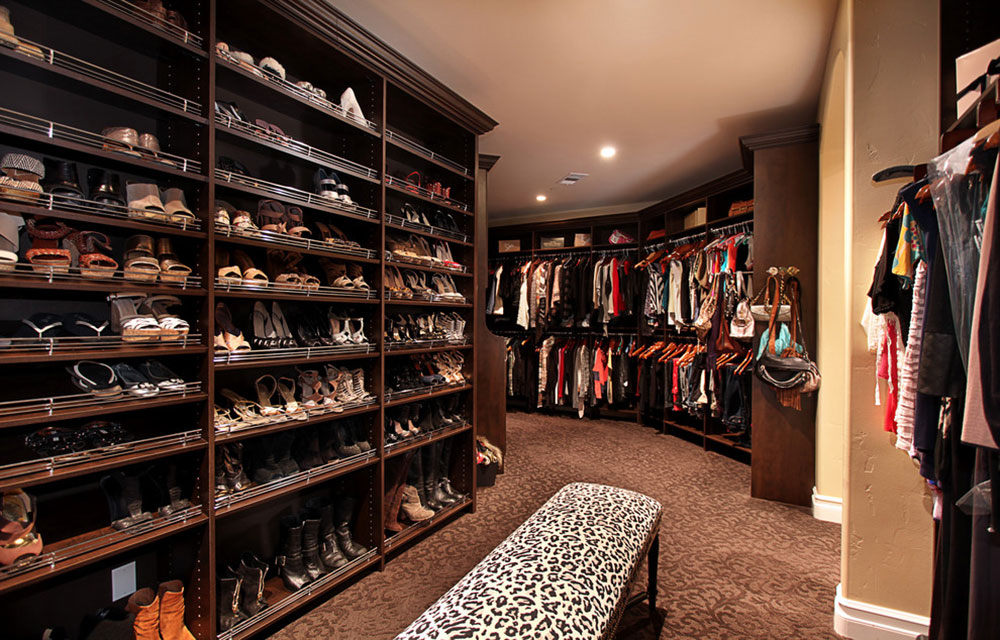
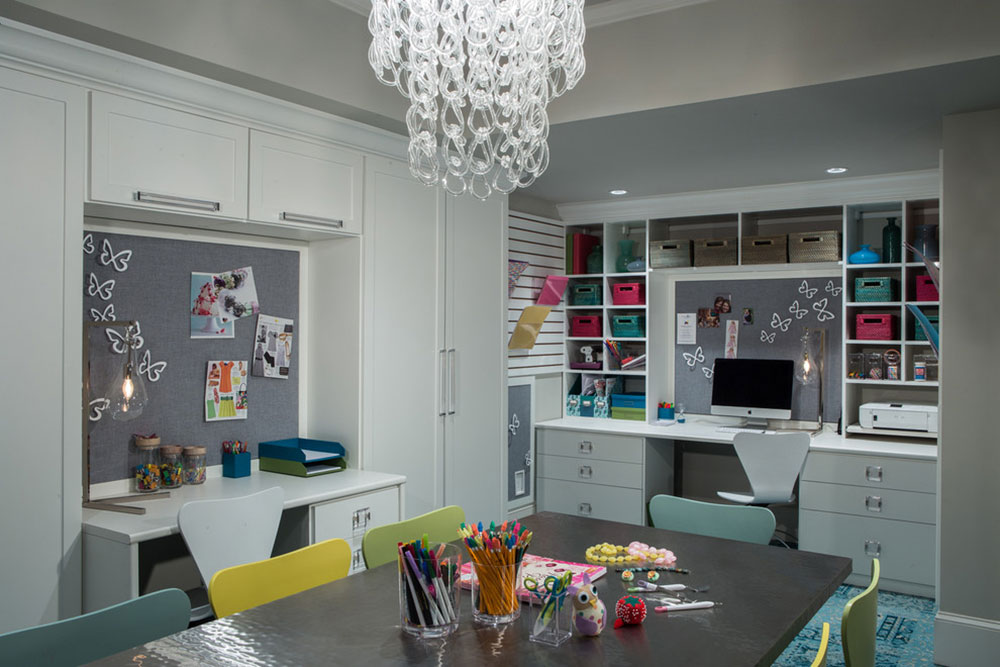
Clean lines. Warm walnut tones. Tapered legs on everything. Mid-century modern home decor has been around since the 1950s, and it still looks like it belongs in every room you put it in.
But getting the look right is trickier than buying a hairpin-leg coffee table and calling it done. The wrong wood tone, the wrong scale, or too much matching can turn a room into a costume instead of a living space.
This guide covers the specific materials, furniture pieces, color palettes, and lighting that define the style. You’ll also find room-by-room direction, budget tiers from IKEA to Herman Miller, and the most common mistakes that break the whole look.
What Is Mid-Century Modern Home Decor?
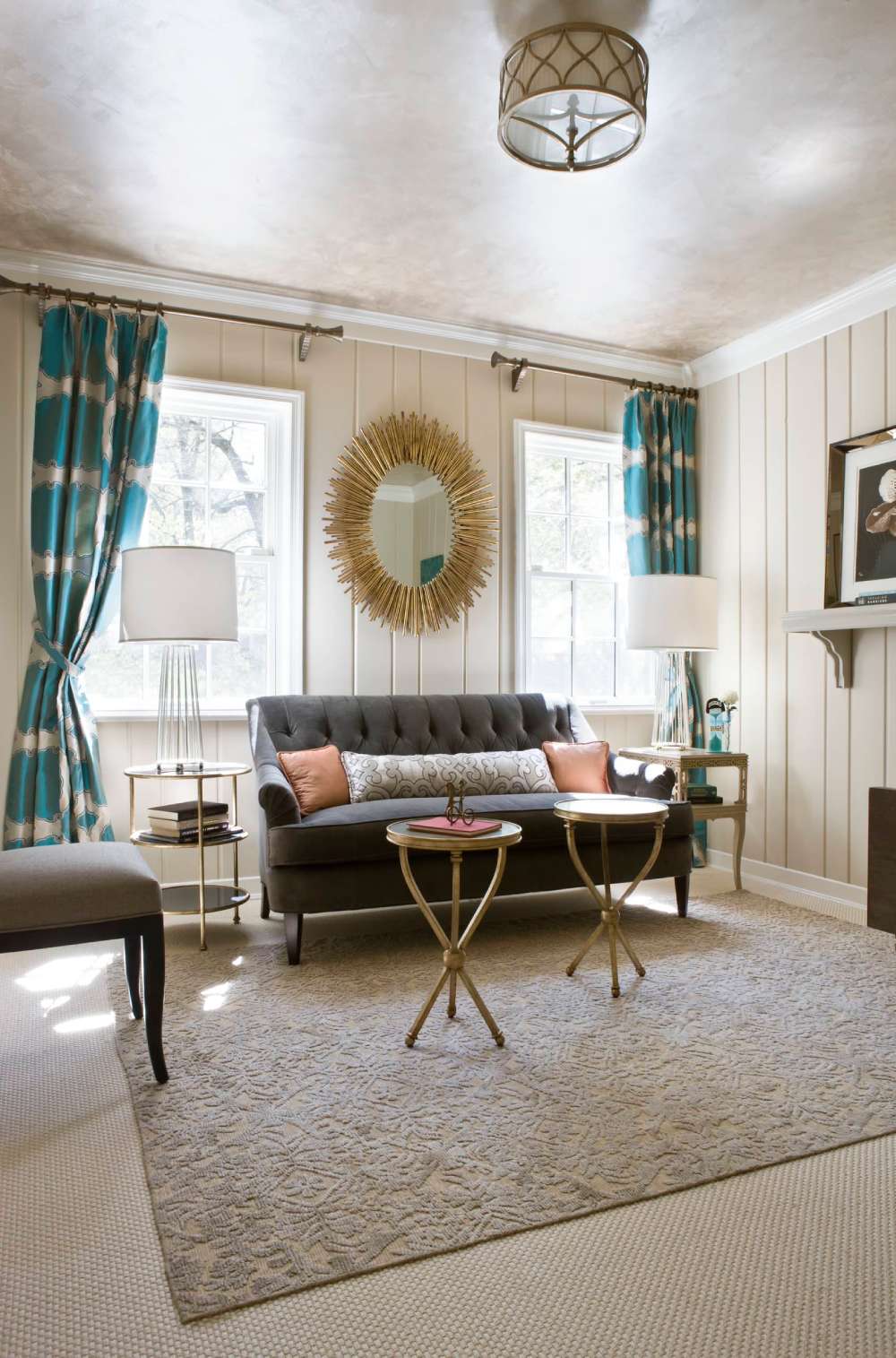
Image source: LORNA GROSS Interior Design
Mid-century modern home decor is a design style rooted in the post-World War II period, roughly 1945 to 1969. It grew out of a cultural shift toward optimism, functional living, and a rejection of the heavy ornamentation that defined earlier periods like Art Deco and Victorian decorating.
The style prioritizes clean lines, organic shapes, and a tight relationship between form and function. Furniture sits low. Legs taper. Wood stays warm. Ornamentation gets stripped back to almost nothing.
Designers like Charles and Ray Eames, Eero Saarinen, George Nelson, and Arne Jacobsen built the visual vocabulary that still defines the look today. Their work for manufacturers like Herman Miller and Knoll produced pieces that remain in continuous production nearly 70 years later.
People confuse mid-century modern with Scandinavian design all the time. There is shared DNA (both value simplicity and natural materials), but the palettes and material choices differ. Scandinavian interiors lean cooler and lighter. Mid-century modern runs warmer, with richer wood tones and bolder accent colors like mustard yellow, olive green, and burnt orange.
The global modern furniture market was valued at $6.19 billion in 2024 and is projected to reach $9.84 billion by 2032, according to Business Research Insights. Mid-century modern pieces account for a significant share of that growth, especially as buyers look for quality furniture that holds value over time.
How It Differs from Modern and Contemporary Styles
Modern interior design is a broader term covering early 20th-century movements that broke from traditional ornamentation. Mid-century modern is a specific subset within that larger category.
Contemporary design, on the other hand, refers to whatever is current right now. It borrows freely from multiple eras and has no fixed set of rules.
| Feature | Mid-Century Modern | Scandinavian | Contemporary |
|---|---|---|---|
| Time period | 1945–1969 | 1930s–present | Current era |
| Wood tones | Walnut, teak, rosewood | Birch, ash, pine | Mixed |
| Color palette | Warm, bold accents | Cool, muted | Variable |
| Key principle | Form meets function | Hygge, simplicity | Flexibility |
The distinction matters when you’re shopping. A “modern” sofa from a big-box store might not have anything in common with actual mid-century design. Look for the specific characteristics: tapered legs, low profiles, organic curves, and warm wood finishes.
Materials and Textures That Define the Style
If you can’t identify the materials, you’ll buy the wrong pieces. Mid-century modern decor has a specific material palette, and getting it right is the difference between a room that looks authentic and one that looks like a costume.
Wood Types
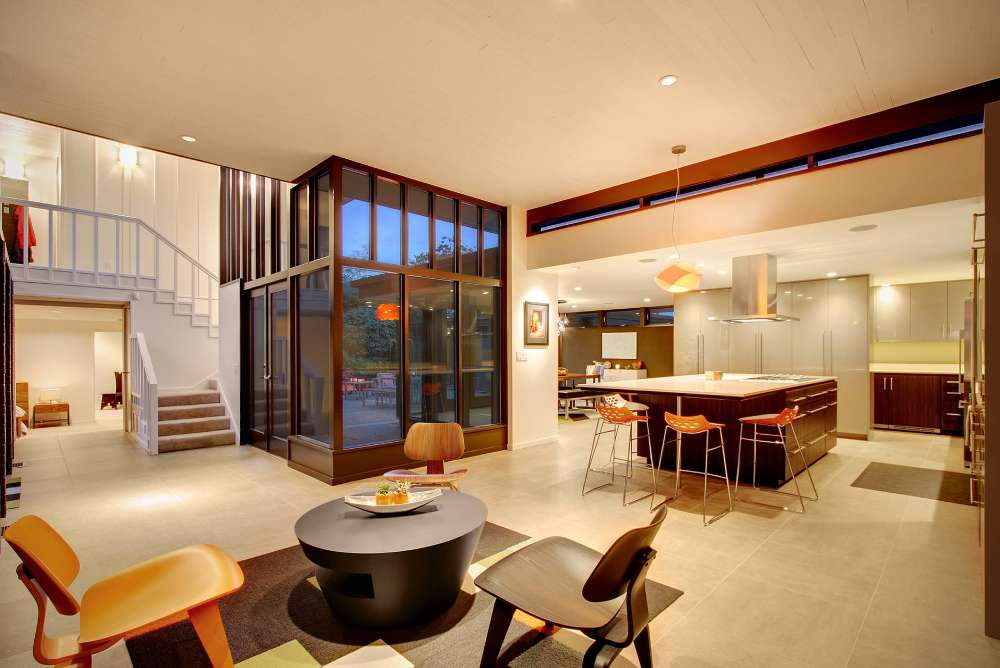
Image source: Darren Patt Construction
Walnut is the signature wood of mid-century modern furniture. Rich, dark, with a grain pattern that reads warm without being heavy. Teak comes in second, especially in Danish Modern pieces. Rosewood appeared in early Eames designs before sustainability concerns limited its use.
The 1stDibs 2025 Designer Survey found that warm walnut tones are driving a resurgence of mid-century pieces specifically because brown is trending as the top color choice for 32% of designers surveyed, nearly double from 2023.
Molded plywood is the other big one. Charles and Ray Eames pioneered the technique in the 1940s, bending thin layers of wood into curves that were impossible with traditional joinery. That technology gave us the Eames Lounge Chair, which has been in continuous production by Herman Miller since 1956.
Metals and Hardware
Brass: The dominant metal accent in authentic mid-century rooms. Drawer pulls, lamp bases, and pendant light fixtures frequently feature brass finishes.
Chrome: Shows up on furniture legs and lighting. Sleeker and cooler than brass, more common in later 1960s pieces.
Brushed metal: A middle ground that pairs well with both walnut and teak. Often seen on Saarinen’s Tulip Table base and similar pedestal designs.
Upholstery and Soft Materials
Leather, boucle, and woven textiles are the core fabric choices. Leather ages well on mid-century frames (particularly on lounge chairs), while boucle adds texture without visual clutter.
Bella Virtual reported that homes staged with mid-century modern furniture sold 31% faster than vacant properties. The material choices play a direct role in that appeal because buyers associate warm woods and natural fabrics with quality.
Signature Furniture Pieces for a Mid-Century Modern Room
You don’t need to fill a room with period-accurate pieces. But you do need at least one or two anchor items that set the tone. The rest can be mixed in from other styles (more on that later).
Lounge Chairs
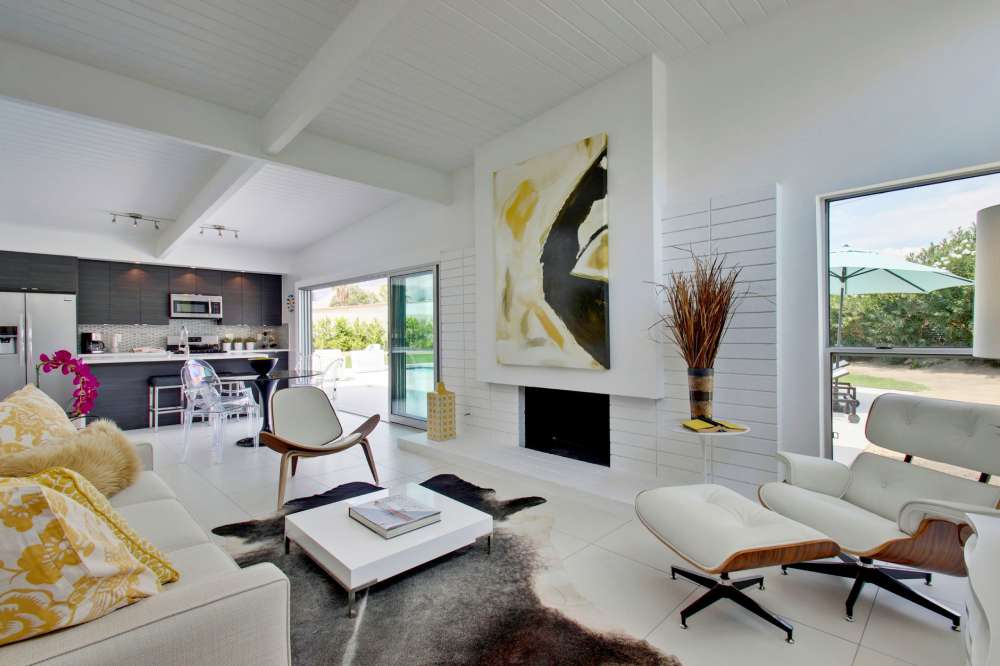
Image source: Mãkena Interiors
The Eames Lounge Chair is the single most recognized piece of mid-century modern furniture in the world. Designed in 1956 by Charles and Ray Eames, it combines molded plywood shells with leather cushions. It sits in the permanent collection at MoMA and has never gone out of production.
Other options that carry the same weight without the same price tag:
- The Womb Chair by Eero Saarinen, designed for Knoll in 1948
- Hans Wegner’s Shell Chair, a masterclass in minimal structure
- Arne Jacobsen’s Egg Chair, a sculptural piece that still shows up in hotel lobbies everywhere
Sofas and Seating
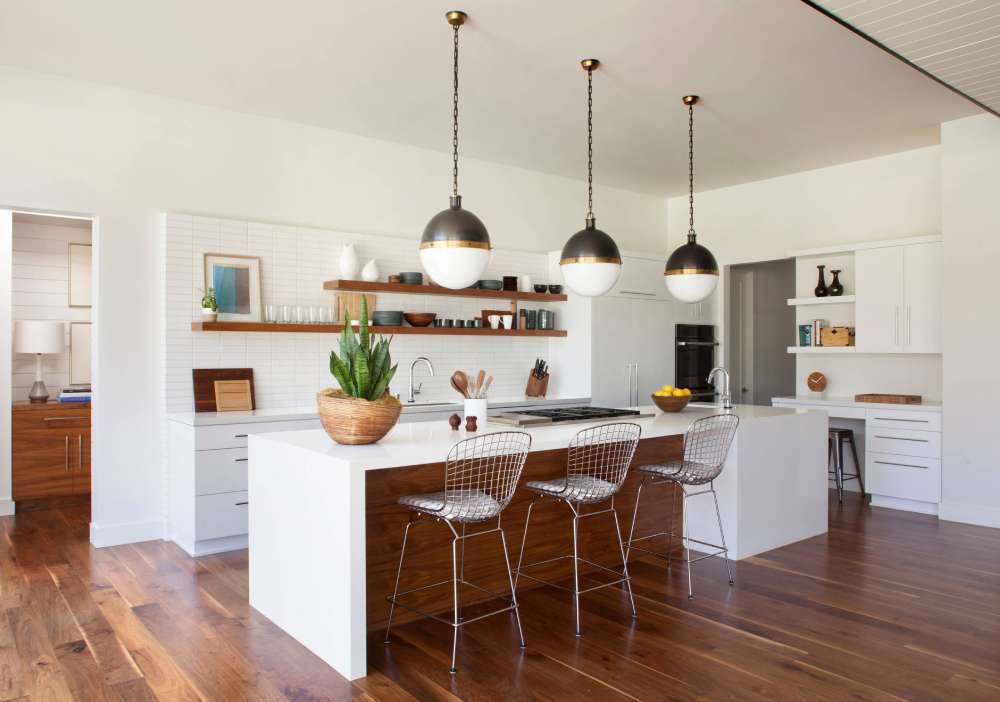
Image source: Brittany Stiles Design
Low profile. Slim armrests. Tapered legs that lift the frame off the floor. That is the mid-century sofa formula.
Tufted cushions are common but not required. The key is visual lightness. A mid-century sofa should look like it barely touches the ground, with enough space underneath for clean sight lines across the room.
Throw pillows can soften the look without breaking it. Stick with geometric prints and solid tones that match the period palette. If you have a grey sofa, certain throw pillow combinations for a grey couch work well with walnut side tables and brass accents.
Tables and Storage
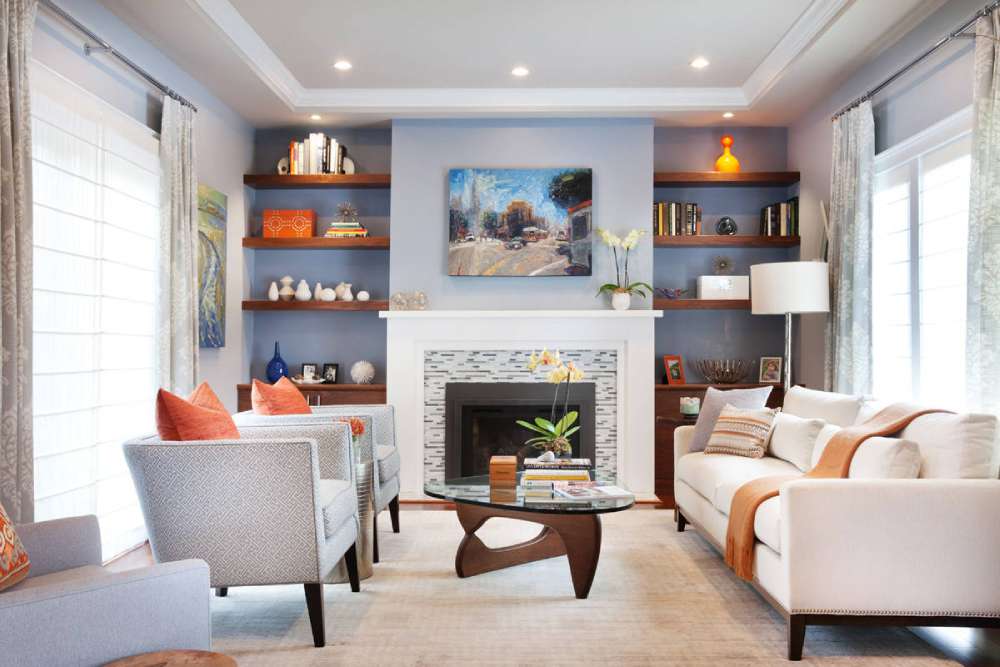
Image source: Cecile Lozano Interiors
Coffee tables: Hairpin legs, kidney-shaped tops, glass-and-walnut combos. The Noguchi Coffee Table by Isamu Noguchi is the most iconic, but there are hundreds of good reproductions.
Credenzas and sideboards: These are the storage workhorses of mid-century rooms. Long, low, with sliding doors or drawers. A good walnut credenza anchors a living room or dining space instantly.
Dining tables: The Saarinen Tulip Table (that white pedestal base with a round top) is still one of the best-selling dining tables in the category. Hans Wegner’s Wishbone Chairs pair with almost any mid-century table.
Where to Buy Authentic vs. Reproduction Pieces
Chairish reported in 2024 that its North American sales grew by 35% year-over-year, with mid-century modern pieces driving a significant share of that demand. The secondhand furniture market in North America hit $13.81 billion in 2024 and is growing at 7.11% annually, according to ResearchAndMarkets.com.
Vintage sources: Chairish, 1stDibs, estate sales, and local consignment shops. For authentication, check labels, joinery quality, and material weight. The Eames Lounge Chair, for example, has a stamped medallion on its underside verifying Herman Miller production.
Quality reproductions: West Elm, Article, CB2, and Modway offer pieces inspired by mid-century design at more accessible price points. Quality varies, so look at frame construction and leg attachment. Screwed-on hairpin legs on a particle board top won’t fool anyone.
Color Palettes That Work
Getting the color wrong is the fastest way to make a mid-century room feel like a Halloween party. The palette has specific parameters, and they’re narrower than most people think.
The Classic Accent Colors
Mustard yellow. Olive green. Burnt orange. Teal. These four colors show up in almost every authentic mid-century interior, used as accents against warm neutral backgrounds.
The Pantone Color Institute named Mocha Mousse (a warm brown-based tone) as a leading shade for 2025. That aligns perfectly with the walnut and teak foundations of mid-century decor.
A Fixr.com survey of design professionals found that 49% cited warm neutrals as a top color trend in 2025, while 48% pointed to dark earthy greens. Both sit comfortably within the mid-century palette.
Wall Colors That Actually Read Mid-Century
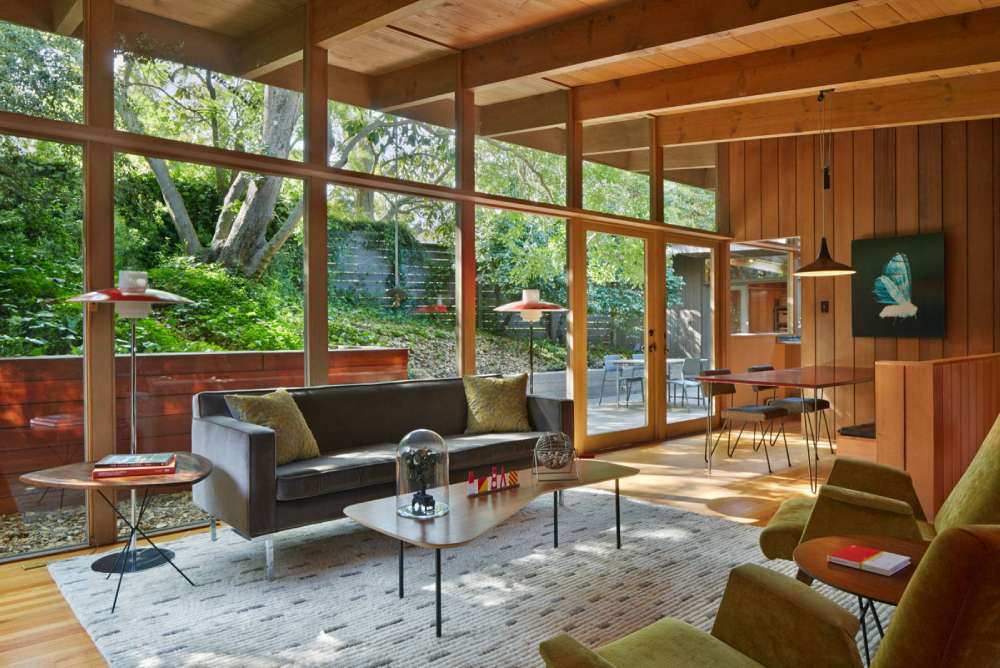
Image source: Koch Architects, Inc.
Warm white. Soft grey. Muted sage. Those are your safe bets for walls.
The mistake most people make is going too bold on the walls and then trying to layer period furniture on top. It reads as theme park, not lived-in home. Keep walls neutral and let the furniture, textiles, and accessories carry the color.
If you do want a painted accent wall, olive green or a deep teal can work. But one wall only. The point is to create a focal point, not to overwhelm the room.
Mixing MCM Colors with Current Trends
The 1stDibs 2025 survey showed that 81% of designers sourced vintage products from the 1920s through the 1990s in 2024. That means most professionals are already blending eras, not sticking to a single period.
Pair a mustard throw pillow with a neutral living room foundation. Use olive green accents against warm beige walls. Drop a teal vase on a walnut credenza. The goal is integration, not recreation.
Brown tones are particularly flexible right now because the broader design world is moving toward exactly the warm palette that mid-century modern has always used. Walnut furniture that might have felt dated five years ago now looks right on trend.
Lighting as a Design Element, Not an Afterthought
Lighting in a mid-century modern room does two jobs at once. It provides function and acts as sculpture. Treating it as only one or the other misses the point entirely.
Statement Fixtures
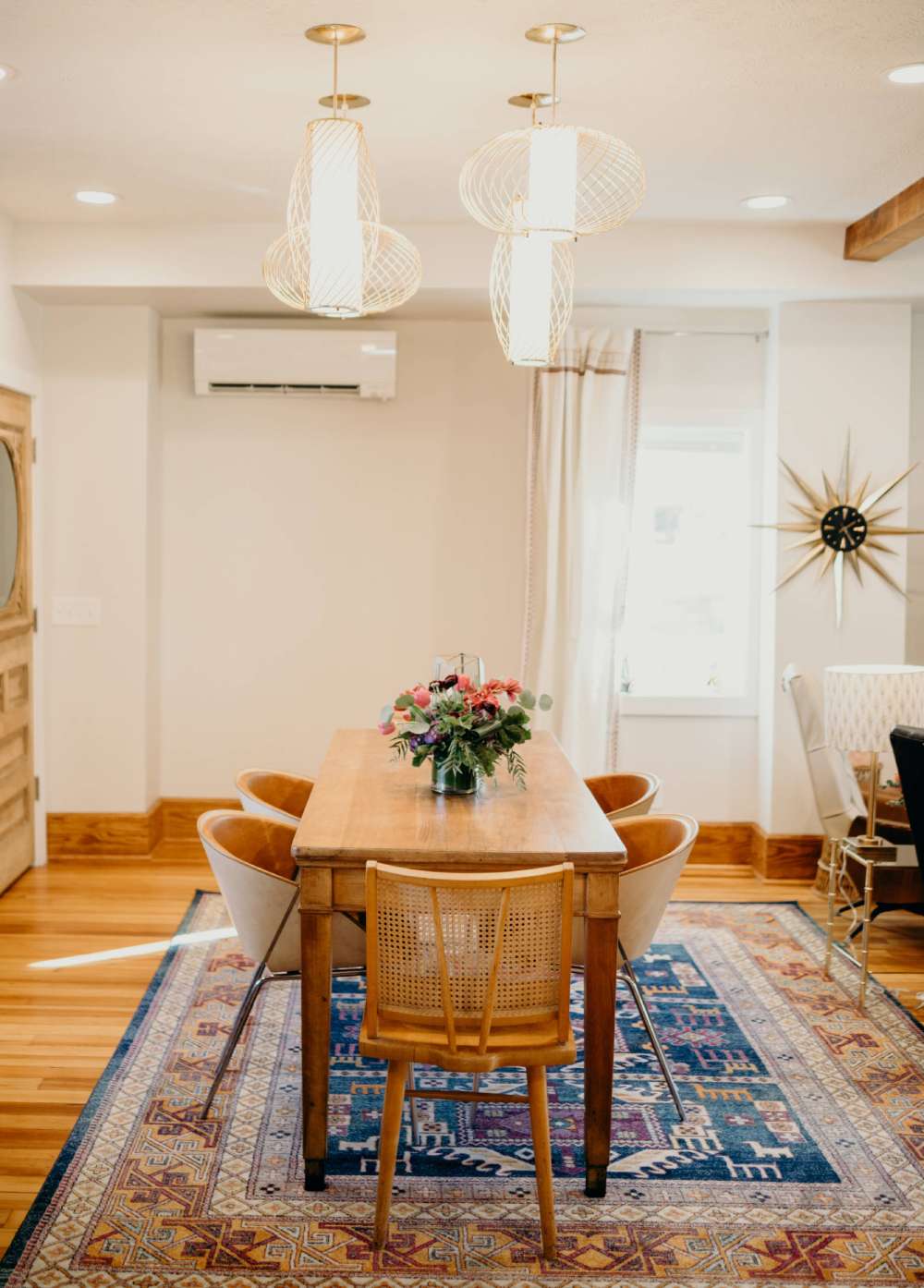
Image source: Carlson Projects INC
Sputnik chandeliers are the most visually distinctive mid-century light fixture. Named after the Soviet satellite, they feature multiple arms radiating from a central sphere. They work best in dining rooms and entryways where they have vertical clearance.
Arc floor lamps (the kind with a heavy base and a long curved arm reaching over seating) give a room that specific 1960s editorial look. Globe pendants in brass or frosted glass are subtler but equally period-accurate.
The 1stDibs survey found that Noguchi Akari lamps ranked as the second most popular vintage lighting choice for 2025, with 16% of designers citing them. Murano-glass pendants and chandeliers took the top spot at 27%.
The Nelson Bubble Lamp
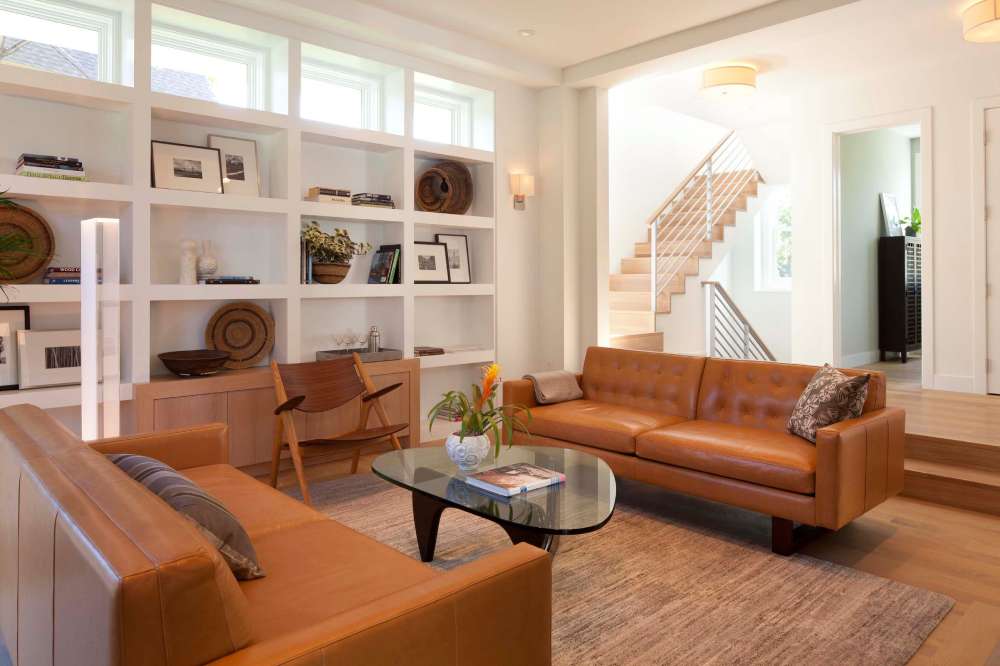
Image source: Charlie & Co. Design, Ltd
George Nelson designed these in 1952 for Herman Miller, and they remain in production today. A translucent polymer skin stretched over a wire frame creates soft, diffused ambient light that flatters everything in the room.
They come in saucer, ball, cigar, and pendant shapes. The saucer version works well as a ceiling fixture in living rooms; the ball version suits bedrooms and reading corners.
Layered Lighting Strategy
A single overhead fixture won’t cut it. Mid-century rooms use three layers:
- Ambient: General room illumination from pendants or ceiling fixtures
- Task lighting: Desk lamps, reading lights, under-cabinet strips
- Accent lighting: Spotlights on art, shelf lighting, floor uplighters
Brass and walnut are the dominant lighting materials. If you’re buying new fixtures, look for those two finishes first. Chrome works too, but it reads cooler and shifts the mood away from that characteristic mid-century warmth.
Wall Decor and Art That Fits the Period
Walls are where most people accidentally break the mid-century modern look. A farmhouse sign or a beach-themed canvas will undo all the work your furniture is doing.
Art Styles That Belong
Abstract art is the natural companion. Think bold geometric shapes, limited color palettes, and compositions that feel graphic rather than photographic.
Atomic-age motifs (starbursts, boomerang shapes, asymmetric patterns) are period-specific but can look kitschy if overused. One piece is a statement. Three is a costume shop.
The vintage and retro goods market hit $75 billion globally in 2024, growing at 10% annually according to Future Data Stats. Original mid-century prints and artwork are part of that boom, though you don’t need originals to get the look right.
Sunburst Mirrors and Wall Clocks
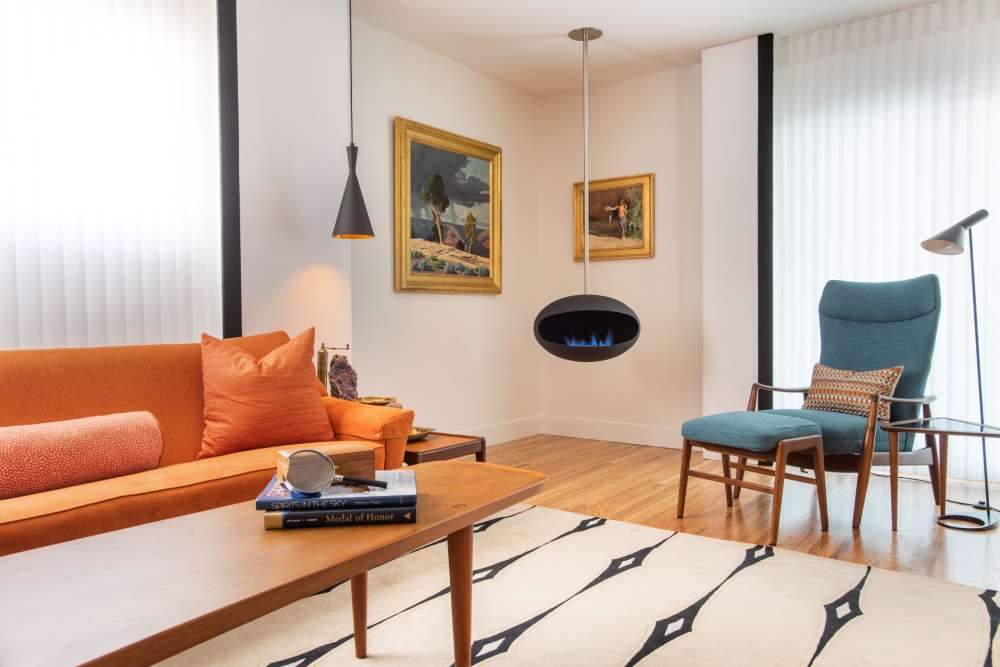
Image source: Libbie Holmes Photography
The sunburst mirror is one of the most recognizable mid-century wall accessories. Gold or brass finishes are standard. Place one above a credenza or fireplace for an instant anchor point that adds radial balance to the wall.
George Nelson’s wall clocks for Howard Miller (the Ball Clock, the Sunflower Clock, the Eye Clock) are collector pieces. Reproductions are widely available and do the job if you’re not chasing provenance.
Gallery Walls and Textile Hangings
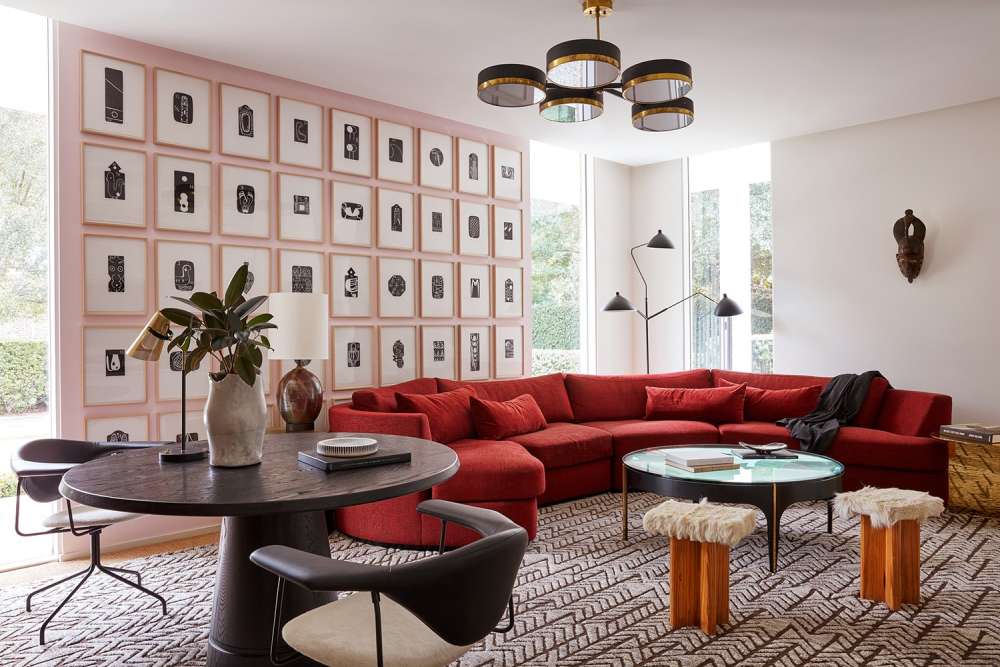
Image source: Jamie Bush & Co.
A gallery wall works in a mid-century room if you keep the frames consistent. Thin black or walnut frames, evenly spaced, with abstract or graphic prints inside. Avoid mixing too many frame styles or sizes because the look should feel intentional, not eclectic.
Textile wall hangings sit in a slightly different zone. They lean more toward the bohemian side, which is adjacent to mid-century but not core to it. A single woven piece in a warm palette can add textural depth without breaking the overall unity of the design. More than one, and you’re drifting into bohemian territory.
Pinterest’s 2025 Trends Report showed that searches for “Vintage Americana” surged by 145%, which includes mid-century wall decor, atomic-age prints, and retro-inspired patterns. The demand is there. Just be selective about how much you put on the walls.
Mid-Century Modern Decor by Room
The style doesn’t apply the same way in every room. A credenza that anchors a living room would look out of place in a bedroom. Knowing what works where saves you from buying pieces that end up in the wrong spot.
The 2025 Houzz study found that median spending on living room renovations dropped to $4,000 in 2024, down 20% from the prior year. That means most people are making targeted updates, not full overhauls, which is exactly how mid-century modern works best.
Living Room
Start with one statement piece. An Eames-style lounge chair or a low-profile tufted sofa with tapered legs sets the tone without requiring everything else to match.
Rug choices: Flatweave, shag, or geometric-patterned rugs in warm neutrals. If your sofa is a neutral grey, look at rugs that pair well with grey couches in mid-toned warmth.
Leave breathing room. Mid-century living rooms value open space as much as they value furniture. Don’t fill every corner.
Bedroom
Platform bed frames with walnut or teak veneer are the foundation. Low-profile nightstands with tapered legs on either side. That’s 80% of the work done.
For textiles, think linen bedding in warm white or grey, with a wool throw at the foot. A couple of throw pillows on the bed in mustard or olive green complete the palette without overdoing it.
Houzz data shows that primary bedroom renovation spending fell to $2,750 median in 2024. A platform bed frame and two nightstands can transform a bedroom for well under that.
Kitchen and Dining Area
Kitchens are tricky because full-period MCM kitchens look dated rather than retro. The better approach is selective:
- Swap cabinet hardware to brass pulls
- Add a retro-inspired kitchen element like open shelving with period-appropriate dishware
- Anchor the dining space with a Tulip Table or pedestal-base alternative
Wishbone Chairs by Hans Wegner remain one of the most paired dining chairs in mid-century rooms. The woven seat adds texture without visual weight.
Home Office
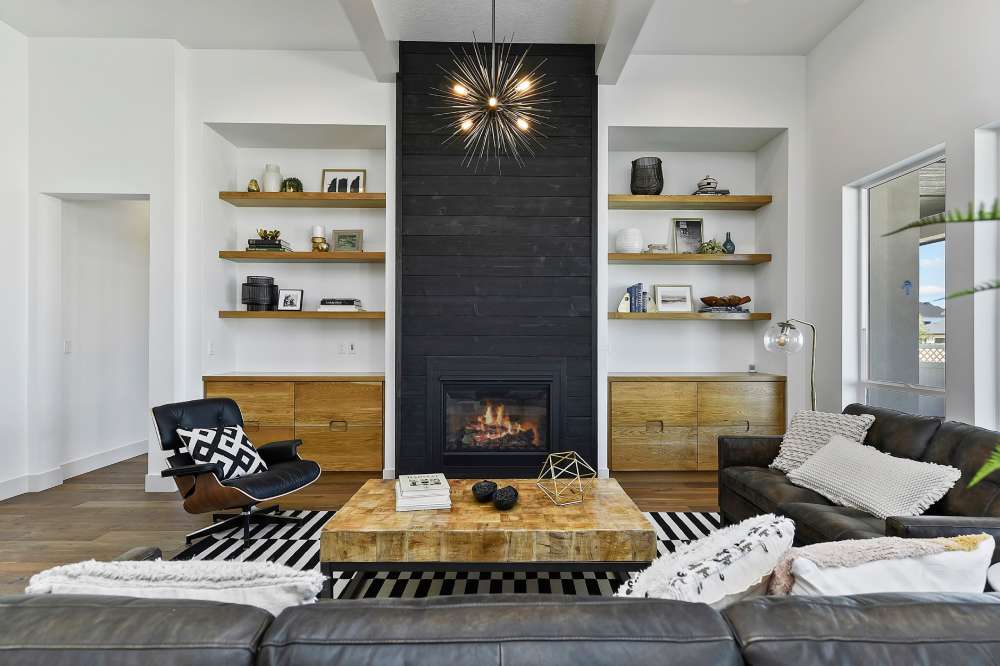
Writing desks with tapered legs and a clean walnut surface are the core piece here. Skip the bulky executive desk. Mid-century home offices run lean.
A brass desk lamp and a modular shelving unit (the String shelving system is a classic) handle lighting and storage. The Nelson Platform Bench works as both a low bookshelf and a display surface if you have wall space.
How to Mix Mid-Century Modern with Other Styles
Almost nobody lives in a single-style home anymore. And honestly? Rooms decorated entirely in one period tend to feel like museums, not living spaces. The real skill is in blending.
The 1stDibs 2025 survey found that the top design approaches for the year were maximalism (33%) and eclecticism (33%), both of which depend on mixing eras and aesthetics.
Pairing MCM with Contemporary Minimalism
This is the easiest crossover because both styles value clean lines and open floor plans. A minimalist space with white walls and simple furniture gets immediate warmth from a walnut credenza or a teak side table.
Keep the minimalist bones. Add MCM accents as the personality layer.
Combining with Industrial Elements
| Element | Works Well | Clashes |
|---|---|---|
| Exposed brick | Warm backdrop for walnut pieces | Can overwhelm if too much texture |
| Metal shelving | Pairs with brass and chrome accents | Black iron looks too heavy next to MCM |
| Concrete floors | Good with area rugs underneath | Cold without textiles to soften |
| Edison bulbs | Fine in moderation | Too trendy, fights MCM lighting |
Industrial design and mid-century modern share a respect for materials, but the textures are very different. The key is not letting raw, heavy industrial surfaces overpower the lighter MCM furniture.
Adding Bohemian Textiles
A single bohemian textile, like a woven wall hanging or a kilim rug, can add warmth to a mid-century room without disrupting the clean-line identity.
But there’s a line. Too many layered textiles, macrame pieces, and mixed patterns will shift the room fully into boho territory. One or two pieces. That’s the limit if you want the MCM framework to hold.
Common Mixing Mistakes
Over-theming: Every piece matches the period perfectly. Looks like a set, not a home.
Ignoring scale and proportion: A massive farmhouse dining table next to a slim MCM credenza creates visual tension. The proportions need to speak to each other.
Too many wood species: Walnut nightstand, oak coffee table, pine bookshelf, teak credenza. Pick two wood tones max and stick with them. Harmony breaks down fast when every surface is a different shade of brown.
Budget Tiers for Mid-Century Modern Decorating
You can enter this style at almost any price point. But where you spend makes a bigger difference than how much you spend. A $200 hairpin-leg coffee table from Target can look great next to a $3,000 vintage credenza if the proportions and materials are right.
Harvard’s Joint Center for Housing Studies projects home renovation spending to reach $509 billion in 2025. A big chunk of that goes to exactly the kind of selective room updates where mid-century modern pieces fit best.
Entry Level: Under $500 per Piece
Where to shop: Target (Threshold line), IKEA (Stockholm collection), thrift stores, Facebook Marketplace, estate sales.
At this tier, you’re looking at reproduction accent chairs, hairpin-leg tables, and smaller accessories like clocks and lamps. Quality varies. Check leg attachments and material weight before buying.
B-Stock reported that furniture brands sold 85% more units through resale channels in 2024 than the year before, according to Modern Retail. Good secondhand MCM pieces show up more often now than they did five years ago.
Mid-Range: $500 to $2,000 per Piece
This is where the real options open up. West Elm, Article, CB2, and Joybird all operate in this range with MCM-inspired lines.
Article can undercut West Elm by 20-30% on comparable pieces, with a focus on solid wood frames and quality upholstery. The trade-off is longer lead times.
Vintage finds under $1,500 on Chairish or 1stDibs often land in this tier too. A genuine 1960s teak credenza at $1,200 will outlast and outperform any new particle-board reproduction at the same price.
Investment Level: $2,000 and Up
Herman Miller. Knoll. Design Within Reach. Authenticated vintage from specialized dealers.
The Eames Lounge Chair starts around $6,000+ new from Herman Miller. A Saarinen Tulip Table runs $2,000 to $4,000 depending on size and top material. These are pieces that hold value for decades, sometimes appreciating.
The global secondhand furniture market is projected to double from $40.2 billion in 2024 to $87.6 billion by 2034, according to Market.US. Authenticated vintage MCM furniture is part of that growth because it holds resale value better than almost any other furniture category.
Where to Invest vs. Where to Save
| Category | Invest | Save |
|---|---|---|
| Seating | Lounge chairs, sofa | Dining chairs |
| Tables | Credenza, sideboard | Coffee table, side tables |
| Lighting | Statement pendant, arc lamp | Desk lamp, shelf lighting |
| Decor | Original art, vintage clock | Throw pillows, prints |
Spend on the pieces you’ll use daily and that visitors notice first. Save on accessories and items that get swapped out more often. A budget-friendly living room approach still works when the anchor pieces are solid.
Common Mistakes That Break the Look
I’ve seen plenty of rooms where every individual piece was technically mid-century modern, and the result still felt wrong. The mistakes are usually about execution, not taste.
Going Full Theme Room
A room where every single item is MCM reads as staged, not lived-in. The 1stDibs survey data backs this up: 33% of designers named eclecticism as a top 2025 trend, and another 31% cited organic modernism. Both approaches depend on mixing, not matching.
Pick three to four strong MCM pieces per room. Fill around them with items from other eras or styles. That’s how you get a space that looks curated instead of costumey.
Choosing the Wrong Wood Tone
The fix is simple: walnut and teak are your safe bets. They are the two woods most associated with authentic mid-century furniture.
Mixing in light pine, blonde oak, or grey-washed wood tones will clash with the warm foundation the style requires. If you already have lighter wood furniture, consider whether paint tones that work alongside wood floors can bridge the gap with wall color or textiles.
Ignoring Proportion and Visual Balance
Mid-century modern furniture tends to be lower and lighter than most other styles. Dropping a massive overstuffed sectional next to a slim-legged walnut coffee table creates a visual mismatch that no amount of accessories will fix.
Balance is one of the most overlooked principles of interior design, and it matters more in MCM rooms because the furniture is intentionally pared back. Every piece is visible. Nothing hides behind bulk.
Buying Cheap Reproductions with Wrong Proportions
The worst MCM reproductions get the proportions wrong. Legs that are too thick. Seats that sit too high. Arm rests that are too wide. These tell your eye that something is off, even if you can’t pinpoint what it is.
Before buying any reproduction, compare its dimensions to the original. The Eames Lounge Chair is 32.75 inches wide and 32.5 inches deep. A reproduction that’s 36 inches wide might look similar in a photo but will feel completely different in a room.
Stick with brands that publish exact measurements and show construction details. If a listing doesn’t tell you the wood type, leg height, and seat depth, skip it.
FAQ on Mid-Century Modern Home Decor
What defines mid-century modern home decor?
The style is built on clean lines, organic shapes, tapered furniture legs, and warm wood tones like walnut and teak. It originated between 1945 and 1969, prioritizing function and minimal ornamentation over decorative excess.
Is mid-century modern still in style?
Yes. Designers continue to source vintage pieces from this era, and warm brown tones central to the style are trending strongly in 2025. The look adapts well to current spaces without feeling dated.
What colors go with mid-century modern furniture?
Mustard yellow, olive green, teal, and burnt orange are the classic accent colors. Use warm whites or soft greys on walls and let the furniture carry the bolder tones.
What is the most iconic mid-century modern furniture piece?
The Eames Lounge Chair, designed by Charles and Ray Eames in 1956 for Herman Miller. It combines molded plywood shells with leather cushions and has been in continuous production for nearly 70 years.
How do I mix mid-century modern with other styles?
Pick three to four strong MCM pieces per room and fill around them with items from other eras. It pairs well with minimalist design and Scandinavian decor. Avoid matching every piece to the same period.
Where can I buy affordable mid-century modern furniture?
West Elm, Article, CB2, Target’s Threshold line, and IKEA’s Stockholm collection offer budget-friendly options. For vintage finds, check Chairish, 1stDibs, estate sales, and Facebook Marketplace.
What wood types are used in mid-century modern furniture?
Walnut is the signature wood. Teak is common in Danish Modern pieces. Rosewood appeared in early Eames designs. Molded plywood, pioneered by the Eames Office, is another defining material of the era.
What lighting works best in a mid-century modern room?
Sputnik chandeliers, arc floor lamps, Nelson Bubble Lamps, and globe pendants in brass or frosted glass. Layer ambient, task, and accent light sources for a balanced result.
What is the difference between mid-century modern and Scandinavian design?
Both value simplicity and natural materials, but Scandinavian interiors lean cooler and lighter. Mid-century modern runs warmer with richer wood tones and bolder accent colors like mustard and orange.
What are common mistakes when decorating mid-century modern?
Going full theme room instead of mixing eras. Using too many wood species. Ignoring scale and proportion. Buying cheap reproductions where the legs are too thick or the seat height is wrong.
Conclusion
Mid-century modern home decor works because it was designed to work. Every piece from that era, whether it’s an Eames Lounge Chair or a simple walnut credenza, was built around the idea that good design serves daily life first.
The organic shapes, warm wood tones, and functional minimalism that defined the postwar period still hold up. Not because they’re trendy, but because the core design details behind them are sound.
Start with one or two anchor pieces. Get the wood tone and color palette right. Mix eras instead of matching everything to a single decade.
Don’t overthink it. A well-placed Noguchi Coffee Table or a brass sputnik chandelier can shift an entire room. The style rewards selectivity over volume, quality over quantity, and restraint over decoration.

- Paint Colors That Go with Oak Floors - August 22, 2026
- Paint Colors That Go with Gray Floors - August 20, 2026
- What Color Bedding Goes with Dark Wood Furniture - August 18, 2026