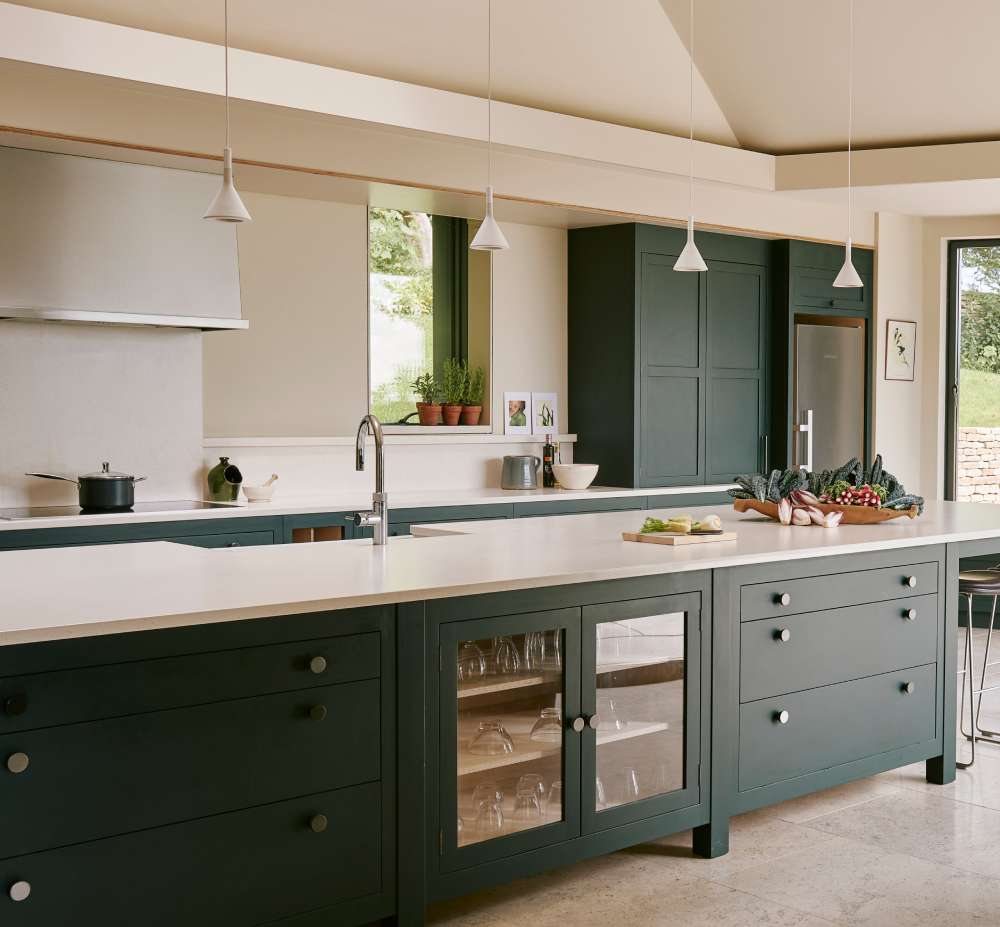
A navy kitchen island does something most bold color choices fail to do: it ages well, pairs broadly, and photographs better than almost any other dark cabinet finish.
Blue holds 25% of the contrasting island color market, according to the 2024 Houzz Kitchen Trends Study. That number has held steady for 3 consecutive years.
But choosing navy is only the first decision. The paint code, countertop pairing, hardware finish, lighting, and kitchen layout all determine whether the island looks intentional or forced.
This guide covers everything from paint codes and countertop pairings to sizing rules, maintenance, and where to buy, so you can specify a navy island that works for your actual kitchen rather than just a design mood board.
What Is a Navy Kitchen Island?
A navy kitchen island is a kitchen island finished in a deep, blue-gray cabinet color that sits between pure blue and dark charcoal on the color spectrum. It functions as a painted or lacquered cabinetry finish applied to an island base, creating a two-tone contrast with white or wood-tone perimeter cabinets.
The color is not one fixed shade. It spans a defined range of deep blue tones, each with different undertones that behave differently under light.
What Paint Codes Define Navy in Kitchen Cabinetry?
The 3 most referenced navy paint codes in kitchen design:
- Benjamin Moore Hale Navy (HC-154): a warm navy with slight gray undertone, the most widely used kitchen island color in this range
- Sherwin-Williams Naval (SW 6244): cooler and slightly darker, reads as pure navy under warm artificial light
- Farrow and Ball Hague Blue (No. 30): a deeper, almost ink-like navy with strong blue-green undertone; tends to look almost black in low light
Each of these reads differently depending on whether your kitchen gets north-facing or south-facing light. Hale Navy, for instance, pulls warm under incandescent bulbs and shifts noticeably cooler in daylight. That shift matters more on a large island than it does on a small accent piece.
How Does Navy Differ from Other Dark Island Colors?

Image source: ReVision Design/Remodeling
Navy sits in a specific position between two common alternatives. It is not charcoal, which reads as a neutral. It is not black, which reads as a hard graphic choice. Navy reads as a color with warmth and depth, which is why it pairs across so many different kitchen styles.
| Color | Undertone | Best kitchen size | Resale appeal |
|---|---|---|---|
| Navy | Blue-gray, warm or cool depending on code | Medium to large | Broad |
| Charcoal | Gray-neutral | Any | Very broad |
| Black | None, absorbs all light | Large only | Narrow |
| Forest green | Blue-green or yellow-green | Medium to large | Moderate |
The 2024 Houzz Kitchen Trends Study, which surveyed 3,437 U.S. homeowners, found blue is the top choice for contrasting island cabinets at 25%, ahead of green at 10%. That number has held consistently even as individual navy shades shift from season to season.
What Finish Types Are Used on Navy Kitchen Islands?
Satin (30-35% sheen): The standard for painted wood and MDF cabinet surfaces. Cleans well, shows fewer brush marks than matte, and holds up under daily contact at cabinet edges and door frames.
Matte (flat or eggshell): Rich and depth-forward on navy, but absorbs grease and moisture. Requires more careful cleaning. Works well in lower-traffic kitchens or on island faces that don’t see frequent handling.
Semi-gloss: Common in factory-lacquered and thermofoil navy cabinet doors. Shows fingerprints and water marks more than satin, but easier to wipe clean on flat door faces.
Factory lacquer and two-pack (2K) polyurethane finishes applied in a spray environment hold color better than brush-applied paint over time. If you are commissioning a custom navy island, ask whether the finish is sprayed or brushed. The difference in longevity is significant.
What Countertop Colors Work with a Navy Kitchen Island?

The countertop on a navy island does more work than on a white or wood-tone base. Navy absorbs light rather than reflecting it, so the countertop carries a large share of the visual weight in the top half of the island.
Engineered quartz is the most common choice. Houzz data from 2023/2024 shows 46% of homeowners chose quartz as their countertop material during kitchen renovations, and that share holds even higher for navy island applications where color-consistency matters more than natural stone variation.
White and Cream Countertops
White and cream surfaces create the highest contrast pairing with a navy island base. The split reads cleanly and works across coastal, farmhouse, and transitional kitchens.
Specific options that work:
- Caesarstone Calacatta Nuvo: bright white with soft gold veining, pairs with both warm and cool navy tones
- Silestone Eternal Calcatta Gold: white ground with warm gold and gray veining, best with Hale Navy
- Calacatta marble slab: the natural version; moves with golden veining and requires annual sealing
- White painted butcher block: works in farmhouse kitchens but needs oiling every 3-6 months to prevent staining against dark cabinet paint
Marble vs. Quartz Countertops on Navy Islands
Quartz is the practical choice. Real marble is the statement choice. Both work, but they commit you to different maintenance routines.
| Factor | Quartz | Natural Marble |
|---|---|---|
| Sealing required | No | Yes, annually |
| Heat resistance | Up to 300°F with trivets | Higher natural tolerance |
| Stain risk | Low | Moderate to high |
| Visual movement | Consistent, engineered | Unique slab variation |
| Cost range (installed) | $50–$150/sq ft | $60–$200/sq ft |
On a busy prep island, the stain risk from acidic foods on marble is real. One thing I have seen repeatedly: homeowners choose marble for the look, then spend the first year anxious about red wine and lemon juice. Quartz removes that variable entirely.
Warm Wood Countertops on Navy Islands

Image source: Topnotch Design Studio
Butcher block and walnut slabs soften the formality of navy blue island cabinetry. This combination is standard in modern farmhouse and transitional kitchens where the goal is warmth over drama.
IKEA Karlby in walnut and oak finishes is the most widely installed budget option for this pairing. Boos Blocks and Boardsmith offer premium solid walnut slabs for higher-end builds. Both require oiling every 3-6 months.
Wood tone rules for navy: Light and medium oak tones work. Red-toned woods like cherry or knotty pine clash with navy’s blue-gray base. Avoid them.
What Hardware Finishes Pair Best with Navy Kitchen Islands?
Hardware on a navy island is a direct expression of the color direction you are taking the kitchen in. The wrong finish pulls the island out of context with the rest of the space.
Brass and matte black dominate the navy island hardware conversation in 2024. According to Family Handyman, a residential developer in Chicago noted navy blue cabinets gaining popularity specifically because they pair well with gold hardware. That observation holds consistently across design forums and project portfolios.
Brass and Unlacquered Brass
Brass is the most common hardware pairing for navy kitchen islands. It warms the cool base of the color and adds contrast without the hard edge of black.
3 brass types used on navy cabinetry:
- Satin brass: Most practical. Consistent finish, does not patina, wipes clean. Best for high-use islands
- Unlacquered brass: Develops a warm patina over time. Looks intentional in traditional and coastal kitchens. Requires occasional polishing if you want it to stay bright
- Antique brass: Pre-aged, warmer and darker than satin. Works in traditional kitchens with raised-panel shaker doors
Matte Black Hardware

Matte black on navy creates a graphic, high-contrast look. It reads as modern or industrial depending on the cabinet door style it sits on.
The practical case for matte black is strong. Unlike polished surfaces, matte finishes resist fingerprints and water spots, which matters on an island that sees constant daily handling.
Amerock and Emtek both offer wide matte black hardware ranges that work specifically with dark cabinet finishes. Cup pulls and bar handles in matte black are the most ordered profiles for navy shaker islands.
Brushed Nickel and Chrome
Brushed nickel and chrome read as cooler metals. They work on navy islands when the perimeter cabinetry is white with similar hardware, creating a consistent tone across the kitchen.
The risk: brushed nickel can make a cool-toned navy (like Sherwin-Williams Naval) look flat rather than rich. Test the finish against your specific paint code before committing to an order.
What Kitchen Styles Use Navy Islands?
Navy is one of the few bold cabinet colors that sits comfortably in multiple kitchen design styles. The door profile, hardware finish, and countertop material shift the same navy base into very different design outcomes.
According to the Interior Designers Institute’s 2024 survey, 78% of designers listed kitchen islands as their top priority for build and specification decisions. The island is the design decision. Navy is one of the most common bold-color choices in that context.
Coastal and Hamptons Kitchens

Image source: Courtney Ellen Interior Design
The coastal kitchen with a navy island against white perimeter cabinets is one of the most produced combinations in residential design. It works because the color split mirrors the visual contrast of water and sand.
Defining features:
- White shiplap or beadboard perimeter cabinetry
- Navy shaker island with unlacquered brass hardware
- White quartz or marble countertop on both perimeter and island
- Light oak or white-painted hardwood floors
McGee and Co. has produced this combination repeatedly in their published kitchen projects, typically pairing a 7-foot navy island with white upper cabinets and a statement pendant cluster above.
Traditional Kitchens
Traditional kitchens use navy with raised-panel shaker doors, antique or satin brass cup pulls, and Calacatta marble countertops.
The island often has furniture-style legs and decorative corbels rather than a flat toe kick. Crown molding at the top of the island base matches the perimeter cabinetry for continuity. Crown Point Cabinetry and Plain English Cupboards both offer navy in this configuration as a standard specification option.
Modern Farmhouse Kitchens
Modern farmhouse uses navy with an apron front sink built into the island, open shelving on one end, and matte black hardware throughout.
What separates farmhouse navy from coastal navy: the countertop. Farmhouse kitchens lean toward butcher block or honed quartz rather than polished marble. The result is warmer and more textured.
Contemporary and Transitional Kitchens

Image source: Blake Marvin Photography
Contemporary applications use flat-front (slab-door) navy island cabinets with integrated handles or recessed bar pulls. The absence of raised panels keeps the navy from reading as traditional.
Transitional kitchens sit between traditional and contemporary. They mix shaker-profile navy islands with brushed or satin brass hardware and either quartz or quartzite countertops. This is the broadest category because it accepts the widest range of countertop and flooring combinations.
What Size Navy Kitchen Island Works for Different Kitchen Layouts?
Island sizing is a structural decision first and a design decision second. A navy island that is too small loses its visual anchoring effect. One that is too large disrupts traffic flow regardless of how good it looks.
Houzz’s 2025 data shows 52% of homeowners now opt for islands exceeding 7 feet in length, a 10-point increase over 2024. Islands under 6 feet are declining in specification, down to 18% of remodels.
Traffic Clearance Rules
Minimum clearance on all sides: 42 inches. This is the standard that allows two adults to pass each other without stepping sideways. For kitchens with an island cooktop or sink, increase the working side clearance to 48 inches.
80% of renovating homeowners choose rectangular islands, according to Houzz. That shape maximizes counter run and seating while fitting most standard kitchen footprints.
Island Sizing by Kitchen Layout

Image source: Osborne Construction
| Kitchen Layout | Recommended Island Size | Notes |
|---|---|---|
| Open plan | 6×3 ft or larger | Navy anchors the space visually; go larger if clearance allows |
| L-shaped | 4×2 ft compact | Avoid closing the corridor; prioritize 42-in clearance |
| U-shaped | 3×2 ft to 4×2 ft | Island works in the work triangle center; include prep sink |
| Galley | Navy kitchen cart (freestanding) | Fixed island rarely fits; cart gives same visual impact |
| Single-wall | Freestanding 36×24 in minimum | Flexible placement; butcher block top adds warmth |
Navy Kitchen Island with Seating Dimensions
Seating overhangs require specific clearances. The wrong overhang depth makes counter stools uncomfortable regardless of how well the navy finish looks.
2 standard configurations:
- Counter-height island (36 in): requires 12-15 in knee clearance overhang; pairs with 24-26 in counter stools
- Bar-height island (42 in): requires 10-12 in overhang minimum; pairs with 28-30 in bar stools
The 2024 Houzz study found that about half of homeowners use their islands for entertaining and socializing post-renovation, which is the main driver behind the shift toward larger islands with seating on 2 or 3 sides.
What Wood Tones and Flooring Work with Navy Kitchen Islands?
The floor is the largest surface in a kitchen. It sets the base tone that the navy island reads against. Get this pairing wrong and the island looks isolated rather than integrated.
Navy’s blue-gray undertone is sensitive to the warmth or coolness of wood species and stain finishes. The undertone in the floor either supports the island or fights it.
Light Oak and Blonde Wood Floors
Light oak is the most versatile floor pairing with navy cabinetry. It provides contrast without competing and keeps the kitchen feeling open regardless of island size.
White oak in a natural or light-stained finish is the top choice among current specifications. It reads as cool-neutral, which works with both warm-navy codes like Hale Navy and cool-navy codes like Sherwin-Williams Naval.
Why white oak specifically: it lacks the orange or red undertone present in red oak, which clashes with navy’s blue base.
Dark Walnut and Hardwood Floors

Image source: Stacy Zarin Goldberg
Dark walnut floors with a navy island create a rich, layered look. The combination works. But it requires 2 conditions: adequate natural light and white or cream perimeter cabinetry to prevent the kitchen from reading as heavy.
Without those conditions, the combination can feel enclosed. I have seen this go wrong in north-facing kitchens with dark floors, dark island, and medium-toned perimeter cabinets. The solution was repainting the perimeter white, which immediately opened the space.
Tile Floors
3 tile options that work consistently with navy islands:
- Large-format white or light gray porcelain (24×24 in or larger) keeps the visual floor plane open
- Classic white hex mosaic in small format adds texture without color noise
- Black-and-white patterned encaustic tile in a traditional kitchen adds graphic interest without clashing with navy
Avoid warm terracotta or reddish stone tile floors with navy islands. The contrast between warm and cool tones at this scale creates color tension that no amount of hardware or countertop work can resolve.
How Does Navy Compare to Other Dark Island Colors?
Navy is not the only dark island color. Forest green, charcoal, and black all occupy the same design space. The choice between them affects resale appeal, pairing flexibility, and how the kitchen reads at different times of day.
According to the 2024 Houzz Kitchen Trends Study, blue holds 25% of the contrasting island color market, while green sits at 10%. Black and charcoal are not separately tracked in this data but consistently appear in designer specification surveys as top choices alongside navy.
Navy vs. Black

Image source: K2 Interior Designs
Black is the more graphic choice. It eliminates the color story entirely and replaces it with contrast.
Navy advantages over black:
- Works in smaller kitchens where black can feel oppressive
- More forgiving with warm-toned hardware pairings
- Broader buyer appeal in resale scenarios
Black advantages over navy: easier to match across multiple finishes (tile, hardware, appliances) because black is consistent regardless of undertone shifts.
Navy vs. Forest Green
Forest green surged in kitchen specifications in 2023 and is still widely used in 2024 and 2025. The 2024 Houzz data shows green for island cabinets doubled from 5% to 10% year over year.
The practical difference: green’s undertone is more variable than navy’s. Sage reads completely differently from hunter green or deep olive. Navy’s range of variation is narrower, which makes it easier to specify confidently and pair consistently.
Navy vs. Charcoal
Charcoal reads as a neutral. It does not commit to a color story the way navy does.
This makes charcoal safer and less interesting. If your goal is a kitchen that feels designed with intention, navy delivers a clearer statement. If your goal is a dark island that disappears into a neutral palette, charcoal is the right call.
Key difference: Navy has a strong focal emphasis in a kitchen. Charcoal does not. That is a design feature, not a defect, but it means navy is the deliberate choice and charcoal is the hedged one.
What Lighting Works Best Over a Navy Kitchen Island?

Image source: Higham Furniture
Navy absorbs light. That is the defining physical fact that drives every lighting decision over a dark blue island base. The countertop and the fixtures above have to compensate for what the cabinetry takes in.
Pendant lighting remains one of the most requested island features in kitchen design. Z&Co. Design Group notes that oversized pendants dominated 2023, then gave way to smaller, proportional fixtures through 2024 as clients shifted toward more minimal approaches.
Bulb Temperature and Navy Cabinetry
Warm white (2700K to 3000K) is the correct bulb temperature for navy islands. This range activates the blue depth in navy paint codes rather than flattening it toward gray.
Cool white bulbs (4000K and above) make navy read as muted and muddy. The island loses its richness entirely under daylight-spectrum light. Taken me a while to understand this, but it is one of those decisions that affects the whole room.
Under-cabinet LED strips on the island base at 2700K also add toe-kick ambient light that makes the dark cabinetry read as intentional rather than heavy.
Pendant Fixture Selection
Pendant finishes should reinforce the hardware story already established on the island. If you chose brass pulls, brass or aged brass pendants complete the pairing. Matte black hardware means matte black or dark bronze pendants.
Pendant sizing and spacing rules:
- Hang pendants 30 to 36 inches above the island countertop surface
- 2 pendants for islands up to 6 ft in length
- 3 pendants for islands 7 ft or longer
- Center the pendant cluster over the island, not over the seating overhang
Homes and Gardens reports that pendant lights are most effective when treated as one component of a layered system, combined with recessed lighting and under-cabinet sources rather than used as the sole light source over dark cabinetry.
Recessed vs. Pendant Over Navy Islands

Image source: Jessica Koltun Home
Recessed-only lighting on a navy island creates flat illumination. The island color loses dimension without a pendant casting a defined pool of warm light.
Recessed lighting: keeps ceilings clean, adds even ambient light across the kitchen, works well in open-plan layouts where visual clutter matters.
Pendant lighting: adds warmth, reinforces design style, creates the visual separation between island and perimeter, and activates the navy color through directed warm-spectrum light.
The combination of both outperforms either alone on a dark island. Recessed for ambient coverage, pendants for warmth and definition.
What Are the Best Navy Kitchen Island Ideas by Layout Type?
The right configuration for a navy island depends almost entirely on the kitchen footprint. The same 6-foot navy island that anchors an open-plan kitchen will close off an L-shaped one.
Houzz data shows 80% of renovating homeowners choose rectangular islands, and 54% report using islands for entertaining post-renovation. The island shape and size directly affect how that social use plays out.
Open-Plan Kitchen
The open-plan layout gives navy the most room to perform. A large island (6×3 ft or bigger) in navy with a waterfall countertop edge creates a defined zone between the kitchen and living areas without needing a wall.
Best configuration: navy shaker or flat-front island with white quartz waterfall edge, bar seating on the living-room-facing side, integrated dishwasher or microwave drawer on the working side.
Pottery Barn’s large freestanding kitchen islands in navy, paired with their standard brass hardware options, are a production-level version of this configuration that shows up frequently in published interiors.
Galley Kitchen
A fixed island rarely fits a galley kitchen without violating the 42-inch clearance rule on at least one side.
A freestanding navy kitchen cart (24 in deep, 36 in high) solves this. It delivers the same dark-island visual impact, adds prep surface and storage, and moves when the layout requires it. IKEA’s RÅSKOG and Wayfair’s Dolly Madison navy carts are 2 commonly available options in this category.
L-Shaped and U-Shaped Kitchens

L-shaped layouts work with a compact navy island (4×2 ft) anchoring the open corner of the L. The island should not extend into the leg of the L-shape or it cuts the work zone.
U-shaped kitchens have enough perimeter counter to absorb a small navy island (3×2 ft) in the center zone. A prep sink on the island in a U-shaped kitchen is worth planning for: it keeps the wet prep work out of the main perimeter run and gives the island a distinct function beyond countertop storage.
Single-Wall Kitchen
Single-wall kitchens have all appliances and cabinets on one wall. The entire remaining floor space is available for an island.
A freestanding navy butcher block island (36×24 in minimum) is the standard solution. It is movable, adds warmth through the butcher block top against the navy base, and requires no plumbing or electrical rough-in. IKEA FÖRHÖJA in navy-painted finish is one of the most widely used options in this format.
What Are the Most Common Navy Kitchen Island Mistakes?
Most navy island problems are not color problems. They are specification errors made before the paint color is even chosen.
Homes and Gardens notes that sizing errors are among the most regretted kitchen decisions, with islands that are either too large (limiting movement) or too small (losing their visual role) being the most cited complaint after renovation.
Not Testing the Paint Code Under Actual Kitchen Lighting
Navy paint codes behave differently under warm incandescent light, cool LED light, and natural daylight. A paint chip in a hardware store tells you nothing useful.
Paint a 12×12 inch sample directly on the island cabinet or on a board held against it. Observe it at morning, midday, and evening under the kitchen’s actual light sources. Benjamin Moore Hale Navy and Sherwin-Williams Naval read as 2 different colors under the same lighting conditions.
Pairing Cool-Toned White Perimeter Cabinets with Navy

The undertone mismatch problem: cool white perimeter cabinets (blue-white, stark white) make a warm-navy island look disconnected rather than intentionally contrasted.
Warm whites (cream, off-white, linen) bridge the temperature gap between navy and perimeter cabinetry. If your perimeter cabinets are already a cool white, choose a navy code with a cooler undertone (Naval rather than Hale Navy) to reduce the visual conflict.
Choosing a Finish That Shows Every Mark
High-gloss lacquer on a navy island reveals every fingerprint, water spot, and grease smear. It looks sharp in a showroom photograph and requires constant wiping in daily use.
Satin finish is the correct choice for most households. It cleans with a damp microfiber cloth and mild dish soap, shows far fewer surface marks than gloss, and holds color depth better than matte on a high-traffic island surface. Professional cabinet paint jobs last approximately 8 to 10 years before needing a refresh, according to cabinet refinishers, when satin or semi-gloss finishes are used with proper prep.
Undersizing the Island
A small navy island in a large kitchen does not anchor the space. It floats.
Navy cabinetry relies on a degree of visual mass to read as an intentional design decision rather than an accent piece. In open-plan kitchens, a navy island under 4 feet long reads as a furniture piece, not an island. The minimum for visual anchoring in a mid-size kitchen is 5 feet long.
Ignoring Undertone Consistency Across Navy Elements
Adding a navy tile backsplash, navy runner rug, or navy accent in the same kitchen as a navy island only works if the undertones align. A warm-navy island (Hale Navy) next to a cool-navy tile reads as a color error, not a layered design.
Rule: if you are using navy in more than one element, confirm the undertone direction matches across all of them. Warm or cool, not mixed.
How Do You Maintain a Painted Navy Kitchen Island?

Image source: Lang’s Kitchen & Bath
Painted navy cabinet surfaces show grease and cooking residue more clearly than white or cream finishes. The dark base makes oils and water marks visible faster. This does not mean navy is high maintenance. It means the routine has to be consistent.
MDF kitchen cabinets last up to 20 years with proper care, according to Designer Cabinets Online. Solid wood painted cabinets can last significantly longer. The finish degrades faster than the underlying material in most cases.
Daily and Weekly Cleaning
A microfiber cloth dampened with warm water and a drop of mild dish soap removes the vast majority of kitchen surface residue from painted navy cabinets.
What to avoid on painted navy surfaces:
- Magic erasers (technically micro-abrasives that dull and strip painted finishes)
- Alkaline or bleach-based cleaners that discolor dark paint
- Abrasive sponges or scrub pads on flat door faces
- Excess moisture left on the surface after cleaning
Wipe with a dry cloth after any damp cleaning. Moisture left on MDF edges is the most common cause of paint lifting and cabinet swelling.
Touch-Up and Finish Protection

Image source: Fontile Kitchen & Bath
Keep 100 ml of the original paint code in storage after installation. Chip repairs done within the first few months are nearly invisible on painted wood surfaces. Left too long, the area oxidizes and the touch-up shows more contrast.
Factory lacquer finishes cannot be touched up with brush-applied paint. They require professional spray respray to match the original sheen and coverage. If your navy island uses a factory lacquer (common in thermofoil or 2K polyurethane cabinet doors), the repair process is different from a paint-applied finish.
Cabinet wax or a furniture polish appropriate for painted surfaces can be applied annually to satin and matte finishes to extend the paint’s protective layer. High-gloss factory lacquers do not benefit from wax in the same way.
High-Wear Areas to Monitor
Door frame contact edges, pull locations, and toe-kick corners wear first. These are the 3 zones where painted MDF and wood surfaces see the most physical friction.
Scuffs at pull locations should be addressed within 3 to 6 months of appearing. Paint lifting at these points accelerates once the surface seal is broken, especially in kitchens with higher ambient humidity from cooking.
Where to Buy Navy Kitchen Islands

The navy kitchen island market spans 4 distinct tiers: flat-pack and ready-to-assemble, mid-range pre-built, high-end custom cabinetry, and freestanding furniture-style pieces. The right tier depends on budget, kitchen size, and whether the island is fixed or freestanding.
Key players in the kitchen island market include IKEA, Home Depot, and Wayfair, each covering different segments of the consumer market for island specifications, according to Mark Wide Research’s 2024 kitchen island market analysis.
Flat-Pack and RTA (Ready-to-Assemble)
The lowest-cost entry point for a navy island with real cabinetry construction.
| Source | Navy Option | Starting Price Range |
|---|---|---|
| IKEA SEKTION | Base cabinets painted navy with AXSTAD doors | $400 to $900 depending on size |
| The RTA Store | Navy shaker island cabinets, pre-assembled | $800 to $2,000 |
| Lily Ann Cabinets | Navy Blue Shaker, flat-pack | $600 to $1,500 |
IKEA SEKTION base cabinets in a painted navy finish require purchasing the doors separately and painting them (or ordering factory-painted alternatives through IKEA’s door replacement programs). This is the most common budget approach to a built-in navy island.
Mid-Range Pre-Built
Wayfair and Home Depot both carry pre-built navy kitchen island collections with countertops included. These ship assembled or flat-pack depending on the product.
What to check before ordering a pre-built island:
- Door style: shaker vs. flat-front vs. raised-panel
- Finish type: painted MDF, thermofoil, or solid wood
- Hinge type: soft-close vs. standard
- Countertop material: butcher block, quartz-look laminate, or bare top (no countertop included)
- Whether the island ships assembled or requires significant build time
Home Depot’s Hampton Bay line and Wayfair’s Andover Mills and Laurel Foundry collections carry navy island options in this tier, typically between $500 and $2,500 depending on size and countertop specification.
High-End Custom and Furniture-Style
Custom navy islands from Crown Point Cabinetry or Plain English Cupboards are specified to exact dimensions with paint codes, door profiles, and hardware selected per project. These start at $3,000 for island cabinetry alone and go well above that for larger kitchens with integrated appliances.
Pottery Barn and Crate and Barrel offer freestanding furniture-style navy islands with solid wood construction and pre-installed countertops. McGee and Co.’s kitchen collection includes several navy island configurations that are designed to be placed without cabinetry installation work. These range from $1,200 to $4,500 depending on size and countertop finish.
For anyone choosing a contemporary kitchen island in a custom format: specify the paint code by manufacturer number, not by color name. “Navy” means different things to different cabinet makers. Hale Navy HC-154 from Benjamin Moore is a verifiable specification. “Navy blue” is not.
If you are comparing a navy island against a lighter blue kitchen island, the finish type, countertop pairing, and hardware finish decision process is identical. The color depth is the only variable that changes in the specification process.
FAQ on Navy Kitchen Islands
What paint color is best for a navy kitchen island?
Benjamin Moore Hale Navy (HC-154) is the most widely used code. Sherwin-Williams Naval (SW 6244) runs cooler and darker. Always test the paint code under your kitchen’s actual lighting before committing to either.
What countertop goes with a navy kitchen island?
White quartz creates the highest contrast and the most versatile pairing. Caesarstone Calacatta Nuvo and Silestone Eternal Calcatta Gold are 2 reliable options. Butcher block in walnut or oak adds warmth in farmhouse and transitional kitchens.
What hardware finish works with navy cabinets?
Brass is the most common pairing. Satin brass suits modern farmhouse and transitional kitchens; unlacquered brass suits traditional ones. Matte black hardware creates stronger contrast and works well in contemporary flat-front island designs.
Does navy work in a small kitchen?
Navy works on an island in a small kitchen if the perimeter cabinets stay white or cream. Avoid using navy on both the island and perimeter in a tight space. Light oak floors and warm white lighting help keep the kitchen from feeling closed in.
Is navy a timeless kitchen island color?
Yes. Blue has held 25% of the contrasting island cabinet market for 3 consecutive years, according to the 2024 Houzz Kitchen Trends Study. It pairs broadly, photographs well, and has stronger resale appeal than most bold cabinet colors.
What flooring goes with a navy kitchen island?
Light oak and white oak are the most versatile options. Both contrast navy without competing with it. Avoid red-toned woods like cherry or knotty pine, which clash with navy’s blue-gray undertone regardless of the specific paint code used.
How do you maintain a painted navy kitchen island?
Clean with a damp microfiber cloth and mild dish soap. Avoid abrasive sponges and alkaline cleaners. Keep 100 ml of the original paint code for chip repairs. Address scuffs at pull locations within 3 to 6 months before the surface seal breaks.
What lighting should go over a navy kitchen island?
Warm white bulbs at 2700K to 3000K activate navy’s depth rather than flattening it. Combine pendant lighting with recessed fixtures for layered coverage. Hang pendants 30 to 36 inches above the countertop surface for the correct sightline clearance.
Where can I buy a navy kitchen island?
IKEA SEKTION base cabinets painted navy cover the budget tier. Wayfair and Home Depot carry pre-built mid-range options. Crown Point Cabinetry, Plain English, and Pottery Barn cover the custom and furniture-style tiers at higher price points.
How does navy compare to forest green for a kitchen island?
Navy pairs more broadly across hardware finishes and countertop materials than forest green. Green’s undertone varies significantly between shades, making it harder to specify. Navy’s range is narrower, which makes countertop and island countertop pairings easier to plan confidently.
Conclusion
This conclusion is for an article presenting navy kitchen islands as one of the most practical bold cabinet decisions in residential kitchen design.
The color works because it is specific enough to make a statement and flexible enough to pair with white quartz, butcher block, brass hardware, and matte black finishes without requiring a full kitchen rebuild around it.
Get the paint code right, test it under your actual lighting, match your countertop undertone, and size the island correctly for your layout.
Those 4 decisions determine whether a dark blue kitchen island looks designed or accidental.
Everything else, from pendant lighting choices to flooring pairings, follows from getting those fundamentals right first.

- Paint Colors That Go with Gray Floors - August 20, 2026
- What Color Bedding Goes with Dark Wood Furniture - August 18, 2026
- What Color Walls Go with Oak Floors - August 16, 2026