
Most coastal kitchen decor fails because it looks like a souvenir shop. Seashells on every surface, anchors on the walls, and a color palette pulled straight from a beach towel. That’s not design. That’s a theme.
A well-done coastal kitchen uses natural textures, a light color palette, and organic materials to create a space that feels open and grounded. The style works in beach houses and landlocked suburbs alike, as long as the approach is right.
This guide covers the specific colors, materials, cabinet styles, lighting, and accessories that make a coastal kitchen look intentional. Plus where to save money and which mistakes to avoid entirely.
What Is Coastal Kitchen Decor
Coastal kitchen decor is a design approach that pulls from shoreline environments to create kitchens that feel open, relaxed, and grounded in natural materials. It uses light color palettes, organic textures like rattan and driftwood, and finishes that look like they’ve been softened by salt air and sun.
That’s the short version. But there’s a lot of confusion around what coastal actually means in a kitchen.
People mix it up with nautical home decor all the time. Nautical leans hard into ship wheels, anchor motifs, and striped patterns. Coastal doesn’t do that. It’s quieter. Think bleached wood, woven pendants, soft blues. Not a themed restaurant.
It also gets confused with tropical home decor, which goes bolder. Palm prints, bright greens, bamboo everywhere. Tropical kitchens have energy. Coastal kitchens have calm.
The core idea: lightness, breathability, and a connection to the natural landscape outside. Sandy neutrals, sea glass greens, weathered finishes. Everything should feel like it belongs near the water without screaming “beach house.”
According to the NKBA’s 2024 Kitchen Trends Report (based on feedback from 630 industry professionals), the top goal when selecting kitchen colors is to create a sense of nature, calm, and harmony. That’s basically the coastal kitchen playbook.
Where it fits in the bigger picture: coastal interior design applies these same principles across the entire home. The kitchen version just has to deal with practical stuff like moisture, heat, and durability that a living room doesn’t worry about. Materials need to hold up near sinks, stoves, and heavy foot traffic while still looking relaxed.
The 2024 Houzz Kitchen Trends Study surveyed over 3,400 U.S. homeowners and found that 43% made their kitchens more open to other indoor spaces during renovation. Coastal kitchens thrive in open layouts because the whole aesthetic depends on light flow and visual connection between rooms.
How Coastal Kitchen Decor Differs From Other Kitchen Styles
| Style | Defining Feature | Color Focus |
|---|---|---|
| Coastal | Natural textures, airy feel | White, sand, pale blue |
| Farmhouse | Rustic warmth, shiplap | White, cream, black accents |
| Mediterranean | Terracotta, arches, tile | Blue, white, warm earth tones |
| Modern | Clean lines, minimal decor | Gray, white, matte black |
The biggest difference? Coastal kitchens use texture in interior design as the main visual driver rather than color contrast or hardware details. Woven seagrass, raw linen, natural stone. The textures do the talking.
Color Palettes That Work in Coastal Kitchens

Image source: Design and Dwell Homes LLC
White is the foundation. Not a trend call, just reality.
The 2024 Houzz study found that white remains the most common cabinet color at 46% of renovating homeowners. In coastal kitchens specifically, white works double duty. It reflects light (which is the whole point of the style) and gives you room to layer sandy beige, seafoam green, and driftwood gray on top.
But “white” doesn’t mean sterile. Warm whites are where coastal kitchens live. Benjamin Moore White Dove, Sherwin-Williams Alabaster. These read softer than a pure bright white and keep the kitchen from feeling clinical.
The Foundation Colors
Primary palette: white, off-white, and sandy beige. These cover your cabinets, walls, and ceiling. They’re the backdrop that makes everything else work.
Supporting tones: pale blue, soft gray, seafoam green. Use these on an island, a single accent wall, or window treatments. Sherwin-Williams Sea Salt is a go-to for that barely-there green-blue that reads as coastal without being obvious.
A Journal of Interior Design study from 2024 found that kitchens with white cabinetry scored 28% higher in perceived spaciousness compared to identical layouts with darker finishes. In a coastal kitchen, where the goal is openness, that optical effect matters a lot.
Where Accent Colors Belong
Accent colors in coastal kitchens come from the shore. Coral, sea glass blue, weathered teal, driftwood brown.
The Houzz data showed that blue remains a top pick for island cabinets at 25% when homeowners choose a contrasting island color. For coastal kitchens, navy or slate blue on the island with white perimeter cabinets is a reliable two-tone approach that doesn’t look forced.
The trick is restraint. One or two accent colors, placed where they’ll actually register. Too many competing tones and the space starts feeling tropical instead of coastal.
Understanding how color works in interior design helps here. Coastal palettes sit in the cool-to-neutral range, pulling from ocean and sand references. If a color wouldn’t look natural on a shoreline, it probably doesn’t belong.
Two-Tone Cabinet Approaches for Coastal Kitchens

Image source: Jackson Design & Remodeling
Two-tone cabinetry isn’t going anywhere. The NKBA’s 2025 report found that 52% of respondents view cabinetry as a primary place for statement colors. In coastal kitchens, two-tone works when the contrast stays gentle.
Best pairings:
- White uppers with slate blue or warm gray lowers
- Whitewashed oak perimeter cabinets with a painted blue island
- Cream throughout with a single natural wood accent (open shelving or island)
The island is where most people take the color risk. Houzz reported that 46% of renovators chose a different color for their island than the main cabinets. That’s a huge number, and it tells you two-tone is mainstream now.
For finish and sheen, matte or satin works best. High-gloss feels too polished for a style that’s supposed to look relaxed. Designers and homeowners are both moving toward matte finishes for this reason, especially in kitchens that lean rustic or coastal.
Materials and Textures for Coastal Kitchen Surfaces
This is where coastal kitchens either look authentic or like a Pinterest board that never translated to real life. Material choices carry more weight in this style than almost any other because the whole aesthetic depends on natural, tactile surfaces.
Countertop Options

Image source: Yvonne McFadden LLC
Engineered quartz leads overall kitchen renovations. But in a coastal context, the specific quartz matters.
White quartz with subtle veining (Caesarstone or Cambria) gives that clean, bright look without the maintenance headaches of marble. Cambria’s Inverness Platinum, which mimics ocean-wave patterns, has gotten attention specifically for coastal kitchens.
Honed marble is the aspirational choice. Carrara marble with a matte honed finish looks incredible in coastal settings because the soft veining reads as organic, not formal. The downside: it stains and etches. You have to be okay with that.
Butcher block on the island or a prep area adds warmth. Light maple or white oak works best. It connects to the natural wood tones that coastal kitchens rely on without darkening the space.
Remodeling Magazine’s 2024 Cost vs. Value Report shows the national average for a midrange major kitchen remodel at $79,982. Countertop selection makes up a significant portion. Quartz runs cheaper long-term than marble when you factor in sealing and repair.
Backsplash Materials and Patterns

Image source: Rae Duncan Interior Design | RDID
The 2024 Houzz study found that 86% of homeowners replace their backsplash during a kitchen renovation. That’s a high number, and it makes the backsplash one of the biggest visual decisions in any kitchen redo.
For coastal kitchens:
- Subway tile in white or off-white is the safe bet. Classic. Clean. Works with everything.
- Handmade zellige tile adds an artisan quality with slight color variations that catch light differently across the surface.
- Glass tile in sea-glass tones (pale green, aqua, frosted blue) is one of the more distinctly coastal moves you can make.
Ceramic or porcelain tile remains the most popular backsplash material at 54% nationally, per Houzz. These tiles are durable, moisture-resistant, and available in virtually any color or pattern.
Layout matters as much as material. Herringbone patterns add movement and visual interest, vertical stack gives a modern coastal feel, and classic brick-lay keeps things traditional. If you want to learn more about how to apply grout to a backsplash, grout color alone can dramatically change the look. White grout with white tile blends seamlessly. A light gray or sandy grout adds definition without harsh contrast.
Flooring That Fits

Image source: Davenport Designs
Wide-plank white oak is the frontrunner. The NKBA’s 2025 report found that 59% of respondents named white oak as the preferred wood choice. Its light grain and warm undertones are practically made for coastal spaces.
Light-washed hardwood or engineered wood runs a close second. If you’re in an actual coastal area with humidity concerns, engineered hardwood handles moisture swings better than solid.
Natural stone tile (light limestone or travertine) works in kitchens that lean Mediterranean coastal. These are heavy and cold underfoot, though. Porcelain tile that mimics natural stone gives you the look with less maintenance.
Coastal Kitchen Cabinet Styles and Hardware

Image source: Clive Daniel Home
Cabinets take up the most visual space in any kitchen. They set the entire mood before you even look at the backsplash or counters.
Door Profiles That Read as Coastal
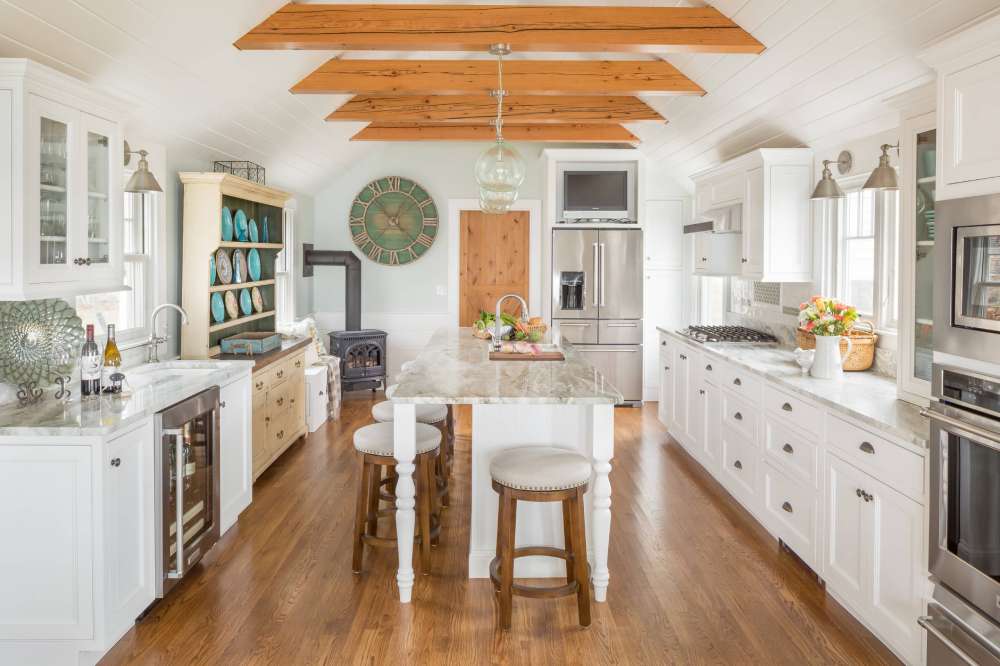
Image source: Cape Associates, Inc.
Shaker cabinets remain the dominant choice. The Studio of Kitchen Designers’ annual survey puts shaker at 48% of white cabinet installations, followed by flat-panel at 27%.
In coastal kitchens, shaker works because it’s simple without being cold. The recessed center panel adds just enough shadow and depth to feel warm.
Beadboard panel inserts push the style toward cottage coastal. Took me a while to warm up to beadboard personally, but in the right kitchen (especially a smaller galley layout) it adds charm without clutter. If you’re going this direction, keep the surrounding elements clean. Beadboard plus open shelving plus a lot of accessories gets busy fast.
Open Shelving vs. Closed Cabinets

Image source: Shelton Design//Build
Here’s where things get interesting. The 2025 NKBA report shows a strong preference for concealed storage and hidden pantries. Glass doors and open shelving are trending down. But coastal kitchens are one of the styles where open shelving still makes sense, at least in small doses.
A couple of floating shelves in place of upper cabinets near a window can open up the kitchen dramatically. You get more light, more airiness, and a spot to display a few curated pieces (white ceramics, woven baskets, a potted herb).
The key: keep it minimal. Two to three shelves max. Edited displays. This is not the place to store your entire dish collection.
Hardware Finishes for the Coastal Look
| Finish | Coastal Fit | Best Paired With |
|---|---|---|
| Brushed brass | Strong, warm tone | White or blue cabinets |
| Matte black | Modern coastal contrast | White oak, white paint |
| Brushed nickel | Classic, understated | Gray or white finishes |
| Oil-rubbed bronze | Weathered, rustic | Cream, beige palettes |
Brass hardware has doubled in popularity each year according to the Houzz UK Kitchen Trends Report. In coastal kitchens, brushed (not polished) brass adds warmth without looking too formal.
Matte black creates contrast in interior design and gives a modern edge. Pair it with light wood and white for that clean modern coastal look that’s taken off recently.
Pulls versus knobs: pulls on drawers, knobs on doors. Mixing both adds variety. Details in interior design like hardware choices seem small, but they account for a surprising amount of the room’s visual personality.
Lighting Fixtures for a Coastal Kitchen
Lighting is where a lot of coastal kitchens either come alive or fall flat. The right fixture can anchor the entire room. The wrong one (looking at you, generic chrome pendant) can make the space feel like it belongs in any suburb, nowhere near the coast.
Pendant Lights Over the Island

Image source: WhiteSpace Architects
This is your biggest lighting moment. The island pendant is the focal point in interior design terms, and in coastal kitchens it’s usually where you bring in the most texture.
Go-to materials:
- Woven rattan or seagrass drum shades
- Blown glass in clear or pale blue tones
- White linen or natural fiber shades
- Rope-wrapped or driftwood-accented fixtures
Serena & Lily, Visual Comfort, and Arteriors all carry lines specifically suited to coastal kitchens. The scale needs to match the island. For islands 7 feet and longer (which 42% of homeowners now choose, per Houzz), two to three pendants spaced evenly is the standard.
About pendant lighting: the fixture height matters. Bottom of the shade should sit roughly 30 to 36 inches above the countertop. Lower and it blocks sightlines. Higher and it loses impact.
Layered Lighting Beyond the Island
Statement lighting was cited as a top trend by 28% of design experts in Fixr’s 2024 survey of over 70 professionals. In coastal kitchens, layering light sources keeps the space feeling bright and warm from every angle.
Recessed lighting handles the general illumination. Clean, invisible, no visual clutter. Exactly what coastal kitchens need on the ceiling.
Task lighting goes under the cabinets. LED strips or puck lights that illuminate the countertop workspace. Practical, and it creates a warm glow at night that changes the whole mood.
Accent lighting inside glass-front cabinets or above open shelves highlights your display pieces. This is optional but it adds a layer of depth, especially when the overhead lights are dimmed.
Understanding how light works in interior design explains why coastal kitchens prioritize natural light above everything else. Windows without heavy treatments, lighter finishes that bounce light around the room, and fixture placement that supplements daylight rather than competing with it.
Coastal Kitchen Decor Accessories and Styling

Image source: Waterview Kitchens
Accessories are where most coastal kitchens go wrong. Too many seashells. Too many “life’s a beach” signs. The accessories should feel collected over time, not purchased in one trip to HomeGoods.
What Belongs on the Counter
Less than you think.
A wooden cutting board (white oak or olive wood) leaned against the backsplash. A stoneware crock holding wooden spoons. Maybe a small ceramic vase with dried eucalyptus or a potted herb.
That’s it. Coastal style depends on negative space. The countertop should breathe. The Houzz 2024 study found that homeowners are increasingly prioritizing clutter-free kitchens, with concealed storage solutions becoming more popular than open display.
Open Shelving Displays
The editing rule: if it wouldn’t survive a move, it shouldn’t be on the shelf.
Stick to functional-beautiful items. White dishes, a couple of woven baskets, a single piece of coral or a driftwood sculpture. Color-coordinate across the displayed pieces so everything reads as intentional, not random.
Balance is what holds this together. The principles of balance in interior design apply directly. Distribute visual weight evenly across the shelves. Tall item on the left? Put something with heft on the right.
Three to five items per shelf, max. Space between objects. If you can’t see the wall behind the items, you’ve overcrowded it.
Textiles and Soft Accessories

Linen dish towels in white, natural, or pale blue. Hung from a simple hook, not wadded on the counter.
A jute or sisal rug in front of the sink adds warmth underfoot and texture to the floor plane. Though if your kitchen is in a coastal area with real humidity, jute can be tricky. It absorbs moisture. A flat-weave cotton or indoor-outdoor rug might hold up better in practice.
Cotton roman shades on kitchen windows keep things soft without blocking light. Heavy curtains don’t belong here. If you’re working with white walls, linen curtains in natural or off-white keep the look cohesive and airy.
Plants finish the room. A small potted herb garden on the windowsill (basil, rosemary, thyme) ties into the growing interest in kitchen herb gardens that the NKBA flagged as a rising trend for 2025. Biophilic design thinking supports this. Living elements in a kitchen reduce visual harshness and connect the indoors to the outside.
Coastal Kitchen Decor on a Budget
A full kitchen renovation averages $60,000 for a major remodel, per the 2025 Houzz Kitchen Trends Study. Most people don’t have that kind of budget. The good news: coastal style responds well to smaller, targeted updates.
You don’t need to gut the room. Some of the highest-impact changes cost a few hundred dollars, not tens of thousands.
Paint and Hardware Swaps
Cabinet painting is the single biggest visual change you can make on a budget. A gallon of Benjamin Moore Advance (a popular choice for cabinets) runs around $70-80. Sand, prime, and paint your existing doors in a warm white or soft gray-blue, and the kitchen looks completely different.
New hardware costs between $2 and $3 per handle or knob at the low end, according to HomeAdvisor. Swap chrome pulls for brushed brass or matte black. Twenty handles at $5 each is $100 for a noticeable style shift.
These two moves together, paint plus hardware, account for most of the visual transformation in a budget coastal kitchen update. Refacing cabinets runs about $6,925 on average, which is still far less than full replacement.
Backsplash and Textile Updates
Peel-and-stick backsplash tiles have come a long way. Subway patterns and fish-scale designs in white or sea-glass tones give a coastal look without the cost of professional tile installation. If you’re curious about the real thing, backsplash cost varies widely depending on material and labor.
Where to save vs. where to spend:
- Save on textiles (linen towels, a cotton runner, a jute rug from Target or IKEA)
- Save on shelf decor (thrift store ceramics, DIY painted terra cotta pots)
- Spend on one statement light fixture over the sink or table
HomeAdvisor data shows pendant lights can cost as little as $70 installed, making them one of the cheapest upgrades with the biggest impact on a room’s character.
DIY Coastal Accents
Rope-wrapped vases. Framed coastal prints from Etsy. A cutting board leaned against the backsplash. None of this costs much, and it all reads as coastal without being cheesy.
The affordable decorating approach works especially well in kitchens because you only need a few pieces. Counter space is limited. So your decorating budget stretches further when there are only three or four spots to fill.
Coastal Kitchen Layouts and How Decor Changes With Them
The same coastal decor strategy doesn’t work in every kitchen. A galley kitchen and a 300-square-foot open-plan space need completely different approaches.
Space planning is where most of this gets decided. Before picking a single accessory or paint color, the layout tells you what’s possible.
Small and Galley Kitchens
| Element | Small Kitchen Approach | Why It Works |
|---|---|---|
| Color | All white or very light palette | Maximizes perceived space |
| Accessories | Two to three items max | Prevents visual clutter |
| Surfaces | Reflective tile, glossy backsplash | Bounces light around |
| Shelving | One or two open shelves only | Avoids heavy upper cabinets |
In a small kitchen, the coastal aesthetic actually has an advantage. The whole style is built around lightness and openness, which is exactly what compact spaces need.
Galley kitchens benefit from a single continuous color on both sides. Breaking up the visual with too many accent tones makes the space feel chopped up.
Large Open-Concept Kitchens
Bigger kitchens give you room to go heavier on texture and accessories. A large woven rattan pendant (or a pair of them) over a 7-foot island becomes a real statement piece.
The 2024 Houzz study found that 43% of homeowners opened their kitchens to adjacent living spaces during renovation. In open-plan layouts, the coastal kitchen needs to flow visually into the next room. Use the same color palette in both spaces. If the kitchen has pale blue accents, carry that into your coastal living room decor through throw pillows or art.
Unity across the design matters more in open layouts because you see everything at once. A coastal kitchen that opens into a completely different style living room feels disjointed.
Kitchens With Natural Light vs. Interior Kitchens
Plenty of windows? You can get away with slightly darker accent tones (slate blue cabinets, gray countertops) because daylight does the heavy lifting.
No windows or limited light? Stick to the lightest version of the coastal palette. White cabinets, white or cream countertops, and use under-cabinet LEDs and ambient lighting to compensate.
The principles of interior design around light and color apply directly here. Darker surfaces absorb light. Lighter surfaces reflect it. In a kitchen without great natural light, fighting that physics lesson is a losing battle.
Common Mistakes in Coastal Kitchen Decor
Coastal is one of the easiest kitchen styles to get wrong. The line between “designed” and “themed” is thin, and most mistakes land on the themed side.
Over-Relying on Beach Motifs
Starfish. Anchors. Seashell soap dispensers. “Life’s a Beach” signs.
One or two natural shell or coral pieces as part of a curated display? Fine. But when every surface carries an ocean reference, the kitchen stops looking like a home and starts looking like a nautical gift shop.
The test: if you removed all the obviously “beachy” items, would the room still read as coastal? If not, the decor is doing all the work and the bones of the kitchen aren’t supporting the style.
Going Too Blue
Blue walls, blue cabinets, blue backsplash, blue accessories. I’ve seen this happen. The kitchen feels cold instead of calm.
Blue should be an accent, not the dominant color. It needs warm counterweights. Natural wood, warm whites, sandy beige, or woven textures in tan and cream. Knowing which colors pair well with blue keeps the palette balanced.
Choosing Wrong Materials for the Environment
Common material mistakes in coastal kitchens:
- Unsealed wood near the sink (warps and stains fast)
- Jute rugs in high-splash zones (absorbs moisture, can mildew)
- Cheap peel-and-stick tile near heat sources (peels and discolors)
If you’re in an actual coastal area, humidity and salt air accelerate wear on everything. Engineered hardwood handles moisture better than solid. Indoor-outdoor rugs last longer than natural fiber in humid kitchens. And if the kitchen gets a lot of use, choose countertop materials rated for heavy wear.
Mixing Too Many Textures Without a Color Thread
Rattan, seagrass, driftwood, linen, woven baskets, raw stone. All of these belong in a coastal kitchen, but not all at once without something tying them together.
The fix is a shared color. If every textured element stays within the same neutral range (warm whites, tans, natural tones), they read as cohesive instead of chaotic. Harmony in design comes from this kind of underlying consistency.
Coastal Kitchen Decor by Sub-Style
Not all coastal kitchens look the same. The style breaks into distinct sub-categories, and knowing which one you’re going for prevents the “everything looks vaguely beachy but nothing feels intentional” problem.
Modern Coastal

Clean lines. Minimal accessories. A mostly white and natural wood palette with very few decorative objects.
Think minimalist design with a coastal color palette layered on top. Flat-panel cabinets in white, a simple quartz counter, matte black hardware. Serena & Lily’s kitchen collections lean heavily into this look. Contemporary kitchens borrow a lot from this sub-style.
Cottage Coastal

Image source: Forward Design Build Remodel
| Feature | Cottage Coastal Take |
|---|---|
| Cabinets | Beadboard, painted white or soft blue |
| Hardware | Vintage brass bin pulls, porcelain knobs |
| Shelving | Open shelves with collected objects |
| Textiles | Gingham, ticking stripe, linen |
This is the warmer, more collected version. It overlaps with shabby chic kitchen decor and country kitchen styling but stays lighter and airier. Pottery Barn and Wayfair carry a lot of cottage-coastal pieces at accessible price points.
Mediterranean Coastal
Terracotta tones. Arched details. Blue-and-white tile patterns, often in zellige or hand-painted ceramic. This sub-style pulls from the coasts of Spain, Italy, and Greece rather than New England or California.
The color palette runs warmer than other coastal looks. Think sandy orange, deep blue, olive green, and cream. If this direction appeals to you, Italian kitchen decor shares a lot of the same DNA, just with slightly different proportions.
White cabinet backsplash options work beautifully here. A decorative blue-and-white tile backsplash against white cabinetry is one of the most recognizable Mediterranean coastal moves.
Tropical Coastal

Image source: Kala Interior Design
Key differences from standard coastal: more rattan, more bamboo, more green and yellow tones, and a looser, more casual feel overall. This is the sub-style that tolerates the most color.
Plants play a bigger role here. Not just a potted herb, but larger leafy plants, hanging planters, and tropical cuttings. The tropical color palette runs brighter and more saturated than the muted tones in modern or cottage coastal.
Blending sub-styles is possible, but keep it to two at most. Modern coastal plus cottage coastal works (clean lines with a few warm, collected pieces). Mediterranean coastal plus tropical gets busy fast. Pick a primary direction and borrow selectively from one other.
The best starting point? Look at your home’s existing interior design style and work from there. A mid-century ranch house naturally lends itself to modern coastal. A Cape Cod or Southern cottage leans toward cottage coastal. Going against the architecture usually creates tension that’s hard to resolve with decor alone.
FAQ on Coastal Kitchen Decor
What defines coastal kitchen decor?
Coastal kitchen decor uses light color palettes, natural textures like rattan and driftwood, and organic materials to create an open, relaxed feel. It draws from shoreline environments rather than literal beach themes. Think calm, not gift shop.
What colors work best in a coastal kitchen?
White and off-white form the foundation. Sandy beige, pale blue, seafoam green, and driftwood gray work as supporting tones. Sherwin-Williams Sea Salt and Benjamin Moore White Dove are popular paint choices for this style.
Is coastal kitchen decor expensive?
Not necessarily. Painting cabinets, swapping hardware for brushed brass or matte black, and adding a peel-and-stick backsplash can shift the look for under $500. Big impact doesn’t require a big renovation budget.
What backsplash works in a coastal kitchen?
Subway tile in white or off-white is the classic choice. Handmade zellige tile and glass tile in sea-glass tones add a more distinctly coastal feel. Herringbone and vertical stack layouts both work well.
Can I do coastal decor in a small kitchen?
Small kitchens actually suit this style well. The coastal approach prioritizes lightness, open space, and minimal clutter. Stick to an all-white palette, limit accessories to two or three pieces, and use reflective surfaces to bounce light.
What cabinet style fits a coastal kitchen?
Shaker cabinets are the default. They’re simple, warm, and work across every coastal sub-style. Beadboard panel inserts lean more cottage coastal. For a modern coastal look, flat-panel doors in white or light wood work better.
What hardware finishes suit coastal kitchens?
Brushed brass adds warmth. Matte black creates clean contrast. Brushed nickel feels understated. Oil-rubbed bronze works for a weathered, rustic coastal look. Avoid polished chrome, which reads too sleek for this style.
How is coastal different from nautical decor?
Nautical leans into ship wheels, anchors, rope details, and navy stripes. Coastal is subtler. It uses natural materials and soft tones to suggest the shoreline without literal references. Coastal is a design approach. Nautical is a theme.
What lighting works in a coastal kitchen?
Woven rattan or seagrass pendants over the island are the signature move. Pair those with recessed ceiling lights for general illumination and under-cabinet LED strips for task lighting. Layered light keeps the space bright from every angle.
What are the biggest coastal kitchen mistakes?
Overdoing beach motifs, using too much blue without warm counterweights, and picking materials that can’t handle kitchen moisture. A good coastal kitchen looks designed, not themed. Edit ruthlessly and let natural textures carry the style.
Conclusion
Getting coastal kitchen decor right comes down to restraint and good material choices. White oak flooring, shaker cabinets in warm white, a ceramic tile backsplash, and a couple of woven pendants over the island. That’s most of the work done.
Skip the themed accessories. Focus on natural fiber rugs, quality countertop surfaces like quartz or honed marble, and a tight two-tone cabinet palette if you want some color.
Whether you’re doing a full renovation or a weekend hardware swap, the goal stays the same. Build a kitchen that feels connected to the coast without announcing it.
Start with the bones. Paint, surfaces, light. The decorative pieces come last, and you’ll need fewer of them than you think.

- Paint Colors That Go with Gray Floors - August 20, 2026
- What Color Bedding Goes with Dark Wood Furniture - August 18, 2026
- What Color Walls Go with Oak Floors - August 16, 2026


